Friday, 25 January 2013
Some (Very) Brief Thoughts on J.J. Abrams Directing The Next Star Wars Film
So, it's been pretty much confirmed that J.J. Abrams will be directing the next Star Wars film, tentatively just known as Star Wars: Episode VII. As to be expected, when this news was announced, the internet exploded with lens flare jokes and strong opinions about the decision. Now that the dust has slightly settled (Though I'm preparing for two years worth of MovieBob bitching and moaning, ala The Amazing Spider-Man), I'm going to weigh in with my thoughts. As always with this type of news, I'm decidely mixed. I've pretty much liked all of Abrams's films, especially his reboot of Star Trek, of which I loved the look and feel. Mission: Impossible 3 is the leanest of the Mission Impossible films and while I didn't feel Super 8 lived up to the quality of the early Spielberg films it was homaging, it showed that Abrams could go really low key if he wanted, and the stuff with the kids making the film was wonderful. Abrams strikes me as one of the smarter blockbuster directors working today. Even his visually hetic Star Trek was suprisingly character and plot driven. He wants to create blockbusters with some kind of soul, even if he's still perfecting his craft.
I think one problem with Abrams directing the next Star Wars film is simply that it feels redundant. It's the equivalent of if, after The Dark Knight, or after The Dark Knight Rises, Christopher Nolan went on to direct a Superman film (which is not too far off since he's a producer on Zack Snyder's Man of Steel). I've already seen Nolan's superhero saga, I don't need another one, even if Batman and Superman are very different characters. With Abrams, I've already seen his space adventure- and while Star Trek and Star Wars are very different franchises, the way Abrams directed Star Trek, it already felt it owed at least something to Star Wars.
I also feel that being a director of another large franchise, even if it's only for one film, squanders Abrams' potential to grow as a director and create really personal work. Super 8 showed that Abrams can do smaller, less visually busy work, and I'd like to see better versions of that film. Abrams' film career so far has seen him attached to pre-existing material that's made it hard for Abrams to form his own identity as a filmmaker. Even in Super 8, which he wrote, Abrams tried a little too hard to be Steven Spielberg. I want him to finally become an auteur, though I don't know if Abrams has that in mind.
Still, I wish Abrams and crew good luck on this project, which, c'mon, it's Star Wars, I'm definitely anticipating it. It's no doubt extremely exciting for Abrams to take the reigns of a saga that inspired so many people of his generation. It's also a great deal of pressure, and I hope he can work through that pressure and create a really great Star Wars film. Just cool it on the lens flares, okay?
Wednesday, 23 January 2013
My Favourite Films of the Year

1. Moonrise Kingdom (Wes Anderson)- Through catching up with some of his work over the past year (I saw The Royal Tenenbaums ten years ago and really need to revisit it), Wes Anderson is slowly but surely becoming one of my favourite directors, particularly with 2009's Fantastic Mr. Fox and now his latest film, Moonrise Kingdom. It's hard to put in to words why this film is so enchanting. I guess it comes down to the fact that the world Anderson creates, another branch of his signature universe seen throughout all his films, is one I want to live in. It's so delicately crafted- Anderson has been described as a minaturist, and the opening scene makes us feel we're in a dollhouse- yet at the same time it feels completely organic, free from any creator. Despite all the huge blockbusters, Oscar contenders and prestige pictures that came out this year, this tale of young love between two 12 year old childrens is the one that I may have loved the most. What may be most impressive about it is how Anderson embraces the pure, uncomplicated romance between Sam Shakusky (Jared Gilman) and Suzy Bishop (Kara Hayward), while subtly acknowledging how in over their heads they are as they run away from their respective homes- for Sam, it's the boy scout camp under the leadership of Scout Master Ward (Edward Norton)- Sam is an orphan- and for Suzy her home is with her parents, Laura and Walt, (Frances McDormand and Bill Murray). Ultimately, running away isn't just about love for Suzy and Sam- it's a way of escape from their trapped in existence. Anderson also shows us how complicated relationships become when you're an adult- Laura is having an affair with police captain Sharp (Bruce Willis). As an ode to young love as well as a mature examination of the difficulties of maintaining a relationship, Moonrise Kingdom, despite being quite stylized, is a really humane and beautiful film.
The Rest, Alphabetically.

The Avengers (Joss Whedon)- Out of the three big superhero films released this year, The Amazing Spider-Man and The Dark Knight Rises being the other two, The Avengers was the one the most completely embraced its comic book origins, making it refreshingly free from any attempts at grittiness or realism. It was also the most purely fun blockbuster released this year-being absolutely what anyone could want in a large scale entertainment- it has great action but never becoming stupid- director Joss Whedon infused a lot of wit and humanity in to the interactions between the offbeat superhero family. Whedon understood that the appeal of seeing all these superheroes (Iron Man, Captain America, Thor, Hulk, etc.) onscreen together wasn't just about them fighting each other or the bad guys-it was about seeing what happens when you get drastically different personalities on the scale of a super soldier, a demi-god, and a billionaire philanphropist together in one room together. Seeing them work through their differences and finally come together is quite meaningful, especially since ten years ago all these characters would have been isolated in their own respective film continuities. With The Avengers being a smashing success, it's opened the doors to many exciting possibilities for the superhero genre, including a possible film about that other superhero team.

The Cabin in the Woods (Drew Goddard)- A smart and brutal deconstruction of the horror genre- as well as love letter to said genre- director Drew Goddard's debut feature, which he co-wrote with Joss Whedon, gives us a straightforward horror movie plot- five friends go for a weekend to a, wait for it, cabin in the woods, where evil stuff begins to happen- while simultaneously, pulling the curtain back and showing us the way the events of all our favourite horror films could actually be engineered. the film questions the reasons why we watch horror films- creating a critique that never feels hypocritical. The film also manages, especially when it gets to its final act, to work as a gory horror film- it's also funny as hell.
The Dark Knight Rises (Christopher Nolan)- While there were many criticisms directed at this film, including its plot holes and its treatment of its main antagonist, after three viewings of Christopher Nolan's third and final Batman epic, I've come to feel that in some ways The Dark Knight Rises is arguably the best of the trilogy. Why there are elements of the film that disappoint me, including not enough reaction to the revelation of Harvey Dent's crimes, as well a villain reveal that shouldn't come about half an hour earlier, Nolan's direction grabs me and sweeps me up in a way most other superhero films, even The Avengers, don't. From the opening sequence involving Bane (Tom Hardy) and a mid air hijacking, to the lead up to Gotham's football stadium being blown up, scored to a child's rendition of the star spangled banner, as well as the first confrontation between Batman/Bruce Wayne (Christian Bale) and Bane- a raw and manner of fact beat down that's free of the more fantastical elements found in other cinematic superhero fight scenes- The Dark Knight Rises is arguably the best and most vividly directed of the three films. It also feels like Nolan has pretty much reached the place he wanted to go seven years ago when the first film of the trilogy, Batman Begins, was released. And Like The Avengers it'll be very exciting to see how Nolan's Batman trilogy affects the genre in years to come.

End of Watch (David Ayer)- Who would've thought that one of the best and most affecting buddy cop movies would come from this quasi found footage crime thriller? End of Watch takes the buddy cop genre and grounds it in the every day life of LAPD police officers, Brian Taylor (Jake Gyllenhaal) and Mike Zavala (Michael Pena), partners and friends, as they patrol the streets of LA. Brian is part of a film class so he records he and Mike's conversations and life on the job- which is where the found footage aspect comes in. While the film is episodic in structure, as things progress we see Brian and Mike confront their morality and the possibility of leaving their wives behind if they die on the job. Gyllenhaal and Pena give richly authentic performances that help us buy in their friendship and believe them as LAPD officers. The film is raw, funny and by the end, devastating.

Les Miserables (Tom Hooper)- As I said in my review of the film, despite being messily directed, as well as revealing flaws in the stage play, the film really worked for me- due to the conviction of its performances, including Anne Hathaway's devastating rendition of "I Dreamed a Dream" and Samantha Barks as Eponine. There are so many moments of subliminity that they outweigh the flaws in its direction.

Looper (Rian Johnson)- When I first saw Rian Johnson's Looper, I walked out a little disappointed- liking the first half- the set up- more then the second half- the payoff. But after hearing more people talk about it- and revisiting it recently, I admire how Johnson takes what seems like too different films and makes them fit together structurally and thematically. Johnson's script is actually quite tight and, while you can probably pick it apart in terms of logic-like all other time travel films- emotionally and thematically, it's all very well thought through. The film, for all its sci fi noir trappings, ultimately comes down to the sincere and simple ideal of motherly love, and the idea of being raised right can set you on the right path. It's an idea that some may scoff at but I respect Johnson for creating a intricate time travel tale based around such a humane idea.

Seven Psychopaths (Martin McDonagh)- What I love most about this film is the way it's able to be meta without being soulless and detached. It makes you care about its characters, particularly Christopher Walken's Hans, a dog thief who works with Billy (Sam Rockwell), the friend of struggling screenwriter Marty (Colin Farrell). When Hans and Billy steal the dog of Woody Harrelson's mobster Charlie, it brings all three together and puts them through an emotional journey that changes all of them. Along the way the film pokes fun at the conventions of the action genre, most notably in Billy's hilarious monologue in the desert. By the end of the film, Walken's Hans gives Marty an idea that helps his screenplay transcend the conventions he was afraid of falling in to. This film is one of the most funnest times I had in a theatre in 2012, with great performances and sharply written scenes.

Skyfall (Sam Mendes)- While I wouldn't call this the best James Bond film, or even the best Daniel Craig Bond film (I would argue for Casino Royale on both counts), there are so many things I love about this film that it earns a place on my list. From Adele's gorgous theme song, invoking the classic Bond tunes of Shirley Bassey, to Javier Bardem's villain Silva and Ben Whishaw's Q, as well as Roger Deakins' stunning cinematography and Sam Mendes' direction, which makes this one of the handful of contemporary action films that actually has breathing room, rather than just being a frenzy of incoherent action, Skyfall has some of my favourite elements in the entire 50 year history of the Bond franchise. This is also the most self conscious Bond film since 1995's GoldenEye, questioning Bond's relevance and usefullness in a era almost thirty years detached from that of the Cold War- one where our enemies do not come from one singular nation but strike from within the shadows. And for a series that has almost always been high tech, stylish, and exotic, climaxing the film at Bond's childhood home in Scotland was a pretty risky move- but one that makes sense. Since Silva is a computer hacker, what better place to face him than somewhere where he cannot use technology. It also fits in to the goal of these Craig Bond films thus far, to take the fully formed character we met in 1962's Dr. No and deconstruct him- and ending at Bond's childhood home, a place that has always haunted him, concludes what can be seen a trilogy of films showing us the true man behind the number.
Silver Linings Playbook (David O. Russell)- While Silver Linings Playbook is in many ways a conventional romantic comedy, it reminds us that what matters in this type of film isn't the framework of the plot but the details and chemistry between its lead. Bradley Cooper's Pat and Jennifer Lawrence's Tiffany, like in romantic comedies, don't get together at first, in this film, it's not just because the script calls for them to hate each other- it's because they're both emotionally damaged- Pat suffers from bipolar disorder and is obessesed with winning his wife back- and Tiffany's husband is dead. As they grow closer together, they're able to help each other make progress in their lives. Lawrence is stunning in her performance as Tiffany, taking what could be the typical "manic pixie dream girl" archetype and giving her a darker and unpredictable edge. Cooper shows what a capable dramatic actor he can be, being both funny and sad in his portrayal of bipolar disorder. While I feel the ending of the film is a little too pat, I cared about these characters so much that I was just happy for them.

21 Jump Street (Phil Lord and Christopher Miller)- Along with End of Watch, 21 Jump Street is one of the best buddy cop films to come along in some time. What makes this film work is how it goes against your expectations of what a 21 Jump Street film would be- instead of just being a retread of its 1980s counterpart, it becomes an honest examination of how, whether you were uncool or even popular in High School, and no matter how much time as elapsed, given the chance, you'd do it all over again- which is what happens when Schmidt and Jenko (Jonah Hill and Channing Tatum) go undercover in a high school. Schmidt gets to hang with the cool kids and Jenko finally gets to feel smart as he becomes friends with the science crowd. Ultimately, Jenko, who was popular in High School, is the one who betters himself while Schmidt gets in to deep. This movie has a lot of heart and really makes you care about the characters at its centre. It works as a buddy cop movie, a romantic comedy, a high school comedy, a spoof of the action genre, and is a pretty good character study as well.
Other films I liked: The Amazing Spider-Man, Brave, Cloud Atlas, Django Unchained, Dredd, The Five Year Engagement, The Hobbit, Lincoln, Prometheus, The Raid, Sinister, Ted, Wreck-it-Ralph, Zero Dark Thirty
Some Other Favourites (AKA the Davies Awards)
Favourite Actor: Joaquin Phoenix, The Master
Favourite Actress: Jennifer Lawrence, Silver Linings Playbook
Favourite Supporting Actors
Javier Bardem- Skyfall
Leonardo DiCaprio- Django Unchained
Michael Fassbender- Prometheus
Tom Hardy- The Dark Knight Rises and Lawless
Samuel L. Jackson- Django Unchained
Seth MacFarlane- Ted
Sam Rockwell- Seven Psychopaths
Mark Ruffalo- The Avengers
Christopher Walken- Seven Psychopaths
Ben Whishaw- Skyfall
Favourite Supporting Actresses
Samantha Barks- Les Miserables
Emily Blunt- Looper
Judi Dench- Skyfall
Anne Hathaway- The Dark Knight Rises and Les Miserables
Brie Larson- 21 Jump Street
Jane Lynch- Wreck-it-Ralph
Sarah Silverman- Wreck-it-Ralph
Emma Stone- The Amazing Spider-Man
Favourite Directors
Wes Anderson, Moonrise Kingdom
Drew Goddard- The Cabin in the Woods
Sam Mendes- Skyfall
Christopher Nolan, The Dark Knight Rises
Joss Whedon, The Avengers
Favourite Screenplays
The Avengers- Joss Whedon
The Cabin in the Woods- Drew Goddard and Joss Whedon
Django Unchained- Quentin Tarantino
Looper- Rian Johnson
Seven Psychopaths- Martin McDonagh
Silver Linings Playbook- David O. Russell, adapted from Matthew Quick's novel
21 Jump Street- Michael Bacall
Favourite Cinematography- Roger Deakins, Skyfall
Favourite Original Song- "Skyfall"- Skyfall
Best James Bond Opening Sequence Not in a James Bond Film- The mid air hijacking- The Dark Knight Rises
Best James Opening Sequence In a James Bond Film- The pre-credit sequence in Skyfall
Favourite Action Sequences
The mid air hijacking- The Dark Knight Rises
The school fight- The Amazing Spider-Man
New York climax- The Avengers
Shootout at Candieland- Django Unchained
Freeway chase- 21 Jump Street
First fight between Bane and Batman- The Dark Knight Rises
Shanghai fight- Skyfall
Pre-credits sequence- Skyfall
Ted and John hotel fight- Ted
Billy's monologue- Seven Psychopaths
Nearly every scene- The Raid
Favourite Onscreen Chemistry
Bradley Cooper and Jennifer Lawrence- Silver Linings Playbook
Andrew Garfield and Emma Stone- The Amazing Spider-Man
Jonah Hill and Channing Tatum- 21 Jump Street
Jonah Hill and Brie Larson- 21 Jump Street
Mark Wahlberg and Seth MacFarlane- Ted
Jason Segal and Emily Blunt- The Five Year Engagement
Robert Downey Jr. and Mark Ruffalo- The Avengers
Favourite Action Film- The Raid
Favourite Comedy- 21 Jump Street
The Happy Anniversary Award: Skyfall and The Amazing Spider-Man- both hitting theatres on the 50th anniversary of Spider-Man and the James Bond franchise.
Stuff I'm Looking Forward to in 2013: Before Midnight, Warm Bodies, Man of Steel, Star Trek Into Darkness, The Hobbit: The Desolation of Smaug, Stoker, Seth MacFarlane hosting the Oscars, Skyfall on Blu-ray, The Importance of Being Earnest at Neptune Theatre, Iron Man 3, Evil Dead, Community Season Four, To the Wonder, The Great Gatsby, A Good Day To Die Hard, Arrested Development, The Wolverine.
Friday, 11 January 2013
And Here We Go: Some Thoughts On The Oscar Nominations
Aw yes, that time of year where everyone exclaims how the Oscars are bullshit, irrelevant, etc, etc, even though we tune in every year to see who's nominated. I guess that's the thing with the Oscars- love them or hate them, they're addictive to movie buffs. Even if you're critical of awards, if you love movies, you care who gets in and, more importantly, who doesn't. I'll go through some of the major categories, giving my thoughts. To be honest, I haven't seen every performance or film nominated yet, but judging from what I have seen, I'll say who I think will win in several categories, as well as the surprising omissions.
Best Picture- Like last year, we have nine nominees: Amour, Argo, Beasts of the Southern Wild, Django Unchained, Les Miserables, Life of Pi, Lincoln, Silver Linings Playbook, Zero Dark Thirty. Out of the nine I still need to see Amour, Beasts, Pi and Zero Dark Thirty. Right now I think it's between Steven Spielberg's Lincoln and Silver Linings Playbook, especially since SLP's director, David O. Russell, previously nominated for 2010's The Fighter, got a Best Director nomination over Ben Affleck for Argo and Kathryn Bigelow for ZD30. SLP is the type of crowd pleaser like the previous two Best Picture winners, The King's Speech and The Artist, that the Academy often loves. Moreover, Russell has never won Best Director or has a Best Picture winner under his belt, whereas Spielberg already has two Best Director Oscars, for 1993's Schindler's List and 1998's Saving Private Ryan. He also won the Best Picture Oscar for Schindler's List. While Speilberg is a titan, the Academy may want to award Russell for his strong work over the years.
Best Director- I think this category provided the most surprising omissions of the race this year, with Affleck and Bigelow, perceived locks for their work with Argo and ZD30, respectively, shut out. Other big names like Tom Hooper, who has been the subject of controversy over his directon of Les Miserables, and Quentin Tarantino, who directed Django Unchained, were also left out. The line up is as follows: Michael Haneke, Amour, Ang Lee. Life of Pi, David O. Russell, Silver Linings Playbook, Steven Spielberg, Lincoln, and Benh Zeitlin for his debut feature, Beasts of the Southern Wild. At 30 years old, he's the youngest nominee in this particular category. Good for him getting a nomination for his first film. With the four big names, Affleck, Bigelow, Hooper and Tarantino out of this category, it does leave Russell some room to take the prize. His biggest competition in this category, again, is Spielberg.
Best Actor- Bradley Cooper, Silver Linings Playbook, Hugh Jackman, Les Miserables, Daniel Day Lewis, Lincoln, Joaquin Phoenix, The Master, Denzel Washington, Flight. I'm glad to see Phoenix here. There was some talk that Pheonix's harsh comments about the Academy and awards in general would lead to hm being left, particularly with The Master losing steam. But here he is. I was really blown away by him in The Master, and I think it's a career best performance- he'd be my pick for Best Actor. However, Day Lewis is the frontrunner for his warm and commanding performance as President Abraham Lincoln. If Les Miserables was more of a frontrunner, Jackman may be more of a threat, but the film, especially without a Best Director nomination, is vulnerable. In fact, Day Lewis' competition may mostly come from (gasp) Bradley Cooper. The internet would explode if Cooper won over Day Lewis, but if SLP is loved enough, who knows, right? John Hawkes, for his role in The Sessions, didn't make it, even though he was a leading contender for a nomination, Jamie Foxx's performance as the title character in Django Unchained also didn't make it, probably due to the more animated performances around him in that film.
Best Actress- Jessica Chastain, Zero Dark Thirty, Jennifer Lawrence, Silver Linings Playbook, Emmanuelle Riva, Amour, Quvenzhane Wallis, Beasts of the Southern Wild, Naomi Watts, The Impossible. I thought Lawrence was stunning in SLP, so I wouldn't be upset if she won. I think it's between her and Chastain, who I like a lot too, for ZD30. ZD30 is finally out in my city so I'll be seeing it Sunday. From what I hear about Watts in The Impossible, it strikes me as the type of performance we may look back on as the one that should've won. Watts can be argued to be overdue as well. Wallis, only six when we shot Beasts, received a nomination for her breakthrough performance. She's the newcomer that this category always seems to like. While I haven't seen Amour, it'd be awesome if a legendary actress like Riva won.
Best Supporting Actor- Alan Arkin, Argo, Robert De Niro, Silver Linings Playbook, Philip Seymour Hoffman, The Master, Tommy Lee Jones, Lincoln, Christoph Waltz, Django Unchained. Like last year, the supporting actor category is full of veterans, although it doesn't have a newcomer like Jonah Hill last year. Also, all these guys are previous winners. Jones seems to be the frontrunner, particularly if Lincoln is going for a sweep. Though, as I keep saying, if people love SLP, De Niro could be on his way to a third Oscar. Though I like Waltz, I'm disappointed Leonardo DiCaprio and Samuel L. Jackson had made it for Django Unchained.
Best Supporting Actress- Amy Adams, The Master, Sally Field, Lincoln, Anne Hathaway, Les Miserables, Helen Hunt, The Sessions, Jacki Weaver, Silver Linings Playbook. Poor Amy Adams. This her fourth nomination in this category over the last seven years, and she keeps getting blocked. Even with Adams' overdue factor, I think this race is between Field and Hathaway. I wasn't really blown away by Field in Lincoln, so I prefer if Hathaway for her short but devastating performance in Les Miserables. I wish Hathaway's co-star, Samantha Barks, had also gotten in. She was a real stand out.
So, those are my thoughts. I'm glad Moonrise Kingdom got a screenplay nomination and a tad disappointed The Dark Knight Rises didn't get in for any of the tech categories. I loved Adele's theme for Skyfall, so excited to see her here, as well as Roger Deakins' for his stunning cinematography in that film. The Academy Awards are on February 24, so until then, have fun predicting. And don't forget, Golden Globes, sans Ricky Gervais, are this sunday.
Friday, 21 December 2012
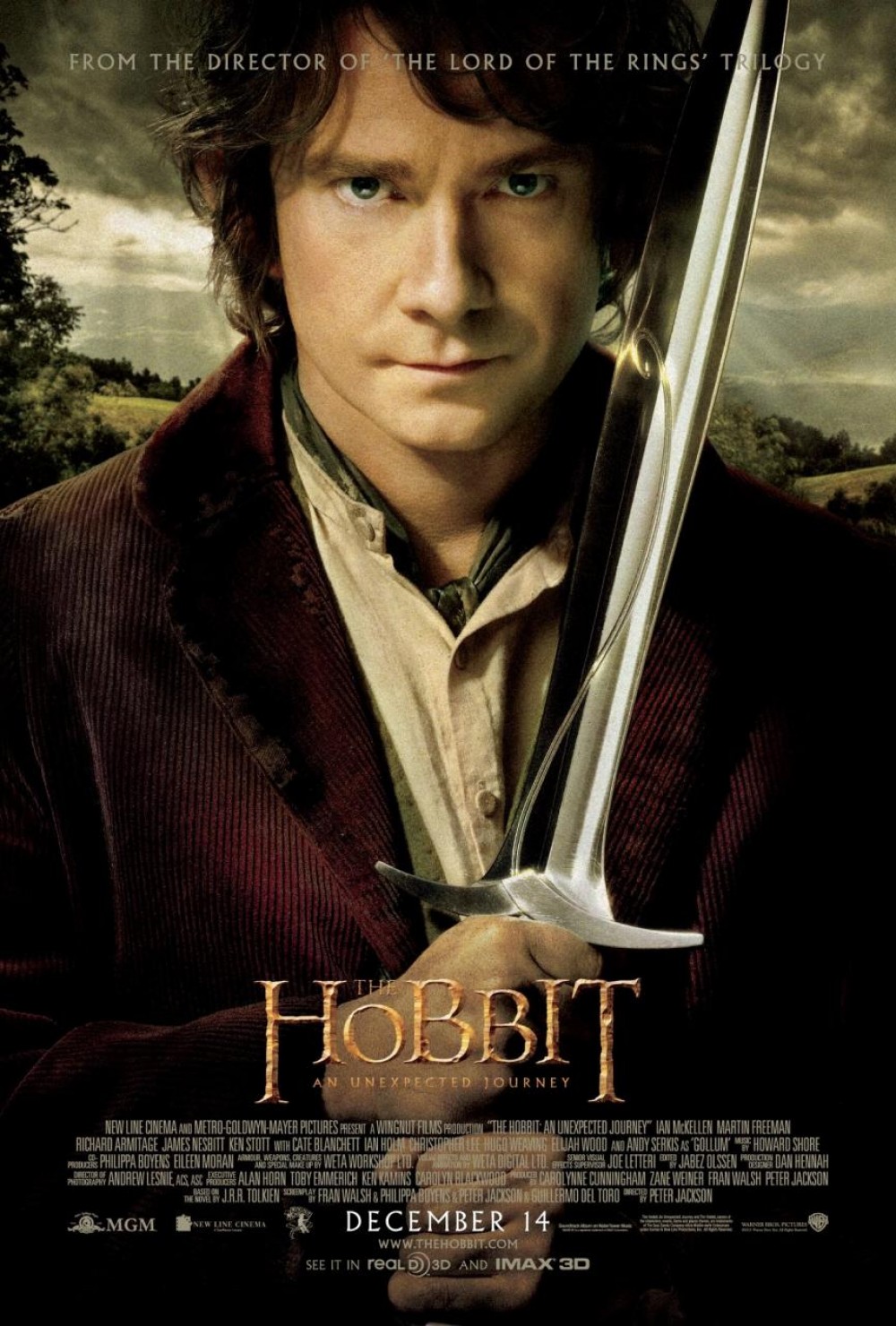
To Dungeons Deep and Caverns Old: "The Hobbit: An Unexpected Journey"
Full disclosure: Until a few weeks ago I had never actually read J.R.R Tolkien's classic novel The Hobbit. I know, pretty shameful, right. Then again, I didn't read Tolkien's The Lord of the Rings books until the movies were coming out either, so I shouldn't be too surprised I didn't read this novel sooner. After reading the novel, I was excited to see the events of the novel on screen. Unfortunately, like everyone else, I had to be prepared only to see part of the story on screen. Director Peter Jackson, who is returning to Middle Earth more than 10 years after directing The Lord of the Rings Trilogy, decided to expand The Hobbit in to three movies, making it a companion trilogy to The Lord of the Rings. Originally, when Guillermo Del Toro was going to direct, and even when Jackson took the director's seat, it was going to be a two parter but then in September, it was announced that extra footage would be shot in order to make a third film. The three films would incorparate events and information from Tolkien's appendices, written after The Hobbit, in order to increase the scale of the film, as well as tie the story in to the events from The Lord of the Rings.
Now, when it was announced that The Hobbit would be three films, I, like many other people, was disappointed and confused about the purpose behind expanding a slim book like The Hobbit into three films. It felt unnecessary and a little too indulgent, almost like Jackson was trying too hard to make this in to an event like The Lord of the Rings, which is a pretty big risk since you're inviting comparisons to an iconic and history making series of films, which you yourself directed. The Hobbit, while it does have a few epic battles, is a much smaller scale story than The Lord of the Rings, and I don't think that a film version could ever compare to The Lord of the Rings Trilogy, even with Jackson at the helm.
Having finally seen the first film in this new trilogy, The Hobbit: An Unexpected Journey, I'm still sceptical of the expansion of the novel. But I'm also more of two minds about it then I was before. On one hand, Tolkien's novel is very episodic, and if adapted too literally in to one movie, events could end up being rushed and the film could feel like it was just bouncing from one unrelated event to the next. The extra material, taken mostly from Tolkien's appendices, helps give the story a more traditional flow, as well as tie it in to the larger mythology of Middle-earth. On the other hand, the structure of this first film does suffer from having to create a three act structure around only six chapters of the novel, as well as trying to incorporate larger mythological exposition that relates to the return of the evil Sauron, the villain of The Lord of the Rings Trilogy. And at nearly three hours, one can't help walking out of the theatre wishing the film could've been tightened up, or at least covered more ground from the actual novel.
Critic Joanna Robinson said she felt Jackson was underestimating the power of the source material and the beauty of its simplicity by expanding upon it. I see what see means, and somewhat agree with her. At the same time, I think Jackson, when faced with the task of going back and telling the backstory of Bilbo Baggins, had a dilemma on his hands. As wonderful as the source material is, going back and adapting it after tackling The Lord of the Rings is somewhat ant-climatic. While I don't doubt Jackson respects the source material, he probably felt that if he was going to adapt The Hobbit he'd need to expand upon it in order for it not to appear too small scale next to his original trilogy.
People have already made comparisons to George Lucas and the first Star Wars prequel, The Phantom Menace. It's an understandable comparison but at the same time feels a little forced, almost as if people want to hate Jackson and make him in to the bad guy- everything he's doing is wrong, he raped my childhood, etc. While I'm not saying you can't criticize Jackson's decisions, I don't think making him in to a villain who has ruined The Hobbit and by default his prior trilogy is the right way to go about things. As a director he has to make difficult decisions, as well as follow his own heart, even if things don't turn out perfectly.
Now, I realized I've been meandering and going back and forth without coming down firmly on what I actually thought about the film. Well, if you've stayed with me until now I can say that I enjoyed The Hobbit and felt that, while it does have structure problems due to being only one part of a larger story, it works due to a endearing central performance, and a solid sense of pace even at nearly three hours. The climatic action scenes are wonderfully staged and a return appearance by a fan favourite character makes for one of my favourite scenes of the year as well as one of my favourite scenes of the four Jackson-directed Tolkien films.
The film begins with a prologue narrated by the Hobbit of the film's title, Bilbo Baggins (Ian Holm, reprising his role from the original trilogy), who plans to write down the story of his adventures for his nephew Frodo (Elijah Wood). This is on the very day that The Fellowship of the Ring begins. He tells of the destruction of the Dwarf kingdom by the dragon Smaug, who steals their gold. The Dwarf king's grandson Thorin (Richard Armitage) and a band of Dwarves seek to retrieve the gold from Smaug. This is where the younger Bilbo comes in. The wizard Gandalf the Grey (Ian McKellen, also reprising his role) has the band of Dwarves meet him and Bilbo at Bilbo's home one evening where Bilbo is recruited by the Dwarves to be their "burglar." Due to his ancestry, Gandalf believes Biblo is the right man, er, Hobbit for the job. Biblo is at first very reluctant, since Hobbits are peaceful, care free creatures who don't go on adventures. Nevertheless, in the morning Biblo decides to go along on the journey with the Dwarves and Gandalf.
Martin Freeman plays the young Bilbo and as I mentioned earlier, he gives a really endearing performance. He strikes a nice balance between capturing the spirit of Holm's performance from The Fellowship of the Ring while still bringing his own sense of personality to the role. Freeman makes us wish he were our uncle, someone afraid of the larger world yet still itching to experience it. The appeal of the novel, of breaking out of your normal day-to-day and life and going on an adventure is encapsulated in the scene when Bilbo runs to catch up with Gandalf and the Dwarves, replying to another Hobbit that he's "going on an adventure"- the joy of this scene and Freeman's performance is very touching.
McKellen, of course, was born to play the role of Gandalf, and as he did in The Lord of the Rings Trilogy, gives Gandalf a combination of gravitas as well as whimsy and mischievousness. The film does have one problem that stems from the book, which is that on several occasions Gandalf disappears for a while only to reappear just in time to save Bilbo and the Dwarves. Gandalf's disappearances and reappearances wouldn't be as problematic if they were only limited to one, or if they had stronger thematic ties to the story, such as when Gandalf reappeared as Gandalf the White in The Two Towers.
Richard Armitage also does fine work as Thorin, the most developed of all the Dwarf characters. There's a scene late at night where one of the Dwarves recounts a battle between the orcs and the Dwarves, where Thorin cut off the arm of Azog, an Orc War chief. The Dwarf says that during this battle he realized Thorin was a Dwarf he could call king. it's a testament to Armitage's screen presence that we also believe Thorin could be King. On another note about Dwarves, on screen, it's harder to have all these Dwarves walking around then it was for Tolkien to just write that there are 13 Dwarves on the journey. It would've been nice to get more character development for some of them but I assume this series will mostly focus on Bilbo, Gandalf and Thorin.
Seeing Gollum (Andy Serkis) again was a real treat. Andy Serkis, with the aid of motion capture technology, once again makes Gollum a fully realized dramatic character, tragic yet funny, disgusting yet adorable. The "Riddles in the Dark" chapter from the novel, where Bilbo discovers and takes Gollum's ring, which is actually the One Ring of power, forged by Sauron in order to rule Middle-earth, was one of the best parts of the novel, and so it goes for the film as well. Bilbo and Gollum play a game of riddles that will either end with Gollum leading Bilbo out of a cave or eating him whole. The scene is both suspenseful and hilarious. There's also a very moving moment where Bilbo, who is invisible due to wearing the ring, has the oppurtunity to kill Gollum but doesn't. It brings to mind the moment from The Fellowship of the Ring where Gandalf tells Frodo that it was out of pity that Bilbo didn't kill Gollum.
The added material, specifically the scenes with Gandalf and the White Council, which features more returning characters and cast members, Elrond (Hugo Weaving), Galadriel (Cate Blanchett) and Sauruman (Christopher Lee), ties in to the overall mythology of Middle-earth, Sauron and the One Ring of power. The wizard Radagast the Brown (Sylvester McCoy) gives Gandalf information that hints at the possible return of Sauron, which we all know will happen, as well as that Bilbo's finding of the Ring ties in to the fate of Middle Earth. This material does give the film an assertive yet subtle foreshadowing of the epic battle that is to come in 60 years, which is pretty cool, but it also seems beside the point of the main thrust of the story. I do hope that as the films progress, the extra material concerning the future of Middle-earth and the main adventure of the novel are more intertwined thematically.
Coming back to the Star Wars comparisons, once the six films were complete, it became clearer than ever that this was the story of a father and son, the father's fall from grace and his redemption through his son. In Jackson's mind, it seems that he sees the story of The Hobbit and The Lord of the Rings partly as a story about an uncle and nephew, two Hobbits who find themselves shaken out of their normal routines and see their lives tied in to the fate of Middle-earth. I'm willing to go with whatever vision Jackson has for this story, even if the films become too bloated. I think that the finished product will work better than any of the stand alone films. Not that you can't judge this film on its own merits, but that you ultimately have to be patient, particularly in this era where franchises are very serialized in terms of their storytelling. I feel The Hobbit Trilogy will ultimately have a better reputation than the Star Wars Prequel Trilogy and will honour and compliment The Lord of the Rings Trilogy. I'm excited to see the next chapter in this trilogy, particularly with that great final shot- pure evil, waking up. So, if you're a fan of this world, go see this film, be open minded, and I think you'll have an enjoyable time.
Monday, 10 December 2012
Trailer Talk: "Star Trek Into Darkness"
A new trailer arrived last week for Star Trek Into Darkness, director JJ Abrams' sequel to his 2009 Star Trek reboot. It's been a while since first film so it's nice that we're finally getting some footage to dissect. As many know, Benedict Cumberbatch, BBC's Sherlock Holmes, is playing the film's villain. There's been a lot of speculation about who the villain in the film actually is. This trailer still doesn't reveal this information, so the guessing amongst fans continues. Some believe Khan to be the villain, the genetically enhanced superman played memorably by Ricardo Montalban in the original series episode "Space Seed," as well as what's considered the greatest of all Trek films, Star Trek II: The Wrath of Khan. I personally don't believe he's Khan. This is because, while the new series is taking place is an alternate timeline, the altered timeline still takes place within the established Trek universe, where Khan was written as an Indian Sikh. His race probably wouldn't be different due to the events of the altered timeline from the first film. From the set pictures and trailers, Cumberbatch doesn't have any makeup that would designate him as an Indian Sikh.
Another popular guess for who the villain is, is Lt. Commander Gary Mitchell, a character who appeared in the original series episode, "Where No Man Has Gone Before." Mitchell was a friend of Captain James T. Kirk's and helmsman of the Enterprise, who, after an accident, gains god like powers that make him a threat to the Enterpise and the universe. While Mitchell only appeared in one episode, I think the character could work for a feature length film. The trailer, as well as the above poster, showcases Cumberbatch as a one man destructive force, which would be line with Mitchell's powers. Mitchell would also be a more interesting and somewhat obscure selection for the villain than Khan, who, while definitive, would be too safe a choice. Fans have also mentioned that Alice Eve, another new addition to the cast, has a strikingly similar hairdo to Dr. Elizabeth Dehner, a character who also appeared in 'Where No Man Has Gone Before." She along with Mitchell, also gained god like powers. While at first she was as power hungry as Mitchell, Kirk was able to convince her to help him defeat Mitchell. Could we be looking at a battle royale between two god like forces in this film? Now that could provide some exciting action scenes.
I enjoyed the hell out of Abrams Star Trek back in 2009. In preparation for that film I went back and started to watch the original Star Trek series from the 1960s. When I finally the film, it was a real pleasure and a thrill to see the original Trek characters reimagined for a new generation. Looking back, the film probably leaned a little bit too much towards the action blockbuster route, without much of the interesting and philosophical conversations and allegorical story elements that have a been a defining trait of the Trek mythology. I hope that in Star Trek Into Darkness, Abrams explores more of how this world relates to ours as well as having those philosophical debates that will show the different points of view from Kirk, Spock and Bones' perspectives. The idea of having god like powers and whether any man or woman should have these kinds of powers, could provide some great brain food to go along with the action.
Like most teaser trailers, this teaser is more about setting the mood then giving away the entire plot, which is does quite well, with Cumberbatch's voice over telling everyone to enjoy peace while it lasts because he's coming back for vengeance. We get the sense that Cumberbatch is going to hit Kirk (Chris Pine) and his crew very hard. I really love when movie villains bring hell down on the heroes, taking their established world and destroying it, like the Joker and Bane in Christopher Nolan's Batman films or Javier Bardem's Silva in the latest James Bond film, Skyfall. And of course, the Mandarin (Ben Kingsley) in next year's Iron Man 3. I am worried though, that revenge being the Cumberbatch's character's motivation isn't that compelling, particularly since revenge was Nero's (Eric Bana) motivation in the first film. I would hope there's something more three dimensional and unique about this guy then just being vengeful. I do love that final bit where Cumberbatch is in the captain's chair on the Enterprise, with he and Kirk just looking at each other, Cumberbatch basically saying, without words, "Yeah, this is my chair now, what are you going to do about it?"
The final moments of the Japanese trailer also shows what is very clearly an homage to Spock's famous "death" scene from The Wrath of Khan, with Spock's (Zachary Quinto) hand behind glass, with what appears to be Cumberbatch's hand pressing against it on the other side. Does this hint at some personal connection between the two. If Cumberbatch is Mitchell, then it'd make sense. So, I'm looking forward to seeing these characters again as well as what Cumberbatch will bring to the villain role. This is probably just behind Man of Steel as being my most anticipated of 2013's blockbusters. Again, I hope there's some depth to go along with the action, especially since the original did focus on making us care about these characters. And I hope, even with Gary Mitchell, that this sequel goes where no other Star Trek film has gone...before.
Monday, 19 November 2012
Noirvember: Even Criminals Have Dreams, or: The Maltese MacGuffin: An Essay on John Huston's "The Maltese Falcon"
Alfred Hitchcock once gave a lecture where he described the term MacGuffin: [W]e have a name in the studio, and we call it the 'MacGuffin'. It is the mechanical element that usually crops up in any story. In crook stories it is almost always the necklace and in spy stories it is most always the papers." Later, in an interview with the director Francois Trauffaut, he illustrated the concept of the MacGuffin with a story:
"It might be a Scottish name, taken from a story about two men in a train. One man says "What's that package up there in the baggage rack?", and the other answers, "Oh, that's a McGuffin". The first one asks "What's a McGuffin?" "Well", the other man says, "It's an apparatus for trapping lions in the Scottish Highlands". The first man says, "But there are no lions in the Scottish Highlands", and the other one answers, "Well, then that's no McGuffin!" So you see, a McGuffin is nothing at all."
Basically, a MacGuffin is what drives a story forward, something that everyone wants- but doesn't really matter what that is. The most famous MacGuffin, I would argue, is the Maltese Falcon, the object at the heart of John Huston's 1941 film, The Maltese Falcon. A jewel encrusted statue of a falcon, it was made by the Knight Templars of Malta to pay tribute to Charles V of Spain, but on its voyage across sea, pirates stole it, and, like Mr. Burns' teddy bear, it has travelled around the world for more than 300 years. Private detective Sam Spade (Humphrey Bogart) gets caught up with the criminals looking for it, headed by Kasper Gutman (Sydney Greenstreet). What's great about the Maltese Falcon, the object I mean, is that it transcends the usual definition of the MacGuffin, something arbritrary, and becomes important in defining the psychology of the villains of the film, particularly Gutman. The Falcon is part of the film's thematic concerns with obsession, history repeating itself, as well as fate, since it was made before any of the characters in this film were born, setting in motion of the events of the film. The idea of fate and of people being doomed from the outset is integral to the film noir universe.
The film, while shown through the perspective of Sam Spade, is at its heart the quietly tragic tale of a man obsessed with finding the Falcon, chasing a dream that's always just of out reach. As the title of this essay suggests, even criminals have dreams. Gutman tells Spade how he almost had the Falcon when a Greek dealer discovered it in a shop in 1923. Gutman went to find this dealer, only to discover he had been murdered and the Falcon stolen. "If I'd only known a few days sooner," Gutman sighs, and you can feel his disappointment and regret. For anyone who's almost had something that was still out of reach, even if it was something small, this is a painfully resonant moment.
At the end of the film, Gutman finally gets the Falcon, after it comes in by ship, but it turns out to be fake. At first he's speechless, and even more stressed out by his associate Joel Cairo (Peter Lorre) calling him a stupid fat idiot and crying. Gutman then tells Cairo there's no point in calling each other names and being upset. They continue on their journey in surprisingly high spirits. While re-watching the film, it struck me that maybe the chase is more rewarding than the actual prize, even if Gutman doesn't realize it. What would he do with the rest of his life if he found it? History repeats itself, with Gutman and Cairo continuing to pursue the Falcon, possibly running in to another Spade like figure. That may be Gutman's ultimate fate, in search of something he'll never have.
But for Brigid O'Shaughnessy, (Mary Astor) the hunt for the Falcon leads her to prison. Sam discovers that she killed his partner Miles Archer and decides to hand her over to the police. How we view Brigid is a complicated matter. Do we sympathize with her or are we annoyed and disgusted at her constant lying? I feel it's a little bit of both. Sam is pretty ruthless in sending her over, telling her if she gets out in 20 years he'll be waiting and if she's hung, he'll always remember her. Any dreams she had of a better life, a life with Sam maybe, are down the drain. At the same time, Brigid's constant lies are pretty exhausting and she could've come clean earlier, or, here's a thought, not killed Miles at all. There was no real reason for her to kill him, except for trying to fram her accomplice Floyd Thursby. Sam also makes a good point when he says if he lets Brigid slide, she'll have stuff on him she'll be able to use whenever she wishes, and vice versa, which may lead to her killing Sam. That's not exactly a healthy relationship. Ultimately, the situation is tragic for both of them, since, as Sam says, maybe they do love each other. Sam watches as Brigid is taken by the police in to an elevator, creating a metaphoric image of her behind bars.
The villain I sympahize most with in the film is Wilmer (Elisha Cook Jr.), Gutman's gun man. He's just a kid and when Sam is trying to set him up as a fall guy, you see that Wilmer is on the verge of crying. I find myself actually wanting Wilmer to knock Sam out. I think this is because if I was Wilmer, I'd be in the same situation, being patronized and bullied by someone like Sam. Sam is kind of a bully in this film, whether it'd be "riding" Wilmer or beating up Cairo due to his "effiminate" nature. Spade also doesn't seem to care that his partner got murdered, kissing his widow the first chance he gets. In many ways, Sam is the least sympathethic character in the whole film.Though at the end of the film, he does show some nobility by saying that he even though he didn't like Miles, he was his partner and he deserves justice. Ultimately, Sam, while maybe not always the nicest guy, does remind of he is the hero of the film, even though he's an anti-hero.
This was director John Huston's first film, and what impresses me most about the film is how Huston composes his shots, allowing us to see multiple actors in a single frame and seeing their body language. While the film's visual style is subtle, it's also quite dynamic. In the first scene, we Spade and Miles over Brigid's shoulder, highlighting them as an audience for Brigid's vulnerable girl act, which they like, even though they don't know Brigid's act hides darker intentions. Cairo's introduction is jarring, in a good way, when he's immediately standing over Spade's desk after Spade's secretary calls him in. It's startling and unnerving, showing how far down the rabbit role Spade is actually going.
The climax of the film, which is mostly exposition, and taking place in Spade's apartment, is a feat of staging as well as acting. Greenstreet is marvelous at delivering exposition while giving a sense of Gutman's personality. Huston also knows how to effectively isolate his actors in different parts of the frame. They're an audience for each other.
The Maltese Falcon, like all film noirs, is very stylized, in its look and dialouge, and like those film noirs, reveals more depth on closer inspection. It's about the moral choices that define our futures, but also about how no choice is completely moral.
Sunday, 11 November 2012
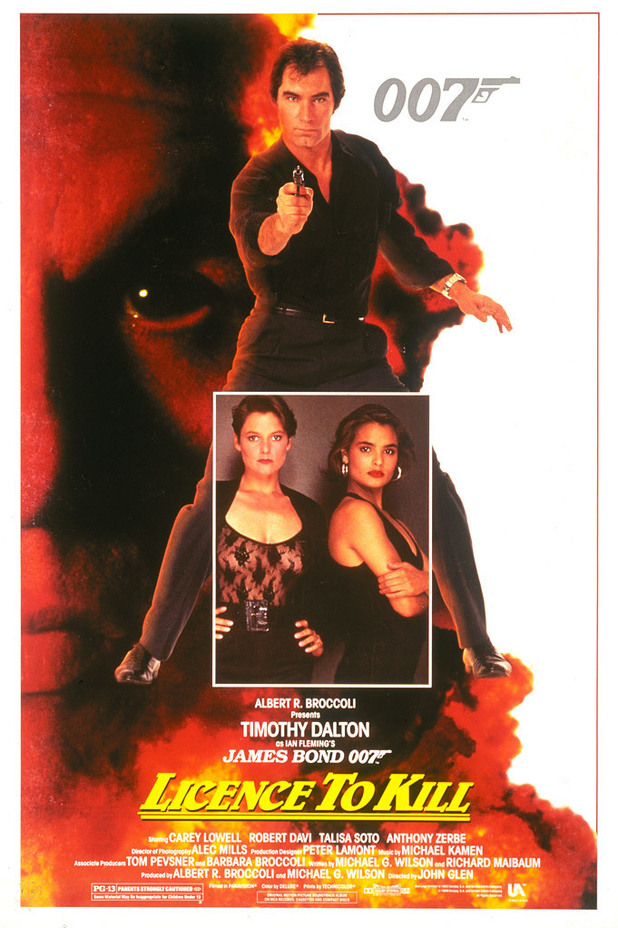
50 Years of Bond: "Licence to Kill"
On the commentary for The Living Daylights, director John Glen says the film was tailored to fit the new James Bond, Timothy Dalton's strengths. Still, it's easy to see The Living Daylights as a transition film for the series as it moved from the more comedic Roger Moore outings to Dalton's hard edged portrayal. With Dalton's next film, Licence to Kill, the series would go darker and more violent then ever before, a big risk since the series has always been a little more kid friendly. I really like this film, and as I mentioned in the previous review, rewatching both of Dalton's films reminded me how passionate, romantic and urgent they are. You really get involved in the character and they have a strong emotional centres. There's some solid storytelling in both of them and they feel like genuine updates of Ian Fleming's novels.
The film takes a different approach to the usual Bond movie plot. The film begins with Bond and his CIA friend Felix Leiter (David Hedison) heading to Felix's wedding when Felix's colleagues in the DEA call him in to help capture drug lord Franz Sanchez (Robert Davi), who has appeared in Miami. Bond comes along and in one of those great practical Bond movie stunts, Bond, while in a helicoptor, attaches a hook to Sanchez's plane and pulls it out of the air. Bond and Felix then parachute down to Felix's wedding, leading in to the title sequence. Sanchez bribes DEA agent Ed Killifer (Everett McGill) who helps Sanchez escape. Sanchez has Felix's wife Della (Priscilla Barnes) murdered and feeds Felix to a shark, who bites off his leg. Felix is kept alive and Bond swears revenge, to which M (Robert Brown) revokes his licence to kill, an earth shattering moments in the franchise. Bond then escapes from M and continues his quest.
What makes the plot so engaging is that this is one of the rare Bond films where Bond truly hates the villain. While the world isn't at risk this time, the fact the mission is personal for Bond, risking his career and his life for his friend, makes the stakes feel even bigger than saving the world. You really feel sympathy towards Felix, especially when we realize that, like Bond, he too has lost his wife on his wedding day. Felix even mentions that Bond was married to Della when Bond is uncomfortable when Della teases Bond about getting married one day. It's always nice when Bond's marriage is mentioned in the series. It reminds us of how tragic a character Bond is-one of the only times he's made himself vulnerable to a woman, she's taken away from him. He can never truly escape from his profession and have a normal life. Fleming's vision of Bond was a man who could have his heart broken, and we believe Dalton is that Bond.
In an interesting twist, Bond infiltrates Sanchez's operation and makes Sanchez view him as an ally. In a variation on Akira Kurosawa's Yojimbo, Bond makes Sanchez suspicious of the people in his organization, resulting in a pretty brutal sequence involving Milton Krest (Anthony Zerbe), who Bond frames for stealing Sanchez's money. It makes what Blofeld did to his minions look like mild spankings. The film's brutality, while it can occasionally seem gratutious, but at the same time, I've seen more violent films. Moreover, I admire the Bond franchise for actually making the violence sting and cringe-worthy. You really feel the deaths of the characters, even the villainous ones. It also suits the type of world Bond is entering, where drug lords like Sanchez are incredibly sadisitic. Davi is strong here and he doesn't have to work too hard to be believable as a drug lord. He does a fine job making Sanchez both terrifying and also charismatic at the same time, making us believe Sanchez could have this type of power.
Bond is joined on his mission by a CIA pilot named Pam Bouvier (Carey Lowell). Pam is one of the more tough as nails Bond women in the series- and while Lowell occasionally over does it with the toughness, she meshes well with Dalton's performance. A love triangle forms between Bond, Pam and Lupe (Talisa Soto), Sanchez's girlfriend. I believe this is the only legitimate love triangle in a Bond film, where Bond forms an actual romantic relationship with two women. While it's obvious that Bond will end up with Pam by the end of the film, it adds some texture to the story- as well as Pam's character when she becomes jealous of Lupe. Thankfully, the script makes Pam's jealously feel in character so it doesn't result in a pathethic version of the character.
Q (Desmond Llewelyn) gets an expanded role in this film when Moneypenny (Caroline Bliss) calls him in to help Bond. Llewelyn's performance is always a highlight and I like that Q's expanded role make sense in the context of the film-it doesn't feel forced, and there's a little more warmth between Bond and Q due to Dalton's performance. Dalton's "You're a hell of a field agent" shows how much Bond admires Q. On the other hand, Wayne Newton's cameo as a corrupt televangelist Professor Joe Butcher working for Sanchez, while humorous, feels like it belongs in a Roger Moore Bond film. It's a little too cheeky-clashing with the gritty nature of the rest of the film.
The finale of the film, involving tankers full of cocaine, is excellently staged- director John Glen establishes a pretty clear sense of geography and Dalton, while 45, was still an able physical performer. The final confrontation between Bond and Sanchez, where Bond lights Sanchez on fire with the leiter given to him by Felix, is a great emotional payoff to the film. Sanchez tells Bond that he could've had everything, to which Bond asks him if he wants to know why-finally showing him the leiter. Usually the Bond villain knows why Bond is trying to stop him. Here, it's only when the villain loses everything he finally knows why-it was out of friendship and love.
Unfortunately, this would be Dalton's final film as James Bond-due to the next Bond film being delayed so long that Dalton eventually bowed out. Licence to Kill wasn't a huge box office hit, which I think was due to a combination of audiences not warming to Dalton's portrayal or the gritty nature of the film, as well as Licence to Kill coming out during the summer when Tim Burton's Batman and Indiana Jones and the Last Crusade coming out. In retrospective, Licence to Kill is a really involving revenge action thriller that showed the lengths Bond would go to to help a friend. Up until Daniel Craig, Dalton felt the most believable as a rouge agent out for revenge. Six years later, the series would return with a film that's close to my heart, what I think is the Bond film of my generation. James Bond will return in: GoldenEye.
Subscribe to:
Comments (Atom)