Showing posts with label M. Night Shyamalan. Show all posts

Wednesday, 10 August 2022

The Essential Films: "Signs" (2002)


A Series of Writings on Films that I feel are essential for film lovers, coupled with films that are personal to me. Spoilers for those you haven't seen the film

20 years ago the cover of Newsweek proclaimed writer/director M. Night Shyamalan "The Next Spielberg," ahead of his latest film, the alien invasion drama Signs. While many laugh at this proclamation now, considering the rough road Shyamalan's career went down, if you rewind your mind back to 2002 it's not a surprise he gained this moniker. Like Spielberg, Shyamalan was a filmmaker with an seemingly innate understanding of filmmaking language whose made genre films  about ordinary people in extraordinary circumstances, imbued with the kind of sentiment often seen in Spielberg's work. Re-watching Signs, I found it's Shyamalan's most Spielbergian film, the closest to a modern day Close Encounters of the Third Kind in that both are intimate family dramas in disguise as alien arrival stories. While I'd argue Unbreakable is his best film, Signs is the one closest to my heart. This may sound funny but Signs was an important film for me on my journey as a cinephile. I think this was the first film I analyzed on a filmmaking level, where I started to think about shot composition and framing. I know you're laughing but hey, I was 13. 

Signs centers around the Hess family: Graham (Mel Gibson), a former priest who left the church after his wife was killed after being hit by a car, Merrill (Joaquin Phoenix), a failed Minor League baseball player, and Graham's two children, Bo (Abigail Breslin) and Morgan (Rory Culkin). They all live on a farm in Bucks County, Pennsylvania and one morning they wake up to discover a crop circle in their corn field. Things get stranger when an intruder is seen on the property and lights appear in the sky over Mexico. While there are several other characters present in the film, including police officer Caroline Paski (Cherry Jones) and Ray Reddy (Shyamalan), the man who killed Graham's wife Colleen (Patricia Calmeber), the story is told through the eyes of the Hesses. Shyamalan eventually leaves behind the other characters, isolating the Hesses. This is similar to Alfred Hitchcock's The Birds, where Hitchcock also isolates Melanie Daniels and The Brenner family by the film's end. Also, when the Hesses board up their house is a direct reference to The Birds' climax.

As I mentioned earlier, Shyamalan as innate filmmaking sense. There's a preciseness to his compositions and camera movement. There's a Kubrickian feel to this shot:


And the way the camera pans to the knife, foregrounding it, is funny and tense in exactly the right way.


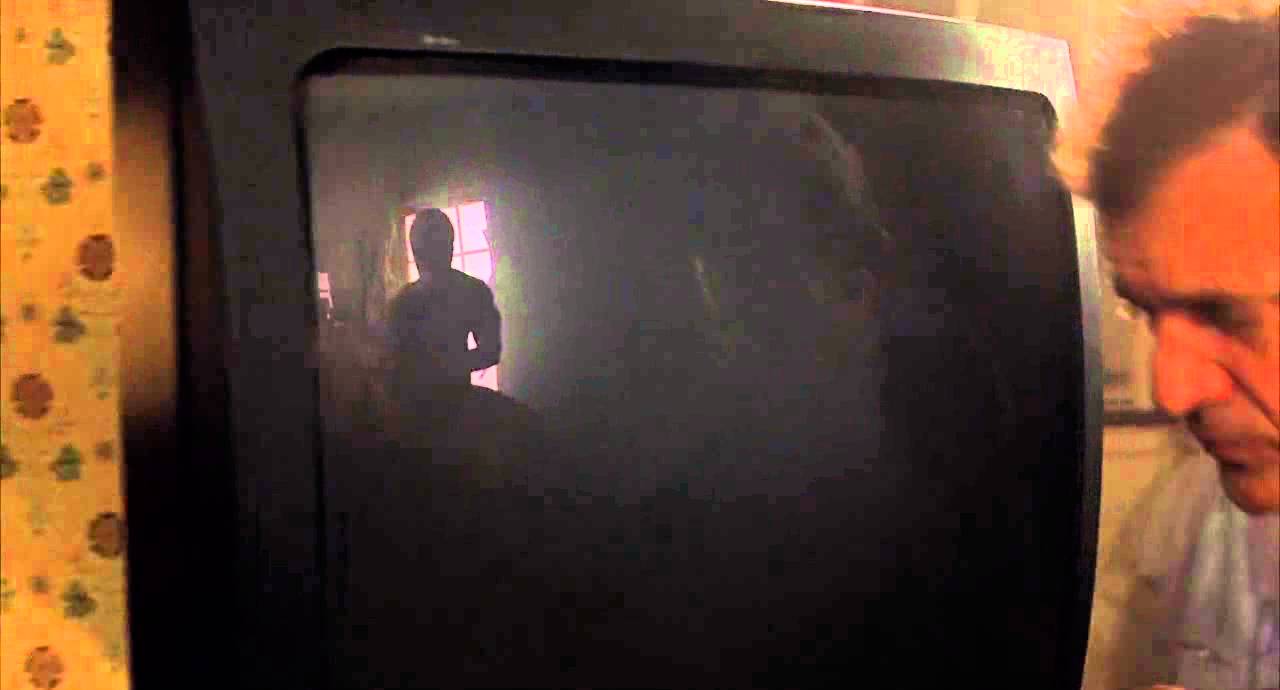
I also love the reveal of the alien still being in the house at the end through the TV screen


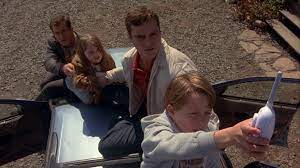
Coming back to Spielberg, the scene where the Hesses are using a walkie-talkie to hear the aliens talking is perhaps the most Spielbergian in the film:


The Sixth Sense and Unbreakable were films about coming to accept the incredible, whether it be the ability of a young boy being able to see ghosts, or that you're a superhero. Malcolm Crowe (Bruce Willis), at first doubts that Cole Seer (Haley Joel Osment) can see ghosts, realizes he's telling the truth after discovering his former patient had the same ability. David Dunn (Willis again), comes to accept he has superhuman powers. In Signs, Graham eventually can't deny there are aliens ready to invade. These films are about faith and belief, as well as accepting your purpose- Cole as the helper of the deceased, David as a superhero vigilante. Shyamalan takes these themes further in Signs by having Graham not just realize these aliens are real but there's a greater design to the universe, something he may have once believed in but turned his back on after his wife was killed. In perhaps Signs' best scene, Graham tells Merrill that there are two groups of people: people who see those lights in the sky and think they're seeing a miracle; the other believe that whether good or bad, there's no higher power looking out for them. 

I think Gibson gives what may be the best performance of his career in this film. Like with Willis, Shyamalan casts Gibson against type as a non-confrontational former priest who can't swear convincingly. When Graham and Merrill are attempting to scare off the intruder Graham awkwardly says "I'm losing my mind." It's hard not to imagine Gibson having fun playing a guy *pretending* to lose his mind rather than genuine loose cannons like Martin Riggs and Mad Max. This role also allows Gibson to be the most emotionally vulnerable he's been since the first two Lethal Weapon movies. There's a scene where Graham encounters Ray, whose trapped an alien in his house and leaving for a safer place, in which her tells Graham he's sorry for the pain he caused him. Gibson's reaction to that-the pain, the anger, but the acceptance of Ray's apology, displays how stronh he can be as actor. Overall it's a great movie star performance and perhaps the last time Gibson was without baggage as an actor/star.

Instead of casting another huge movie star as Merrill Shyamalan went for a more offbeat choice with Phoenix. Phoenix was coming off his first Oscar nomination for Gladiator and Walk the Line was a few years down the road. This was the film that turned me in to a Phoenix fan. He's so funny here. His reaction to the alien walking across the TV screen and the image of him sitting with the children, all of them wearing tinfoil hats, is likely the funniest thing Shyamalan has put on screen. Merrill is sort of a loser but he's got a good heart and is pretty endearing. I love that when Graham asks Merrill if he believes in miracles Merrill tells of the time he avoided being vomited on a girl he wanted to kiss because he had to take a piece of gum out. This is the same scene where Graham outlines the two groups of people and Shyamalan really gives us a good sense of how these two guys approach life. Gibson and Phoenix don't look a thing like brothers but I really enjoy their chemistry.

Coming back to the themes of faith and belief, Shyamalan's twist ending her- along with the Village- is his most audacious conceptually and thematically. I remember when I first the saw Signs I was expecting a twist along the lines of The Sixth Sense or Unbreakable, more of an "Oh my God!" than a slow realization of what has been set up over the course of the film. Shyamalan is going less for shock than for quiet realization. Bo's leaving glasses of water around for various reasons (supposed contamination, tastes funny), Morgan's asthma, Merrill's bat hanging in the living room, and Colleen's final words to Graham about telling Merrill to swing away, are all part of a grand design, calling back to Graham's question, "What if there are no coincidences?" Morgan's asthma protects him from the aliens' poisons and the glasses of water kill the aliens. Graham's faith is restored and the final shot shows him months later getting ready to go to church. He's found his purpose again. I find the ending I find little too pat. If Shyamalan had made things more ambiguous regarding whether certain things were coincidental or not it would've provided some great discussion. Instead, there's not much room for questioning these things. If we're going to continue the Spielberg comparisons, it's the kind of  easy ending for which, Spielberg often gets criticized. 

Ultimately, I don't think Signs is a particularly deep movie but I still think the movie overall works on an emotional and technical level. After using Eduardo Serra on Unbreakable as his cinematographer, Shyamalan brought back his The Sixth Sense cinematographer Tak Fujimoto (who photographed no less than Terrence Malick's debut feature Badlands as well as The Silence of the Lambs) for Signs. Fujimoto bring an eerily cozy feel to the film, the same way he did with The Sixth Sense. There's a paradoxical cold and warmth to these early Shyamalan films. James Newton Howard's elegant and elegiac scores also bring a beautiful autumnal melancholy this film and Shyamalan's other work. There's a little bit of Danny Elfman too in Howard's main theme for Signs. If not for Shyamalan's name you'd be forgiven if you thought maybe you were about to watch a Tim Burton alien invasion film. 

Like H.G.Wells' War of the Worlds and its cinematic interpretations, the aliens are defeated pretty easily at the end of story, which I'm okay with because the story isn't really about a war against aliens. It's a home invasion thriller which just happens to be set against a backdrop of a world invasion. The Birds, which I referenced earlier is also a smaller, almost apocalyptic story that's focused on this small town and its inhabitants. Shyamalan goes even smaller than Hitchcock, creating an almost chamber drama feel to the certain parts of the film. I almost wish there no other characters in the film other than the Hesses. 

The next Spielberg moniker obviously didn't stick, with The Village getting mostly negative reviews and Shyamalan getting worse and worse reviews over the next several films, though he's made a comeback or the last several years. However,  I don't think Shyamalan has ever recaptured what made people deem him the heir to Spielberg. The specific atmosphere of his early work has never completely returned for me unfortunately. Still, Shyamalan has always stayed true to his own particular sensibilities, similar to George Lucas, who's also gone through a reappraisal regarding his specific quirks. Maybe because we're at a place where pop culture lacks vision and spark it's easier to appreciate people like Shyamalan more now. Signs, along with The Sixth Sense, Unbreakable and yes, The Village, represent a filmmaker unafraid of being laughed at for his earnestness, whose pretentiousness oddly feels like genuine sincerity. 

It's weird to think of Signs as a 20 year old film but it makes sense- it does feel like a film from another era, a star and director driven blockbuster, the kind that would feel like a throwback if released now. I never know how to end these things so I'll say that despite it losing some of its luster for me over the years, I still think Signs is a beautiful, if somewhat reductive, film, which represents a filmmaker who at the time seemed unstoppable as a pop culture force, even if calling him the next Spielberg ended up being a curse. So, what are your thoughts on Signs and M. Night Shyamalan's career. Comment and let me know. 

Wednesday, 27 March 2019

Watch Yourself: "Us"


Image result for us 2019 cast


While I've attempted to reveal too much about this film's twists, if you haven't seen the film yet and want to go in as cold as possible, go see it and come back later.

It's impressive that just two movies in director Jordan Peele's name has already become a brand, representing horror movies which are smart and socially conscious, familiar yet different Peele's name was already a brand based on his sketch comedy days with Key & Peele; but even so, transitioning to feature film-making with 2017's critically acclaimed Get Out, which won Peele the Best Original Screenplay Oscar, was quite a feat. Peele is in the position where he can pretty much do whatever he wants. But it is a mixed blessing to have that type of success early on. It's nice to have creative control in Hollywood- a place that's not always supportive of a director's vision- and not having to compromise your vision. However, you're put under a lot of pressure to live up to your early success. Film critics build you up but are equally ready to tear you down. Then there's the pressure to compromise for film critics instead of studio execs. Peele is already receiving comparisons to M. Night Shyamalan, and while Peele's new film Us has received extremely positive reviews, it's a film that's on shakier ground than his first- largely because it's a more ambitious and yes, Shyamalanesque venture, with some pretty big twists. It's a film whose denouement forces us to re-contextualise everything we've just seen, and is genuinely disturbing in its implications.

Adelaide Wilson (Lupita Nyong'o), her husband Gabe (Winston Duke), and two children, Zora (Shahadi Wright Joseph) and Jason (Evan Alex) are on a family vacation to where Adelaide once grew up. She once had a traumatic experience seeing her doppelganger in a mirror house,  which resulted in her not being able to speak for a time. Adelaide tells Gabe she still feels she's coming for her and soon enough, all the family's doppelgangers show up. The set-up is basic but what is revealed by the end of the film suggests a much larger mythology to the story. Like Alfred Hitchcock's The Birds, Shyamalan's Signs and George A. Romero's Night of the Living Dead, we see a large scale event through the eyes of a small group of characters. This makes the terror more realistic due to its intimacy and limited knowledge concerning the events occurring around the country.   

Image result for us movie beach


Peele doesn't explain everything about the story, which can be viewed as a significant flaw but I think Peele's lack of explanation adds to the film's nightmarish and mysterious ambience; he's a director more invested in creating atmosphere and staging horror sequences.With this film I sensed Peele wanted to strengthen and further his visual storytelling abilities. He's a skilled filmmaker, with a great eye for composition and framing. Mike Gioulakis (the cinematographer for It Follows and this year's Glass), clearly understands the horror genre. I love how he use shadow to make the doppelgangers appear as if they're part of another world. The film's editor is Nicholas Monsour, who worked on Key & Peele. He's just starting out in feature films and he has strong grasp on how to slowly pace a film while still having a certain dramatic momentum. 

Before the family of doppelgangers show up, Peele visually foreshadows them- the shadows of the family on the beach, the multiple rabbits during the opening credits. It's cheeky while still being spooky. Peele is adept at incorporating humour in to his films without undermining the uneasiness or weight of the story. I particularly liked the Home Alone reference, which reminds me that I'm getting older and younger kids may not even know what the hell Home Alone is. 

I'd be interested in seeing Peele a silent film due to how effectively he uses close-ups on actors' face, letting those faces tell the story. Peele also makes the doppelgangers being unable to speak, presenting them as primal, inhuman but still frighteningly human. 

Us asks what peoples' reaction would be to twisted mirror version of themselves. But more importantly, it asks what the doppelgangers's reaction would be, especially if they had it worst off than their double. And who is the "real" version, what defines individuality and personhood. The film also asks the timeless question of what happens when those who have been oppressed fight back. In Get Out, it was one individual- In Us, the retaliation is on an ever larger scale.    

Related image

Nyong'o is great as Adelaide and her doppelganger, Red. She's fierce, vulnerable and maternal as Adelaide and as Red she's incredibly creepy but also deeply wounded by her past and what we eventually learn about her. The tragic implications of their backstories could form the basis of a whole other film. And like many horror films before it, Us's story is fueled by tragedy and trauma. Horror movies are- in a weird way- extreme therapy sessions for the audience and characters. Peele adds a twist to the catharsis experienced at the end, giving what at first feels like a typical ending a more complex and insidious layer. 

The more I've thought about Us, the more I've liked it. The film showcases the oppressed and the marginalised fighting for their piece of the world. Us is appropriately titled since it's such simple and universal word. I also take the title to refer to the doppelgangers talking: us- humans, people who deserve the same basic dignity as anyone else.  

The title also refers to us, the audience and our comfortable sense of identity. The film is about what happens our sense of identity is challenged. I'd say Peele is preparing us for but I think he's highlighting how it's already happening. We have to make room for each other. Like the aforementioned films I mentioned (The Birds, etc.) Us is about human survival but Peele subverts those films by having it about the supposed villains' survival. And Peele isn't merely preparing us for a revolution, he's clearly saying it's already begun.
    

Wednesday, 13 February 2019

On M. Night Shyamalan, "Unbreakable" and "Glass"

Related image


Warning: Spoilers for Unbreakable The Village, Split and Glass Follow.


In the nearly 20 years since 1999's The Sixth Sense M. Night Shyamalan's career trajectory has been as dramatic, twisty and unusual as any of his films; he's gone from critically acclaimed, Oscar-nominated auteur to a filmmaker whose name in a movie trailer elicited laughs from audiences. In recent years he's made a moderate comeback. He's a cautionary tale of how early success can be a mixed blessing, especially when your ego goes unchecked but also an example of perseverance in the face of intense criticism. I have a nostalgic soft spot for Shyamalan since Signs (2002) was a big deal for 13 year old me, even though I acknowledge the flaws of its ending. I've always liked his combination of European formalism and familiar genre tropes, resulting in what could be called Art-House Blockbusters, more The Exorcist (1973) and Rosemary's Baby (1968) then other genre films that were coming out in Shyamalan's hey-day.

I'd argue Shyamlan's best film is his follow-up to The Sixth Sense, Unbreakable (2000). The film tells the story of a seemingly ordinary man named David Dunn (Bruce Willis), who becomes not the sole survivor of a horrific train accident but is miraculously unharmed. He is contacted by Elijah Price (Samuel L. Jackson), a man who has "brittle bone disease," making his bones easily breakable, placing him on the opposite end of the spectrum from David. Elijah believes comic book characters walk the earth and that David is one of them. By film's end David has accepted his identity as a superhero. It's also revealed that Elijah caused the train accident as well as other acts of terrorism. 

While Unbreakable was overshadowed at the time by The Sixth Sense, in the years since its stature has risen. I actually think its twist ending is even better than the former's ending. For me, what makes Unbreakable's ending brilliant is how it's not simply a villain reveal; it's about finding one's purpose. As Elijah tells David, "Now that we know who we are, I know who I am." Elijah says he should've known he was the villain since as a child the other kids called him "Mr. Glass." Elijah is such a sympathetic character that the ending becomes oddly touching. Despite Elijah's horrific acts, when he says "I wasn't a mistake," it's deeply moving. At his best Shyamalan is able to communicate the deep sadness within his characters with a simple line. 

Shyamlan had discussed the possibility of a Unbreakable sequel for years and in 2017 he snuck in a secret sequel in to theatres with Split, about a man named Kevin Wendell Crumb (James McAvoy) who has over 20 different personalities including a hidden one called "The Beast," who has superhuman abilities, and is compelled to kidnap three teenage girls. Kevin is on the run at the film's end and in a post-credit scene Willis shows up to basically say "Hey, it's a sequel to Unbreakable."

Image result for unbreakable

Glass is the third part of Shyamlan's trilogy, and picks up not too long after Split. David, now being called the "Overseer" online is attempting to find Kevin, who has kidnapped more young women. David eventually finds Kevin but is arrested along with Kevin and placed in the same psychiatrist hospital as Elijah. Dr. Ellie Staple (Sarah Paulson) believes the three men are under the delusion they are superheroes and wants to convince them they're normal people. 

Doubt is a major theme in this film, how the power of it can prevent us from accepting who we truly are. It's eventually revealed that Staple is part of a global conspiracy to prevent the world from ever learning about super-powered beings. She says the Clover Organization doesn't take sides. They're not pro-hero or pro-villains. This revelation expands the scope of this universe and while I wish there was more build up and background regarding this organization- and it doesn't completely fit in with my mental image of Unbreakable, I think it does thematically fit the world Shyamalan has built for his characters. In a more realistic universe the concept of superheroes would be threatening and there'd be attempt to eliminate or cover-up their existence. 

It's also revealed that Kevin's father died in the same train accident that David survived. It's a huge coincidence I think it works it's supposed to be an amazing display of fate. I also believe it's supposed to parallel the scene in Watchmen where Dr. Manhattan discovers Laurie is the daughter of Silk Spectre and The Comedian. It's also Shyamlan saying because of Elijah's illness, because of simple chance, that everything has led to this moment. How fate brings us together has always been one of Shymalan's thematic and emotional concerns. The ending of Signs was all about seemingly coincidental details that had deeper meaning and purpose. Willis' child psychologist Dr. Malcolm Crowe in The Sixth Sense failed to understand his patient Vincent Grey was seeing the dead, which led to Vincent killing him. Malcolm then comes back as a ghost to help another child, Cole Sear deal with the same ability. And if David had never been on the train, Elijah may have never found his opposite. 

Elijah's plan is to make Staple and David believe he and Kevin are going to attack a building about to be unveiled. Elijah's real end game to capture on video a fight outside the hospital between David and the Horde (the name given to Kevin and his personalities). 

Image result for the village 2004


Glass reminds me of Shyamalan's 2004 film The Village, which set itself up as a "creatures in the woods" thriller set in the 1800s that would climax with a confrontation in the woods between Joaquin Phoenix's character Lucius and the monsters. It not only doesn't deliver that climax but also reveals the village is in a park in modern day Philadelphia. It was created by people who wanted to escape the horrors of 20th Century life.) At the end of the film the status quo is maintained whereas Glass' ending has the truth revealed to the world about superheroes. 

Glass sets us up for a big climax similar to that of The Avengers, and I'd argue Shyamalan structures this film similarly to that first Avengers film. Both have a middle act where the characters are all in one location, interacting with each other and being psychologically played with by the villain, the villain in this case being Staple, not Elijah. The film is in someways an anti-narrative, building up towards something that never comes and I feel the disappointment in the film from many comes from how David is killed off unceremoniously, drowned in a puddle. But I'd say that's Shyamalan's intention, to disappoint you, to make you feel bitter towards the tragedy and reality of superheroes in the real world. Usually it's the superheroes are maintaining the status quo but here it's the presence of superheroes that ultimately challenge it. 

The film leaves us with the question of what happens when the truth is revealed. Will it cause more harm than good, will it cause chaos? I think what's truly important is these men existed- and they deserve to have their stories known. Elijah's mother (Charlayne Woodward) David's son Joseph (Spencer Treat Clark), and Casey Cooke (Anya Taylor Joy), who formed a connection with Kevin while being held captive, are the ones who spread the video. I believe Shyamalan is saying those closest to us are the ones who will ultimately tell our stories, good or bad. Mrs. Price turned Elijah on to comic books, which led to his actions, so its appropriate she show the world a live action comic and continue on his legacy. And while Shyamalan broke out with The Sixth Sense, this trilogy may be his most lasting legacy as a filmmaker.     


Thursday, 2 June 2011

An analysis of "M. Night Shyamalan's The Village"

                                                                                  
Warning: Spoilers Ahead 

I'm interested to see how director M. Night Shyamalan will be percieved thirty or fifty years from now. I'll be in my seventies by then and I'll either be telling my grandkids how poorly recieved some of his films used to be even if they're looked upon more fondly by then, or I may be having to explain why I like elements of his films that people still hate. I would hope The Sixth Sense (1999) his breakthrough film would retain the stature it has now and would have evolved in to an acknowledged horror classic. I think something like Unbreakable, which some actually regard as his best film also seems like a film which could gain in stature. I also think Signs, which is my favourite of Shyamalan's films, should be reavaluated. In particular, I'm interested to see how  The Village ages. The Village is a film that invokes strong emotions from people. In a way, I think its practically impossible to have a neurtral opinion on this film, you either hate it and think Shyamalan's signature twist ending silly and cheap, or you love it, thinking it has quite a beautiful love story at its center, and is an interesting parrable on the time in which it was made.

In the late seventies an American history professor named Edward Walker (William Hurt) approached a group of people he met at a grief counselling clinic after his father was murdered with an idea. The idea was to use his wealthy father's money to build a secluded town in the middle of a nature preserve. The elders also create a myth of "those we do not speak of," creatures that haunt the woods but do not come in to the village because of a truce. The elders have also set the clock back to the 19th century. As the film opens we see from the tombstone of August Nicholson's (Brendan Gleeson) recently deceased son that it is 1897 within this self contained world. Now, what I have just said about the creation of the village is only revealed at end of the film and I think this may be where the problems with the film start. The concept of people overcome by grief who retreat in to a artficially created world is for me fascinating. Thinking about The Village's twists, I'd wish Shymalan would have disregarded the twist ending and played the film straight, revealing this twist early on, and possibly showing flashbacks to the seventies. This is not to say that an absence of flashbacks in the film is a huge flaw; that single photograph Shymalan shows us near the end of the film with the elders of the village is extremely haunting, particularly with the voiceover of the actors discussing what brought them to the grief counselling center. I like the implications of the ending but I feel that Shyamalan leaves us with these implications rather than fully explore them. Now, to be fair, he does explore issues of innocence, fear, bravery and seclusion throughout the film, themes which relate to the ending, but they are explored while tip toeing around the actual situation these characters are in; and even on subsequent viewings this tip toeing is still present.

What I find most interesting about the first twist in this film is how Shyamalan is using his most familar trademark to order to subvert the expectations of a M. Night Shyamalan film. His three previous films, The Sixth Sense, Unbreakable (2000), and Signs (2002), stayed true to the supernatural or other worldly aspects that were established in the films, and actually reinforced by the endings. In The Sixth Sense, Malcolm Crowe (Bruce Willis) is one of the ghosts Cole Sear (Haley Joel Osment) is able to see; in Unbreakable, Elijah Prince (Samuel L. Jackson) is the supervillian to David Dunn's (Bruce Willis) superhero, and in Signs, the aliens are revealed to be completely real. In The Village, on the other hand, the first twist subverts the supernatural aspects of the film, revealing The Village to be very different than his previous three films. We of course learn that the creatures are not real when Edward reveals the truth to his blind daughter Ivy (Bryce Dallas Howard). The final twist, which establishes that the villagers are not in the 19th century but in the 21st, can also be seen as subverting the expectations of a Shyamalan film because we have also come to expect that the worlds Shyamalan's characters occupy are also going to stay true to what has been established, which also relates to the presence of the supernatural.

By not revealing the secrets of the village until the end, Shyamalan seems to want it both ways in this film: he wants to provide a supernatural mystery that became his signature in The Sixth Sense but at the same subvert these expectations and provide a religious and political parrable that is pretty much distanced from the supernatural. I think the balance pretty much works because Shyamalan is pretty light on the suspense sequences in this film. Seeing the film knowing the twist, I think one can sense that Shyamalan is already preparing the audience for the realization that the supernatural does have as firm existence as in his previous films, as well as allowing the audience to adjust themselves to the fact that this is Shyamlan's first genuine romance film. Romance was there in The Sixth Sense but I think the romance of the film only becomes apparent in the last scene. I do really like the romance between Lucius and Ivy, particularly the porch scene where Ivy asks Lucius if he'll dance with her on their wedding night.

Ivy and Lucius are two points of a love triangle that also includes the mentally challenged Noah Percy (Adrien Brody). I find that Brody's performance is both limited in terms of screen time and also character dimension. I think Shyamalan made Noah mentally challenged to make him more sympathethic as well as reinforce how the fear of the outside world stopped the elders or anyone else going to get medicine to help Noah's condition. He is sympathetic but as I said, he's too much of a cypher. I believe that Shyamalan is dealing with the most characters up to this point in his filmography, particularly compared to his previous film Signs. I feel that juggling this amount of characters makes Shyamalan not so much unsure of who is important but that everyone seems to become important but many of characters aren't developed enough. I find it disappointing that Lucius gets stabbed by a jealous Noah about an hour in to the film, then spending the rest of the film in a coma, particularly since it seemed that it arch wasn't yet completed. I think Lucius should have gotten sick so then he could still regain consciousness and still feel a part of the story aside from just a character who needs to be saved.

This is not only Shyamalan's first genuine romance film but it's also his first female driven film, with Ivy becoming the one who ventures to the towns to save the man she loves' life. Sigourney Weaver, who plays Lucius's mother, probably saw a connection between the emergence of Ivy as the heroine and the character she played in Alien, Ellen Ripley, who by the end of that film became the heroine, and thus becoming  the central frigure of the Alien franchise. Ivy of course is a softer character than Ripley, more vulnerable I find. I've always loved Howard's performance in this film. I think her performance has the most life to it than the rest of the cast, which I feel is intentional. She has a transcendent, almost otherworldy quality to her in this film, which is why we can believe that the reserved Lucius could fall in love with her. I also like Phoenix in this film; he conveys conviction and a bravery in the face of fear, a fear that he later states relates to Ivy's safety, very well.

While Shyamalan's screenwriting can be fairly criticized, I think that Shaymalan's visual sense, his feel for composition and editing, is something that even his distractors could learn to admire. Some of his images could even be paintings, they're so well thought out and quietly beautiful, particularly in the porch scene.Unfortunately, One feels like Shyamalan's formalism can feel too constricting, that he is too much focused on his carefully storyboarded images than moving every single scene forward as dynamically as he should.

When The Village was released in the summer of 2004, the Second Gulf War had only just begun the year prior, and the events of September 11, 2001 had happened less than three years prior. I think the film speaks to the time in which it was made, as well as the years following its release because it captures the fear of the "other" that I think was and still is prevalent today in Northern America. Many of Shyamlan's films deal with the element of fear and how one confronts his or her fears, whether it be Cole in The Sixth Sense, who sees ghosts, Elijah in Unbrekable, who is afraid of not having a purpose in the world, or Graham Hess (Mel Gibson) in Signs, afraid of not being able to protect his family. The Village, at its core is about how fear of our world can make people want to hide away from it, to go back to a simpler time. This same fear is what the elders use to subjugate the other villagers, except they disguise it with the myths of the creatures.

I'm still divided about The Village but I nevertheless love parts of this film and overall I like it. It is a continuing fascinating exploration of how fear can corrupt the human experience yet even in the most morally ambiguous of situations, hope can still presevere.