
Warning: Spoilers for many of the films listed below
I consider the 1950s the greatest decade in film history. It was the decade in which Hitchcock made several of this greatest films- including the film many regard as his masterpiece, Vertigo. Akira Kurosawa made Rashomon, Seven Samurai, Throne of Blood. Ingmar Bergman would have Smiles of a Summer's Night and The Seventh Seal. Marlon Brando would come on the scene deliver one of the greatest screen performances of all time- as Terry Malloy in On the Waterfront. Fellini would give us Nights of Cabiria and La Strada. James Dean became of the great screen icons with all only three films. Billy Wilder made what is considered the funniest film of all time with Some Like It Hot, as well maybe the best film about Hollywood, Sunset Boulevard.
I wanted to discuss my favourite films of the decade. They include multiple appearances by a few directors, especially Mr. Hitchcock. So, here they are, my favourite films of this wonderful decade of cinema. Again, there will be spoilers.
Rear Window (1954)
Alfred Hitchcock's Rear Window is one of the rare films that I would argue is perfect. L.B. "Jeff" Jeffries (Jimmy Stewart) is a photographer who- after breaking his leg photographing a racetrack accident- is confined to a wheelchair and passes the time spying on his neighbours in the courtyard where he lives. He soon starts to suspect that Lars Thorwold (Raymond Burr) has murdered his invalid wife.
Hitchcock takes what sounds like an uncinematic concept and crafts it in to a commentary on cinema, voyeurism and the how the two are intrinsically connected. Hitchcock always believed in what he called "pure cinema," meaning the story should should be told using the specific tools of cinema. We see most everything from Jeff's perspective as he's looking in to the other apartments. We as the audience are also voyeurs and accomplices in Jeff's preoccupation. Even when there's dialogue- Jeff interacts with and involves in his investigation his girlfriend Lisa Fremont (Grace Kelly), nurse Stella (Thelma Ritter) and police friend Tom Doyle (Wendell Corey). But even in dialogue scenes Hitchcock still tells the story visually: who can forget Lisa's introduction- seen through Jeff's blurred vision as she comes in to kiss him.
Rear Window is also a commentary on our relationship to our neighbours and how we perceive people and their actions. And overall it's just an incredibly entertaining film. More than 60 years on, it's still an exemplary example of its genre and Hitchcock's filmography.

12 Angry Men (1957)
Sidney Lumet's debut film only has one scene set in a courtroom but it ranks amongst the greatest films about the justice system. It also remains an relevant examination about racial prejudice in America.
On a hot summer day 12 jurors must decide the fate of a 18 year old Hispanic boy charged with murdering his father. For most of the jurors it's an open-and-shut case that the boy guilty. Juror 8 (Henry Fonda) wants to discuss the details of the case to make certain they're not sending an innocent person to their death. Throughout the afternoon the other jurors will confront their own biases and preconceptions. Juror 3 (Lee J. Cobb, one of the great character actors) has the most powerful and significant transformation. His decision is the culmination of the whole drama.
Fonda is perfectly cast as Juror 8. Fonda almost always portrayed noble character and here represents what a juror should be: open-minded and desiring a fair verdict. Aside from Fonda and Cobb, the superb ensemble cast also includes a who's who of character actors: Jack Klugman, E.G. Marshall, Martin Balsam, and Jack Warden.
As I've gotten older the film has become more ambiguous and complex. When I was younger I thought it was clear the boy was innocent. I now think there's a possibility the boy could be guilty. The larger point is he got a second chance at life and the possibility of redemption.

Singin' in the Rain (1952)
The late Debbie Reynolds made her screen debut in Singin' in the Rain, which is my absolute favourite movie musical. Energetic, sweet, and with a humourous commentary on how Hollywood switched from silent films to "talkies," this may be the happiest film ever made, or at least among the most happiest. Taking place in the late 1920s, Don Lockwood (Gene Kelly) is a silent film star who's paired in films with Lina Lamont (Jean Hagen). Don and Lina's latest film The Dueling Cavalier is to be turned in to talking picture after the success of The Jazz Singer but Lina's shrill voice wasn't made for talkies. Don meets Kathy Selden (Reynolds) and the two fall in love. Kathy is eventually employed to dub Lina's voice when Don, Don's best friend Cosmo Brown (Donald O'Connor) and Kathy get the idea to turn The Dueling Cavalier in to a musical
The film is famous for the scene of Hollywood star Don Lockwood (Gene Kelly) singing the title song but the film is full of other memorable musical set pieces, including "Good Morning, Good Morning," "Moses Supposes" and O'Connor's "Make 'Em Laugh." It's a shame this film was only nominated for two Oscars- Best Scoring of a Musical Film and Best Supporting Actress for Hegan's performance. In a better world, the film, Kelly, Don O'Connor, Director Stanley Donen and Reynolds would all have been nominated.

Sunset Boulevard (1950)
Sunset Boulevard is one of Billy Wilder's essential masterpieces, a darkly funny, biting and ultimately tragic story about the way Hollywood both gives and takes away- and the obsession with maintaining one's fame and the audience's love. Joe Gillis (William Holden) is a struggling screenwriter who- while escaping from men attempting to repossess his car- finds himself at the mansion of former film star Norma Desmond (Gloria Swanson). When Joe recognizes her and comments she used to be a big star she says "I am big. It's the pictures that got small." She's written a screenplay for her "return" (she hates the word comeback) and Joe persuades her to let him rewrite it.
Norma Desmond is one of the great film characters- sad, scary, funny, incredibly confident and yet vulnerable to the core. Swanson- who was nominated for the Best Actress Oscar- plays Norma just broadly enough to make her outlandish but not cartoonish. Her tragedy is of someone who had everything and can't live without being a star. She eventually brings Joe down with her, their two fates intertwined.
While Joe can physically leave the mansion, he is still a prisoner of Norma's and his own desires. Casting a handsome movie star like Holden as a down on his luck screenwriter is actually a great joke. And casting actor-director Eric von Stroheim as Norma's former husband and director, now butler Max von Mayerling also functions as meta-joke.
Wilder and Charles Brackett, whom had co-written several previous films with Wilder, won Oscars for writing Sunset Boulevard but it was to be their final collaboration. Wilder- hailing from Germany- always looked at America from an outsider's perspective. I think he was both cynical of American society was still compassionate, never looking down on his characters- and even finding hope for them in The Apartment and Some Like It Hot. And even Norma finds happiness in her delusions.

Vertigo
Alfred Hitchcock's Vertigo is a prime example of film that wasn't well liked at the time of its release but was later on re-valuated. Vertigo is now seen as Hitchcock's supreme masterpiece. In 2012 it dethroned Citizen Kane in Sight and Sound's greatest films poll. Whether Hitchcock intended it or not, Vertigo is the revealing of his own psychology, his obsession with a particular kind of woman and manipulation of women.
John "Scottie" Ferguson is a retired police officer who realized he had acrophobia during a rooftop chase of a suspect, which led to the death of another officer. Scottie is hired by an old college friend Gavin Elster (Tom Helmore) to follow his wife Madeline, whom Elster believes has been possessed by the ghost of her great-grandmother Carlotta Valdes. Scottie Madeline and subsequently saves her life after she throws herself in to the bay under the Golden Gate Bridge. He soon becomes romantically involved with Madeline but he is unable to stop her from committing suicide by throwing herself off the top of a bell tower. Scottie is found not responsible for Madeline's suicide and spends some time in a sanitarium. Plagued with guilt, Scottie eventually meets a woman named Judy who looks remarkably like Madeline, whom he then begins to make in to the image of his dead love.
Vertigo is like a maze and Hitchcock is leading you through it. I think when one first sees the film his or her focus will mostly be on the plot. But on re-watch once you know where the story is going, one is able to focus on the film-making and the psychological complexity of the story. The plot is a red herring. Like Scottie we are led down multiple paths, not realizing the grand design until it's too late.
On re-watch, one is also able focus on character study of Scottie. Even from the beginning of the film Hitchcock establishes Scottie's fragile mental state and how Scottie will eventually blame his vertigo for mot being able to save Madeline. As Scottie begins to trail Madeline, this is where is obsession begins, and he's the one who ultimately becomes possessed- not by a ghost but by romantic obsession.
The casting of Stewart is brilliant due to his relatability and image as the every man. In him audiences saw who they could be at their best. In Vertigo we see ourselves at our worst. If Stewart can be consumed by a twisted obsession, we all can
A trope of Hitchock's filmography is the "Hitchcock Blonde," cold, cool, mysterious women. Just as Scottie is obsessed with an image that doesn't really exist- the "Madeline" he knows is just Judy, an actress playing a part- Hitchcock was obsessed with a particular image of a woman. Vertigo is largely about the extent someone will hurt another as part of their art. Hitchcock is known for his cruelty towards Tippi Hendren and his obsession with her and several other actresses with whom he worked. Vertigo is Hitchcock as his most self-reflective even while imbuing the film with a hypnotic mystery and elusiveness.

The Seventh Seal
Endlessly homaged and parodied, The Seventh Seal- was many North American audiences' introduction to director Ingmar Bergman. As with Woody Allen- who was heavily inspired by Bergman- and Annie Hall, this was a transitional film for Bergman, forging the way for his later masterpieces. The film chronicles the journey of knight Antonius Block (Max von Sydow, in his first of many films for the director), who has returned from fighting in the crusades, along with his squire Jons (Gunnar Bjornstrand). Sweden has been struck by the Black Plague. Block comes face to face with Death (Bengt Ekerot), whom has come for Block. Block then challenges Death to a chess match for his very soul.
At the film's core is Block's crisis of faith, his feeling of God's absence. The existential crisis that can plague one's life is universal- regardless of one's faith. I think The Seventh Seal is maybe Bergman's accessible film due to the literalness in which Bergman approaches this subject. But while Bergman arguably made more complex films later on, this doesn't diminish the visual and thematic impact of the film.
The Seventh Seal's personification of Death is definitive He's drily funny- in one scene he is sawing down a tree, killing an actor. But he's also very ominous and matter of fact. When he reappears at the end of the film it's a harrowing climax.
It's easy to parody Bergman due to his earnestness but its that very earnestness that makes The Seventh Seal such a haunting experience 60 years on.
The Night of the Hunter
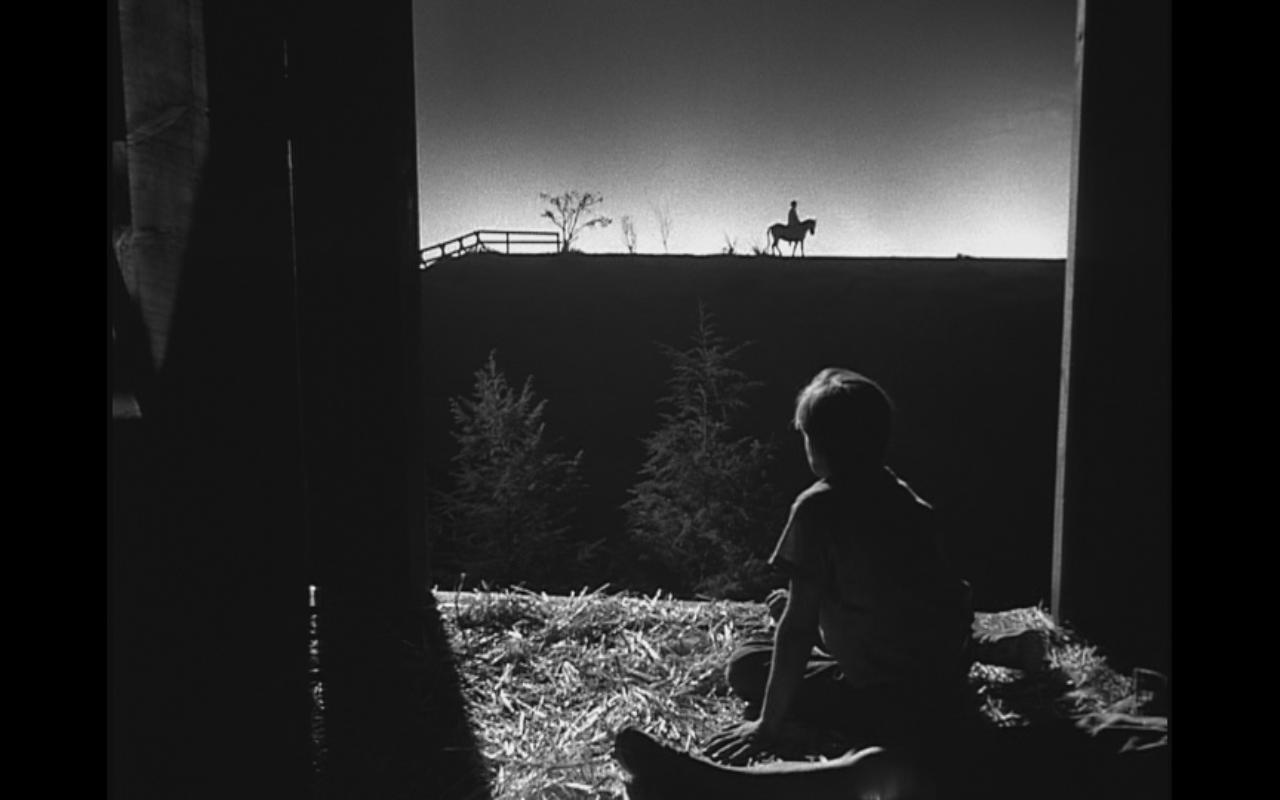
Harry Powell ranks as one of the terrifying villains in film history, a boogieman that feels he's been ripped right out of your nightmatre Powell is a "preacher" who is sentenced to prison due to driving a stolen car. Powell shares a cell with Ben Harper (Peter Graves). Harper had robbed a bank and killed two police officers in the process. Powell learns enough from Harper to know infer Harper's children, John and Pearl, know where the money is. Harper is executed and when Powell is released he locates Harper's widow, Willa (Shelly Winters). Powell marries her so he can get closer to the money. He eventually murders Willa and the children have to escape, with Powell coming after them.
Powell is portrayed by Robert Mitchum, whose screen image was defined by a laconic and laid back quality. He didn't seem to care about being a movie star, which made him cool. Powell, in contrast, isn't very cool. Mitchum's other characters didn't care and if they did, they didn't show it. Powell cares too much. He'll terrorize children if it'll help him get rich. Mitchum's characters usually were upfront about who they were but Powell is deceptive and slick. He cons the naive town in to thinking he's a good man. And even when he's showing his true self, it doesn't feel like we're seeing a real person. Rather, Powell is a personification of evil rather than a flesh and blood man. This contrast between Mitchum's typical screen persona and the characterization of Powell is what makes him the character so terrifying. Mitchum is an actor with whom the audience is usually so comfortable. Here he takes the form of a monster. Powell's monstrosity is countered by Lillian Gish's Rachel Cooper, who looks after stray children. Powell is a man who wears the mask of a good Christian man but Rachel is the true light in the darkness.
The Night of the Hunter is the only film directed by actor Charles Laughton. That is was Laughton's sole film is a significant part of this film's mystique and power. In this one film we glimpse Laughton's mastery as a filmmaker. Laughton crafted a film that can't be boiled down to a one genre or description. It's a surreal horror film, a southern noir, a gothic fairytale, and a commentary on organized religion in America. It feels like a nightmare, which eventually turns in to a peaceful dream. The film wasn't a critical or commercial success. This disappointed Laughton greatly, which led him to never direct another film.
Stanley Cortez's cinematography provides the film with much of its unsettling atmosphere. Cortez had previously photographed Orson Welles' The Magnificient Ambersons and Fritz Lang's Beyond the Door. Cortez would later photograph Samuel Fuller's Shock Corridor and The Naked Kiss, as well as Roman Polanski's Chinatown.
The Night of the Hunter is another film that was not appreciated in its time. In many ways it was ahead of its time. It would inspire future filmmakers such as Martin Scorsese and Spike Lee. But while ahead of its time it also tells a timeless story of good and evil. It ends with the hope that goodness and love can win in the end.
The Quiet Man
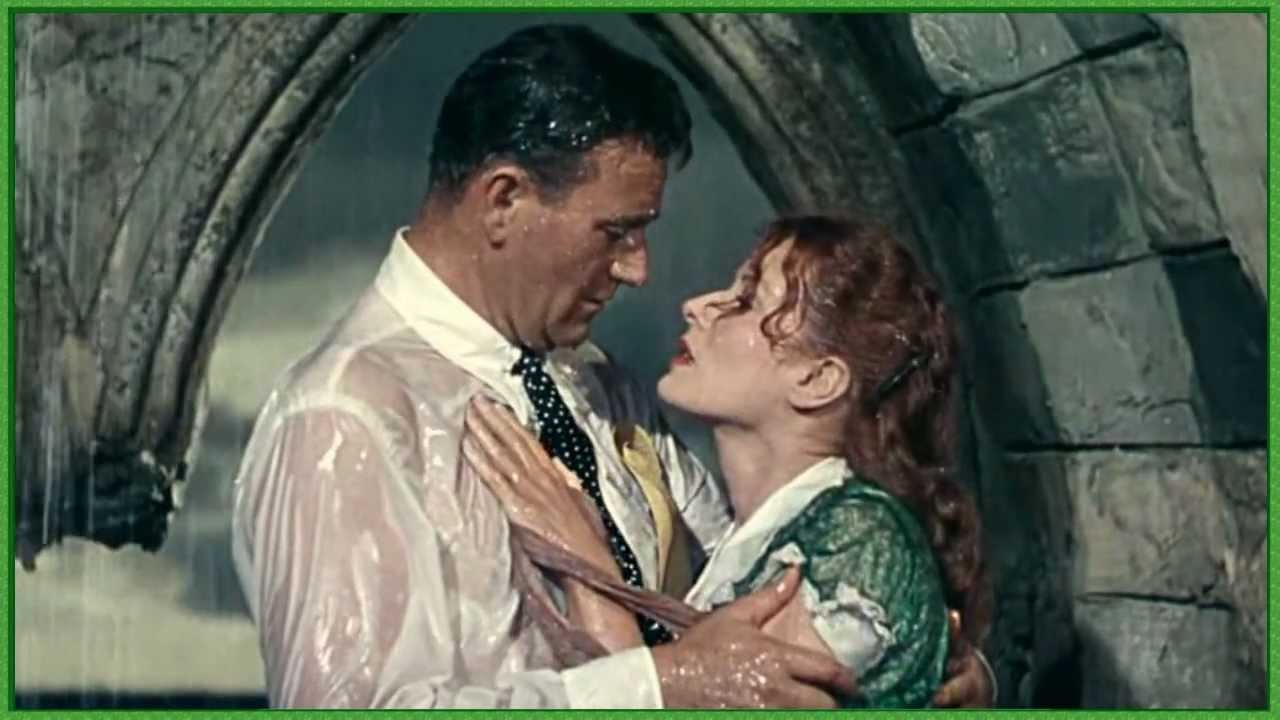
The Quiet Man is John Ford's most personal film and one of his warmest as well. Ford would win his fourth and final Best Director Oscar for this film. Frequent Ford collaborator John Wayne plays Sean Thornton, a former boxer and Irish-born American. Sean returns to Ireland to reclaim his family's farm. While there is he falls in love with Mary Kate Danaher (Maureen O'Hara). The two eventually marry and several complications arise including Mary Kate's brother Will (Victor McLaglen), a landowner who has a beef with Sean.
Ford, whose parents were Irish Immigrants, is one of the quintessential American filmmakers. Before making Citizen Kane Orson Welles watched Stagecoach numerous times in preparation. He defined the image of the American Western and made Wayne a movie star. But while was Ford is associated with classic Western, he would never win an Oscar for any of his Westerns. He won for The Informer, The Grapes of Wrath, How Green is My Valley and as mentioned before, this film.
When I was writing for WhatCulture! a few years back, I included The Quiet Man on the list of 10 great "Hang-out movies," a term made popular by Quentin Tarantino. I included the film because of its roster of colorful characters, and it's charming and funny atmosphere. In four years Ford would make one of the darkest westerns with The Searchers but The Quiet Man sees Ford at his most nostalgic and gentle. And Ford's nostalgia for this world is passed on to the audience through this film, whatever one's individual background

Throne of Blood
Throne of Blood is the first of Akira Kurosawa's Shakespeare adaptations. It would be followed by The Bad Sleep Well (1960, a variation on Hamlet) and his late career masterpiece Ran (1985, a film whose story through the writing process became more like King Lear). Throne of Blood is a re-telling of Macbeth and follows the basic story of the play closely. In this version Macbeth is Taketoti Washizu (Toshiro Mifune) and Banquo is Yoshiyaki Miki. Isuzu Yamada plays Asaji, this film's version of Lady Macbeth. Instead of encountering three witches Washizu and Miki come upon a spirit in the forest who tells them their future. The scene where they encounter the spirit is one of the spookiest sequences ever captured on film and displays Kurosawa's gift for bizarre yet entrancing imagery.
The ending, where Washizu is swarmed by arrows, is one of Kurosawa's greatest set pieces. And while I'm a huge Shakespeare fan I prefer this film's ending to the play.
While the film doesn't employ any of Shakespeare's language, it's atmosphere and performances invoke the feeling of the play. But the film also works as its own piece of art. Shakespeare took inspiration from other works and actual history to craft his art. Kurosawa does the same with Shakespeare. Kurosawa is one of those directors I would put on a Mount Rushmore of film directors.
North by Northwest
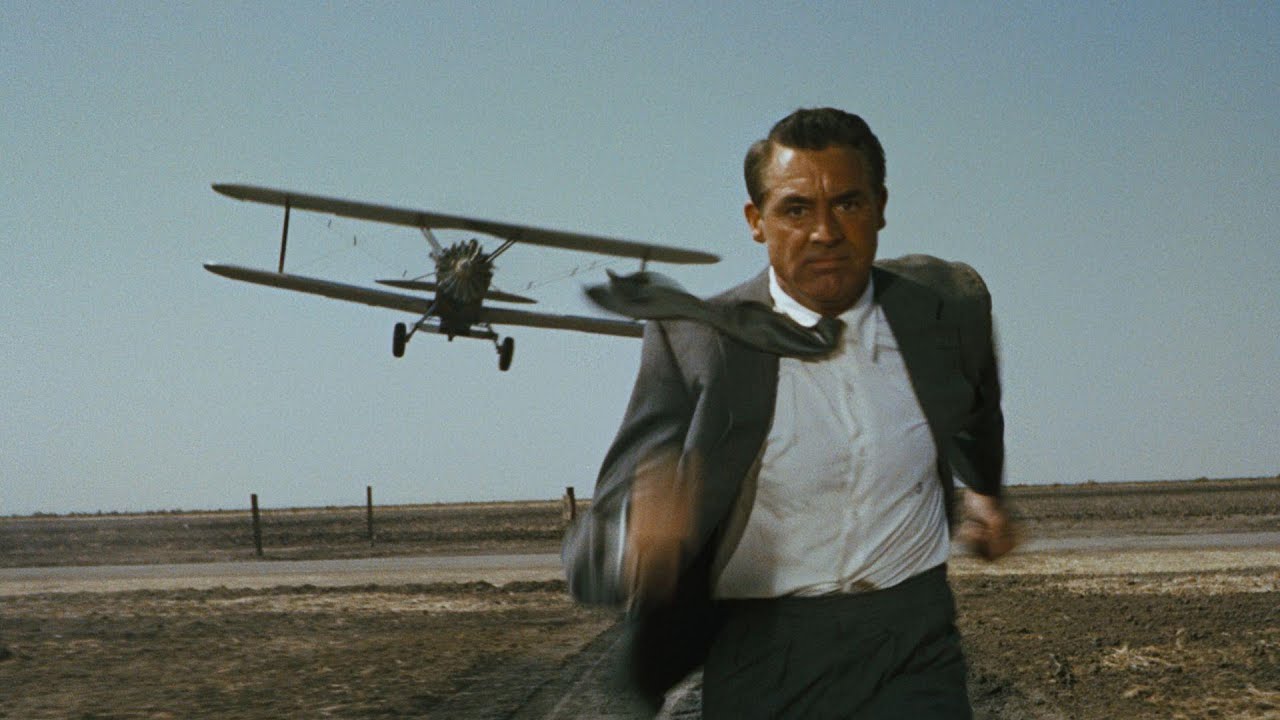
The first Hitchcock film I ever saw is also the proto-James Bond movie. From Russia With Love's (1963) helicopter showdown is known to be inspired by North by Northwest's iconic crop-duster sequence. North by Northwest's star Cary Grant was also considered for Bond in Dr No. Grant's performance in Notorious is probably the best example of what he could've brought to Bond if he was younger when they made Dr. No. The film's ending even has a naughty visual gag that rivals that of the Bond films.
Hitchcock constantly returned to the theme of the wrong man in his films, inspired by an incident in his childhood when his father sent him to the police station with a note. Young Alfred was put in a jail cell for several minutes and was told this was what happened to bad little boys.
Roger Thornhill (Grant), is a New York ad executive who is mistaken for a spy named George Kaplan by Philip Vandamm (James Mason). Vandamm's plan to kill Thornhill fails. Vandamm's thugs try again and accidentally kill a U.N. Diplomat. Thornhill is mistaken as the assassin he has to go on the run. On a train he meets Eve Kendall (Eva Marie Saint), who isn't what she seems.
North by Northwest can best be described as a comic thriller but falls in to camp or becomes too serious. It's light not overly slight and it's still superior entertainment to many modern blockbusters. It's also the one that made me a Hitchcock fan.

Witness For The Prosecution
Billy Wilder, like his contemporary Howard Hawks, made films in various genres and styles during his career, sometimes within the same film. Sunset Boulevard is both a film noir and a Hollywood satire. The Apartment is a romantic comedy but also a drama about isolation. Some Like It Hot, another romantic comedy, is also a period piece, buddy comedy and gangster film.
Witness For The Prosecution is Wilder's take on the courtroom drama, with a dose of film noir. Charles Laughton plays Sir Wilfrid Robarts, a barrister in ill health who takes on the defence of Leonard Vole (Tyrone Power). Vole is accused of murdering an elderly woman named Emily French. He had met French and she became very infatuated with him. She named him the main beneficiary in her will. Things become complicated when Vole's German wife Christine (Marlene Dietrich) is called as a witness for the prosecution.
The film is based on short story- and later a play- by mystery writer Agatha Christie. It's twisty plot and denouement have the Christie touch. She was always ahead of her time in regards to subverting reader expectations.
Laughton and Elsa Lanchester (Laughton and Lanchester were married in real life) as Robarts' nurse provide much of the film's humour. Power is great casting because his matinee idol image contrasts with the possibility he could be a cold-blooded murderer.

The Searchers
The Searchers wasn't John Ford's final western but it sfeels like a definitive statement on Ford's part on the genre he both came to define and which defined him. In this film Ford is looking back at the racism inherent to the genre and which was found in his own westerns.
Ethan Edwards (John Wayne) is an civil war veteran who has returned to his brother Aaron's (Walter Coy) homestead after a long absence. Soon after, his nieces Debbie (Lana Wood) and Lucy (Pippa Scott) are kidnapped by Comanches led by a man named Scar (Henry Brandon). The homstead is burned down, with Aaron and his wife Martha (Dorothy Jordan) dead. Ethan, Lucy's finance Brad Jorgensen (Harry Carey Jr.) and Debbie's adopted brother Martin Pawley (Jeffrey Hunter) go after in pursuit. When Lucy is found dead Brad rides in to the Indian camp and is killed.
In Ethan's mind, Debbie has become one of them and needs to be killed. Throughout the film and even at the film's conclusion, Ethan is an unapologetic racist. While he ultimately doesn't kill Debbie (whose is played by Natalie Wood in later scenes), this isn't a complete justification for his attitudes nor does it mean his attitudes have completely changed. The final shot of Ethan framed in the doorway of the Jorgensten homestead as the door closes on him symbolizes how Ethan is a man of the past. He has not place in the changing world.

Sweet Smell of Success
Alexander Mackendrick's Sweet Smell of Success is a wry blend of cynicism and entertainment. Clifford Odets and Ernest Lehman's brilliant script spares no one in its examination of a New York gossip columnist J.J. Hundsecker (Burt Lancaster) and press agent Sidney Falco (Tony Curtis), whom Hundsecker enlists to help him smear the jazz musician that is romancing his sister. If it was made today Falco would be the hero who becomes bad but then makes the right choice and is redeemed. But here Falco is just as bad- and probably even worst than Hundsecker.
Sweet Smell of Success is a dialogue driven film that also manages to be cinematic. The film is a time capsule of New York in the 1950s James Wong Howe's cinematography makes New York the most noirish is has ever looked in a film.

All About Eve
Released the same year as Sunset Boulevard, All About Eve is another film about being woman in an industry that sees 40 as being old. Bette Davis gives one of her greatest performances as Margo Channing, a famous stage actress, Margo meets aspiring actress Eve Harrington (Anne Baxter), whom has followed Margo's play across the country. She tells Margo and her friends a sad story about being poor and losing her husband in the war. Margo takes to the girl and makes Eve her personal assistant. But Eve is a manipulative schemer and she becomes a big star in the theatrical world, upstaging Margo at every turn.
Writer/director Joseph L. Mankiewicz would win his second consecutive Best Screenplay and Best Director Oscars for All About Eve (He won both the previous year for A Letter to Three Wives) and the film would win Best Picture. It was nominated for 14 Oscars, a record only matched by Titanic. George Sanders would win Best Supporting Actor for his sardonic turn as theatre critic Addison DeWitt. In a case of life imitating art, Davis and Baxter would both be nominated for Best Actress. They would cancel each other out and the Oscar went to Judy Holliday for Born Yesterday.
Mankiewicz's script is one of the best ever written, balancing humour and drama flawlessly. The film would also mark an early appearance of an actress by the name of Marilyn Monroe.

Ace in the Hole
I think this Billy Wilder's most cynical and angry film. Kirk Douglas is brilliant as Chuck Tatum, a disgraced reporter who after his car breaks down in New Mexico, talks his way in to a job at an Albuquerque newspaper. When a man named Leo Minosa (Richard Benedict) becomes stuck in a cave collapse while digging for artifacts Tatum sees an opportunity for a story. He manages to prolong Leo's rescue the story eventually becomes a circus sideshow.
While the film wasn't a commercial or critical success upon release it's stature grew over the years. It has become only more relevant in our age of 24/7 news and the ability of the media to make anyone a celebrity. It's ultimately a tragic film about how the human element can be forgotten amongst media coverage. Tatum is a real bastard but Douglas is magnetic in the role, creating one of the great cinematic anti-heroes.

In A Lonely Place
In Nicholas Ray's In a Lonely Place, Humphrey Bogart gives perhaps his greatest performance, a haunted and visceral depiction of rage and heartbreak. Bogart plays screenwriter Dixon "Dix" Steele who is assigned to adapt a novel. At a nightclub the coat check girl Mildred (Martha Stewart) is reading the novel. Dix takes her home so she can explain the book to him. Dix's new neighbour Laurel Gray (Gloria Grahame) sees him and Mildred coming home. Dix gives Mildred cab fare home after she explains the novel. The next morning Mildred is found dead. Dix is taken in to the police station. He gets Laurel to explain that Mildred left Dix's alive. Dix and Laurel- an actress- soon fall in love and Dix begins to write more.
However, Dix has severe anger problems and Laurel begins to suspect that Dix actually did kill Mildred. But at its core the film isn't really a whodunit. It's about a man who can't escape his own violent impulses and how he ultimately pushes away the woman he loves. It remains one of the darkest films about Hollywood ever made. I mentioned Bogart's performance but credit also has to be given to Grahame. She gives Laurel plenty of confidence and allure but then shows her vulnerability as Dix becomes more violent. Grahame and Ray were married at the time of the film's making.
Ray was a filmmaker who blended sensitivity with brutality. Like Elia Kazan, Ray was interested in the realistic psychology of human beings, particularly men. Rebel Without a Cause, Bigger Than Life, On Dangerous Ground and In a Lonely Place are all startling explorations of mentally unbalanced me. For me, In a Lonely Place is Ray's finest achievement as a director in this regard.
Strangers on a Train
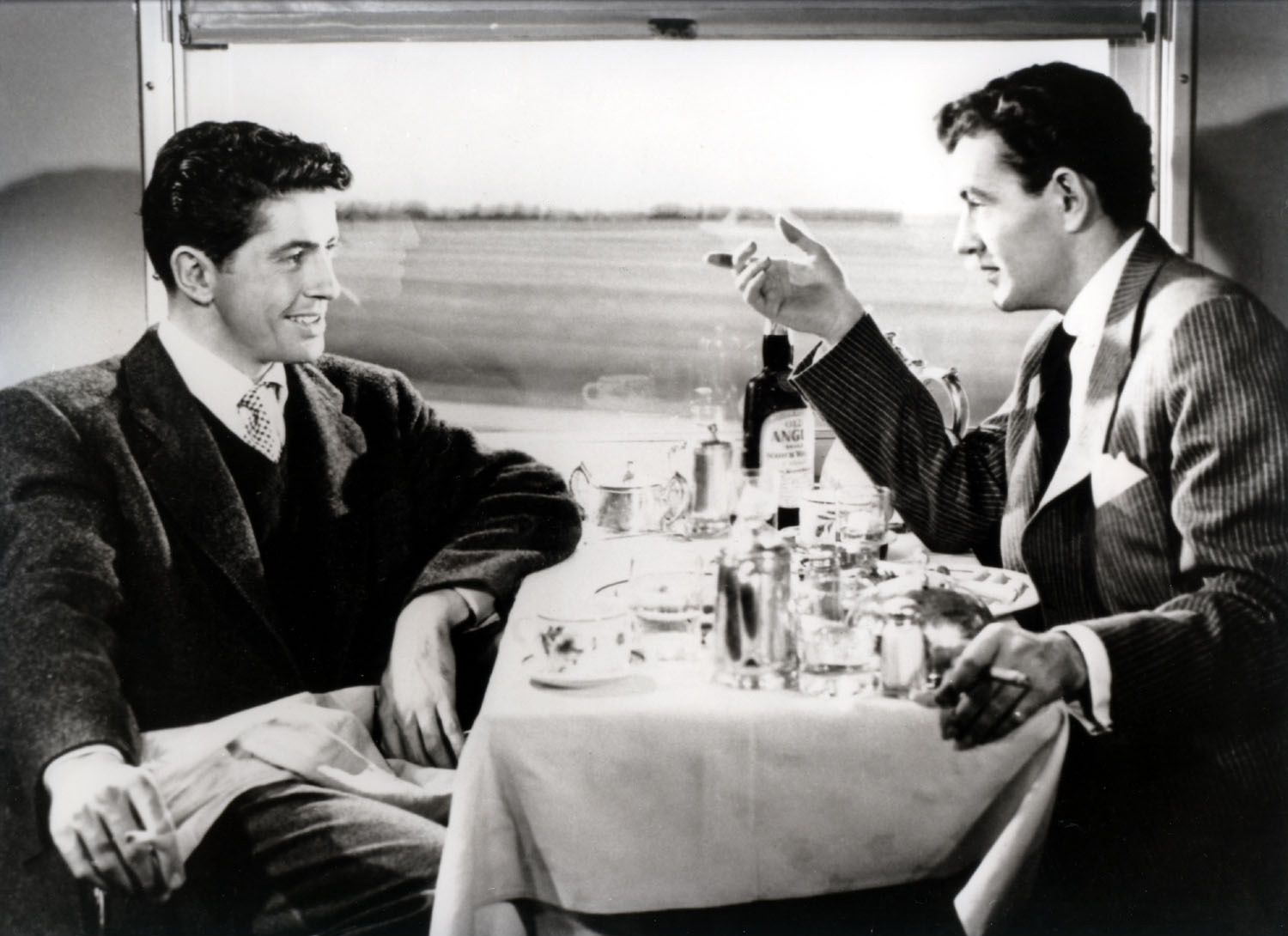
Yes, I'm a really big Hitchcock fan. Strangers on a Train was adapted from Patricia Highsmith's novel of the same name. Highsmith of course was the creator of Tom Ripley, the brilliant psychopath of The Talented Mr. Ripley and subsequent novels. Strangers on a Train another film that explored Hitchcock's favourite theme of the wrong man. Guy Haines is a tennis player who meets a man named Bruno Antony on a train. Bruno recognises Guy and knows about his troubled marriage to Miriam (Laura Elliott). Bruno hates his own father and proposes to Guy the idea of a murder swap. Two people murder someone for each other, thus there's no motive for the crimes. Guy thinks Bruno is joking and plays along but Bruno thinks Guy is agreeing the plan. Bruno kills Miriam, which makes Guy a suspect. Now Bruno wants Guy to murder Bruno's father.
Bruno is one of Hitchcock's great villains, someone that is both to be pitied but who is also frightening. What makes Bruno so sinister how sincere and friendly he seems. Walker never plays Bruno as a villain. Sadly Walker would die shortly after the film was released at the age of 32- this was due to an adverse reaction to prescription drugs.
Granger, whom Hitchcock had previously cast in Rope (1948) brings both sensitivity and darkness to his portrayal of Guy. While Guy is innocent of murder we see he's not too far from being pushed over the edge.
The film is full of vintage Hitchcock visuals. The most famous is the murder of Miriam seen through her glasses on the ground. Then there's the shot of Bruno amongst the audience watching the tennis match. Everyone's heads are going back and forth but Bruno is staring at Guy. Hitchcock made it all look effortless which is why I think he was often unfortunately seen as merely an entertainer but not an artist.
The Wrong Man
Oh my God, I know, another Hitchcock. The 50s was a great period Hitchcock. It makes sense that Hitchcock would eventually make a film entitled The Wrong Man. As I've mentioned before it was a theme he returned to frequently. In the case of this film Hitchcock was inspired by a true story. Christopher "Manny" Balestero (Henry Fonda) is a New York club jazz player. He and his wife Rose (Vera Miles) are having money problems but they are very much in love. When Manny goes in the insurance office to take out a loan he is falsely identified as the man who twice had held up the office. The police have Manny walk in to a deli and liqour store, both which had also robbed. The owners- like the clerks at the insurance office- identify Manny. Manny being falsely accused weighs heavily on Rose. She blames herself for Manny's arrest and suffers a nervous breakdown.
I would argue The Wrong Man is Hitchcock's most serious-minded film, particularly in regards to its exploration of the wrong man theme. While he had used this this conceit as the launching point of twisty thrillers, here Hitchcock treats it with a sober sense of realism. The film- with the exception of Fonda's casting- is very un-hollywood. Hitchcock even filmed on actual locations, including an actual prison for the scene where Manny is locked up.
While Fonda's casting is a case of white-washing, it works because of Fond's noble and upright image. Seeing Fonda treated so ignobly adds to the film's power. Miles is devastating as she shows us Rose's breakdown. Rose eventually recovered and she, Manny and their children moved to Florida. Miles was to play Madeline in Vertigo but she became pregnant. Hitchcock would cast her again as Lila Crane in Psycho, a role she would reprise in the 1983 sequel.
The Wrong Man remains one Hitchcock's most undervalued works in many respects- and one his most mature as well.

Paths of Glory
I don't know if there's a more harrowing anti-war film than Stanley Kubrick's Paths of Glory. One of Kubrick's earlier films, it shows that Kubrick was already a master of camera movement and composition. Kirk Douglas- already a Hollywood heavyweight- put a lot of faith in Kubrick as a director. Douglas gives a sturdy and impassioned performance as Colonel Dax, whom defends three soldiers accused of cowardice during Word War 1 in France. The commanding generals sent the troops to take hold of a German position. It's essentially a suicide mission but they still decide three men must be punished. While Dax pleads for mercy, the three men are executed.
The film is full of righteous anger and Dax's outburst at General Broulard (Adolphe Menjou) is one of the most powerful pieces of acting I've ever seen in a movie. Looking back at Ace in the Hole and Paths of Glory it's a shame Douglas wasn't nominated Oscar nominated for either performance.
This feels like Kubrick's most cynical film. Kubrick is often seen as a cold, emotionless filmmaker who hated humanity. However, Paths of Glory is a deeply humane film that shows us the goodness along with the cruelty of humankind. I believe Paths of Glory was Kubrick's first masterpiece and his most emotionally affecting film.
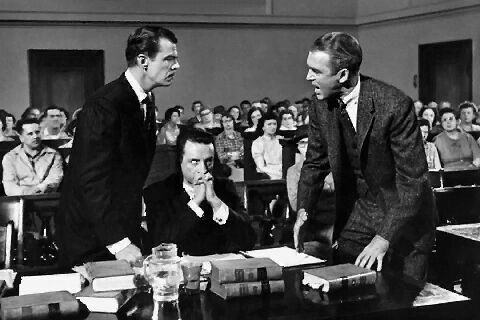
Anatomy of a Murder
Otto Preminger's Anatomy of a Murder is considered to be a very accurate depiction of the justice system. Made two years after 12 Angry Men and Witness For The Prosecution, it may be the best courtroom drama ever made. I don't know if any film in the genre has surpassed it.
The film is based on a novel by John D. Voelker (writing under the pen name Robert Traver) who was a Michigan Supreme Court Judge, and inspired by a trial in which Voelker was the defence attorney. Jimmy Stewart plays small-town lawyer Paul Biegler who lost the re-election bid for District Attorney. Biegler becomes the defence attorney for Lieutenant Frederick "Manny" Manion (Ben Gazzara), who murdered innkeeper Bernard "Barney" Quill, whom Manny says raped his wife Laura (Lee Remick). Biegler plans his defence around Mannie being temporarily insane.
George C. Scott plays Claude Dancer, who has been brought in to help the prosecution. Scott's performance is perhaps the most vicious and smug depiction of a lawyer on film. Both Scott and Stewart would be Oscar nominated for their performances- Best Supporting Actor and Best Actor respectively- though Hugh Griffith and Charlton Heston would win in those respective categories for their performances in Ben-Hur.
What I admire about Anatomy of a Murder is it has no heroes. Biegler is manipulative and twists the facts to fit his case. In this regard Anatomy of a Murder is the most unsentimental honest depiction of the trial system. For Biegler and Dancer it's all about winning.
Ruthless material like this needs a ruthless director, which is why Preminger, who was known for being notoriously rough on actors, was perfect. Wendell Mayes' screenplay balances the personal scenes with the courtroom scenes, giving enough weight to both arenas. The film was very controversial for its frank discussion of rape and the use of the word "panties." While this dialogue is tame by today's standards, the film was an important taboo breaking landmark.
Some other favourites: The 400 Blows, The Band Wagon, Roman Holiday, Sabrina, Seven Samurai, Smiles of a Summer's Night Some Like It Hot.


