Friday, 9 October 2026

The Essemtial Films: "East of Eden" (1955)


A series of writings on films that I feel are essential for film lovers, coupled with films that are important to me. Spoilers for those who haven't seen the film.

Seeing James Dean in Elia Kazan's East of Eden, Dean's first role of only three movies before his death at 24, I can't help but wish we could've had 5 more movies with this guy, 10, 20, 30, at least just one more. An intensely poignant actor, maybe in large part because of his death, Dean's acting hero was Marlon Brando and like Brando, Dean, in his acting, was attempting something more visceral, internal and unpredictable than what audiences had been accustomed to in regards to screen acting. While there's a debate about whether Dean matched or could've matched Brando's greatness I think there was definitely something there in Dean. He has an peculiar quality as an actor, quirky and mysterious, in on a private joke with himself but still incredibly sincere. Dean's unpredictability, even improvising lines in his scenes with Raymond Massey, who plays Dean's pious and stern father, didn't go over well with Massey who came to despise Dean. Kazan, being of sort of "Method Director," liked actors having the same off screen relationship they did on and encouraged Dean to antagonize Massey.  Of the relationship between Dean and Massey, Kazan said

 He simply couldn't stand the sight of the kid, dreaded every day he worked with him. "You never            know what he's going to say or do!" Ray said. "Make him read the lines the way they're written."        Jimmy knew that Ray was scornful of him, and he responded with sullenness he didn't cover. This was  an antagonism I didn't try to heal; I aggravated it. I'm ashamed to say- well not ashamed; everything  goes n directing a movie- I didn't conceal from Jimmy or Ray what they thought of each other, made    it  plain to each of them. The screen was alive with precisely what I wanted; they detested each                other. Casting should tell the story of a film without words; this casting did. It was a problem that         went  on to the end, and I made uses of it until the end.

In the film Dean plays Cal Trask, the teenage son of farmer Adam Trask (Massey.), living in 1914 Salinas. Since they were children Cal and his brother Aron (Richard Davalos) believed their mother to be deceased. By film's beginning Cal has discovered his mother may be the the nearby town's "madam," operating a brothel out of bar-Kate (Jo Van Fleet.) Aron has an easier relationship with his father, him being the more responsible and level-headed of the brothers. Cal is more wayward and unruly, frustrating Adam, whom, as I mentioned earlier, is very pious. Cal begins to emphasize with Adam's dream of a refrigerated long-haul vegetable shipping expedition, which ends disastrously, costing Adam his fortune, to which Cal plans to pay him back through the bean growing business. The upcoming war will skyrocket the prices, making Cal a war profiteer.

Based on John Steinbeck's sprawling novel, the film takes the last third of the novel, relegating the relationship of Adam and Kate to offscreen backstory. Kazan did this largely because he wasn't interested in the earlier parts of the novel. It's believed Kazan's own troubled relationship with his father led to focus on the father-son dynamic. Kazan was also occupied with the idea of dramatic unity and adhered to screenwriter John Howard Lawson's theory that unity came from climax. In 1933 Lawson had helped form the Screen Writers' Guild and was one of the "Hollywood Ten," the initial group of Hollywood filmmakers asked to testify in regards to communist influence in Hollywood. They refused to testify and were blacklisted. Lawson wrote- uncredited- the script for Cry The Beloved Country and then to turned to scholarship, teaching at California universities. He was never "unblacklisted" and of course we know this ties in to Kazan's own personal and professional life. But more on that later. 

Steinbeck had written the screenplay for Kazan's Viva Zapata!, which chronicles the Mexican revolutionary Emiliano Zapata, played by Brando. Kazan and Steinbeck worked on a treatment for East of Eden  but in a letter to Steinbeck, Kazan outlined how he felt another screenwriter was needed to properly give proper dramatic life and stricture to the screenplay. Kazan felt Viva Zapata! didn't quite work, and believed those problems started on the page. He suggested Bob Ardrey or Paul Osborn (who eventually wrote the script). It was also in this letter that Kazan put forward the idea centralizing Cal even more. 

It was Osborn who actually recommended Dean to Kazan. Dean had played an Arab boy in a production of Andre Gide's The Immoralist. Kazan had told Jack Warner, head of Warner Bros. at the time, that he wanted to go with an unknown for Cal, to which Warner obliged. In an interview with George Stevens, Jr. 20 years later, Kazan said Warner probably wouldn't do that now, adding that no one would. Having an unknown quality immediately makes Cal more enticing, even now with Dean's legendary status. It was the beginning of the legend.  We're thrown in to the story and automatically something's clearly different and off about this boy. Why is he following this woman? By starting later in the story does create a sense of ambiguity regarding who the Cal character is and who this woman is in relationship to him. It also allows us to be more in Cal's headspace. We, like him, are entranced and curious about who this woman is.

Dean wasn't consistent as an actor, with Kazan saying "Jimmy would either get the scene immediately, without any detailed direction- that was 95 percent of the time- or he couldn't get it at all."  Kazan felt Dean "had the most natural talent after Brando" but he didn't  have technique or training and couldn't play outside his range. Despite criticisms labelled at Dean that he was just imitating Brando Kazan didn't feel they were comparable: "Dean was a cripple, anyway, inside- he was not like Brando. People compared them but there was no similarity. He was a far, far, sicker kid. And Brando's not sick, he's just troubled."

Dean's lack of training or technique ends up being a boon of sorts, maybe a double-edged boon. His offbeat-ness contrasts decidedly well with the other actors, making Cal feel all the more unusual compared to everyone else. I would argue Dean's performance brings the movie to life in a way a more experienced or refined actor wouldn't have. On the DVD/Blu Ray commentary, the late Time Magazine film critic Richard Schickel says Dean's best scenes are with Julie Harris, who plays Abra, who's dating Aron but begins to become attracted to Cal. Schickel says these scenes with Harris show Dean as less mannered than the rest of the film. Harris has a maturity as an actress that counterbalances Dean's moodiness. We see the good in Cal through her eyes. 

The question of who is good and bad runs through the film. Cal tells Kate Aron is good like the father, whereas Cal is bad like the mother. When Cal asks Adam what his mother was like, if she was bad, Adam responds by saying she was lacking in kindness and compassion, hateful towards everyone. In her short screentime Fleet- in her film debut that won her the Best Supporting Actress Oscar- makes Kate the most compelling and unusual character outside of Cal, a sardonic, bitter woman full of pride and independence. When Cal asks her why she left she says it was because Adam tried to hold her down, and no one holds her down.

Cal pays back his father, which is good, but does so through war profiteering, which Adam vehemently disagrees with, refusing the money. Cal's reaction to Adam's rejection is one Dean's most unusual acting choices, though one that highlights Cal's continuing immaturity. Brando was considered for the role of Cal but was considered too old.  The same goes for Montgomery Clift being considered for Aron. Paul Newman was also a finalist for Cal. If Brando and Clift were 10-15 years younger they'd probably be perfect but I agree they were too old. Coming off On the Waterfront, it would've been weird Brando playing a teenager. I can see Newman- again, if he was 10 years younger- doing it. He likely plays up the bitterness and resentment even more. I often wonder if Dean takes some of those prime Newman roles if he had lived. Dean was supposed to star in Someone Up There Likes Me before his death, with Newman taking over

Clift likely makes Aron more memorable than Davalos though in general Aron feels underdeveloped and without texture. To be fair, Aron is a difficult character to work with because he acts primarily as the good son to Cal's "bad" son and just maybe isn't that interesting. 

 Kazan is one of the most important and controversial figures in 20th Century film, heralded for contributions to both the art of theatre and film, despised for his naming of names in front of HUAC in the 1950s. When he received an honorary Oscar in 1999, many refused to stand and clap. Regardless of his actions the continuing relevancy, impact and influence of his work cannot be denied. Brando's early impact is hard to separate from his work with Kazan  Aside from The Godfather, Brando's most iconic works came from his work with Kazan. He was directed by Kazan both on stage and on film with A Streetcar Named Desire, and my favourite performance of Brando is in Kazan's On the Waterfront, which I think is Kazan's masterpiece. His granddaughter, Zoe Kazan, wrote the new East of Eden miniseries on Netflix.

On the commentary, Schickel remarks that while Kazan was never considered a great visual stylist by critics, he did master the early Cinemascope format. Cinemascope was still in its infancy and East of Eden was Kazan's first film in the format, as well as hiss first film in colour . The film is the closest I think Kazan got to making an epic feeling kind of film on a visual level. On an more intimae level, one of the shots that stands out the most to me is the hallway to Kate's office in the back of the bar.


It represents the darker world Cal is entering, the part of his life that's been kept in the shadows, hidden by his father. Kazan's use of canted ("Dutch") angles don't completely work but they show Kazan taking a chance with something more expressionistic. similar to how in On the Waterfront, Kazan blends the docudrama and noir style. 

Ted McCord shot East of Eden but almost backed out because he had never shot in CinemaScope before. Kazan told him this is why he wanted him, because he had no preconceived notions of about the format and Kazan wanted McCord to use his imagination. Kazan didn't want any kind of "formula." The tilted angles were a first for CinemaScope, which as a format was largely used to draw audiences from TV back to the movie theatre. In an American Cinematographer article back when the film was released, the use of canted angles and the approach to it was described:

Perhaps the most startling innovation is the way he tilted or angled the CinemaScope camera in order to achieve a more compelling composition when shooting the dramatic scene where the father is having a heart-to-heart talk with his troublesome son, Cal. The two are seated at the family dining room table — the father at the far end, and son at the side, in left foreground. To bring the two dramatically into prominence in a tight, widescreen closeup, McCord moved his camera around to place the table diagonally in the CinemaScope frame, then tilted the camera to one side so that the wide rectangular area of the CinemaScope frame would tightly fit the composition. In this way, the father was given visual dominance in the scene that could not have been accomplished in any other way. It is something that never before had been tried with the CinemaScope camera, undoubtedly because of the ultra widescreen format. McCord’s imaginative treatment here sets a pattern sure to be followed by others. 

Kazan described himself  as a poetic realist or "essentialist." Kazan's film combine gritty social realism and method style acting with something others have called lyrical. As a visual stylist I think he's somewhat underappreciated, maybe largely because his films are often remembered so much because of their performances. But On the Waterfront, East of Eden and Wild River are visually alive films with a great sense of place, people and feeling.

Talking to Stevens, Kazan said he felt East of Eden was the closest to perfect of all his films. As with Dean, there's an unfilled sense of greatness about. It is great but also maybe doesn't completely live up to what it could be. Maybe it needed to be longer and tell more of the book's story, I don't know. I do love its final moments: Adam has had a stroke after Aron has had a mental breakdown after discovering who his mother is and goes off to war. Cal was so jealous he broke his brother mentally. But now he dedicates himself to caring for his father. For all the bad, Cal ends the story being good. He sits in a chair in his father's bedroom, with Abra leaving them together. The music swells and punches, and we fade to black. Dean would die six months later but on screen Cal lives on, grows maybe to old age. That's the beauty of film- actors live on even after they're gone.  

Friday, 26 June 2026

"Disclosure Day"


Warning: Spoilers Below

Throughout his career Steven Spielberg has explored the UFO subgenre through various angles. In Close Encounters of the Third Kind he approached the material through the prism of one man's obsession and the breaking down of the family unit; in E.T. it was a coming of age story. He made H.G. Wells' War of the Worlds in to a 9/11 allegory that was as terrifying as Orson Welles' famous 1938 broadcast. With the fourth Indiana Jones movie, Indiana Jones and the Kingdom of the Crystal Skull, he took the 1950s B movie approach to the material, though obviously that foundation was laid by George Lucas. In his newest foray in to his genre, Disclosure Day, it's all about truth and faith. How would peoples' faith in religion and God be shaken by the revelation of aliens, and who gets to decide if the truth should be revealed; should we be treated as children who can't handle the truth and need to lied to by our parents? We of course live in a post-truth world, where "alternative facts" matter as much as objective reality. Trump and his supporters will lie to your face and call you deranged for pointing out what an imbecile and clown (apologies to clowns) he is. Spielberg suggests truth should win out over comfort. Though he's often seen as giving the audience too much comfort rather than challenging or upsetting the viewer, and he perhaps perhaps needed to push and expand upon its ideas, Disclosure Day has potentially one of the most provocative endings of his career.

Disclosure Day feels like the spiritual cousin of Close Encounters. One can feel the spirit of Richard Dreyfuss's Roy Neary in Daniel Kellner (Josh O'Connor) and meteorologist Margaret Fairchild (Emily Blunt). Like Roy, Margaret has something unlocked within her after an encounter with an alien (appearing in the form of a bird). She begins speaking other languages, including an alien one which she speaks live on air. She's also able read minds and while Roy had images of Devil's Tower in Close Encounters, she sees images of Daniel, formally charge keeping government secrets regarding aliens safe but now on the run with proof of their existence. And weirdly, though definitely not coincidentally, Daniel is also able to understand the alien language Margaret is speaking

David Koepp's script begins on a run, pretty much skipping the usual first act stuff and beginning with Daniel already on the run being chased by the shady government unit Wardex and its head, Noah Scanlon (Colin Firth).  As several people have pointed out the film never does the "Five days earlier" thing, we're just expected to play catch up and pay attention. Koepp's script pulls this trick where it skips the first act but still does the first act thing of establishing this bigger conflict then introducing he normal person in to the mix, who is Margaret, which ends establishing her as the main character, more so than Daniel. Like Close Encounters with Roy and Melinda Dillon's Jillian, the story takes its time getting these together, making it more satisfying when these two pieces of the story fit together. We eventually learn both of them were experimented on when they were children, though it's never clear why they were picked by the aliens, other than they're the main characters. Daniel's ability 

Looking over Koepp's filmography, he's done quite a few films I really like, including Brian De Palma's Snake Eyes and the first Mission: Impossible, also directed by De Palma. He's probably best known for writing Jurassic Park and I also feel War of the Worlds is an underrated Spielberg film. Secret Window, which Koepp also directed is also an underappreciated gem. Koepp is adept at structurally his scripts quite elegantly and I actually think Disclosure Day is one of the better structured and paced blockbusters of the modern era. Spielberg and Lucas often get blamed for the blockbusterization of American cinema. Not only would I argue that's more the studios' fault than the two filmmakers, I'd say Spielberg's blockbusters, regardless of how challenging they should be vs. what they aren't, provides a human touch that is often absent in more recent blockbusters. There's also a level of craftsmanship that can't really be denied. Spielberg has always been really good at understanding the appeal of movies and how to make them work on an emotional level. 

Margaret, I think, embodies exactly what a Spielberg often is- funny, sad, melancholic, and very earnest.  This is probably the most I've liked Blunt in a movie. I don't know if she's always been the most exciting actress but she's really wonderful. Like Daniel, she has a partner who questions her journey (this being her boyfriend Jackson, played by Wyatt Russell). Russell is one of those actors who's able to be both likable but is also believable as kind of dismissive guy who doesn't completely emphasize with what Margaret is going through. I love she is pulled over by a cop and through her psychic powers, we learn more about this character then we would've have in an ordinary drama. Blunt conveys the overwhelming feeling of seeing and feeling everything about this man. 

Daniel is positioned as a guy with good intentions but is also someone who, like Scanlon and Wardex, making a choice for everyone else. His love interest Jane (Eve Hewson), who is a former Nun, brings forth the question of how revealing the existence of aliens will affect peoples' faith. Spielberg's films are often about belief in something beyond the material, seemingly rational world. The Indiana Jones movies always have Jones doubt in the supernatural but is ultimately always proven wrong. Disclosure Day doesn't cement a supernatural being existing but puts forward the idea- stated by an older Nun character, that it'd be weird for a God to create such a vast universe just for us. However, the film suggests we shouldn't embrace Messiah figures-- as her powers emerge Margaret outright rejects being viewed as a messiah. The aliens are positioned less as deities in Spielberg's film then they are something hat provokes awe and wonderful while not being inherently superior or necessarily above understanding This makes him the opposite of Kubrick in 2001: A Space Odyssey, which hypothesis that our evolution and future is largely determined by an unknowable alien species.  

 There's no really winning when it comes to the film's conflict. Scanlon and Daniel both have their reasons for hiding or revealing the biggest truth humanity may ever face. And Scanlon says, there's no reset key if Daniel reveals the truth. I wish Daniel was challenged even further then he is, and O'Connor, while he brings the proper earnestness to Daniel, the problem is Daniel is given the proper grit and hauntedness that I think the character needs. Admittedly, I've already kind of forgotten his backstory. Hewson is appealing but again, I don't feel we get enough of her as a character.

The film also never figures out what to down with Scanlon as a villain. The idea of his using alien tech t invade Janes' mind is a good and creates some tension, but it feels he doesn't get to be as dynamic given the chase-thriller aspect of this film. He's ultimately less of a villain then just some guy, and maybe that's the point. His relationship with Wardex whistleblower Hugo Wakefield (Colman Domingo) gives Scanlon some proper humanity, and when Margaret is able to appear to others as their loved ones, she appears to Scanlon as his deceased wife, whose death, Hugo, suggests, cut Scanlon off from people emotionally.

It can sometimes feel like the ideas of the film are talked about more than explored, including the conversation between Scanlon and Hugo, where Domingo has to use his natural charisma to sell the more philosophical dialogue. I know I'm starting to sound a little more down on the film than I planned to. I actually overall quite liked the film, largely because its old-school Spielberg feel, which transposes what he did in the later 70s and 80s to 2026. This ends up making Disclosure Day feeling less like a 2026 blockbuster, or at least not like any other blockbuster of this era, then something that feels like it's pushing the blockbuster both towards and back to something more pure and cynical. Like Close Encounters represented something more optimistic for the cynical times of the 70s, the same as Star Wars, which came out the same year, Disclosure Day is perhaps a represents something more optimistic for the post-truth Trumpian era. What better to unite us then the suggestion we are not alone, that out there there's something so much bigger than us. It make all our petty squabbles appear so insignificant. Spielberg was in his early 30s when he made Close Encounters, ending it on a more whimsical note. Almost 80, and with more life experience, Spielberg ends this film on a more sober note, a plea to listen. Hopefully the audience will. 

Thursday, 18 December 2025

For England?: 30 Years of "GoldenEye"


It's crazy we're as far removed from GoldenEye, released this fall back in 1995, as that film was from 1965's Thunderball. Even when I was younger in the 90s, those 60s Sean Connery films already felt like relics from a bygone age. I don't think GoldenEye would feel as much like a time piece to Gen Z or Gen Alpha the way the Connery films did when I was growing up; it still probably acts as a perfect gateway in to the Bond franchise. It was mine and admittedly I didn't exactly love the older Bond films when I initially saw them- probably because they weren't GoldenEye and it took me a while to get used to older films.

I also can't help but remember that I'm about the same age as my mother when Goldeneye was released. I'm about to turn 37 in February and she was 37 when she took me to see my first Bond in theatres, The World is Not Enough and that is a little weird. Your parents seem so much older when you're younger and when you hit their age when you were a kid, you realize young they were. My mother was a single mother and I can't imagine raising a kid on my own. 

GoldenEye was the first Bond released in over 6 years, the last one coming out when I was a baby in 1989, that film being Timothy Dalton's second and last Bond film, Licence to Kill. It wasn't a huge it at the box office, coming out the same summer as Tim Burton's original Batman, Lethal Weapon 2, Ghostbusters II, and Indiana Jones and the Last Crusade. It would end up being the last Bond film released in the summer. Behind the scenes legal issues would delay a third Dalton film until 1994, but by that time Dalton had decided to quit. Pierce Brosnan, who was supposed to take over from Roger Moore in The Living Daylights but was replaced when his contract for the TV show Remington Steele was renewed and Bond producer Albert R. Broccoli didn't want Brosnan doing both, was chosen as Dalton's replacement. 

GoldenEye was originally written for Dalton and it's one of the sizable what ifs of the Bond franchise, along with what if George Lazenby continued on in the role. Okay, maybe not as sizable as that, but still pretty sizable. As much as I like Dalton and I think he would've killed certain moments, I don't know if Goldeneye is as big of a deal if Dalton comes back. He wasn't the most popular Bond in his time, even though he gained a following. I think Brosnan got a lot oof people excited when he finally got to take over the role, and he became the Bond for mu generation.  

Brosnan was the first actor to come of age with the franchise, citing seeing Goldfinger as having a huge influence on him. His portrayal of Bond is often seen as an amalgamation of the previous Bonds, and just as often he's negatively seen as not being different enough from the other Bonds. But I'd argue what Brosnan is doing is harder than it looks. He has to be both down to business as a spy but still pull of the humour, as well be convincing in the more tender scenes with Natalya Simonova (Izabella Scorupco). Personally, I feel Brosnan pulls it really well, though I think he gets even more comfortable in the part as he goes along. Was he a safe choice for Bond? Sure, especially when he's placed in between Dalton and Craig, two bolder choices. But I think Brosnan is probably the coziest Bond next to Roger Moore. 

We fans take it for granted but from 1962 until 1989 there was only a two year to at the most a three year gap between Bond films. People were never given the chance to miss the franchise. That, and there was so much competition from other franchises, like Indiana Jones and action films like Die Hard, Batman and Lethal Weapon. Before Star Wars, Bond was kind of the pinnacle of cinematic escapism and excitement, and even Bond can feel passe compared to other franchises, and I feel Bond 26 has the potential to make Bond exciting again, the way GoldenEye did. The six year gap from 1989 to 1995 gave the franchise the opportunity to feel fresh again, with new writers, a new director (Martin Campbell took over from John Glen who had directed the last five films in the series), and again, a new actor who would appeal to both old and new fans. 

Aesthetically, there's a big jump from Licence to Kill to GoldenEye. If the 1980s Bond films are often criticized for being TV movieish, from the very first shot GoldenEye feels more wildly cinematic. It also has a stronger sense of mood and place. Campbell and cinematographer Phil Meheux create a more shadowy and atmospheric film, a film that's haunted the ghosts of the Cold War.  It feels like a more lived-in world of spies and espionage, vibing like an actual spy film in a way the Bond films usually don't. The film's aesthetics are complimented by Eric Serra's industrial score, with also has its moments that can't help but create a certain amount of nostalgia in me. I know Serra's score is somewhat controversial and not well liked by some. Maybe because I grew up with this movie and the score is ingrained in me that I've never had a problem with it. I get it's not the typical score that was defined by John Barry as the Bond sound but it's a sizable part of what gives the film its singular identity in the franchise (David Arnold would score the next five films) and for me it sounds as much "Bond" as the Barry stuff. And Tina Turner's theme song does feel indebted to the classic Bond songs of Shirley Bassey and remains one of the more underrated songs in the franchise

GoldenEye was the first Bond film made after the fall of the Berlin Wall and the end of the Cold War, and this is strongly reflected in the film's story and vibes. As I said earlier, The ghosts of the Cold War haunt this film, with one sequence taking place in a graveyard where Bond meets a literal ghost from his past, Alec Trevelyan, former 006, who fakes his death at the beginning of the film and is the villain behind the stealing of the titular GoldenEye satellite, planning to send England back to the "stone age" in revenge for England's betrayal of the Leinz Cossacks after WWII, which led Trevelyan's father to the murder of his mother and then suicide. Trevelyan was the first time the series attempted a sympathetic villain, and making him a former ally of Bond (another first) just makes him doubly interesting. I don't love a lot of the main Bond villains but Trevelyan is my favourite, I think largely due to Sean Bean's performance. It's those line readings, right. They're so good. Bean supposedly did audition for Bond and casting a would-be Bond as Bond's dark twisted mirror is kind of perfect. And if the previous film, Licence to Kill saw Bond going rogue avenging his friend, GoldenEye sees Bond on a mission where he has to eliminate a friend. 


The big meta-narrative of GoldenEye is how the world has changed and Bond is a relic of the past. Bond's boss, M, is now a woman (Judi Dench in her debut in the role), who calls him out for being a "sexist, misogynist dinosaur." Bond is a difficult character to grapple with because he originated in the 50s, and unlike superheroes like Superman and Batman are easy to adapt modern times, Bond often does feels stuck in the past. His womanizing and sexism feel like it's hard to separate from the character without making him completely different. However you do have to call it out. Natalya also calls out Bond on his emotional detachment in perhaps the film's most pivotal scene, though because it's a Bond she still winds up in bed with him after. That's always going to be a problem when franchises do the self-critique thing.  There's always limit to how much you can do it because you ultimately still embrace what makes the franchise the franchise, and also you still have to making the movies.

Natalya may be my favourite Bond woman. I like that she feels like a real person who's been swept up in to a Bond adventure. It's often pointed out she's as much a main character as Bond and we spend quite a bit of time with her before she meets Bond and she's given her motivation and backstory. We sympathize with her due to her witnessing the murder of her colleagues during the stealing of the GoldenEye. While her romance with Bond could feel forced Brosnan and Scorupco make the affection between Bond and Natalya surprisingly real. Natalya never comes across as just automatically falling for Bond because he's Bond. There's certain efficiency in how the script brings Bond and Natalya believability together emotionally by sending them through a pretty tense series of events. It ends up being one of the series' most likable relationships. I remember being disappointed that she wasn't back in Tomorrow Never Dies, but this was before I understood the formula Bond series. Sadly, Bond's relationships don't last.

GoldenEye may have the best ensemble cast of all the Bond films. We remember this film not just because of Bond but of the supporting characters. Tchecky Karyo is only in this film for a few minutes as Defense Minister Dmitri Mishkin but he has such a strong presence you forget how little he actually is in this film. Robbie Coltrane may be Hagrid to many but I always think of him as Valentin Zukovsky, the ext-KGB agent whose knee "aches every day, twice as bad when it's cold." Gottfreid John and Alan Cumming as General Ouromov and Boris Grishenko, respectively, are perfectly slimy in their roles, I would say pretty much all the villains in this film are perfectly deserving of their comeuppances. 

All of the Brosnan films provided personal stakes for Bond and despite the finale's large scale backdrop, the story all comes down to a pretty brutal fight between Bond and Trevelyan.  Trevelyan's demise is probably the best of any Bond villain: Bond drops him from the satellite, responding to Trevelyan's "For England, James?" which he's said to Bond throughout the film,  with "No. For me." Trevelyan always thought Bond cared more about the mission than his friend, which is ironic considering the previous film, but at the end Bond makes it clear he did care about the friendship enough to feel betrayed. Bond wants Trevelyan to know this isn't just about the mission, it's personal. 


Campell had a magic touch when he directed GoldenEye and later, Casino Royale, the first Daniel Craig film. He's able to find the balance of seriousness and fun that I think the Craig films struggled with post Casino Royale. GoldenEye has dramatic weight to it but it's still giving the audience a good time with enough Bondian humour and a sense of escapism. Xenia Onatopp (Famke Janssen) is a campy villain but she surprisingly never unbalances the more serious elements. Denis Villenueve is directing the next film in the franchise and his films are pretty heavy. I would hope he would find he balance between seriousness and humour that the franchise is at its best when it nails the juggling act.

The film owes something to Dalton but Skyfall also owes a lot to it. That film is also commenting the relevance of Bond in the modern world, as well as having a villain who's a mirror to Bond. Skyfall also takes from Brosnan's third, The World is Not Enough, where the villain wants revenge against M. Brosnan is the more archetypal Bond between Dalton and Craig, who are spiritually connected, but the Dalton and Brosnan eras set the stage for Craig.

GoldenEye is the most important Bond film of my life, and I hope it's that important for the younger generation getting in to the franchise. It's kind of a perfect gateway in to this world, so here's to 30 years and to another 30 more. Thanks Martin Campbell and Pierce Brosnan for making me a life long Bond fan.

Thursday, 21 August 2025

Why Do We Fall?: 20 Years of Batman Begins


Spoilers below

The Batman film franchise, barring the 1940s serials and the 1966 Adam West movie based on the  TV series, began with Tim Burton's 1989 Batman, released a little over a decade after the original Christopher Reeve Superman opened the doors for all future superhero adaptations. The Burton films were attempt to present a darker, more gothic vision of the dark knight, akin to Frank Miller's Year One and The Dark Knight Returns than the West show. When Batman Returns, the follow-up to Burton's original, where he had more creative control, was met with outcries from parents for being too dark and violent, as well as MacDonald's cutting its Happy Meal deal with Warner Bros. for the same reasons, the studio decided to go in a more kid friendly direction, hiring Joel Schumacher to direct the third installment, Batman Forever. The film was a success and Schumacher was tasked with directing the follow-up, Batman & Robin. To quote George Lucas watching the rough cut of Phantom Menace's climax, Schumacher may have gone a little too far in some places. Schumacher dialed up the camp, and supposedly would say "Remember, it's a cartoon" before yelling action. Ironically, there was a really good Batman cartoon in the 90s that appealed to kids while still being mature and character driven. 

While Schumacher was originally slated to direct a third film, Batman Triumphant, which may have starred Nicolas Cage as the Scarecrow and Madonna as Harley Quinn (except retconned in to being the Joker's daughter), it never came to fruition. Appropriately for a film starring Mr. Freeze, Batman & Robin put the franchise on ice for several years. It wouldn't be until 2005 that we saw the caped crusader again, except this time it wouldn't just be another film in a franchise, but a film that reinvented the whole idea of the Batman franchise, creating something more psychological and character-driven that had been done in the live action films. This was Christopher Nolan's Batman Begins.. At this point in his career Nolan wasn't yet the blockbuster auteur he would become with The Dark Knight and Inception. He was still very much the indie filmmaker making his first blockbuster. The film feels modest compared to the second and third and film in the trilogy but it also feels the most like a stright forward Batman film. 

Burton's approach to Batman was enigmatic and mysterious, while Nolan and Goyer's is internal and personal. Batman Forever tried to be a little more character driven, most of Val Kilmer's arc as Bruce was exorcised in that film. To be fair, those previous 4 films were more interested in the villains than Batman. And I get why- they're often more colorful and entertaining than him. But I appreciate Nolan and Goyer zeroing in on Bruce and Batman essentially giving us the full of arc of Bruce becoming Batman. To get us more in to Bruce's head, Goyer's script employs a flashback structure, beginning with this nightmare Bruce is having of the time when he was a child and fell in to a pit of bats. We then jump to Bruce waking up in prison. In the years since his parents were murdered during a mugging, Bruce has traveled the world learning the ways of criminals, but has completely lost himself in that life. But then a man named Henri Ducard (Liam Neeson) gives him a chance to train under Ra's Al Ghul (Ken Watanabe) and become part of the League of Shadows. As he trains with Ducard we get more flashbacks of Bruce's life before leaving Gotham, including the moment where he about to kill Joe Chill, his parents' murderer, before he is murdered for being a informer by one of mobster's Carmine Falcone's (Tom Wilkinson) cronies. After being given a stern lecture on justice vs. revenge by childhood friend, now lawyer, Rachel Dawes (Katie Holmes), he begins his journey in to the criminal underworld.

Nolan and Goyer don't just use the murder of Bruce's parents as a set up for a completely sepearate story but use is as the film's thematic crux. Joe Chill only existed because of the economic depression, leading to financial desperation in men like him. While the murder of the wealthy Waynes supposedly urged Gotham to pull itself out of this depression Rachel points out that things haven't really gotten better. Gotham is full of corruption and is run by Falcone. And essentially this corruption and decadence fuels Ghul's motivation to destroy Gotham.

Nolan and Goyer trust the audience to wait awhile for Bruce to don the cowl. They knew they had to make Bruce a compelling enough figure our of the suit that audiences wouldn't be impatient getting to  Batman stuff. I think the reason why this approach ended up working for audiences is due to Nolan and Goyer approaching this material with a certain kind of seriousness and earnestness. From very beginning the film plays out as a straight drama rather than a comic-book movie, though I feel of the trilogy this one feels the most a straight-up Batman movie. Ultimately, the film encourages the audience to engage with the narrative on a character and thematic level rather than just pure entertainment. I do hate when people say Nolan was embarrassed to be doing a comic-book movie since I feel it's the opposite. Nolan obviously thought there was something more to this material then silly pulpiness. He saw something mythic and compelling this character. He of course had to strip down some of the fantasy in order to do the story he wanted, but I like when these films have a specific vision. And to be fair, this is still a pretty pulpy movie and it has a sense of humour about itself.

Maybe the film's wisest decisions, is forgoing the Joker as the antagonist. Structurally, it just ended up working better for the overarching story of the trilogy. In this one Batman brings hope back to Gotham City and by the beginning of The Dark Knight is very confident in his abilities, and even underestimates the Joker, as does the mob. only for the Joker to completely destroy his whole world. This film's ending is so satisfying, having Lieutenant Gordon (Gary Oldman) giving Batman the Joker's calling card. It's the best sequel set-up of any superhero film, largely because it wasn't designed to be a set-up, but a payoff of the whole story.  

In typical Nolan fashion, he uses the concept of fear both as a plot device and as a larger thematic concept. Ducard (who is revealed to have been the actual Ghul in the third act) wants to use Dr. Jonathan Crane/Scarecrow's (Cillian Murphy) fear toxin against Gotham so it it will tear itself apart. Bruce uses fear (the symbol of the Batman) to invoke a positive change. And Bruce initially blames his fear of bats (he had to leave the opera due to the people in bat costumes) for his parents' death. 

 While I usually really like Neeson, I do find the character, and his performance, a little bit on smug side. It's a big part of why I have a love/hate relationship with this film. I do like that this movie focuses in more on Batman than any of the previous live action films and feels the most like a Batman of Nolan's trilogy, especially in the aesthetic of Gotham. I do wish Nolan was a stronger visual stylist and that his shooting style wasn't always so basic. There's also some janky editing going on in the fight scenes, and the third act just isn't as strong as the first two. Rachel also feels likes she's just there to tell Bruce what he needs to hear, rather than being a fully formed character, though Nolan has often been a stronger idea and conceptual guy and his characters can often feel like mouthpieces for exposition. However, his Dark Knight Trilogy does have some really good character stuff and oddly feels like his most character driven work.

He's not unlike George Lucas, who also struggles with dialogue and character. Lucas' strengths, like Nolan, are in the bigger picture stuff.  But Lucas and Nolan's flaws as directors don't really matter to most people because their films, often seen by people when they're younger, have such a impact on viewers and define a young person's upbringing as a cinephile. 

Superhero movies often get seen as right wing power fantasies, though someone like Stan Lee was always very progressive in his politics. Batman, in particular, gets reduced, maybe fairly or unfairly, to the rich guy who beats up poor people. Nolan also got blowback when The Dark Knight came out when Batman chose to spy on people via cell phone to find the Joker, viewing this as pro Bush and Patriot Act. And in the third film, Tom Hardy's Bane was seen as a criticism of Occupy Wall Street. The Dark Knight does prevent the surveillance stuff as pretty morally dubious and Bane doesn't really represent the ideals of Occupy Wall Street but rather uses the ideology to turn Gotham against itself. Still, Nolan does try to have it both ways with the surveillance technology, presenting it as necessary one time thing before it's destroyed. The ending of The Dark Knight also prevents lying about Harvey Dent's crimes as a necessary evil to keep order. And The Dark Knight Rises does present the ideology of Occupy Wall Street as useful weapon to turn classes against each other. Nolan's politics are thorny but I'd argue it makes the films more interesting, especially compared to the more overt thematic exposition that has probably hurts these films the most on rewatch. 

The key to casting Batman and Bruce Wayne is you don't go for the traditional leading man like George Clooney. You go for someone like Michael Keaton or Val Kilmer. You need some who you can believe dresses up as bat and fights crime. Christian Bale may have gotten himself the role by playing another rich, crazy guy with Patrick Bateman in American Psycho. I think Bale often gets overshadowed in these movies by the more colorful performances but he's good in this initial go around. Bale can sometimes be too actorly and heavy as an actor, but here he doesn't overplay the seriousness but lets it come naturally. He finds the reality in essentially an outlandish character.

While I feel The Dark Knight and The Dark Knight Rises are stronger films formally, I understand why Batman Begins is often seen as the best of the trilogy and many peoples' favourite. It's thematically the tightest and feels the most comfortable being a superhero film. I always wonder the series would've been like if  Nolan had continued on with this aesthetic. So, what are your feelings about Batman Begins? Is this your favourite? Comment and let me know.


Friday, 30 May 2025

Sith Happens: 20 Years of "Revenge of the Sith"


It's interesting how the reception of the Star Wars prequels, particularly the first has so dramatically changed over the 26 years since The Phantom Menace came out in 1999. There was plenty of vitriol and disappointment from fans when the film was released, and Attack of the Clones wasn't beloved either. Revenge of the Sith- released 20 years ago this past month- was the most critically well received, and I think fans were more responsive. But overall these well liked movies. Red Letter Media became famous for their "Mir Plinkett" reviews and I think fans who liked them were in a minority.

But over time, with people my age or younger who saw the prequels when they younger, and gained a presence online, the prequels have gone through a resurgence. It's not unsurprising. There's something incredibly nostalgic about this franchise, a certain magic that makes it different from anything in film history. And it feels like we're in a era where everything not immediately beloved is almost reclaimed automatically. Prequel fans say the sequel trilogy will never be reevaluated but never say never, right.

But as the prequels have become more praised, with many claiming they're masterpieces of cinema, I've gone in the opposite direction, becoming critical and negative towards them, though I don't consider them irredeemably bad. They are intriguing contradictions-grand scale achievements that revolutionized filmmaking, but not really great films on a directing, acting, or screenwriting level. George Lucas's greatest gift as a filmmaker is his unique imagination but I think he struggles with, and maybe is a little bit bored, with the more intimate and human parts of storytelling. Lucas set out to create a Shakespearian/Greek tragedy with back drop concerning the fall of democracy, but he also wanted to revolutionize and experiment with new special effects. He ended up getting lost in the technology and not taking enough time to finetune the story and character beats and overall dramatic and political arc of the story. 

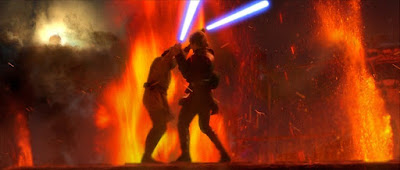
But I understand why for my generation Revenge of the Sith is the Star Wars film. I get it. I can see why at 10 or 12 years of age it blew a lot of peoples' mind in the same way the original films did for the previous generation. The opening action sequence, the lightsaber duels, as well as Obi Wan fighting General Grievous, are really spectacular stuff. Revenge of the Sith is the best of the prequels even though the execution of its stories and themes is still uneven. It has the most dynamic pacing and the strongest overall dramatic arc. In the previous two prequels Lucas was too leisurely in his pacing. In The Phantom Menace in particular we spend an entire act before even getting to Anakin Skywalker. And even then it's not really his story. In Attack of The Clones we get more focus on Anakin and an actual internal struggle, something lacking in Phantom Menace, but in Revenge of the Sith, there's more urgency, and it feels like an actual movie.

At the time Revenge of the Sith was supposed to be the final Star Wars film, bringing the saga full circle back to those twin suns on Tatooine, and a lot was riding on it. As I mentioned, many were disappointed with Phantom Menace and Attack of the Clones and Lucas had to stick the landing on this one. The critical reception was much better this time, with former New York Times critic A.O. Scott calling it better than the original Star Wars, even though he said it made his inner child shudder. And in 2012, critic Camille Paglia called Revenge of the Sith was the greatest work of art of the last 30 years 

Revenge of the Sith is the most streamlined of the prequels but that turns out to be a double edged sword. As I said earlier, Revenge of the Sith feels more urgent compared the first two prequels and has more forward momentum but at the same time it feels almost too compact and rushed. I think the problem, again, lies in Lucas being too leisurely in those first 2 prequels, with Phantom Menace not really being Anakin's story. While most of the necessary pieces are there in the previous films- leaving his mother, not being accepted by the Jedi, the death of his mother, and his love for Padme (Natalie Portman)- something still feels lacking in the development of his arc. For one, Anakin and Padme's lovey story wasn't organically told. However, you can feel Anakin's desperation in wanting to save Padme when he begins having visions of her dying from childbirth. Anakin had visions of his mother dying and wasn't able to save her in time, so it makes he's so determined to prevent this from happening again.

 We also needed see more of Anakin coming to believe the Jedi were corrupt and a genuine threat, turning so violently against them. It's an interesting angle Lucas takes that Palpatine (Ian McDermid) is kind of right about the Jedi. I do sometimes find it hard to know how to take the Jedi in these films, since we don't really get to know them. The Order 66 montage is superb and, again, it makes this film feel more dramatically immediate, but are the Jedi tragic or are they the cause of their own destruction. I guess it's supposed to be both. If we had seen more of Anakin's friendship with the other Jedi, this sequence probably hits even harder. When Anakin tells Obi Wan (Ewan McGregor) that he should've know the Jedi were taking over and from his point of view the Jedi are evil, it doesn't feel completely earned. I guess the point is Anakin isn't thinking straight and is trying to convince himself that what's he doing is right. Still, when  he says he's brough peace and justice to his new Empire, it doesn't really fit with the motivation of trying to save Padme. There is that red flag scene in Attack of the Clones where Anakin talks about the merits of fascism but it's only briefed touched upon and laughed off.


Revenge of the Sith opens pretty well, the strongest of all the prequels' beginning. I like that we see more of the Anakin/Obi Wan friendship then previously, and Anakin feels more like the mature and skilled Jedi that we heard about in the original film. Christensen's acting has gotten a lot of flak over the years but the way Anakin was conceived and written by Lucas, Christensen's acting is kind of fitting. I do wish we had seen more of the Clone Wars in these films instead of just getting the beginning and the end, and it's another reason why Phantom Menace feels kind of disconnected from the second and third films, with it being more of a set up for a duology rather than part one of a trilogy. The Clone Wars maybe should've been ongoing through the trilogy and we could've seen how it devastated the galaxy, establishing that it was so destructive that people wanted to prevent that ever happening again, which is why Palpatine restructuring the republic in to an Empire and killing off the Jedi is so embraced. For such grand-scaled films we don't see how the politicians actually operate, or how they feel and the wider galaxy feels . It is strange that Lucas doesn't use the death of Anakin's mother, Shmi, as more a catalyst for why he turns against the Jedi, since it is largely their fault for keeping Anakin away from, when he could've saved her if he had gotten to Tatooine. The films don't do enough with the whole "Jedi don't anything about slavery" angle, and how that relates to Anakin, who as a child wanted to save the slaves on Tatooine. The irony obviously is that as Vader he helps oppress the whole galaxy.  

Lucas himself compares himself to Vader, saying he became the very thing he fought against. In Anakin's case it was the Sith, in Lucas' case it was the Hollywood studio systems and corporations. Lucas then became a corporate businessman and the conflict between being an artistically pure filmmaker while also making films that could sell toys is deeply felt in the prequels, as well as Return of the Jedi.

I do give Lucas credit for being ahead of the curve with the whole fall of democracy thing. "So this is how liberty dies, with thunderous applause," spoken by Padme, feels pretty relevant in today's world.  Lucas obviously wanted to parallel real world politics and events, showing realistically in a fantasy setting how a democracy becomes a dictatorship. As much as Star Wars was an escapist fantasy, Lucas always had political messages and allegories he was delivering, basing Palpatine on Nixon, and the Empire on the US. The rebellion is the Vietcong, with the Ewoks being the less technologically advanced society that overtakes a massive war machine. And when Anakin tells Obi Wan "You're either with me or you're my enemy," people have always seen that as a clear allusion to George W. Bush. Lucas always talks how these movies "rhyme," and I'll add that  history repeats itself, which keeps these films very relevant. Palpatine and the Empire can be whatever dictatorship or colonial power you want them to be, they're not  locked in to the 70s. And of course the sequel trilogy is all about having to continuingly fight the same battles. 

Lucas also wanted to show even an innocent child who's good at heart become a fascist monster.. I mean how many people started decent before they became monsters? The first time we Anakin is him asking Padme if she's an angel, the last time is this man stuck in a machine looking over a planet destroying weapon. It's quite an arc.  When Anakin and Obi Wan part before Anakin goes down the dark path, Obi Wan reminds us he has trained Anakin since he was a boy. It's a wonderful moment that makes Obi Wan's final speech to Anakin even more tragic. McGregor really sells the love Obi Wan had for Anakin, probably better than the movies have.  

The film's best scene is arguably where Palpatine tells Anakin the story of "Darth Plageuis the Wise." I don't know if Lucas had someone to punch up the dialogue in this scene but it's really well crafted in showing Palpatine beginning to plant the seeds of distrust in Anakin's mind regarding to the Jedi. We see that Anakin does admire what it means to be a Jedi, even though he has a difficult relationship with the council. I love when Palpatine says "They made you do something that made you feel dishonest," in relation to Anakin being made to spy on him. So warm, so understanding. It's easy to see why Anakin viewed him as someone he could talk to. Did Palpatine have some genuine fatherly warmth for Anakin? Maybe so. McDermid is so good in this film because he knows exactly how to pitch his performance, from seductive and warm to hammy. While actors have struggled under Lucas' direction, McDermid knows what kind of movie he is. 

Another great passage in the film is Anakin and Padme looking across the Coruscant skyline from two different locations, edited to look like they're looking at each other. When Lucas lets the images and John Williams' music do their thing he's at his best. I think Lucas definitely struggles a bit with character arcs and A to B plotting. To be fair Lucas never wanted to be a conventional narrative filmmaker, wanting to do experimental films and documentaries, which is why I think he grapples with character scenes arcs and plotting. His first film, THX-1138, based on his short film, is more abstract and mood driven then plot driven. And American Graffiti is very loose in its and structure and has pretty basic characters. The original Star Wars was probably the most plot driven thing he had done at that point. But even that film is very stripped in terms of plot and character.   


While the montage with Anakin and Padme is splendid. Lucas lets down Portman as an actress and Padme as a character. A big part of that is cutting out her scenes where she's forming the rebel alliance with Mon Mothma and Bail Organa. It feels like she has less screen time then in the previous 2 films and just isn't as proactive. She was essentially the hero of Phantom Menace and she was the one who wanted to go help Obi Wan in Attack of the Clones. For being so important to Anakin's turn, she mostly just sits at home in this film. And I while I get that dying from grief is a real thing, I don't think Lucas really sells just how much trauma she's been though

While Lucas is perhaps the most influential filmmaker of the last 50 years, I feel his fellow fillmakers and friends who came up in that era, Steven Spielberg, Martin Scorsese, Francis Ford Coppola, and Brian De Palma are better filmmakers overall. It's hard not to wonder what Lucas would have done if Star Wars hadn't taken over the world and had been more of a modest success. I know directing the film was such a grueling ideal that he didn't direct Empire Strikes Back or Return of the Jedi, but again I'm interested in what he would've directed and what his legacy would be. Creating something as game changing as Star Wars is a mighty weight to hold on your shoulders. I think even Lucas views it as a curse sometimes, despite it giving him a permanent place in film history. 

I feel fans have a hard time criticizing Lucas, using the argument that he made the films he wanted to make the way he wanted to make. My problem is this basically negates any criticism of any film, or any piece of art. The artist made it intentionally that way so it's beyond criticism. I get it, Lucas made Star Wars and many fans have such warm feelings towards Lucas that they have difficulty seeing him as anything less than a God. I mean, Lucas is second to none when it comes to creating a whole cinematic universe on screen, more so than something like Marvel, but I feel post Empire Strikes Back, the films start to become more uneven, including Return of the Jedi, even though there's plenty of stuff I like about that film.

I also feel Lucas probably relied a little too much on CGI for the second and third films. I know people will make the argument that more practical effects and sets were used for these films than the originals but it's hard not feel you're often drowning in a computer generated world, especially when you cut to Ewan McGregor walking in a real environment on the set of the Tantive IV. Now, there is some great us of CGI in this film, particularly that shot of the twin suns at the end. And there's Coruscant in general, maybe my favourite planet in the series, and a great representation of what the Republic used to be, as well as a contrast to where Anakin grew up. 

For better or for worse, Revenge of the Sith was the end of an era, the next time we would see Star Wars on screen would be without his involvement. And regardless of how good you think the newer films, one can tell that these are films made without the original creator, films and tv shows that are riffing on what came before. I think Rian Johnson's The Last Jedi is the most ambitious and narratively and thematically curious of the new trilogy, the one closest to having more a directorial vision. I'll probably have to write about that one one day. So, how do you feel Revenge of the Sith on its 20th anniversary. Comment and let me know. 

Saturday, 2 November 2024

I have been taught by masters: "The Heiress" and the Art of Cruelty


Spoilers Below

Hamlet once said  he had to be cruel only to be kind. I couldn't help but think of this while watching William's Wyler excellent The Heiress (1949), one of the best examples of classic Hollywood elegance and emotional intensity. "Hollywood" can often be a negative descriptor for movies but classic Hollywood gave us plenty of stellar films that are amongst the best films ever made in America. But back to what I was saying about Hamlet. I couldn't help but think of what Hamlet said because it matches the mentality of Dr. Austin Sloper, a wealthy doctor who believes the penniless suitor (Montgomery Clift) courting his wallflower daughter Catherine (Olivia de Havilland) is a a fortune hunter, only after her inheritance, believing she doesn't possess any qualities a man would be interested in. He wants to protect his fortune but in his own way he's also protecting his daughter from what the believes is inevitable heartbreak. He tells her many girls are prettier and cleverer, that her money is her only virtue. And perhaps he's right (ignoring the fact de Havilland was a beautiful and glamorous movie star in real life), but we also sympathize with Catherine, wanting to earn her father's respect and admiration, and grow beyond what she is. The Heiress is largely her journey, one that ends in what the audience can decide is either triumph or tragedy. 

The film's screenplay, by Ruth and Augustus Goetz, is adapted from their play based on Henry James' novel Washington Square. The script is a masterclass of emotional suspense, knowing that Catherine will reach her limits and finally push back against the men in her life. We feel deeply for Catherine because De Havilland shows us a woman so willing to be loved and swept off her feet. She's naïve but Clift's sensitivity and sincerity as Morris Townsend presents us with the possibility of genuine love for her. We want to believe he's of noble heart, that there could be a happily ever after for Catherine. 

Catherine wants to prove her father wrong an plans to elope with Morris. She tells tells Morris she will be disinherited and when he supposed to pick her up to get married, he doesn't show. This is the turning point of the film where Catherine becomes hardened. But here's the interesting part- she blames Sloper. She tells him that even if Morris was only interested in her money she still could've bought a husband that pretended to love her, something Sloper couldn't do. Sloper could never pretend but only criticize Catherine for her failings. When he learns she's not going to marry Morris he says he's proud of her. And we're happy that Sloper has finally shown admiration for his daughter and it's cathartic that she finally stands up to him. But it's also awful that her relationship with her father is never reconciled, that she breaks his heart. 

It'd easy for Sloper to come across as a completely heartless man but the film provides him, like Morris, with genuine nuance. We learn that Sloper can't help but compare his daughter to his deceased wife, who was glamorous and witty, and all those things. The implication is the mother dies in child-birth, with Catherine bearing the unfair bitterness Sloper has towards her for not being exactly like her mother. But this plot point does humanize him, gives him a past and sense that he once had human warmth, a warmth that became a veneer of iciness after his wife died. Richardson was nominated for Best Supporting Actor for his performance and I think he should've won over Dean Jagger for Twelve O'Clock  High. 

Years after Sloper dies Morris returns, telling Catherine he only left so she wouldn't lose her inheritance. She agrees to marry Morris. He goes off to make arrangements. But she leaves him outside, banging on the door when he comes back. It'd be easy to cast a slicker more polished kind of actor, to get across that Morris is an opportunist but with Clift the answer isn't easy. The truth may be that he did love Catherine even if he was also interested in her money. I wrote about this before but Clift deserves just as much credit as Marlon Brando for bringing a new kind of raw naturalism to the screen. "Method Acting" gets a bad rap but I think early on it was valid and valuable way to find a more emotionally realistic way of acting. You always hear about actors being able to act with their eyes. Clift's eyes are deep reservoirs of emotion, and he feels he's going to break at certain instances when you watch him in a given film. His voice also often seems to shake slightly. There's so tenderness to Clift as an actor that the ending isn't a easy triumph. But maybe that's the point, there's no easy triumph in life.'

I avoided talking about De Havilland's performance because I wanted to save it for last. De Havilland ended up winning her second Best Actress Oscar for The Heiress (1946's To Each His Own was her first win). She's miraculous here, simultaneously effortlessly and painfully showing us Catherine hardening from naïve girl to more cunning ruthless older woman. Her final walk up the stairs is one of Hollywood's great endings, in a history of great endings. 

Saturday, 8 June 2024

The Essential Films: “Alien” (1979)


A series of writings on films that I feel are essential for film lovers, coupled with films that are important to me. Spoilers for those who haven't seen

There's just something about Alien. It's the atmosphere, the vibe. Yes, Aliens is often considered the better movie. And yes, Aliens is one the best movies of its kind, a textbook for any aspiring action filmmaker. But Alien is on a whole other level in its visual design, acting and suggestive power. It was partly born out of director Ridley Scott's depression after seeing what George accomplished technically with Star Wars. Scott had made his first film, The Duellists, and was planning on doing Tristan and Isolde next but Star Wars gave him the urge to make a science fiction. It's funny. Star Wars appears so quaint now, which is fine and appropriate given Lucas's old fashioned influences, but Alien still the power to startle its audience. And while Star Wars is seen as the creative vision of one man, Alien acts as a debunking of the "auteur theory." The film isn't just indebted to Scott but also to screenwriters Dan O'Bannon and Ronald Shusett and artist H.R Giger. 

Scott viewed Star Wars as the flipside of Stanley Kubrick's 2001: A Space Odyssey, and in turn Alien was the flipside of Star Wars. Both films, however, influenced the visual look of the film. In a Deadline interview on the influence of Star Wars, director Guillermo Del Toro elegantly summed up the influence of Lucas's and Kubrick's visions   

If you think about Ridley Scott and 'Alien,' the idea of truckers in space, which Ridley Scott does beautifully, and the way he made certain parts of the bowels of the ship feel worn and used and dingy. That is the crossbreeding of '2001' with 'Star Wars.' Ridley Scott is in the direct lineage of Lucas and Kubrick. His is a very different tone but he is as precise with his lensing. The areas of the ship that are pristine are very Kubrick-ian in a way, but there are parts of the ship where you can see the direct influence of 'Star Wars.

The other film apart from Star Wars and 2001 I can draw a comparison to is Alfred Hitchcock's Psycho. Both Alien and Psycho take their time getting to their most iconic moments, the shower scene and the chestburster. Marion Crane steals money to set up a life with her boyfriend, veering off course to spend a night at the Bates Motel. The crew of the freighter vessel the Nostromo are woken up out of cryosleep, supposedly because they're near earth, but like Marion they are taken off course to pick up a distress signal. From their titles, we know they're going to be a "psycho" and an Alien. But when are they going to show up. All through Marion's car journey, to her meeting with Norman, tension and unease mounts. The crew find a derelict ship with alien eggs on them. Kane (John Hurt) gets a facehugger to, well, the face. Quarantine is broken by scientist officer Ash (Ian Holm). And then there's the whole bleeding acid thing. Norman is a friendly but strange man with an unhealthy relationship with his mother. The facehugger falls, off and the crew can finally go home. Marion decides to return the money and takes a shower. The crew sit down to eat. Them it happens/ Marion is killed by a knife-wielding maniac and an alien bursts out of Kane's chest.

Both these moments take place in safe, benign settings- a shower, a meal room. The violence is shocking because every thing has returned to calm. These moments also push forward the narratives in to the second half of their stories. Psycho starts out as a crime drama, Alien starts out as a sci-fi mystery, and they both organically take us through the events as they become more horrific. It's all about structure. Alien is a perfectly structured film, with immaculate pacing. Some may find it slow. I get that but again I think the pacing is masterful.    

A big part of why the horror of Alien is so effective is its sense of realism. The film takes this sci-fi premise and grounds it in a lived-in workaday reality. Making the characters "truckers in space" was a great way to make these people relatable and normal. It also takes the glamour of the idea of space travel. These aren't explorers, there's no sense of awe and wonder in what they do. You even have tow characters, Parker (Yaphet Kotto) and Brent (Harry Dean Stanton) who are only focused on getting their fair share. There's a documentary-like quality to the performances, with Scott creating a detached, unsentimental vibe to the proceedings. He creates a breathing room for the performances and the atmosphere. 

The film's sense of realism is also indebted to Michael Seymour's immersive production designed. The Nostromo feels like an actual space vessel that people would live on. The derelict spacecraft has this ominous vibe, one of mystery and unease. The ship, and the moment they find the "Space Jockey" suggests a mysthic grandeur that contrasts with the more claustrophobic interiors of the Nostromo

I mentioned this film's "suggestive power" earlier. I want to explain what I mean. Without the characters having to discuss it philosophically, the film conveys its deeper meanings through its actions. The facehugger and chestburster represent the themes of sexual assault. The film is often talkin about as taking the fears of women and placing them on a man. There's also what I just mentioned about the Space Jockey, a sense of mystery of what species are out there. Then there's the themes of distrust towards authority, with the company the truckers work for treating them as expendable in the face of retrieving the "xenomorph." This was the 70s. There was a whole nihilistic streak to the films of this error, The difference between 70s and 80s cinema is best exemplified in the contrast between Alien and Aliens. Alien is a bleak, unsentimental horror film while Aliens is a Reagan-era pumped up action movie with one-liners and Spielbergian sentiment, including a happy ending for its surviving characters. Ellen Ripley (Sigourney Weaver) barely survives this film and the ending is more low-key than strictly happy.  

The dichotomy between Alien and Aliens can also be found in The Terminator and Terminator 2: Judgment Day (funnily enough, both Terminator films are directed by Aliens helmer James Cameron). The originals are stripped down horror thrillers while the sequels are bigger action blockbusters. There's a bad robot in the first, a good robot in the second who the female lead has to learn to trust. There's the mother/child relationship, and an ending that seemingly puts to bed any need for sequels.  

You know what makes Alien scary? More than the xenomorph? It's Ash. We know there's something up with Ash. However, the film constantly draws our attention away and never reveals too much. When it his head is bashed off by Parker, revealing him to be android, it's one of the film's creepiest images. Then there's that smirk from the disembodied head and the slightly electronic voice, telling the remaining crew members that he has his sympathies. I don't think this film is as unsettling if it's just the alien. That somebody else is "alien" amongst the crew, seemingly friendly but slightly creepy, working against them, makes the film even starker. He acts as the face of the company "Weyland-Yutani," which gets a human face for the sequels but remains in the shadows here, which I like better. For the company these people are expendable. And they'll alone in the coldness of space. The film's famous tagline is "In space no one can hear you scream" which I think just sums up the bleakness of this film and this era of film so well. 

Then there's Ripley.  Weaver wasn't a star when the film was released and Ripley wasn't the iconic character she is now so it wasn't a guarantee that she would live initially. Weaver has such a unique presence as a an actress, a strong no-nonsense physical presence while also being a capable dramatic actress, believable in her vulnerability and strength to survive.  And okay, you're either going to get why she goes back for the cat or not. I would probably go back for the cat. It just makes her more human. 

Alien could've just been as cash-in on the sci-fi craze like the James Bond film Moonraker, also released the same year. But it stands up as a genuine classic in the genre. Scott may have been depressed when he saw Lucas accomplished but he helped make something that could also cause the same level of depression in an aspiring filmmaker. And even Kubrick wanted to know how the chestburster scene was done. Alien is the greatest sci-fi horror film of all time, smart and sophisticated, while never carrying itself with pretension. Just an all around immaculately made movie.