Showing posts with label Ralph Richardson. Show all posts

Saturday, 2 November 2024

I have been taught by masters: "The Heiress" and the Art of Cruelty


Spoilers Below

Hamlet once said  he had to be cruel only to be kind. I couldn't help but think of this while watching William's Wyler excellent The Heiress (1949), one of the best examples of classic Hollywood elegance and emotional intensity. "Hollywood" can often be a negative descriptor for movies but classic Hollywood gave us plenty of stellar films that are amongst the best films ever made in America. But back to what I was saying about Hamlet. I couldn't help but think of what Hamlet said because it matches the mentality of Dr. Austin Sloper, a wealthy doctor who believes the penniless suitor (Montgomery Clift) courting his wallflower daughter Catherine (Olivia de Havilland) is a a fortune hunter, only after her inheritance, believing she doesn't possess any qualities a man would be interested in. He wants to protect his fortune but in his own way he's also protecting his daughter from what the believes is inevitable heartbreak. He tells her many girls are prettier and cleverer, that her money is her only virtue. And perhaps he's right (ignoring the fact de Havilland was a beautiful and glamorous movie star in real life), but we also sympathize with Catherine, wanting to earn her father's respect and admiration, and grow beyond what she is. The Heiress is largely her journey, one that ends in what the audience can decide is either triumph or tragedy. 

The film's screenplay, by Ruth and Augustus Goetz, is adapted from their play based on Henry James' novel Washington Square. The script is a masterclass of emotional suspense, knowing that Catherine will reach her limits and finally push back against the men in her life. We feel deeply for Catherine because De Havilland shows us a woman so willing to be loved and swept off her feet. She's naïve but Clift's sensitivity and sincerity as Morris Townsend presents us with the possibility of genuine love for her. We want to believe he's of noble heart, that there could be a happily ever after for Catherine. 

Catherine wants to prove her father wrong an plans to elope with Morris. She tells tells Morris she will be disinherited and when he supposed to pick her up to get married, he doesn't show. This is the turning point of the film where Catherine becomes hardened. But here's the interesting part- she blames Sloper. She tells him that even if Morris was only interested in her money she still could've bought a husband that pretended to love her, something Sloper couldn't do. Sloper could never pretend but only criticize Catherine for her failings. When he learns she's not going to marry Morris he says he's proud of her. And we're happy that Sloper has finally shown admiration for his daughter and it's cathartic that she finally stands up to him. But it's also awful that her relationship with her father is never reconciled, that she breaks his heart. 

It'd easy for Sloper to come across as a completely heartless man but the film provides him, like Morris, with genuine nuance. We learn that Sloper can't help but compare his daughter to his deceased wife, who was glamorous and witty, and all those things. The implication is the mother dies in child-birth, with Catherine bearing the unfair bitterness Sloper has towards her for not being exactly like her mother. But this plot point does humanize him, gives him a past and sense that he once had human warmth, a warmth that became a veneer of iciness after his wife died. Richardson was nominated for Best Supporting Actor for his performance and I think he should've won over Dean Jagger for Twelve O'Clock  High. 

Years after Sloper dies Morris returns, telling Catherine he only left so she wouldn't lose her inheritance. She agrees to marry Morris. He goes off to make arrangements. But she leaves him outside, banging on the door when he comes back. It'd be easy to cast a slicker more polished kind of actor, to get across that Morris is an opportunist but with Clift the answer isn't easy. The truth may be that he did love Catherine even if he was also interested in her money. I wrote about this before but Clift deserves just as much credit as Marlon Brando for bringing a new kind of raw naturalism to the screen. "Method Acting" gets a bad rap but I think early on it was valid and valuable way to find a more emotionally realistic way of acting. You always hear about actors being able to act with their eyes. Clift's eyes are deep reservoirs of emotion, and he feels he's going to break at certain instances when you watch him in a given film. His voice also often seems to shake slightly. There's so tenderness to Clift as an actor that the ending isn't a easy triumph. But maybe that's the point, there's no easy triumph in life.'

I avoided talking about De Havilland's performance because I wanted to save it for last. De Havilland ended up winning her second Best Actress Oscar for The Heiress (1946's To Each His Own was her first win). She's miraculous here, simultaneously effortlessly and painfully showing us Catherine hardening from naïve girl to more cunning ruthless older woman. Her final walk up the stairs is one of Hollywood's great endings, in a history of great endings. 

Friday, 12 January 2018

Shakespeare on Screen: Laurence Olivier's "Richard III"


Laurence Olivier's Richard III (1955) was the third and last Shakespeare adaptation directed by Olivier, the two previous being Henry V (1944) and Hamlet (1948), the latter which won Olivier both Best Picture and Best Actor at the Oscars. Olivier did not intend Richard III to be his final interpretation of Shakespeare as director. He planned to helm a version of Macbeth with Vivien Leigh (to whom he was then married) but unfortunately, due to Richard III not performing well financially the film never came to fruition. However, Richard III befits a trilogy capper and is perhaps Olivier's crowning achievement as a filmmaker. The film is gorgeously photographed, expertly blends the theatrical and the cinematic, and Olivier's performance is a transformative marvel.

While Richard isn't as complex a villain as Iago or Macbeth he's conceivably Shakespeare's most entertaining creations. Despite his villainous acts Richard is very likeable, largely because he's intelligent and witty. I think we can respect his intelligence. There's also a darkly comic aspect to the proceedings, which makes us laugh even though we know we shouldn't. Vocally, Olivier plays Richard with a high pitched cadence, setting his voice apart from the other characters' graceful voices. Physically, Olivier moves roughly, reminding us of the burden of Richard's hunchback. The performance is theatrical but Olivier understands how close-ups and medium shots allow for more subtlety than a performance on stage
Image result for claire bloom lady anne

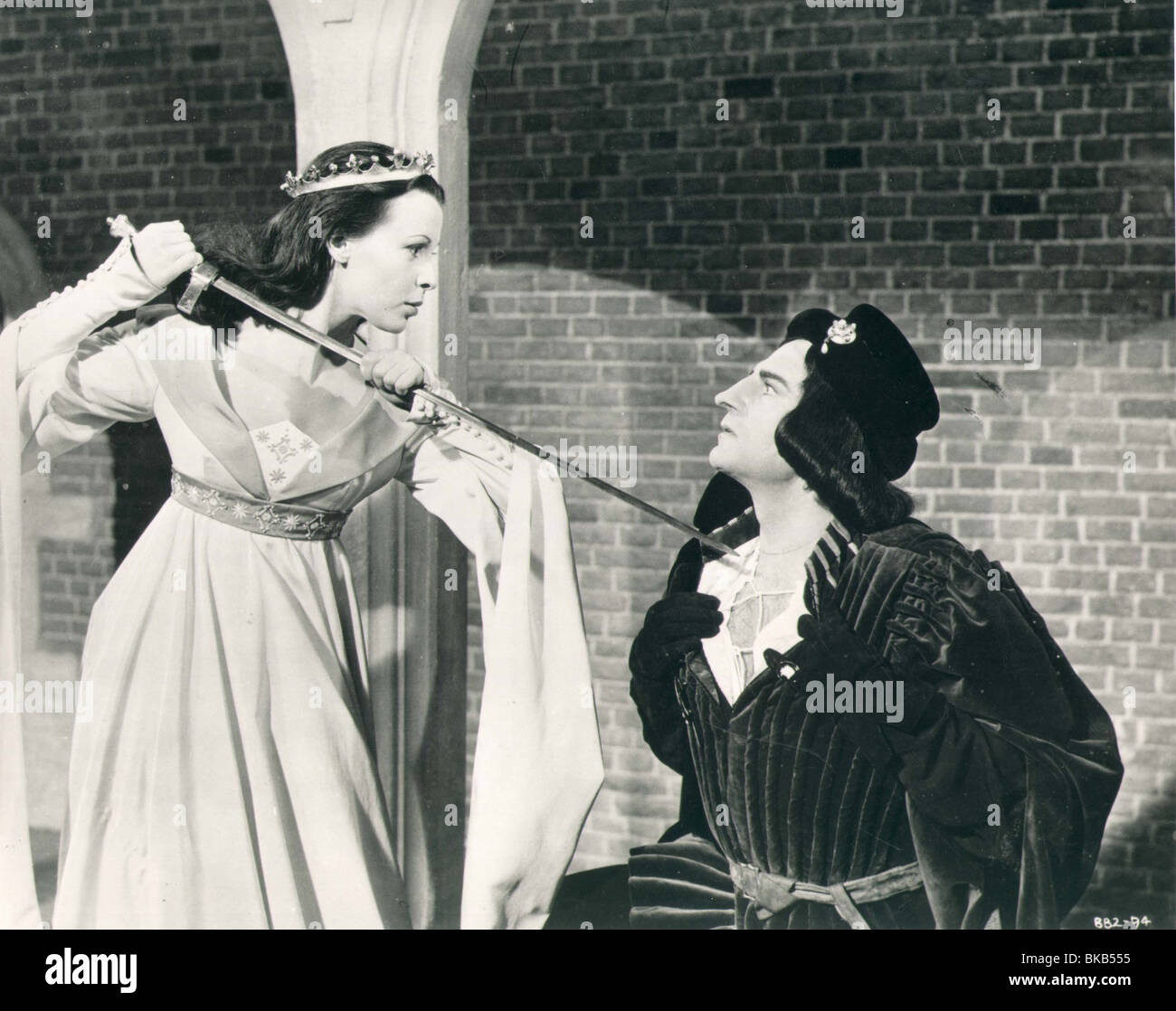
But let's also remember the other tremendous actors who act texture and depth to the film. The role of Lady Anne is difficult since she hates Richard for murdering her husband and father-in-law but being wooed by him. Claire Bloom convincingly plays a Anne as conflicted, not merely falling in love with Richard but harbouring conflicting feelings of lust and hatred.  

John Gielguld makes Clarence a vivid and sympathetic character. He conveys the horror of Clarence's nightmare and its lasting effect once awake. 

Olivier wanted to cast Orson Welles as Richard's co-conspirator Buckingham but Olivier's friend Ralph Richardson wanted it and he felt he owed it to Richardson. Richardson lends an intelligence and genuine moral compass to his portrayal.

While it's understandable why'd we focus on the performances when walking an adaptation of Shakespeare, it must be said that Richard III is an elegantly well-crafted film this is. Just re-watching it, I was really noticing the camera movement, Olivier's compositions and blocking of scenes. Most notably, he plays out scenes either in one long take or in several long takes. Olivier brilliantly brings us in Richard's first soliloquy ("Now is the winter of our discontent") by moving the camera move through a closed door, revealing Richard in the background beside the throne. It's an unsettling image but oddly inviting since Richard only shares his thoughts with us. Olivier performs the soliloquy in a single take. This reflects the theatrical experience but it's also cinematic due to the camera movement through rooms and the ability for Olivier to move away from and towards the camera.


Image result for olivier richard iii crown


Olivier begins the film with the final scene of King Henry VI Part III, in which King Edward IV (Cedric Hardwicke, adding warmth to the film) is coronated (the first shot, which is repeated when Richard is crowned, is a crown hanging from a ceiling). This provides context for viewers are new to this play. It also allows for the happiness of the coronation to be subverted as we transition to Richard stating his plan to become King. 

Olivier stages the scene where Edward (on his deathbed) learns of his brother Clarence's death in multiple long takes, only cutting on specific moments. The blocking of this scene and its camera movements are all specific and concise. It takes what could be a visually dull scene and makes it dynamic in regards to how its acted and filmed. 

What's also visually striking about this film is how colourful it is, as well as Roger K. Furse's extravagant production design. On the Criterion Collection commentary, playwright and stage director Russell Lees says there's an almost surrealistic, storybook quality to the look of the film. He argues Olivier does this to prepare the audience for the heightened quality of Shakespeare's language. The production design and cinematography remind me of an old Disney cartoon, particularly the recurring image of Richard's shadow. The most disquieting instant of this image is when Richard enters Anne's bed chamber. He opens the door and the camera pans down to show the bottom of her dress and his shadow enveloping it.  

Some other visuals I love include Richard looking out and through windows, with the deep-focus photography allowing us to seeing what he does. The introduction of Richard is also effective. At first, we only see the back of his head. Richard then turns his head. It appears as if he's looking at us but he's really looking at Buckingham. The aforementioned image of hanging crown is repeated when Richard is crowned and when Richmond becomes King Henry VII. It's a wonderful motif, representing the crown outliving its wearers, a continuously passed down symbol of power. The film begins with one King ushering in a new era of peace, one which doesn't last long. By the end Henry VII is doing the same, ideally an age of peace which lasts longer.


Image result for richard iii claire bloom

Lees argues we should feel bad for liking Richard and adds that Lord Stanley (Laurence Naismith) is crowning us at the end, symbolizing power belonging to the people in democracy. Moreover, now that we have realized that we all have evil within us, what kind of ruler will we be?

How do we reconcile the pleasure we take in Richard's personality and scheming with the awareness of the pain and suffering he inflicts on others? We have to like Richard for his defeat to have the sobering effect it needs, to understand the inevitable downfall that follows ascension by murder and betrayal. Though Olivier does excise Queen Margaret, whose presence exemplifies the theme of being haunted by the past, the theme is still present, particularly when you consider Richard is literally haunted by ghosts before the final battle. Unfortunately, Olivier removes Richard's soliloquy after being haunted but I believe Olivier trusts the audience to understand Richard's guilt. When Richard dies Olivier has Richard lift his sword up by the blade, another of the film's trademark images. Lees highlights how its the sign of the cross- Olivier gives Richard a "a moment of grace".

Is Richard a tragic figure? He's certainly not a tragic figure like Othello or Hamlet, and on the commentary, former governor of the Royal Shakespeare Company, John Wilders, argues Richard lacks "tragic depth" even though the plot follows the structure of tragedy. I would argue villainy always comes from a very human place. While I don't condone Richard's actions I understand his bitterness at being a hunchback and his desire for power. I also think there's something sorrowful about being so hateful and power-hungry you'd have your own brother murdered. I would put forth that Richard is also a product of his environment, one that is full of violence and betrayal. and unclean hands. Again, this is not to apologize for Richard just to put his actions in a larger context, particularly that of Shakespeare's other History plays, which are full of betrayal 

Olivier created something special with this film. While we didn't get another Shakespeare adaptation from him, I'm thankful Olivier concludes his trilogy with a triumphant blend of theatre and cinema, and one of the great screen performances of all time.