Showing posts with label Batman Forever. Show all posts

Thursday, 21 August 2025

Why Do We Fall?: 20 Years of Batman Begins


Spoilers below

The Batman film franchise, barring the 1940s serials and the 1966 Adam West movie based on the  TV series, began with Tim Burton's 1989 Batman, released a little over a decade after the original Christopher Reeve Superman opened the doors for all future superhero adaptations. The Burton films were attempt to present a darker, more gothic vision of the dark knight, akin to Frank Miller's Year One and The Dark Knight Returns than the West show. When Batman Returns, the follow-up to Burton's original, where he had more creative control, was met with outcries from parents for being too dark and violent, as well as MacDonald's cutting its Happy Meal deal with Warner Bros. for the same reasons, the studio decided to go in a more kid friendly direction, hiring Joel Schumacher to direct the third installment, Batman Forever. The film was a success and Schumacher was tasked with directing the follow-up, Batman & Robin. To quote George Lucas watching the rough cut of Phantom Menace's climax, Schumacher may have gone a little too far in some places. Schumacher dialed up the camp, and supposedly would say "Remember, it's a cartoon" before yelling action. Ironically, there was a really good Batman cartoon in the 90s that appealed to kids while still being mature and character driven. 

While Schumacher was originally slated to direct a third film, Batman Triumphant, which may have starred Nicolas Cage as the Scarecrow and Madonna as Harley Quinn (except retconned in to being the Joker's daughter), it never came to fruition. Appropriately for a film starring Mr. Freeze, Batman & Robin put the franchise on ice for several years. It wouldn't be until 2005 that we saw the caped crusader again, except this time it wouldn't just be another film in a franchise, but a film that reinvented the whole idea of the Batman franchise, creating something more psychological and character-driven that had been done in the live action films. This was Christopher Nolan's Batman Begins.. At this point in his career Nolan wasn't yet the blockbuster auteur he would become with The Dark Knight and Inception. He was still very much the indie filmmaker making his first blockbuster. The film feels modest compared to the second and third and film in the trilogy but it also feels the most like a stright forward Batman film. 

Burton's approach to Batman was enigmatic and mysterious, while Nolan and Goyer's is internal and personal. Batman Forever tried to be a little more character driven, most of Val Kilmer's arc as Bruce was exorcised in that film. To be fair, those previous 4 films were more interested in the villains than Batman. And I get why- they're often more colorful and entertaining than him. But I appreciate Nolan and Goyer zeroing in on Bruce and Batman essentially giving us the full of arc of Bruce becoming Batman. To get us more in to Bruce's head, Goyer's script employs a flashback structure, beginning with this nightmare Bruce is having of the time when he was a child and fell in to a pit of bats. We then jump to Bruce waking up in prison. In the years since his parents were murdered during a mugging, Bruce has traveled the world learning the ways of criminals, but has completely lost himself in that life. But then a man named Henri Ducard (Liam Neeson) gives him a chance to train under Ra's Al Ghul (Ken Watanabe) and become part of the League of Shadows. As he trains with Ducard we get more flashbacks of Bruce's life before leaving Gotham, including the moment where he about to kill Joe Chill, his parents' murderer, before he is murdered for being a informer by one of mobster's Carmine Falcone's (Tom Wilkinson) cronies. After being given a stern lecture on justice vs. revenge by childhood friend, now lawyer, Rachel Dawes (Katie Holmes), he begins his journey in to the criminal underworld.

Nolan and Goyer don't just use the murder of Bruce's parents as a set up for a completely sepearate story but use is as the film's thematic crux. Joe Chill only existed because of the economic depression, leading to financial desperation in men like him. While the murder of the wealthy Waynes supposedly urged Gotham to pull itself out of this depression Rachel points out that things haven't really gotten better. Gotham is full of corruption and is run by Falcone. And essentially this corruption and decadence fuels Ghul's motivation to destroy Gotham.

Nolan and Goyer trust the audience to wait awhile for Bruce to don the cowl. They knew they had to make Bruce a compelling enough figure our of the suit that audiences wouldn't be impatient getting to  Batman stuff. I think the reason why this approach ended up working for audiences is due to Nolan and Goyer approaching this material with a certain kind of seriousness and earnestness. From very beginning the film plays out as a straight drama rather than a comic-book movie, though I feel of the trilogy this one feels the most a straight-up Batman movie. Ultimately, the film encourages the audience to engage with the narrative on a character and thematic level rather than just pure entertainment. I do hate when people say Nolan was embarrassed to be doing a comic-book movie since I feel it's the opposite. Nolan obviously thought there was something more to this material then silly pulpiness. He saw something mythic and compelling this character. He of course had to strip down some of the fantasy in order to do the story he wanted, but I like when these films have a specific vision. And to be fair, this is still a pretty pulpy movie and it has a sense of humour about itself.

Maybe the film's wisest decisions, is forgoing the Joker as the antagonist. Structurally, it just ended up working better for the overarching story of the trilogy. In this one Batman brings hope back to Gotham City and by the beginning of The Dark Knight is very confident in his abilities, and even underestimates the Joker, as does the mob. only for the Joker to completely destroy his whole world. This film's ending is so satisfying, having Lieutenant Gordon (Gary Oldman) giving Batman the Joker's calling card. It's the best sequel set-up of any superhero film, largely because it wasn't designed to be a set-up, but a payoff of the whole story.  

In typical Nolan fashion, he uses the concept of fear both as a plot device and as a larger thematic concept. Ducard (who is revealed to have been the actual Ghul in the third act) wants to use Dr. Jonathan Crane/Scarecrow's (Cillian Murphy) fear toxin against Gotham so it it will tear itself apart. Bruce uses fear (the symbol of the Batman) to invoke a positive change. And Bruce initially blames his fear of bats (he had to leave the opera due to the people in bat costumes) for his parents' death. 

 While I usually really like Neeson, I do find the character, and his performance, a little bit on smug side. It's a big part of why I have a love/hate relationship with this film. I do like that this movie focuses in more on Batman than any of the previous live action films and feels the most like a Batman of Nolan's trilogy, especially in the aesthetic of Gotham. I do wish Nolan was a stronger visual stylist and that his shooting style wasn't always so basic. There's also some janky editing going on in the fight scenes, and the third act just isn't as strong as the first two. Rachel also feels likes she's just there to tell Bruce what he needs to hear, rather than being a fully formed character, though Nolan has often been a stronger idea and conceptual guy and his characters can often feel like mouthpieces for exposition. However, his Dark Knight Trilogy does have some really good character stuff and oddly feels like his most character driven work.

He's not unlike George Lucas, who also struggles with dialogue and character. Lucas' strengths, like Nolan, are in the bigger picture stuff.  But Lucas and Nolan's flaws as directors don't really matter to most people because their films, often seen by people when they're younger, have such a impact on viewers and define a young person's upbringing as a cinephile. 

Superhero movies often get seen as right wing power fantasies, though someone like Stan Lee was always very progressive in his politics. Batman, in particular, gets reduced, maybe fairly or unfairly, to the rich guy who beats up poor people. Nolan also got blowback when The Dark Knight came out when Batman chose to spy on people via cell phone to find the Joker, viewing this as pro Bush and Patriot Act. And in the third film, Tom Hardy's Bane was seen as a criticism of Occupy Wall Street. The Dark Knight does prevent the surveillance stuff as pretty morally dubious and Bane doesn't really represent the ideals of Occupy Wall Street but rather uses the ideology to turn Gotham against itself. Still, Nolan does try to have it both ways with the surveillance technology, presenting it as necessary one time thing before it's destroyed. The ending of The Dark Knight also prevents lying about Harvey Dent's crimes as a necessary evil to keep order. And The Dark Knight Rises does present the ideology of Occupy Wall Street as useful weapon to turn classes against each other. Nolan's politics are thorny but I'd argue it makes the films more interesting, especially compared to the more overt thematic exposition that has probably hurts these films the most on rewatch. 

The key to casting Batman and Bruce Wayne is you don't go for the traditional leading man like George Clooney. You go for someone like Michael Keaton or Val Kilmer. You need some who you can believe dresses up as bat and fights crime. Christian Bale may have gotten himself the role by playing another rich, crazy guy with Patrick Bateman in American Psycho. I think Bale often gets overshadowed in these movies by the more colorful performances but he's good in this initial go around. Bale can sometimes be too actorly and heavy as an actor, but here he doesn't overplay the seriousness but lets it come naturally. He finds the reality in essentially an outlandish character.

While I feel The Dark Knight and The Dark Knight Rises are stronger films formally, I understand why Batman Begins is often seen as the best of the trilogy and many peoples' favourite. It's thematically the tightest and feels the most comfortable being a superhero film. I always wonder the series would've been like if  Nolan had continued on with this aesthetic. So, what are your feelings about Batman Begins? Is this your favourite? Comment and let me know.


Sunday, 12 July 2020

On Directors' Cuts and "Zack Snyder's Justice League"

Will We Ever See Zack Snyder's Cut of Justice League? | 411MANIA


The term "auteur theory" was first coined by American film critic Andrew Sarris in the 1960s though the idea of an filmmaker being an auteur originated with the French film critics of the magazine Cahiers du Cinema. The auteur theory believes the director is the author of a film and a director is an auteur if they have a distinguishable visual style and recurring themes throughout their work

I begin with the auteur theory because I believe the term "director's cut" reinforces the idea of director as author. A director's cut of a film suggests validity- this is the true version of the film and what was seen originally was a compromised version of a filmmaker's vision. And I do think that's true in many cases. Films have suffered from being cut down from their intended length and tampered with by studios. One of the best examples is Ridley Scott's Blade Runner. The 1982 theatrical cut had the studio imposed happy ending and Harrison Ford's voice-over narration. The 1992 director's cut and subsequent 2007 Final Cut enhanced the film's standing as a science fiction masterpiece. 

Then there are times where a true director's cut can't exist. For example, the restored version of Orson Welles' Touch of Evil. Welles had died before that version was released so it cannot be called a director's cut. However it is based on Welles' memo to Universal Studios and is the closest thing to Welles' vision for the film. And the Assembly Cut of Alien 3 didn't have David Fincher's involvement but is seen as an improvement over the theatrical release, closer to what Fincher was attempting with the film.

Peter Jackson and James Cameron don't like the label of Director's Cut because it implies dissatisfaction  with the theatrical release. They prefer "Special" or "Extended Edition." The Extended Edition of his Lord of the Rings Trilogy weren't intended by Jackson to replace the theatrical versions. They were for fans who wanted more of Middle-Earth. But there's also the several special editions of the original Star Wars Trilogy. George Lucas feels the special effects at the time of the original trilogy's production didn't allow him to fully realize the Star Wars universe on screen.

As I said earlier the term director's cut relates to the auteur theory. But, as with the auteur theory, it's important not to lose sight of the collaborative process of filmmaking. Many people's work is also compromised. One major case of this is Zack Snyder's Justice League. It was recently announced we are finally getting to see Zack Snyder's version of Justice League in 2021 when it premieres on HBO Max. In this case, this isn't a director's cut since the the theatrical cut was largely Joss Whedon's, with some footage from Snyder. What we have is a completely different film. And it feels like a game-changer. Warner Bros. smuggled in the Whedon--directed film under Snyder's name, hoping to get approval from critics and fans who reacted negatively to Batman v. Superman. The plan backfired when the film bombed and fans felt betrayed. The #Releasethesnydercut movement was born and led to Snyder's gaining the opportunity to show his original vision.

In the wake of the movement there's already been a push to release the late Joel Schumacher's supposed darker and longer cut of Batman Forever. And David Ayer's Suicide Squad may also finally being getting a director's cut as well. Ayer initially said the version released in theatres was his cut but the film received a extended cut on blu ray and he has recently been talking on Twitter about his original vision for the film and scenes which were cut. It's become a meme to say "#releasethe" whatever cut. Studios may engage with the directors they hire differently going forward. In the era of social media people are more aware of what goes on behind the scenes and directors have a platform to talk about their work. 

Now, I want to make clear I don't think studio involvement is always a bad thing. In the case of Howard Hawks' The Big Sleep (1946), the film was improved by additional scenes shot at the behest of producer Jack L. Warner. He encouraged by Lauren Bacall's agent Charles K. Feldman who believed Bacall's career would be over if she received the same negative reviews she did for Confidential Agent (1945), shot after The Big Sleep was released first due to its war-time subject. The additional scenes between her and Bogart, including a discussion about horses which is very sexual in its innuendo, helped make the film a classic.
  
I'm glad Snyder and everyone involved finally sees their work get its due. As a fan of Snyder's first two films in this story it's exciting to see a proper continuation of what he set up.      

So, are you excited for Snyder's Justice League? Do you believe it'll change anything in Hollywood? Comment and let me know.

Tuesday, 23 June 2020

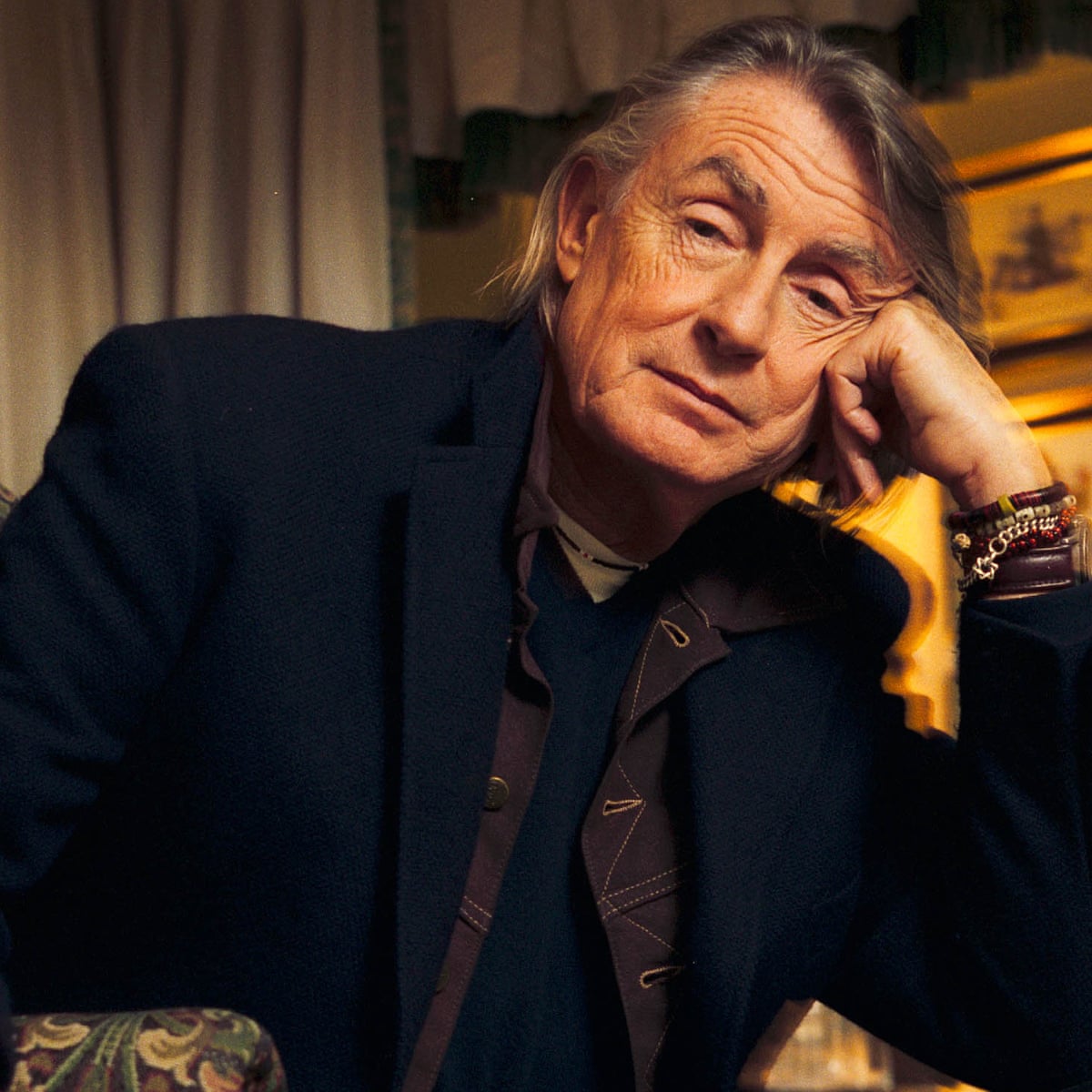
Joel Schumacher (1939-2020)


Joel Schumacher, Batman Forever and The Lost Boys director, dies ...

Joel Schumacher, the director of such films as The Lost Boys, Falling Down, and Flatliners, died yesterday at the age of 80. Schumacher had an eclectic career that began in the fashion industry, where he discovered his passion for filmmaking. His first foray in to movies was as a costume designer for films including Woody Allen's Sleeper (1973) and Interiors (1978). He wrote the screenplay for the film adaptation of the Broadway musical The Wiz (1978) before making his film debut with The Incredible Shrinking Woman (1981), starring Lily Tomlin.   

Schumacher would go on to the direct one of the seminal "Brat Pack" films, St. Elmo's Fire (1985), as well as the provocative Falling Down (1993), featuring one of Michael Douglas' best performances. But Schumacher's career was often overshadowed by his contribution to the Batman franchise. Warner Bros. decided to take the series in a lighter direction after Tim Burton's Batman Returns (1992) was criticized for being too dark and grotesque. Schumacher was brought on as director due to him directing several successful films for the studios. 

Batman Forever (1995) was a commercial success and a sequel was fast-tracked. Batman & Robin (1997) doubled down on the camp and is seen as one of the worst comic-book films ever made. I'll defend Batman Forever as having good elements, including Val Kilmer as Bruce Wayne/Batman and his relationship with Dick Grayson (Chris O'Donnell). It was the ideal Batman film for kids, the one I grew up with and for which I still have a soft spot.

Schumacher's name became synonymous with "campy superhero" films. However, looking at the rest of Schunacher's filmography, it is filled with films about racism, rage against society, snuff films, and the Vietnam War. Schumacher made mid-budget, adult-skewing dramas- the anti-thesis of superhero blockbuster culture, and films are increasingly hard to get made in Hollywood. And his Batman films are amongst the most directorially distinct of the sub-genre.  

Schumacher was also unique in that he was an openly gay man directing major Hollywood films, and his Batman films have been viewed through a Queer lens. His 1999 film Flawless also dealt with homosexuality and transgenderism. In the film Philip Seymour Hoffman plays a gay man helping the homophobic security guard played by Robert De Niro recover from a stroke.  

Schumacher also directed Phone Booth, a very good one-location thriller starring Colin Farrell as man held hostage in one of the last phone booths in New York City.

So, what's your favourite Joel Schumacher film? How do you feel about his Batman films? Comment and let me know.

Thursday, 18 June 2015

20 Years of "Forever": A Look Back at "Batman Forever"


June 16 marked the 20th anniversary of Batman Forever's North American release. I was six at the time and Batman Forever was the Batman film for me growing up- a film I watched a lot on VHS. Which isn't a surprise since the film's main goal was to be a more kid friendly film than the previous two films in the franchise, Batman (1989) and Batman Returns (1992)- both directed by Tim Burton. After Batman Returns was criticized for being too dark and grotesque, Warner Bros. felt uneasy about another Burton-directed Bat film. Burton almost did direct the third installment  but eventually dropped out ( I wrote about what that film might've been like here:http://whatculture.com/film/tim-burtons-batman-forever-best-dark-knight-movie-never-made.php). Joel Schumacher- known for films such as The Lost Boys, St. Elmo's Fire, and Falling Down- was hired to make a more light, less depressing take on the Batman mythos.

Batman Forever is often lumped in beside Schumacher's follow-up, 1997's Batman & Robin as the low-points of the franchise. But we have to remember that before Batman & Robin put the franchise on ice until Christopher Nolan's Batman Begins in 2005 Batman Forever was received fairly well by audiences. It was more accessible and mainstream than Batman Returns, which is more Burton than Batman film and not really a superhero action film either. Moreover, Forever also out-grossed Returns at the box-office. 

The last time I watched Batman Forever before revisiting it for this retrospective was after seeing Batman Begins. Due to being older and having just seen Nolan's darker take on the character, I found myself appreciating Burton's vision more and being disappointed we never got a third film from him; though I still enjoyed Batman Forever. However, seeing the film just recently, I can see it's flaws more clearly.


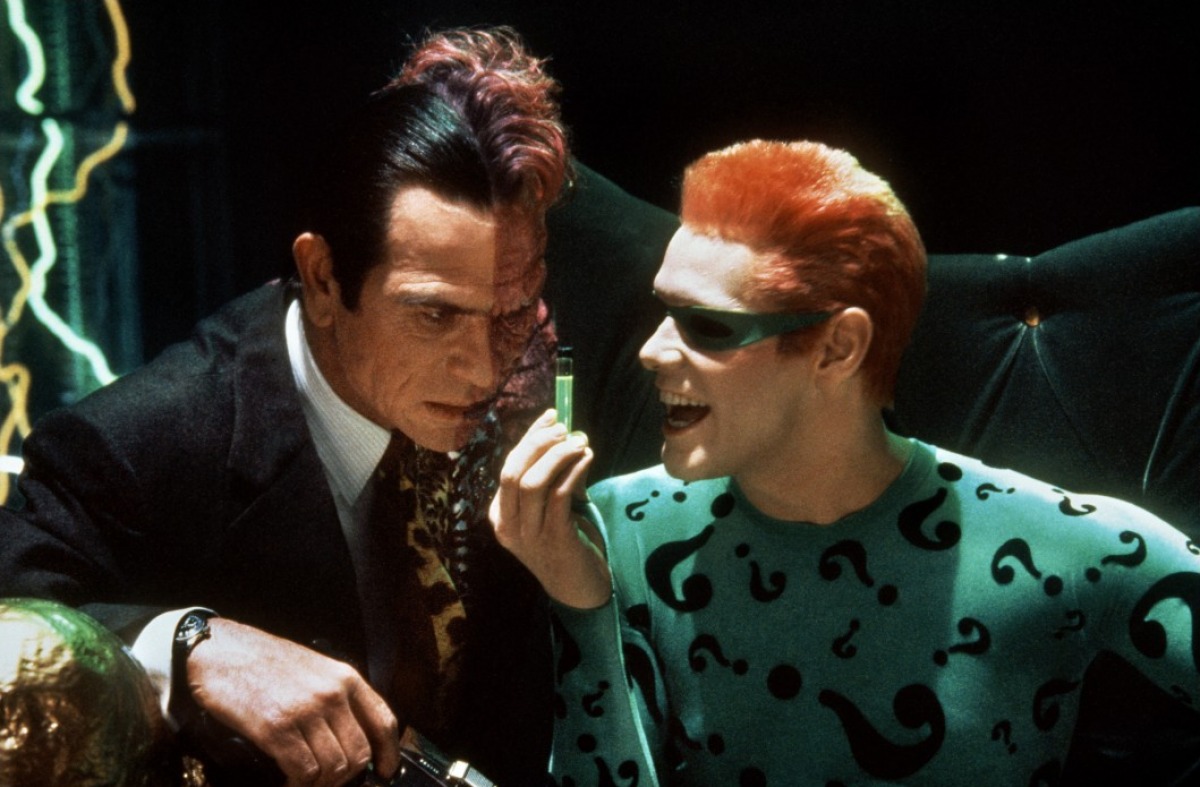
For one, it's a very tonally awkward film. The scenes featuring Edward Nygma/Riddler (Jim Carrey) and Harvey Dent/Two-Face (Tommy Lee Jones) are very broad and comedic, whereas the scenes with Bruce Wayne/ Batman (Val Kilmer) and Dick Grayson (Chris O'Donnell) are more realistic. I wish Jones had played Two-Face more subtly, particularly since Carrey's performance is flamboyant and over the top enough for ten movies. You needed a straight man in the scenes with Carrey and we never get that with Jones hamming it up like he's playing the Joker.

I also feel Chase Meridian (Nicole Kidman), the psychiatrist Commissioner Gordon (Pat Hingle) brings in to analyze Two-Face, is a little too shallow. To be fair, that's part of her character arc as she's first attracted to Batman but then  falls for the man behind the mask, telling Batman a girl eventually has to grow up. The idea of a psychiatrist being Bruce Wayne's love interest, with Bruce's own alter ego being his romantic rival is a great idea that I wished the filmmakers had unpacked more. This plotline highlights the duality of Batman and the superhero archetype in general. Batman isn't just Bruce in a suit but a different persona- both literally and metaphorically. The love triangle between Bruce/Batman/Chase is also reminiscent of the Clark Kent/Superman/Lois Lane relationship in the Christopher Reeve Superman films.

At the film's climax, Riddler (having found out that Bruce is Batman) makes Batman choose between Chase and Dick (now having taken on the mantle of Robin). Nygma was a Wayne Enterprises employee who felt betrayed when Bruce rejected his idea for a box that enables Television signals to beam directly in to a person's brain. "It just raises too many questions," Bruce told him. Riddler wants to make Bruce suffer but he's also fascinated in the riddle of who will eventually win over- Batman or Bruce? Which persona wins out? Batman saves both Robin and Chase, which you can argue is a little too neat. But it pays off when Batman tells Riddler, "I had to save them both. You see, I'm both Bruce Wayne and Batman not because I have to be, now, because I choose to be." Batman is no longer a psychological burden for Bruce but someone he chooses to be. He'll go out and fight crime but he'll be more psychologically and emotionally well rounded.

I do like Val Kilmer's performance. I won't say he's better than Michael Keaton or Christian Bale but I feel he's probably the most underrated of the four actors who've played the character in live action. Supposedly Schumacher wanted to do a adaption of Frank Miller's seminal Batman: Year One, which was an influence on Batman Begins. I've would've liked to have seen Kilmer in a film between that was cross a between Burton's gothic sensibilities and Begins' exploration of Bruce's psyche.


More so than Burton's films, Schumacher does attempt to explore the motivation behind his crusade as Batman. There is a deleted scene where Bruce remembers reading his father's diary after his parents' murder. On the night they were murdered, Bruce's father wrote his in diary he and his wife went out that night because Bruce really wanted to go see a movie. Thus guilt was a large incentive for him to dawn that suit and battle crime. I feel this deleted scene should never have been cut, since it adds more depth to Bruce's character and makes his becoming Batman more understandable. The flashback to young Bruce encountering the bat in the cave is a striking scene, nightmarish but Bruce's narration also reflects how terror can also inspire us to do great things.

Another character revealing moment- this one in the film- is when Bruce and Dick are talking about the nature of revenge. Dick is dead set on killing Two-Face for the murder of his parents. Dick  is taken in by Bruce and eventually discovers  that Bruce is Batman. Bruce tells Dick that after he kills Two-Face, the pain won't go away. He'll keep going out to find another "face" each night until revenge becomes his entire life. Dick says Bruce couldn't understand because his parents weren't killed by a maniac, to which Bruce replies, "They were."

This exchange reads to me like the most direction connection- aside from Gordon and Alfred (Michael Gough) reprising their roles from the Burton films- that this film is still connected to the previous films. In Burton's Batman, Bruce's parents were killed by Jack Napier (Jack Nicholson) years before he became the Joker (a maniac). And Batman did kill Joker at the end of that film. So, Bruce does get revenge but he still has to go out each night. Revenge hasn't changed anything.

Despite having these connections to Burton's films, in other ways Batman Forever was a reboot before the word became a staple in Hollywood. Gotham City looks and feels completely different from Burton's, we have a distinctly different tone and direction for the franchise. This film  isn't a hard reboot like Batman Begins but it's closer then other franchise installments got to a full on revamp until Nolan's film. Batman Forever came out the same year as Gdeneye, Pierce Brosnan's first outing as James Bond. Goldeneye-like Batman Forever- isn't a complete reset but it did set out to shift the direction of the franchise. Furthermore, Bond got his own Batman Begins the following year in 2006- Casino Royale.


Coming back to the Bruce/Dick relationship, I think the problem with his arc is he gets everything he wants. He's persistent in wanting to be Bruce's partner and despite Bruce being adamant about working alone and wanting Dick to lead a normal life, He eventually has to put aside those reservations and team up with Dick. It feels like Bruce isn't really given a choice, rather then reaching his acceptance of Dick as a partner organically. And while Dick doesn't kill Two Face personally, he gets the satisfaction of seeing him die when Batman causes Two- Face falls to his death.   


While I've grown to prefer Burton and Nolan's film to Schumacher's take, Batman Forever gave me cinematic Batman I highly enjoyed and that's what matters. And in an age where superhero films can feel very "assembly line" Schumacher crafts a flamboyant mixture of comic book, camp, darkness and sex, a film that owes something to Adam West and Frank Miller. It doesn't completely work but it- and Batman & Robin- remain fascinating pop culture products of their time.