Showing posts with label Tommy Lee Jones. Show all posts

Monday, 1 August 2016

I remember everything: "Jason Bourne"


Warning: Significant Spoilers for Jason Bourne and The Bourne Supremacy follow


It's funny what you remember and what you don't. I remember seeing The Bourne Identity back in 2002- and during the first big fight scene between Jason Bourne and an assassin, my mother began singing the ''Secret Agent Man'' theme from the 60s TV series Danger Man. I don't know why I still remember that, but I just do. And it can't help but fuel the nostalgia for the Bourne series. I was 13 when the first film came out. I was still in junior high. And by the time The Bourne Ultimatum came out in 2007, I had just finished high school and was about to enter university in the fall. I know you're probably wondering why I'm getting so personal. Personally I feel it's hard to separate certain films for franchises from the periods of my life in which they came out. And it being nine years since The Bourne Ultimatum and with a new Bourne film being released- simply titled Jason Bourne- I've been watching Jason Bourne movies for more than half my life.

The Bourne Identity- directed by Doug Liman- was filmed before the events of 9/11 and released less than a year after the tragedy. Back in 2002- and more so now-it was a pretty old-fashioned action film, less concerned with bombastic action set-pieces and more on smaller scaled encounters. It even had a pretty tidy happy ending for the most part. When Paul Greengrass took over the franchise with The Bourne Supremacy and the subsequent The Bourne Ultimatum, he took what Liman established and brought a raw and contemporary edge to the franchise. The franchise became a little more darker and morally ambiguous, no- doubt influenced by the 9/11 era that the original film existed outside at its time of filming.

Jason Bourne- again directed by Greengrass- begins with former government agent Jason Bourne- real name David Webb (Matt Damon)- living off the grid and taking part in illegal fighting rings. He's regained his memory yet is still unable to find any kind of real peace. When Damon first played Bourne back in 2002, he was in many ways still the fresh-faced kid from Good Will Hunting and was an unusual choice for an action film role. Now at 45, Damon has played the character for a significant portion of his career and the character has aged with Damon- and vice-versa. Bourne doesn't speak much in the film but Damon conveys the weight of Bourne's emotional and physical journey throughout the series in his body language and face.

Now in a post-Snowden world, Jason Bourne has a strong focus on the theme cyber-hacking. In the beginning of the film. Nicky Parsons (Julia Stiles), former C.I.A operative and current ally of Bourne, hacks in to the C.I.A's mainframe so she can expose the agency's black ops program. She discovers information on Bourne's father Richard Webb and Bourne's recruitment in to the Treadstone program. Nicky finds Jason and informs him of what she's been working on. He and Nicky escape from a team sent after them but Nicky is killed by an assassin known as the Asset (Vincent Cassel). 

Nicky's death-which recall's the death of Bourne's former lover Marie's (Franka Potente) in the first act of The Bourne Supremacy- is surprisingly poignant. Bourne is a character- like other action heroes- marked by tragedy. Nicky was one of the last people he had any real connection to and now she's gone. Bourne a survivor in the purest sense of the word. He outlives both his enemies and his loved ones. What's most impressive about the franchise is despite Bourne miraculously surviving events that would have killed someone in reality, he never feels too ridiculous or super-human. Greengrass always makes you feel the weight of every collision, punch and- in one instant- concrete landing. As "cool" and exciting as the action is in the franchise, there's a real sense of pain to it. When Bourne walks away from a fight, he may be the "winner" but I think Bourne regrets every life he's taken or person he's hurt. 

As in all the Bourne films, while the movie is ostensibly about him, there's also a great deal of focus on the government officials who are after Bourne. While Joan Allen's Pamela Landy unfortunately doesn't return or is even mentioned, we are introduced to two pivotal new characters- C.I.A director Rober Dewey (Tommy Lee Jones, an actor who fits perfectly in to this series) and Cyber-ops division head Heather Lee (Alicia Vikander), who persuades Dewey to let her attempt to bring in Bourne from the cold, so to speak.    
Vikander- a recent Oscar winner for The Danish Girl- is one of the most naturalistic young actors working today. While the role feels its written for someone older, Vikander brings a maturity- coupled with a youthful ambition- to the role of Lee. Without giving away the ending, Lee feels like she's going to be a pivotal character moving forward in the franchise. Lee isn't Pamela Landy 2.0- unlike Landy, she's not as trustworthy and in a reversal of the Bourne/Landy dynamic, Bourne is the older one in this pair.

Jason Bourne reveals the final emotional piece of the puzzle, revealing why Bourne volunteered for the Treadstone in the first place. There's also the story thread involving Aaran Kalloor (Riz Ahmed) as the CEO of a social media enterprise called Deep Dream. It was secretly funded by Dewey, who wants to use it as a means of mass surveillance. This plot feels like it's supposed to be the larger thematic arc running through the film but the themes of hacking and surveillance needed a little delving in to. In some ways Jason Bourne feels only like half a film; and Bourne's emotional storyline doesn't have much to do with him protecting peoples' privacy. But I guess that's the point; Bourne's never been out to save the world. It's not that he doesn't care about people; it's just that all he can really do in this world is survive. 

Both Bourne and the Asset's motivations- when his connection to Bourne is revealed- concern revenge against each other- but the film isn't merely a revenge story for Bourne. Revenge is just another way for Bourne to justify some kind of existence. The tragedy of Jason Bourne and Jason Bourne is he's no better off at the end of the film than he was at the beginning. He may not even realize why the Asset hated him. 

The climatic action sequence of the film- the car and SWAT van chase through Las Vegas stands as one of the best action sequences in recent memory; it's genuinely exciting and is a testament to how practical stunt-work. 

I do feel the previous three Bourne are better and that Jason Bourne needed to flesh things out to create a more complete story. It's ending certainly sets things up for another installment- this isn't the grand finale for the character.  Ideally, the next film may change things up a little more. Still, Jason Bourne is still a solid piece of action cinema. I do hope Jason Bourne gets a happy ending one day. Maybe it's naive of me but It's the least I can hope for a man I've known half my life.  

Thursday, 18 June 2015

20 Years of "Forever": A Look Back at "Batman Forever"


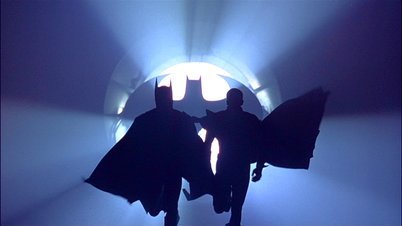
June 16 marked the 20th anniversary of Batman Forever's North American release. I was six at the time and Batman Forever was the Batman film for me growing up- a film I watched a lot on VHS. Which isn't a surprise since the film's main goal was to be a more kid friendly film than the previous two films in the franchise, Batman (1989) and Batman Returns (1992)- both directed by Tim Burton. After Batman Returns was criticized for being too dark and grotesque, Warner Bros. felt uneasy about another Burton-directed Bat film. Burton almost did direct the third installment  but eventually dropped out ( I wrote about what that film might've been like here:http://whatculture.com/film/tim-burtons-batman-forever-best-dark-knight-movie-never-made.php). Joel Schumacher- known for films such as The Lost Boys, St. Elmo's Fire, and Falling Down- was hired to make a more light, less depressing take on the Batman mythos.

Batman Forever is often lumped in beside Schumacher's follow-up, 1997's Batman & Robin as the low-points of the franchise. But we have to remember that before Batman & Robin put the franchise on ice until Christopher Nolan's Batman Begins in 2005 Batman Forever was received fairly well by audiences. It was more accessible and mainstream than Batman Returns, which is more Burton than Batman film and not really a superhero action film either. Moreover, Forever also out-grossed Returns at the box-office. 

The last time I watched Batman Forever before revisiting it for this retrospective was after seeing Batman Begins. Due to being older and having just seen Nolan's darker take on the character, I found myself appreciating Burton's vision more and being disappointed we never got a third film from him; though I still enjoyed Batman Forever. However, seeing the film just recently, I can see it's flaws more clearly.


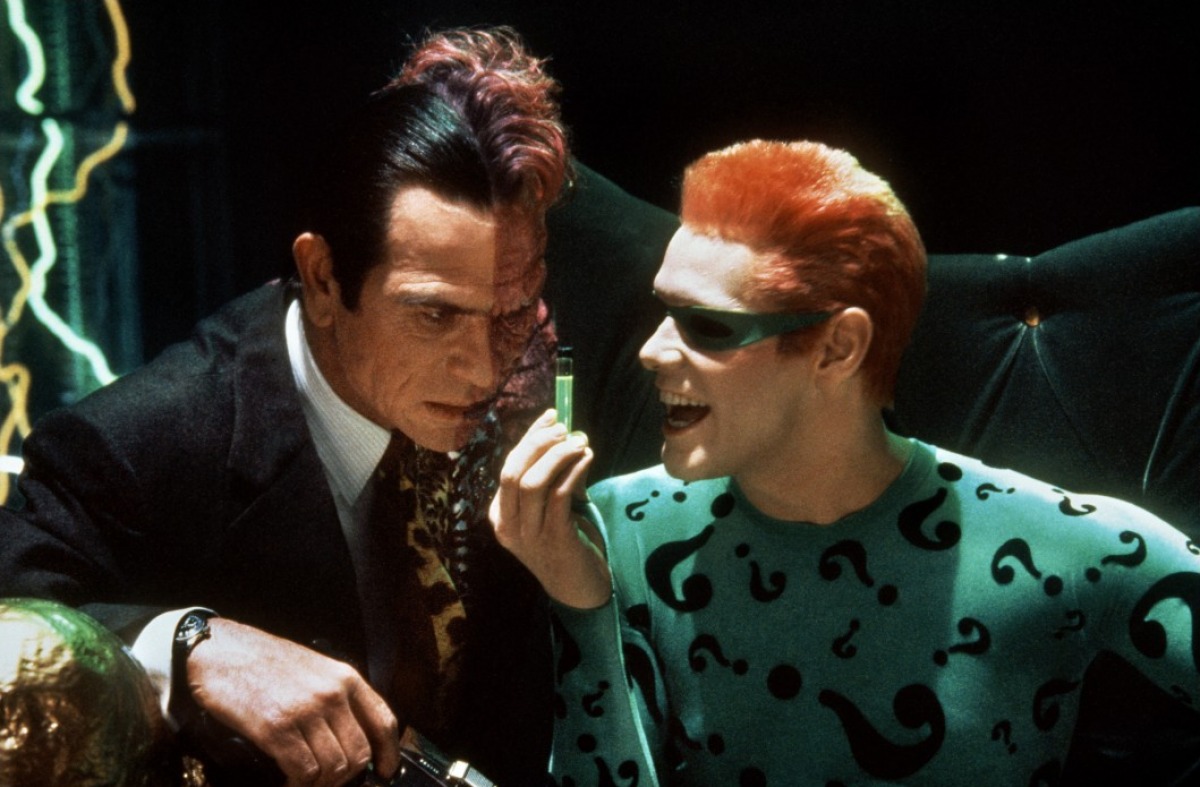
For one, it's a very tonally awkward film. The scenes featuring Edward Nygma/Riddler (Jim Carrey) and Harvey Dent/Two-Face (Tommy Lee Jones) are very broad and comedic, whereas the scenes with Bruce Wayne/ Batman (Val Kilmer) and Dick Grayson (Chris O'Donnell) are more realistic. I wish Jones had played Two-Face more subtly, particularly since Carrey's performance is flamboyant and over the top enough for ten movies. You needed a straight man in the scenes with Carrey and we never get that with Jones hamming it up like he's playing the Joker.

I also feel Chase Meridian (Nicole Kidman), the psychiatrist Commissioner Gordon (Pat Hingle) brings in to analyze Two-Face, is a little too shallow. To be fair, that's part of her character arc as she's first attracted to Batman but then  falls for the man behind the mask, telling Batman a girl eventually has to grow up. The idea of a psychiatrist being Bruce Wayne's love interest, with Bruce's own alter ego being his romantic rival is a great idea that I wished the filmmakers had unpacked more. This plotline highlights the duality of Batman and the superhero archetype in general. Batman isn't just Bruce in a suit but a different persona- both literally and metaphorically. The love triangle between Bruce/Batman/Chase is also reminiscent of the Clark Kent/Superman/Lois Lane relationship in the Christopher Reeve Superman films.

At the film's climax, Riddler (having found out that Bruce is Batman) makes Batman choose between Chase and Dick (now having taken on the mantle of Robin). Nygma was a Wayne Enterprises employee who felt betrayed when Bruce rejected his idea for a box that enables Television signals to beam directly in to a person's brain. "It just raises too many questions," Bruce told him. Riddler wants to make Bruce suffer but he's also fascinated in the riddle of who will eventually win over- Batman or Bruce? Which persona wins out? Batman saves both Robin and Chase, which you can argue is a little too neat. But it pays off when Batman tells Riddler, "I had to save them both. You see, I'm both Bruce Wayne and Batman not because I have to be, now, because I choose to be." Batman is no longer a psychological burden for Bruce but someone he chooses to be. He'll go out and fight crime but he'll be more psychologically and emotionally well rounded.

I do like Val Kilmer's performance. I won't say he's better than Michael Keaton or Christian Bale but I feel he's probably the most underrated of the four actors who've played the character in live action. Supposedly Schumacher wanted to do a adaption of Frank Miller's seminal Batman: Year One, which was an influence on Batman Begins. I've would've liked to have seen Kilmer in a film between that was cross a between Burton's gothic sensibilities and Begins' exploration of Bruce's psyche.


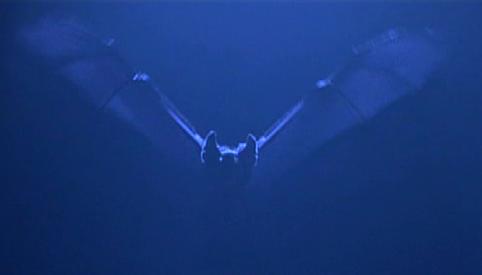
More so than Burton's films, Schumacher does attempt to explore the motivation behind his crusade as Batman. There is a deleted scene where Bruce remembers reading his father's diary after his parents' murder. On the night they were murdered, Bruce's father wrote his in diary he and his wife went out that night because Bruce really wanted to go see a movie. Thus guilt was a large incentive for him to dawn that suit and battle crime. I feel this deleted scene should never have been cut, since it adds more depth to Bruce's character and makes his becoming Batman more understandable. The flashback to young Bruce encountering the bat in the cave is a striking scene, nightmarish but Bruce's narration also reflects how terror can also inspire us to do great things.

Another character revealing moment- this one in the film- is when Bruce and Dick are talking about the nature of revenge. Dick is dead set on killing Two-Face for the murder of his parents. Dick  is taken in by Bruce and eventually discovers  that Bruce is Batman. Bruce tells Dick that after he kills Two-Face, the pain won't go away. He'll keep going out to find another "face" each night until revenge becomes his entire life. Dick says Bruce couldn't understand because his parents weren't killed by a maniac, to which Bruce replies, "They were."

This exchange reads to me like the most direction connection- aside from Gordon and Alfred (Michael Gough) reprising their roles from the Burton films- that this film is still connected to the previous films. In Burton's Batman, Bruce's parents were killed by Jack Napier (Jack Nicholson) years before he became the Joker (a maniac). And Batman did kill Joker at the end of that film. So, Bruce does get revenge but he still has to go out each night. Revenge hasn't changed anything.

Despite having these connections to Burton's films, in other ways Batman Forever was a reboot before the word became a staple in Hollywood. Gotham City looks and feels completely different from Burton's, we have a distinctly different tone and direction for the franchise. This film  isn't a hard reboot like Batman Begins but it's closer then other franchise installments got to a full on revamp until Nolan's film. Batman Forever came out the same year as Gdeneye, Pierce Brosnan's first outing as James Bond. Goldeneye-like Batman Forever- isn't a complete reset but it did set out to shift the direction of the franchise. Furthermore, Bond got his own Batman Begins the following year in 2006- Casino Royale.


Coming back to the Bruce/Dick relationship, I think the problem with his arc is he gets everything he wants. He's persistent in wanting to be Bruce's partner and despite Bruce being adamant about working alone and wanting Dick to lead a normal life, He eventually has to put aside those reservations and team up with Dick. It feels like Bruce isn't really given a choice, rather then reaching his acceptance of Dick as a partner organically. And while Dick doesn't kill Two Face personally, he gets the satisfaction of seeing him die when Batman causes Two- Face falls to his death.   


While I've grown to prefer Burton and Nolan's film to Schumacher's take, Batman Forever gave me cinematic Batman I highly enjoyed and that's what matters. And in an age where superhero films can feel very "assembly line" Schumacher crafts a flamboyant mixture of comic book, camp, darkness and sex, a film that owes something to Adam West and Frank Miller. It doesn't completely work but it- and Batman & Robin- remain fascinating pop culture products of their time.