Showing posts with label Classic Film. Show all posts

Monday, 5 April 2021

The Essential Films: "The Gunfighter" (1950)


A series of Writings on Films that I feel are essential for film lovers, coupled with films that are personal to me. Spoilers for those who haven’t seem the film.

Henry King's western The Gunfighter is one of the quietist films about violence I've ever seen. The Gunfighter could've been the title of a hundred different traditional action-driven westerns but King’s film concerns a man who doesn't want to be a gunfighter and is burdened by his own legend, which gives the title a melancholic and tragic quality. I would argue the film is an anti-western in how it refuses to fulfill the audiences' desire for violence and when it does there's no glamour, triumph or thrilling-ness to it. The film is largely about trying to outrun your own reputation.

Jimmy Ringo (Gregory Peck) is known as the fastest gun in the west. After he kills a young man named Eddie (Richard Jaeckel)- who wanted to become the man who killed Ringo- in self-defence, Ringo heads to the town of Cayenne. He waits to speak to his wife Peggy (Helen Westcott), with whom he has a son he's never met, while Eddie's brothers are in pursuit. Ringo's arrival also brings unwanted attention. Like High Noon (1952) the film takes place in a short amount of time and has a sense of intimacy in regards to the town. We become acquainted with several members of the town, most importantly the town's Marshal, Mark Strett (Millard Mitchell), an old friend of Ringo's and whom was in a gang with Ringo. In Strett we see a man who never became cursed by legend and was able to start over as a lawman. And Peggy has changed her surname, to conceal her marriage to Ringo. 

I said the film was an anti-western but it's also a film-noir in its themes and visual style. Many noir films deal with men and women wanting to escape their past but are caught in the web of fate. I also mentioned High Noon, which sees Gary Cooper's Marshal Will Kane walk around town in an attempt to gather people to help him fight outlaws who have targeted Will for revenge. In The Gunfighter Ringo is in a saloon for long stretches of the film. He has no interest in fighting Eddie's brothers. High Noon, despite being an unconventional western, still has the hero facing down the villains at the climax. There is no climatic showdown in this film. And Ringo isn’t portrayed as a hero. Like many film noir protagonists,  he’s morally grey. 

 John Bowers and Andre De Toth originally wrote the story for John Wayne. Wayne loved the story and offered Bowers 10,000 for it. Bowers thought it was worth more and eventually sold it to to Columbia for 70,000. Wayne refused to work for Columbia's President Harry Cohn, who had treated Wayne poorly earlier in his career. 20th Century Fox ultimately bought the story and Peck was cast. Peck wasn't associated with westerns the way Wayne obviously was. On the Criterion Collection Blu-Ray/DVD, filmmaker Gina Telaroli remarks how the film visually changes Peck's onscreen image, giving him a period accurate mustache and clothes that don't completely fit, also a period accurate detail. 

Telaroli adds that Peck was considered too intellectual an actor for the part but argues- and I agree- Peck's intellectualism suits the more psychological quality the film has. I feel the humility and pragmatism Peck radiates as an actor is perfect for Ringo's approach to his own legend and to killing. For Ringo killing is a matter or "him or me." He doesn't view it as glamorous or exciting. When Ringo kills Eddie at the beginning the film's editor Barbara McLean doesn't show Ringo fire the shot. We see Eddi gunned down and then a shot of Ringo with his gun drawn, punctuating Eddie's death. By not showing Ringo fire, cutting the scene in a more matter of fact matter, the audience is made to look at the situation more objectively, the way Ringo does.

I mentioned the film's noir inspired visual style earlier and never got around to talking about it.  Cinematographer Arthur C. Miller's use of shadows is obviously very noir-ish. Keeping the story indoors allows Miller to create a claustrophobic atmosphere in regards to the framing. The film keeps Ringo very isolated at his table, with Miller's deep-focus photography allowing us to see the other people in the saloon watching Ringo. This emphasizes the separation between Ringo and the townspeople. Despite its minimalist plot, King and Miller make the film visually interesting striking. 

At the end of the film it's not Eddie's brothers who get Ringo. It’s Hunt Bromley (Skit Homeier), another young man like Eddie who wants to be Ringo’s killer. Ringo says he drew first, saving Bromley from hanging. Ringo does this in order to have Bromley live the rest of his life with the reputation Ringo had, the curse which will bring challengers against Bromley. The curse of reputation and myth is passed down, and will continue to be passed down from killer to killer. 

The Gunfighter is a gem of a film. It's not always the first film mentioned when talking about the great westerns but it deserves more consideration. It sets itself apart from other westerns in its intimacy and seemingly anti-drama elements. But in its simplicity it harbors complex ideas concerning the challenge in separating yourself from your reputation, and the question you are vs. what you've been built up to be. And ultimately I believe Jimmy Ringo doesn't want to be more than his reputation; he just wants to be less.


Friday, 18 December 2020

"The life of men among men:" Reflections on "Reflections in a Golden Eye"

1967 was a taboo breaking year for Hollywood movies. Bonnie and Clyde, In the Heat of the Night, Guess Who's Coming to Dinner and The Graduate challenged the traditional portrayals of violence, sexuality and race in movies. Sidney Poitier slapped a racist white man and dated a white girl, Bonnie Parker and Clyde Barrow were shown brutally shot down, and college graduate Benjamin Braddock had an affair with an older married woman. As the 60s were leading in to the 70s, Hollywood was changing forever. 

John Huston's Reflections in a Golden Eye, while not as well received then (and even now) still belongs that company due to its portrayal of a suppressed gay man on an army base. This is Major Weldon Penderton (Marlon Brando), who has a fraught marriage to Lenora (Elizabeth Taylor). Lenora is being unknowingly stalked by a young soldier named Williams (Robert Forster in his film debut). Penderton begins to grow attracted to Williams, without knowing Williams' fascination with Lenora. Lenora is also having an affair with Lieutenant Colonel Morris Langdon (Brian Keith), whose wife Alison (Julie Harris) suffers from depression due to a miscarriage, staying inside with only her servant Anacleto (Zorro David) as a companion.

Many of Huston's films were adaptations of novels, short stories, or in the case of Key Largo, a play. Reflections in a Golden Eye came from the pen of Carson McCullers, author of The Heart is a Lonely Hunter (1940). Originally published in two parts in  Harpers' Bazaar and then as a novel,  Reflections in a Golden Eye was her follow up novel. Like William Faulkner McCullers' work is categorized as southern gothic. Huston's film exists in a heightened and unusual reality, which is accentuated by Huston's choice for the film to have a golden hue. After a week in theatres, Warner Bros. took the film and removed the golden hue, re-releasing  the film in a normal colour version. The new Warner Bros. blu ray contains both versions. Many of the film's images feel like they could come from a dream, a memory or something in between. 

Huston's films were often very masculine but also about the vulnerability underneath the bravado. Think of Humphrey Bogart in his most iconic roles under Huston's direction, Sam Spade in The Maltese Falcon (1941) and Fred C. Dobbs in The Treasure of the Sierra Madre (1948). Spade falls for the femme fatale who he has to send to prison. Dobbs becomes sick with greed. And while Brando and Bogart have differing acting styles they're similar in being unconventional leading men. Bogart lisped and had a hard, occasionally sinister look. Brando mumbled and lacked the polish of more traditional male actors at the time. And underneath both Bogart and Brando's swagger lied a sensitive nature.

Reflections in a Golden Eye finds Brando- as Penderton- struggling with the ideas of masculinity and  leadership. Pernderton questions his sexuality. He hates himself for his feelings, which undermines his ability to be a leader. As he says in his speech to his students, "Leadership must include a measure of inherent ability to control...uh...and direct self-confidence." Penderton knows he lacks these things despite his rank. He doesn't even have Lenora's respect. Penderton beats her beloved horse due to  being thrown off by it.  Lenora confronts Penderton at that night's party and hits him with a riding crop. Earlier in the film she taunts Penderton and strips naked in front of him. 

Penderton is almost like Othello if he was more interested in Michael Cassio than Desdemona. But unlike Shakespeare's play this is more a slow-burn to tragedy. The film does have what could be called a leisurely pace, examining the day-to-day lives of the people on the base and how they all interweave. The first line of McCullers' novel reads "An army post in peacetime is a dull place," which is accurate to the story's slow pace but also ironic given what happens by the film's end. I'll admit, I struggled with the film's pace and wish it had focused more on Brando and Taylor. I've talked quite a bit about Penderton but he kind of drifts in to the background during the film. 

Reflections In A Golden Eye (1967) - Firebird Is A Stallion - Turner  Classic Movies


While watching the film I responded more to the direction and atmosphere but Penderton and Brando's performance are the most substantial character stuff in the film. Taylor is having fun as Lenora; coming off her Oscar winning performance in Who's Afraid of Virginia Woolf?, she's playing a more voluptuous and lighter take on Martha. Harris, as in one of my favourite horror movies The Haunting (1963), is adept at portraying fragility without overly invoking pity. Forster gives a practically silent performance, making his voyeuristic nature even creepier.

While the reviews for the film, outside Roger Ebert and Pauline Kael, were mixed, Huston considered this one of his favourite among his films. Satisfaction is maybe all that matters when you're an artist. It's an off-beat in Huston's career, one I don't think is completely successful due to its pacing and sometimes thin characterization outside of Penderton. But it's worth seeing for its direction and unique look and feel, along with Brando and Taylor's performances.

Tuesday, 3 November 2020

The Essential Films: "Rebecca" (1940)


A Series of Writings on Films that I feel are essential for film lovers, coupled with films that are personal to me. Spoilers for those you haven't seen the film- as well as spoilers for the novel.


Rebecca marked a turning point in Alfred Hitchcock's career. It was his first film made in America and was the beginning of his working relationship with David O. Selznick. Selznick was a notoriously hands on producer and wanted a very faithful adaptation of Daphne Du Maurier's 1938 novel. Hitchcock had fashioned a strong visual identity as a director. This resulted in tension between the two, which could have led to a fractured and uneven film. However, the resulting film is an elegant meshing of  the two men's styles. It is at once a handsomely mounted old-school Hollywood film as well containing some genuine Hitchcockian flourishes. Its success, both critically and commercially, would allow Hitchcock to continue working in Hollywood, where he would direct several of his most revered films. 

Hitchcock had wished to buy the rights to Du Maurier's novel but deemed the price too high. He would end up directing another adaptation of a Du Maurier novel, Jamaica Inn (1939),  with which Du Maurier was displeased. Selznick would later buy the rights himself. When Hitchcock signed a contract with Selznick he was first slated to direct a film called The Titanic. When that project fell through he was assigned to direct Rebecca. The initial screenplay was written under Hitchcock's supervision by his assistant and screenwriter Joan Harrison, along with author Philip MacDonald. Selznick hated it, due to it veering too far from the novel. In a letter to Hitchcock Selznick said, "We bought Rebecca and we intend to make Rebecca." The final screenplay by Harrison and playwright Robert E. Sherwood was a much more faithful adaptation of the novel.

While on vacation in Monte Carlo the unnamed narrator (Joan Fontaine)- the paid companion of Mrs. Edythe Van Hopper (Florence Bates)- meets the wealthy widower Maxim de Winter (Laurence Olivier). As the  narrator and Maxim spend more time together they fall in love. When she and Van Hopper are to leave he surprises her with a marriage proposal. He brings her to his home estate of  Manderley, a world of wealth and privilege in which the narrator feels uncomfortable, largely due to the feeling of being compared to Maxim's beautiful and elegant first wife Rebecca, who died in a boating accident the year prior. The housekeeper Mrs. Danvers (Judith Anderson) takes a special disliking to the narrator, due to her close relationship with Rebecca.

Mrs. Danvers' introduction is one of the most Hitchcockian moments in the film. She glides in to the frame as the other servants are happily gathered to greet the new Mrs. de Winter. Her entrance in to the shot tells the audience she is the barrier between the narrator and true acceptance in to Manderley. Lyle R. Wheeler's production design for the film makes Manderley one of the great gothic locations in all of cinema. Hitchcock and cinematographer George Barnes (who won an Oscar for his work here) convey through the framing how the narrator is being overwhelmed by the mansion, both physically and emotionally.


Rebecca is a metaphorical ghost story. Rebecca's ghost never appears but her memory haunts the narrator and Maxim. Mrs. Danvers even wonders whether Rebecca's ghost comes back to Manderley and watches them. What makes the memory of Rebecca even more oppressive for both Maxim and the narrator is when her body is discovered after her boat is recovered. The body identified by Maxim was an unknown woman. Maxim knew this because he placed Rebecca's body in the cabin. Maxim never loved Rebecca and their happy marriage was just an act. As Maxim tells it, she was manipulative and cruel. After a confrontation between Rebecca and Maxim regarding her having a child with another lover, her cousin Jack Favell (George Sanders), she fell and struck her head. Maxim then sunk the boat by opening the seacocks. 

In the novel Maxim intentionally kills Rebecca by shooting her. It's ultimately discovered she had cancer, which gives her a motivation for suicide. Due to the Hays Code Maxim couldn't kill Rebecca and not be punished for his crime. I think if the had been able to retain this plot point it would've made the film's story even more powerful. But the message remains the same, which is Maxim cannot escape Rebecca even after she's dead. 

Fontaine and Olivier beautifully embody Du Maurier's lovers. While Maxim is older in the novel than Olivier was at the time of the film's production he expertly conveys Maxim's enchantment with the narrator as well as his bitterness towards Rebecca. Maxim is a man of contradictions, capable of warmth and coldness, condescension and respect towards his new bride.

And who wouldn't fall in love with Joan Fontaine? Fontaine effortlessly captures the narrator's purity as a person, as well as her awkwardness and lack of confidence. It's these qualities that attracts Maxim to her. She's not part of his world, not phony or privileged. She's real, which to Maxim Rebecca never was. When Maxim tells the narrator he never loved Rebecca, this finally breaks down the barrier between them. The narrator no longer has to feel inferior to Rebecca. 

My favourite moment from Fontaine is when she answers the phone on Rebecca's desk, telling the caller Mrs.de Winter has been dead for over a year. When she puts the phone down she realizes her mistake, cries "Oh, I mean...:" as she reaches for the phone with both hands. It's a very charming moment, while also accentuating the narrator's awkwardness, especially when Mrs. Danvers walks in. 

Anderson gives a positively spectral performance as Mrs. Danvers. Others have noted that she appears to glide rather than walk. This is because Hitchcock wanted the audience to see Mrs. Danvers from the narrator's perspective, feeling afraid she could appear at any moment. In one of the novel's and film's most famous scenes Mrs. Danvers finds the narrator in Rebecca's room and shows her around. Mrs. Danvers appears a woman possessed. She, more than anyone else, still has a passionate connection with Rebecca.  I'd argue Mrs. Danvers is more of an antagonist than an villain. Her story is actually quite sympathetic. She loved Rebecca, possibly romantically, and her death no doubt affected her deeply. Now Maxim is replacing her with a woman Mrs. Danvers views as inferior to Rebecca. Obviously she'd be upset. Her burning down of Manderley of the story represents her inability to live with the narrator taking Rebecca's place. But the narrator is not a replacement for Rebecca, rather she's her own person. She is able to stop comparing herself but Mrs. Danvers can't. 


Another tragedy of the story is Rebecca never gets a voice. The film is wise to now show flashbacks of Rebecca, keeping us in the perspective of the narrator, who's never seen Rebecca, can only imagine her. We only know Rebecca from what we're told; we're given two contrasting views of her. One is the beautiful, adored wife who everyone loved and whose death tormented Maxim. The other view, the one Maxim communicates to the narrator, is certainly not flattering: "She was incapable of love or tenderness or decency." But who really was Rebecca? Is it fair to assume she was some kind of monster as Maxim tells it? I don't believe so. Rebecca is a story about perception and the limits of one's knowledge of a human being. The narrator had one view of Maxim when marrying him, which turned out to be wrong. There is something quietly tragic about learning she had cancer and not wishing anyone else to know. In the book Du Maurier makes it clear Rebecca wanted Maxim to kill her so she wouldn't have to suffer from the cancer. 

Rebecca won the Best Picture Oscar- along with the aforementioned win for cinematographer Barnes- though Hitchcock lost Best Director to John Ford for The Grapes of Wrath. This may have solidified in Hitchcock's mind that Rebecca more of a Selznick film than a Hitchcock film. But there's still plenty of Hitchcock in this film, with its themes of romantic obsession, the limits of subjectivity, and fear of police/authority. And as I mentioned earlier the film allowed Hitchcock to continue working in Hollywood, where he grew as a artist, crafting sophisticated thrillers with provocative subtext. And  Rebecca is ultimately, for me, a story about a woman isn't alive to tell her story and another who is able to finally become the heroine of her own. 

Monday, 18 April 2016

The Essential Films: "The Manchurian Candidate" (1962)


The Essential Films: A series of writings on films I feel are essential viewings for film lovers, coupled with films that are personal to me.  

Warning: This essay contains spoilers. 


What's remarkable about John Frankenheimer's The Manchurian Candidate- based on Richard Condon's 1959 novel of the same name- is balances being a satire, a thriller, a science fiction "what if" story, a black comedy, a love story, and ultimately a tragedy- sometimes in the same scene. It remains cohesive throughout- never showing its seams and propelling us through to it's devastating climax. George Axelrod adapted Condon's novel and the film's cohesiveness and humanity owes a lot to him. 

The film's plot is outlandish enough to undermine the paranoia regarding communism in America during the 50s (which involved witch-hunts led by Senator Joseph McCarthy) yet also works as a genuine nightmarish vision of the lengths those in power will go to for ever more control.

The dramatic irony of the film is the two Republican characters who supposedly want to weed communists in America-John ''Johnny'' Iselin (James Gregory) and his wife Eleanor (Angela Lansbury)- are actually part of a communist conspiracy. The liberal Senator Thomas Jordan (John McGiver)- who is a so called communist- is the most decent political figure in the entire film.

Eleanor's son from another marriage, Raymond Shaw (Laurence Harvey) is a veteran of the Korean War. In the pre-title sequence Raymond and and the other members of his platoon are captured and taken to Communist China. Two days later the surviving soldiers return to America and credit Raymond with saving them. The platoon's captain Bennett Marco (Frank Sinatra) recommends Shaw for the Medal of Honor.  When asked what they think about Shaw, Marco and Corporal Al Melvin (James Edwards), they automatically say "Raymond Shaw is the bravest, kindest, warmest, most wonderful human being I've ever known in my life"

Both Marco and Melvin have nightmares about Raymond being brainwashed and killing two of the soldiers. These nightmares are in fact real. Raymond is to kill the presidential nominee for the Republican party. By doing so, Iselin- the vice-presidential candidate- can become President.


The flashback/nightmare sequences are master-classes in understated surreality. The captured soldiers believe they are at a ladies' tea and garden party. As the camera moves 360 degrees we move from the subjective point of view to the objective- the soldiers are in the presence of officials from Korea, China and Russia. The lady speaking is actually Dr. Yen Lo (Khigh Dhiegh), who demonstrates the power of hypnotism by having Shaw strangle a fellow soldier. In a notable bit of dark comedy, Marco is yawning as Raymond strangles the soldier. The matter-of-fact nature of Marco's yawning makes the act of murder more horrific. We then cut to Marco waking up screaming, which puts an exclamation mark on the scene.

What brought me back to the film- and a big reason why I feel the film lives on so vividly in our minds- is at it's heart The Manchurian Candidate is a tragedy. And like all great tragedies, even when we know the ending we come back, subconsciously hoping the outcome will be different. Sinatra is the star but the film is really about Raymond, a man who's been suffocated by his mother his entire life and hasn't had experienced much true experience. The only time he's been in love is with Jordan's daughter Jocelyn (Leslie Parrish). Raymond and Jocelyn met during the summer before Raymond entered the army. Raymond tells Marco that Jocelyn made him a lovable person. This is one of the great summations of romance I've ever heard in a film. Love can make us better people.

Mrs. Iselin broke up the relationship due to Jordan being a political enemy. Raymond meets Jocelyn again at a party held by the Iselins and they decide to get married. When Jordan tells Mrs. Iselin that he plans to stop the Iselin's political plans Mrs. Iselin hypnotizes Raymond. She sends him to kill Jordan. In the process Raymond also kills Jocelyn.

Marco attempts to undo the programming but Raymond still falls under the hypnosis and goes to assassinate the presidential nominee. But at the moment he's supposed to kill the nominee Raymond resists his programming and kills The Iselins. Marco barges in and Raymond shoots himself in front of Marco. Raymond's chance for happiness died with Jocelyn and one can only sympathize with Raymond's decision to end his life. Harvey is perfect in the role of Shaw. He makes Shaw cold and stern and then slowly shows us the wounded heart at the core of this man. 

Sinatra brings a convincing sense of inner pain to the role of Marco. There's a sense that Marco has seen a lot through the years and he's been worn down by life. What stands out to me on re-watch is that Marco isn't really the hero of the film. He participates in the plot and has his own character arc but his ultimate role is that of a witness to the film's events. . In the last scene Marco reads the citations for the Medal of Honor winners. Marco invents one for Raymond:

"Made to commit acts too unspeakable to be cited here by an enemy who had captured his mind and his soul. He freed himself at last and in the end heroically and unhesitatingly gave his life to save his country. Raymond Shaw. Hell! Hell!" 
         
Marco had said earlier in the film that despite saying how brave and warm Shaw was, deep down he knew he thought Shaw was unlikable and repulsive. But why the film's end Marco has grown to appreciate Shaw as a man and see him as a hero- finally worthy of the Medal of Honor.  Gone is the shallow automatic response to his feelings towards Shaw and in it's absence a profound human one. Marco has gotten a piece of his humanity back. Coming back to the idea of the film as a tragedy, in the final scene Marco reminds me of the character typical in Shakespearean tragedy who comments on the horrible events that have unfolded.

Lansbury- in an Oscar-nominated performance- is brilliant as Mrs. Iselin. The way she shifts from the atypical overbearing mother and condescending wife to a more sinister power-hungry and fanatical political figure is masterful. The scene in which the assassination plot is described displays acting and direction completely in sync. The result in a unforgettable portrayal of political ambition. Mrs. Iselin never planned for Shaw to be the assassin but he was chosen so the Communists would have power over her. But she swears revenge on them. In her own twisted way Mrs. Iselin loves her son. This is punctuated by a concealed kiss on the lips.

I feel John Frankenheimer remains a somewhat underrated director- despite a prolific career. He began a TV director- directing live television episodes of shows such as Playhouse 90 and Climax!- and then made the transition to film with The Young Stranger (1957). He followed that up with two films starring Burt Lancaster, The Young Savages (1961) and  Birdman of Alcatraz (1962)the latter being nominated for 4 Oscars- though Frankenheimer would never receive a Best Director nomination for his work.

Frankenheimer's compositions and camera angles give the film an off-kilter, hallucinatory feeling throughout. Lionel Lindon's stark and rough black & white cinematography underlines the cold and bleak nature of the film. Look at how Frankenheimer shoots the murder of Bobby Lembeck- the platoon's youngest soldier. We see Shaw from Bobby's perspective- a perspective that's indifferent to the violence that's to be afflicted on him.


Lembeck has a innocent smile on his face, making the murder all the more upsetting and unusual.


Frankenheimer  shows us Lembeck's murder with out really showing it- in two succinct shots. A high angle shot has Lembeck falling over in his chair, followed by a shot of blood splatter on a poster of Stalin. The shots move by so fast we don't really see a bullet go through Lumbeck's head. Credit goes to Ferris Webster's Oscar-nominated editing, which creates the distinct pace and feel of the sequence and overall film. Since this is Melvin's dream, we see him wake up screaming- as did Marco earlier. The murder becomes almost impressionistic and Melvin's screams add to the horror.


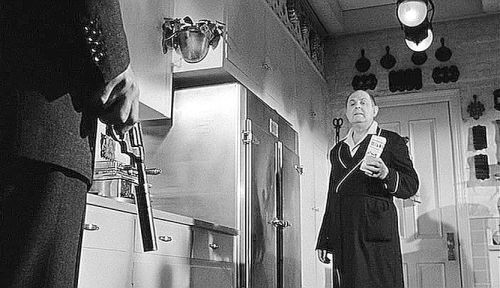
Another evocatively directed scene is the murder of the Jordans. Shaw comes to the house late at night. Jordan tells Shaw he's happy to welcome him to the family. In the above both Jordan and Shaw are enveloped in shadow, contrasting Jordan's happiness at having a son-in-law and our knowledge of what is to come.


As Shaw pulls out his gun, Frankenheimer doesn't show Raymond's face. He's no longer Jordan's son-in-law- he's his executioner. 


Several shots later we see Raymond in a low angle show. He looms over us, making even more ominous.

The bullet goes through the milk carton Jordan is holding- concealing the violence while also punctuating the act.


Jocelyn races down and is killed by Shaw. After the murders Shaw is in the mid-ground while Jordan and Jocelyn lay dead in the foreground and background, respectively. Frankenheimer uses every part of the frame to great effect. Shaw is almost like a spectre in this shot- just as dead as his two victims.  

This is a film I would love to see on the big screen. It's images are so absorbing that I feel a theatre screen can only magnify the effect


Here are some other images that stand out:


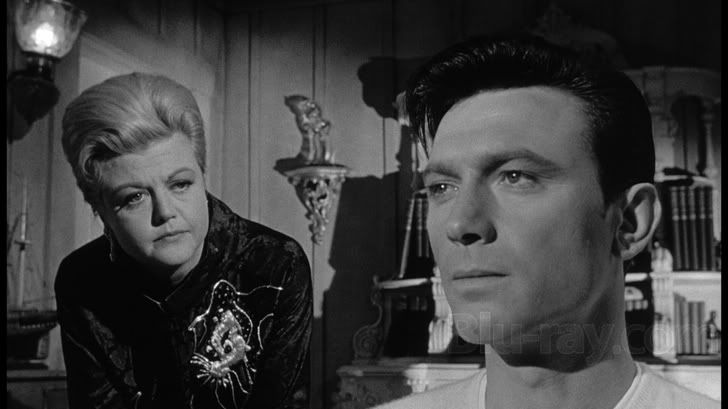
With Mrs. Iselin in the background, she's like a devil on his shoulder. Ultimately  Marco will become an angel of sorts.


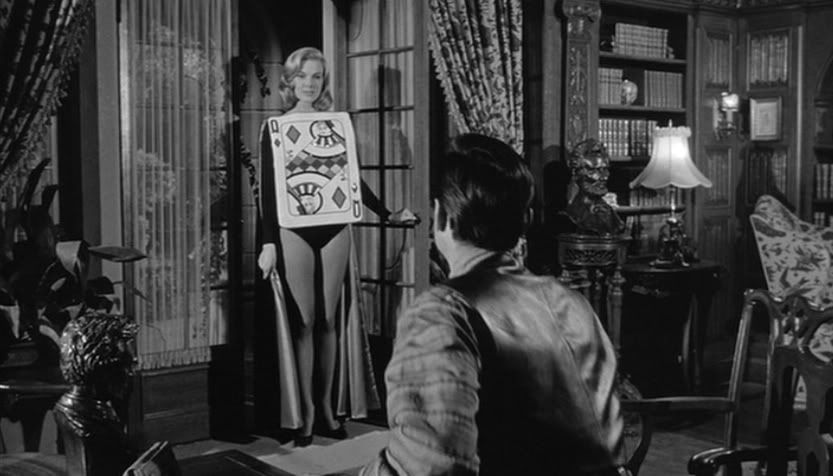
The image of Jocelyn as the Red Queen blends the two things that dominate Raymond's psyche: Jocelyn and the game of solitaire that unlocks his programming. It also underlines Shaw's troubled relationships with women.


Mrs. Iselin cares not about who her husband really is...only the image which she can project unto the public.


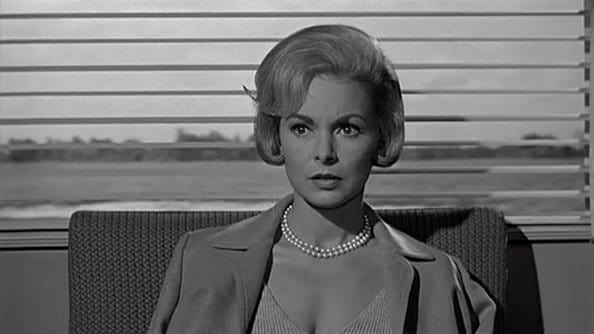
Now, I need to talk about the film's most unusual sub-plot, that of the relationship between Marco and Rosie Cheney (Janet Leigh). Rosie first meets Marco on a train to New York a Marco attempts to discover the truth about Raymond. They exchange an odd bit of dialogue, which has led some to theorize Rosie is Marco's handler or an agent of some kind. The back and forth between Marco and Rosie comes across as code rather than naturalistic dialogue. Moreover, when Rosie comes to bail Marco out of jail she says she's broken up with her fiance after meeting Marco. Her falling in love with Marco is very sudden- which isn't entirely unique to this film. While one can chalk it up to Marco requiring a love interest, in this movie you have to suspect everything.

Before I wrap things up, I want to focus a little more on the character of John Iselin. He's clearly a stand-in for McCarthy but his wife is the one pulling the strings. However Iselin is still dangerous- as Jordan points out when he's speaking to Mrs. Iselin. Jordan says Iselin is viewed as a fool but he does not. I couldn't help but think of Donald Trump during Jordan's speech.The film uses the figures of the Iselins to comment on McCarthyism. The film says there is evil in America but in the form of those pretending to act in the country's best interests. 

I want to mention another person involved with the film's production. Firstly, David Amram's score that invokes the melancholy and surreal nature of the film. Seco 

The Manchurian Candidate was made in the 60s, set in the 50s- yet remains somewhat out of time- an eerie else-world. Yet it still speaks to its time and ours as well. I appreciate the film now more than I did a decade ago. It's an evocative masterpiece that-akin to the brainwashing done to characters at the centre- imprints itself on our psyches- haunting us more than 50 years on.

Tuesday, 11 June 2013

The Essential Films: "Whatever Happened to Baby Jane?"


A Series of Writings on Films that I feel are essential viewings for film lovers, coupled with films that are personal to me

I don’t think a film like Whatever Happened to Baby Jane? would be possible in today’s Hollywood. Or, a better way to put it, I don’t think it would have the same effect. Here is a film that stars two Hollywood titans who’s off screen relationship so affects our reaction to onscreen events that it’s hard to think of two actresses who could pack so much personal subtext in to their performances and our reading of the film. Bette Davis and Joan Crawford really did hate each other in real and no doubt it must have been a joy for Davis to psychologically and physically torture her. And there is a certain twisted pleasure the audience gets from this.

The film begins in 1917 where Baby Jane Hudson is a famous child star on the Vaudeville stage. As she gets older, she begins to appear in films but in an ironic twist of fate, it is her sister Blanche Hudson, who had been in her sister’s shadow when they were children, becomes the more popular and beloved star. One night Jane drives her car in to Blanche, crippling her. The rest of the film takes place in 1962- Blanche now spends her life in a wheelchair in a house being taken care of by her sister.  

I feel that how you approach a film is important to judging it fairly. If one goes in to this film expecting something that wants to be taken completely seriously, then one may start criticizing this film as too silly or “hammy” to be taken seriously. But I think the key to enjoying the film is to understand that the film is largely a black comedy, as well as a psychological thriller. The film, I believe, wants you to laugh at the relationship between the Hudson sisters. What’s miraculous about the film is how it both has this darkly humorous edge while still working as a compelling, tragic and empathetic psychological thriller. Outside of Alfred Hitchcock, I don’t think there are many directors who can pull off this feat- but director Robert Aldrich, director of the great film noir, Kiss Me Deadly,  is able to both play much of the film for sinister laughs, while still creating a genuine sense of fear and suspense that gets us invested in the story. He also finds the tragedy in this story. Both Jane and Blanche used to have it all, now Blanche is crippled and Jane is mentally sick, still in many ways a little girl who likes to torment her sister and who still clings on to her former fame as a child star.

I think Whatever Happened to Baby Jane? would make a great double bill with Billy Wilder’s Sunset Boulevard, made 12 years earlier. Both films deal with former actresses, Norma Desmond and Jane Hudson who become disillusioned and bitter when they’re no longer famous. Sunset Boulevard is more of a satire but both films show a dark and twisted side of show business, where people who never knew anything but fame shrink in to insecurity. When Jane goes to put out an advertisement for a piano player to help her revive her act she mentions that she’s Baby Jane Hudson, but the younger men at the office don’ t have the slightest idea who she is, though she doesn’t catch on to this fact. Norma and Jane both live in almost gothic mansions, shut away from society. Norma’s only companion is her former husband and director, now servant, Max Von Mayerling. Jane only really has Blanche, who despite being treated poorly, does care about Jane’s health. Both Norma and Jane also try to revive their careers through the help of a younger man- William Holden’s screenwriter Joe Gillis who happens upon Norma’s mansion- and Victor Buono’s piano player Edwinn Flagg. Both films eventually end with Norma and Jane completely detached from reality, convinced they still have an audience.

Blanche has a firmer grasp on reality. I think this has to do with the fact Blanche became famous later in her life than Jane, who was shoved in to the spotlight when she was only a child. Blanche had enough distance from the craziness of Jane’s life that she was able to understand the pressure of being famous even before she became a star. The fact that Blanche became a bigger star than Jane is a big reason for Jane’s bitterness and hatred towards Blanche. That and the fact she has to carry around the guilt of crippling her sister. At the end of the film we learn that it was Blanche who crippled herself when she tried to run over a very drunk Jane. “You mean all this time, we could’ve been friends?” Jane asks. Like a lot of the film, it’s both funny and tragic. These two sisters, due to their upbringing and careers never really had the chance to have a normal, healthy relationship.

Aldrich’s restrained visual style contrasts well with the more macabre elements of the story. If his visual style was too assertive, we’d probably feel smothered by the camp horror.  Like Kiss Me Deadly, Aldrich finds a tone that is both cold but still absorbing. I love a lot of his camera angles and way he shoots Davis and Crawford. Just through their close-ups. Davis is grotesque, covered up in make-up that makes her look like a living doll- creating a link between Jane and the Baby Jane dolls from her time as a child star, one which she still keeps. Crawford is haggard, but we can still see the beauty that made Blanche, as well as Crawford, a star. This film uses footage from Davis and Crawford’s actual films, so it’s very impactful seeing the younger Davis and Crawford in this film and having the contrast between their younger and older selves. When we first see the older Blanche, she’s watching one of her older movies. There’s an added poignancy to the scene since Crawford is literally watching her younger self.

The title of the film asks where Baby Jane went. And the answer may be that nothing ever happened to her, she never grew up, never moved on or went away. Jane is still that little girl, stuck in a twisted kind of arrested development.   Her dancing on the beach at the end suggests that even if Jane had moved in to adulthood, has no regressed back in to the child Baby Jane. It’d be simplistic to say this is a just a cynical film about show business/Hollywood, but I do feel the film is a tragedy about that world. As in Kiss Me Deadly, Aldrich puts us in a reality that is a nightmare version of our own, but finds thematic and, in the case of this film, emotional truths that allow us to connect with the stories. Jane and Blanche represent the broken lives of two women who, in a better world, could’ve been best friends.    

Saturday, 16 February 2013

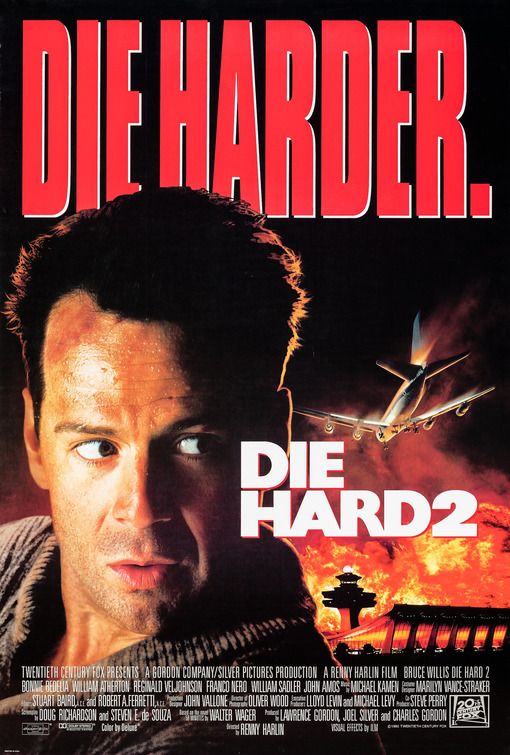
Die Hard Series Retrospective Part 2: "Die Hard 2" (1990)


For better or worse, of all the Die Hard sequels, Die Hard 2 feels the most like a sequel to the original film, in terms of its tone, atmosphere, and returning characters. With this sequel we begin to see the problem, further highlighted by the next two installments, of making a sequel to Die Hard. Make a film too close to the formula of the original film, like Die Hard 2, and it makes the audience conscious of watching a sequel that's similar but not as great as the original. Make a sequel that's tonally and structurally different from the original, with Die Hard With a Vengeance and Live Free or Die Hard, and it feels like the series is departing too far from the original premise. All that being said, Die Hard 2, while sometimes feeling too conscious of being a sequel, and repeating several of the elements from the first film, manages to balance those formula elements while still feeling like its own film. It's as rock solid as a sequel can get and is one of the most entertaining action films of the 1990s.

The plot of the film revolves around General Ramon Esperanza (Franco Nero), drug lord and dictator, who is being extradited to the United States to stand trial for drug trafficking charges. Colonel Stuart (William Sadler), of the US Army Special Forces, and his men take over Washington's airport systems from a church and demand that Esperanza's plane not be met by anyone and also demand a plane so they can all escape to another country. Of course, guess who's also at the airport. That's right- John McClane (Bruce Willis). It's Christmas Eve again and his wife Holly (Bonnie Bedelia) is on one of the planes that can't land wiithout landing lights and is running low on fuel. Once again McClane is "up to his ass in terrorists" and has to use his wits, and his gun, to save his wife and the other people up in the air as well.

This is where one of the problems of Die Hard 2 comes in. As I said earliier, the film is very conscious of being a sequel, particularly in McClane's reaction to the situtation. It's not a completely bad thing. We hear, in the confrontation between McClane and Carmine Lorenzo (Dennis Franz), captain of airport police, that McClane became famous for a while after the situation at Nakatomi. And Colonel Stuart tells McClane he thought he was out of his element while being interviewed on Nightline. These references give some nice texture to the Die Hard universe and grounds the film in reality- of course people would know who McClane was, even if they didn't respect him. On the other hand, when McClane says the line  Oh man, I can't fucking believe this. Another basement, another elevator. How can the same shit happen to the same guy twice?" It feels like the screenplay is laying it on a little too thick, and being a little too meta. While the line suits the everyman quality McClane posseses, it lends itself too much to parody and plays up the absurdity of the situation that would best be left unsaid.

I think Die Hard 2 is the most unnerving and terrifying of the Die Hard films, which is largely due to the scene is which Stuart, in response to McClane interfering, makes a plane crash by talking to its pilots. It's a harrowing and devastating scene, particularly in how McClane tries to make it pull up but fails. It's actually surprising that this scene made it in to the film- and in our post 9/11 age, it's even more unsettling. It's also in this scene where we see how ruthless Stuart can be. Sadler is utterly convincing as the calculated Stuart. He makes you really hate him, and as an aspiring actor myself, I admire him not being afraid to play such an unlikable character. He also has one of the most memorable introductions I've ever seen for a villain (nakes ti-chi!). He's not as great a villain as Alan Rickman's Hans but he's very memorable.

This film has some pretty strong action scenes, such as the catwalk ambush and the snowmobile chase. I love the scene where McClane has to eject himself from a plane cockpit to escape the villains' grenades. It provides the most memorable shots from the film. Renny Harlin, the finnish director who almost directed Alien 3 and would go on to direct the Sylvester Stallone film Cliffhanger, handles the action pretty well for his first big budget action film.

An essential component of the first Die Hard was the claustrophic surrounding that also allowed enough movement to create thrilling action. I like how this feel generates claustrophobia for McClane by having his wife stuck in the air- an interesting twist on the situation from the first film. McClane can leave the airport but he still needs to see this adventure through to the end. He also has to clash with Lorenzo, who wants nothing more than to kick McClane out of his airport. Franz is perfect as the arrogant blowhard Lorenzo but the character is pretty monotonous. I do like that when McClane finally makes Lorenzo take him seriously- via the blanks the supposedly "good guys" led by Major Grant (John Amos) were using against Stuart (Grant and his men are in cahoots with Stuart)- Lorenzo simply says "It's time to kick ass." It's a nice and simple way to show Lorenzo finally trusting McClane as well as ready to show he's not just a bureuacrat.

The film isn't quite as soulful as the first film, which at its heart was about a guy trying to fix his marriage. That was the metpahor for the entire film. In this film, Holly and McClane's marriage is doing well so having Holly being on board one of the planes is more of a plot device-albeit a relatable and emotional one for McClane. The movie isn't entirely soulless- McClane not being able to save the plane shows how McClane isn't the perfect action hero who can save everyone- and the reunion between Holly and McClane is touching. I do wish Richard "Dick" Thornburg (William Atherton) went through an arch of redemption rather than just be the same slimy reporter he was in the first film but I'm glad Holly is portrayed as an assertive woman rather than a damsel in distress.

Die Hard 2 is a very entertaining and well paced action film that's very lean and brutal- as well as unpretentious about what it wants to be. It's also arguably the only Die Hard sequel that feels like a sequel to Die Hard. It doesn't match the greatness of the first film but it's still a damn good film. Next up, probably my favourite of the Die Hard sequels: Die Hard With a Vengeance.

Monday, 19 November 2012

Noirvember: Even Criminals Have Dreams, or: The Maltese MacGuffin: An Essay on John Huston's "The Maltese Falcon"


Alfred Hitchcock once gave a lecture where he described the term MacGuffin: [W]e have a name in the studio, and we call it the 'MacGuffin'. It is the mechanical element that usually crops up in any story. In crook stories it is almost always the necklace and in spy stories it is most always the papers." Later, in an interview with the director Francois Trauffaut, he illustrated the concept of the MacGuffin with a story:

"It might be a Scottish name, taken from a story about two men in a train. One man says "What's that package up there in the baggage rack?", and the other answers, "Oh, that's a McGuffin". The first one asks "What's a McGuffin?" "Well", the other man says, "It's an apparatus for trapping lions in the Scottish Highlands". The first man says, "But there are no lions in the Scottish Highlands", and the other one answers, "Well, then that's no McGuffin!" So you see, a McGuffin is nothing at all."

Basically, a MacGuffin is what drives a story forward, something that everyone wants- but doesn't really matter what that is. The most famous MacGuffin, I would argue, is the Maltese Falcon, the object at the heart of John Huston's 1941 film, The Maltese Falcon. A jewel encrusted statue of a falcon, it was made by the Knight Templars of Malta to pay tribute to Charles V of Spain, but on its voyage across sea, pirates stole it, and, like Mr. Burns' teddy bear, it has travelled around the world for more than 300 years. Private detective Sam Spade (Humphrey Bogart) gets caught up with the criminals looking for it, headed by Kasper Gutman (Sydney Greenstreet). What's great about the Maltese Falcon, the object I mean, is that it transcends the usual definition of the MacGuffin, something arbritrary, and becomes important in defining the psychology of the villains of the film, particularly Gutman. The Falcon is part of the film's thematic concerns with obsession, history repeating itself, as well as fate, since it was made before any of the characters in this film were born, setting in motion of the events of the film. The idea of fate and of people being doomed from the outset is integral to the film noir universe.

The film, while shown through the perspective of Sam Spade, is at its heart the quietly tragic tale of a man obsessed with finding the Falcon, chasing a dream that's always just of out reach. As the title of this essay suggests, even criminals have dreams. Gutman tells Spade how he almost had the Falcon when a Greek dealer discovered it in a shop in 1923. Gutman went to find this dealer, only to discover he had been murdered and the Falcon stolen. "If I'd only known a few days sooner," Gutman sighs, and you can feel his disappointment and regret. For anyone who's almost had something that was still out of reach, even if it was something small, this is a painfully resonant moment.

At the end of the film, Gutman finally gets the Falcon, after it comes in by ship, but it turns out to be fake. At first he's speechless, and even more stressed out by his associate Joel Cairo (Peter Lorre) calling him a stupid fat idiot and crying. Gutman then tells Cairo there's no point in calling each other names and being upset. They continue on their journey in surprisingly high spirits. While re-watching the film, it struck me that maybe the chase is more rewarding than the actual prize, even if Gutman doesn't realize it. What would he do with the rest of his life if he found it? History repeats itself, with Gutman and Cairo continuing to pursue the Falcon, possibly running in to another Spade like figure. That may be Gutman's ultimate fate, in search of something he'll never have.

But for Brigid O'Shaughnessy, (Mary Astor) the hunt for the Falcon leads her to prison. Sam discovers that she killed his partner Miles Archer and decides to hand her over to the police. How we view Brigid is a complicated matter. Do we sympathize with her or are we annoyed and disgusted at her constant lying?  I feel it's a little bit of both. Sam is pretty ruthless in sending her over, telling her if she gets out in 20 years he'll be waiting and if she's hung, he'll always remember her. Any dreams she had of a better life, a life with Sam maybe, are down the drain. At the same time, Brigid's constant lies are pretty exhausting and she could've come clean earlier, or, here's a thought, not killed Miles at all. There was no real reason for her to kill him, except for trying to fram her accomplice Floyd Thursby. Sam also makes a good point when he says if he lets Brigid slide, she'll have stuff on him she'll be able to use whenever she wishes, and vice versa, which may lead to her killing Sam. That's not exactly a healthy relationship. Ultimately, the situation is tragic for both of them, since, as Sam says, maybe they do love each other. Sam watches as Brigid is taken by the police in to an elevator, creating a metaphoric image of her behind bars.


The villain I sympahize most with in the film is Wilmer (Elisha Cook Jr.), Gutman's gun man. He's just a kid and when Sam is trying to set him up as a fall guy, you see that Wilmer is on the verge of crying. I find myself actually wanting Wilmer to knock Sam out. I think this is because if I was Wilmer, I'd be in the same situation, being patronized and bullied by someone like Sam. Sam is kind of a bully in this film, whether it'd be "riding" Wilmer or beating up Cairo due to his "effiminate" nature. Spade also doesn't seem to care that his partner got murdered, kissing his widow the first chance he gets. In many ways, Sam is the least sympathethic character in the whole film.Though at the end of the film, he does show some nobility by saying that he even though he didn't like Miles, he was his partner and he deserves justice. Ultimately, Sam, while maybe not always the nicest guy, does remind of he is the hero of the film, even though he's an anti-hero.    

This was director John Huston's first film, and what impresses me most about the film is how Huston composes his shots, allowing us to see multiple actors in a single frame and seeing their body language. While the film's visual style is subtle, it's also quite dynamic. In the first scene, we Spade and Miles over Brigid's shoulder, highlighting them as an audience for Brigid's vulnerable girl act, which they like, even though they don't know Brigid's act hides darker intentions. Cairo's introduction is jarring, in a good way, when he's immediately standing over Spade's desk after Spade's secretary calls him in. It's startling and unnerving, showing how far down the rabbit role Spade is actually going.

The climax of the film, which is mostly exposition, and taking place in Spade's apartment, is a feat of staging as well as acting. Greenstreet is marvelous at delivering exposition while giving a sense of Gutman's personality. Huston also knows how to effectively isolate his actors in different parts of the frame. They're an audience for each other.  

The Maltese Falcon, like all film noirs, is very stylized, in its look and dialouge, and like those film noirs, reveals more depth on closer inspection. It's about the moral choices that define our futures, but also about how no choice is completely moral.

Tuesday, 2 October 2012

50 Years of Bond: "On Her Majesty's Secret Service"


This year marks the 50th anniversary of the James Bond franchise, and the 23rd Bond movie, Skyfall, is set to hit theatres this November. I thought now was a pretty good time to revisit several of the Bond films. I'll probably not cover every film but I'll discuss the most important films in the franchise as well as my personal favourites, which do overlap frequently. Now it's time to look at what's arguably the most controversial Bond film in the series' history: On Her Majesty's Secret Service.

Note: This is a revised version of a review I did a little over a year ago. The original review can be found here.

On Her Majesty's Secret Service is a paradoxical Bond film in that while the film, and especially its lead actor, have been overshadowed in the past by other Bond films, the film is actually one of the best in the series. It's a film that combines the kind of spectacle and intense action one would want from a Bond film, while still telling a shockingly poignant story about James Bond actually falling in love and having to confront the idea of quitting the British Secret Service. It's the most grounded Bond film since From Russia With Love and the closest in spirit to the original Ian Fleming novels since that film.

After Sean Connery announced his retirement from the role while filming You Only Live Twice, the Bond producers, Albert R. Broccoli and Harry Saltzman, made two signficent changes to the Bond series-one by nescessity and one by choice. The nescesarry change, of course, was to find another actor to play the iconic superspy, which was the most daunting task they had to face since casting Bond in the first place The change they made by choice was to ground the series back in to a semi-plausiable reality-the previous film had taken the series all the way in to a hollowed-out volcano. This would be a pattern as the series continued-when things became too fantastical, the series would have to be reigned in and find a comfortable middle ground between escapism and reality-which this film does very well.

When Sean Connery retired from the role, Broccoli and Saltzman made a surprising choice, an Austrailian model with no acting experience outside of commericials, George Lazenby. They even make a pretty big deal out of it in the pre-title sequence, not showing his face until he introduces himself to the woman who'll change his life, Tracy di Vicenzo (Diana Rigg). Bond stops her from drowning herself in the ocean. They're attacked by some unknown thugs, which Bond dispatches. As Tracy gets away, Bond breaks the fourth wall and says "This never happened to the other fella." This was a way of "breaking the ice," so to speak and shows that changing actors for the first time was deemed to require some self-consciousness on the film's part. Even the title sequence shows images from the previous five films. The theme for the film, orchestrated by John Barry, is the first without lyrics and this is the first title-sequence since From Russia With Love that's just instrumental. The theme really captures the propulsive energy of the film as well as its epic nature.

I think the reason why On Her Majesty's Secret Service is still not as widely embraced as Goldfinger is probably due to the controversy regarding its Lazenby- and the fact that he  only played it once plays in to the notion that he was pretty horrible as Bond. Honestly, I like Lazenby, I even like him more than Roger Moore. Lazenby doesn't have the presence of Connery but he feels more real to me than the Connery of the last two Bond films. He's more posh and refined than Connery's Bond, who had a certain roughness about him. Like Moore after him, Lazenby is very much the English gentleman. Nevertheless, physically he's believable as someone who can handle himself in a fight and it's this aspect of his performance that is usually praised. There's a debate about whether Connery could've pulled off the vulnerbility and the romantic side of this Bond. Honestly, I'd be interested to see what Connery would've done in this film-it could've been his best performance in the role. But to be fair, this isn't a Connery Bond film-it's not even a Lazenby Bond film-it's more like an Ian Fleming Bond film.

The plot of the film deals with Bond's determination to take down the head of SPECTRE, Ernest Stravo Blofeld (Telly Salvalas). Marc-Ange Draco (Gabriele Ferzetti), head of the largest crime syndicate in Europe, offers Bond information on Blofeld's location in exchange for Bond marrying his daughter Tracy, the same woman Bond rescued in the pre-title sequence. Bond is at first hesitant about wooing Tracy, saying he prefers the bachelor life. It's a nice little moment of self-consciousness for Bond, one of those moments that makes Bond feel real to us. Eventually him and Tracy do start to fall in love and we get a lovely montage- not seen in a Bond film until now- of Bond and Tracy spending time together, set to Louis Armstrong's touching song "We Have All the Time in the World." The montage is without dialogue but with simple images and music the film captures the joy and poignancy of falling in love for the first time. It was actually quite a bold decision to stay true to the love story element of the novel, particularly since audiences were used to Bond being a womanizer without strong emotional attachments to the women he slept with.

But before things get too "mushy," the film shifts directions from love story to spy story in the middle section of the film, which involves Bond going uncover as geneologist Hilary Bray at Blofeld's clinical research insitute in the Alps. Unfortunately, in these scenes Lazenby is dubbed by George Baker, who plays the real Bray and I think it distracts a little from Lazenby's performance. Blofeld wants to claim the title of 'Comte Balthazar de Bleuchamp,' giving Bond the perfect in. Bond soon discovers Blofeld is brainwashing ten young women to dispurse bacteriological warfare agents in to the world. Blofeld, in typical Blofeld fashion, will hold the world ransom- and in typical Bond villain fashion explains the plot to Bond even when he figures out Bray is Bond. It's a fun little continuity error that Blofeld only seems to know Bray is Bond after he slips up a geneological detail even though Bond and Blofeld met face to face in You Only Live Twice. This may be due to the faithfulness of On Her Majesty's Secret Service to the novel, which comes before You Only Live Twice in the novel chronology. One could also chalk this up to Bond getting plastic surgery because his face had become too well known to his enemies, which was the original idea to explain why Bond know longer looking like Sean Connery.

Salvalas is sometimes criticized as playing Blofeld like a mob boss but I like his performance and feel he gives the best performance as Blofeld out of the three actors who physically played him the official series, the other two being Donald Pleasence and Charles Gray. His Blofeld, like Lazenby's Bond, is more grounded than previous incarnations. Blofeld is no longer just a hand stroking a cat, his face unseen, nor is he the Dr. Evil-ish figure from You Only Live Twice. He's determined and subtly sinister, and I wish Salvalas had a few more dialogue scenes. I also feel the confrontation between Bond and Blofeld in this film is much more satisfying in this film than it was in You Only Live Twice. Here's there more of a dynamic between them being face to face- a genuine feeling these two are arch-enemiies

As mentioned earlier, when Bond goes to Blofeld's clinic, the love story is put on hold- only for Tracy to rescue Bond when he escapes the clinic and is being chased by Blofeld and his men. They share a wonderful scene in a barn where Bond is at his most vulnerable. He tells Tracy he'll never find another girl like her and asks her to marry him. The structure of the film is the one thing that always feels off to me. The shift from the emotional story to the second act of the film is perhaps too rushed. I would have liked a final scene between Bond and Tracy before he left on the mission and maybe a little bit more of Tracy back home as well as a lead up to when she meets Bond yet again. Nevertheless I feel the film does a good love of giving equal weight to both the spy and love story, and the tragic ending brings them completely together. I like the idea of Bond being saved by Tracy instead of the other way around. It puts a nice twist on the whole "damsel in distress" situation when Bond saves Tracy from Blofeld's clinic.  It's Bond's way of saying "thanks" and returning the favour in a pretty explosive fashion.

Diana Rigg is arguably the best Bond girl in the series though I think I still love Honor Blackman and Shirley Eaton in Goldfinger more. Nevertheless, until Vesper Lynd in Casino Royale nearly forty years later, I think Tracy is the most complicated and complex Bond Woman in the series. She is strong willed yet she still has the desire to die. She is independent but still needs someone in her life to love her. Ultimately, Bond is able to give her a future, as she says at the end of the film. Rigg brings an intelligent and self-awareness to the role-she's a real person and one that Bond feels the desire to understand and to help.

After Bond and Draco save Tracy from Blofeld's clinic and foil Blofeld's plan once again, Bond and Tracy do get married. As they stop their car to clear off some of the flowers, Blofeld comes driving by with his henchwoman Irma Bunt (Ilse Steppat) firing a machine gun at the car. Bond gets in the car, discovering Tracy has been shot and killed. A police officer drives up and in Bond tells him Tracy is just resting and that they have all the time in the world. Lazenby's speech is all done in one take and I think this is his best moment on screen. Heartbroken and in shock, unable to truly say what he must feel, he pretends like everything is okay. As he puts his head in her dress and sobs, it's devastating and shows real courage by the filmmakers to stay true to Fleming's vision of a world where Bond constantly has his heart broken but remains a survivor in the only world he'll probably ever know, the world of a spy, where true happiness can be taken away in an instance. In a weird musical shift, the orchestratal version of "We Have All the Time in the World" sag ways in to the Bond theme. I think it would've been much better to just stay with the love theme, keeping true to what this film is about, rather than saying "Bond will be back!" with the Bond theme.

Peter Hunt, who had been a editor on the previous Bond films, sat in to the director's chair this time and I feel his work as an editor aided him very well in putting together the action sequences with his editor John Glen, who would also go on to direct all the Bond films in the 1980s. The action is intense and fast but still easy to follow geographically. The "zoom ins" when Bond throws his punches in the pre-title sequence. I love that the last 45 minutes or so of this film feel like an extended suspense/action sequence, with occasional quieter moments. From the moment Bond escapes the clinic, there's a propulsiveness that we haven't quite seen since the final act of From Russia With Love or Goldfinger.  When the clinic is attacked, it's able to take the climax of the previous Bond film, in the volcano, and put it on a smaller yet still invigorating scale. When the Bond theme plays and Bond is sliding on his stomach down ice, firing his machine gun, it's a pretty cool moment. The blobshed show-down between Bond and Blofeld is edited in a fashion that makes Blofeld getting his neck stuck in a branch a great payoff.

Lazenby supposedly felt Bond would not survive in to the seventies so he quit the role and as a result I don't think he's ever transcended the label of "that guy who only did one movie," or "being an answer to a trivia question" though he undeniably has admirers. I count myself as one. If he had played Bond a few more times he may have found his groove and become a more respected Bond. When he decided to quit being Bond, I think it made the producers want to ignore this film as much as possible for the next go around. Connery returned for the next film, Diamonds are Forever (1971), which is really bad follow-up to On Her Majesty's Secret Service, being much sillier and campier, whereas with Lazenby, it could've been a strong revenge story for Bond- and it's only until The Spy Who Loved Me (1977), where Tracy is actually mentioned. It's a shame that the series ditched much of the seriousness of this entry and eventually became much too goofy in the next film and several of the Moore films. Still, On Her Majesty's Secret Service is a poignant, funny, exciting, and ultimately tragic film which gives us what feels like an authentic human being in James Bond. It's not just a great Bond film, it's a great film on its own terms as well.

P.S. That's it for the 60s Bond era. From now on, I won't be going through all the Bond films but focusing on specific ones throughout the rest of the series history.

Friday, 28 September 2012

50 Years of Bond: "You Only Live Twice"

This year marks the 50th anniversary of the James Bond franchise, and the 23rd Bond movie, Skyfall, is set to hit theatres this November. I thought now was a pretty good time to revisit several of the Bond films. I'll probably not cover every film but I'll discuss the most important films in the franchise as well as my personal favourites, which do overlap frequently. Next up: You Only Live Twice.

For it's time, You Only Live Twice was the pinnacle of how outlandish the Bond producers were willing to go in terms of the series. This was when the series had completely become a genre of its own-the James Bond genre. At the time, this was also going to be Sean Connery's final film as James Bond. He announced his retirement during filming, most likely becoming and bored and feeling boxed in by the role. It's hard to blame him, especially since the films were becoming more about spectacle than the actual character of James Bond. The character was still the draw for audiences but Connery was just going through the motions now and he wasn't really being challenged as an actor. While this wouldn't turn out to be Connery's final outing, it's the last one that feels like a true 60s Connery Bond film, an end of an era of sorts. As I said earlier, it's probably the most outlandish film in the series yet-and there's some unfortunate rascist and sexist overtones- but if you're willing to embrace the film for what it is, it's pretty enjoyable escapism. 

The plot of the film involves the abduction of an American space shuttle by a spacecraft in the pre-title sequence. The Americans believe the abduction to be the work of the Russians, which causes tension between the two countries. The British suspect the Japanese to be involved since the spacecraft landed in Japan. We cut to Hong Kong where Bond is in bed with a woman. She gets out of bed and pushes a button that launches the bed in to the wall. Men come in with machine guns and shoot through the wall. Like the beginning of From Russia With Love, it's pretty shocking to see Bond killed before the credits roll. But as the title, and title song, sung by Nancy Sintra, implies, Bond may not be dead quite yet. As we exit the title sequence, Bond's coffin is being buried at sea. Scuba divers bring it on board a submarine and we discover Bond has faked his death. This will make it easier for Bond to go undercover in Tokyo and discover who's behind the disappearance of the American space shuttle.

Tokyo is arguably the most "foreign" location in a Bond film up to this point. In Tokyo, Bond teams up with Tiger Tanaka (Tetsuro Tamba), head of the Japanese Secret Service. He meets Tiger by being lured in to a subway station by Aki (Akiko Wakabayashi), Tiger's assistant, and then falling through a trap door. It's a fun Bond movie moment where we're led to believe Tiger is the villain but realize he's on Bond's side. Tiger serves as the Karim Bey of the film and I like the interplay between Bond and Tiger. The name is pretty cool as well. There's a scene that's humourous only because it's so blantantly and uncomfortably sexist where Bon and Tiger are at a bath and Tiger tells Bond "In Japan, men come first, women come second," to which Bond replies "I might just have to retire here." It's pretty cringe worthy hearing Bond be so nakedly sexist but at the same time it's interesting to view these early Bond films as time capsules of both a less enlightened and yet sexually aggressive time. The Bond series would eventually mature out of its sexist roots but at this time, it was still pretty cavailer towards women.

There's also the bizarre plot point of James Bond becoming Japanese. In order to remain undercover while on the island where Tiger trains ninjas, Bond has to get a makeover-except the it doesn't really make him look Japanese. His hairdo is a little more in the Japanese style and the corners of his eyes are widened but he still looks like Bond-or at least the Paul McCartney version:


This transformation is another element in this film that just wouldn't fly. It's nearly as bad as Mickey Rooney in Breakfast at Tiffany's but it's still pretty bad. At the same time, the matter of fact nature of the transformation is what makes somewhat funny.

While I haven't read every Bond novel, I would argue that, up to this point, You Only Live Twice is the least faithful to the original novel on which it's based. The novel followed On Her Majesty's Secret Service, the novel in which Bond gets married to Tracy Di Vicenzo, who is then murdered by Blofeld. The novel was about Bond dealing with the loss of his wife when M assigns him to a mission in Japan to gain information from Tiger Tanaka. Tiger wants Bond to kill a Dr. Gunthram Shatterhand, who operates a garden with poisonous flowers where people go to commit suicide. Bond discovers that Shatterhand is Blofeld. Bond eventually get revenge for his wife's murder and kills Blofeld. After blowing up Blofeld' castle, Bond suffers a head injury and loses his memory. The film version of You Only Live Twice was made before On Her Majesty's Secret Service in the film chronology, so it couldn't be a straight adaptation of the novel. The novel was thematically and emotionally more interesting whereas the film goes for a more escapist feel. 

Blofeld still factors in to the plot since it is SPECTRE that is behind the abduction of the American space shuttle, and who later captures a Russian space shuttle. SPECTRE has been hired by an Asian organization to create tension between the US and Russia and start World War III. While Blofeld is still the shadowy figure pulling the strings, this is the first Bond film where Blofeld is the main villain- and near the end of the film we finally see Blofeld's face. Donald Pleasence plays Blofeld and while he gives a fine performance, he doesn't match up with the Blofeld from the previous films. His voice is a little too high and to me, he seems too short. I think it comes down to Blofeld being more intimidating when we don't see him. The meeting between Bond and Blofeld isn't very satisfying either, seeming to be more of a set-up for future confrontations now that they've met face two face. The confrontation between them in the next film, On Her Majesty's Secret Service, will be much more satisfying. 

The action in the film is pretty spectacular. The sequence where Bond flies the mini-helicoptor Little Nelly to investigate an island and gets in a fire fight is a highlight. So is the hollowed out volcano where Blofeld is operating. Throughout these writings I've unforgivably forgotten to mention Ken Adam, who was the production designer for many of the Bond films, including this one. The volcano headquarters actually feels tangiable  and the final shootout in the volcano, with ninjas coming down on ropes, is marvelously epic.

Unfortunately, the Bond women don't get a lot of character development. Aki is eventually murdered by poison that is meant for Bond. While it's sad, Bond pretty much moves on to the woman he's pretending to be married to, Kissy Suzuki (Mie Hama). Kissy becomes the main Bond women of sorts but I wish there was more time to develop her character-especially since her arc in the film is to go from someone who just wants to pretend to be married to Bond to actually falling for him.

You Only Live Twice is an enjoyable Bond film but On Her Majesty's Secret Service will be more emotionally complex and resonant and closer to the spirit of the Ian Fleming novels. James Bond will return in: On Her Majesty's Secret Service.