Showing posts with label 50 Years of Bond. Show all posts

Sunday, 11 November 2012

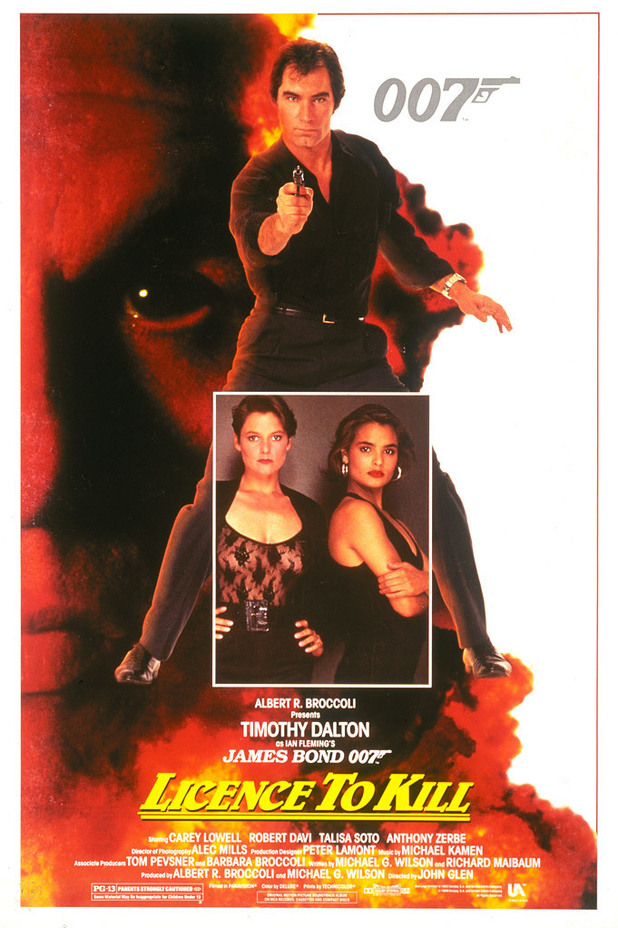
50 Years of Bond: "Licence to Kill"


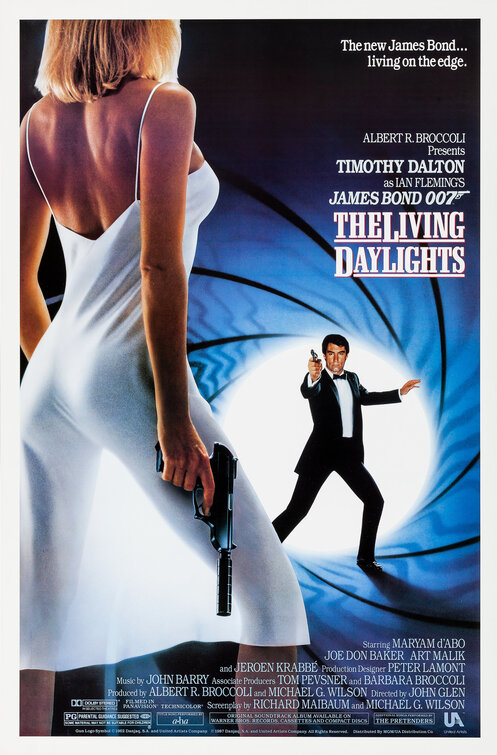
On the commentary for The Living Daylights, director John Glen says the film was tailored to fit the new James Bond, Timothy Dalton's strengths. Still, it's easy to see The Living Daylights as a transition film for the series as it moved from the more comedic Roger Moore outings to Dalton's hard edged portrayal. With Dalton's next film, Licence to Kill, the series would go darker and more violent then ever before, a big risk since the series has always been a little more kid friendly. I really like this film, and as I mentioned in the previous review, rewatching both of Dalton's films reminded me how passionate, romantic and urgent they are. You really get involved in the character and they have a strong emotional centres.  There's some solid storytelling in both of them and they feel like genuine updates of Ian Fleming's novels.

The film takes a different approach to the usual Bond movie plot. The film begins with Bond and his CIA friend Felix Leiter (David Hedison) heading to Felix's wedding when Felix's colleagues in the DEA call him in to help capture drug lord Franz Sanchez (Robert Davi), who has appeared in Miami. Bond comes along and in one of those great practical Bond movie stunts, Bond, while in a helicoptor, attaches a hook to Sanchez's plane and pulls it out of the air. Bond and Felix then parachute down to Felix's wedding, leading in to the title sequence. Sanchez bribes DEA agent Ed Killifer (Everett McGill) who helps Sanchez escape. Sanchez has Felix's wife Della (Priscilla Barnes) murdered and feeds Felix to a shark, who bites off his leg. Felix is kept alive and Bond swears revenge, to which M (Robert Brown) revokes his licence to kill, an earth shattering moments in the franchise. Bond then escapes from M and continues his quest.

What makes the plot so engaging is that this is one of the rare Bond films where Bond truly hates the villain. While the world isn't at risk this time, the fact the mission is personal for Bond, risking his career and his life for his friend, makes the stakes feel even bigger than saving the world. You really feel sympathy towards Felix, especially when we realize that, like Bond, he too has lost his wife on his wedding day. Felix even mentions that Bond was married to Della when Bond is uncomfortable when Della teases Bond about getting married one day. It's always nice when Bond's marriage is mentioned in the series. It reminds us of how tragic a character Bond is-one of the only times he's made himself vulnerable to a woman, she's taken away from him. He can never truly escape from his profession and have a normal life. Fleming's vision of Bond was a man who could have his heart broken, and we believe Dalton is that Bond.

In an interesting twist, Bond infiltrates Sanchez's operation and makes Sanchez view him as an ally. In a variation on Akira Kurosawa's Yojimbo, Bond makes Sanchez suspicious of the people in his organization, resulting in a pretty brutal sequence involving Milton Krest (Anthony Zerbe), who Bond frames for stealing Sanchez's money. It makes what Blofeld did to his minions look like mild spankings. The film's brutality, while it can occasionally seem gratutious, but at the same time, I've seen more violent films. Moreover, I admire the Bond franchise for actually making the violence sting and cringe-worthy. You really feel the deaths of the characters, even the villainous ones. It also suits the type of world Bond is entering, where drug lords like Sanchez are incredibly sadisitic. Davi is strong here and he doesn't have to work too hard to be believable as a drug lord. He does a fine job making Sanchez both terrifying and also charismatic at the same time, making us believe Sanchez could have this type of power.

Bond is joined on his mission by a CIA pilot named Pam Bouvier (Carey Lowell). Pam is one of the more tough as nails Bond women in the series- and while Lowell occasionally over does it with the toughness, she meshes well with Dalton's performance. A love triangle forms between Bond, Pam and Lupe (Talisa Soto), Sanchez's girlfriend. I believe this is the only legitimate love triangle in a Bond film, where Bond forms an actual romantic relationship with two women. While it's obvious that Bond will end up with Pam by the end of the film, it adds some texture to the story- as well as Pam's character when she becomes jealous of Lupe. Thankfully, the script makes Pam's jealously feel in character so it doesn't result in a pathethic version of the character.

Q (Desmond Llewelyn) gets an expanded role in this film when Moneypenny (Caroline Bliss) calls him in to help Bond. Llewelyn's performance is always a highlight and I like that Q's expanded role make sense in the context of the film-it doesn't feel forced, and there's a little more warmth between Bond and Q due to Dalton's performance. Dalton's "You're a hell of a field agent" shows how much Bond admires Q. On the other hand, Wayne Newton's cameo as a corrupt televangelist Professor Joe Butcher working for Sanchez, while humorous, feels like it belongs in a Roger Moore Bond film. It's a little too cheeky-clashing with the gritty nature of the rest of the film.

The finale of the film, involving tankers full of cocaine, is excellently staged- director John Glen establishes a pretty clear sense of geography and Dalton, while 45, was still an able physical performer. The final confrontation between Bond and Sanchez, where Bond lights Sanchez on fire with the leiter given to him by Felix, is a great emotional payoff to the film. Sanchez tells Bond that he could've had everything, to which Bond asks him if he wants to know why-finally showing him the leiter. Usually the Bond villain knows why Bond is trying to stop him. Here, it's only when the villain loses everything he finally knows why-it was out of friendship and love.

Unfortunately, this would be Dalton's final film as James Bond-due to the next Bond film being delayed so long that Dalton eventually bowed out. Licence to Kill wasn't a huge box office hit, which I think was due to a combination of audiences not warming to Dalton's portrayal or the gritty nature of the film, as well as Licence to Kill coming out during the summer when Tim Burton's Batman and Indiana Jones and the Last Crusade coming out. In retrospective, Licence to Kill is a really involving revenge action thriller that showed the lengths Bond would go to to help a friend. Up until Daniel Craig, Dalton felt the most believable as a rouge agent out for revenge. Six years later, the series would return with a film that's close to my heart, what I think is the Bond film of my generation. James Bond will return in: GoldenEye.

Friday, 9 November 2012

50 Years of Bond: "The Living Daylights"


The idea of a classically trained, Shakespearean actor taking on the role of an action hero sounds like the makings of an SNL sketch rather than an actual reality. But that's what happened when actor Timothy Dalton took on the role of James Bond after Roger Moore finally left the role he had played for seven films over 12 years, his final film being 1985's A View To a Kill. Dalton had been approached by Bond producer Albert R. Broccoli back in 1968 when Sean Connery had first retired from the role and Broccoli was looking for a new 007. Dalton, who was 24 at the time, thought he was too young and declined the offer. Dalton was approached several times during Moore's tenor, including after when Moore finally retired. Dalton had committed to another project at the time. Producers turned to Pierce Brosnan, who was eventually locked in to play Bond. Remington Steele, the TV show on which Brosnan was appearing at the time, had been been cancelled, leaving Brosnan free to play the role. At the end of the fourth season, NBC decided not to cancel the show. Even though NBC was willing to alter Brosnan''s schedule in order for him to play Bond, Broccoli reportedly did not want Brosnan playing both roles at the same time. NBC had a 60 day deadline in which to decide whether to renew the show or not. On the 60th day, they made the decision to renew it. In an ironic twist of fate, the delay on the new Bond film eventually became allowed Dalton to finish his work on the film Brenda Starr and then begin filming the Bond film, which was The Living Daylights.

Rewatching both this film and Dalton's subsequent, and final Bond film, Licence to Kill (1989), reminded me of what I love about the two Dalton Bond films, which is that they're two of the most emotionally resonant and character driven of the Bond series. It's been said that in preparation for the role, Dalton went back and read the original Ian Fleming novels in order to stay true to Fleming's original vision. The Living Daylights, despite featuring the trademark stunts and gadgets of the Bond films, is one of the rare entries in the series, along with From Russia With Love (1963) and Casino Royale (2006), that feels like an authentic spy thriller. It has the double crosses and black  and dagger intrigue that reminds us of what world James Bond was inhabiting at the time. Dalton also feels more human than Moore did in many of his films. From the first shot of Dalton in the film, watching a fellow 00 agent fall to his death via a Russian agent during what's supposed to be a routine training exercise, his eyes squinted, his jaw hardened, you know this is a more hard edged Bond. Dalton is almost like a proto-type Daniel Craig in that, like Craig, he's not as obviously suave or sophisticated as we imagine Bond to be but if you're willing to go with the interpretation of the character, Dalton provides a fascinatingly vulnerable and grounded portrait of the character. Moreover, Dalton's one of the strongest actors to play the part. I would say that, up until this point, Dalton was the best Bond since Sean Connery.

The plot revolves around the supposed defection of Russian General Georgi Koskov (Jeroen Krabbe), who Bond protects from a sniper, Kara Milovy (Maryam D'Abo), a cellist from the concert hall from which Koskov is sneaking out. Bond deliberately misses her, angering Saunders (Thomas Wheatley), the MI6 agent heading the mission. Bond gets Koskov out of the country. Koskov tells the British that the reason he defected was because General Leonid Pushkin (John Rhys Davies), the head of the KGB, is ordering the murder of American and British agents. Koskov is later snatched back by the KGB at the MI6 safe house. In fact, the defection and the kidnapping are all part of a ruse by Koskov to have the British kill Pushkin because he discovered Koskov was embezzaling Russian funds as part of an arms deal operation involving arms dealer General Brad Whitaker (Joe Don Baker).

The plot is somewhat convoluted but I admire thaat the film takes its time to establish all the pieces of the plot and how everything clicks together. I also like realistic nature of the plot. No one's trying to conquer the world- it's essentially about corrupt military officials. What also makes the plot work is the emotional centre of the film, which is the relationship between Bond and Kara, who is actually Koskov's girlfriend, hire by Koskov to pose as a sniper. Bond pretends to be Koskov's friend so Kara will help Bond find him. Their relationship is actually quite touching, which is due to the contrast between the rough around the edges, devilishly handsome Bond, and the more innocent, angelic and free-spirited Kara, who begins to warm Bond's heart, even as she occasionally annoys him with things like having them go back for her cello when the KGB are after them. This brings me to an interesting characteristic of of the Dalton Bond, which is while he still has a thing for the ladies, he's not ready to jump in to bed with Kara the moment he meets her. Dalton's Bond is a harder nut to crack in many ways, in terms of his sexual appetite, which makes the relationship between him and Kara feel more authentic. It's not just a fling but something that is developing over time. And by the end of the film, you feel Bond and Kara could actually have a real relationship outside the events of the film.

Kara is also one of the more complex Bond women in the series history. Kara loves Georgi, and tells Bond she owes him everything, including her career. At the same time, she's falling in love with Bond, a man she eventually learns was hired to kill to kill her but chose not to. D'Abo is quite lovely in the role, both innocent and naive but still assertive and occasionally funny. You actually care about her fate and the ending of the film gives her a real happy ending. I think Koskov is an effective villain because he's not megalomanical.  Rather, he's a more down to earth, weaselly and smug type of villain, the type of guy you want to be taken down because he resembles something more authentically real world villain, a corrupt official. Don Baker, who would star as a Bond ally in the Pierce Brosnan Bond films, GoldenEye (1995)and Tomorrow Never Dies (1997), combines jovilaity and cold-bloodedness in his portrayal of Whitaker, making him a surprisingly intimidating foe.

One of my favourite parts in the film is the reunion between Bond and Saunders, where Bond asks Saunders to help him find information on Kara's cello. At first Saunders is reluctant, due to the red tape he'd have to cut through, but he eventually helps Bond out. Later on when Saunders gives Bond a lead on the cello, Bond tells Saunders thanks, to which Saunders gives him a slight smile. As Saunders leaves the cafe he and Bond are sitting in, he's killed by an explosion set by Necros (Andreas Wisniewski), of one Koskov's henchmen. I find this scene quite powerful because while Bond and Saunders really didn't like each other at the beginning of the film, Bond saying thanks is also him saying "You're okay." Their brief exchange implies Bond and Saunders had put their differences behind them and could become really good allies and maybe even friends down the line. With Saunders dead, that partnership can never happen. 

The film is an interesting time capsule in that Bond teams up with the Mujahideen, the Afghan resistance to the Pro- Soviet Afghanistan, and their leader Kamran Shaw (Art Malik), in order to defeat Koskov. The real life conflict in Afghanistan at the time becomes the backdrop for the climax of the film, a fight in the desert between the Mujahideen and the Russians. The highlight of this sequence is probably when Bond plants a bomb on a plane full of opium that Koskov is going to sell-Bond then has to fly the plane away during an attack. There's a terrific fight between Bond and Necros on a net outside the plane and when Bond finally gets back in the plane, he forgets for a moment there's a bomb in the plane. The Necros fight, as well as the bomb on the plane is a great way of creating overlapping suspense, and it's a very human moment when Bond forgets there's a bomb on board.

The Living Daylights may not be everyone's ideal Bond-nor Dalton everyone's ideal Bond. Personally, I really love this film. Romantic, adventurous, intense, funny and smart, this for me is an excellent Bond film and I wish  Dalton had the oppurtunity to take on the role earlier and made a few more films. He would play Bond only once more-in what I think is probably the darkest and most violent Bond film to date. James Bond will return in: Licence to Kill.

Tuesday, 30 October 2012

50 Years of Bond: "For Your Eyes Only"

Despite the massive success of Moonraker-it was at the time the highrst grossing Bond film- the Bond producers decided that after taking Bond to space there wasn't really any farther you could go, so they brought Bond back to Earth, both literally and figuratively, stripping away some of the more fantastic elements of the franchise and crafting a more hard-edged and straight forward spy thriller- which would be For Your Eyes Only. I remember watching this year not long after I had seen Casino Royale, and after watching that film, For Your Eyes Only's down to earth approach really appealed to me, and it became my favourite Roger Moore Bond film. After the recent rewatch of The Spy Who Loved Me, that film may be my favourite Moore film, but this film still ranks pretty high for me among his tenure. Similar to On Her Majesty's Secret Service, it has a nice blend of the big action sequences you'd want from a Bond film, but at the same time, it still keeps it real, so to speak.

The film opens with Bond visiting the grave of his wife Tracy, who was murdered in On Her Majesty's Secret Service. Right from the get go the film establishes itself as attempting something more emotionally resonant in terms of the Bond character and his world. Like the mention of Tracy in The Spy Who Loved Me, visiting her grave reminds us that Bond is human and there is a cost to living the life he does. Even when he cut ties with the spy world in On Her Majesty's Secret Service, his enemy Ernst Stavro Blofeld came back for revenge. Coincidentally, Blofeld makes an unofficial re-appearance in the pre-title sequence. While Bond is standing over Tracy's grave, a priest tells him that MI6 has called him in. Bond gets in a helicoptor and flies off. The pilot is electrocuted through his headphones, and Blofeld takes control of the helicoptor. Bond eventually gains control of the helicoptor and picks up Blofeld using the bottom of the vehicle, dropping him down a smokestack

Now, the bald headed man in the wheelchair is never referred to as Blofeld, but it's pretty obvious that's who it's supposed to be, especially with the persian cat in his lap. The reason the character isn't referred to as Blofeld goes back a while. In 1959, Ian Fleming, the author of the James Bond novels, worked on a screenplay with producer Kevin McClory for a James Bond film entitled Thunderball. The screenplay was eventually aborted but Fleming went on to write the Bond novel Thunderball in 1961, based on that screenplay. The character of Ernst Stavro Blofeld, leader of the terrorist organization SPECTRE, who featured in the screenplay, appeared in the novel and subsequent Bond novels as well. When the Bond films began being produced, and Blofeld appeared, McClory sued, eventually winning the rights to the character in 1971, the year Diamonds are Forever was released, which was the last Bond film in which Blofeld officially appeared. Having Blofeld killed off was reportedly Broccoli's way of telling McClory that the success of the Bond series didn't depend on Blofeld.

I like the concept of the pre-title sequence, it's quintiessentially Bondian and the practical stunt work adds a sense of reality, which makes it more exciting. It also establishes the more balanced tone of the film-spectacular but still grounded. I do wish the bald man had been a different character than Blofeld though. It feels like an anti-climatic ending to someone who is supposed to be Bond's arch-nemesis, even though his demise ties in to visiting Tracy's grave- though that makes things a little too convienent. I do hope that if Blofeld is ever re-introduced in to the Bond franchise, whether it be the Daniel Craig run or later, he gets a better send off.

The plot of the film deals with a British spy ship being sunk. The ship contains something known as the ATAC, the MacGuffin of the film, which is an encryption device that can control nuclear submarines. MI6 comissioned Timothy Havelock, a marine archaeologist, to look for the wreckage and recover the ATAC. Havelock and and his wife are brutally murdered in front of their daughter Melina (Carol Bouquet), who swears revenge against those who murdered them, and which leads to her and Bond crossing paths. What's great about these last three Moore films is the female leads, Anya Amasova, Holly Goodhead, and Melina Havelock, have their own motivations before meeting Bond, which makes them a little more three dimensional and interesting.

The way in which Bond and Melina's seperate missions bring them together is really well done. It also allows us to see that, despite Bond's occasional cold bloodedness, he understands the toll revenge can take on a person's soul. He tells Melinda a Chinese proverb about digging two graves when you set out for revenge. This provides a nice contrast between the two characters. Bond is a professional who always tries to keep hiis emotions in check, whereas Melinda is driven by her passion for vengeance. Despite their differences, they develop a mutual respect and learn to work together, which adds a sense of urgency and genuine teamwork to their relationship.

Aristotle Kristatos (Julian Glover), is the man behind the sinking of the ship, and means to sell the ATAC to the KGB. He's a Greek businessman who's also Bond's contact in Italy and makes Bond believe a smuggler named Milos Columbo (Topol), is behind the sinking of the ship, but whom Kristatos wants out of the way because he's a former business partner but now rival. What's interesting about Kristatos is that's he not introduced as the villain the same way Bond's other enemies are. He's not a megolomaniac in a secret base and at first is someone who we can believe is an ally to Bond.

Kristatos also seems to really care about his protege Bibi Dahl (Lynn Holly Johnson), a figure skater. He tells Bond that when she wins the gold medal at the Olympics, it'll be the proudest moment of his life. Kristatos is a more realistic villain than we've had in previous films, and his relationship with Bibi gives him more texture as a character. Their relationship comes to a head at the climax of the film when Bibi and her instructor Jacoba Brink (Jill Bennett) plan to leave Kristatos. I would've liked more development in terms of the relationship between Kristatos and Bibi. If Bibi had been a more mature character, I think this angle would've had more of an emotional impact. As written and played, Bibi is too childish to be a compelling character, and she doesn't really fit in to the film. There's also her somewhat icky fascination with Bond. It doesn't really work because Moore is too old to be convincingly attractive to someone as young as Bibi. I do however like Bond's wry reactions to Bibi's advances, telling her that he'll buy her an ice cream. I also like that, despite Brink being very hard on Bibi throughout the film, at the climax we see that she genuinely cares about Bibi.

There are some real standout sequences in the film, such as Bond and Melinda being dragged through the coral reefs by Kristatos' boat, which is based on the climax of the Bond novel Live and Let Die. The ski chase with Bond being chased by some henchman on motorcycles also has a great sense of momentum. The scene is also quite humorous because you just know that Moore isn't doing much of the skiing. Bond's confrontations with the hitman Emile Locque (Michael Gothard) are also quite intense, including a car chase on a beach which leads to the death of Columbo's mistress Countess Lisl (Cassandra Harris, who was actually married to Pierce Brosnan at the time). Bond takes out Locque later on during a raid on Kristatos' warehouse, kicking his car off a cliff. It's a satisfying payoff since Locque was such a evil sonofabitch and it's a great moment of pure Bond ruthlessness, which Moore was able to handle surprisingly well. On a sidenote I also like Topol as Columbo. He's actually quite charismatic and I wouldn't have minded seeing him return in another Bond film.

The climax, like the rest of the film, is rather stripped down compared to the previous two Moore films. There's no space station or underwater fortress. Kristatos' hideout  is just an abandoned monastery on top of a cliff. While that may sound boring, the sequence of Bond climbing up that cliff is pretty exciting and suspenseful-while still quite realistic. I do wish the moment between Bond and Melinda before she intends to kill Kristatos had gone on for a few beats longer and that Melinda, instead of Columbo, would've been the one to kill Kristatos. It seems like her arc doesn't quite get the resolution it needed.

I think For Your Eyes Only is a good Roger Moore Bond film for those who don't really like Moore's Bond films. It's less outlandish while still providing excellent thrills-as well as some strong emotional beats. I do think this should've been Moore's last outing as Bond, since he was getting too old for the part. I also think this film could've been a good introduction for someone like Timothy Dalton, who, even though I like Moore in this film, I think would've made this film even better and whose hard-edged portrayal of Bond would've fit in to this film. Still, For Your Eyes Only is a pretty strong Bond film. Dalton, however, will be the next film I talk about, one of the more underrated entries, in my opinion, in the Bond franchise. James Bond will return in: The Living Daylights.

Sunday, 28 October 2012

50 Years of Bond: "Moonraker"


I originally wasn't going to talk about Moonraker, deciding that after The Spy Who Loved Me, to jump right in to For Your Eyes Only, the film the ending of The Spy Who Loved Me promised would come next. But after listening to a commentary for Moonraker on the Out Now Podcast,  in which the commenters were in agreement that Moonraker was an underrated entry in the Bond cannon, I decided to give Moonraker another look. I never hated the film but my memory of it was that it was a weaker entry in the franchise, falling prey to campiness and without a solid narrative structure. After watching it again, I still think it's goofy moments that clash with the darker elements of the film and that it's structure needed some work- but, if you're willing to go with the space based climax and get past stuff like the double- taking pigeon, Moonraker isn't as bad as you may remember it, and in fact it's a pretty solid entry in the Bond franchise.

After the success of Star Wars, instead of moving forward with For Your Eyes Only, it was decided to cash in on the phenomenon of George Lucas' space epic by taking James Bond to space. Funnily enough, there's not much space based action in the film, and it all comes in the final act. And even when we get to space, it doesn't feel like a Star Wars movie, it feels like a James Bond movie. I think that's because the space-based stuff is a variation on the hollowed out volcano from You Only Live Twice and the tanker from The Spy Who Loved Me, both directed by Lewis Gilbert, who directed this film as well, which would ulimately be his final Bond film as well.

With all three of these films, Gilbert was essentially doing a variation on the same concept-space shuttles or submarines go missing, Bond goes looking for them-and discovers a plot to cause WIII or armageddon. In both The Spy Who Loved Me and Moonraker, the main villain wants to create a new civilization. Stromberg from The Spy Who Loved Me wanted to create a underwater civilization while Hugo Drax (Michael Lonsdale), the villain of Moonraker, wants to kill everyone on earth and re-populate it with a selected few he deems worthy.  Drax's obsession with the notion of a perfect human is a rare moment in a Bond film that is reminiscent of uncomfortable ideals that were- and still are- present in our world. Lonsdale is  very good here, being a convincing authority figure as well as being very sinister without overdoing any bad guy posturing.

Like The Spy Who Loved Me, Moonraker's pre-title sequence announces that the film is going to be pretty large scale. After a  Moonraker space shuttle is hijacked while in space, we cut to a scene on a plane, with Bond, in typical Bond fashion, kissing a beautiful woman. She pulls a gun on him and then another man appears who shoots the plane's controls. Jaws (Richard Kiel), from the previous film, makes a re-appearance and pushes Bond out of the plane. Bond gets hold of the the man with the gun's parachute and then escapes from Jaws via parachute while Jaws, in typical Jaws fashion, has a faulty parachute. This is pretty great opening. I love how there's no context to why these people want to kill Bond- he's James Bond and this is the stuff he deals with on  a daily basis. It's a excitng mini-adventure that reminds us how thrilling practical stunt work can be.

My favourite sequence in Moonraker features Bond in a machine used for astronauts in H-G training, and whose speed is cranked up by one of Drax's henchman in an attempt to kill Bond. Bond is able to stop the machine using the wrist dart gun given to him by Q (Desmond Llewelyn). I love this sequence because after Bond gets out of the machine, you see he's really wiped out. He can't speak, so there's no one liner. It humanizes Bond and since Dr. Holly Goodhead (Los Chiles) is there, it's fascinating to see Bond so vulnerable in front of a woman- it's a great payoff to the intensity of the sequence, which had put us in to Bond's perspective, as the machine keeps speeding up. It's one of the only moments in a Bond film where it genuinely seems Bond could die.

There's another sequence that's really well done. It involves Corinne Dufur (Corinne Clery), Drax's personal pilot, being hunted through the woods by Drax's dogs after he discovers she has been helping Bond. It's actually quite a haunting scene and while Corinne wasn't a fully fleshed out character, I surprisingly felt her death.

Holly Goodhead is actually a CIA agent who has gone undercover in order to discover what Drax is up to and who eventually forms a reluctant relationship with Bond.  Essentially, it's the same set-up as in The Spy Who Loved Me. The relationship between Bond and Goodhead doesn't quite have the heart of that film, though. The film also never allows the their relationship to settle in to a groove and keeps pulling them apart. I would have liked them to stay together longer throughout the middle of the film, instead of having Goodhead captured for no particular reason then to give Bond more solo screentime. Like Barbara Bach, Lois Chiles isn't the strongest actress but I feel she does have a little more personality than Bach. I als like that this is the second Roger Moore Bond to have a reasonably strong female lead alongside Bond. The notion of Bond teaming up with someone who has the profession as he does is a really nice touch.

Jaws does appear again after the pre-titles sequence, being hired by Drax to kill Bond. In this film Jaws actually falls in love with a short blonde woman named Dolly (Blanche Ravalec), who Jaws takes to Drax's space based headquarters. After Bond questions Drax about people who aren't perfect in Drax's eyes, who Drax will exterminate, Jaws turns on Drax, teaming up with Bond and Goodhead. Jaws becoming a good guy who reportedly done because children really liked Jaws and wanted him to be good guy. I actually don't have a huge problem with Jaws falling in love, even though it is one of the goofy elements that clashes with the darker tone of the film. Jaws has always been a humourous figure and a big clutz, so it's not hard to imagine that deep down he's not that bad of a guy. I do think the relationship between Jaws and his girlfriend could have been developed more but it's probably the most human thing in the film.

I really love the film's finale, with Bond and Goodhead in a space shuttle, attempting to destroy the three globes that contain the nerve gas that will keep many people on earth. While they're able to destroy the first two with no problem but the third proves more difficult. It's pretty tense sequence and it's quite a relief when Bond is able to destroy the third globe.

The film's main problem is that it's tone is all over the place. It has moments of darkness but it's also outlandish and goes for sight gags like a double taking pigeons and Jaws falling over waterfalls. The Spy Who Loved Me was a more tonally solid film, and of course, this film also suffers from being too similar to that film in terms of plot. Still, the film deserves a second look because it's not really bad in my eyes. It has some genuinely suspenseful sequences, a solid Bond woman, and plenty of rousing action. But despite Moonraker's success, the Bond producers decided that after taking Bond to space, he needed to be brought back down to earth. James Bond will return in: For Your Eyes Only.

Monday, 22 October 2012

50 Years of Bond: "The Spy Who Loved Me"


This year marks the 50th anniversary of the James Bond franchise, and the 23rd Bond movie, Skyfall, is set to hit theatres this November. I thought now was a pretty good time to revisit several of the Bond films. I'll probably not cover every film but I'll discuss the most important films in the franchise as well as my personal favourites, which do overlap frequently. Now it's time to look at the third Roger Moore Bond film: The Spy Who Loved Me.

The Spy Who Loved Me is probably the best Bond film of the Roger Moore era, though I feel my favourite of his entries is For Your Eyes Only. Along with that film, The Spy Who Loved Me is the most tonally solid of the Moore era. It's outlandish and large-scaled, with fancy gadgets, an underwater fortress, and a henchman with metal teeth-but it avoids the double taking pigeons, southern sheriffs and overall campiness that would plague other Moore entries. It's arguable that this is the closest the Moore era got to the later Connery era films-in that it's absurd, but still enjoyably so.

This is the grandest Bond film since You Only Live Twice, so it makes sense that the producers brought back that film's director, Lewis Gilbert, to direct this film. The film announces itself as being a very production right from the pre-title sequence.  Bond is involved in a ski chase with Russian agents in Austria, which ends with Bond jumping off a cliff and unveiling a Union Jack parachute. The stunt was performed by Rick Sylvester and cost $500,000, making it the most expensive movie stunt at the time. The Union Jack parachute is such a great punchline to the pre-title sequence. It also establishes the hostile relationship between Britian and Russia, which leads to a detente between the two countries in the film.

The detente is a result of British and Russian submarines being abducted while undersea. This is part of shipping tycoon and scientist Karl Stromberg's (Curt Jurgens) plan to use the submarines to destroy the world, with Stromberg creating a new civilization underwater. I'm not quite sure how this plan will work and how he'll re-populate the underwater civilization. But, despite being insane, there's something surprisingly sweet about Stromberg's obsession with the underwater world. In a conversation with Bond, Bond asks him whether he misses the outside world, to which Stromberg tells him: "For me, this is all the world. There is beauty... there is ugliness... and there is death."  As Stromberg is telling him this, there are insert shots of different underwater creatures seen through the windows of Stromberg's underwater base, personifying each of these characteristics, which is a great visual touch by Gilbert and editor John Glen, who in four years would direct his first of five Bond films, the most of any director, with For Your Eyes Only.

The detente leads to Bond having to team up with a Russian agent, Major Ana Amasova (Barbara Bach), also known as Agent Triple X. Bond and Ana's relationship is really the heart of the film, resulting in one of the more interesting and nuanced Bond/Bond woman relationships in the franchise. They start off as rivals, then grow closer together and start to fall in love once they have to work together. Then things get more complicated when Ana discovers that Bond killed her lover during the ski chase in Austria. We had known this information earlier in the film but it's still a great payoff. Bond's "It was either him or me" justification is also one of Moore's best moments in the franchise and, as written, it really channels the moral grayness found in Ian Fleming's source material.

This was Moore's third time as Bond. I'm not a overall fan of the Moore era, which I think was due to the problem of the series, as I stated earlier, becoming too campy- as well as being worn thin by adhering to the Bond formula, which was coupled with the fact that Moore played Bond for 12 years and seven films, which did make the franchise feel a little stale near the end of the 80s. Moore was essentially being spread over too much bread (he was nearly 60 when he stopped playing it). I really wish someone as like Timothy Dalton had taken over at the beginning of the 80s.

Still, I actually like Moore as Bond. People involved in the franchise always say in Moore's first two films, Live and Let Die and The Man With the Golden Gun, the writers were writing Bond, and Moore was playing him, in a way that was more like Sean Connery than Roger Moore. What's good about Moore is he eventually found his groove and was able to make his portrayal of Bond different from Connery, being more of an English gentleman than the Connery rough around the edges approach. Moore could also be quite ruthless and darkly funny, as in a scene when Bond is fighting Stromberg's henchman Sandor on the roof of a building. When Sandor almost falls off the building, he grabs hold of Bond's tie. Bond asks him where someone is. Sandor tells him, to which Bond knocks Sandor's hand off his tie, sending him to his death. "Such a helpful chap" he says. It's a perfect example of Bond combining brutality with dark humour, which Moore pulls off very well.

I do wish a stronger actress had played Ana since she's one of the stronger women in the franchise. Bach is a little too stiff and removed for me. She isn't horrible and actually does a decent job of going from being a little cool towards Bond to falling in love with him, to swearing to kill him. I just feel that with a more accomplished actress, like Diana Rigg in On Her Majesty's Secret Service or Honor Blackman in Goldfinger, I would've loved the film more. My favourite moment between Bond and Ana is one of their first meetings, where they both know each other's backgrounds. She goes through some of Bond's backstory, reaching the murder of his wife Tracy, to which Bond curtly cuts her off, telling her "You've made your point." "Your'e sensitive Mr. Bond," she says. "About certain things, yes," he replies.  It's a moment that really reminds us that Bond is human, whose loss of his wife still haunts him.

While Stromberg is the main villain of the film, his henchman Jaws (Richard Kiel), is the the most memorable villain of the film, as well as one of the most memorable of the franchise. Jaws gets his name from having a mouth full of metal teeth. The fact that he shares a name with the shark from Steven Spielberg's Jaws, released a year earlier, plays in to the underwater theme, particularly when Jaws kills a shark near the end of the film. Jaws is both terrifying but also quite funny in how Bond keeps getting the better of him- as well as how clutzy Jaws is-dropping a rock on his foot, get buried under Egyptian archictecture, and having his teeth stuck to a magnet.   

The final big action sequence, taking place in Stromberg's tanker, is the kind of spectacle that is quintiessentially Bondian. Someone on the IMDb message board for this film asked why Bond isn't backed up by a platoon anymore in the films. It's a good point, since several of the early Bond films, including this, had Bond joined by soldiers during the final action sequence. Having Bond joined by the submarine teams gives the finale a sense of comradery, and reminds us that Bond was once in the navy. I do like the sequence when Bond has to take out of the core of a nuclear bomb in order to blow through a wall in the tanker. If the core touches the sides, the bomb will blow. It's one of the genuinely suspenseful sequences in a Bond film. The stuff involving Bond's Lotus Espirit, which can travel underwater, is also pretty cool.

The Spy Who Loved Me is the best Bond of the 70s. It has a healthy blend of outlandish spectacle, humour, and humanity. The next film, Moonraker,  would go even bigger, taking Bond in to outer space and having Jaws fall in love. James Bond will return in: Moonraker

P.S Carly Simon's theme song is one of the franchise's best, poignant and nostalgic. Here's another article I wrote recently about the best Bond theme songs- http://www.examiner.com/article/the-ten-best-james-bond-theme-songs?cid=db_articles

Tuesday, 2 October 2012

50 Years of Bond: "On Her Majesty's Secret Service"


This year marks the 50th anniversary of the James Bond franchise, and the 23rd Bond movie, Skyfall, is set to hit theatres this November. I thought now was a pretty good time to revisit several of the Bond films. I'll probably not cover every film but I'll discuss the most important films in the franchise as well as my personal favourites, which do overlap frequently. Now it's time to look at what's arguably the most controversial Bond film in the series' history: On Her Majesty's Secret Service.

Note: This is a revised version of a review I did a little over a year ago. The original review can be found here.

On Her Majesty's Secret Service is a paradoxical Bond film in that while the film, and especially its lead actor, have been overshadowed in the past by other Bond films, the film is actually one of the best in the series. It's a film that combines the kind of spectacle and intense action one would want from a Bond film, while still telling a shockingly poignant story about James Bond actually falling in love and having to confront the idea of quitting the British Secret Service. It's the most grounded Bond film since From Russia With Love and the closest in spirit to the original Ian Fleming novels since that film.

After Sean Connery announced his retirement from the role while filming You Only Live Twice, the Bond producers, Albert R. Broccoli and Harry Saltzman, made two signficent changes to the Bond series-one by nescessity and one by choice. The nescesarry change, of course, was to find another actor to play the iconic superspy, which was the most daunting task they had to face since casting Bond in the first place The change they made by choice was to ground the series back in to a semi-plausiable reality-the previous film had taken the series all the way in to a hollowed-out volcano. This would be a pattern as the series continued-when things became too fantastical, the series would have to be reigned in and find a comfortable middle ground between escapism and reality-which this film does very well.

When Sean Connery retired from the role, Broccoli and Saltzman made a surprising choice, an Austrailian model with no acting experience outside of commericials, George Lazenby. They even make a pretty big deal out of it in the pre-title sequence, not showing his face until he introduces himself to the woman who'll change his life, Tracy di Vicenzo (Diana Rigg). Bond stops her from drowning herself in the ocean. They're attacked by some unknown thugs, which Bond dispatches. As Tracy gets away, Bond breaks the fourth wall and says "This never happened to the other fella." This was a way of "breaking the ice," so to speak and shows that changing actors for the first time was deemed to require some self-consciousness on the film's part. Even the title sequence shows images from the previous five films. The theme for the film, orchestrated by John Barry, is the first without lyrics and this is the first title-sequence since From Russia With Love that's just instrumental. The theme really captures the propulsive energy of the film as well as its epic nature.

I think the reason why On Her Majesty's Secret Service is still not as widely embraced as Goldfinger is probably due to the controversy regarding its Lazenby- and the fact that he  only played it once plays in to the notion that he was pretty horrible as Bond. Honestly, I like Lazenby, I even like him more than Roger Moore. Lazenby doesn't have the presence of Connery but he feels more real to me than the Connery of the last two Bond films. He's more posh and refined than Connery's Bond, who had a certain roughness about him. Like Moore after him, Lazenby is very much the English gentleman. Nevertheless, physically he's believable as someone who can handle himself in a fight and it's this aspect of his performance that is usually praised. There's a debate about whether Connery could've pulled off the vulnerbility and the romantic side of this Bond. Honestly, I'd be interested to see what Connery would've done in this film-it could've been his best performance in the role. But to be fair, this isn't a Connery Bond film-it's not even a Lazenby Bond film-it's more like an Ian Fleming Bond film.

The plot of the film deals with Bond's determination to take down the head of SPECTRE, Ernest Stravo Blofeld (Telly Salvalas). Marc-Ange Draco (Gabriele Ferzetti), head of the largest crime syndicate in Europe, offers Bond information on Blofeld's location in exchange for Bond marrying his daughter Tracy, the same woman Bond rescued in the pre-title sequence. Bond is at first hesitant about wooing Tracy, saying he prefers the bachelor life. It's a nice little moment of self-consciousness for Bond, one of those moments that makes Bond feel real to us. Eventually him and Tracy do start to fall in love and we get a lovely montage- not seen in a Bond film until now- of Bond and Tracy spending time together, set to Louis Armstrong's touching song "We Have All the Time in the World." The montage is without dialogue but with simple images and music the film captures the joy and poignancy of falling in love for the first time. It was actually quite a bold decision to stay true to the love story element of the novel, particularly since audiences were used to Bond being a womanizer without strong emotional attachments to the women he slept with.

But before things get too "mushy," the film shifts directions from love story to spy story in the middle section of the film, which involves Bond going uncover as geneologist Hilary Bray at Blofeld's clinical research insitute in the Alps. Unfortunately, in these scenes Lazenby is dubbed by George Baker, who plays the real Bray and I think it distracts a little from Lazenby's performance. Blofeld wants to claim the title of 'Comte Balthazar de Bleuchamp,' giving Bond the perfect in. Bond soon discovers Blofeld is brainwashing ten young women to dispurse bacteriological warfare agents in to the world. Blofeld, in typical Blofeld fashion, will hold the world ransom- and in typical Bond villain fashion explains the plot to Bond even when he figures out Bray is Bond. It's a fun little continuity error that Blofeld only seems to know Bray is Bond after he slips up a geneological detail even though Bond and Blofeld met face to face in You Only Live Twice. This may be due to the faithfulness of On Her Majesty's Secret Service to the novel, which comes before You Only Live Twice in the novel chronology. One could also chalk this up to Bond getting plastic surgery because his face had become too well known to his enemies, which was the original idea to explain why Bond know longer looking like Sean Connery.

Salvalas is sometimes criticized as playing Blofeld like a mob boss but I like his performance and feel he gives the best performance as Blofeld out of the three actors who physically played him the official series, the other two being Donald Pleasence and Charles Gray. His Blofeld, like Lazenby's Bond, is more grounded than previous incarnations. Blofeld is no longer just a hand stroking a cat, his face unseen, nor is he the Dr. Evil-ish figure from You Only Live Twice. He's determined and subtly sinister, and I wish Salvalas had a few more dialogue scenes. I also feel the confrontation between Bond and Blofeld in this film is much more satisfying in this film than it was in You Only Live Twice. Here's there more of a dynamic between them being face to face- a genuine feeling these two are arch-enemiies

As mentioned earlier, when Bond goes to Blofeld's clinic, the love story is put on hold- only for Tracy to rescue Bond when he escapes the clinic and is being chased by Blofeld and his men. They share a wonderful scene in a barn where Bond is at his most vulnerable. He tells Tracy he'll never find another girl like her and asks her to marry him. The structure of the film is the one thing that always feels off to me. The shift from the emotional story to the second act of the film is perhaps too rushed. I would have liked a final scene between Bond and Tracy before he left on the mission and maybe a little bit more of Tracy back home as well as a lead up to when she meets Bond yet again. Nevertheless I feel the film does a good love of giving equal weight to both the spy and love story, and the tragic ending brings them completely together. I like the idea of Bond being saved by Tracy instead of the other way around. It puts a nice twist on the whole "damsel in distress" situation when Bond saves Tracy from Blofeld's clinic.  It's Bond's way of saying "thanks" and returning the favour in a pretty explosive fashion.

Diana Rigg is arguably the best Bond girl in the series though I think I still love Honor Blackman and Shirley Eaton in Goldfinger more. Nevertheless, until Vesper Lynd in Casino Royale nearly forty years later, I think Tracy is the most complicated and complex Bond Woman in the series. She is strong willed yet she still has the desire to die. She is independent but still needs someone in her life to love her. Ultimately, Bond is able to give her a future, as she says at the end of the film. Rigg brings an intelligent and self-awareness to the role-she's a real person and one that Bond feels the desire to understand and to help.

After Bond and Draco save Tracy from Blofeld's clinic and foil Blofeld's plan once again, Bond and Tracy do get married. As they stop their car to clear off some of the flowers, Blofeld comes driving by with his henchwoman Irma Bunt (Ilse Steppat) firing a machine gun at the car. Bond gets in the car, discovering Tracy has been shot and killed. A police officer drives up and in Bond tells him Tracy is just resting and that they have all the time in the world. Lazenby's speech is all done in one take and I think this is his best moment on screen. Heartbroken and in shock, unable to truly say what he must feel, he pretends like everything is okay. As he puts his head in her dress and sobs, it's devastating and shows real courage by the filmmakers to stay true to Fleming's vision of a world where Bond constantly has his heart broken but remains a survivor in the only world he'll probably ever know, the world of a spy, where true happiness can be taken away in an instance. In a weird musical shift, the orchestratal version of "We Have All the Time in the World" sag ways in to the Bond theme. I think it would've been much better to just stay with the love theme, keeping true to what this film is about, rather than saying "Bond will be back!" with the Bond theme.

Peter Hunt, who had been a editor on the previous Bond films, sat in to the director's chair this time and I feel his work as an editor aided him very well in putting together the action sequences with his editor John Glen, who would also go on to direct all the Bond films in the 1980s. The action is intense and fast but still easy to follow geographically. The "zoom ins" when Bond throws his punches in the pre-title sequence. I love that the last 45 minutes or so of this film feel like an extended suspense/action sequence, with occasional quieter moments. From the moment Bond escapes the clinic, there's a propulsiveness that we haven't quite seen since the final act of From Russia With Love or Goldfinger.  When the clinic is attacked, it's able to take the climax of the previous Bond film, in the volcano, and put it on a smaller yet still invigorating scale. When the Bond theme plays and Bond is sliding on his stomach down ice, firing his machine gun, it's a pretty cool moment. The blobshed show-down between Bond and Blofeld is edited in a fashion that makes Blofeld getting his neck stuck in a branch a great payoff.

Lazenby supposedly felt Bond would not survive in to the seventies so he quit the role and as a result I don't think he's ever transcended the label of "that guy who only did one movie," or "being an answer to a trivia question" though he undeniably has admirers. I count myself as one. If he had played Bond a few more times he may have found his groove and become a more respected Bond. When he decided to quit being Bond, I think it made the producers want to ignore this film as much as possible for the next go around. Connery returned for the next film, Diamonds are Forever (1971), which is really bad follow-up to On Her Majesty's Secret Service, being much sillier and campier, whereas with Lazenby, it could've been a strong revenge story for Bond- and it's only until The Spy Who Loved Me (1977), where Tracy is actually mentioned. It's a shame that the series ditched much of the seriousness of this entry and eventually became much too goofy in the next film and several of the Moore films. Still, On Her Majesty's Secret Service is a poignant, funny, exciting, and ultimately tragic film which gives us what feels like an authentic human being in James Bond. It's not just a great Bond film, it's a great film on its own terms as well.

P.S. That's it for the 60s Bond era. From now on, I won't be going through all the Bond films but focusing on specific ones throughout the rest of the series history.

Friday, 28 September 2012

50 Years of Bond: "You Only Live Twice"

This year marks the 50th anniversary of the James Bond franchise, and the 23rd Bond movie, Skyfall, is set to hit theatres this November. I thought now was a pretty good time to revisit several of the Bond films. I'll probably not cover every film but I'll discuss the most important films in the franchise as well as my personal favourites, which do overlap frequently. Next up: You Only Live Twice.

For it's time, You Only Live Twice was the pinnacle of how outlandish the Bond producers were willing to go in terms of the series. This was when the series had completely become a genre of its own-the James Bond genre. At the time, this was also going to be Sean Connery's final film as James Bond. He announced his retirement during filming, most likely becoming and bored and feeling boxed in by the role. It's hard to blame him, especially since the films were becoming more about spectacle than the actual character of James Bond. The character was still the draw for audiences but Connery was just going through the motions now and he wasn't really being challenged as an actor. While this wouldn't turn out to be Connery's final outing, it's the last one that feels like a true 60s Connery Bond film, an end of an era of sorts. As I said earlier, it's probably the most outlandish film in the series yet-and there's some unfortunate rascist and sexist overtones- but if you're willing to embrace the film for what it is, it's pretty enjoyable escapism. 

The plot of the film involves the abduction of an American space shuttle by a spacecraft in the pre-title sequence. The Americans believe the abduction to be the work of the Russians, which causes tension between the two countries. The British suspect the Japanese to be involved since the spacecraft landed in Japan. We cut to Hong Kong where Bond is in bed with a woman. She gets out of bed and pushes a button that launches the bed in to the wall. Men come in with machine guns and shoot through the wall. Like the beginning of From Russia With Love, it's pretty shocking to see Bond killed before the credits roll. But as the title, and title song, sung by Nancy Sintra, implies, Bond may not be dead quite yet. As we exit the title sequence, Bond's coffin is being buried at sea. Scuba divers bring it on board a submarine and we discover Bond has faked his death. This will make it easier for Bond to go undercover in Tokyo and discover who's behind the disappearance of the American space shuttle.

Tokyo is arguably the most "foreign" location in a Bond film up to this point. In Tokyo, Bond teams up with Tiger Tanaka (Tetsuro Tamba), head of the Japanese Secret Service. He meets Tiger by being lured in to a subway station by Aki (Akiko Wakabayashi), Tiger's assistant, and then falling through a trap door. It's a fun Bond movie moment where we're led to believe Tiger is the villain but realize he's on Bond's side. Tiger serves as the Karim Bey of the film and I like the interplay between Bond and Tiger. The name is pretty cool as well. There's a scene that's humourous only because it's so blantantly and uncomfortably sexist where Bon and Tiger are at a bath and Tiger tells Bond "In Japan, men come first, women come second," to which Bond replies "I might just have to retire here." It's pretty cringe worthy hearing Bond be so nakedly sexist but at the same time it's interesting to view these early Bond films as time capsules of both a less enlightened and yet sexually aggressive time. The Bond series would eventually mature out of its sexist roots but at this time, it was still pretty cavailer towards women.

There's also the bizarre plot point of James Bond becoming Japanese. In order to remain undercover while on the island where Tiger trains ninjas, Bond has to get a makeover-except the it doesn't really make him look Japanese. His hairdo is a little more in the Japanese style and the corners of his eyes are widened but he still looks like Bond-or at least the Paul McCartney version:


This transformation is another element in this film that just wouldn't fly. It's nearly as bad as Mickey Rooney in Breakfast at Tiffany's but it's still pretty bad. At the same time, the matter of fact nature of the transformation is what makes somewhat funny.

While I haven't read every Bond novel, I would argue that, up to this point, You Only Live Twice is the least faithful to the original novel on which it's based. The novel followed On Her Majesty's Secret Service, the novel in which Bond gets married to Tracy Di Vicenzo, who is then murdered by Blofeld. The novel was about Bond dealing with the loss of his wife when M assigns him to a mission in Japan to gain information from Tiger Tanaka. Tiger wants Bond to kill a Dr. Gunthram Shatterhand, who operates a garden with poisonous flowers where people go to commit suicide. Bond discovers that Shatterhand is Blofeld. Bond eventually get revenge for his wife's murder and kills Blofeld. After blowing up Blofeld' castle, Bond suffers a head injury and loses his memory. The film version of You Only Live Twice was made before On Her Majesty's Secret Service in the film chronology, so it couldn't be a straight adaptation of the novel. The novel was thematically and emotionally more interesting whereas the film goes for a more escapist feel. 

Blofeld still factors in to the plot since it is SPECTRE that is behind the abduction of the American space shuttle, and who later captures a Russian space shuttle. SPECTRE has been hired by an Asian organization to create tension between the US and Russia and start World War III. While Blofeld is still the shadowy figure pulling the strings, this is the first Bond film where Blofeld is the main villain- and near the end of the film we finally see Blofeld's face. Donald Pleasence plays Blofeld and while he gives a fine performance, he doesn't match up with the Blofeld from the previous films. His voice is a little too high and to me, he seems too short. I think it comes down to Blofeld being more intimidating when we don't see him. The meeting between Bond and Blofeld isn't very satisfying either, seeming to be more of a set-up for future confrontations now that they've met face two face. The confrontation between them in the next film, On Her Majesty's Secret Service, will be much more satisfying. 

The action in the film is pretty spectacular. The sequence where Bond flies the mini-helicoptor Little Nelly to investigate an island and gets in a fire fight is a highlight. So is the hollowed out volcano where Blofeld is operating. Throughout these writings I've unforgivably forgotten to mention Ken Adam, who was the production designer for many of the Bond films, including this one. The volcano headquarters actually feels tangiable  and the final shootout in the volcano, with ninjas coming down on ropes, is marvelously epic.

Unfortunately, the Bond women don't get a lot of character development. Aki is eventually murdered by poison that is meant for Bond. While it's sad, Bond pretty much moves on to the woman he's pretending to be married to, Kissy Suzuki (Mie Hama). Kissy becomes the main Bond women of sorts but I wish there was more time to develop her character-especially since her arc in the film is to go from someone who just wants to pretend to be married to Bond to actually falling for him.

You Only Live Twice is an enjoyable Bond film but On Her Majesty's Secret Service will be more emotionally complex and resonant and closer to the spirit of the Ian Fleming novels. James Bond will return in: On Her Majesty's Secret Service.       
        

Sunday, 23 September 2012

50 Years of Bond: "Thunderball"


This year marks the 50th anniversary of the James Bond franchise, and the 23rd Bond movie, Skyfall, is set to hit theatres this November. I thought now was a pretty good time to revisit several of the Bond films. I'll probably not cover every film but I'll discuss the most important films in the franchise as well as my personal favourites, which do overlap frequently. Next up-the film that for its time was the "Biggest Bond of them all:" Thunderball.

When Goldfinger was released, I believe this was when the James Bond series became a full blown pop culture phenomenon as well as a genre of its own-rather than just purely being spy films or action films. In fact, one could argue this series was really the birth of the modern action film. With Goldfinger's success, the pressure was on for producers Albert R. Broccoli and Harry Saltzman to pull out all the stops and make what was to be the "Biggest Bond of them all," as Thunderball was advertised. And to be fair, Broccoli and Saltzman, along with director Terence Young, succeeded- making everything work on much larger scale than ever before. And while it doesn't have the economy or iconic imagery of Goldfinger, it's a fairly entertaining Bond film and provides a nice blend of outlandishness while not succumbing to campiness.

If you want to see what the Austin Powers series was parodying, this is a good place to start. From punching a man dressed up as woman, stolen nuclear bombs, and minions electrocuted in their chair, this is where the first Austin Powers movie got a lot of its best material. The plot involves SPECTRE stealing two nuclear bombs and holding the world ransom. SPECTRE henchman Angelo, who has had plastic surgery to make himself look like French NATO pilot Francois Derval (Paul Stassino), replaces Derval on the plane containing the bombs, sabotaging the plane and crashing it in the ocean. The real Durval is placed in the clinic where Angelo was recovering from the plastic surgery. It's the same clinic James Bond (Sean Connery) is staying at- so when he's called in, along with the other 00s, Bond tells M that he saw Durval dead at the clinic. This leads Bond to Nassau where he encounters Durval's sister, Domino (Claudine Auger). Domino is also the mistress of SPECTRE No. 2, Emilio Largo (Adolfo Celi), who was behind the operation to steal the bombs.

The film takes a while to establish its plot and I found it wasn't as economic as Goldfinger in doing so. In my write-up for that film I admired how the film really established the relationship between Bond and Goldfinger and the plot very quickly. Now, to be fair, there's a little more plot to be established here. I also found that this set-up doesn't drag too much and the mechanics of SPECTRE's plot and Bond accidentally happening upon it, is well orchestrated. 

After being absent in Goldfinger, SPECTRE, and its mysterious leader Blofeld, returns for this film. I really like how we get to see a full SPECTRE meeting in this film. While SPECTRE agents met with Blofeld in From Russia With Love, this is the first time we see all the main SPECTRE agents gathered together and talking about blackmail and exortion in the most casual manner. It makes them sinister because you can half-way believe them as existing in the real world. Blofeld casually electrocuting one of the SPECTRE agents in his change because he had embezzled money is menacingly funny. It shows how expendable these people are to Blofeld if they fail or disobey him. We still don't see Blofeld's face, continuing to tease the audience to what he looks like. The only problem with having Blofeld as the shadowy figure pulling the strings in this film is that it makes Largo a small fry in the grand scheme of things. Thankfully, the film gives Largo a sense of assertiveness and leadership (He came up with the plan to steal the bombs) that makes him still feel powerful despite Blofeld being his boss. 

In a nice parallel, we also get to see a meeting of all the 00s. The gathering of the 00s, after the bombs have been stolen, really establishes the stakes of the film, which are the biggest of the Bond series so far. Unfortunately, the film is a little over two hours and I feel it loses a little bit of its urgency due to its running time. I think the film would've benefitted from being just two hours or a little under two hours like the previous three films. The underwater battle between SPECTRE and the Coast Guard near the end of the film is usually criticized as being too long and I agree. Still, the underwater battle is unlike any action sequence I've ever seen in a film. It's bizarre to see all these guys fighting and shooting spears at each other underwater but, accompanied by Monty Norman's frantic score, is surprisingly visceral and in many cases, brutual.

In terms of action, I also really love the pre-titles sequence, which was the origin of the "That's a man, man" bit from Austin Powers. Bond attends the funeral of SPECTRE agent Jacques Bouvar, only to discover that Bouvar's "widow" is Bouvar himself. Bond follows him to a chateau and confronts him. Bouvar is still dressed as a woman and Bond punches him. It's a shocking moment because we're not yet clued in that this is actually Bouvar. Bond kills him and then escapes using a jetpack. It's really funny that Bond has a jetpack waiting for him. We never see it being placed  but we're asked to just go with it, which is part of the fun. "No well dressed man should be without one," he tells his female colleague. Like the pre-titles sequence for Goldfinger, It captures what the Bond series is all about as well as creating a mini-adventure that gets you pumped for the rest of the film. It's no wonder that Christopher Nolan has been inspired so much by this series.

 While it's always mentioned that Connery became bored with the role, his charisma and presence is still prevalent makes this film work. I like his relationship with Domino-their dance scene together is tender and reveals how much Domino wants to escape from her relationship with Largo-and I like how she says that Bond is a better man than Largo. I just wish the film explored the relationship between Largo and Domino a little more, especially when she discovers that Largo killed her brother. Claudine Auger is likable but Domino doesn't really the presence of Pussy Galore. SPECTRE agent Fiona Volpe (Luciana Paluzzi) is the most dynamic Bond woman in this film. She's more evil than Pussy and seems to scoff at women like Pussy when she says to Bond "James Bond, the one where he has to make love to a woman, and she starts to hear heavenly choirs singing. She repents and turns to the side of right and virtue." Unlike Pussy, she's not going to help Bond save the day. Fiona meets her demise during a dance with Bond after he's tried to escape from her and her men. Someone is going to shoot Bond but he turns Fiona in to the line of fire. Sitting her down at table, he tells the others seated, "Do you miind if my friend sits this one out? She's just dead." The line is a return to the black humour from Dr. No and hits the mark pretty well. The editing leading up to Fiona being shot is expertly suspenseful as well.

For the first time since Dr. No, I don't have too much to say. Terence Young, directing his last Bond film, handles the larger scale very well. Along with editor Peter Hunt, who would go on to direct the Bond film On Her Majesty's Secret Service, they create action sequences that are sharply and frantically edited without being incomphrensible. I like the skyhook save at the end as well. Traditionally it would end with Bond and Domino making out in that liferaft, so it's a nice change of pace, and matches the scale of the film. Domino kill killing Largo before he kills Bond is a great payoff to her character arc and provides a pretty humourous exchange between Bond and Domino: "I'm glad I killed him"/"You're glad?"  

While not as bombastic as most modern action films-Thunderball is energetic and enjoyable. The series would of course become even more outlandish by the next film and become a genre in and of itself. James Bond will return in: You Only Live Twice.

P.S:  I have to hand it to Tom Jones. He takes a song that doesn't make a lot of sense and really sells it.

Thursday, 20 September 2012

50 Years of Bond: "Goldfinger"


This year marks the 50th anniversary of the James Bond franchise, and the 23rd Bond movie, Skyfall, is set to hit theatres this November. I thought now was a pretty good time to revisit several of the Bond films. I'll probably not cover every film but I'll discuss the most important films in the franchise as well as my personal favourites, which do overlap frequently. The next film is the big game changer of the series up to this point: Goldfinger.

When I was discussing From Russia With Love, I said while I don't always think of the Bond films as sequels to one another, that From Russia With Love was one of the best sequels ever made. And now with Goldfinger, I would argue this is one of the best third installments ever made. And in a rarity for third installments, Goldfinger is even more influential and iconic than its predecessors. This is where, for better or for worst, the Bond formula was really nailed down. While those formula elements had been present in the previous two films-the "Bond girl," Bond's personality, the mix of violence and sex, and even Desmond Llewelyn showed up as gadget master Q in From Russia With Love- this is where the the gadgets became more prominent, the Bond woman names more suggestive, the one liners more frequent, and the overall tone went from cold war espionage thriller to pure escapism. If you showed Goldfinger to someone more familiar with the Pierce Brosnan films, or even the Roger Moore films, it'd probably be more recognisable as a "James Bond film" than the previous two films. I say for better or for worse because the Bond formula would haunt the series for the next two decades and would take it down a path that diverged from the spirit of the original Ian Fleming novels.

But I shouldn't be coming off as such a downer. Goldfinger is a film that truly defines escapism. You watch it to get away from reality-to lose yourself in a world full of gorgeous women, funny one liners, cool cars, and a hero who's effortlessly suave and sophisicated-the ultimate ladies man. Again, this movie really defined what the whole Bond series is about. The film begins with the pre-titles sequence, introduced in From Russia With Love. This time the "real" Bond actually appears and we have the first mini-adventure of the series, in which Bond (Sean Connery) emerges from the water in Latin America- with a fake pigeon on his head no less. He then places explosives in a drug lord's lab, preventing the drug lord from dealing heroin to finance revolutions. After he successfully plants the explosives, Bond slips out of his swimsuit to reveal that he's wearing a white suit underneath. He walks in to a night club and as the explosives go off, he just casually smokes a cigarette. It's a great classic Bond sequence, showing Bond's professionalism and his calm under pressure. Of course, Bond's not out of the woods yet. As he goes upstairs to an exotic dancer's dressing room, he's attacked by a man. In a cool visual, Bond catches the man's reflection in the woman's eye- and actually lets her take the hit! It's one of those Bond moments that's pretty "politically incorrect" but is effective in showing how cruel Bond can be, even to a beautiful woman. As the man falls in to the bathtub, he reaches for Bond's shoulder holster, containing his gun. Bond throws a lamb in to the tub, electrocuting the man. "Shocking. Postively shocking," Bond says as he leaves. As the door slams the screen cuts to black and we hear the first notes of Shirley Bassey's Goldfinger theme.

This pre-titles sequence is great in how it economically shows us the type of world Bond exists in as well as creating a mini-adventure where a lot of thrilling stuff happens in only a few short minutes. I love the cut to the title sequence and theme song. Bassey's voice is powerful and the song has a sinster vibe to it as Bassey warns a woman about not entering Goldfinger's "web of sin," that  he only loves gold. Bassey belts out that final note like no one's business.

The film begins with Bond vacationing on Miami Beach when his friend from the CIA, Felix Leiter (Cec Linder) tells him that M (Bernard Lee) wants Bond to keep an eye on Auric Goldfinger (Gert Frobe), whom MI6 suspects of gold smuggling. Bond discovers that Goldfinger cheats at cards by having his "girlfriend" Jill Masterson (Shirley Eaton) use binoculars to spy on Goldfinger's playing-mate from Goldfinger's hotel room. Bond talks through the radio that Jill uses to communicate with Goldfinger and tells him to "start losing." Jill takes a liking to Bond and...well...you know. What I like about this sequence is, like the pre-titles sequence, it's very economic in setting up elements of the plot. We get the antagonistic relationship between Bond and Goldfinger and the film further develops how this is a fantasy world. Despite just meeting her, Bond is able to take Jill to bed. I feel the Bond series is the ultimate wish fillfullment fantasy for men and the best example of which I can think of a hero really defined by his sexual appetite.

And let me say, while she's only in the film for a few minutes, Shirley Eaton is one of my favourite Bond women. She's one of the first Bond women, along with the other women in this film, that doesn't come across as naive. And she doesn't just fall in to Bond's arms either. In these shots, notice that Bond actually has to come to her. She doesn't have to move for him, or any man.

Gf_146


Gf_150

I also really like Eaton because I think she's just so gorgeous. The reason she's only in the movie for a few minutes is because she's killed by Goldfinger via being covered in gold paint, from which she suffocates. The image of Jill laying on the bed, covered in gold paint, is probably the most iconic image in the entire film, and maybe the whole series. Notice the pillow convienently placed in front of her rear:

Gf_204
  
The image is both really cool and stunning, as well as tragic. I believe this is the first time in the series that we see how Bond's sexual appetite can get someone innocent killed. And again, I love how this whole sequence establishes many things about the plot and the world in which the film takes place-Bond vs. Goldfinger, Bond's regret and anger over Jill's death, and the appeal and danger of Bond persona.

I think it's time to talk about what ultimately makes this film work, and that's Sean Connery's performance. He had played Bond twice by the time he made Goldfinger and he had really become comfortable in the role. People always say Connery became bored with the role-and that's no doubt true-but here I feel he's having a lot of fun, bringing a dry sense of humour and an interesting blend of confidence and vulnerability to the role- as well as essentially being the straightman to the absurd stuff going on around him. I love when Jill tells Bond that Goldfinger only pays her to be seen with him, to which he replies, "I'm so glad." He line reading and smile are priceless. His eyeroll during Q's demonstration is also funny and encapsulates how Bond has never been that interested in what Q has to tell him. I also like his brief shout when he asks M what his assignment is about, communicating Bond's anger at Goldfinger as well as frustration in not knowing what this assignment was about in the first place. It's a very human moment for Bond, one that grounds the character in some kind of emotional reality.

Let's also not forget the scene where Bond almost gets cut in half by Goldfinger's laser, which contains the infamous exchange between Bond and Goldfinger, "Do you expect me to talk?/"No Bond I expect you to die!" In this scene we really get a sense of Bond's fear that I think we'd lose in many of the later films. It's also pretty funny because the laser will go through Bond's crotch first, stripping him of his manhood first before stripping him of his life.

Before this sequence, Bond is hiding out above Goldfinger's industrial plant. As night comes, he encounters Jill's sister, Tilly (Tania Mallet), who is trying to kill Goldfinger in revenge for the murder of her sister. Bond had met her earlier that day, not knowing she was Jill's sister. After a chase sequence in Bond's car, Tilly is murdered by Oddjob (Harold Sakata), Goldfinger's henchman. Oddjob kills people with the razor blade hat he throws. I haven't read the book but to my understanding Tilly has a bigger part in the novel than in the film, though I believe she also dies in the novel. I would've liked if Tilly stayed around a little longer. The fact that Bond was responsible for her sister's death would've been an interesting element to explore in terms of Bond and Tilly' relationship. It feels that Tilly is set up to be a more important part of the plot and then that plot thread is cut short. We definitely feel the tragedy of her death-Tilly is ultimately out of her element in trying to kill Goldfinger. But like Jill, Tilly isn't made out to be weak or naive-which I like.

Of course, it's forgivable that Tilly isn't in the rest of the movie because we're soon introduced to one of the most dynamic Bond women in the series' history-Pussy Galore (Honor Blackman), Goldfinger's personal pilot. This is the first of the Bond woman names that's very suggestive-and reportedly the name was very controversial. The first time we see Pussy it's through Bond's hazy vision as he wakes up from being tranquilized. Putting us in Bond's perspective really emphasizes Pussy's beauty and I like that when she introduces herself, Bond says "I must be dreaming," instead of the rumoured original line, "I know you are but what's your name?" which would've called too much attention to the absurdity and suggestiveness of her name. It's much better to just let the name speak for itself without the film winking at us. 

Pussy is smart, assertive, has a no-nonsense attitude, and is "immune" to Bond's charms, the subtext being that she's a lesbian, which is due to her being a lesbian in the novel. Blackman makes Pussy feel like a fully formed presence in her first scene alone. For me she also gives off a Catwoman vibe with the sound of her voice, very Eartha Kitt-like, which goes along nicely with her first name. Bond's overtaking of Pussy later on the film is unfortunately one of the more uncomforting moments in the series and also makes the film feel rushed as well. It would've been much better to develop Bond and Pussy's attraction to one another in order to reach Pussy's eventual change of heart about Goldfinger's operation.

Goldfinger plans to break in to Fort Knox but not to steal any gold. His plan is to actually detonate an atomic bomb in the building, making America's gold supply radioactive for over 50 years and thus raising the value of Goldfinger's gold. It's one of the best overall schemes in a Bond film actually-even Bond is impressed.

Terence Young, who directed the previous two Bond films, did not return for this film due to contract negotiation problems. Guy Hamilton was brought in to direct this film and what I like about Hamilton's direction is that he doesn't call attention to the more absurd elements of the film. And as one reviewer pointed out, the later Connery Bond films were very matter of fact about their absurdity whereas the Roger Moore films called a little too much attention their absurdity-with double-taking pigeons and what not. I like Hamilton's staging of the final fight between Bond and Oddjob in Fort Knox.While not as great as the one between Bond and Red Grant in From Russia With Love, is still effective in that, unlike more modern fight sequences, it's not edited to shreds and feels like two guys genuinely going at it.

While I would argue that From Russia With Love is the superior film, Goldfinger may be the more fun of the two. What it lacks in the psychological complexity of Bond films such as On Her Majesty's Secret Service or Casino Royale, it makes up for in inventiveness and economcy. And while this film defined the Bond formula, the series would go even bigger in the next film. James Bond will return in: Thunderball.