Showing posts with label Frank Sinatra. Show all posts

Tuesday, 14 September 2021

The Essential Films: "On the Town" (1949)


A guide to Bernstein's On the Town - Classical Music


A Series of Writings on Films that I feel are essential for film lovers, coupled with films that are personal to me. Spoilers for people who haven't seen the film.

On the Town is a lovely and very funny movie musical, a encapsulation of that one day where you meet the guy or girl of our dreams. You don't know when you'll see each other again but at least you were together for a moment. Directed by Stanley Donen and star Gene Kelly, On the Town is a precursor to their ultimate triumph, Singin' in the Rain (1952), but it stands up pretty well aside that film. When people say "They don't make 'em like they used to," this is the kind of film they're talking about, a film filled with joy and is absent of cynicism, as well as a snap-shot of performers like Kelly and Frank Sinatra in their prime, forever young.

On the Town began life as a ballet called Fancy-Free (1944)- choreographed by Jerome Robbins, who also choreographed the original production of West Side Story- with music by Leonard Bernstein .Stage designer Oliver Smith and his business partner Paul Feigay convinced Robbins and Bernstein to turn the ballet in to a musical. Leonard Bernstein wrote the music while Betty Comden and Adolph Green wrote the book and lyrics. Comden and Green's long running partnership would involve writing the screenplays for Singin in the Rain and Vincente Minnelli's The Band Wagon (1953), starring Fred Astaire and Cyd Charisse, the latter gaining them an Oscar nomination. They would also write Auntie Mame (1958) starring Rosalind Russell.

On the Town premiered on December 28, 1944, at the Aldephi Theatre, directed by George Abbott, who also directed the original stage productions of Damn Yankees, Pal Joey (starring Kelly) and The Pajama Game (co-directed by Robbins with choreography by Bob Fosse). On the Town ran for 462 performances and is noted for its racially diverse cast, which the film unfortunately does not replicate. 

MGM head Louis B. Mayer didn't like the stage show and producer Arthur Freed had to convince him to buy the film rights. I believe this is why the film version does away with all but four of Bernstein's songs, with new songs by producer Roger Edens, with lyrics by Comden and Green. This led Bernstein to boycott the film. Abbott almost directed the film but Donen and Kelly were eventually assigned directing duties.

On the Town chronicles 24 hours in the life of three sailors, Gabey (Kelly), Chip (Sinatra) and Ozzie (Jules Munshin) get shore leave for a day. While on the subway Gabey sees a picture of "Miss Turnstiles," Ivy Smith (Vera-Ellen). The three fantasize about her in a one of the film's signature set-pieces, which was the sequence which really got be on board with the film- due to its humor and visual storytelling via choreography and cinematography (the film's cinematographer was Harold Rosson, who also did the cinematography for The Wizard of Oz, Singin in the Rain, The Asphalt Jungle and The Bad Seed.). Gabey encounters Ivy when they get off the subway but she leaves before Gabey gets to know her. He gets Chip and Ozzie to go help him search for her. On their quest they meet cab driver Brunhilde "Hildy" Esterhazy (Betty Garrett) and anthropologist Claire Huddesen (Ann Miller), who take a interest in Chip and Ozzie, respectively. To cover more ground Gabey goes off alone while Chip and Ozzie become closer to Hildy and Claire. Gabey eventually finds Ivy but doesn't realize she's not actually that big of a celebrity 

And yeah, that's basically the plot. It's simple but it works perfectly for what this film is, what Quentin Tarantino would maybe call a "hangout movie." Most of the film is spending time with fun characters. There's not even much conflict-  Ivy not being exactly who Gabey thinks she is doesn't really matter all that much Essentially, three guys and three girls fall in love, party a little, then have to say goodbye. But isn't that everything?   

Classic Movie Travels: Betty Garrett – Missouri, Washington State and New  York | Classic Movie Hub Blog

The film is also a great time-capsule of New York in the 1940s. On the Town was the first movie musical to be shot on location. The on-location shooting provides a cinematic quality to the story which is important when jumping from stage to screen. The location shooting also allows the film to be fantastical and realistic simultaneously. The emotions are heightened but being in an actual environment helps keep it grounded. And there's something romantic about New York which makes it the perfect setting for the story. 

Let's talk about the actors. Kelly, as both a actor and dancer, combined masculinity with tenderness and vulnerability. He was graceful but a little bit rugged. Sinatra is boyish but kind of rough-around-the-edges. Munshin is the most comedic of the three, reminding  me a bit of Donald O'Connor in Singin in the Rain. However, I find the women were the most interesting of the six main characters. I particularly loved Hildy, whose "I want to have sex with you" energy towards Chip feels progressive for the time and is just plain funny. And Hildy and Chip's duet, "You're Awful," is maybe my favourite song of the film. It has so much intimacy and wry charm it's hard not to smile.  I also like how Donen and editor Ralph E. Winters (who won Oscars for Ben-Hur and King Solomon's Mines) allow it to play out in only a few shots. For me, seeing actors play out a scene in longer takes it always more pleasurable than constantly cutting.

Ellen has to be both the ideal woman but also down-to-earth which she pulls off very well. Miller is a dynamo in the "Prehistoric Man" number, her tap-dancing forceful but smooth. I also liked Alice Pearce (the only actor from the Broadway production to reprise her role) as Hildy's roommate Lucy Schmeeler, Lucy has a cold the others set her up with Gabey when Ivy has to leave for a burlesque show. The movie is a little mean to Lucy during this part, with Gabey not wanting some other sailors to mistake her for Ellen. However, I think it pays off well when when Gabey takes Lucy home, giving her a kiss on the cheek. He also tells her there is a guy for her. It made me feel better the whole set-up in general and adds to Gabey's likability. Pearce is probably best known for her role on the tv show Bewitched as the nosy neighbor Gladys Kravitz.
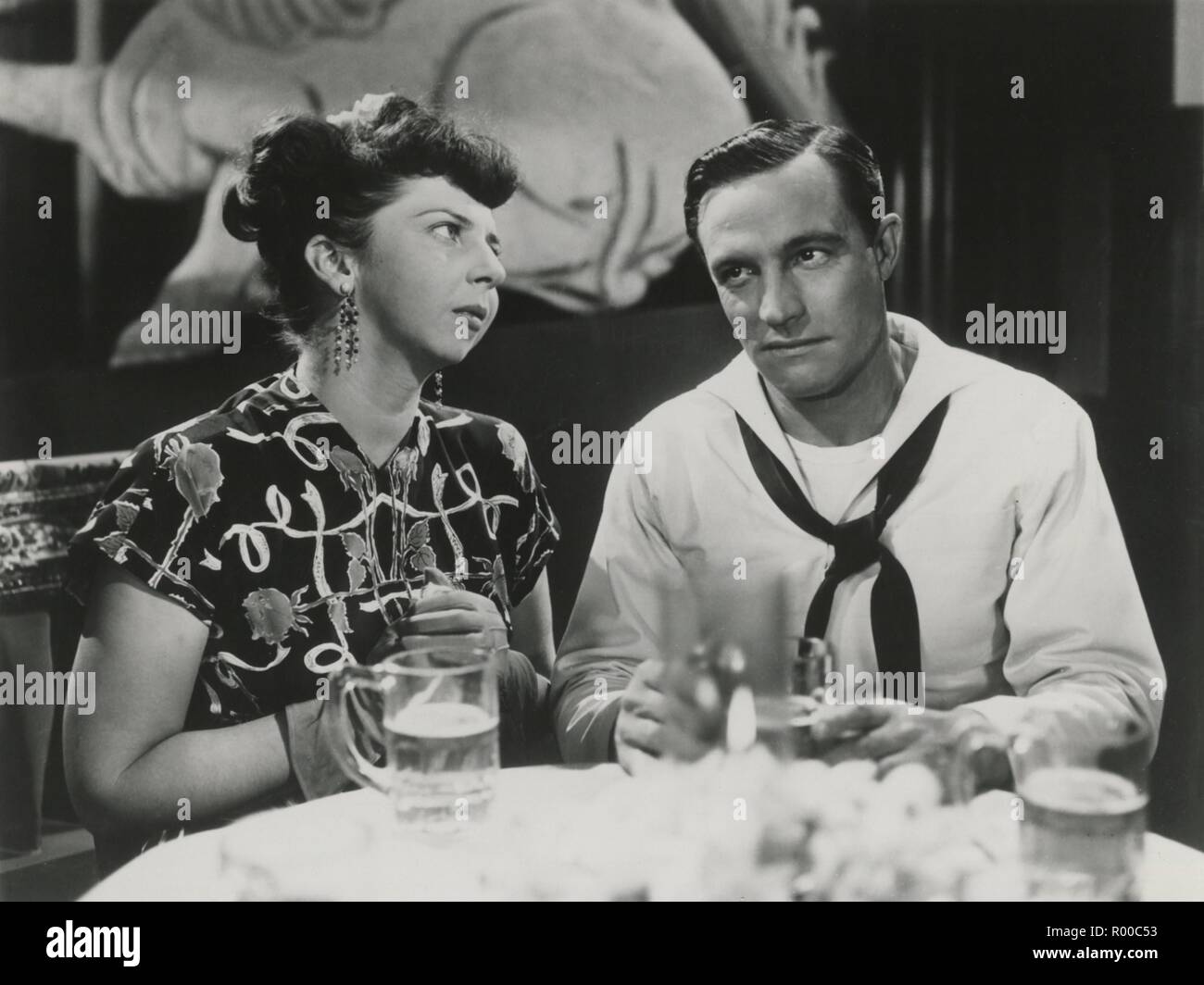
On The Town Year : 1949 USA Director : Gene Kelly et Stanley Donen Gene  Kelly, Alice Pearce Stock Photo - Alamy

The film is book-ended by three new sailors getting shore leave, singing the exact same song- "New York, New York" that Gabey, Chip and Ozzie sang at the film's opening. This is reminding us this isn't the first or last time someone will fall in love in New York or have an adventure. Gabey tells Ivy he believes they'll see each other again. And I hope they do. On the Town has become one of my favourite movie musicals, a film with which I'm very glad I caught up. So, what are your thoughts on On the Town. Where does it rank among your favourite musicals. Comment and let me know.    


Monday, 18 April 2016

The Essential Films: "The Manchurian Candidate" (1962)


The Essential Films: A series of writings on films I feel are essential viewings for film lovers, coupled with films that are personal to me.  

Warning: This essay contains spoilers. 


What's remarkable about John Frankenheimer's The Manchurian Candidate- based on Richard Condon's 1959 novel of the same name- is balances being a satire, a thriller, a science fiction "what if" story, a black comedy, a love story, and ultimately a tragedy- sometimes in the same scene. It remains cohesive throughout- never showing its seams and propelling us through to it's devastating climax. George Axelrod adapted Condon's novel and the film's cohesiveness and humanity owes a lot to him. 

The film's plot is outlandish enough to undermine the paranoia regarding communism in America during the 50s (which involved witch-hunts led by Senator Joseph McCarthy) yet also works as a genuine nightmarish vision of the lengths those in power will go to for ever more control.

The dramatic irony of the film is the two Republican characters who supposedly want to weed communists in America-John ''Johnny'' Iselin (James Gregory) and his wife Eleanor (Angela Lansbury)- are actually part of a communist conspiracy. The liberal Senator Thomas Jordan (John McGiver)- who is a so called communist- is the most decent political figure in the entire film.

Eleanor's son from another marriage, Raymond Shaw (Laurence Harvey) is a veteran of the Korean War. In the pre-title sequence Raymond and and the other members of his platoon are captured and taken to Communist China. Two days later the surviving soldiers return to America and credit Raymond with saving them. The platoon's captain Bennett Marco (Frank Sinatra) recommends Shaw for the Medal of Honor.  When asked what they think about Shaw, Marco and Corporal Al Melvin (James Edwards), they automatically say "Raymond Shaw is the bravest, kindest, warmest, most wonderful human being I've ever known in my life"

Both Marco and Melvin have nightmares about Raymond being brainwashed and killing two of the soldiers. These nightmares are in fact real. Raymond is to kill the presidential nominee for the Republican party. By doing so, Iselin- the vice-presidential candidate- can become President.


The flashback/nightmare sequences are master-classes in understated surreality. The captured soldiers believe they are at a ladies' tea and garden party. As the camera moves 360 degrees we move from the subjective point of view to the objective- the soldiers are in the presence of officials from Korea, China and Russia. The lady speaking is actually Dr. Yen Lo (Khigh Dhiegh), who demonstrates the power of hypnotism by having Shaw strangle a fellow soldier. In a notable bit of dark comedy, Marco is yawning as Raymond strangles the soldier. The matter-of-fact nature of Marco's yawning makes the act of murder more horrific. We then cut to Marco waking up screaming, which puts an exclamation mark on the scene.

What brought me back to the film- and a big reason why I feel the film lives on so vividly in our minds- is at it's heart The Manchurian Candidate is a tragedy. And like all great tragedies, even when we know the ending we come back, subconsciously hoping the outcome will be different. Sinatra is the star but the film is really about Raymond, a man who's been suffocated by his mother his entire life and hasn't had experienced much true experience. The only time he's been in love is with Jordan's daughter Jocelyn (Leslie Parrish). Raymond and Jocelyn met during the summer before Raymond entered the army. Raymond tells Marco that Jocelyn made him a lovable person. This is one of the great summations of romance I've ever heard in a film. Love can make us better people.

Mrs. Iselin broke up the relationship due to Jordan being a political enemy. Raymond meets Jocelyn again at a party held by the Iselins and they decide to get married. When Jordan tells Mrs. Iselin that he plans to stop the Iselin's political plans Mrs. Iselin hypnotizes Raymond. She sends him to kill Jordan. In the process Raymond also kills Jocelyn.

Marco attempts to undo the programming but Raymond still falls under the hypnosis and goes to assassinate the presidential nominee. But at the moment he's supposed to kill the nominee Raymond resists his programming and kills The Iselins. Marco barges in and Raymond shoots himself in front of Marco. Raymond's chance for happiness died with Jocelyn and one can only sympathize with Raymond's decision to end his life. Harvey is perfect in the role of Shaw. He makes Shaw cold and stern and then slowly shows us the wounded heart at the core of this man. 

Sinatra brings a convincing sense of inner pain to the role of Marco. There's a sense that Marco has seen a lot through the years and he's been worn down by life. What stands out to me on re-watch is that Marco isn't really the hero of the film. He participates in the plot and has his own character arc but his ultimate role is that of a witness to the film's events. . In the last scene Marco reads the citations for the Medal of Honor winners. Marco invents one for Raymond:

"Made to commit acts too unspeakable to be cited here by an enemy who had captured his mind and his soul. He freed himself at last and in the end heroically and unhesitatingly gave his life to save his country. Raymond Shaw. Hell! Hell!" 
         
Marco had said earlier in the film that despite saying how brave and warm Shaw was, deep down he knew he thought Shaw was unlikable and repulsive. But why the film's end Marco has grown to appreciate Shaw as a man and see him as a hero- finally worthy of the Medal of Honor.  Gone is the shallow automatic response to his feelings towards Shaw and in it's absence a profound human one. Marco has gotten a piece of his humanity back. Coming back to the idea of the film as a tragedy, in the final scene Marco reminds me of the character typical in Shakespearean tragedy who comments on the horrible events that have unfolded.

Lansbury- in an Oscar-nominated performance- is brilliant as Mrs. Iselin. The way she shifts from the atypical overbearing mother and condescending wife to a more sinister power-hungry and fanatical political figure is masterful. The scene in which the assassination plot is described displays acting and direction completely in sync. The result in a unforgettable portrayal of political ambition. Mrs. Iselin never planned for Shaw to be the assassin but he was chosen so the Communists would have power over her. But she swears revenge on them. In her own twisted way Mrs. Iselin loves her son. This is punctuated by a concealed kiss on the lips.

I feel John Frankenheimer remains a somewhat underrated director- despite a prolific career. He began a TV director- directing live television episodes of shows such as Playhouse 90 and Climax!- and then made the transition to film with The Young Stranger (1957). He followed that up with two films starring Burt Lancaster, The Young Savages (1961) and  Birdman of Alcatraz (1962), the latter being nominated for 4 Oscars- though Frankenheimer would never receive a Best Director nomination for his work.

Frankenheimer's compositions and camera angles give the film an off-kilter, hallucinatory feeling throughout. Lionel Lindon's stark and rough black & white cinematography underlines the cold and bleak nature of the film. Look at how Frankenheimer shoots the murder of Bobby Lembeck- the platoon's youngest soldier. We see Shaw from Bobby's perspective- a perspective that's indifferent to the violence that's to be afflicted on him.


Lembeck has a innocent smile on his face, making the murder all the more upsetting and unusual.


Frankenheimer  shows us Lembeck's murder with out really showing it- in two succinct shots. A high angle shot has Lembeck falling over in his chair, followed by a shot of blood splatter on a poster of Stalin. The shots move by so fast we don't really see a bullet go through Lumbeck's head. Credit goes to Ferris Webster's Oscar-nominated editing, which creates the distinct pace and feel of the sequence and overall film. Since this is Melvin's dream, we see him wake up screaming- as did Marco earlier. The murder becomes almost impressionistic and Melvin's screams add to the horror.


Another evocatively directed scene is the murder of the Jordans. Shaw comes to the house late at night. Jordan tells Shaw he's happy to welcome him to the family. In the above both Jordan and Shaw are enveloped in shadow, contrasting Jordan's happiness at having a son-in-law and our knowledge of what is to come.


As Shaw pulls out his gun, Frankenheimer doesn't show Raymond's face. He's no longer Jordan's son-in-law- he's his executioner. 


Several shots later we see Raymond in a low angle show. He looms over us, making even more ominous.

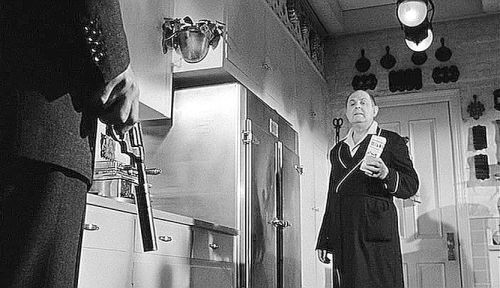
The bullet goes through the milk carton Jordan is holding- concealing the violence while also punctuating the act.


Jocelyn races down and is killed by Shaw. After the murders Shaw is in the mid-ground while Jordan and Jocelyn lay dead in the foreground and background, respectively. Frankenheimer uses every part of the frame to great effect. Shaw is almost like a spectre in this shot- just as dead as his two victims.  

This is a film I would love to see on the big screen. It's images are so absorbing that I feel a theatre screen can only magnify the effect


Here are some other images that stand out:


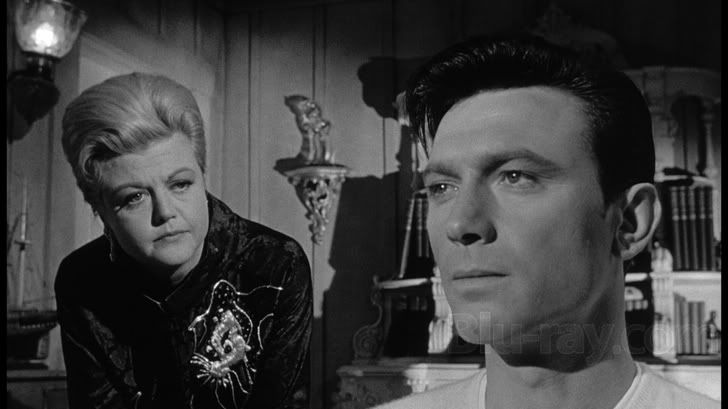
With Mrs. Iselin in the background, she's like a devil on his shoulder. Ultimately  Marco will become an angel of sorts.


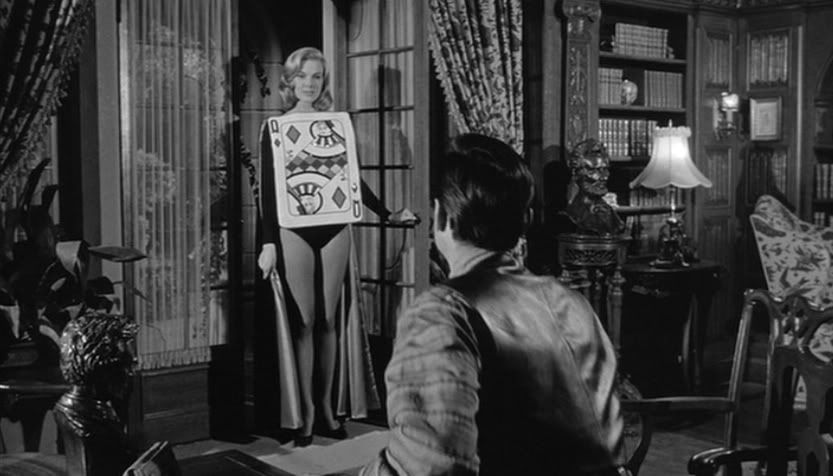
The image of Jocelyn as the Red Queen blends the two things that dominate Raymond's psyche: Jocelyn and the game of solitaire that unlocks his programming. It also underlines Shaw's troubled relationships with women.


Mrs. Iselin cares not about who her husband really is...only the image which she can project unto the public.


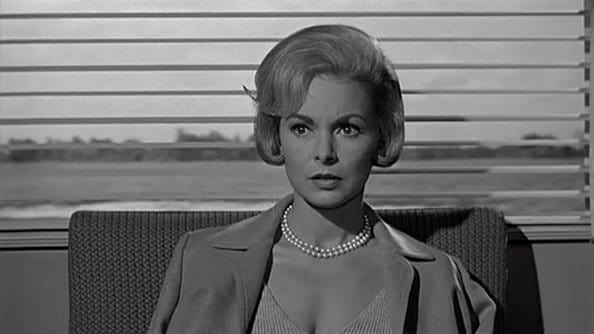
Now, I need to talk about the film's most unusual sub-plot, that of the relationship between Marco and Rosie Cheney (Janet Leigh). Rosie first meets Marco on a train to New York a Marco attempts to discover the truth about Raymond. They exchange an odd bit of dialogue, which has led some to theorize Rosie is Marco's handler or an agent of some kind. The back and forth between Marco and Rosie comes across as code rather than naturalistic dialogue. Moreover, when Rosie comes to bail Marco out of jail she says she's broken up with her fiance after meeting Marco. Her falling in love with Marco is very sudden- which isn't entirely unique to this film. While one can chalk it up to Marco requiring a love interest, in this movie you have to suspect everything.

Before I wrap things up, I want to focus a little more on the character of John Iselin. He's clearly a stand-in for McCarthy but his wife is the one pulling the strings. However Iselin is still dangerous- as Jordan points out when he's speaking to Mrs. Iselin. Jordan says Iselin is viewed as a fool but he does not. I couldn't help but think of Donald Trump during Jordan's speech.The film uses the figures of the Iselins to comment on McCarthyism. The film says there is evil in America but in the form of those pretending to act in the country's best interests. 

I want to mention another person involved with the film's production. Firstly, David Amram's score that invokes the melancholy and surreal nature of the film. Seco 

The Manchurian Candidate was made in the 60s, set in the 50s- yet remains somewhat out of time- an eerie else-world. Yet it still speaks to its time and ours as well. I appreciate the film now more than I did a decade ago. It's an evocative masterpiece that-akin to the brainwashing done to characters at the centre- imprints itself on our psyches- haunting us more than 50 years on.