Showing posts with label Horror. Show all posts

Saturday, 8 June 2024

The Essential Films: “Alien” (1979)


A series of writings on films that I feel are essential for film lovers, coupled with films that are important to me. Spoilers for those who haven't seen

There's just something about Alien. It's the atmosphere, the vibe. Yes, Aliens is often considered the better movie. And yes, Aliens is one the best movies of its kind, a textbook for any aspiring action filmmaker. But Alien is on a whole other level in its visual design, acting and suggestive power. It was partly born out of director Ridley Scott's depression after seeing what George accomplished technically with Star Wars. Scott had made his first film, The Duellists, and was planning on doing Tristan and Isolde next but Star Wars gave him the urge to make a science fiction. It's funny. Star Wars appears so quaint now, which is fine and appropriate given Lucas's old fashioned influences, but Alien still the power to startle its audience. And while Star Wars is seen as the creative vision of one man, Alien acts as a debunking of the "auteur theory." The film isn't just indebted to Scott but also to screenwriters Dan O'Bannon and Ronald Shusett and artist H.R Giger. 

Scott viewed Star Wars as the flipside of Stanley Kubrick's 2001: A Space Odyssey, and in turn Alien was the flipside of Star Wars. Both films, however, influenced the visual look of the film. In a Deadline interview on the influence of Star Wars, director Guillermo Del Toro elegantly summed up the influence of Lucas's and Kubrick's visions   

If you think about Ridley Scott and 'Alien,' the idea of truckers in space, which Ridley Scott does beautifully, and the way he made certain parts of the bowels of the ship feel worn and used and dingy. That is the crossbreeding of '2001' with 'Star Wars.' Ridley Scott is in the direct lineage of Lucas and Kubrick. His is a very different tone but he is as precise with his lensing. The areas of the ship that are pristine are very Kubrick-ian in a way, but there are parts of the ship where you can see the direct influence of 'Star Wars.

The other film apart from Star Wars and 2001 I can draw a comparison to is Alfred Hitchcock's Psycho. Both Alien and Psycho take their time getting to their most iconic moments, the shower scene and the chestburster. Marion Crane steals money to set up a life with her boyfriend, veering off course to spend a night at the Bates Motel. The crew of the freighter vessel the Nostromo are woken up out of cryosleep, supposedly because they're near earth, but like Marion they are taken off course to pick up a distress signal. From their titles, we know they're going to be a "psycho" and an Alien. But when are they going to show up. All through Marion's car journey, to her meeting with Norman, tension and unease mounts. The crew find a derelict ship with alien eggs on them. Kane (John Hurt) gets a facehugger to, well, the face. Quarantine is broken by scientist officer Ash (Ian Holm). And then there's the whole bleeding acid thing. Norman is a friendly but strange man with an unhealthy relationship with his mother. The facehugger falls, off and the crew can finally go home. Marion decides to return the money and takes a shower. The crew sit down to eat. Them it happens/ Marion is killed by a knife-wielding maniac and an alien bursts out of Kane's chest.

Both these moments take place in safe, benign settings- a shower, a meal room. The violence is shocking because every thing has returned to calm. These moments also push forward the narratives in to the second half of their stories. Psycho starts out as a crime drama, Alien starts out as a sci-fi mystery, and they both organically take us through the events as they become more horrific. It's all about structure. Alien is a perfectly structured film, with immaculate pacing. Some may find it slow. I get that but again I think the pacing is masterful.    

A big part of why the horror of Alien is so effective is its sense of realism. The film takes this sci-fi premise and grounds it in a lived-in workaday reality. Making the characters "truckers in space" was a great way to make these people relatable and normal. It also takes the glamour of the idea of space travel. These aren't explorers, there's no sense of awe and wonder in what they do. You even have tow characters, Parker (Yaphet Kotto) and Brent (Harry Dean Stanton) who are only focused on getting their fair share. There's a documentary-like quality to the performances, with Scott creating a detached, unsentimental vibe to the proceedings. He creates a breathing room for the performances and the atmosphere. 

The film's sense of realism is also indebted to Michael Seymour's immersive production designed. The Nostromo feels like an actual space vessel that people would live on. The derelict spacecraft has this ominous vibe, one of mystery and unease. The ship, and the moment they find the "Space Jockey" suggests a mysthic grandeur that contrasts with the more claustrophobic interiors of the Nostromo

I mentioned this film's "suggestive power" earlier. I want to explain what I mean. Without the characters having to discuss it philosophically, the film conveys its deeper meanings through its actions. The facehugger and chestburster represent the themes of sexual assault. The film is often talkin about as taking the fears of women and placing them on a man. There's also what I just mentioned about the Space Jockey, a sense of mystery of what species are out there. Then there's the themes of distrust towards authority, with the company the truckers work for treating them as expendable in the face of retrieving the "xenomorph." This was the 70s. There was a whole nihilistic streak to the films of this error, The difference between 70s and 80s cinema is best exemplified in the contrast between Alien and Aliens. Alien is a bleak, unsentimental horror film while Aliens is a Reagan-era pumped up action movie with one-liners and Spielbergian sentiment, including a happy ending for its surviving characters. Ellen Ripley (Sigourney Weaver) barely survives this film and the ending is more low-key than strictly happy.  

The dichotomy between Alien and Aliens can also be found in The Terminator and Terminator 2: Judgment Day (funnily enough, both Terminator films are directed by Aliens helmer James Cameron). The originals are stripped down horror thrillers while the sequels are bigger action blockbusters. There's a bad robot in the first, a good robot in the second who the female lead has to learn to trust. There's the mother/child relationship, and an ending that seemingly puts to bed any need for sequels.  

You know what makes Alien scary? More than the xenomorph? It's Ash. We know there's something up with Ash. However, the film constantly draws our attention away and never reveals too much. When it his head is bashed off by Parker, revealing him to be android, it's one of the film's creepiest images. Then there's that smirk from the disembodied head and the slightly electronic voice, telling the remaining crew members that he has his sympathies. I don't think this film is as unsettling if it's just the alien. That somebody else is "alien" amongst the crew, seemingly friendly but slightly creepy, working against them, makes the film even starker. He acts as the face of the company "Weyland-Yutani," which gets a human face for the sequels but remains in the shadows here, which I like better. For the company these people are expendable. And they'll alone in the coldness of space. The film's famous tagline is "In space no one can hear you scream" which I think just sums up the bleakness of this film and this era of film so well. 

Then there's Ripley.  Weaver wasn't a star when the film was released and Ripley wasn't the iconic character she is now so it wasn't a guarantee that she would live initially. Weaver has such a unique presence as a an actress, a strong no-nonsense physical presence while also being a capable dramatic actress, believable in her vulnerability and strength to survive.  And okay, you're either going to get why she goes back for the cat or not. I would probably go back for the cat. It just makes her more human. 

Alien could've just been as cash-in on the sci-fi craze like the James Bond film Moonraker, also released the same year. But it stands up as a genuine classic in the genre. Scott may have been depressed when he saw Lucas accomplished but he helped make something that could also cause the same level of depression in an aspiring filmmaker. And even Kubrick wanted to know how the chestburster scene was done. Alien is the greatest sci-fi horror film of all time, smart and sophisticated, while never carrying itself with pretension. Just an all around immaculately made movie.  

Friday, 27 October 2023

Hitchcock's Experimental, Art-House Monster Movie: "The Birds" at 60.


Spoilers for The Birds and Psycho

Do I own The Birds on Blu-ray and can watch it comfortably at home? Yes. Did I still head out to a theatre to see a 60th anniversary showing of the film? Also yes. There's something cool about seeing classic cinema on the big screen and since it's one my favourites from my favourite director, I'm almost obligated to go). It got me thinking that there was a time where you had to see a movie in theatres, it wasn't as easy as it is now to see films. There was something special about something being shown on TV or getting re-released. Now it feels like something's in theatres for a week before it hits streaming. But anyway, back to The Birds. This was Hitchcock's follow-up to Psycho and its notable the only two horror films in his career were made consecutively. They actually make pretty good companion pieces: with both of them displaying Hitchcock experimenting in the later part of his career (he was in his 60s when he made them) Psycho was a lower budget film shot in black and white with his crew from his TV show Alfred Hitchcock Presents, coming on the heels of the proto-blockbuster North by Northwest nd was subversive in its plot structure, particularly the murder of its supposed main character almost an hour in. The Birds showed Hitchcock forgoing plot almost all together in favor of atmosphere and metaphorical/apocalyptic horror. 

The first way Hitchcock experiments in The Birds (and Psycho) is how he subverts genre expectations. The thing is, people walked in to Psycho knowing there was going to be a character who was a psycho. They also walked in to The Birds knowing there were going to be bird attacks. The suspense comes from how long Hitchcock takes to get to the shower scene and the initial bird attack. What Hitchcock does mischievously is begin the films not as horror but as a noir crime film (Psycho) and a romantic comedy (The Birds) It's almost a hour before Marion Crane (Janet Leigh), a bank clerk who steals money from work to start a life with her boyfriend, is killed in the infamous shower scene.  

In  The Birds it takes a half hour before a gull attacks socialite Melanie Daniels. The film begins with her being spotted at a bird store by Mitch Brenner (Rod Taylor), a lawyer whom recognizes her from court appearance regarding a practical joke. He pretends to mistake for a employee, giving her a taste of her own medicine. He thinks she should've gone to jail. She thinks he's "a louse." Basically, it's the "He's arrogant, she's stuck-up but they're obviously attracted to each other" romantic comedy set-up. Mitch inquired about some love birds for his sister Cathy (Veronica Cartwright's) birthday so Melanie gets two and travels all the way to his family farm in Bodega Bay. While she's watching Mitch discover them from her boat, a gull attacks her. The gull attack parallels the shower scene- a stroke of violence in the midst of water, in a moment of  calm. It also puts the audience on edge for another instance of violence. 

The Birds also has something in common with one off Hitchcock's earlier film,  Shadow of a Doubt (1943). In both, a small community is invaded by a sinister force. In the former it's a serial killer played by Joseph Cotton, in the latter it's, well...birds; but not only birds, but normally docile birds. In in the indispensable book Hitchcock/Truffaut, which transcribes interviews between Hitchcock and filmmaker Francois Truffaut, Hitchcock says "I think that if the story had involved vultures, or birds of prey, I might not have wanted it. The basic appeal to me is that it had to do with ordinary, everyday birds."  Hitchcock contrasts these normal birds' usual docile nature with random bursts of violence. And like Shadow of a Doubt, the violence is juxtaposed with a low-key setting. 

Truffaut later on in the interview says of The Birds' structure: 

    The story construction follows the three basic rules of classic tragedy: unity of place, of time, and of     action. All of the action takes place within two days' time in Bodega Bay, The birds are seen in ever        growing numbers and they become increasingly dangerous as the action progresses. 

Screenwriter Evan Hunter and Hitchcock understand the need to make each attack bigger, until the film takes on apocalyptic overtones. By the climax it feels the like the world is ending. However, keeping the story in one setting and focusing on a small set of characters also makes the story intensely intimate. M. Night Shyamalan was clearly inspired by Hitchcock and this film when making his alien invasion thriller Signs, which I wrote about here: Davies in the Dark: The Essential Films: "Signs" (2002) (thenoirzone.blogspot.com)  

I want to take some time now to focus on the character dynamics which foreground much of the film, particularly the relationship between Melanie and Mitch's mother, Lydia (Jessica Tandy), whom she meets after Mitch has looked to her wound. Mitch invites Melanie over for dinner where she also meets Cathy, who takes a immediate liking to Melanie, clearly liking her present. Lydia, however is more aloof. Melanie is staying with schoolteacher Annie Heyward, who once had a relationship with Mitch. That night, Melanie and Annie discuss Annie's former romance with Mitch and her complicated relationship with Lydia.

Annie: I was seeing quite a lot of him in San Francisco, you know. And then, one weekend, he asked me up to meet Lydia.

Melanie: When was this?

Annie: Four years ago. Of course, that was shortly after his father died. Things may be different now. 

Melanie: Different?

Annie: With Lydia. Did she seem a trifle distance? 

Melanie. A trifle.

Annie: Then maybe it wasn't different at all. You know, her attitude nearly drove me crazy. I simply couldn't understand it. When I got back to San Francisco I spent days trying to figure out just what I'd done to displease her.

Melanie: And what had you done.

Annie: Nothing. I simply existed. So what was the answer? A jealous woman, right? A clinging, possessive mother. Wrong. With all due respect to Oedipus, I don't think that was the case at all.

Melanie: Then what was it?

Annie: Lydia liked me, you see. That was the strange part of it. In fact, now that I'm no longer a threat, we're very good friends.

Melanie: Then why did she object to you?

Annie: She was afraid.

Melanie: Afraid you'd take Mitch?

Annie: Afraid I'd give Mitch.

Melanie: I don't understand.

Annie: Afraid of any woman who'd give Mitch the only she can give him- love.

Melanie: Annie, that adds up to a jealous, possessive woman. 

Annie: No, I don't think so. She's not afraid of losing her son, you see. She's only afraid of being abandoned.   

On a sidenote, Hunter's dialogue is so good. While Hitchcock always believed in the idea of "pure cinema," telling the story strictly through the visuals, his films often had stellar dialogue passages. What I like specifically about this passage is it's all about small but significant differences. While everything points to Lydia being a "jealous, possessive woman," Annie doesn't feel it's that simple. She can't see Lydia as purely jealous, she even says Lydia liked her. Annie also makes distinctions between fear of giving vs. fear taking and fear of lost vs. fear of abandonment. Minute differences but they tell us about how Annie views things and maybe tells us something about Lydia as well.

We get to understand Lydia quite a bit in a later scene, which comes after Lydia's seen the dead body (with eyes gouged out by birds) of a neighbor. She's alone with Melanie and in a vulnerable position. She talks about the death of her husband, her reliance on his strength throughout  the years and her wish to be a stronger person. It's the first time Lydia warms up to Melanie and she says something surprising to her, which is she's not sure if she even likes Melanie. A honest statement, and one that reflects Lydia's complicated feelings towards Melanie and her relationship with her son. It'd be easy to just have Lydia outright hate Melanie but her confession feels more nuanced and sympathetic.

Mitch also has his own complicated relationship with Melanie. His lawyer side dislikes her troublemaking side but when he spies her on the boat, he smiles, amused, and probably surprised she went though all that trouble to bring hum those birds. He's clearly concerned when she's attacked by a gull and invites her over for dinner. So, he's not completely hostile towards her. And I suspect there was likely already an attraction towards her. There's something playful already at play in the initial encounter,  

And how are we, the audience, supposed to take Melanie? She's maybe not as easily "likable" as the main character is "supposed" to be. Hitchcock, Hunter, and Hedren allow us to feel our way through the character as we learn more about and spend more time with her. I personally find Mitch to be kind of a judgmental ass at the beginning, though as I said, he's compensating a little for his attraction to her.. Watching the movie this time, I quite liked Hedren's performance. She has the right amount of cool and warmth needed for a character who goes from socialite who glides through life to a more mature, deeper feeling person who becomes part of the Brenner family. Just before the first bird attack at Cathy's, Melanie and Mitch have a conversation where Melanie, like Lydia a few scenes later, shows her vulnerability. We learn Melanie's mother abandoned her when she was young and Melanie tells about the things she does with her life, including putting a Korean boy through school. Of course, it's obvious what's Melanie is missing in her life- a family.  

Okay, let's come back to how Hitchcock is experimenting in this film. What I find notable about The Birds in contrast to Hitchcock's other work is it's virtually plotless. Hitchcock usually has a Macguffin (the thing every character wants but doesn't matter what it is, it's just there to get the ball rolling), a murder, or an innocent man on the run. According to Hunter there was almost going to be a murder mystery plot, with the birds being the culprits. Instead, there's no real mystery except when the birds are going to attack. Hitchcock once used the example of a bomb under the table to highlight surprise vs. suspense. You see two men at a table. A bomb suddenly goes off- that's surprise. What's suspense is seeing the bomb under the table and wondering when it's going off. The film goes for the latter approach and I think that's the proper choice. It also allows the film to foreground the characters more.

I mentioned earlier the escalation of the bird attacks gave the film apocalyptic overtones, which again shows Hitchcock playing with something new- a world ending scenario, as well as a "monster movie." Hitchcock's monster were typically serial killers or Nazis. But here, the monsters aren't really monsters. Mother nature is simply fighting back against humanity for taking them for granted, or at least this was Hitchcock's explanation. I believe the film is thematically more fascinating and starker if there isn't an explanation for the bird attacks. In his book, Hitchcock's Films Revisited, Robin Wood views the birds as 

    a concrete embodiment of the arbitrary and unpredictable, of whatever makes human life and human     relationships precarious, a reminder of fragility and instability that cannot be ignored or evaded and,     beyond that, of the possibility that life is meaningless and absurd.

He also compares the bird attack to Marion murder in Psycho, in that they're both unprovoked and unearned. Horror often has a nihilistic streak to it. In horror we witness innocent people die and evil winning out. It's a ruthless genre and Hitchcock showed how ruthless he could be in Psycho. He further shows this mercilessness when Annie is unceremoniously killed by the birds offscreen. Annie's death is more painful because it's not seen and it demonstrates Hitchcock's preoccupation with placing us in the mind of his characters. We have to imagine Annie's end as Melanie and Mitch must do. 

Aside from providing no clear explanation for the birds' war against humans Hitchcock also doesn't give us a neat ending either. Melanie and the Brenners live but the final shot is the car driving off in to an uncertain future, with the birds still covering the Brenner house, in what we already know is a short reprieve from the attacks. This is arguably the most ambiguous ending Hitchcock ever concocted, though Psycho and Vertigo's endings also create a sense of unease in the audience. The Birds was ahead of its time, for a Hollywood movie at least, in providing no clear finish for the story. The film end before it seems to end. 

The only resolution the ending contains is the shared look between the injured Melanie and Lydia in the backseat of the car, suggesting Lydia has finally accepted Melanie and will care for her in her weakened state. Is the ending partly hopeful? I don't know. However, it does suggest that as the world is ending, people will stick together, that we need each other and must accept one another. It's also the resolution to Melanie's arc, where she starts out as an aloof loner but becomes part of a family.    

Adding to the film's escalating terror is Hitchcock's choice to forgo an accompanying score, another experimental choice. During the bird attacks all you hear is the flapping of wings and squawking sounds. This accomplishes two things: giving you the felling of being in the middle of  a bird assault, with your senses being overwhelmed. It's also another way the film sets itself apart from a traditional Hollywood feature. We may not first notice the absence of a musical score but when you realize it it's a brilliant way to an even stronger sense of fear in the audience. When Melanie is waiting outside the school for Cathy, the children's choir is the ironic soundtrack to the birds gathering behind Melanie on the jungle gym. George Tomasini's editing is so in tune with Hitchcock's dark sense of humour as the editing steadily builds the flocking of the birds behind the oblivious Melanie. Tomasini deserves recognition as being a key Hitchcock collaborator, editing several of Hitchcock's most famous films, including Psycho, Rear Window, and North by Northwest. He also edited the original Cape Fear, which I wrote about on this blog as having a heavy Hitchcock influence.

Why did Hitchcock move towards something more experimental, forgoing plot and certain Hitchcockian tropes. It may have something to do with Hitchcock's fascination with the international art house cinema of the 60s. Richard Allen, in his essay "Hitchcock and the Wandering Woman: The Influence of Italian Art Cinema on The Birds," argues that Hitchcock was 

        challenged and provoked by the remarkable and rapid developments taking place in European art            cinema. The Birds was conceived by Hitchcock in part as a response to this challenge, a work that         at once would continue continue his commercial success and confirm his status as an auteur on a            par with the European directors he so admired. Hitchcock engaged with art cinema to inspire                  creativity and sustain his critical reputation

In an interview with Charles L.P. Silet, Hunter also makes the claim that Hitchcock want be seen as a serious artist: 

    Hitch also told me later, and I learned later from other sources, that he was looking for some 'artistic     respectability' with The Birds. This was something that always eluded him, and he deliberately chose     to work with a successful New York novelist, rather than a Hollywood screenwriter.

Hitchcock was embraced by the French critics as a genuine artist, an auteur, whereas he wasn't as highly regarded in the states, seen as more of an entertainer than an artist. Of course, he wasn't one who was reclaimed by the French: Howard Hawks, another great mesher of entertainment and artistry, was another to whom the French applied the Auteur Theory approach of criticism, the idea that the director was the "author" of their films and had a singular visual style and consisitent themes running through their work.

Not only did Hitchcock go to a novelist for screenwriting duties, he chose a short story from Daphne  Du Maurier, the author who wrote the basis of his first American film, and the only one of his that won Best Picture: Rebecca. While Hitchcock considered Rebecca as belonging to its producer, David O.Selznick, he may have felt the Best Picture victory and Du Maurier's literary pedigree could provide him with the basis for a true artistic picture. 

As relating to the thesis of Hitchcock being influenced by European cinema, Allen argues that The Birds shares quite a bit in common with F.W. Murneau's 1927 silent film, Sunrise, where a woman enters a small town to seduce a man who lives with the family. Allen argues that Hitchcock drawing from Murneau displays a return to Hitchcock's roots in the 1920s as a young filmmaker, where he also took inspiration from directors he admired. Allen also sees a reverse influence by way of Michelangelo Antonioni recontextualizing Rear Window and The Lady Vanishes in the shape of his 1960 film L'Avventura. In that film a woman goes missing, after which her boyfriend and friend engage in an affair, which echoes the disappearing women plots of the former films.

Allen further develops the Antonioni connection by citing David Bordwell's classification of the art   house protagonist, a wanderer who is in a passive relationship with the environment. "The wandering woman" walks without purpose, and is both observed and observing. This is a character that can be found Antonioni's films in the form of actress Monica Vitti. Allen relates Melanie to the archetype of the wandering woman but stresses that the difference between the women in Hitchcock's film have agency, whereas the women in Antonioni's film don't. In the early parts of the film, where Melanie travels to Bodega Bay show us a woman on a mission but by showing us every part of her journey suggests something distinctly European in terms of plot, or lack of plot I should say. It's all very banal, but in its banality it creates the proper contrast to the gull attack. 

I'd say Hitchcock combined the art-house with the monster movie, but also blurring those lines, where the birds take on the same thematic weight as the environments do in Antonioni. Admittedly, it wasn't until this viewing of The Birds and reading up and thinking about the connection between the art-house and Hitchcock that I saw it as the experimental work it really is. While Hitchcock would eventually retreat in to familiarity with Torn Curtain, when looking at Psycho, The Birds, and his next film, Marnie. these films showcase what could be called Hitchcock's art-house phase- and I think you can certainly add Vertigo in there as well. While some see these films as quaint, I'd argue they represent an artist in his later years re-thinking of what he was capable. The Birds is singularly Hitchcock, however one looks at it, however, and one of his boldest experiments in suspense.


Saturday, 22 April 2023

Oceans of Time: "Bram Stoker's Dracula"


Spoilers Below

We don't make films that look and like Francis Ford Coppola's Dracula anymore. It belongs to the era that also gave us Tim Burton's Batman Returns and Joel Schumacher's 2 Batman films, as well as
Baz Luhrmann's Romeo + Juliet, singular, director driven movies with big budgets and based on popular source material. Dracula and Batman Returns owe themselves more to German expressionism and silent movies than Hollywood conventions. While we have auteur driven big budget films from the likes of Christopher Nolan and Denis Villeneuve it's hard to imagine either them making something as campy, avant-garde and erotic as this film. They're both too sexless to make an sexual film. Robert Eggers is doing his Nosferatu remake but that's probably going to be a more somber affair without the camp humour of this film. But to be fair, the guy who put a decapitated horse's head in a guy's bed and had Marlon Brando talk about polio doesn't necessarily seem like anyone's idea of a sexy filmmaker. However, Coppola's career and style has always been varied and unpredictable. 

Coppola's style is defined by its fluidity and adaptation, fitting his style to what the film needs- from the novelistic quality of The Godfather films, the surreal nightmarishness of Apocalypse Now, the chilly paranoia of The Conversation, and the lowkey fantasy of Peggy Sue Got Married. He also doesn't box himself by genre. He took the gangster film and put on a Shakespearean scale with both parts of The Godfather, combined the gangster and musical genres with The Cotton Club, and made a war film as strange and atmospheric as Apocalypse NowDracula is a horror film but it's also a gothic romance blended with the avant-garde and camp. It also wasn't the first time Coppola delved in to the gothic. When he enrolled in UCLA film school, he directed couple of short horror films, Two Christophers, inspired by Edgar Allan Poe's William Wilson, and Ayamonn The Terrible, about a sculptor's nightmares coming to life. In 1963 Coppola was one of several uncredited directors on Roger Corman's The Terror, starring Boris Karloff and a young Jack Nicholson. Coppola's first full length feature was the Psycho-inspired Dementia 13.  And one can detect Coppola's horror roots in the horse's head and murder of the five families sequences from The Godfather

Before Dracula, Coppola returned to this greatest financial and artistic success with The Godfather Part III. And thematically Dracula begins where that film ends. After seeking legitimacy throughout the film  Michael Corleone (Al Pacino) witnesses his daughter Mary (Sofia Coppola) murdered by assassins meant to kill him. In 1462 Romanian knight Vlad Dracula (Gary Oldman) returns home from his war against the Ottoman Empire to find his wife Elisabetta (Winona Ryder) has committed suicides after the Ottomans reported him dead. Dracula is enraged that after fighting for God this same God didn't prevent his wife's death (and since it was a suicide she won't be allowed in to Heaven). Dracula renounces God and, in an expressionistic piece of storytelling. drinks the blood from a stone cross,  making him in to a vampire. Both Michael and Dracula lose loved ones to their enemies and if Godfather Part III's ending reminds us of King Lear, Dracula's prologue brings to mind Romeo & Juliet, which Coppola does reference in one of the behind the scenes documentaries, as well as Ophelia's suicide from Hamlet. So, Coppola, as he did with the Godfather films, is taking a piece oggenre fiction and reinterpreting it as operatic tragedy. Dracula's howl of pain before cutting to the title is probably the film's most effective emotional moment, for me. 

Coppola said in interviews he felt the other adaptations of Dracula never really did the book, so with his interpretation is was an attempt to follow Bram Stoker's novel more closely- the official title of this film is Bram Stoker's Dracula and Coppola always likes giving the author credit. However, I believe the love story element is something screenwriter James V. Hart added (Hart also did two other literary adaptations, Steven Spielberg's Hook. Kenneth Branagh's Frankenstein and, of all things, Muppet Treasure Island). I've never read Stoker's novel but I do know it's told via letters and journal entries, which Hart and Coppola reference throughout the film. And of course there's this great (practical shot of Jonathan Harker's (Keanu Reeves) diary in the foreground while a train runs across the screen in the background. The diary was an oversized book and the train was an actual miniature train. 


Harker (Keanu Reeves) is  the young solicitor who, in 1897, comes to Dracula's castle to arrange his real estate acquisitions in London. His fiancee, Mina Murray (Ryder, again), is the reincarnated Elisabeta and when Dracula sees her picture it becomes his goal to seek her out. Without the use of flashbacks, we're left to imagine the hundreds of years Dracula has been undead. He feels like the loneliest, most haunted Dracula to grace the screen. This was Oldman back when he really threw himself in to these offbeat villain roles and such a chameleon that I remember knowing someone who joked he wasn't sure what Oldman actually looked like. Oldman certainly knows what kind of movie he's in and is able to pull off the campy, gothic and theatrical side of the character while also bringing real pathos to his tragic longing, specifically when he transitions from decrepit count to handsome and seductive Prince Vlad. 

Reeves. dodgy accent aside, is endearing as Harker, and works as a proper contrast to Oldman. Reeves' Harker is sexually non-threatening, kind of dull, as opposed to Prince Vlad, a more sexually exciting prospect, challenging the Victorian restrictiveness Mina she's used to. But the relationship between Dracula and  is where my problems with the film begin. I just have a hard time getting swept up emotionally as much as I'd like with the film's love story. I'm not even sure if Oldman and Ryder even have chemistry. I do wonder what the film would've been like with a young Kate Winslet or Rachel Weisz. I also have a problem in general, I think with these kind of heightened love stories. I prefer lower-key, more developed and slower burn romances instead of the more melodramatic kind. for which the film is going. It's a little bit like what Coppola's friend and contemporary George Lucas was attempting in Attack of the Clones with Anakin and Padme. I liked the idea behind the romance but I don't believe it pulled it off that well. However, I think the romance in Dracula is better acted. 

Dracula is one of those films that leads with its aesthetics and mood rather than strong storytelling. If the first 2 Godfather films are like a great novel on screen than Dracula feels like an overproduced Broadway play. This isn't to say there aren't visual pleasures to be found here. The in-camera practical effects are terrific, and they make the film, especially with the stuff in Dracula's castle, reminiscent of a 1920s silent film. Honestly, I'd watch a whole film set in this film's version of late 15th century Transylvania, an expressionistic fairy tale where Dracula fights silhouettes of shadow puppets instead of actors. I also love Dracula's armour, which is like a sci-fi take on Japanese samurai armour. In Elizabeth Joy Glass' piece on the film's costumes (Designing Fear: Bram Stoker's Dracula - The Art of Costume), she discusses how at  the beginning of  production, Coppola said "The costumes will be the set." Glass adds that Coppola "wanted the costumes to be visually exciting set pieces, and set the film's atmosphere." Coppola enlisted Eiko Ishioka, who had designed the Japanese poster for Apocalypse Now,  and who at the time only had a couple of costume credits but she would go on to win the Oscar for Best Costume Design. The Simpsons homaged the film's most famous outfit, Dracula's red coat, along with his hundred-of-years-old white make up and what I once heard described as the "boob head." Lucy (Sadie Frost), Mina'a friend who Dracula turns in to a vampire also has a striking funeral/death dress that's a highlight "set piece Watching the film, it's clear what Coppola was going for. Moreso than the settings, the film's costumes- significantly Dracula's different looks, which rival Padme's in The Phantom Menace- define the film's mix of realism and stylization, where certain scenes feel like they're an authentic depiction of the period, while others, like the scenes in Dracula's castle, feel very theatrical and exaggerated. This helps create a distinction between Dracula's world and the more normal world of Victorian England, which then becomes invaded by Dracula's presence.

But coming back to what I was saying, the storytelling and character work does take a backseat to the costumes and the mood. Don't get me wrong, I'll all about visual style and I hate the expression "style over substance." And I do feel strong visual style and directing can overcome a film's other issues. But like Ridley Scott's Legend, a film that also draws me back because of its strong aesthetics (I know, I'm using that word a lot), I wish I could get more in to Dracula emotionally or at least on a entertainment level. There's some grade A Anthony Hopkins ham from his performance as Professor Abraham Van Helsing, who's brought in to the fray after  Lucy is turned in to a vampire. Hopkins was right off his Oscar win for The Silence of The Lambs and one wishes the movie was just Hopkins vs. Oldman, in a similar vein to the Christopher Lee/Peter Cushing Hammer Horror Dracula movies. There's definitely a more entertaining film in here about Helsing and Dr. Jack Seward (Richard E. Grant), Lucy's fiancée, Arthur Holmwood (Cary Elwes), and Texan Quincy Morris (Billy Campbell) facing off against Dracula. 

So, the film isn't emotionally engaging on the love story level, and it's not fun enough despite the Hopkins bits, so it ends up unsatisfying as both a romance and an entertaining horror film. The sincere romanticism and the camp are also never completely reconciled. Though the film's unwieldy nature gives it its beguiling and esoteric allure. Like Lucas, Coppola is a experimental director at heart, more so than his populist success would lead you to believe. I feel that if Lucas would've kept directing movies after the original Star Wars, he may have eventually become who Coppola is now, a director whose films are outside of the mainstream and experimental. Dracula is one of Coppola's last true commercial films, followed by Jack (1996) and the John Grisham adaptation  The Rainmaker (1997).  He has just completed production on his long-gestating project Megalopolis, a sci-fi film about an architect attempting rebuild New York in to a utopia after a disaster. 

Dracula is a film I always return to, wanting to love it more than I do and it has grown on me in certain respects, though I can't say it's a complete success. However, it's such an distinctive film of excess and theatricality that I'll always go back to for its strong visual design fun performances. A little over 30 years after its release, there's still never anything quite like Coppola's gothic, camp, whatever you want to call it, opus.

Monday, 12 September 2022

The Essential Films: "Jaws" (1975)


A Series of Writings on Films that I feel are essential for film lovers, coupled with films that are personal to me. Spoilers for people who haven't seen the film.

Jaws is a masterclass in filmmaking. It ranks amongst films like Die Hard, The Exorcist, and the original Star Wars, as one of those films which started out as popular entertainment but can be seen as a masterpiece of its genre. This was only Spielberg's third film; he had done the TV movie Duel and then his first theatrically released feature, The Sugarland Express-starring Goldie Hawn. Duel and The Sugarland Express are impressive films bur Jaws was a huge step forward for Spielberg in terms of his filmmaking abilities. While the film was a difficult- to say the least- shoot, Spielberg's filmmaking is so assured that when I'm watching it I'm hardly thinking of the behind the scene issues. Of course, credit has to go to Bill Butler's gorgeous and warm cinematography (he still with us at 101 years old) as well as Verna Fields' Oscar winning editing, which contributes mightily to the film's fluid pacing.  Spielberg took that assuredness in to his next film Close Encounters of the Third Kind and later Raiders of the Lost Ark, becoming the king of blockbuster movie making. Much like Jaws itself, Spielberg has grown in my estimation as a filmmaker over the last several films. I always liked/loved his films but I guess I took him for granted, didn't realize just how good he is. Now I rank him in my top ten filmmakers.

All you need to do is watch the first scene of Jaws, where Chrissie Watkins (Susan Backlinie) is screaming for life before disappearing under water and everything going silent, to know the film still kills. There's a reason this movie still makes people afraid to go in the water. John Williams' theme- which opens the movie, was originally thought by Spielberg to be a joke, and I get why. It's hard not to find it a little amusing, but like Bernard Herrmann's screeching violins from Psycho are synonymous with "psycho killer," Williams "Duh Duh" is inseparable from "a shark is coming to get you."

After the first shark attack we're introduced to the first of the film's main trio, Chief Martin Brody (Roy Scheider) who has moved to Amity Island recently with his family.  I think he's an underrated actor, good at being the lead or supporting player. He was never the intense Pacino/DeNiro kind of actor but he had a physical presence and the ability to be a regular guy, which works well for Brody, who isn't a tough action hero type. 

Brody begins the investigation in to Chrissy's death and has the beaches shut down. However, the Mayor of the town, Larry Vaughn (Murray Hamilton), convinces him to keep them open due to the summer season being the biggest money-earner of the year for the community. Brody reluctantly agrees but then a boy, Alex Kitner (Jeffrey Voorhees), gets eaten and Brody brings in Oceanographer Matt Hooper (Richard Dreyfuss) to investigate. Meanwhile Alex's mother (Lee Fierro) puts out ads promising a reward for killing the shark, bringing in a lot of amateur shark hunters. The only professional on the island, Quint (Robert Shaw), promises to kill the shark for a much larger reward. While at first the shark is thought to be caught, another shark attack brings Brody, Hooper and Quint together to hunt the shark.

Jaws is actually two films in one. The first film is a damning critique of capitalism and political leadership, the second is an almost Moby Dick-esque adventure at sea, with Quint being a kind of Captain Ahab. I know some may find the film too slow and talky getting to the shark-hunting stuff but I believe it's crucial to this movie's success that we spend the time we do on the island and with the community before going off to sea. The transition from island to sea feels more significant and weighty because of what's happened- Alex's death, Brody's guilt, his dynamic with Hooper and the injection of Quint in to that dynamic. Then there's the three shark attacks. The first one is ignored, the second is addressed and supposedly resolved, then the third is the breaking point where we see some humanity from the Vaughn, who mentions his kids were on that beach. We don't like Vaughn anymore than we did before, but Hamilton plays his revelation beautifully. The way Carl Gottlieb and Peter Benchley (who wrote the novel) structure the three shark attacks and Vaughn's arc is the kind of good screenwriting that seems too rare these days.

I do love the subtle bromance between Brody and Hooper.  Instead of the screenplay creating a forced antagonism between them Brody and Hooper are friendly with each other from the outset. However, Hooper gets angry with Brody when he's examining Chrissy and  finds out this was never reported to the coast guard. Brody is a little naive and thinks the captured and killed shark is the shark who who Chrissy and Alex. Hooper calls him out on his naivete but when he comes to Brody's house that night, he shows that he respects Brody's rationality compared to everyone else. He also knows Brody had a rough day after Mrs. Kitner slapped because she found out he didn't close the beaches earlier. Hooper tells Brody he's out to tell his superiors that there's still a shark problem, leading him and Brody to cut open the dead shark to see what it's ate. The dinner scene is the real beginning of Brody and Hooper's partnership. When they're both trying to convince Vaughn to close the beach and talking over each other, Brody is  telling Hooper to tell the mayor about shark stuff, and it's organically funny, indicative of Brody's earnestness as a man. He obviously respects and is excited by Hooper's knowledge and authority.   

The more I've watched Jaws the more apparent it's become how the characters really make the movie. Not just our main trio but all the islanders as well- Vaughn, Bad Hat Harry, Mrs Taft. Similar to Raiders of the Lost Ark or the original Star Wars trilogy, you remember these supporting and minor characters, and they make the world feel lived in. I'd argue the best scene in the film doesn't feature the shark- it's is the scene where Hooper and Quint are bonding over scars, which leads in to one of the great film monologues - Quint talking about the sinking of the USS Annapolis and the death of most the crew from sharks. Shaw's delivery of the monologue and the vivid imagery it creates in the audiences' minds is perhaps more horrifying than anything we see on screen. It tells us so much about Quint and makes his death even more cruelly ironic- it's one of the most painful deaths I've ever seen in a film. Shaw should've gotten an Oscar nomination just for this monologue. 

I also love how each of the three men relate to the other two. Hooper is the nerdy scientist compared to the more masculine cop and hunter. Brody is the one most uncomfortable at sea next to Hooper and Quint, and Quint is the loner figure, the outsider. It creates an uneasy dynamic between the three and the point of the bonding/monologue is that this is first and last time all three will be at peace with each other. It's right before the final stretch of the film, which doesn't let up until that shark is blown up. 

I saw Jaws on IMAX just a few days ago and seeing it with a audience highlights just what a funny film this is, largely due to Dreyfuss, whose laugh alone is hilarious. I think this where Dreyfuss first established his persona as the intellectual smart-aleck. Some of his best lines- "They're all going to die"- after he's been mocked by the fishermen going out to hunt the shark-, referring to the mayor as wanting to be a "hot lunch," and "That makes a lot of sense" when water-fearing Brody says Amityville is only an island if you look at it from the water.   

But it's not that big of a surprise that the film has plenty of humour. It wouldn't have become what many consider the first summer blockbuster if it was without the levity to contrast with the horror. It's an incredibly entertaining film but the fun never undermines the horror of the film, never makes those moments of terror less impactful. While Spielberg went too far with the darkness with Indiana and the Temple of Doom, Jaws perhaps best shows Spielberg managing both the light and dark. Spielberg has often gotten flak for being too sentimental but I feel he's much darker than the image people have. He's capable of  being incredibly nasty and remorseless when he wants to. I don't think anyone forgets seeing those Nazis' faces being burnt off for the first time. 

Spielberg is also able to do some technically impressive stuff without you really thinking about it. The Aforementioned scene with Brody and Hooper attempting to the convince Vaughn to close the beaches is one shot, with Spielberg moving the actors and reframing the shot effortlessly. The first scene between Brody and Vaughn is similarly one shot that has the actors move in a way that changes the focus of the show.. But you're not thinking of these scenes too much on a technical level, you're just watching the story. Spielberg is able to use his technique to draw you in to a scene without noticing the technique -very hard to do. But then he can also emphasize his shots, as with the "vertigo" shot on Brody on the beach. He employs  it better than Hitchcock and there's no doubt Spielberg is a student of Hitchcock. Hitchcock always believed in the concept of "pure cinema," where the visuals did most of the storytelling, and Spielberg takes that approach here, making sure you can understand what's happening, even if the sound was off. 

In a piece on Spielberg's War Horse (2011), critic Michael Phillips recounts Hitchcock's quote on Spielberg: "Young Spielberg is the first one us who doesn't see the proscenium arch." Phillips explains that Hitchcock is describing Spielberg's filmmaking as "fluidity cinematic," adding he has "Old style craftsmanship with a new spontaneity." Hitchcock's last decade of films can seem behind the times, with the possible exception of Frenzy (1972), especially compared with what Spielberg is doing here. . As much as Spielberg, along with George Lucas, are blamed for destroying what many see as the adult driven nature of 70s films, Jaws did raise the bar for filmmakers, and even Spielberg himself had to attempt to top himself. While he arguably did with Close Encounters and even his latest, West Side Story, blows away all modern movie musicals, Jaws may remain as close to perfect as anything Spielberg's done.  Jaws is the first true Spielberg film, where his specific sensibilities feel pretty much fully formed, contradictory as they may seem. He takes the lessons of Hitchcock and perhaps surpasses his master, changing pop culture forever.                                                                                                                                                                                           

Wednesday, 10 August 2022

The Essential Films: "Signs" (2002)


A Series of Writings on Films that I feel are essential for film lovers, coupled with films that are personal to me. Spoilers for those you haven't seen the film

20 years ago the cover of Newsweek proclaimed writer/director M. Night Shyamalan "The Next Spielberg," ahead of his latest film, the alien invasion drama Signs. While many laugh at this proclamation now, considering the rough road Shyamalan's career went down, if you rewind your mind back to 2002 it's not a surprise he gained this moniker. Like Spielberg, Shyamalan was a filmmaker with an seemingly innate understanding of filmmaking language whose made genre films  about ordinary people in extraordinary circumstances, imbued with the kind of sentiment often seen in Spielberg's work. Re-watching Signs, I found it's Shyamalan's most Spielbergian film, the closest to a modern day Close Encounters of the Third Kind in that both are intimate family dramas in disguise as alien arrival stories. While I'd argue Unbreakable is his best film, Signs is the one closest to my heart. This may sound funny but Signs was an important film for me on my journey as a cinephile. I think this was the first film I analyzed on a filmmaking level, where I started to think about shot composition and framing. I know you're laughing but hey, I was 13. 

Signs centers around the Hess family: Graham (Mel Gibson), a former priest who left the church after his wife was killed after being hit by a car, Merrill (Joaquin Phoenix), a failed Minor League baseball player, and Graham's two children, Bo (Abigail Breslin) and Morgan (Rory Culkin). They all live on a farm in Bucks County, Pennsylvania and one morning they wake up to discover a crop circle in their corn field. Things get stranger when an intruder is seen on the property and lights appear in the sky over Mexico. While there are several other characters present in the film, including police officer Caroline Paski (Cherry Jones) and Ray Reddy (Shyamalan), the man who killed Graham's wife Colleen (Patricia Calmeber), the story is told through the eyes of the Hesses. Shyamalan eventually leaves behind the other characters, isolating the Hesses. This is similar to Alfred Hitchcock's The Birds, where Hitchcock also isolates Melanie Daniels and The Brenner family by the film's end. Also, when the Hesses board up their house is a direct reference to The Birds' climax.

As I mentioned earlier, Shyamalan as innate filmmaking sense. There's a preciseness to his compositions and camera movement. There's a Kubrickian feel to this shot:


And the way the camera pans to the knife, foregrounding it, is funny and tense in exactly the right way.


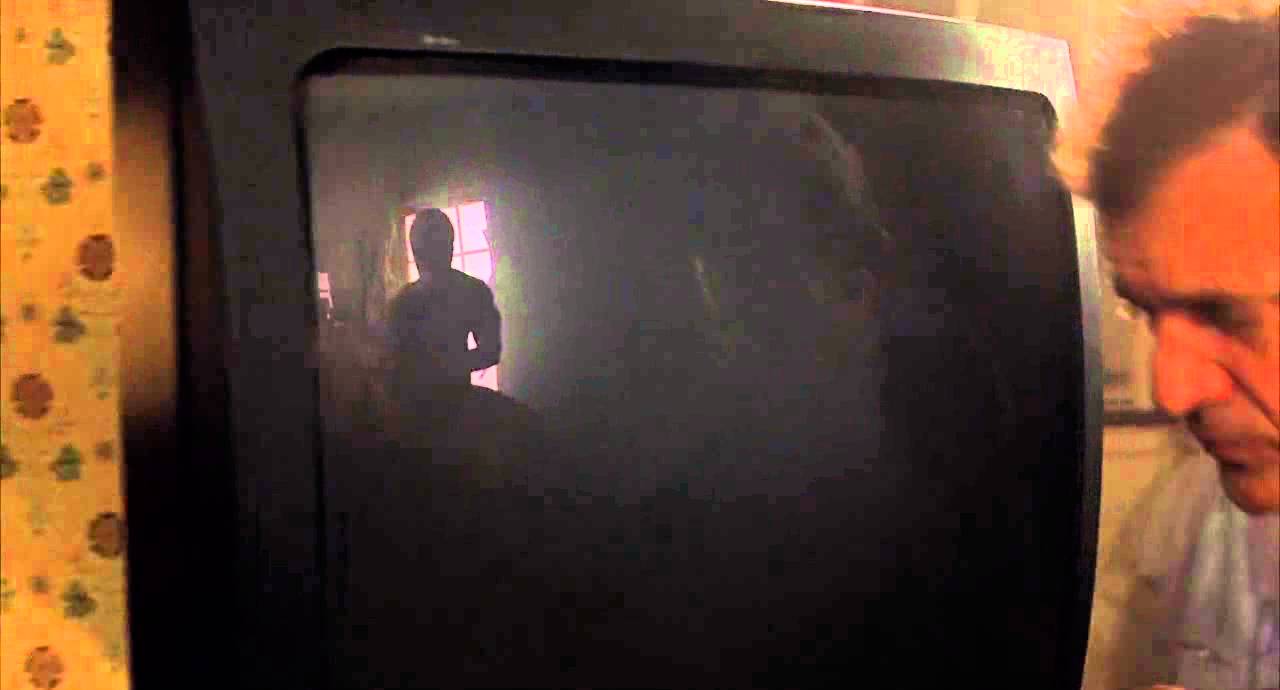
I also love the reveal of the alien still being in the house at the end through the TV screen


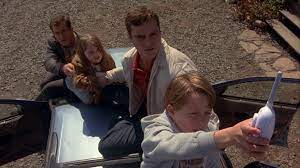
Coming back to Spielberg, the scene where the Hesses are using a walkie-talkie to hear the aliens talking is perhaps the most Spielbergian in the film:


The Sixth Sense and Unbreakable were films about coming to accept the incredible, whether it be the ability of a young boy being able to see ghosts, or that you're a superhero. Malcolm Crowe (Bruce Willis), at first doubts that Cole Seer (Haley Joel Osment) can see ghosts, realizes he's telling the truth after discovering his former patient had the same ability. David Dunn (Willis again), comes to accept he has superhuman powers. In Signs, Graham eventually can't deny there are aliens ready to invade. These films are about faith and belief, as well as accepting your purpose- Cole as the helper of the deceased, David as a superhero vigilante. Shyamalan takes these themes further in Signs by having Graham not just realize these aliens are real but there's a greater design to the universe, something he may have once believed in but turned his back on after his wife was killed. In perhaps Signs' best scene, Graham tells Merrill that there are two groups of people: people who see those lights in the sky and think they're seeing a miracle; the other believe that whether good or bad, there's no higher power looking out for them. 

I think Gibson gives what may be the best performance of his career in this film. Like with Willis, Shyamalan casts Gibson against type as a non-confrontational former priest who can't swear convincingly. When Graham and Merrill are attempting to scare off the intruder Graham awkwardly says "I'm losing my mind." It's hard not to imagine Gibson having fun playing a guy *pretending* to lose his mind rather than genuine loose cannons like Martin Riggs and Mad Max. This role also allows Gibson to be the most emotionally vulnerable he's been since the first two Lethal Weapon movies. There's a scene where Graham encounters Ray, whose trapped an alien in his house and leaving for a safer place, in which her tells Graham he's sorry for the pain he caused him. Gibson's reaction to that-the pain, the anger, but the acceptance of Ray's apology, displays how stronh he can be as actor. Overall it's a great movie star performance and perhaps the last time Gibson was without baggage as an actor/star.

Instead of casting another huge movie star as Merrill Shyamalan went for a more offbeat choice with Phoenix. Phoenix was coming off his first Oscar nomination for Gladiator and Walk the Line was a few years down the road. This was the film that turned me in to a Phoenix fan. He's so funny here. His reaction to the alien walking across the TV screen and the image of him sitting with the children, all of them wearing tinfoil hats, is likely the funniest thing Shyamalan has put on screen. Merrill is sort of a loser but he's got a good heart and is pretty endearing. I love that when Graham asks Merrill if he believes in miracles Merrill tells of the time he avoided being vomited on a girl he wanted to kiss because he had to take a piece of gum out. This is the same scene where Graham outlines the two groups of people and Shyamalan really gives us a good sense of how these two guys approach life. Gibson and Phoenix don't look a thing like brothers but I really enjoy their chemistry.

Coming back to the themes of faith and belief, Shyamalan's twist ending her- along with the Village- is his most audacious conceptually and thematically. I remember when I first the saw Signs I was expecting a twist along the lines of The Sixth Sense or Unbreakable, more of an "Oh my God!" than a slow realization of what has been set up over the course of the film. Shyamalan is going less for shock than for quiet realization. Bo's leaving glasses of water around for various reasons (supposed contamination, tastes funny), Morgan's asthma, Merrill's bat hanging in the living room, and Colleen's final words to Graham about telling Merrill to swing away, are all part of a grand design, calling back to Graham's question, "What if there are no coincidences?" Morgan's asthma protects him from the aliens' poisons and the glasses of water kill the aliens. Graham's faith is restored and the final shot shows him months later getting ready to go to church. He's found his purpose again. I find the ending I find little too pat. If Shyamalan had made things more ambiguous regarding whether certain things were coincidental or not it would've provided some great discussion. Instead, there's not much room for questioning these things. If we're going to continue the Spielberg comparisons, it's the kind of  easy ending for which, Spielberg often gets criticized. 

Ultimately, I don't think Signs is a particularly deep movie but I still think the movie overall works on an emotional and technical level. After using Eduardo Serra on Unbreakable as his cinematographer, Shyamalan brought back his The Sixth Sense cinematographer Tak Fujimoto (who photographed no less than Terrence Malick's debut feature Badlands as well as The Silence of the Lambs) for Signs. Fujimoto bring an eerily cozy feel to the film, the same way he did with The Sixth Sense. There's a paradoxical cold and warmth to these early Shyamalan films. James Newton Howard's elegant and elegiac scores also bring a beautiful autumnal melancholy this film and Shyamalan's other work. There's a little bit of Danny Elfman too in Howard's main theme for Signs. If not for Shyamalan's name you'd be forgiven if you thought maybe you were about to watch a Tim Burton alien invasion film. 

Like H.G.Wells' War of the Worlds and its cinematic interpretations, the aliens are defeated pretty easily at the end of story, which I'm okay with because the story isn't really about a war against aliens. It's a home invasion thriller which just happens to be set against a backdrop of a world invasion. The Birds, which I referenced earlier is also a smaller, almost apocalyptic story that's focused on this small town and its inhabitants. Shyamalan goes even smaller than Hitchcock, creating an almost chamber drama feel to the certain parts of the film. I almost wish there no other characters in the film other than the Hesses. 

The next Spielberg moniker obviously didn't stick, with The Village getting mostly negative reviews and Shyamalan getting worse and worse reviews over the next several films, though he's made a comeback or the last several years. However,  I don't think Shyamalan has ever recaptured what made people deem him the heir to Spielberg. The specific atmosphere of his early work has never completely returned for me unfortunately. Still, Shyamalan has always stayed true to his own particular sensibilities, similar to George Lucas, who's also gone through a reappraisal regarding his specific quirks. Maybe because we're at a place where pop culture lacks vision and spark it's easier to appreciate people like Shyamalan more now. Signs, along with The Sixth Sense, Unbreakable and yes, The Village, represent a filmmaker unafraid of being laughed at for his earnestness, whose pretentiousness oddly feels like genuine sincerity. 

It's weird to think of Signs as a 20 year old film but it makes sense- it does feel like a film from another era, a star and director driven blockbuster, the kind that would feel like a throwback if released now. I never know how to end these things so I'll say that despite it losing some of its luster for me over the years, I still think Signs is a beautiful, if somewhat reductive, film, which represents a filmmaker who at the time seemed unstoppable as a pop culture force, even if calling him the next Spielberg ended up being a curse. So, what are your thoughts on Signs and M. Night Shyamalan's career. Comment and let me know. 

Wednesday, 2 February 2022

All We Can Do Is Understand and Remember: Time Travel and Tragedy in "Last Night in Soho"


Spoilers Below


What if we could travel back in time but were unable to change anything and were forced to be a passive witness to tragedy? How painful would that be, especially if we were nostalgic towards that period. We would have our heart broken by the dark reality of the time with which we were so enamored. This is what happens to aspiring fashion designer Eloise Turner (Thomasin McKenzie) in Edgar Wright's Last Night in Soho, a film about the inability to see we can't change the past but can only learn from it. In this short essay I will discuss how Eloise is not a typical time traveler and her actual role in the story. I will also discuss the dream-like quality of the time travel in this film.

First, I want to give more context regarding the film's plot. Eloise lives with her Aunt Peggy (Rita Tushingham) and through a supernatural ability is able to see the ghost of her mother, who committed suicide when Eloise was very young. Eloise is accepted in to a fashion school in London but when she moves there she quickly realizes she doesn't fit in with her roommates so she rents a room from Ms. Collins (Diana Rigg). On the first night in that room she is able to travel back in time to 1960s London and witness the story of Sandie (Anya Taylor Joy), an aspiring singer who comes to London and is ensnared by supposed talent manager Jack (Matt Smith), who pimps her out to wealthy men in clubs.

While many time travel movies fall in to the science fiction genre there's no technological component to the time travel in this film. It's a supernatural conceit that allows Eloise to travel back in time. But what truly makes Eloise different from other time travelers is she can't change things or interact with the past, though she sometimes experiences things through Sandie. Eloise is almost like a ghost from the future, haunting the past even as it begins to haunt her.  

The time-travel sequences feel like dream sequences, which makes sense since they occur when Eloise has gone to sleep. The way Eloise enters 1960s London has a dream logic to it. She gets out of bed and walks down an alleyway on to a London city street. In "Anatomy of a Scene" from the New York Times Youtube page, Wright even compares the first time-travel sequence to The Wizard of Oz. Wright says that when you see the film in a theatre the soundtrack switches from front-facing stereo to all the surround sound kicking in when Eloise steps out of the alley. Wrights says this is the audio equivalent of Dorothy stepping in to Oz. I think the film also clearly visually parallels that moment by having the camera follow Eloise from behind as she enters this new world, the same way the camera does with Dorothy. 

Another conceit the films uses to craft a dream-like atmosphere is having Eloise seemingly embodying Sandie and experiencing things from her perspective. In the first sequence  Eloise looks in the mirror in the Cafe de Paris and she sees herself as Sandie. The camera pushes in to the reflection. and as the camera turns away from the mirror it's Sandie on the other side, replacing Eloise. And when the camera turns back to the mirror, it's Eloise on the other side. And during Sandie's dance with Jack we transition- through editing and camera movies- from seeing Sandie dancing to seeing Eloise dancing. 

Let's come back to the mirrors, as Sandie walks down some steps we see Eloise in the mirrors going downwards. And when Jack is kissing Sandie on the neck, in a mirror we see him kissing Eloise. These shots of Eloise in mirrors are a visual metaphor for her being an outsider in the past rather than an active participant. Eloise will again be seen in a mirror as she watches Sandie talking to the men to which she is being propositioned. Eloise tries to break through to the other side but when she gets through and grabs Sandie, she wakes up. Eloise being seen in mirrors also represents how her and Sandie are mirror images of each other. They're both ambitious and artistic young women who move to London and learn it's not all they expected. Their romantic image of the city is shattered. When Eloise first gets to London she has an uncomfortable encounter with a cab driver and her run ins with a older gentlemen (Terence Stamp), whom she believes to be the older Jack are also unsettling for her. Eloise and Sandie's dreams have become nightmares. And speaking of nightmares, when Eloise believes she sees Sandie killed by Jack, the bloodied vision of Sandie appears to Eloise in the present, along with the ghastly shadow men. 

Eloise becomes determined to solve Sandie's murder and get for justice for her. So she is an inactive protagonist in the past but in the present she able to be active. Eloise attempts to expose "Jack" but it turns out he's actually a retired Soho vice cop named Lindsey (Sam Claflin) whom we and Eloise had seen talk to Sandie in the past. And just how Lindsey wasn't Jack, there's another identity reveal around the corner. This is Ms. Collins is the elderly Sandie, who killed Jack and many other men who abused her, whose bodies she's hid in the house for over 50 years (the shadow men are their ghosts).  Eloise went to the police about Sandie's murder and traveling back to the past. This caused the police to come to Ms. Collins' house. Becoming afraid that her crimes will be discovered, Ms. Collins attempts to kill Eloise. So Sandie is the true murderer of the story, not Jack. It's the final subversion and shattering of Eloise's nostalgic vision of the 60s and her idealization of Sandie. Sandie is a victim but also someone capable of brutal violence. And Eloise is almost killed by the woman for whom she so desperately wanted justice.

Sandie didn't literally die but as Ms. Collins says, the young Sandie died 100 times in that room in which Eloise has slept. Sandie's soul died, with Ms. Collins being a ghost of her former self. She's a ghost in the present just as Eloise is a ghost in the past. And Eloise didn't realize the real Sandie was there all along nor did Ms. Collins know that Eloise was witnessing her story in the past. They were so close together but by the time Eloise realizes the truth she doesn't have time to truly explain how much she knows about Sandie's story. As the house burns down Ms. Collins decides to stay behind. She refuses to go to prison because, as she tells Eloise, she's been in a prison her whole life. That one encapsulates so much of the tragedy of Sandie's life. It's really painful, I find. 

Eloise's role in this story is not to change things or solve a murder but to understand what happened to Sandie and why she killed those men. Eloise is here to remember Sandie and who she was before her innocence and vibrancy was robbed from. And while time travel exists in this film we're reminded time travel doesn't exist in reality, that like Eloise we can't change the past. We are all on the other side of the mirror when it comes to history. We can't save it's victims but we can remember them. 

In the final scene we see a presentation of Eloise's designs, with "Downtown" by Petula Clark playing, the song Sandie sang when she auditioned at a Soho nightclub. The audience watching the show doesn't understand the irony of the song choice. It's a happy song but it's not the reality of the 60s, it's not Sandie's life. She didn't get the happy ending she deserved. The song choice tells us that while Eloise still loves 60s fashion, she understands the darkness underneath the glamour. On the commentary Wright says nostalgia is a failure to deal with the present. "You're in retreat," he says. Him and co-writer Krysty Wilson-Cairns agree it's better to make a better world in the present because the past was never a better world. But I'd argue we have to learn from it if there to be a better future an it's always going to haunt us. Which brings us to the film's final moments. Eloise sees Sandie in a mirror,  suggesting the past is never truly dead and that, to paraphrase that classic song that plays at one point in the film, there will always be something there to remind you.

Friday, 20 August 2021

The Essential Films: "Creature From the Black Lagoon" (1954)

Classic Film Through a Feminist Lens: CREATURE FROM THE BLACK LAGOON


A Series of Writings on Films that I feel are essential for film lovers, coupled with films that are personal to me. Spoilers for people who haven't seen the film.

If you were to guess what movie director Ingmar Bergman reportedly watched every year on his birthday the answer may not be Creature From The Black Lagoon but it shows the far-reach and lasting impact of this film, an impact its makers probably could've never expected. But why does Creature endure? I would argue it's due to its odd elegance and beauty as well as the subtle tragic pathos of its titular character, who despite being a "monster" is actually a sympathetic figure. He's in love with a woman with whom can never be and is trying to protect his home from interlopers. He winds up being more alluring and interesting than the human characters.  

Before I get to the film's plot I want to talk about the film's fascinating and strange origin. Actor and future producer William Alland-who was part of Welles' Mercury Theater and played the reporter in Citizen Kane- was at a dinner party with Welles, actress Dolores del Rio and cinematographer Gabriel Figueroa during Citizen Kane's production. Figueroa told stories of  part-fish, part-human creatures that lived in the Amazon. These stories inspired Alland to write down notes that a decade later would be developed in to the script for Creature.

Jack Arnold, who directed It Came From Outer Space, was hired on to direct. Before he became a feature film director Arnold was an actor on Broadway. When WWII began he was placed in the Signal Corps where he took a course on cinematography. He then became a cameraman, working on military documentaries as an assistant to famed documentary filmmaker Robert Flaherty (Nanook of the North). After the war he formed a production company with his air squadron friend Lee Goodman named Promotional Films, which made fund-raising films for non-profit organizations. He would eventually direct an Oscar-nominated documentary entitled With These Hands, about working conditions in the early 20th Century.  

The underwater sequences were directed by James C. Havens and photographed by Scotty Welbourne. Ricou Browning played "Gill-man" in the underwater scenes while Ben Chapman played him in the land scenes. Browning started out as a diver in underwater shows but after being in Creature and its two sequels he would go on to have a career in the film business as a producer, director and second unit director. He was the second unit director on the James Bond film Thunderball, which is funny because when I was watching the film I couldn't help but think of Thunderball's underwater scenes.   

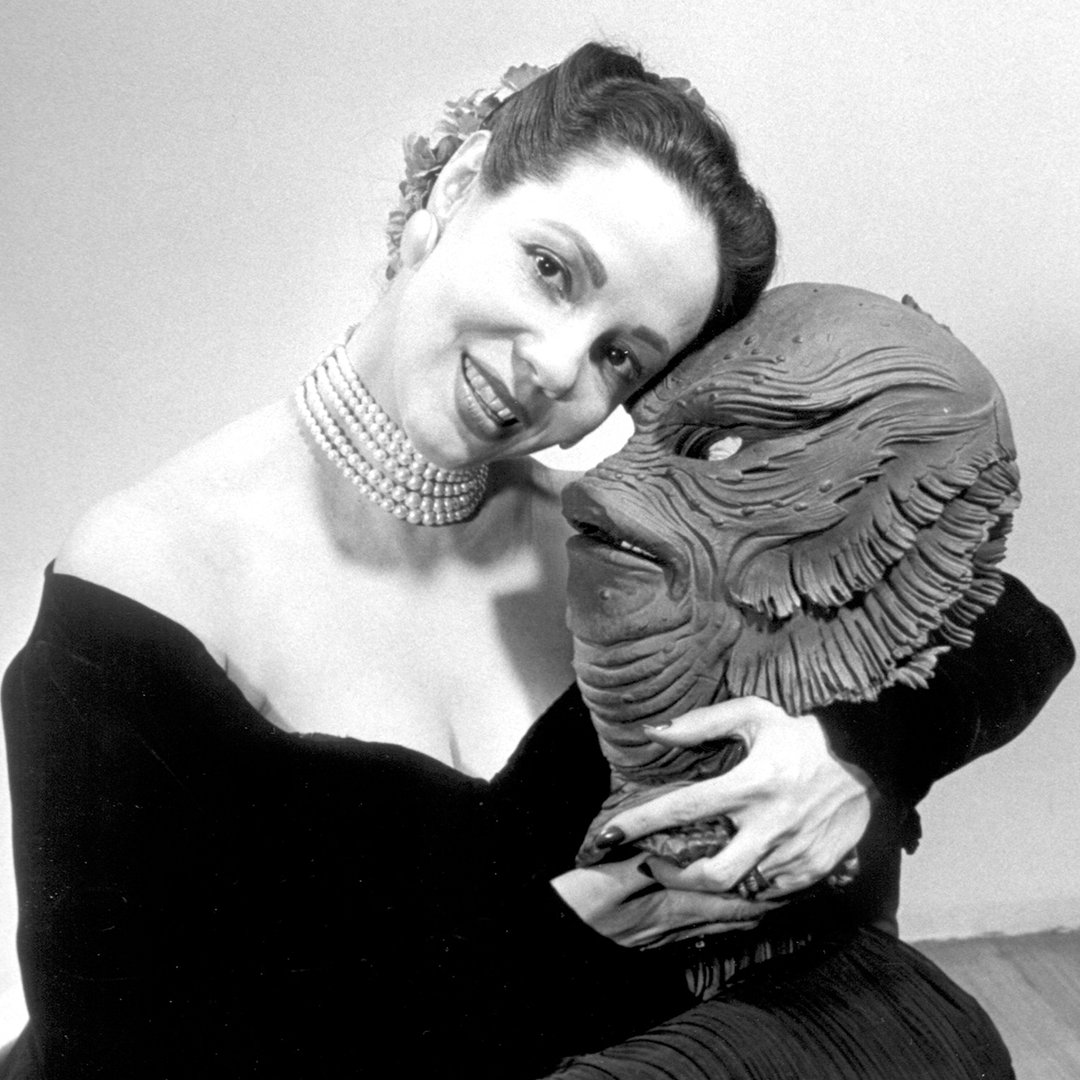
The design for "Gill-man" came from Milicent Patrick, born Mildred Elizabeth Fulvia di Rossi, and who some claim to have been an Italian baroness. Her father C.C. Rossi helped design William Randolph Hearst's castle estate (another Citizen Kane connection.) She worked as animator for Walt Disney before becoming a model. When she became an actress she met Bud Westmore, head of Universal Studios' make-up department, showing him her sketches.

Universal Monsters Spotlight on MILICENT PATRICK: Hollywood's Unsung M –  Mondo

She created Gill-man's design but was let go from Universal due to Westmore's jealousy over her creating the design. Westmore got the credit for Gill-Man until research reclaimed Patrick's contribution to the film. Patrick is the most fascinating figure associated with this film, with a recent book about her life and career by Mallory O'Meara entitled The Lady From The Black Lagoon being published in 2019.

I've talked quite a bit about the behind the scenes players  so now it's time to discuss the actual  story. The film begins with the discovery of a a skeletal hand which links man and sea animal. Dr. Carl Maia (Antonio Moreno) seeks out friend and former student Dr. David Reed (Richard Carlson) to help with an expedition. David, Carl, Dr. Mark Williams (Richard Denning), Dr. Edwin Thompson (Whit Bissel), and David's colleague and lover Kay Lawrence (Julie Adams), go back to the amazon to find the rest of the skeleton. This leads to them encountering the Gill-man, who takes a liking to Kay, ala King Kong. 

The characters are archetypes- you have the good scientist who doesn't want to kill the creature (David), the scientist who acts like a big game hunter (Mark), the bookish scientist (Edwin), the older doctor (Carl), the girl (Kay), and the foreign riverboat captain, Lucas (Nestor Paiva). But the simplicity of the characters just makes Gill-man all the more interesting. Chapman and Browning both give Gill-Man a personality despite never speaking, a certain "character" if you will. Chapman was directed by Arnold to not lift his feet when walking on the boat. Arnold conceived that since Gill-Man glided underwater he would glide on surface. It's easy to forget its two actors playing the part because it feels like a consistent character.

Coming back to King Kong, If that film's plot is repurposed for Creature, then Creature's DNA can be found in everything that came after, including Jaws and Alien. The sequence where Kay is swimming in the lagoon, mirrored by Gil-man underwater, can't help but bring to mind Stevem Spielberg's classic. When we see Kay from the creature's perspective it's hard not imagine Spielberg having seen the film when he was a boy. In the opening where we see Chrissie (Susan Backline) from the shark's perspective underwater it feels like a clear homage. Welbourne's cinematography gives this scene a dream/nightmare-like quality. The underwater sequences all have a lyrical and visceral quality. And since this film was released in 3-D, audiences in 1954 were immersed in the watery world along with the characters. 

Playing the 'Creature from the Black Lagoon' | Considerable


Adams describes Kay and Gill-Man swimming together- unbeknownst to Kay- as a "love dance," which I think is a great description. There's always  an odd romanticism in this kind of film, with the creature in love with a human. On the DVD documentary historian and science fiction illustrator Vincent Di Fate suggests that thinking too much about the logic of sexual intercourse between Gill-man and Kay would ruin the story. He say what matters is the subtext of this scene connecting with an audience.  

The lagoon becomes the thin dividing line between humanity and Gill-man, where humanity is the intruder on his terrain. In the documentary film historian Paul M. Jensen sees an environmental message in the film. When Kay dumps a cigarette in the water it pans down to Gill-man. While Gill-man is actually looking at Kay rather than the cigarette Jensen says the camera movement links the cigarette to Gill-man. This makes it seem like Gill-man is watching his home being polluted. This for makes his actions understandable, and I would argue sympathetic. As Chapman puts it in the documentary, if you came home and people were partying in your house, how would you react? 

Continuing on with the film's themes regarding the underwater world, there's a particular emphasis put on the underwater world's mystery and danger. In one scene David tells Mark:

We've just begun to learn about the water and its secrets, just as we've only touched on outer space. We don't entirely rule out the possibility that there might be some form of life on another planet, and why some entirely different form of life in a world we already know is inhabited by millions of living creatures?

I like the comparison to space, how it and the water are both mysterious worlds still in many ways unknown to man, though we know for certain the water is inhabited. Even if Gill-man is scary he's also an incredible discovery. The film's opening narration is dedicated to how life started underwater, placing the Gill-man as a mythic figure who's been around for ages and is a missing link between man and amphibian. The point of the story is how man will react violently to such a creature. They would want to destroy it instead of trying to make peaceful contact or leaving it alone. Gill-man, after kidnapping Kay is shot down at the end, though the ending was made to be ambiguous so as to leave room for a sequel, which I as made reference to earlier did happen- twice. 

On the DVD commentary, Tom Weaver quotes from an interview Arnold gave where he said he always set out to explore man's inhumanity towards man and those who are different- as well and how humanity hadn't evolved beyond focusing on what was superficial- in his science-fiction films. However he wanted to do so in a way audiences would accept. Arnold said he didn't think audiences would sit for a polemic. He also knew the House Unamerican Activities Committee or other societies would come after him. Arnold wanted to entertain but also hoped audiences would pick up on the deeper themes. Arnold strikes me as a thoughtful filmmaker even if certain critics didn't see anything deeper in Creature. I feel he was able to make an entertaining film without falling in to camp. I think its because it takes its premise seriously without being too serious.  

A discussion of Creature wouldn't be complete mentioning its score and the iconic "Bah Bah Baaahh" theme for Gill-man (created by Herman Stein), which is played every time he appears,. The score is an composite of different composers' contributions, including Henry Mancini (Breakfast at Tiffany's, The Pink Panther), as well as tracks from other Universal Studios' films. 

So, that's Creature From The Black Lagoon. Where does it rank for you amongst the Universal horror films? And why do you think it has endured over the years. Comment and let me know.


Wednesday, 4 August 2021

Thoughts on the Announced "Exorcist" Trilogy

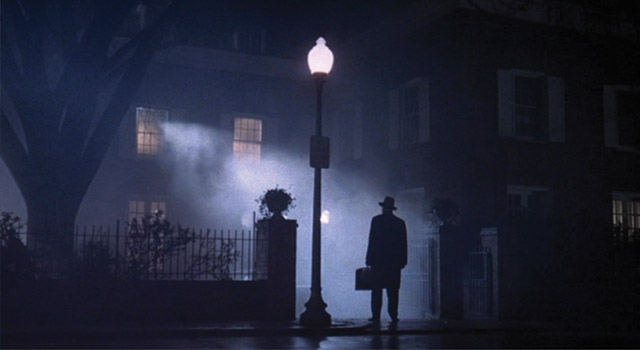
DGA Quarterly Magazine | Fall 2008 | Shot to Remember - The Exorcist

The Exorcist ranks amongst the most seminal horror films, right up there with The Shining, Night of the Living Dead and Psycho. It's spawned a couple of sequels, two very different prequels (from Renny Harlin and Paul Schrader) and a two-season TV show. But it's William Friedkin's original that endures, a film whose power to terrify comes from grounding the horror in a believable reality. The film made people feel like it could happen in their homes or down the street.  It received 10 Oscar nominations and won for William Peter Blatty's screenplay (adapted from his own novel) and Best Sound. And like many classics it's once again getting a continuation. 

Blumhouse is producing a new Exorcist trilogy, similar to the new Halloween films. The trilogy will follow the original film, with Ellen Burstyn set to reprise her Oscar nominated role as Chris MacNeil, the mother of the possessed Regan (Linda Blair). And David Gordon Green, who directed 2018's Halloween sequel and the upcoming Halloween Kills, is set to direct. While producer Jason Blum has alluded to this sequel ignoring the previous sequels Green has said those films are "acceptable mythology."

I wish they hadn't announced a trilogy before the first film is even released. It already makes me feel cynical towards the whole endeavor. I believe it's important to just make a good movie first before thinking about sequels. You run the risk of making the first film more set-up than story. And while I liked aspects of Green's Halloween it felt like it needed some streamlining. There were several subplots which could have been nixed. And having the same director as the Halloween sequels already makes it feel like Blumhouse is counting on replicating the success of the last Halloween film. I don't want Green to repeat himself, doing the "trauma affecting three generations of a family" story. 

There's also the problem being too reverential towards the original. I get it, The Exorcist is an amazing film but it's difficult to recapture the film's impact. It's better just to go in your own direction, similar to the already made sequels. I haven't seen John Boorman's Exorcist II: The Heretic. I know it's infamously bad but it feels it at least did something different. I have seen Exorcist III, directed by Blatty himself, and that is really good, containing maybe the best jump scare of all time. The Exorcist has influenced exorcism movies ever since it's release so the challenge Green is faced with is how to make it fresh.

I know I'm sounding really down on the idea of these movies and I don't want to be. I believe in being open-minded towards upcoming movies. I am interested in what the story is going to be and seeing Burstyn again- and possibly Blair- is alone an exciting prospect. I hope the movies can surprise us as to what story they're telling. 

So, what are your thoughts on The Exorcist sequel(s).  Comment and let me know.