Showing posts with label Edgar Wright. Show all posts

Wednesday, 2 February 2022

All We Can Do Is Understand and Remember: Time Travel and Tragedy in "Last Night in Soho"


Spoilers Below


What if we could travel back in time but were unable to change anything and were forced to be a passive witness to tragedy? How painful would that be, especially if we were nostalgic towards that period. We would have our heart broken by the dark reality of the time with which we were so enamored. This is what happens to aspiring fashion designer Eloise Turner (Thomasin McKenzie) in Edgar Wright's Last Night in Soho, a film about the inability to see we can't change the past but can only learn from it. In this short essay I will discuss how Eloise is not a typical time traveler and her actual role in the story. I will also discuss the dream-like quality of the time travel in this film.

First, I want to give more context regarding the film's plot. Eloise lives with her Aunt Peggy (Rita Tushingham) and through a supernatural ability is able to see the ghost of her mother, who committed suicide when Eloise was very young. Eloise is accepted in to a fashion school in London but when she moves there she quickly realizes she doesn't fit in with her roommates so she rents a room from Ms. Collins (Diana Rigg). On the first night in that room she is able to travel back in time to 1960s London and witness the story of Sandie (Anya Taylor Joy), an aspiring singer who comes to London and is ensnared by supposed talent manager Jack (Matt Smith), who pimps her out to wealthy men in clubs.

While many time travel movies fall in to the science fiction genre there's no technological component to the time travel in this film. It's a supernatural conceit that allows Eloise to travel back in time. But what truly makes Eloise different from other time travelers is she can't change things or interact with the past, though she sometimes experiences things through Sandie. Eloise is almost like a ghost from the future, haunting the past even as it begins to haunt her.  

The time-travel sequences feel like dream sequences, which makes sense since they occur when Eloise has gone to sleep. The way Eloise enters 1960s London has a dream logic to it. She gets out of bed and walks down an alleyway on to a London city street. In "Anatomy of a Scene" from the New York Times Youtube page, Wright even compares the first time-travel sequence to The Wizard of Oz. Wright says that when you see the film in a theatre the soundtrack switches from front-facing stereo to all the surround sound kicking in when Eloise steps out of the alley. Wrights says this is the audio equivalent of Dorothy stepping in to Oz. I think the film also clearly visually parallels that moment by having the camera follow Eloise from behind as she enters this new world, the same way the camera does with Dorothy. 

Another conceit the films uses to craft a dream-like atmosphere is having Eloise seemingly embodying Sandie and experiencing things from her perspective. In the first sequence  Eloise looks in the mirror in the Cafe de Paris and she sees herself as Sandie. The camera pushes in to the reflection. and as the camera turns away from the mirror it's Sandie on the other side, replacing Eloise. And when the camera turns back to the mirror, it's Eloise on the other side. And during Sandie's dance with Jack we transition- through editing and camera movies- from seeing Sandie dancing to seeing Eloise dancing. 

Let's come back to the mirrors, as Sandie walks down some steps we see Eloise in the mirrors going downwards. And when Jack is kissing Sandie on the neck, in a mirror we see him kissing Eloise. These shots of Eloise in mirrors are a visual metaphor for her being an outsider in the past rather than an active participant. Eloise will again be seen in a mirror as she watches Sandie talking to the men to which she is being propositioned. Eloise tries to break through to the other side but when she gets through and grabs Sandie, she wakes up. Eloise being seen in mirrors also represents how her and Sandie are mirror images of each other. They're both ambitious and artistic young women who move to London and learn it's not all they expected. Their romantic image of the city is shattered. When Eloise first gets to London she has an uncomfortable encounter with a cab driver and her run ins with a older gentlemen (Terence Stamp), whom she believes to be the older Jack are also unsettling for her. Eloise and Sandie's dreams have become nightmares. And speaking of nightmares, when Eloise believes she sees Sandie killed by Jack, the bloodied vision of Sandie appears to Eloise in the present, along with the ghastly shadow men. 

Eloise becomes determined to solve Sandie's murder and get for justice for her. So she is an inactive protagonist in the past but in the present she able to be active. Eloise attempts to expose "Jack" but it turns out he's actually a retired Soho vice cop named Lindsey (Sam Claflin) whom we and Eloise had seen talk to Sandie in the past. And just how Lindsey wasn't Jack, there's another identity reveal around the corner. This is Ms. Collins is the elderly Sandie, who killed Jack and many other men who abused her, whose bodies she's hid in the house for over 50 years (the shadow men are their ghosts).  Eloise went to the police about Sandie's murder and traveling back to the past. This caused the police to come to Ms. Collins' house. Becoming afraid that her crimes will be discovered, Ms. Collins attempts to kill Eloise. So Sandie is the true murderer of the story, not Jack. It's the final subversion and shattering of Eloise's nostalgic vision of the 60s and her idealization of Sandie. Sandie is a victim but also someone capable of brutal violence. And Eloise is almost killed by the woman for whom she so desperately wanted justice.

Sandie didn't literally die but as Ms. Collins says, the young Sandie died 100 times in that room in which Eloise has slept. Sandie's soul died, with Ms. Collins being a ghost of her former self. She's a ghost in the present just as Eloise is a ghost in the past. And Eloise didn't realize the real Sandie was there all along nor did Ms. Collins know that Eloise was witnessing her story in the past. They were so close together but by the time Eloise realizes the truth she doesn't have time to truly explain how much she knows about Sandie's story. As the house burns down Ms. Collins decides to stay behind. She refuses to go to prison because, as she tells Eloise, she's been in a prison her whole life. That one encapsulates so much of the tragedy of Sandie's life. It's really painful, I find. 

Eloise's role in this story is not to change things or solve a murder but to understand what happened to Sandie and why she killed those men. Eloise is here to remember Sandie and who she was before her innocence and vibrancy was robbed from. And while time travel exists in this film we're reminded time travel doesn't exist in reality, that like Eloise we can't change the past. We are all on the other side of the mirror when it comes to history. We can't save it's victims but we can remember them. 

In the final scene we see a presentation of Eloise's designs, with "Downtown" by Petula Clark playing, the song Sandie sang when she auditioned at a Soho nightclub. The audience watching the show doesn't understand the irony of the song choice. It's a happy song but it's not the reality of the 60s, it's not Sandie's life. She didn't get the happy ending she deserved. The song choice tells us that while Eloise still loves 60s fashion, she understands the darkness underneath the glamour. On the commentary Wright says nostalgia is a failure to deal with the present. "You're in retreat," he says. Him and co-writer Krysty Wilson-Cairns agree it's better to make a better world in the present because the past was never a better world. But I'd argue we have to learn from it if there to be a better future an it's always going to haunt us. Which brings us to the film's final moments. Eloise sees Sandie in a mirror,  suggesting the past is never truly dead and that, to paraphrase that classic song that plays at one point in the film, there will always be something there to remind you.

Tuesday, 11 July 2017

"Was he slow?" Baby Driver

Image result for baby driver poster

Warning: Major Spoilers Follow

Edgar Wright is someone who's in love with his job as a filmmaker, which has shown in every film he's made thus far. This love affair continues with his latest film Baby Driver. The film's story involves familiar genre archetypes: a getaway driver (Ansel Elgort) who wants to quit the life of crime, the crime boss (Kevin Spacey) who reels him in for another job, the waitress with whom our hero wants to run away (Lily James) and the assortment of criminals along for the ride (Jon Hamm, Eiza Gonzalez, and Jamie Foxx). It's an old song but performed with genuine style, charm and heart.

Speaking of songs, Baby Driver can be best described as a film noir musical. This is because our hero-Baby- listens to music while heists are being pulled off and when he's out-driving the police. He also records conversations and makes songs out of them. The film as an extension of Baby's mindset; Wright shot and edited the action sequences to the music, creating a unique synthesis of sound and visuals that's organic to the film's universe. 

We learn Baby listens to music constantly due to a childhood car accident which left with him a constant humming in his right ear. The same accident also killed both his musician mother (Sky Ferreira) and father (Lance Palmer). When he was still a kid, Baby stole from Spacey's Doc. Doc was so impressed that he's used Baby for every heist. Baby is in debt to Doc and is due to retire after one more heist. Like Ryan Gosling's unnamed character in Drive Baby is great at his job but still strikes others as odd. Griff (Jon Bernthal) and Foxx's Bats are antagonistic towards him. However, due to his youth several of the criminals treat him as a surrogate son or little brother. 

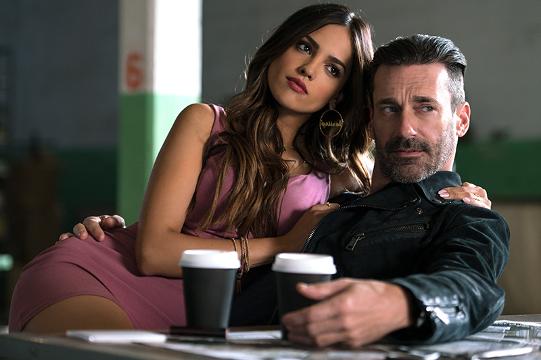
Hamm and Gonzalez's Bonnie and Clyde married couple Buddy and Darling treat him with a kind of bemusement- not quite affection but a certain level of respect. Baby has a complicated relationship with Doc, who is part extorter/part father figure to Baby. Spacey is one of the best actors at doing quiet menace while being darkly funny. When he brings Baby back in to the fold after debts had supposedly been settled Doc casually remarks that he could cripple Baby and kill everyone he loves if Baby doesn't keep working for him; it's this scene where Baby realizes how much he's still in Doc's grip- and desperately needs a way out. 
Image result for lily james baby driver

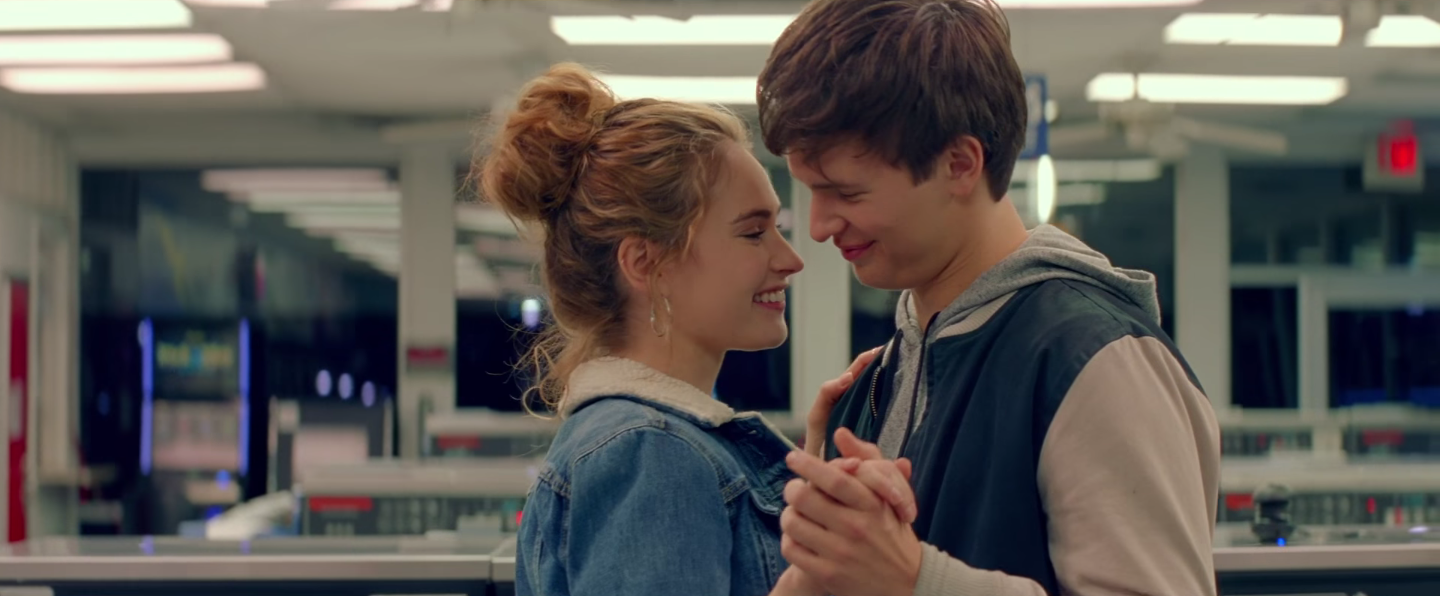
While James Debora and the whole love story between her and Baby is somewhat underwritten, she and Elgort's chemistry makes the relationship very pleasurable to watch unfold. Wright understands that there's a inherent romanticism inherent in noir- wanting to drive away with a beautiful woman, turning your back on the world of violence and greed- and he portrays the romance in an idealized fashion. The movie believes two people can be brought together by music. I get the impression that Baby sees something of his mother in Debora- a memory of a happier time when he felt protected. Debora and Darling are notably the two major female characters in the film and they are deliberately contrasted. Darling isn't quite a femme fatale but she's certainly a more dangerous and sexual figure than Debora- who projects a virginal innocence. And while Gonzalez is younger than James, Darling does come across as older and seasoned woman.

While Baby may see his mother in Debora, fatherhood an important aspect of this film. I mentioned that Doc is a twisted version of a father figure; but the man Baby views as a father in the film is foster father, Joe (C.J. Jones), who is deaf and whom Baby looks after, being a father of sorts to Joe. This relationship is perhaps the most touching in the film and helps make Baby a more sympathetic character. 

While the movie is using well-worn genre tropes, it also manages to subvert expectations- particularly regarding certain characters. Bats is killed before the third act even though he was being built up as possibly the major antagonist of the film. It's actually Buddy who becomes the villain in the finale of the film. We understand Buddy's motivations- Darling is killed by the police after Baby intentionally ruining the heist. We see that Buddy and  Darling's love was as or even more genuine than Baby and Debora's. Unlike other noir heroes- Baby lives at the end of the film- but the film doesn't escape tragedy if you look at the film from Buddy's point of view. This makes ending's romanticized reunion of Baby and Debora- after Baby gets out of prison- ironic considering the fact Baby is partly responsible the death of a man's wife.

Image result for eiza gonzález baby driver jon hamm
  

Hamm- who became famous for his portrayal of Don Draper on the TV show Mad Men- has in his film roles avoided Draper-esque characters. Instead he's played the good-looking doofus (Bridesmaids), rugged detective (The Town), and a doctor who specializes in lobotomies (Sucker Punch). Hamm's smooth grizzled-ness makes Buddy a distinct personality and a character who could likely carry his own movie.

I do want to talk about Elgort's casting in the role of Baby. Elgort first came to audiences' attention with his role in the teen romance The Fault in Our Stars alongside Shailene Woodley, whom he also co-starred with in the Divergent franchise. His casting as a slick getaway driver would appear to be a case of miscasting. But it ends up working due to how Elgort's image as an actor in Young Adult-orientated films offers a humorous contrast to the noir archetype he's playing; at the same Elgort's offbeat stoicism makes him believable as this odd but cool getaway driver. The opening scene establishes the relationship between Baby and his music, how he grooves to it even as a dangerous heist is occurring. 

I don't know where I'd rank Baby Driver in the Wright Pantheon, particularly since I still need to re-watch most of his work- but it clearly shows a director high on the joy of making movies and pushing himself as an artist, which makes what he'll do next always very exciting. 

Thursday, 6 March 2014

Some Thoughts on My Mixed Feelings Towards Marc Webb and "The Amazing Spider-Man" Franchise


Just this past week it was announced that Marc Webb- the director of 2012's Spider-Man reboot The Amazing Spider-Man and this year's sequel The Amazing Spider-Man 2- had signed on to direct the third installment in this new series. This wasn't a huge surprise since this series is so obsessed with universe building- Sony definitely wants to keep on the same director for at least one more film to keep things consistent. But if you remember, Webb almost didn't return to direct The Amazing Spider-Man 2 due to his contract with Fox. For me, this announcement brought my conflicting feelings towards Webb being the director of this franchise-for now- to the surface. Unlike a lot of people I am not really on board on the Webb love train.


Now- to be completely clear- I don't have anything against Webb personally or professionally. I remember really enjoying his debut feature- 2009's (500) Days of Summer- and he deserves a hearty congratulations for breaking in to Hollywood in such a big way. The reasons I'm not in love with the idea of him directing Spider-Man films are somewhat paradoxical. For one, I don't exactly like the idea of a upcoming director wasting the first stage of his film career directing sequels- particularly when they're essentially films that aren't personal works but are films essentially made for Sony. I'd like to see him take on more interesting projects and forge his own path apart from Spider-Man. Of note is that Webb- aside from signing on to The Amazing Spider-Man 3- has also been linked to the project Cold Comfort, based on the book How to Catch a Russian Spy co-written by Ellis Henican. The project sounds interesting and it'd be nice if we could see a non-Spider-Man film from Webb before the third Amazing is released.


My other problem regarding Webb directing the Spider-Man franchise- and this is where things get contradictory- is I don't find Webb that exciting or interesting a director. This isn't to say he's a bad director- he did fine work on (500) Days and there were certain directorial touches in The Amazing Spider-Man I really liked- but overall I just wasn't blown away by his direction in that film. To be fair I don't think The Amazing Spider-Man was ever going to be a director's film. Due to the circumstances regarding its inception the film was always going to be mostly a studio controlled film. That- and the fact it was Webb's first Blockbuster. He likely wasn't confident enough to really bring forth a particular vision-nor would Sony let him.


I am glad, however, that Webb got another go at this universe. With superhero franchises the first film is more of a test run while the second film emerges as a stronger effort- think Bryan Singer's X-Men United and of course Sam Raimi's Spider-Man 2. The Amazing Spider-Man 2 does look more promising- more colorful, more action-packed and we're past the origin story stuff. Moreover, people have suggested Webb has more control over this film than the previous installment. Ideally Webb will bring more of his own ideas in to the mix and the film will have a more confident feel. Still, while The Amazing Spider-Man 2 will likely be a good film I get the sense from watching the trailer that'll still feel like it came off a conveyor belt and be more of a  Hollywood product than a singular vision from a great artist.  


Maybe it's superhero fatigue or that I shouldn't be watching trailers. I just can't help but wonder what someone Alfonso Cuaron or Edgar Wright (who's directing Ant-Man with Paul Rudd and Michael Douglas for Marvel) would do with this franchise. When Cuaron came on board the Harry Potter franchise for the third film- Harry Potter and the Prisoner of Azkaban- he made what is- in my eyes- the most imaginatively directed and re-watchable of all the Harry Potter films.


For the sake of transparency my mixed feelings towards Webb and these films have a lot to do with the backlash against the Sam Raimi-directed Spider-Man films. I'm okay with seeing someone else's take on the character and universe but the hatred towards those films has turned me off this new franchise to a large degree. Especially when it comes to Cinemablend critic Sean O'Connell being the walking definition of "conflict of interest" as he has become practically a "cheerleader" (his words) for this franchise and acts like The Amazing Spider-Man was completely his vision. I feel O'Connell's love for The Amazing Spider-Man has to do with certain things absent from the Raimi films being present in this new franchise- mechanical web shooters, Gwen Stacy as Peter Parker's first major romance and more sarcastic jokes from Spider-Man. But I don't think these elements being present in the film makes Webb a brilliant auteur. Nevertheless, Raimi is now seen as the man who butchered Spider-Man, the man who couldn't less about fans while Webb is a man of the people who can do no wrong.The film gave what certain fans wanted and now Webb is hailed as some sort of visionary.


The Amazing Spider-Man 2 could be a truly mind-blowing and great film. But it'd have to reach that level for me to get completely excited for a third Marc Webb-directed Spider-Man film. Webb is a solid director and may grow in to a great one in time. But first I think he needs to get out of the Sony/Spider-Man wheelhouse before he can truly bloom.

Wednesday, 31 October 2012

Six Possible Directors For "Star Wars: Episode VII"


Yesterday, it was announced that Disney had bought Lucasfilm, thus ow ning the rights to Star Wars and planning to release a new Star Wars film in 2015. With Star Wars: Episode VII in the works, and with George Lucas being a creative consultant on the film, one of big questions that looms heavy is who will take the director's chair. Most of the Star Wars films have been directed by Lucas, but with The Empire Strikes Back, directed by Irvin Kershner, usually considered the best of the Star Wars films, a different director is just what the Star Wars series needs to create something fresh and exciting. Here are some directors who could be a good fit to take us back to that galaxy far far away

1. Duncan Jones
 
With Moon and Source Code, Jones provided audiences with two of the smartest and intricate sci-fi films of recent memory-as well as providing both with a strong emotional core to go along with the mind bending twists. With an even larger canvas to paint on, Jones could create his first real epic science-fiction film, as well as possibly providing some twists to the narrative that made his first two films fascinating to watch. Jones is also very good with creating characters that we sympathize with, due to the fact they're often confused about the situations they are in. One of the problems of the prequel trilogy was how unnatural a lot of the dialogue and performances were. Jones directed one of Sam Rockwell's best performances in Moon, and also did fine work with Jake Gyllenhall in Source Code. Jones would likely get strong performances from his actors that would make us care about them as well as believe they exist as human beings, just in another galaxy.

2. Rian Johnson
 
Like Jones, Johnson created a smart and intricate, thematically and plotwise, sci fi film with this year's Looper. And like Jones-he's mostly worked with a lower budget, creating smaller scale films that play around with genre conventions like Brick and The Brothers Bloom. With Star Wars, he'd be working on the largest scale imaginable. With Brick, he handled the film noir inspired dialogue very well, and if there's any Han Solo or gangster like characters, Johnson could have fun infusing it with that same type of sharp and funny dialogue. Looper also effectively dealt with the criminal underworld, so it'd be exciting to see what Johnson would do with the underbelly of the Star Wars univers And of course, if Johnson did end up directing the film, it's likely he'd find a part for friend and frequent collaborator Joseph Gordon-Levitt- and who wouldn't want to see Levitt as a Jedi knight or a Han Solo-inspired smuggler?

3. Alfonso Cuaron


 Cuaron made what I consider the best of the Harry Potter films, Harry Potter and The Prisoner of Azkaban. What was great about Cuaron coming in for the third film of the Harry Potter series was that he brought a real personal touch to the series, providing a lot of visual invention that complimented J.K. Rowling's already complete creation. He also directed the bleak and gritty Children of Men, proving that he can also handle science fiction as well, albeit a more understated type of science fiction. Cuaron is also directing another sci fi film, Gravity, starring Sandra Bullock and George Clooney as astronauts stranded in space, so he'll have plenty of experience with the genre by the time the new Star Wars goes in to production. His Harry Potter film had a great blend of darkness with a touch of whimsy and magic, and with Children of Men, he combined grittiness and intense action. The Star Wars series has featured all these qualities, and if there's a Luke Skywalker-esque coming of age story, his work on Harry Potter and Y Tu Mama Tambien, is also a benefit to the film.

4. Brad Bird


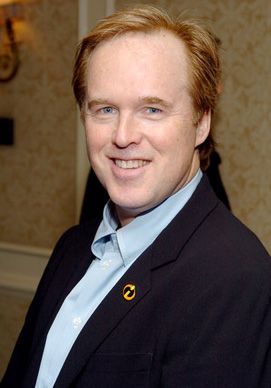
With Mission Impossible: Ghost Protocol, Bird made a surprisingly inventive, visually spectacular and quite fun film, which was quite a feat considering it was the fourth film in the franchise, as well as Bird's first live action film. Bird is best known for his animated films, The Iron Giant, as well as the two films he helmed for Pixar, The Incredibles and Ratatouille. Since Bird was able to inject some new lifeforce in to the Mission Impossible franchise, he could do the same for what will be the seventh Star Wars film, eight if you count Star Wars: The Clone Wars. Bird has worked for Pixar, so he already has a connection with Disney. It wouldn't be too much of a surprise if execs at Disney were already considering him. Star Wars is great for combining intense action with a lightness of touch and a certain charm, which helped make The Incredibles and Ghost Protocol so entertaining. Both films also emphasized the idea of teamwork, with The Incredibles being all about a family work together and growing closer as a result. What was great about the original Star Wars trilogy was it featured characters who couldn't be any more different from each other, a farmboy, a princess, a space pirate and his furry companion, and two droids, working through their differences to save the galaxy and becoming a family. If the new Star Wars films feature this same kind of dynamic, Bird could make it both very entertaining as well as emotionally resonant.

5. Edgar Wright


Wright, as evident in his last film, Scott Pilgrim Vs. The World, is a strong and inventive visual stylist and nearly every frame of that film was filled with energy. And with Shaun of Dead and Hot Fuzz, he gets what makes genre films great while at the same time poking fun at them. If Wright did direct a Star Wars film, it'd be great to see him self-consciously both reference and poke fun at some of the previous films, without going too far in to parody. He was able to handle a large cast of characters in Scott Pilgrim, which will be an advantage if the new Star Wars deals with a lot of diverse characters. His handling of the relationships between Simon Pegg and Nick Frost in Shaun of the Dead and Hot Fuzz also gave those films a lot of heart, and the original Star Wars films, particulalry The Empire Strikes Back, benefited from the strong relationships between the characters. And the idea of Simon Pegg and Nick Frost appearing in a Star Wars film is very funny. The only problem is Wright will be probably be too buy with Ant-Man, unless Star Wars gets pushed back, which is a possibility, then Wright could be free to do it.

And an even bigger longshot....

6. Joss Whedon


Every one would just nerdgasm if this happened. Since Disney also owns Marvel, like Bird, Whedon already has a relationship with Disney, if you can cal it that. Unless Star Wars is delayed, he won't be directing the first of the new Star Wars films, what with him directing the next Avengers film. Still, with The Avengers, Whedon showed that he could handle big scale action while still incorporating a personal style that really felt like it understood and was passionate about the material. Whedon also knows how to work team dynamics, as in Buffy the Vampire Slayer and The Avengers. As I mentioned earlier, if the new Star Wars has the same team dynamic as the original trilogy, someone like Bird or Whedon could make it work.