Showing posts with label Keanu Reeves. Show all posts

Saturday, 22 April 2023

Oceans of Time: "Bram Stoker's Dracula"


Spoilers Below

We don't make films that look and like Francis Ford Coppola's Dracula anymore. It belongs to the era that also gave us Tim Burton's Batman Returns and Joel Schumacher's 2 Batman films, as well as
Baz Luhrmann's Romeo + Juliet, singular, director driven movies with big budgets and based on popular source material. Dracula and Batman Returns owe themselves more to German expressionism and silent movies than Hollywood conventions. While we have auteur driven big budget films from the likes of Christopher Nolan and Denis Villeneuve it's hard to imagine either them making something as campy, avant-garde and erotic as this film. They're both too sexless to make an sexual film. Robert Eggers is doing his Nosferatu remake but that's probably going to be a more somber affair without the camp humour of this film. But to be fair, the guy who put a decapitated horse's head in a guy's bed and had Marlon Brando talk about polio doesn't necessarily seem like anyone's idea of a sexy filmmaker. However, Coppola's career and style has always been varied and unpredictable. 

Coppola's style is defined by its fluidity and adaptation, fitting his style to what the film needs- from the novelistic quality of The Godfather films, the surreal nightmarishness of Apocalypse Now, the chilly paranoia of The Conversation, and the lowkey fantasy of Peggy Sue Got Married. He also doesn't box himself by genre. He took the gangster film and put on a Shakespearean scale with both parts of The Godfather, combined the gangster and musical genres with The Cotton Club, and made a war film as strange and atmospheric as Apocalypse NowDracula is a horror film but it's also a gothic romance blended with the avant-garde and camp. It also wasn't the first time Coppola delved in to the gothic. When he enrolled in UCLA film school, he directed couple of short horror films, Two Christophers, inspired by Edgar Allan Poe's William Wilson, and Ayamonn The Terrible, about a sculptor's nightmares coming to life. In 1963 Coppola was one of several uncredited directors on Roger Corman's The Terror, starring Boris Karloff and a young Jack Nicholson. Coppola's first full length feature was the Psycho-inspired Dementia 13.  And one can detect Coppola's horror roots in the horse's head and murder of the five families sequences from The Godfather

Before Dracula, Coppola returned to this greatest financial and artistic success with The Godfather Part III. And thematically Dracula begins where that film ends. After seeking legitimacy throughout the film  Michael Corleone (Al Pacino) witnesses his daughter Mary (Sofia Coppola) murdered by assassins meant to kill him. In 1462 Romanian knight Vlad Dracula (Gary Oldman) returns home from his war against the Ottoman Empire to find his wife Elisabetta (Winona Ryder) has committed suicides after the Ottomans reported him dead. Dracula is enraged that after fighting for God this same God didn't prevent his wife's death (and since it was a suicide she won't be allowed in to Heaven). Dracula renounces God and, in an expressionistic piece of storytelling. drinks the blood from a stone cross,  making him in to a vampire. Both Michael and Dracula lose loved ones to their enemies and if Godfather Part III's ending reminds us of King Lear, Dracula's prologue brings to mind Romeo & Juliet, which Coppola does reference in one of the behind the scenes documentaries, as well as Ophelia's suicide from Hamlet. So, Coppola, as he did with the Godfather films, is taking a piece oggenre fiction and reinterpreting it as operatic tragedy. Dracula's howl of pain before cutting to the title is probably the film's most effective emotional moment, for me. 

Coppola said in interviews he felt the other adaptations of Dracula never really did the book, so with his interpretation is was an attempt to follow Bram Stoker's novel more closely- the official title of this film is Bram Stoker's Dracula and Coppola always likes giving the author credit. However, I believe the love story element is something screenwriter James V. Hart added (Hart also did two other literary adaptations, Steven Spielberg's Hook. Kenneth Branagh's Frankenstein and, of all things, Muppet Treasure Island). I've never read Stoker's novel but I do know it's told via letters and journal entries, which Hart and Coppola reference throughout the film. And of course there's this great (practical shot of Jonathan Harker's (Keanu Reeves) diary in the foreground while a train runs across the screen in the background. The diary was an oversized book and the train was an actual miniature train. 


Harker (Keanu Reeves) is  the young solicitor who, in 1897, comes to Dracula's castle to arrange his real estate acquisitions in London. His fiancee, Mina Murray (Ryder, again), is the reincarnated Elisabeta and when Dracula sees her picture it becomes his goal to seek her out. Without the use of flashbacks, we're left to imagine the hundreds of years Dracula has been undead. He feels like the loneliest, most haunted Dracula to grace the screen. This was Oldman back when he really threw himself in to these offbeat villain roles and such a chameleon that I remember knowing someone who joked he wasn't sure what Oldman actually looked like. Oldman certainly knows what kind of movie he's in and is able to pull off the campy, gothic and theatrical side of the character while also bringing real pathos to his tragic longing, specifically when he transitions from decrepit count to handsome and seductive Prince Vlad. 

Reeves. dodgy accent aside, is endearing as Harker, and works as a proper contrast to Oldman. Reeves' Harker is sexually non-threatening, kind of dull, as opposed to Prince Vlad, a more sexually exciting prospect, challenging the Victorian restrictiveness Mina she's used to. But the relationship between Dracula and  is where my problems with the film begin. I just have a hard time getting swept up emotionally as much as I'd like with the film's love story. I'm not even sure if Oldman and Ryder even have chemistry. I do wonder what the film would've been like with a young Kate Winslet or Rachel Weisz. I also have a problem in general, I think with these kind of heightened love stories. I prefer lower-key, more developed and slower burn romances instead of the more melodramatic kind. for which the film is going. It's a little bit like what Coppola's friend and contemporary George Lucas was attempting in Attack of the Clones with Anakin and Padme. I liked the idea behind the romance but I don't believe it pulled it off that well. However, I think the romance in Dracula is better acted. 

Dracula is one of those films that leads with its aesthetics and mood rather than strong storytelling. If the first 2 Godfather films are like a great novel on screen than Dracula feels like an overproduced Broadway play. This isn't to say there aren't visual pleasures to be found here. The in-camera practical effects are terrific, and they make the film, especially with the stuff in Dracula's castle, reminiscent of a 1920s silent film. Honestly, I'd watch a whole film set in this film's version of late 15th century Transylvania, an expressionistic fairy tale where Dracula fights silhouettes of shadow puppets instead of actors. I also love Dracula's armour, which is like a sci-fi take on Japanese samurai armour. In Elizabeth Joy Glass' piece on the film's costumes (Designing Fear: Bram Stoker's Dracula - The Art of Costume), she discusses how at  the beginning of  production, Coppola said "The costumes will be the set." Glass adds that Coppola "wanted the costumes to be visually exciting set pieces, and set the film's atmosphere." Coppola enlisted Eiko Ishioka, who had designed the Japanese poster for Apocalypse Now,  and who at the time only had a couple of costume credits but she would go on to win the Oscar for Best Costume Design. The Simpsons homaged the film's most famous outfit, Dracula's red coat, along with his hundred-of-years-old white make up and what I once heard described as the "boob head." Lucy (Sadie Frost), Mina'a friend who Dracula turns in to a vampire also has a striking funeral/death dress that's a highlight "set piece Watching the film, it's clear what Coppola was going for. Moreso than the settings, the film's costumes- significantly Dracula's different looks, which rival Padme's in The Phantom Menace- define the film's mix of realism and stylization, where certain scenes feel like they're an authentic depiction of the period, while others, like the scenes in Dracula's castle, feel very theatrical and exaggerated. This helps create a distinction between Dracula's world and the more normal world of Victorian England, which then becomes invaded by Dracula's presence.

But coming back to what I was saying, the storytelling and character work does take a backseat to the costumes and the mood. Don't get me wrong, I'll all about visual style and I hate the expression "style over substance." And I do feel strong visual style and directing can overcome a film's other issues. But like Ridley Scott's Legend, a film that also draws me back because of its strong aesthetics (I know, I'm using that word a lot), I wish I could get more in to Dracula emotionally or at least on a entertainment level. There's some grade A Anthony Hopkins ham from his performance as Professor Abraham Van Helsing, who's brought in to the fray after  Lucy is turned in to a vampire. Hopkins was right off his Oscar win for The Silence of The Lambs and one wishes the movie was just Hopkins vs. Oldman, in a similar vein to the Christopher Lee/Peter Cushing Hammer Horror Dracula movies. There's definitely a more entertaining film in here about Helsing and Dr. Jack Seward (Richard E. Grant), Lucy's fiancĂ©e, Arthur Holmwood (Cary Elwes), and Texan Quincy Morris (Billy Campbell) facing off against Dracula. 

So, the film isn't emotionally engaging on the love story level, and it's not fun enough despite the Hopkins bits, so it ends up unsatisfying as both a romance and an entertaining horror film. The sincere romanticism and the camp are also never completely reconciled. Though the film's unwieldy nature gives it its beguiling and esoteric allure. Like Lucas, Coppola is a experimental director at heart, more so than his populist success would lead you to believe. I feel that if Lucas would've kept directing movies after the original Star Wars, he may have eventually become who Coppola is now, a director whose films are outside of the mainstream and experimental. Dracula is one of Coppola's last true commercial films, followed by Jack (1996) and the John Grisham adaptation  The Rainmaker (1997).  He has just completed production on his long-gestating project Megalopolis, a sci-fi film about an architect attempting rebuild New York in to a utopia after a disaster. 

Dracula is a film I always return to, wanting to love it more than I do and it has grown on me in certain respects, though I can't say it's a complete success. However, it's such an distinctive film of excess and theatricality that I'll always go back to for its strong visual design fun performances. A little over 30 years after its release, there's still never anything quite like Coppola's gothic, camp, whatever you want to call it, opus.

Tuesday, 4 January 2022

Why did this story feel like a memory?: "The Matrix Resurrections"


Spoilers Below


"They took my life and turned in to a video game" laments Neo (Keanu Reeves) at one point in Lana Wachowski's The Matrix Resurrections, her return, sans her sister Lily, to the universe that defined them. Neo has learned after his sacrifice at the end of The Matrix Revolutions he was resurrected and put back in to the Matrix, where he was given the identity of a video game developer who created the video game called...The Matrix. One of the big themes of The Matrix was choice of identity. The Matrix gives you an identity but it is not one of your choosing. In Resurrections Neo's identity has been robbed of him and his life has been reduced to entertainment. The Matrix took humanity's imprisonment and turned it in to mass entertainment created by the very man who attempted to free humanity from their virtual prison. It would be a cosmic joke except it was specifically manufactured by a computer program, the Analyst (Neil Patrick Harris), who took over the Matrix from the Architect, he of the "ergo" and "vis a vis."

Bugs (Jessica Henwick), a resistance fighter, tells Neo that the Matrix took something so important to her and others, Neo's story and "turned it in to something trivial. Were better to bury truth than in something as ordinary as a video game?" One can hear through Neo and Bugs' conversation Wachowski lamenting on what was so personal to them becoming so commercialized. Hell, The Matrix was turned in to a video game, one written and directed by them. So maybe there's a little bit of self-critique from Wachowski. The Matrix was so personal to them- it's often read as a trans allegory- so perhaps it was reductive to turn it in to a video game and make sequels from it.

It's no coincidence the film's title has Resurrections in it, acknowledging  this is a dead franchise being resurrected, along with a couple of previously thought dead characters. The film is a meta-commentary on legacy sequels, nostalgia and the role of a creator. This is Wachowski grappling with the legacy of her creation and the burden of creating something so popular it almost becomes bigger than you.

The Matrix Resurrections was to be made even without the Wachowskis' involvement but Lana Wachowski came on to steer the ship along with novelist and co-screenwriter David Mitchell (who wrote the novel Cloud Atlas on which the Wachowskis' film was based.) Neo (Thomas Anderson in the Matrix), like the Wachowskis, is told by his business partner (Jonathan Groff)- who's actually a new version of Neo's old nemesis Agent Smith- a sequel is happening to his seminal game with or without him. Smith even name drops Warner Bros. Making a sequel to the game is largely about nostalgia and Wachowski is critiquing how legacy sequels are largely dependent and coast on nostalgia. There's also the irony, as I already mentioned, of humanity's imprisonment becoming a touchstone for a generation via this game. 

The success of the game has plagued Neo as he is unable to separate his "real life" from his "creation," even almost walking off a roof, believing he could fly.  As a creator you can become so defined by your creation that it becomes a curse. You're not able to completely move on from it and people keep asking for more, more of you that you shouldn't have to give, more of what gives them comfort from the real world. In the film's case the "real world" is in itself a virtual reality. When you're playing a video game you're enjoying a simulation within what you don't realize is a simulation. 

Your creation can also be co-opted by people for whom it was never meant. Look at how the concept of the Red Pill was incorporated in to the alt-right philosophy even though The Matrix was made by two trans women, people whom that movement hates. While art is always open to anybody to interpret as they wish, certain people can attach themselves to and misinterpret your work.

Coming back to Neo being unsure of his own reality- when Morpheus (Yahya Abdul Manteen II) shows up Neo thinks he's going crazy. This Morpheus is a computer program created by Neo, an amalgamation of the real Morpheus and Smith. I like Manteen's laidback and chic cool cat interpretation of Morpheus. This version of Morpheus is a cool conceit and I like that he can interact with people in the real world via a new technology. But my favourite performance in the film may be Groff's. Groff doesn't imitate Hugo Weaving but instead invokes something about that performance, all while adding his own corporate cut-throat smarm to the part. And his "awakening" provides one of the film's most memorable moments.

When Neo is taken out of the Matrix and learns the truth he begins grappling with his own legend and questions whether his sacrifice at the end of Revolutions mattered, due to learning his whole life became a video game for mass consumption. He's a little like Luke Skywalker in The Last Jedi in that regard. He has to be told that what he did indeed mattered, even if things didn't work out perfectly. There actually was peace between machines and humans until a civil war broke out between the machines over an energy shortage. The last human city Zion was destroyed but humans and their machine allies forged a new underground city called IO. And Neo reunites an old ally, Niobe (Jada Pinkett Smith), who never believed in the concept of the "One" but believed in Neo. There's even a field of study encompassing his life called "Neology." 

Neo is defined by his own legend, just like the Wachowskis are defined by their creation. He is a man who can never just be a man. He is the One, he is a legend, he's the creator of the most important video game ever. Whether in the Matrix or out he's burdened by expectation, just like the Wachowskis are expected to always return to this universe. The only thing grounding Neo is Trinity (Carrie-Anne Moss), who died in Revolutions but along with Neo was resurrected by the aforementioned Analyst, who was tasked with researching Neo. He discovered Neo's powers were linked to Trinity and he could run the Matrix based on Neo and Trinity's relationship. I'm still a little confused on how this all works. But essentially, with Neo leaving the Matrix, it has destabilized. Trinity was given the name "Tiffany" while in the Matrix and the Analyst made sure to keep her and Neo close together in the Matrix. Neo wanting her out of the Matrix puts him at odds with the Analyst who wants him back in the Matrix. While the love story between Neo and Trinity didn't quite work for me in the trilogy I found there was something genuinely touching about their reunion in this film. 

As others have pointed out, the Analyst is essentially a cynical Kevin Feige- like studio producer who's vision of the Matrix is to give people what they want. "The sheeple aren't going anywhere. They like my world," he tells Neo and Trinity in the final scene. "They want to be controlled. They crave the comfort of certainty." Coming back to the title, he's essentially resurrected the franchise and its dead characters. But Neo and Trinity tell him they're going to rewrite the Matrix. This echoes the original film's ending which implied Neo could change the Matrix, which the sequels ignored. It's also commenting on change and creativity in a franchise a good thing. And I would hope if there is a Matrix 5 the Matrix should look very different. 

I feel I'm liking this film more in retrospect, which I know I've said before about certain films. I do feel this a film that's more interesting than enjoyable. It perhaps loses itself in its meta-commentary to the detriment of being a satisfying entertainment. The reason the original film is still the best is because it was just a exceptionally cool action film, with its blend of philosophy, martial arts, cyberpunk and rage against the system energy. The first two sequels- particularly The Matrix Reloaded- doubled down on the philosophy and action, ending up disappearing up their own asses. Re-watching them recently what stands out is the thin and stretched out story. Most of the films' running time is dedicated to bigger action sequences and duller scenes of philosophical discussion.

The original film had the right amount of philosophy without losing the audience. It was simple and accessible. And it was one of those zeitgeist defining films, a film I'd argue is the Star Wars of its time. And It probably never should have never gotten a sequel.  The Matrix films have become like the Terminator franchise, in that it's been difficult to continue on the story from the first film- though Terminator 2 is a terrific sequel. The Matrix Resurrections critiques its own existence but may not prevent more Matrix films. It may have even opened the door. But as Morpheus would say, the Wachowskis will be the ones who have to walk through it.  

Monday, 27 December 2021

"Do you want to know what it is?:" Looking Back At The Matrix Trilogy

The Art of Cinematography — The Matrix (1999) 

Spoilers for all 3 films below

In 1999 Star Wars- Episode 1: The Phantom Menace was the year's- and maybe the decade's- most anticipated film. But in late March, just before The Phantom Menace's May premiere, Lily and Lana Wachowski The Matrix premiered, a film without the same level of expectation that The Phantom Menace had but I 'd argue is the Star Wars of its time. Like Star Wars, The Matrix took aspects from different genres and weaved them together to create something singular and new. But if George Lucas took from samurai films, westerns and old movie serials then the Wachowskis took from cyberpunk, martial arts films and film noir. And while The Phantom Menace disappointed many The Matrix entertained and energized audiences, resulting in a sleeper hit that led to two divisive sequels and a just released fourth film

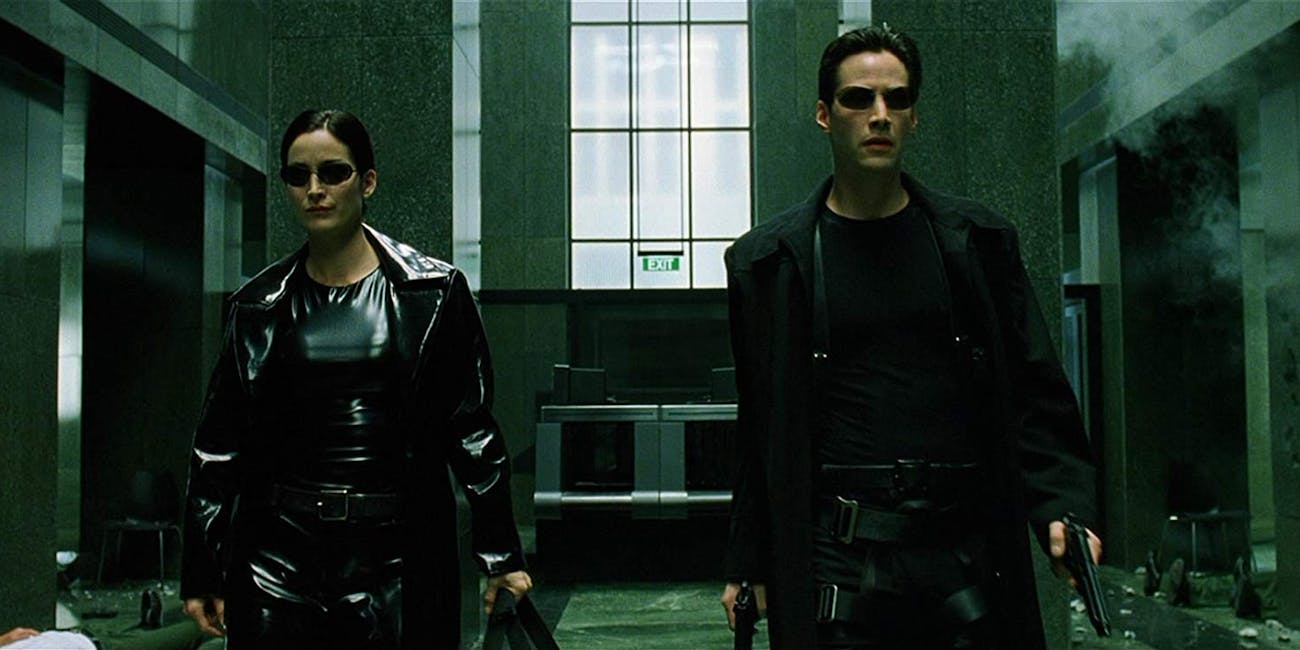
What I love about the first Matrix film is first act's sense of mystery. Instead of providing context for thing Wachowskis instead drop you in to their world, not telling or showing us what the Matrix is or how this mysterious woman named Trinity (Carrie Ann-Moss) can defy physics. Adding to the mystery are the mysterious agents led by Agent Smith (Hugo Weaving), who also break the rules of reality. This all immediately gets the audience asking questions and wanting to continue following the story. Our main character Thomas Anderson (Keanu Reeves), a computer hacker named Neo by night and office worker by day, is being pursued both by the agents and Trinity. Trinity works with a mysterious terrorist named Morpheus (Laurence Fishburne), for whom Neo also been searching. When Neo and Morpheus finally meet he reveals what the Matrix is, a computer program that most of humanity is plugged in to, a prison for your mind. 

Morpheus tells Neo of a man born in the Matrix who freed the first humans and prophesized his return. Morpheus freed Neo from the Matrix because he believes Neo is the reincarnation of this man, the "One" who will destroy the Matrix and free humanity. The concept of the Matrix is horrific but the trade-off is you get to be a hero instead of working a drab office job. Finding your real identity is a crucial component of Neo's character arc. Inside the Matrix he is Thomas Anderson and he can only be Neo by night, in the shadows. Outside of the Matrix you forge your own identity, have your own name. "The Matrix can't tell you who you are," Trinity tells him. But being told you're the One is still being told something about yourself that you haven't forged for yourself tells Morpheus he doesn't like the concept of fate because he wants to be in control of his own destiny. And in the sequels Neo and the audience realize Neo is still part of a system of control even though he's free of the Matrix. But more on that later.

Reeves' inherent sincerity as an actor helps us root for him to be the One and fulfill his destiny. Neo's humility feels genuine because Reeves is such a genuine performer. Neo does start to believe that he's the One until he is taken to a woman named The Oracle (Gloria Foster) by Morpheus. She tells Neo he's  not the One. After Neo and Trinity save Morpheus from the Agents and Neo performs a stunning feat, Morpheus says the Oracle told Neo the exact thing Neo needed to hear. I take this as meaning that once Neo felt unburdened by these expectations he was free to make choices which led naturally to him becoming the One.

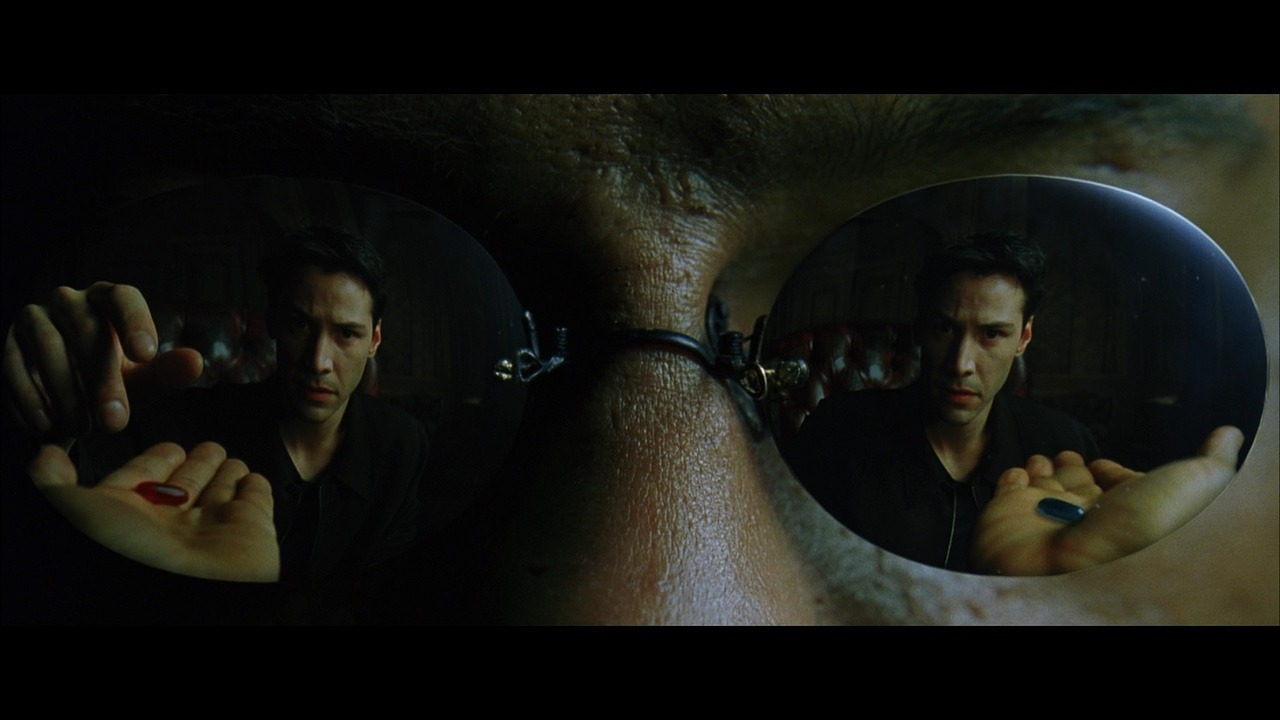
And choice is a major theme in this film. Morpheus gives Neo two pills to choose from, a blue pill that will allow him to go back to his ordinary life or a red pill that will show him "how far the rabbit hole goes" as Morpheus puts it, alluding to Alice in Wonderland. My reading on the blue pill/red pill choice is this: you're given a choice but not all the information regarding what that choice means. Morpheus tells Neo "No one can be told what the Matrix is, you have to see it for yourself."  Once you realize the truth it's too late to go back. I would argue you didn't choose to be freed. However, being freed is arguably inseparable from learning the truth; you wouldn't necessarily believe you were part of a computer program without concrete evidence. 

Cypher (Joe Pantiolano), who is part of Morpheus' crew aboard the ship the Nebuchadnezzar, would agree with me. He tells Neo he wished he'd had taken the blue pill instead. Cypher believes he and the rest of the crew were lied to by Morpheus, which is why he betrays  Morpheus to the agents in exchange to be put back in to the Matrix and his memory wiped. Cypher doesn't believe he's free since the real world is a nightmarish hellhole. He also hates taking orders from Morpheus.  He says "ignorance is bliss" when eating a steak within the Matrix and it's easy to understand where he's coming from. And what does it mean to be free? What can the humans do with their other than fight an endless war? Is it even worth being free? I would argue yes. It's worth being free so you can find a purpose outside of a fake reality. To live and die for something is important. 

Cypher wants to be put back in the Matrix but the aforementioned Agent Smith- who like the other agents is a computer program designed to prevent people being freed from the Matrix- wants to be free of it. He is aware not just of being in a computer program but being a program himself. He is as much a slave as the humans are. He despises humanity but this fact shows he is capable of human emotions. Neo and Smith both seek an escape from their existence and both need Morpheus for that. Morpheus has the codes to the last human city Zion's mainframe. Smith wants them so the war can end and he can be set free. 

Smith is seemingly destroyed by Neo at the film's end but he returns in the two sequels, The Matrix Reloaded and The Matrix Revolutions. Smith hating humans showed he was capable of human emotion. In the sequels, as Captain Logan of the Youtube channel Geekvolution points out,  he becomes what he accused of humans being- parasites. Smith assimilates others, creating multiple versions of himself. In Revolutions specifically he takes over everyone in the Matrix, taking what was his prison and making it his domain. Smith is also able to exit the Matrix by assimilating one of the freed humans named Bane while still in the Matrix. But Smith is still trapped-  trapped in a human body that he refers to not being designed to survive due to its fragility. 

I find Smith to be the most interesting character in the trilogy due to how he becomes increasingly human and independent of his programming, paralleling how Neo becomes independent of what his purpose is as the One. But more on that later.

Admittedly I struggled re-watching the sequels. Maybe I wasn't in the right mind-set or just didn't focus enough on them, and maybe going in with a negative attitude, but I found them hard to engage with. Reloaded doubles down on the elements of which the original had the right amount.  For example, the action is too bloated this time around. It's impressive but it's not as lean and essential to the story like in the original. And while the original had plenty of philosophical "mumbo jumbo," it helped propel the story and Neo's character arc forward. In Reloaded there are two many scenes of characters talking about philosophy but don't move the story forward. It's also not clear  what the main thematic arc is supposed to be. And it takes almost an hour for Neo to be given a goal, which is to find the Keymaker who can get him to the Source.

At the film's climax Neo learns from the Architect- the program who created the Matrix- that his purpose is not to destroy the Matrix but begin a new cycle that has occurred 5 times previously; moreover there have been 5 previous Ones like Neo, all anomalies that can't be prevented. Zion will be destroyed by the machines and Neo is to choose humans from the Matrix to repopulate Zion.  He will prophesize his own return and use the code in his body to reload the Matrix.

While the ideas in this scene are intriguing and the Wachowskis were bold in blowing up their own mythology, the Architect's dialogue- while appropriately dense and machine-like- lacks dynamism and Neo should have had a more emotional reaction to learning that he is still not free of the machines' control. In the first film he learned his reality wasn't real. Now he learns he has been deceived again. This should shatter Neo but I don't believe that's felt enough in the film's denouement. 

If there is a thematic arc to Reloaded- and subsequently to Revolutions- I would argue it's one regarding choice and free will. Instead of doing what his predecessors did,  Neo decides save Trinity from being killed by an agent. This breaks the cycle and leaves the future in flux. Revolutions follows that up with a new status quo established at the film's end. The big problem is the Architect told Neo there'd be a complete system shutdown if he saved Trinity and that everyone in the Matrix would die. Instead nothing really happens as a result of Neo's actions. The third film never answers why there wasn't a system failure and it's never brought up in dialogue as far as I remember.

In the third film the philosophy takes somewhat of backseat to the war against the machines. This brings me to the main reason why I like the original film compared to the sequels, which is it had a smaller-scale. The film focuses on Neo's character arc and the climax is about Neo vs. Smith, not humans in mech-suits against thousands of machines. Character is so unimportant in Revolutions that Trinity dies by accident half an hour before the film's end. Morpheus is also wasted and the sequels overall introduce too many characters.

Neo makes a deal with the machines to defeat Smith- who's assimilated everyone in the Matrix- in exchange for peace with the humans. Neo sacrifices himself fighting Smith and a truce is established between humans and machines. In the final scene between the Oracle and the Architect he tells her humans who wish to be free will be. 

I'll admit I don't have much to say about Revolutions. Of the three it's the least interesting and both sequels feel really drawn out. Neo doesn't really have a character arc in the sequels. Instead he's mostly being driven by the plot. I think the sequels should have gone in a different direction with the story and Neo's character. The original ended with the implication Neo could control the Matrix so I think the status quo should've been considerably different at the beginning of Reloaded. Maybe Neo shouldn't have even been the main character. He's essentially become a God in this virtual world so I would argue it makes more sense to see him from a new character's perspective.

Ideally The Matrix should've remained a standalone film but with the latest installment, The Matrix Resurrections, just released, The Matrix has certainly expanded beyond its initial self-contained story. So, what are your thoughts about the Matrix Trilogy and have you seen The Matrix Resurrections yet? Comment and let me know. 


Saturday, 31 August 2019

Musings on Matrix 4

Image result for the matrix


I don't think any film will ever be able to replicate the "whoa" factor of the Wachowskis' original The Matrix, which came out 20 years ago this year. Seamlessly weaving together cyber-punk, martial arts, John Woo amounts of bullets and philosophical questions about reality, I would argue it's the Star Wars of its time, a game changer whose influence is still being felt today. Its sequels, The Matrix Reloaded and The Matrix Revolutions doubled- hell, triple- down on the action and cerebral themes but received mixed reactions from audiences. It had been reported this past year that Warner Bros. was planning to do another Matrix film, with rumours suggesting it was to be a prequel focused on the Laurence Fishburne character of Morpheus. But just recently it was announced Lana Wachowski would be returning to write the fourth installment of the series along with novelists Aleksandar Hemon and David Mitchell (who wrote the novel Cloud Atlas, which was adapted by the Wachowskis); Wachowski will be directing, the first time a Matrix film was helmed by just one of the siblings. Keanu Reeves and Carrie-Anne Moss are returning to reprise their roles of Neo and Trinity.

It makes sense to bring Reeves back for another Matrix film. When people think of The Matrix, they think of his surfer-dude delivery of "whoa" and "I know Kung-Fu, and the iconic bullet dodger. Along with the popularity of the John Wick films and Reeves persona as one of the nicest guys in Hollywood, it'd be remiss not to include him. However,  Neo's story did appear to be over at Revolutions' end, though his fate was left ambiguous; and Trinity's death was the big emotional scene of that film. Can they be brought back without seemingly undoing the emotional and thematic beats of the film?
It's the same problem with which the new Star Wars films have faced. Return of the Jedi had such a concrete ending to the Star Wars saga that the events of the new films have put a damper on the series' happy ending. Though unlike ROTJ, Revolutions' ending was more guardedly optimistic than fairy-tale perfect.

I do like we're not travelling down the prequel or reboot hole with the franchise, despite rumours of casting a younger actor as Morpheus. Unless this is like The Godfather Part II were we get flashbacks to Morpheus at the beginning of his journey to finding The One. The young Vito scenes in that film are in my opinion the best example of doing a prequel/origin story for a character. I do hope Fishburne because I feel the film would feel incomplete without his presence.

Regardless of the sequels' receptions there's a compelling story to be told about the trilogy's aftermath. The Wachowskis have always been audacious filmmakers, refusing to water down their vision for mainstream audiences, so I believe this will be daring and unexpected. Both Cloud Atlas and Jupiter Ascending make the Matrix films seem tame by comparison. But I do miss the simplicity of the original Matrix and wouldn't be against pulling back a little and returning to the more intimate scale of that film. 

So, what are your feelings continuing down the rabbit of The Matrix franchise? Comment below and let me know.