Showing posts with label Alfred Hitchcock. Show all posts

Friday, 27 October 2023

Hitchcock's Experimental, Art-House Monster Movie: "The Birds" at 60.


Spoilers for The Birds and Psycho

Do I own The Birds on Blu-ray and can watch it comfortably at home? Yes. Did I still head out to a theatre to see a 60th anniversary showing of the film? Also yes. There's something cool about seeing classic cinema on the big screen and since it's one my favourites from my favourite director, I'm almost obligated to go). It got me thinking that there was a time where you had to see a movie in theatres, it wasn't as easy as it is now to see films. There was something special about something being shown on TV or getting re-released. Now it feels like something's in theatres for a week before it hits streaming. But anyway, back to The Birds. This was Hitchcock's follow-up to Psycho and its notable the only two horror films in his career were made consecutively. They actually make pretty good companion pieces: with both of them displaying Hitchcock experimenting in the later part of his career (he was in his 60s when he made them) Psycho was a lower budget film shot in black and white with his crew from his TV show Alfred Hitchcock Presents, coming on the heels of the proto-blockbuster North by Northwest nd was subversive in its plot structure, particularly the murder of its supposed main character almost an hour in. The Birds showed Hitchcock forgoing plot almost all together in favor of atmosphere and metaphorical/apocalyptic horror. 

The first way Hitchcock experiments in The Birds (and Psycho) is how he subverts genre expectations. The thing is, people walked in to Psycho knowing there was going to be a character who was a psycho. They also walked in to The Birds knowing there were going to be bird attacks. The suspense comes from how long Hitchcock takes to get to the shower scene and the initial bird attack. What Hitchcock does mischievously is begin the films not as horror but as a noir crime film (Psycho) and a romantic comedy (The Birds) It's almost a hour before Marion Crane (Janet Leigh), a bank clerk who steals money from work to start a life with her boyfriend, is killed in the infamous shower scene.  

In  The Birds it takes a half hour before a gull attacks socialite Melanie Daniels. The film begins with her being spotted at a bird store by Mitch Brenner (Rod Taylor), a lawyer whom recognizes her from court appearance regarding a practical joke. He pretends to mistake for a employee, giving her a taste of her own medicine. He thinks she should've gone to jail. She thinks he's "a louse." Basically, it's the "He's arrogant, she's stuck-up but they're obviously attracted to each other" romantic comedy set-up. Mitch inquired about some love birds for his sister Cathy (Veronica Cartwright's) birthday so Melanie gets two and travels all the way to his family farm in Bodega Bay. While she's watching Mitch discover them from her boat, a gull attacks her. The gull attack parallels the shower scene- a stroke of violence in the midst of water, in a moment of  calm. It also puts the audience on edge for another instance of violence. 

The Birds also has something in common with one off Hitchcock's earlier film,  Shadow of a Doubt (1943). In both, a small community is invaded by a sinister force. In the former it's a serial killer played by Joseph Cotton, in the latter it's, well...birds; but not only birds, but normally docile birds. In in the indispensable book Hitchcock/Truffaut, which transcribes interviews between Hitchcock and filmmaker Francois Truffaut, Hitchcock says "I think that if the story had involved vultures, or birds of prey, I might not have wanted it. The basic appeal to me is that it had to do with ordinary, everyday birds."  Hitchcock contrasts these normal birds' usual docile nature with random bursts of violence. And like Shadow of a Doubt, the violence is juxtaposed with a low-key setting. 

Truffaut later on in the interview says of The Birds' structure: 

    The story construction follows the three basic rules of classic tragedy: unity of place, of time, and of     action. All of the action takes place within two days' time in Bodega Bay, The birds are seen in ever        growing numbers and they become increasingly dangerous as the action progresses. 

Screenwriter Evan Hunter and Hitchcock understand the need to make each attack bigger, until the film takes on apocalyptic overtones. By the climax it feels the like the world is ending. However, keeping the story in one setting and focusing on a small set of characters also makes the story intensely intimate. M. Night Shyamalan was clearly inspired by Hitchcock and this film when making his alien invasion thriller Signs, which I wrote about here: Davies in the Dark: The Essential Films: "Signs" (2002) (thenoirzone.blogspot.com)  

I want to take some time now to focus on the character dynamics which foreground much of the film, particularly the relationship between Melanie and Mitch's mother, Lydia (Jessica Tandy), whom she meets after Mitch has looked to her wound. Mitch invites Melanie over for dinner where she also meets Cathy, who takes a immediate liking to Melanie, clearly liking her present. Lydia, however is more aloof. Melanie is staying with schoolteacher Annie Heyward, who once had a relationship with Mitch. That night, Melanie and Annie discuss Annie's former romance with Mitch and her complicated relationship with Lydia.

Annie: I was seeing quite a lot of him in San Francisco, you know. And then, one weekend, he asked me up to meet Lydia.

Melanie: When was this?

Annie: Four years ago. Of course, that was shortly after his father died. Things may be different now. 

Melanie: Different?

Annie: With Lydia. Did she seem a trifle distance? 

Melanie. A trifle.

Annie: Then maybe it wasn't different at all. You know, her attitude nearly drove me crazy. I simply couldn't understand it. When I got back to San Francisco I spent days trying to figure out just what I'd done to displease her.

Melanie: And what had you done.

Annie: Nothing. I simply existed. So what was the answer? A jealous woman, right? A clinging, possessive mother. Wrong. With all due respect to Oedipus, I don't think that was the case at all.

Melanie: Then what was it?

Annie: Lydia liked me, you see. That was the strange part of it. In fact, now that I'm no longer a threat, we're very good friends.

Melanie: Then why did she object to you?

Annie: She was afraid.

Melanie: Afraid you'd take Mitch?

Annie: Afraid I'd give Mitch.

Melanie: I don't understand.

Annie: Afraid of any woman who'd give Mitch the only she can give him- love.

Melanie: Annie, that adds up to a jealous, possessive woman. 

Annie: No, I don't think so. She's not afraid of losing her son, you see. She's only afraid of being abandoned.   

On a sidenote, Hunter's dialogue is so good. While Hitchcock always believed in the idea of "pure cinema," telling the story strictly through the visuals, his films often had stellar dialogue passages. What I like specifically about this passage is it's all about small but significant differences. While everything points to Lydia being a "jealous, possessive woman," Annie doesn't feel it's that simple. She can't see Lydia as purely jealous, she even says Lydia liked her. Annie also makes distinctions between fear of giving vs. fear taking and fear of lost vs. fear of abandonment. Minute differences but they tell us about how Annie views things and maybe tells us something about Lydia as well.

We get to understand Lydia quite a bit in a later scene, which comes after Lydia's seen the dead body (with eyes gouged out by birds) of a neighbor. She's alone with Melanie and in a vulnerable position. She talks about the death of her husband, her reliance on his strength throughout  the years and her wish to be a stronger person. It's the first time Lydia warms up to Melanie and she says something surprising to her, which is she's not sure if she even likes Melanie. A honest statement, and one that reflects Lydia's complicated feelings towards Melanie and her relationship with her son. It'd be easy to just have Lydia outright hate Melanie but her confession feels more nuanced and sympathetic.

Mitch also has his own complicated relationship with Melanie. His lawyer side dislikes her troublemaking side but when he spies her on the boat, he smiles, amused, and probably surprised she went though all that trouble to bring hum those birds. He's clearly concerned when she's attacked by a gull and invites her over for dinner. So, he's not completely hostile towards her. And I suspect there was likely already an attraction towards her. There's something playful already at play in the initial encounter,  

And how are we, the audience, supposed to take Melanie? She's maybe not as easily "likable" as the main character is "supposed" to be. Hitchcock, Hunter, and Hedren allow us to feel our way through the character as we learn more about and spend more time with her. I personally find Mitch to be kind of a judgmental ass at the beginning, though as I said, he's compensating a little for his attraction to her.. Watching the movie this time, I quite liked Hedren's performance. She has the right amount of cool and warmth needed for a character who goes from socialite who glides through life to a more mature, deeper feeling person who becomes part of the Brenner family. Just before the first bird attack at Cathy's, Melanie and Mitch have a conversation where Melanie, like Lydia a few scenes later, shows her vulnerability. We learn Melanie's mother abandoned her when she was young and Melanie tells about the things she does with her life, including putting a Korean boy through school. Of course, it's obvious what's Melanie is missing in her life- a family.  

Okay, let's come back to how Hitchcock is experimenting in this film. What I find notable about The Birds in contrast to Hitchcock's other work is it's virtually plotless. Hitchcock usually has a Macguffin (the thing every character wants but doesn't matter what it is, it's just there to get the ball rolling), a murder, or an innocent man on the run. According to Hunter there was almost going to be a murder mystery plot, with the birds being the culprits. Instead, there's no real mystery except when the birds are going to attack. Hitchcock once used the example of a bomb under the table to highlight surprise vs. suspense. You see two men at a table. A bomb suddenly goes off- that's surprise. What's suspense is seeing the bomb under the table and wondering when it's going off. The film goes for the latter approach and I think that's the proper choice. It also allows the film to foreground the characters more.

I mentioned earlier the escalation of the bird attacks gave the film apocalyptic overtones, which again shows Hitchcock playing with something new- a world ending scenario, as well as a "monster movie." Hitchcock's monster were typically serial killers or Nazis. But here, the monsters aren't really monsters. Mother nature is simply fighting back against humanity for taking them for granted, or at least this was Hitchcock's explanation. I believe the film is thematically more fascinating and starker if there isn't an explanation for the bird attacks. In his book, Hitchcock's Films Revisited, Robin Wood views the birds as 

    a concrete embodiment of the arbitrary and unpredictable, of whatever makes human life and human     relationships precarious, a reminder of fragility and instability that cannot be ignored or evaded and,     beyond that, of the possibility that life is meaningless and absurd.

He also compares the bird attack to Marion murder in Psycho, in that they're both unprovoked and unearned. Horror often has a nihilistic streak to it. In horror we witness innocent people die and evil winning out. It's a ruthless genre and Hitchcock showed how ruthless he could be in Psycho. He further shows this mercilessness when Annie is unceremoniously killed by the birds offscreen. Annie's death is more painful because it's not seen and it demonstrates Hitchcock's preoccupation with placing us in the mind of his characters. We have to imagine Annie's end as Melanie and Mitch must do. 

Aside from providing no clear explanation for the birds' war against humans Hitchcock also doesn't give us a neat ending either. Melanie and the Brenners live but the final shot is the car driving off in to an uncertain future, with the birds still covering the Brenner house, in what we already know is a short reprieve from the attacks. This is arguably the most ambiguous ending Hitchcock ever concocted, though Psycho and Vertigo's endings also create a sense of unease in the audience. The Birds was ahead of its time, for a Hollywood movie at least, in providing no clear finish for the story. The film end before it seems to end. 

The only resolution the ending contains is the shared look between the injured Melanie and Lydia in the backseat of the car, suggesting Lydia has finally accepted Melanie and will care for her in her weakened state. Is the ending partly hopeful? I don't know. However, it does suggest that as the world is ending, people will stick together, that we need each other and must accept one another. It's also the resolution to Melanie's arc, where she starts out as an aloof loner but becomes part of a family.    

Adding to the film's escalating terror is Hitchcock's choice to forgo an accompanying score, another experimental choice. During the bird attacks all you hear is the flapping of wings and squawking sounds. This accomplishes two things: giving you the felling of being in the middle of  a bird assault, with your senses being overwhelmed. It's also another way the film sets itself apart from a traditional Hollywood feature. We may not first notice the absence of a musical score but when you realize it it's a brilliant way to an even stronger sense of fear in the audience. When Melanie is waiting outside the school for Cathy, the children's choir is the ironic soundtrack to the birds gathering behind Melanie on the jungle gym. George Tomasini's editing is so in tune with Hitchcock's dark sense of humour as the editing steadily builds the flocking of the birds behind the oblivious Melanie. Tomasini deserves recognition as being a key Hitchcock collaborator, editing several of Hitchcock's most famous films, including Psycho, Rear Window, and North by Northwest. He also edited the original Cape Fear, which I wrote about on this blog as having a heavy Hitchcock influence.

Why did Hitchcock move towards something more experimental, forgoing plot and certain Hitchcockian tropes. It may have something to do with Hitchcock's fascination with the international art house cinema of the 60s. Richard Allen, in his essay "Hitchcock and the Wandering Woman: The Influence of Italian Art Cinema on The Birds," argues that Hitchcock was 

        challenged and provoked by the remarkable and rapid developments taking place in European art            cinema. The Birds was conceived by Hitchcock in part as a response to this challenge, a work that         at once would continue continue his commercial success and confirm his status as an auteur on a            par with the European directors he so admired. Hitchcock engaged with art cinema to inspire                  creativity and sustain his critical reputation

In an interview with Charles L.P. Silet, Hunter also makes the claim that Hitchcock want be seen as a serious artist: 

    Hitch also told me later, and I learned later from other sources, that he was looking for some 'artistic     respectability' with The Birds. This was something that always eluded him, and he deliberately chose     to work with a successful New York novelist, rather than a Hollywood screenwriter.

Hitchcock was embraced by the French critics as a genuine artist, an auteur, whereas he wasn't as highly regarded in the states, seen as more of an entertainer than an artist. Of course, he wasn't one who was reclaimed by the French: Howard Hawks, another great mesher of entertainment and artistry, was another to whom the French applied the Auteur Theory approach of criticism, the idea that the director was the "author" of their films and had a singular visual style and consisitent themes running through their work.

Not only did Hitchcock go to a novelist for screenwriting duties, he chose a short story from Daphne  Du Maurier, the author who wrote the basis of his first American film, and the only one of his that won Best Picture: Rebecca. While Hitchcock considered Rebecca as belonging to its producer, David O.Selznick, he may have felt the Best Picture victory and Du Maurier's literary pedigree could provide him with the basis for a true artistic picture. 

As relating to the thesis of Hitchcock being influenced by European cinema, Allen argues that The Birds shares quite a bit in common with F.W. Murneau's 1927 silent film, Sunrise, where a woman enters a small town to seduce a man who lives with the family. Allen argues that Hitchcock drawing from Murneau displays a return to Hitchcock's roots in the 1920s as a young filmmaker, where he also took inspiration from directors he admired. Allen also sees a reverse influence by way of Michelangelo Antonioni recontextualizing Rear Window and The Lady Vanishes in the shape of his 1960 film L'Avventura. In that film a woman goes missing, after which her boyfriend and friend engage in an affair, which echoes the disappearing women plots of the former films.

Allen further develops the Antonioni connection by citing David Bordwell's classification of the art   house protagonist, a wanderer who is in a passive relationship with the environment. "The wandering woman" walks without purpose, and is both observed and observing. This is a character that can be found Antonioni's films in the form of actress Monica Vitti. Allen relates Melanie to the archetype of the wandering woman but stresses that the difference between the women in Hitchcock's film have agency, whereas the women in Antonioni's film don't. In the early parts of the film, where Melanie travels to Bodega Bay show us a woman on a mission but by showing us every part of her journey suggests something distinctly European in terms of plot, or lack of plot I should say. It's all very banal, but in its banality it creates the proper contrast to the gull attack. 

I'd say Hitchcock combined the art-house with the monster movie, but also blurring those lines, where the birds take on the same thematic weight as the environments do in Antonioni. Admittedly, it wasn't until this viewing of The Birds and reading up and thinking about the connection between the art-house and Hitchcock that I saw it as the experimental work it really is. While Hitchcock would eventually retreat in to familiarity with Torn Curtain, when looking at Psycho, The Birds, and his next film, Marnie. these films showcase what could be called Hitchcock's art-house phase- and I think you can certainly add Vertigo in there as well. While some see these films as quaint, I'd argue they represent an artist in his later years re-thinking of what he was capable. The Birds is singularly Hitchcock, however one looks at it, however, and one of his boldest experiments in suspense.


Monday, 6 March 2023

Normalcy, Psychopathy, and The Hitchcock Influence on "Cape Fear" (1962)


Spoilers Below

In 1961, after filming The Guns of Navarone under the direction of J. Lee Thompson, Gregory Peck hired Thompson to direct a film adaptation of novel for which Peck bought the rights for his production company,  John D. MacDonald's' The Executioners. Not liking the title, Peck changed it to Cape Fear, since he believed films named after places did very well commercially. And just typing the words Cape Fear alone bring to mind Bernard Herrmann's classic score. While the film has bee  overshadowed by its 1991 remake, directed by Martin Scorsese, Thompson's original is still a startling, tight-knit thriller of psychological torture. It's also one of the best riffs on Alfred Hitchcock ever made. This essay will delve in to the master's influence on the film in terms of style and narrative.  

Like Hitchcock's films, Cape Fear explores the intersection of normalcy and psychopathy. Think of Shadow of a Doubt, where a serial killer returns to his quaint home town, or of Strangers on a Train where a tennis pro gets embroiled in the plot of a psychopath. In Psycho, Hitchcock showed us the darker side of seemingly ordinary people like Marion Crane (Janet Leigh), a bank clerk who steals money from a client. Her path crosses with hotel proprietor Norman Bates (Anthony Perkins), another seemingly ordinary, if slightly strange man, who is eventually revealed as the titular psycho. Then there there's Rope, where a dinner party is taking place in the unknown presence of a corpse and two murderers. In Cape Fear a ordinary lawyer, Sam Bowden (Peck) had prior to the events of the film intervened in the attack of a woman by Max Cady (Robert Mitchum). Bowden acted as a witness and got him convicted. At the film's beginning, Cady, now out of prison has come to Georgia, blaming Bowden for his conviction. So, like in Hitchcock we have the ordinary (Bowden and his wife and daughter) and the preternatural evil (Cady). Cady brutally beats a woman before and during the events of the film. He wants to rape Bowden's daughter, Nancy (Lori Martin), and even attempts to blackmail Bowden's wife (Polly Bergen) into giving consent to sex in exchange for sparing Nancy. He's a vile animal, a smart animal, but an animal nonetheless. 

Hitchcock's villains often had similar qualities to Cady, a sort of otherworldly evil, and a lack of remorse for the crimes they've committed: Uncle Charlie (Joseph Cotton) in Shadow of a Doubt or Brandon Shaw (John Dall) in Rope. Brandon killed a college friend solely because he believed he was superior to him. And Charlie didn't think  much of  of his victims. Look at this exchange between him and his niece Little Charlie (Teresa Wright):

Uncle Charlie: The cities are full of women, middle-aged widows, husbands dead, husbands who've spent their lives making fortunes, working and working. And then they die and leave their money to their wives, their silly wives. And what do the wives do, these useless women? You see them in the hotels, the best hotels, every day by the thousands, drinking their money, eating their money, losing the money at bridge, playing all day and all night, smelling of money, proud of their jewelry but of nothing else, horrible, faded, fat, greedy women.

Young Charlie: But they're alive. They're human beings.

Uncle Charlie: Are they? Are they, Charlie? Are they human or are they fat, wheezing animals, hmm? And what happens to animals when they get too fat and too old?


Cady has this same hatred towards women. He got horrible revenge against his ex-wife for divorcing him and marrying a plumber, raping her, forcing her to write Cady a love letter than threatening to show it to the plumber if she ever phoned the cops. He views them as animals. Again, Cady has no remorse, blaming Bowden for winding up in prison. That's what makes  him and the premise so terrifying. Interfere with evil and evil will bite you back. With Peck and Mitchum you have the perfect casting to represent these good and evil. Peck is the stalwart everyman, blandly likeable, conventionally handsome. Then you have Mitchum, a rougher kind of actor, whose face often seems drawn by someone rather than birthed. He often played anti-heroes but was capable of playing true, other-worldy, almost comedic evil, as in The Night of the Hunter, which I wrote about many years ago: Davies in the Dark: The Essential Films: "The Night of the Hunter" (1955) (thenoirzone.blogspot.com)


Coming back to Hitchcock, the director always had a distrust of the police, which can be seen in his work, which is full of innocent men on the run, attempting to prove their innocence. The law can't protect you in Hitchcock's world, and it can't in Cape Fear either. 
The film posits the law cannot protect you but can only respond to a crime. And even when Cady beats up Diane Taylor, she won't testify due to the fear of repercussions from Cady. Essentially, she wants to avoid being in Bowden's position. She can put him away but it won't stop him from coming back and exacting revenge. "No good deed goes unpunished" could've been the film's tagline. Bowden did the right thing in the law's eyes but now it can't remove Cady from Bowden's life. Bowden is a fine upstanding lawyer who believes he can get rid of Cady pretty easily with the help of his friend and police chief, Mark Dutton (Martin Balsam). You'll be forgiven if you assume Dutton will be seen climbing some stairs before getting stabbed, since Balsam will always be associated with Psycho. But no, Cady understands that he can psychologically torment Bowden and his family without breaking the law. . The only way the law will work in Bowden's favor is putting his family in extreme danger, putting them on a boat, so he can trap Cady in the act of attempted violence.
I've talked about the thematic connections between Hitchcock's work and Cape Fear. Now, I want to discuss the stylistic similarities between the two. First, Bernard Herrmann, a frequent Hitchcock collaborator, was brought on to do the score. Like his score for Psycho, his theme for Cape Fear has a stalking terror- something evil is coming for you. Herrmann's scores fitted Hitchcock's expressive style-Hitchcock always wanted to communicate things without dialogue, i.e. visually and auditorily, so Hitchcock provided the images Herrmann's provided the emotion.   
On the DVD making of documentary, director Thompson discusses how he studied Hitchcock,  actually working with him in England years prior. Thompson says he always approached a scene wondering how Hitchcock would do it. One thing Thompson highlights about Hitchcock's style is that he always liked to clue the audience in on something the character didn't know. The footage shown while Thompson is talking is when of Cady's victims, deputy Kersak, who's protecting the Bowden women on a boat, is being stalked by Cady. This is quintessential suspense, obvious, maybe, but it was crucial to Hitchcock's approach to storytelling, the camera being a character that saw things others didn't, and was unable to prevent things. 
Thompson also says he only saw the film in black and white, that the blacks and shadows would enhance the story, that color would ruin it. Like Psycho, it's hard to imagine the film being as effective in color. The world of both films exist in the shadows. Cape Fear's stark cinematography is courtesy of Sam Leavitt. His work provides much of the film's unnerving atmosphere. And it's just styilized enough without drifting in to complete unreality. 
Another Hitchcock collaborator working on the film was Robert Doyle,  Due to his own relationship with Hitchcock, knew what Thompson was looking for in terms of production design. For example, the bed that becomes a cage for Diane Taylor. Then there's the sequence where Nancy is behind a gate, being stalked by Cady. Thompson wanted to the gates to be black. The gates Thompson found were painted extra black by Boyle. What makes this sequence truly Hitchcockian is the payoff at the end when who we think is Cady following Nancy is someone else. George Tomasini, who edited Psycho and Vertigo, obviously knew what he was doing with the editing of that sequence. 
Paying homage can result in a wane amalgamation of that person's style, but  while Cape Fear may not be Rear Window or Psycho, it's a respectable and effective thriller that stands well amongst Hitchcock's ouevre. It doesn't force the Hitchcockiness but comes by it organically. It subtly reminds us of Hitchcock, why creating its own unique personification of evil in Max Cady. Mitchum's performance is arguably up there with Anthony Perkins in Psycho, Joseph Cotton in Shadow of a Doubt, and Robert Walker in Strangers on a Train. Bowden lets Cady live at the end, knowing he can punish him more by sending him to prison than killing him. I can understand why this can strike some as a cop out, that the film should've had Bowden cross the line, having Cady win. But I'd argue Cady has won, permanently scarring Bowden and his family.  He's shown Bowden the lengths how the law, the thing he's dedicated his life too, won't protect him unless he goes to the methods he's gone, almost killing a man. We don't see the family happy at the end as they're being escorted home. They're silent, worn down by the ordeal through which they've gone. Just like the psychiatrist's explanation at the end of Psycho doesn't really matter because Norman can't truly be summed up so neatly, neither can this so story wrap up so easily. Both Norman and Cady can't allow a truly happy ending for anyone in their stories. 

Friday, 20 January 2023

11 Great Films That Were Not Nominated For The Best Picture Oscar


Spoilers Below

The history of the Oscars tell their own narrative regarding the greatest films in the history of the medium. While what we consider great is subjective, the Oscars, I would argue, provide a limited view of cinematic greatness. Genre films are often left out, actors of color ignored, great actors and directors never won. But specifically, I wanted to take a moment and look at 11 films that were not nominated for Best Picture, films which have lived on longer some winners. Some may surprise you, but I think it's important to understand why certain films were not appreciated in their moment, that it took time for them to attain classic stature. So, let's get started. These aren't in specific order, but I will be starting with three by a director who never got his due from Oscar.


1. Rear Window  (1954)

Alfred Hitchcock is defined by his dark and twisted portrayals of human nature in the guise of entertaining Hollywood thrillers. One of the most purely entertaining of films, Rear Window isn't just about whether a man has killed his wife, it's about a peeping tom, kind of a pervert, and the human desire to watch. The film is essentially  a meta commentary on cinema in general, on the need for excitement in our ordinary lives. 

We're watching L.B "Jeff" Jefferies, a photographer who's in a cast, stuck in his apartment (after being injured taking a picture of a race car crash) watch his neighbours in the courtyard of apartments, everyone with a story, an entire universe in and of itself. He needs these stories the same way we need films, which give us the ability to view other peoples' lives (albeit fictional). When Jeff suspects businessman Lars Thorwold (Raymond Burr) of killing his invalid wife, his obsession with proving his guilt gives him the ultimate reprieve from boredom, even bringing him closer to his socialite girlfriend Lisa Friedmont (Grace Kelly). But as much as the film deals with the investigation of Thorwold, the other apartment dwellers are just as important. All these people become as familiar to us as they are to Jeff. 

Hitchcock would get a Best Director nomination for the technical brilliance on display ( the whole film is shot on a set, with Hitchcock giving directions via earpiece to his actors), as well as nominations for Best Writing- Screenplay, Color Cinematography, and Best Sound Recording, but oddly not Best Picture. The five nominees were On the Waterfront, The Caine Mutiny, Seven Wives For Seven Brothers, The Country Girl (for which Kelly won Best Actress), and Three Coins in the Fountain. On the Waterfront was the winner, with its director, Elia Kazan, winning Best Director. For me, I would split the two, giving Hitchcock Director and On the Waterfront Picture. 


2. Psycho (1960)

Hitchcock once again received a Best Director nomination (his last) for this proto-slasher film, but without the film getting in to Best Picture. And like Rear Window, it also received four nominations (Hitchcock, Best Supporting Actress for Janet Leigh, B&W Cinematography, and Best Art Direction-Set Decoration (B&W). 

While the film can be argued to be the first modern slasher film, pre-dating Black Christmas and Halloween by nearly 20 years, it starts out as a film noir about real-estate Marion secretary Crane (Janet Leigh) stealing a client's money so she can start a new life with her boyfriend. She winds up at the Bates Motel, where the whole dynamic shifts with the introduction of proprietor Norman Bates (Anthony Perkins). The film seems to have- like Marion- taken a detour as we spend a lengthy conversation between the two over supper. Norman is a sad and lonely man who's only relationship is with his invalid mother. 

When Marion is killed in the infamous shower scene it's the film's first interjection of horror, upsetting the narrative we thought we were watching. The sequence is still startling in its violence and impressive in its filmmaking. George Tomasini's sharp editing reflects the knife going in to Marion's body and Bernard Herrmann's screeching score has become synonymous with 'crazy.' The film has spent so much time with Marion that the sudden burst of violence unsettles. There's only 2 murder scenes in the film- this and the murder of Private Investigator Arboghast (Martin Balsam) bu the film relies more on atmosphere and build-up to create a sense of subtle horror in the audiences' mind. 

It's revealed Norman killed his mother and her lover and took on a split personality- he and his mother. The film was never about the money or Marion, it was about Norman's psychosis, with every thing else being a distraction from the truth about Norman  Perkins' performance is so convincing that he could never escape the role. Perkins is deeply sympathetic as Norman; I never view him as the film's villain but as a tragic character, despite the horrible crimes he commits. 

Hitchcock's direction displays his mastery of visual storytelling and his ability to place us n the minds of both Marion and Norman, two people who are closer in spirit than either of them realizes, two people who are tragically torn apart by "mother."  

The Best Picture Nominees that year were The Apartment, The Alamo, Elmer Gantry, Sons and Lovers, and The Sundowners. The winner was The Apartment, which, like On the Waterfront, is one my favourite Best Picture winners. Again, I would give Hitchcock the directing Oscar (Billy Wilder won), while giving Best Picture to The Apartment.


3. Vertigo  

Yes, another Hitchcock, but probably the biggest one to be left out of Best Picture. Not surprisingly, since Vertigo took many years to earn the critical acclaim it now enjoys. The film which was voted the greatest of all time by Sight & Sound back in 2012, and holds at # 2 in 2023, only got two Oscar nominations, for Best Art Direction-Set Decoration and Best Sound. Bernard Herrmann's swooningly melancholic and romantic score, James Stewart and Kim Novak's layered performances, Hitchcock's visionary direction, all ignored. And I get it, I get in 1958 why this was seen as a misfire, why it takes a rewatch or two to really appreciate this film. It took me a second viewing to begin to embrace it. It's probably Hitchcock's most purely artistic and audacious film, one whose D.N.A can be found in other films like David Lynch's Mulholland Drive, George Sluizer's The Vanishing, and Brian De Palma's Obsession. But despite being the influence behind several films, the story remains fresh and unique in the way it moves from ghost story to romance and finally, to obsession. 

It's the story of an acrophobic detective, Scottie Ferguson (Stewart). hired by a old college friend, Gavin Elster, (Tom Helmor)  to follow his wife, Madeleine (Novak), whom he believes has been possessed by the ghost of her great-grandmother. Scottie falls in love with Madeleine but fails to stop his suicide. Afterwards meets another woman named Judy (Novak), who looks like Madeleine, whom he tries to make over in to the image of his dead love. 

Vertigo has an hypnotic power that brings me back time and again, and time is a big theme in the film. Scottie didn't get to Madeleine in time, the past is coming back to haunt Madeleine and then Scottie, near the film's end Scottie says he needs to do one thing to be free of the past.        

The nominees that year were Gigi, Cat on a Hot Tin Roof, Auntie Mame, The Defiant Ones, and Separate Tables, with Gigi being the winner (its director Vincente Minnelli won Best Director), which I've still have yet to see.


4. The Searchers

John Ford had already won 4 Oscars for directing by the time he did the The Searchers, and a fifth one wouldn't have been out of the question, except Ford and the film were completely shut out at the Oscars (Ford did get a DGA nomination, however), which now seems inexplicable considering The Searchers stature as an American classic. It's a difficult film to reconcile, a story dealing with racism that also still has some racist leanings, but it nonetheless a great film, though I still prefer Stagecoach. John Wayne plays Ethan Edwards, a confederate soldier returning to his brothers' home after the Civil War. When his brother Aaron, and Aaron's wife are murdered by Comanche Native Americans,, Edwards, along with his adopted nephew Martin (Jeffrey Hunter) go off in pursuit of Ethan's kidnapped nieces. 

The film, courtesy of Ford cinematographer of Winton C. Hoch, has some of the striking visuals of any western, capturing what director John Milius said felt to him what the real American west was like. And even with the many revisionist westerns that followed, The Searchers still feels like the most realistic western of its time, especially in terms of its violence, which is still unsettling. The most disturbing aspect of the film is the notion that Ethan will kill one of his nieces Debby (Natalie Wood) after she's "gone native" living with the Comanches for several films (the other, Lucy (Pippa Scott) was killed). 

Wayne plays his most complex role in a performance that, as Martin Scorsese said, makes you hate him but still love him when he returns Debbie home by film's end. And of course, there's that great closing shot of him walking away, as a door closes, bookending the opening door at the beginning. It's wistful and, honourable and poetic. 

The nominees that year where Around the World in 80 Days, Giant, Friendly Persuasion, The King & I, and The Ten Commandments. Around the World in 80 Days, directed by Michael Anderson and produced by Elizabeth Taylor's then husband Mike Todd, who would die a year later in a plane crash. The extravagant film is probably one of the weaker Best Picture winners but is still worth seeing for the sheer scale of it, it's a fascinating time capsule. 


5. Days of Heaven

After establishing his esoteric sensibilities in Badlands (1973), Terrence Malick came back with his voice and style fully formed with Days of Heaven, one of the most ravishing films of all time. It won the Oscar for Best Cinematography- given to Nestor Almendros, though Haxell Wexler took over after after Almendros had to fulfill his commitment to shooting Francois Trauffaut's The Man Who Loved Women.

Taking what 20 years earlier what would've been a 3 hour plus epic, Malick strips down the story of a Chicago steelworker, Bill (Richard Gere) on the run after killing his boss, his sister Linda (Linda Manz), his girlfriend Abby (Brooke Adams), and the dying farmer (Sam Shepherd) Abby marries, in a compact 90 minutes, showing us the fragments of a story through an impressionistic visual style that favours mood and setting over complex characterization.  

The nominees that year were The Deer Hunter, Coming Home, Heaven Can Wait, Midnight Express, and An Unmarried Woman. The Deer Hunter won, which I'm ashamed to say I still haven't seen.


6. Alien 

Ridley Scott's Alien has only gotten better in age, a genuine masterpiece of horror sci fi. The story is so simple but what it's doing is difficult, essentially blending the slow pace of 2001, the lived in junky feel of Star Wars, and the grisliness of The Texas Chainsaw Massacre, all while updating a 50s sci-fi creature and placing it in an symbolic haunted house. The alien could've looked goofy, the setting cheap, the pace too slow, but this didn't happen. The pace is slow but with a great sense of dread. The alien is kept in the shadows so we only get glimpses of it and the production design is immaculate, making us believe in the film's unglamorous vision of the future.

A brilliant choice by the film's screenplay- by Dan O'Bannon, with a story by Ronald Shusett-  is conceiving the ensemble of characters as "truckers in space" rather than explorers or scientists.  The characters have a lived-in-ness, a believability as blue collar workers. Them being truckers is also why the Nostromo is so junky- this isn't supposed to be the Enterprise. Michael Seymour's production design and Derek Vanlint's cinematography make the Nostromo one of the most atmospheric settings in horror cinema. 

Like the shower scene in Psycho, the chestburster sequence hasn't lost its shocking impact. Both scenes happen just when things feel like they're getting better, in moments of peace. When Captain Dallas (Tom Skerritt) is killed, it really feels like things are at their worst. And then Ash (Ian Holm) is revealed as an android who has been working against them, leaving only Ripley (Sigourney Weaver), Parker (Yaphet Khotto) and Lambert (Veronica Cartwright), the feeling of claustrophobia is palpable. 

Weaver became a star for her performance as Ripley, giving her assertiveness, sternness but also vulnerability. Her fear during the final stretch of the film feels authentic and her decision to go back and save the cat is a relatable human moment  Her ultimate survival is almost surprising, given this was the decade of the downer ending but it's not completely triumphant either. She's lost her ship and crew, and has found out she was viewed as expendable by the company for which she works. Still, there is a sense of peace for Ripley at the film's end, as she goes back in to cryosleep, going back in to a dream after a nightmare

The nominees that year were Apocalypse Now, Kramer vs. Kramer, All That Jazz, Breaking Away, and Norma Rae. I personally would go with All That Jazz.


7. The Innocents

Completely shut out of the Oscars, though nominated for the Palme d'Or, this is the spookiest film ever made, as well as the best haunted house movie. Governess Miss Giddens? (Deborah Kerr, in a performance that should've earned her an Oscar nomination) is sent to look after two orphaned children , Miles and Flora, whose uncle has no use for them. After learning about the influence of the late Peter Quint and Miss Jessel on the children, Miss Giddens begins to see apparitions that match their descriptions. She soon comes to the conclusion these ghosts are controlling the children. 

The ambiguity surrounding whether Miss Giddens is actually seeing the ghosts or imagining them is what keeps The Innocents so fascinating 60 years after it premiered. Cinematographer Freddie Francis' Widescreen black and white compositions are immaculate and director Jack Clayton captures a certain Victorian-era Britishness in the performances and characters. The film's chilly atmosphere also makes it-like Stanley Kubrick's The Shining- a perfect alternative Christmas film.

The nominees that year were West Side Story, The Hustler, Fanny, The Guns of Navarone, and Judgement at Nuremberg, with West Side Story winning, along with nine other wins. I prefer Spielberg's new West Side Story (My thoughts here :Davies in the Dark: Tonight, Tonight: "West Side Story" (thenoirzone.blogspot.com) and if I were picking from these nominees I would go with The Hustler (which I wrote about here: Davies in the Dark: Search results for the hustler (thenoirzone.blogspot.com)


8. Carrie

Brian De Palma's masterpiece is also the first Stephen King adaptation and one of the best. A hallucinatory film, but one that has moments of sweetness that only make the tragedy of its climax hit even harder.

 Carrie may be the best film about teenage isolation ever made. Despite being incredibly stylized the film finds emotional truth through Sissy Spacek's nominated performance as Carrie White.  What stood out watching it this time is how Spacek makes Carrie both incredibly unusual but also very sweet and nice. We see her coming out of her shell as things being to go- and then when she's humiliated she really comes out of her shell as she unleashes her telekinetic powers against her tormenters. 

The whole prom sequence and how it leads to the pig blood pouring over Carrie is virtuoso filmmaking. In De Palma fashion it feels like he's showing off but you don't mind because it's so impressive. Then there's Carrie's return home and her final confrontation with her religious zealot mother, Margaret (Piper Laurie, in the film's other nominated perfomances), another amazing stretch of filmmaking. This is one of those films you could watch on mute and still understand what's happening.  The emotions and story are all communicated through the visuals. 

Mario Tosi's cinematography gives the film a hazy dreamlike quality that turns in to a nightmare during the prom sequence- and Carrie covered in blood is one cinema's indelible images.  

The nominees that year were Rocky, Taxi Driver, All The President's Men, Network, and Bound For Glory. Bound for Glory is the only one I haven't see but it's a pretty strong line-up overall. 


9. Close Encounters of the Third Kind

My second favourite Spielberg, right behind Jaws. This is also the ultimate Spielberg film, made a couple of years after Jaws, with his voice fully formed. He received his first Best Director nomination (the only time he and pal George Lucas were nominated alongside each other- Lucas was nominated for Star Wars). The film was beat out in most categories by Star Wars, though it won Best Cinematography for Vilmos Zsigmond's stellar work on the film and won a special award for sound effect editing.

It's a darker film then you may remember, with Roy Neary (Richard Dreyfuss) becoming obsessed with U.F.Os after a close encounter with one and alienating his family. But it's also awe-inspiring and wonderous, encapsulating what Spielberg does better than anyone else. It's hard to imagine a blockbuster movie like this getting made now, given it doesn't have a big action climax, but a climax involving the attempt to communicate with an alien mothership. Denis Villenueve's Arrival is the only equivalent I can think of.

Dreyfuss won for The Goodbye Girl (which I haven't seen) but I also would argue he could've been nominated for this instead, making Roy a relatable and likable character even as he becomes more unhinged.

The nominees that year were Annie Hall, Star Wars, The Turning Point, Julia, and The Goodbye Girl. Annie Hall was the winner, with Woody Allen winning for direction and screenplay. The film has plenty of baggage attached to it, but it's a very fine winner overall 


10. 2001: A Space Odyssey

Maybe the greatest film not to be nominated for Best Picture, and the best film about contact with alien beings, mostly because we never see them. Stanley Kubrick (who was nominated for Best Director) keeps them mysterious and kind of spooky. The film is a visual marvel (it won Best Visual Effects and it still feels ahead of its time, even as we've long since passed the year in which it takes place. The nominees that year were Oliver!, The Lion in Winter, Funny Girl, Rachel, Rachel, and Romeo & Juliet. Oliver! was the winner, with Carol Reed winning Best Director. I feel Reed should've won for The Third Man instead. Oliver! is okay but I think I would go with The Lion in Winter or Romeo & Juliet


11. Singin' in the Rain

The greatest movie musical of all, and a great film about Hollywood, Stanley Donen and Gene Kelly's Singin' in the Rain is superior to the previous year's Best Picture winner, another Kelly musical, An American in Paris. The film is about Hollywood's transition from silent films to talkies, with movie star Don Lockwood falling in love with chorus girl Kathy Selden (Debby Reynolds), while his screen partner Lina Lamont (Jean Hagen in an Oscar nominated performance), whose shrill voice doesn't make the cut when it comes to talkies, becomes jealous. Donald O'Connor lends support as Don's friend Cosmo Brown, a performance that also should've garnered a Oscar nomination. 

The dancing is off the charts great, the songs funny and poignant, Kelly is at his most charismatic, Hagen is hilarious, and Reynolds becomes a star right before our eyes. It's a truly joyous film, technically brilliant and with a lot of heart. A great example of Hollywood studio filmmaking done right.

The nominees that year were The Quiet Man, The Greatest Show on Earth, High Noon, Ivanoe, and Moulin Rouge. The Greatest Show on Earth won, with John Ford winning for The Quiet Man (his fourth Oscar). The film is usually considered one of the worst- if not the worst film to win Best Picture, though I haven't seen it. For me, I would go with The Quiet Man, maybe my favourite of Ford's films, along with Stagecoach.


So, what films do you think should've been nominated for Best Picture? Comment and let me know.


Monday, 12 September 2022

The Essential Films: "Jaws" (1975)


A Series of Writings on Films that I feel are essential for film lovers, coupled with films that are personal to me. Spoilers for people who haven't seen the film.

Jaws is a masterclass in filmmaking. It ranks amongst films like Die Hard, The Exorcist, and the original Star Wars, as one of those films which started out as popular entertainment but can be seen as a masterpiece of its genre. This was only Spielberg's third film; he had done the TV movie Duel and then his first theatrically released feature, The Sugarland Express-starring Goldie Hawn. Duel and The Sugarland Express are impressive films bur Jaws was a huge step forward for Spielberg in terms of his filmmaking abilities. While the film was a difficult- to say the least- shoot, Spielberg's filmmaking is so assured that when I'm watching it I'm hardly thinking of the behind the scene issues. Of course, credit has to go to Bill Butler's gorgeous and warm cinematography (he still with us at 101 years old) as well as Verna Fields' Oscar winning editing, which contributes mightily to the film's fluid pacing.  Spielberg took that assuredness in to his next film Close Encounters of the Third Kind and later Raiders of the Lost Ark, becoming the king of blockbuster movie making. Much like Jaws itself, Spielberg has grown in my estimation as a filmmaker over the last several films. I always liked/loved his films but I guess I took him for granted, didn't realize just how good he is. Now I rank him in my top ten filmmakers.

All you need to do is watch the first scene of Jaws, where Chrissie Watkins (Susan Backlinie) is screaming for life before disappearing under water and everything going silent, to know the film still kills. There's a reason this movie still makes people afraid to go in the water. John Williams' theme- which opens the movie, was originally thought by Spielberg to be a joke, and I get why. It's hard not to find it a little amusing, but like Bernard Herrmann's screeching violins from Psycho are synonymous with "psycho killer," Williams "Duh Duh" is inseparable from "a shark is coming to get you."

After the first shark attack we're introduced to the first of the film's main trio, Chief Martin Brody (Roy Scheider) who has moved to Amity Island recently with his family.  I think he's an underrated actor, good at being the lead or supporting player. He was never the intense Pacino/DeNiro kind of actor but he had a physical presence and the ability to be a regular guy, which works well for Brody, who isn't a tough action hero type. 

Brody begins the investigation in to Chrissy's death and has the beaches shut down. However, the Mayor of the town, Larry Vaughn (Murray Hamilton), convinces him to keep them open due to the summer season being the biggest money-earner of the year for the community. Brody reluctantly agrees but then a boy, Alex Kitner (Jeffrey Voorhees), gets eaten and Brody brings in Oceanographer Matt Hooper (Richard Dreyfuss) to investigate. Meanwhile Alex's mother (Lee Fierro) puts out ads promising a reward for killing the shark, bringing in a lot of amateur shark hunters. The only professional on the island, Quint (Robert Shaw), promises to kill the shark for a much larger reward. While at first the shark is thought to be caught, another shark attack brings Brody, Hooper and Quint together to hunt the shark.

Jaws is actually two films in one. The first film is a damning critique of capitalism and political leadership, the second is an almost Moby Dick-esque adventure at sea, with Quint being a kind of Captain Ahab. I know some may find the film too slow and talky getting to the shark-hunting stuff but I believe it's crucial to this movie's success that we spend the time we do on the island and with the community before going off to sea. The transition from island to sea feels more significant and weighty because of what's happened- Alex's death, Brody's guilt, his dynamic with Hooper and the injection of Quint in to that dynamic. Then there's the three shark attacks. The first one is ignored, the second is addressed and supposedly resolved, then the third is the breaking point where we see some humanity from the Vaughn, who mentions his kids were on that beach. We don't like Vaughn anymore than we did before, but Hamilton plays his revelation beautifully. The way Carl Gottlieb and Peter Benchley (who wrote the novel) structure the three shark attacks and Vaughn's arc is the kind of good screenwriting that seems too rare these days.

I do love the subtle bromance between Brody and Hooper.  Instead of the screenplay creating a forced antagonism between them Brody and Hooper are friendly with each other from the outset. However, Hooper gets angry with Brody when he's examining Chrissy and  finds out this was never reported to the coast guard. Brody is a little naive and thinks the captured and killed shark is the shark who who Chrissy and Alex. Hooper calls him out on his naivete but when he comes to Brody's house that night, he shows that he respects Brody's rationality compared to everyone else. He also knows Brody had a rough day after Mrs. Kitner slapped because she found out he didn't close the beaches earlier. Hooper tells Brody he's out to tell his superiors that there's still a shark problem, leading him and Brody to cut open the dead shark to see what it's ate. The dinner scene is the real beginning of Brody and Hooper's partnership. When they're both trying to convince Vaughn to close the beach and talking over each other, Brody is  telling Hooper to tell the mayor about shark stuff, and it's organically funny, indicative of Brody's earnestness as a man. He obviously respects and is excited by Hooper's knowledge and authority.   

The more I've watched Jaws the more apparent it's become how the characters really make the movie. Not just our main trio but all the islanders as well- Vaughn, Bad Hat Harry, Mrs Taft. Similar to Raiders of the Lost Ark or the original Star Wars trilogy, you remember these supporting and minor characters, and they make the world feel lived in. I'd argue the best scene in the film doesn't feature the shark- it's is the scene where Hooper and Quint are bonding over scars, which leads in to one of the great film monologues - Quint talking about the sinking of the USS Annapolis and the death of most the crew from sharks. Shaw's delivery of the monologue and the vivid imagery it creates in the audiences' minds is perhaps more horrifying than anything we see on screen. It tells us so much about Quint and makes his death even more cruelly ironic- it's one of the most painful deaths I've ever seen in a film. Shaw should've gotten an Oscar nomination just for this monologue. 

I also love how each of the three men relate to the other two. Hooper is the nerdy scientist compared to the more masculine cop and hunter. Brody is the one most uncomfortable at sea next to Hooper and Quint, and Quint is the loner figure, the outsider. It creates an uneasy dynamic between the three and the point of the bonding/monologue is that this is first and last time all three will be at peace with each other. It's right before the final stretch of the film, which doesn't let up until that shark is blown up. 

I saw Jaws on IMAX just a few days ago and seeing it with a audience highlights just what a funny film this is, largely due to Dreyfuss, whose laugh alone is hilarious. I think this where Dreyfuss first established his persona as the intellectual smart-aleck. Some of his best lines- "They're all going to die"- after he's been mocked by the fishermen going out to hunt the shark-, referring to the mayor as wanting to be a "hot lunch," and "That makes a lot of sense" when water-fearing Brody says Amityville is only an island if you look at it from the water.   

But it's not that big of a surprise that the film has plenty of humour. It wouldn't have become what many consider the first summer blockbuster if it was without the levity to contrast with the horror. It's an incredibly entertaining film but the fun never undermines the horror of the film, never makes those moments of terror less impactful. While Spielberg went too far with the darkness with Indiana and the Temple of Doom, Jaws perhaps best shows Spielberg managing both the light and dark. Spielberg has often gotten flak for being too sentimental but I feel he's much darker than the image people have. He's capable of  being incredibly nasty and remorseless when he wants to. I don't think anyone forgets seeing those Nazis' faces being burnt off for the first time. 

Spielberg is also able to do some technically impressive stuff without you really thinking about it. The Aforementioned scene with Brody and Hooper attempting to the convince Vaughn to close the beaches is one shot, with Spielberg moving the actors and reframing the shot effortlessly. The first scene between Brody and Vaughn is similarly one shot that has the actors move in a way that changes the focus of the show.. But you're not thinking of these scenes too much on a technical level, you're just watching the story. Spielberg is able to use his technique to draw you in to a scene without noticing the technique -very hard to do. But then he can also emphasize his shots, as with the "vertigo" shot on Brody on the beach. He employs  it better than Hitchcock and there's no doubt Spielberg is a student of Hitchcock. Hitchcock always believed in the concept of "pure cinema," where the visuals did most of the storytelling, and Spielberg takes that approach here, making sure you can understand what's happening, even if the sound was off. 

In a piece on Spielberg's War Horse (2011), critic Michael Phillips recounts Hitchcock's quote on Spielberg: "Young Spielberg is the first one us who doesn't see the proscenium arch." Phillips explains that Hitchcock is describing Spielberg's filmmaking as "fluidity cinematic," adding he has "Old style craftsmanship with a new spontaneity." Hitchcock's last decade of films can seem behind the times, with the possible exception of Frenzy (1972), especially compared with what Spielberg is doing here. . As much as Spielberg, along with George Lucas, are blamed for destroying what many see as the adult driven nature of 70s films, Jaws did raise the bar for filmmakers, and even Spielberg himself had to attempt to top himself. While he arguably did with Close Encounters and even his latest, West Side Story, blows away all modern movie musicals, Jaws may remain as close to perfect as anything Spielberg's done.  Jaws is the first true Spielberg film, where his specific sensibilities feel pretty much fully formed, contradictory as they may seem. He takes the lessons of Hitchcock and perhaps surpasses his master, changing pop culture forever.                                                                                                                                                                                           

Tuesday, 22 June 2021

Francois Truffaut's "Fahrenheit 451"


Spoilers follow for the film and book

Francois Truffaut's Fahrenheit 451 (1966) was a surprise to me. For years I thought it was supposed to be an successful adaptation of Ray Bradbury's classic 1953 novel- about a future society where books are banned and "firemen" burn them. When I saw it in the library I think I forgot it was even directed by Truffaut. But I wanted to see it  because I knew it'd at least be interesting. What I found was actually a strong film in many ways. And the DVD making of documentary made me appreciate it more. This is an underrated gem from the 60s and a singular adaptation by Truffaut, bringing an European flavour to an American classic.

What makes the film European isn't merely having a French director but having an non-American cast, with a German actor in the lead role and Britons as his co-stars. Themes of fascism were always there in the novel but the film takes this further by visualizing the firemen in Nazi-esque all-black uniforms and its main character Guy Montag (Oskar Werner) having blonde hair. And as others have pointed out Montag even gives his boss Captain Beatty (Cyril Cusack) a salute similar to the Nazis. So yeah, this isn't a subtle metaphor.  

The European flavour also extends to the film's overall atmosphere. It feels less like a Hollywood movie and more art-house. Having Julie Christie play both Montag's vapid wife Linda and his next door neighbor Clarisse, a school-teacher who awakens Montag's curiosity in reading, also feels more avant-garde than Hollywood. It was actually producer Lewis M. Allen's idea (he was the husband of screenwriter Jay Presson Allen). Truffaut didn't want Linda and Clarisse to have a villain/hero thing going on but to be two sides of the same coin. 

Christie playing duel roles brings to mind Alfred Hitchcock's Vertigo. That film sees Kim Novak playing duel roles as well though technically it's one character playing a part. But the key similarity is the woman being the instigator of the protagonist's journey. And in both films the two women represent a choice. In Vertigo Scottie could choose the normal and nice life with Judy. Instead he wants the romanticized figure of Madeline. In Fahrenheit 451 Montag is given the choice between the monotonous but safe life with Linda or the more intellectually fulfilling but dangerous path with Clarisse. She is one of the "book people," radicals who memorize books to preserve them. 

In the DVD  documentary film historian Annette Insdorf calls this chapter of Truffaut's career his "Hitchcock period," where he delved extensively in to Hitchcock's work. His films around this time- The Soft Skin (1964), The Bride Wore Black (1968) and Mississippi Mermaid (1969) have gotten comparisons to Hitchcock's work. The documentary discuses how Truffaut used the "Vertigo Effect" in one scene, which is also called a dolly zoom. This is when the camera operator zooms in while dollying forwards or backwards.. There's also a dissolve which homages The Wrong Man (1956).  Another Vertigo-esque sequence is Montag's dream after a woman burns down her because she won't leave her books. Montag later has a dream where he sees Clarisse in the woman's outfit. This brings to mind Scottie's dream where he sees Carlotta in the scene with him and Madeline's husband, Gavin Elster. 


Truffaut also brought on frequent Hitchcock collaborator- composer Bernard Herrmann- to score this film.  Herrmann asked Truffaut why he didn't hire one of his composer friends. Truffaut told Herrmann they would give him the music of the 20th Century but he would give him music of the 21st. I'm not always the best when describing musical scores but I would call Herrmann's score variable. He goes from the dreamy "Prelude" to the aggressive "Fire Station" which underscores the opening sequence of the firemen going out on duty. The xylophones combined with violins give the opening a quirky but dangerous quality. And in "The Bedroom" he invokes the romantic whirlpool of his Vertigo score, which is my favourite film score of all time.

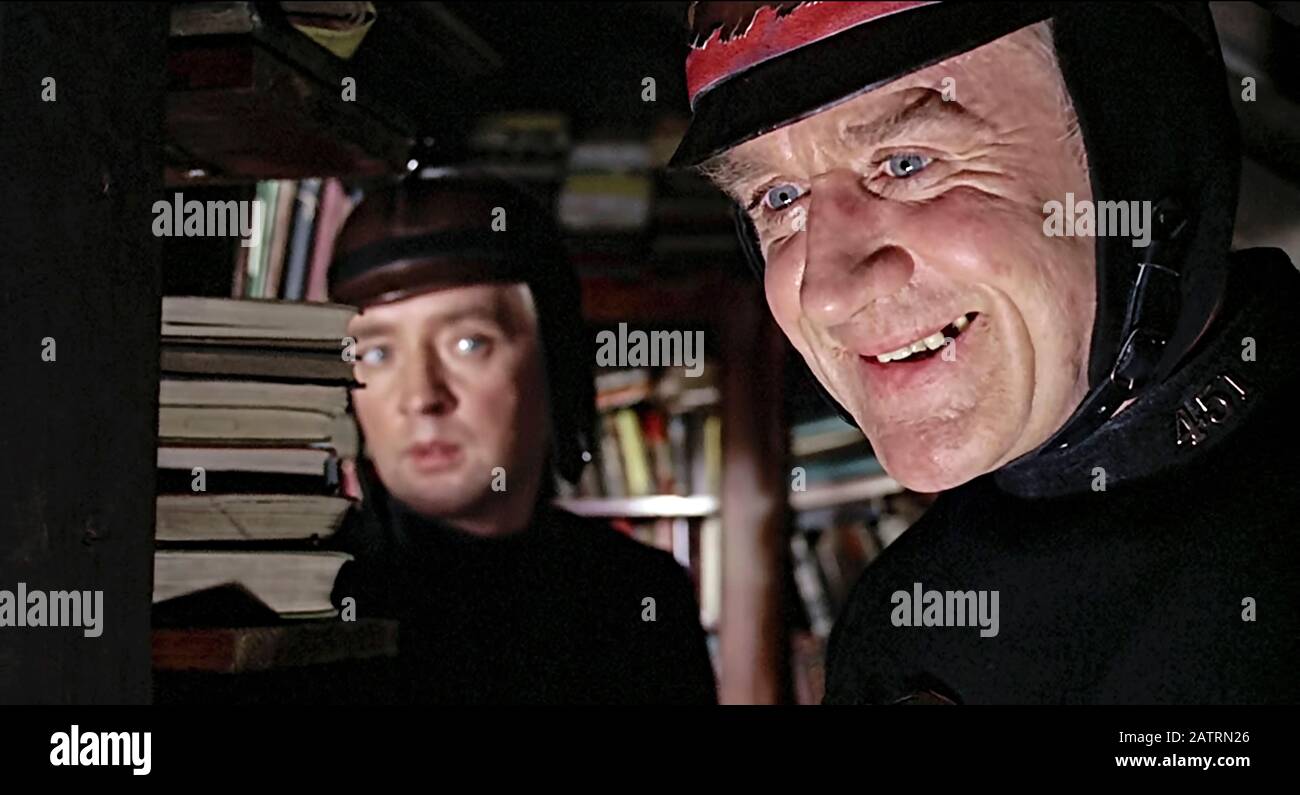
I want to come back to the sequence where the house burns down. Montag and Beatty find a hidden library in the attic and it's in this sequence where we see Beatty takes a sadistic pleasure in the burning of books. By this point Montag has already begun to read.

Fahrenheit 451 (1966) directed by François Truffaut and starring Oskar  Werner as Guy Montag and Cyril

The way Beatty is foregrounded in this shot and the lighting on his face makes him look incredibly sinister and wolfish. He's positively orgasmic at the thought of burning books. And Montag looks to be questioning his captain's sanity. When Beatty holds up Adolf Hitler's Mein Kampf the irony couldn't be clearer: Nazis had books burned and now Hitler's book is to be burned by another group of fascists.  Despite how evil that book is it's an important historical document that shouldn't ever be forgotten. For these fascists to continue their existence they have to make sure society never questions their actions. The society of Fahrenheit 451 is very insular and content with their wall screens but emotionally they're repressed. In the scene where Montag reads David Copperfield to Linda and her friends one of them breaks down crying. She tells Linda she hasn't felt these emotions in years. Without literature- or art in general people- peoples' humanity begins to deteriorate. 

DREAMS ARE WHAT LE CINEMA IS FOR...: FAHRENHEIT 451 1966

Werner based his performance on the idea of being robotic; he felt science fiction films demanded this kind of performance. But Truffaut wanted Werner to act like a a monkey discovering books for the first time, even going as far to sniff them.  While Truffaut and Werner got along well when they made Jules and Jim Werner's ego got inflated after starring in Stanley Kramer's Ship of Fools, for which he received a Best Actor nomination. By the time he made Fahrenheit 451 I guess he thought himself above Truffaut. Regardless of Werner's ego I think his approach to the character makes sense. Montag should be a more reserved guy, someone who doesn't have felt much passion. When he begins to read he awakens his soul. 

I want to talk a little bit more about Truffaut and what brought him to this project. Truffaut wasn't a science fiction fan and Insdorf, when she first saw the film, didn't know what to expect given Truffaut's previous films were all character dramas. Upon watching the film she realized it wasn't science fiction because Truffaut was more interested in the themes dealing with literature. I'd argue Truffaut stripped down a lot of the book's sci-fi and focused on the speculative aspect of the story. The production design isn't very futuristic but more vague and disparate in its elements. On the documentary it's discussed how the film combines the new and the old. Linda buys Montag a straight razor to replace his electric one, there are old phones and wall-screens. And as I said earlier the world of the film feels very insular. There's nothing grand about this future. If anything it all feels banal.

By the film's end Montag becomes one of the book people. Like the firemen they burn books but only after they've been memorized. They're protected in a person's mind and they refer to themselves by the book in their head. While they are defined by a book rather than personality traits they're more individuals than the rest of society. This is because they have something important about them which is the art they're preserving. The snow in the final scene where we see the book people walking around memorizing the books was happenstance. It makes the final image of these people incredibly poignant. 

Fahrenheit 451 wasn't a box office or critical success. But I think it holds up pretty well nearly 60 years later and can be better appreciated for being a distinctive film in Truffaut's filmography. So, what's your favourite Truffaut film? And where does Fahrenheit 451 rank for you in his output. Comment and let me know.