Showing posts with label Julie Christie. Show all posts

Tuesday, 22 June 2021

Francois Truffaut's "Fahrenheit 451"


Spoilers follow for the film and book

Francois Truffaut's Fahrenheit 451 (1966) was a surprise to me. For years I thought it was supposed to be an successful adaptation of Ray Bradbury's classic 1953 novel- about a future society where books are banned and "firemen" burn them. When I saw it in the library I think I forgot it was even directed by Truffaut. But I wanted to see it  because I knew it'd at least be interesting. What I found was actually a strong film in many ways. And the DVD making of documentary made me appreciate it more. This is an underrated gem from the 60s and a singular adaptation by Truffaut, bringing an European flavour to an American classic.

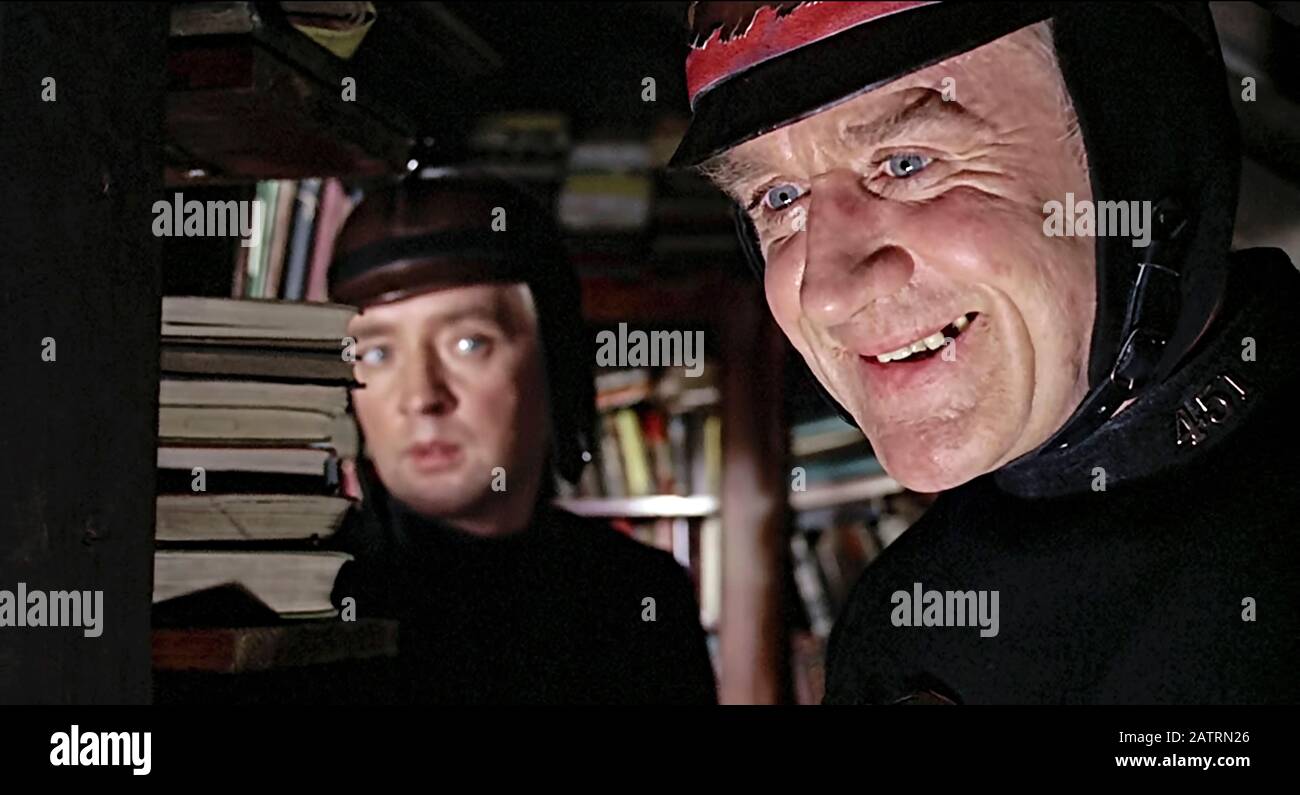
What makes the film European isn't merely having a French director but having an non-American cast, with a German actor in the lead role and Britons as his co-stars. Themes of fascism were always there in the novel but the film takes this further by visualizing the firemen in Nazi-esque all-black uniforms and its main character Guy Montag (Oskar Werner) having blonde hair. And as others have pointed out Montag even gives his boss Captain Beatty (Cyril Cusack) a salute similar to the Nazis. So yeah, this isn't a subtle metaphor.  

The European flavour also extends to the film's overall atmosphere. It feels less like a Hollywood movie and more art-house. Having Julie Christie play both Montag's vapid wife Linda and his next door neighbor Clarisse, a school-teacher who awakens Montag's curiosity in reading, also feels more avant-garde than Hollywood. It was actually producer Lewis M. Allen's idea (he was the husband of screenwriter Jay Presson Allen). Truffaut didn't want Linda and Clarisse to have a villain/hero thing going on but to be two sides of the same coin. 

Christie playing duel roles brings to mind Alfred Hitchcock's Vertigo. That film sees Kim Novak playing duel roles as well though technically it's one character playing a part. But the key similarity is the woman being the instigator of the protagonist's journey. And in both films the two women represent a choice. In Vertigo Scottie could choose the normal and nice life with Judy. Instead he wants the romanticized figure of Madeline. In Fahrenheit 451 Montag is given the choice between the monotonous but safe life with Linda or the more intellectually fulfilling but dangerous path with Clarisse. She is one of the "book people," radicals who memorize books to preserve them. 

In the DVD  documentary film historian Annette Insdorf calls this chapter of Truffaut's career his "Hitchcock period," where he delved extensively in to Hitchcock's work. His films around this time- The Soft Skin (1964), The Bride Wore Black (1968) and Mississippi Mermaid (1969) have gotten comparisons to Hitchcock's work. The documentary discuses how Truffaut used the "Vertigo Effect" in one scene, which is also called a dolly zoom. This is when the camera operator zooms in while dollying forwards or backwards.. There's also a dissolve which homages The Wrong Man (1956).  Another Vertigo-esque sequence is Montag's dream after a woman burns down her because she won't leave her books. Montag later has a dream where he sees Clarisse in the woman's outfit. This brings to mind Scottie's dream where he sees Carlotta in the scene with him and Madeline's husband, Gavin Elster. 


Truffaut also brought on frequent Hitchcock collaborator- composer Bernard Herrmann- to score this film.  Herrmann asked Truffaut why he didn't hire one of his composer friends. Truffaut told Herrmann they would give him the music of the 20th Century but he would give him music of the 21st. I'm not always the best when describing musical scores but I would call Herrmann's score variable. He goes from the dreamy "Prelude" to the aggressive "Fire Station" which underscores the opening sequence of the firemen going out on duty. The xylophones combined with violins give the opening a quirky but dangerous quality. And in "The Bedroom" he invokes the romantic whirlpool of his Vertigo score, which is my favourite film score of all time.

I want to come back to the sequence where the house burns down. Montag and Beatty find a hidden library in the attic and it's in this sequence where we see Beatty takes a sadistic pleasure in the burning of books. By this point Montag has already begun to read.

Fahrenheit 451 (1966) directed by François Truffaut and starring Oskar  Werner as Guy Montag and Cyril

The way Beatty is foregrounded in this shot and the lighting on his face makes him look incredibly sinister and wolfish. He's positively orgasmic at the thought of burning books. And Montag looks to be questioning his captain's sanity. When Beatty holds up Adolf Hitler's Mein Kampf the irony couldn't be clearer: Nazis had books burned and now Hitler's book is to be burned by another group of fascists.  Despite how evil that book is it's an important historical document that shouldn't ever be forgotten. For these fascists to continue their existence they have to make sure society never questions their actions. The society of Fahrenheit 451 is very insular and content with their wall screens but emotionally they're repressed. In the scene where Montag reads David Copperfield to Linda and her friends one of them breaks down crying. She tells Linda she hasn't felt these emotions in years. Without literature- or art in general people- peoples' humanity begins to deteriorate. 

DREAMS ARE WHAT LE CINEMA IS FOR...: FAHRENHEIT 451 1966

Werner based his performance on the idea of being robotic; he felt science fiction films demanded this kind of performance. But Truffaut wanted Werner to act like a a monkey discovering books for the first time, even going as far to sniff them.  While Truffaut and Werner got along well when they made Jules and Jim Werner's ego got inflated after starring in Stanley Kramer's Ship of Fools, for which he received a Best Actor nomination. By the time he made Fahrenheit 451 I guess he thought himself above Truffaut. Regardless of Werner's ego I think his approach to the character makes sense. Montag should be a more reserved guy, someone who doesn't have felt much passion. When he begins to read he awakens his soul. 

I want to talk a little bit more about Truffaut and what brought him to this project. Truffaut wasn't a science fiction fan and Insdorf, when she first saw the film, didn't know what to expect given Truffaut's previous films were all character dramas. Upon watching the film she realized it wasn't science fiction because Truffaut was more interested in the themes dealing with literature. I'd argue Truffaut stripped down a lot of the book's sci-fi and focused on the speculative aspect of the story. The production design isn't very futuristic but more vague and disparate in its elements. On the documentary it's discussed how the film combines the new and the old. Linda buys Montag a straight razor to replace his electric one, there are old phones and wall-screens. And as I said earlier the world of the film feels very insular. There's nothing grand about this future. If anything it all feels banal.

By the film's end Montag becomes one of the book people. Like the firemen they burn books but only after they've been memorized. They're protected in a person's mind and they refer to themselves by the book in their head. While they are defined by a book rather than personality traits they're more individuals than the rest of society. This is because they have something important about them which is the art they're preserving. The snow in the final scene where we see the book people walking around memorizing the books was happenstance. It makes the final image of these people incredibly poignant. 

Fahrenheit 451 wasn't a box office or critical success. But I think it holds up pretty well nearly 60 years later and can be better appreciated for being a distinctive film in Truffaut's filmography. So, what's your favourite Truffaut film? And where does Fahrenheit 451 rank for you in his output. Comment and let me know. 

Sunday, 25 December 2016

Shakespeare on Film: Looking Back at Kenneth Branagh's Hamlet (1996), 20 Years Later


Image result for hamlet 1996

Branagh's adaptation of Hamlet turns 20 this month.  feels even more bold and radical than it did back in 1996. While it was considered a risky endeavour then, I honestly don't know if it could be made today, at least not with the budget and amount of creative control Branagh had. It could possibly be done on HBO as a mini-series. In many ways it's a miracle this film exists. When Branagh first pitched his idea for an unabridged adaptation of William Shakespeare's Hamlet, most studios wouldn't touch it, sceptical of how well it would do financially, especially after Branagh's previous film, Mary Shelley's Frankenstein failed at the box office. Castle Rock eventually agreed to finance the film under certain conditions- including an all-star cast and an edited 150 minute version for a wide release. Branagh was able to shoot on 70mm- the last film to shoot on the format until Paul Thomas Anderson's The Master in 2012.

The film was the culmination of Branagh's interpretation of Shakespeare on film, following Henry V (1989) and Much Ado About Nothing (1993). Branagh had always strived to make accessible adaptations of Shakespeare for general audiences, and he employed both his theatrical background while also thinking in cinematic terms. What Branagh did with Hamlet was to take it out of the shadowy, black and white world of Laurence Olivier's 1948 Oscar winning film- and also Russian Grigori Kozintsev's 1964 version and sets it against a opulent, majestic and bright castle. In the promo for the Cannes Film Festival Branagh explains that he wanted to go for impressionistic 19th century, not set in one specific year or country; he also wanted to have close enough to reality while retaining a distance that would audiences to accept the heightened language.

The setting and it being shot on 70mm gives it the grandeur of a David Lean epic like Lawrence of Arabia or Dr. Zhivago. The epic scale of the film would appear to run contrary with the play's psychological drama. However, the approach ultimately, I think, works. Consider that Lawrence of Arabia is a study of T.E. Lawrence's psychology while also being a war epic. In the play, Hamlet's personal turmoil and the domestic drama of the royal family is set against the approach of Fortinbras; there's a larger political context to the story.  I would venture this film emphasises that juxtaposition of personal and political more than the other film version.

After Hamlet encounters Fortinbras' soldiers he begins the "How all occasions do inform against me" soliloquy, in which he compares his inaction to the soldiers going in to battle, ready to die. As Hamlet gives the speech the camera pulls back, until the final proclamation, "My thoughts be bloody, or be nothing worth!" has Hamlet against the backdrop of frozen mountains. To me, this both grants Hamlet's pivotal turn a more grand gesture- Claudius' murder won't just be revenge, it'll change the fate of the kingdom. The play ends with Fortinbras becoming king of Denmark, Hamlet giving him his "dying voice." Fortinbras is also a man out to avenge his father's murder, though on a more overtly large scale than Hamlet.
Image result for hamlet 1996 how all occasions


Elsinore does feel like something from a bygone era. The exteriors of the castle were shot at Blenheim Castle in Oxfordshire and the wintry landscape feels Russian; if Olivier's and Kozintsev's versions were 50-era Ingmar Bergman, Branagh's recalls Fanny and Alexander. Tim Harvey's Oscar nominated production design (it lost to The English Patient) represents a place of prestige, privilege and comfort- but it's also a maze of secret rooms where anybody could be spying on you; there's an oppressiveness that weighs down on Hamlet. Despite the castle having a different aesthetic and ambiance from other adaptations, it still functions thematically as Hamlet's ''prison." Alexandra Byrne's costume design- also Oscar nominated and losing to The English Patient- feels both authentic to the time but as per Branagh's vision, not strictly attached to one specific year or country.

Coming back Elsinore being from a bygone era, the invasion at the film's conclusion does represent one era ending and another beginning. The deaths of Claudius, Gertrude and Hamlet signify this end. The film begins with the inscription of "Hamlet" on the statue of Hamlet's father- which also acts as the film's title card- and ends with that statue being torn down. Hamlet's father was already killed literally and at the film's end he's symbolically killed via the statue's destruction.

Branagh plays Hamlet very diva-like, and as someone highly intelligent yet easily overcome with emotion. He does calm down his performance in the second part of the film, which begins after "How all occasions do inform against me." Branagh is complimented by one of the greatest ensemble casts in a Shakespearean adaptation, including Derek Jacobi- who himself played Hamlet- as Claudius, Julie Christie as Gertrude (whom-to continue the David Lean connection- was in Dr. Zhivago), Richard Briers as Polonius, and Kate Winslet as Ophelia. In a interesting bit of history, Baz Luhrmann's Romeo+Juliet was released in the November before Hamlet's release. Leonardo DiCaprio starred in that fil and of course he and Winslet would be seen together a year later in Titanic. Supposedly Winslet learned she was cast as Rose in the film on the day she was to film her strait-jacket scene.


Several of the cameos don't fit. Jack Lemmon, Billy Crystal and Robin Williams stand out too much, especially when compared with actors like Jacobi and Briers. The film gets away with Charlton Heston as the Player King due to his commanding voice and presence. Moreover, there's something poignant about Heston- whom of his early roles was as Marc Antony in a 1950 film version of Julius Caesar- returning to Shakespeare near the end of his film career.

Admittedly, Branagh can go too broad as an actor and as a director. Hamlet in a Jesus pose as his body is being carried out by Fortinbras feels excessive and unnecessary; but Branagh also stages many scenes with restraint and nuance. I admired how he puts Ophelia in a doorway during the "Oh, what a noble mind is here o'erthrown" speech. She's in a literal framework while also framed by the camera. Then there's the way Branagh reveals Hamlet in his first scene- panning across the crowd to find him; this reveal adds an certain ominousness vibe to the character. Hamlet is also constantly lurking. The ever-moving camera during scenes with multiple characters also gives off an Robert Altman-vibe and also acts another spying eye.

As a production Hamlet was part of a resurgence of old-fashioned epic films in the 80s and 90s that included the following year's Titanic, Gandhi, Amadeus the aforementioned The English Patient, Braveheart. This resurgence culminate in with The Lord of the Rings trilogy in the early 2000s, maybe the boldest film-making venture in modern film history.

If Hamlet is partly about one era giving away to another, Branagh's film equally represents one kind of film that has given way to less ambitious and more conventional blockbusters. I've actually dreamt of adapting Othello on the same scale as this film.  Branagh's film is one of a kind, a testament to sincere and passionate movie-making and love of Shakespeare.