Showing posts with label Bernard Herrmann. Show all posts

Tuesday, 22 June 2021

Francois Truffaut's "Fahrenheit 451"


Spoilers follow for the film and book

Francois Truffaut's Fahrenheit 451 (1966) was a surprise to me. For years I thought it was supposed to be an successful adaptation of Ray Bradbury's classic 1953 novel- about a future society where books are banned and "firemen" burn them. When I saw it in the library I think I forgot it was even directed by Truffaut. But I wanted to see it  because I knew it'd at least be interesting. What I found was actually a strong film in many ways. And the DVD making of documentary made me appreciate it more. This is an underrated gem from the 60s and a singular adaptation by Truffaut, bringing an European flavour to an American classic.

What makes the film European isn't merely having a French director but having an non-American cast, with a German actor in the lead role and Britons as his co-stars. Themes of fascism were always there in the novel but the film takes this further by visualizing the firemen in Nazi-esque all-black uniforms and its main character Guy Montag (Oskar Werner) having blonde hair. And as others have pointed out Montag even gives his boss Captain Beatty (Cyril Cusack) a salute similar to the Nazis. So yeah, this isn't a subtle metaphor.  

The European flavour also extends to the film's overall atmosphere. It feels less like a Hollywood movie and more art-house. Having Julie Christie play both Montag's vapid wife Linda and his next door neighbor Clarisse, a school-teacher who awakens Montag's curiosity in reading, also feels more avant-garde than Hollywood. It was actually producer Lewis M. Allen's idea (he was the husband of screenwriter Jay Presson Allen). Truffaut didn't want Linda and Clarisse to have a villain/hero thing going on but to be two sides of the same coin. 

Christie playing duel roles brings to mind Alfred Hitchcock's Vertigo. That film sees Kim Novak playing duel roles as well though technically it's one character playing a part. But the key similarity is the woman being the instigator of the protagonist's journey. And in both films the two women represent a choice. In Vertigo Scottie could choose the normal and nice life with Judy. Instead he wants the romanticized figure of Madeline. In Fahrenheit 451 Montag is given the choice between the monotonous but safe life with Linda or the more intellectually fulfilling but dangerous path with Clarisse. She is one of the "book people," radicals who memorize books to preserve them. 

In the DVD  documentary film historian Annette Insdorf calls this chapter of Truffaut's career his "Hitchcock period," where he delved extensively in to Hitchcock's work. His films around this time- The Soft Skin (1964), The Bride Wore Black (1968) and Mississippi Mermaid (1969) have gotten comparisons to Hitchcock's work. The documentary discuses how Truffaut used the "Vertigo Effect" in one scene, which is also called a dolly zoom. This is when the camera operator zooms in while dollying forwards or backwards.. There's also a dissolve which homages The Wrong Man (1956).  Another Vertigo-esque sequence is Montag's dream after a woman burns down her because she won't leave her books. Montag later has a dream where he sees Clarisse in the woman's outfit. This brings to mind Scottie's dream where he sees Carlotta in the scene with him and Madeline's husband, Gavin Elster. 


Truffaut also brought on frequent Hitchcock collaborator- composer Bernard Herrmann- to score this film.  Herrmann asked Truffaut why he didn't hire one of his composer friends. Truffaut told Herrmann they would give him the music of the 20th Century but he would give him music of the 21st. I'm not always the best when describing musical scores but I would call Herrmann's score variable. He goes from the dreamy "Prelude" to the aggressive "Fire Station" which underscores the opening sequence of the firemen going out on duty. The xylophones combined with violins give the opening a quirky but dangerous quality. And in "The Bedroom" he invokes the romantic whirlpool of his Vertigo score, which is my favourite film score of all time.

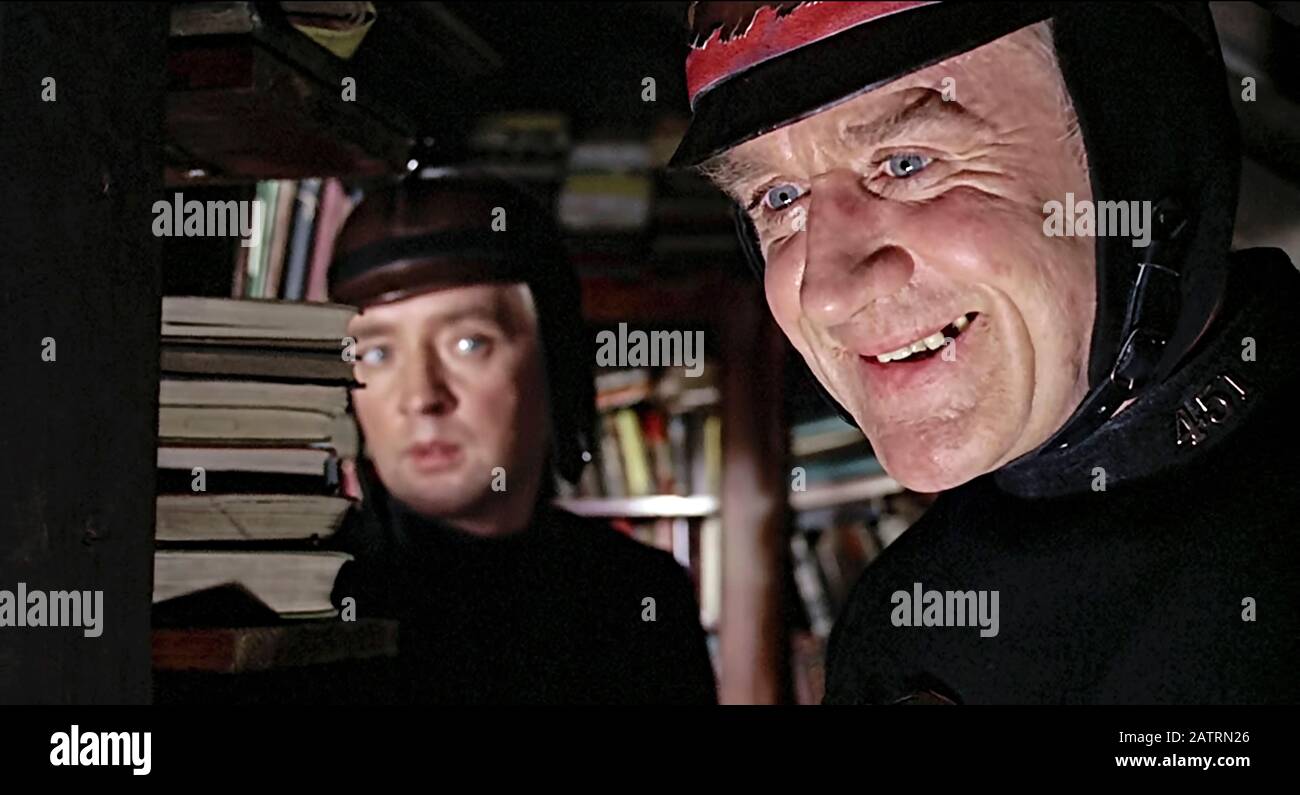
I want to come back to the sequence where the house burns down. Montag and Beatty find a hidden library in the attic and it's in this sequence where we see Beatty takes a sadistic pleasure in the burning of books. By this point Montag has already begun to read.

Fahrenheit 451 (1966) directed by François Truffaut and starring Oskar  Werner as Guy Montag and Cyril

The way Beatty is foregrounded in this shot and the lighting on his face makes him look incredibly sinister and wolfish. He's positively orgasmic at the thought of burning books. And Montag looks to be questioning his captain's sanity. When Beatty holds up Adolf Hitler's Mein Kampf the irony couldn't be clearer: Nazis had books burned and now Hitler's book is to be burned by another group of fascists.  Despite how evil that book is it's an important historical document that shouldn't ever be forgotten. For these fascists to continue their existence they have to make sure society never questions their actions. The society of Fahrenheit 451 is very insular and content with their wall screens but emotionally they're repressed. In the scene where Montag reads David Copperfield to Linda and her friends one of them breaks down crying. She tells Linda she hasn't felt these emotions in years. Without literature- or art in general people- peoples' humanity begins to deteriorate. 

DREAMS ARE WHAT LE CINEMA IS FOR...: FAHRENHEIT 451 1966

Werner based his performance on the idea of being robotic; he felt science fiction films demanded this kind of performance. But Truffaut wanted Werner to act like a a monkey discovering books for the first time, even going as far to sniff them.  While Truffaut and Werner got along well when they made Jules and Jim Werner's ego got inflated after starring in Stanley Kramer's Ship of Fools, for which he received a Best Actor nomination. By the time he made Fahrenheit 451 I guess he thought himself above Truffaut. Regardless of Werner's ego I think his approach to the character makes sense. Montag should be a more reserved guy, someone who doesn't have felt much passion. When he begins to read he awakens his soul. 

I want to talk a little bit more about Truffaut and what brought him to this project. Truffaut wasn't a science fiction fan and Insdorf, when she first saw the film, didn't know what to expect given Truffaut's previous films were all character dramas. Upon watching the film she realized it wasn't science fiction because Truffaut was more interested in the themes dealing with literature. I'd argue Truffaut stripped down a lot of the book's sci-fi and focused on the speculative aspect of the story. The production design isn't very futuristic but more vague and disparate in its elements. On the documentary it's discussed how the film combines the new and the old. Linda buys Montag a straight razor to replace his electric one, there are old phones and wall-screens. And as I said earlier the world of the film feels very insular. There's nothing grand about this future. If anything it all feels banal.

By the film's end Montag becomes one of the book people. Like the firemen they burn books but only after they've been memorized. They're protected in a person's mind and they refer to themselves by the book in their head. While they are defined by a book rather than personality traits they're more individuals than the rest of society. This is because they have something important about them which is the art they're preserving. The snow in the final scene where we see the book people walking around memorizing the books was happenstance. It makes the final image of these people incredibly poignant. 

Fahrenheit 451 wasn't a box office or critical success. But I think it holds up pretty well nearly 60 years later and can be better appreciated for being a distinctive film in Truffaut's filmography. So, what's your favourite Truffaut film? And where does Fahrenheit 451 rank for you in his output. Comment and let me know. 

Tuesday, 12 May 2020

The Essential Films: "The Day the Earth Stood Still" (1951)

Michael Rennie, "The Day the Earth Stood Still," 1951 | Flickr

A Series of Writings on Films that I feel are essential for film lovers, coupled with films that are personal to me. Spoilers for those you haven't seen the film.


I'm always interested in how films can act as metaphors for themselves, either by accident or design. Robert Wise's The Day the Earth Stood Still is about an alien sending a message to the human race: do not continue to war amongst yourselves or you will be destroyed. Just as the film is about a messenger, the film is a messenger. In lieu of an actual space emissary the film acts as a cautionary warning. While Wise's film may appear quaint to many modern viewers the film's message was and remains powerful in its bluntness, and its influence on later science fiction films cannot be overlooked. It's also just a very well made film with good performances and tight pacing.

The film begins with a flying saucer landing in Washington. A being in a space-suit (Michael Rennie) emerges, along with a robot named Gort (Lock Martin). After being shot by a soldier, the spaceman is taken to the hospital where it is revealed he is a humanoid named Klaatu. Klaatu tells the President's secretary he  has a message he wishes to communicate to all the world leaders. The secretary tells him it's not possible to arrange a meeting. Later Klaatu escapes from the hospital. He goes to a boarding house under the name of Mr. Carpenter. There Klaatu befriends Bobby (Billy Gray), the son of a war widow, Helen Benson (Patricia Neal). Klaatu asks Bobby who the smartest man is on the planet, to which Bobby answers Professor Jacob Barnhardt (Sam Jaffe).  Klaatu convinces Barnhardt to gather renowned scientists at the spaceship so Klaatu can deliver his message. But first Klaatu must display his power nonviolently.

Spencer Tracy and Claude Rains were considered for the part of Klaatu but producer Julian Blaustein believed a lesser known actor would work better for conveying an alien quality to American audiences. The head of 20th Century Fox, Daryl F. Zanuck, suggested  British actor Rennie, who had gotten his start in an uncredited role in Alfred Hitchcock's Secret Agent (1936) and made his American film debut in The Black Rose (1950) alongside Tyrone Power and Orson Welles. Rennie turned out to be the perfect choice. He brings an amused but slightly sinister quality to the role; but Rennie never plays Klaatu as a hero or villain, just someone with a mission. He's cold and objective about its importance and what he needs to achieve it. But he's also capable of warmth, as in his scenes with Bobby; and he inevitably turns to our other main character, Helen, for help.  

The Day the Earth Stood Still (1951)

While Helen at first doesn't believe Billy when he tells her he saw "Mr. Carpenter" enter the space ship, Klaatu tells her the truth during his nonviolent display of power- switching off the electricity across the world. Klaatu asks for Helen's help and I can see why he trusts her. Neal conveys trustworthiness and maturity. Helen is dating a man named Tom Stevens (Hugh Marlowe) who also discovers Klaatu's identity. Tom only cares about becoming famous by exposing Klaatu, in contrast to Helen who cares about his mission.

Neal started her career on Broadway and won Best Featured Actress in a Play for Another Part of the Forest at the first Tony Awards in 1947. A few years later she would star in the film version of The Fountainhead (1949) with Gary Cooper. After The Day the Earth Stood Still, she would win the Best Actress Oscar for Hud (1963) and co-star in Breakfast at Tiffany's (1961). Neal supposedly thought The Day the Earth Stood Still would just be another flying saucer film and had difficulty keeping a straight face while delivering some of her lines; but she helps ground the film and give it the necessary human element. The scene where Neal delivers the film's iconic phrase- "Klaatu barada nikto"- which stops Gort from destroying humanity- is also the film's most suspenseful moment.  

After Gort has been prevented from causing harm he brings Klaatu back to life via a machine on the ship. When Helen asks if Gort has the power of life and death Klaatu responds that only  "the Almighty Spirit" has this power, meaning his resurrection is only temporary. This reference was at the behest of the censors who didn't like the scientific explanation for resurrection. It's this reference that has led to Klaatu being interpreted as a Christ like figure.

Wise and writer Edmund H. North added this line reluctantly. They believed it under-minded the idea of Klaatu's race being God-like. I understand Wise and North's issue but I'd argue it reinforces the Christ metaphor and adds another layer of mystery to the film. Is this Almighty Spirit the human idea of God or something else entirely? Could this spirit have some basis in science rather than being strictly spiritual? The line is vague enough to allow interpretation.    


Robert Wise 20 greatest films ranked: 'West Side Story' and more ...

Wise described himself as "journeyman director," someone who doesn't a specific directorial style but who acquits themselves to different genres. But despite his modesty Wise's career is very impressive.  After starting out as a sound and music editor at RKO Pictures he would become a film editor. Wise edited what many consider to be the greatest film of all time- Orson Welles' Citizen Kane (1941, for which he received an Oscar nomination. He then directed additional footage for Welles' follow-up The Magnificent Ambersons (1942). Wise's first directorial credit was The Curse of the Cat People (1944), which he finished after it's director Gunther von Fritsch was fired for falling behind schedule. Wise would receive two Best Director Oscars for West Side Story and The Sound of Music (the former he shared with Jerome Robbins). And he directed what I think- along with The Innocents (1961)- is the definitive haunted house movie, The Haunting (1963). His last major film was Star Trek: The Motion Picture (1979), which for its noted problems has some visually stunning moments.

I love how Wise and his cinematographer Leo Tover- who photographed William Wyler's The Heiress- make certain scenes in this film feel like a film-noir, a sci-fi-noir you could say. The scenes I'm thinking of are when Klaatu first returns to the ship and near the end when Helen confronts Gort and then is on the spaceship.  Tover's use of shadows invoke the noir atmosphere. Wise chose Bernard Herrmann to score the film. Herrmann used two theremins to create the film's unusual sound. The film's main theme is ominous, mysterious  and must importantly, other-worldly. I think it  epitomizes what I think of as the sound of 50s  or old school sci-fi.  

The Day the Earth Stood Still is a direct and efficient film. Klaatu delivers his message and leaves. There's no sentimental goodbyes to Helen and Billy. We are simply left to ponder how humanity will respond. I talked at the beginning of how the film is a metaphor for itself. Coming back to that: just like the scientists at the film's end, we the audience is gathered to witness Klaatu's message. The message is terrifying in its implications but sobering as well. The ending doesn't strive for optimism but acts as a precursor to a unseen larger story. Part of me would have loved to see Rennie and Neal back in a sequel but it probably for the best the film stands alone. The ending's chilling ambiguity will forever remain untainted.