Showing posts with label Comedy. Show all posts

Monday, 1 June 2020

Performances I Love: Barbara Stanwyck and Henry Fonda in "The Lady Eve" (1941)


A Royal Flush: Close-Up on "The Lady Eve" and "Sullivan's Travels ...

Spoilers for the film  below

Acting is often about having the right balance. Go too far one way, you can become too campy, too far the other way, too serious. And when actors play off each other they have to be in perfect sync with one another- like a duet. Barbara Stanwyck and Henry Fonda perform one of the great romantic comedy duets in Preston Sturges' The Lady Eve, his third film and my favourite of his. In their second pairing- after 1938's The Mad Miss Manton- Stanwyck and Fonda's combination of con-woman and klutz make for an endearing and quite sexy pair.

Stanwyck plays a con artist named Jean Harrignton, partners with her father (Charles Coburn). whose latest target is Charles Pike (Fonda), the heir to a brewery fortune. Jean and Charles ends up falling in love and plan to get married, which complicates the scheme, to say the least. Charles discovers Jean's true identity, calling off their engagement. Jean wants to get back at Charles so she pretends to be the British Lady Eve Sadwich. Charles believes Eve looks too much like Jean to be her, though his valet Muggsy (William Demarest) isn't fooled.

About 10 minutes in to the film, in an unbroken shot, Stanwyck caresses Fonda's face and plays with his hair for several minutes in what I think is one of the sexiest scenes ever put to screen. Fonda never looks at Stanwyck during this. He stares straight ahead, almost lost in another world. He's intoxicated by her/  Before movies could really show sex, the implication of sex was a very powerful thing. The scene exemplifies the film's perfect combination of comedy and sensuality. 

And speaking of comedy, Fonda has to be both the straight man while also performing most of the film's physical comedy. This could result in an inconsistent performance but Fonda deftly never plays Charles' pratfalls too broadly, allowing him still to be the straight man in the centre of this farce. Moreover, Charles is gullible but his reasoning for believing Eve isn't Jean- why wouldn't she disguise herself?- makes sense in the context of this movie's universe.   

Stanwyck plays Jean as mischievous rather than outright cruel. She pretends at wanting vengeance for being scorned by Charles but she really wants him back. In the scene when Charles breaks off the engagement Stanwyck reveals Jean's vulnerability as well as her bitterness at being caught. She jokes about the "rotten likeness" of her picture. Jean then attempts to convince Charles she was going to tell him the truth before they were married. Charles lies and says he knew from the start who she was,  which reveals how bitter he is. Stanwyck and Fonda play this scene beautifully. They know this is the centre of the film, and has to give weight to Jean and Charles' relationship. Without the necessary poignancy, the audience won't desire them getting back together.  

Stanwyck and Fonda didn't receive Oscar nominations for their performances and I'd argue those are two of the biggest acting omissions in the Oscars' history. They would team one more time-the same year- in You Belong To Me but The Lady Eve is their most remembered work together. It's a wonderful duet.

Sunday, 6 April 2014

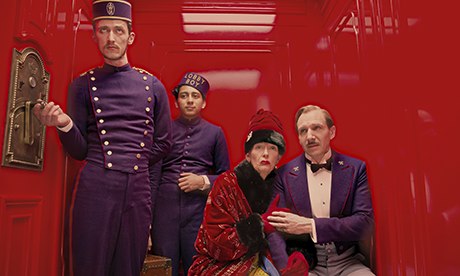
This Barbaric Slaughterhouse That Was Once Known as Humanity: "The Grand Budapest Hotel"


I’ve only seen Wes Anderson’s The Grand Budapest Hotel once at the time of writing this piece but I feel the film may be Anderson’s greatest accomplishment yet as a filmmaker. To be fair, I haven’t seen The Darjeeling Limited (2007) yet and I do need to revisit The Royal Tenenbaums (2001), which I saw at an age when I was too young to completely appreciate the style of Anderson’s filmmaking. Nevertheless The Grand Budapest Hotel is a triumph- a film that-like all of Anderson’s work- crafts a fully realized world of artificiality while still creating a sense of poignancy that deepens the whole experience  

The film is told through layers of narrative- Inception done Anderson style. A female student in the present comes to a cemetery to see a monument dedicated to a writer. She begins reading the authors’ memoir and we’re sent back to 1985 where the author (Tom Wilkinson) begins talking about the story he’s about to tell. Then we’re in 1968 where we meet the younger version of the author (Jude Law), who talks about his trip to the Grand Budapest Hotel.  The hotel is no longer the glamorous and luxurious place it used to be and the author meets Zero Moustafa (F. Murray Abraham), the owner of the hotel. During dinner the Moustafa tells the author about his early years as the lobby boy to the Hotel’s concierge Gustave H. (Ralph Fiennes). We’re whisked back to 1932 where Zero (Tony Revolori) and Gustave become embroiled in a complex plot involving a dead widow/one of Gustave’s lovers, Madame D. (Tilda Swinton), her prized portrait that Gustave steals, Gustave being framed for murder, a prison break, and Madame D.’s son Dmitri (Adrien Brody) who also wants the painting. Willem Dafoe also shows up as an assassin.  

For me personally I became a little lost in regards to the plot. Maybe I’m just too dense or maybe the Anderson’s goal is to create a somewhat vague plot. There is one hilarious moment when Gustave, after breaking out of prison violently asks Serge X (Mathieu Amaliric) - the D. Family butler- “What the f—k is going on.” It’s a somewhat meta-moment that highlights the ridiculousness of the plot and how the characters we’re dealing with aren’t exactly any clearer on the proceedings than the audience.  

Ultimately I don’t think the plot really matters. What does matter is the escalation of absurdity and violence, constantly keeping the audience on its toe to what surprise or shock is right around the corner. The film is essentially a farce but Anderson’s craftsmanship makes it so the film transcending merely being a farce. The pure joy of the film is so seductive and infectious that I could have watched the film for another hour.  Anderson is one of the select filmmakers that have truly created their own cinematic world- Anderson’s filmography is essentially a sandbox in which he can play in. I know many don’t like and resist Anderson’s style- and also don’t like him using similar aesthetics in each film. But while all of Anderson’s films-with the exception of his debut feature Bottle Rocket (1996) – have a recognizable visual style and tone, Anderson- to me at least- never seems to tell the same story twice. As I said Anderson’s world is a sandbox and while his films have familiar surroundings he always tells a unique and charming story each time out.

Anderson is one of the most meticulous filmmakers working right now. His shot compositions often are perfectly symmetrical- Anderson often seems like a warmer Stanley Kubrick.  Almost every shot in this film is one you want to live in. Anderson’s films are perfect for the DVD generation- there’s so much detail that you can’t catch everything on first viewing. And many shots you want to- and pardon the cliché- hang up as painting. A fascinating visual element of this film is how it shifts between different aspect ratios- 1:37:1 for the 30s scenes, 2:35:1 for the 60s scenes and 1:85:1 for the present day scenes. The aspect ratio for the 30s works very well with Anderson’s compositions which already have a boxed in quality. The change in aspect ratio reflects how films were framed throughout history. They also reflect the story’s different layers and make the time frames feel like individual worlds.    

The film’s multiple layers present us with Anderson’s commentary on how story telling is all about layers or to put it this way- storytelling is about passing down stories over time. The young student- for all we know- has never met the author or the elderly Zero- and definitely not Gustave-but through the authors’ work she gets a glimpse in to the past- or at least a version of the past. Maybe that’s the whole point. We only see the past through Zero’s memories, which may be why these events seem to exist in such a heightened reality.

The Grand Budapest Hotel, for me, is a very nostalgic film- told through the eyes of a man (Zero) who was there when a hotel was majestic and another man (the author) when it was past its glory days but still held on to by Zero. But it’s also one that acknowledges how- in respect to Gustave- the old world in which some feel they have lived may have already been long gone before they even entered the world.  Like Woody Allen’s Midnight in Paris (2011), The Grand Budapest Hotel suggests that the idea of a “golden age” is just that- an idea rather than something that actually exists or existed. Gustave may have been the last representation of something glorious and is now gone forever.

Zero’s nostalgic connection to the hotel has less to do with its ties to a long lost world than with its association with Agatha (Saorise Ronan), the girl who works at Mendl’s, a pastry shop beloved by Gustave. Agatha became the love of Zero’s life and while I won’t reveal what exactly happened to Agatha, Zero’s explanation of why he’s kept the hotel all this time is incredibly poignant and sweet in its simplicity- and brings to mind the happiness that we all wish to share with someone in our lives, in only for a short time. Ronan’s lovely and beautiful presence makes us believe in Zero’s love for Agatha, and we can see ourselves falling in love with her too.

Ronan is one part of a large ensemble cast that fills out this universe and gives it texture.Many of these actors are Anderon regulars- along with many several new faces, like Fiennes. Fiennes is the standout here, giving a dryly funny performance, presenting us with a man both debonair and somewhat clueless.

My only complaint about the film is- similar to Anderson’s previous film Moonrise Kingdom, my favourite film of 2012- there’s a bit of animal cruelty that felt a little too dark. That and some of the violence felt a little too jarring in this universe.

On a closing note, I can see The Grand Budapest Hotel becoming a beloved classic as the years go by. Like Anderson’s other films there’s timeless quality to the film. It’s bittersweet and ultimately tragic but still manages to be one of the most joyous experiences I’ve had at the movies in quite some time.

Monday, 26 March 2012

Back to School: "21 Jump Street"


Up front, I really liked 21 Jump Street. It's very funny and surprisngly poignant. It's also one of the more focused comedies of recent memory.

It's based on the TV show which ran from 1987 to 1991 and put a young actor named Johnny Depp on the map, which makes it funny how the film's lead character, police officer Schmidt (Jonah Hill), was a former geek in high school. The film opens in 2005, with Schmidt unsuccessfully asking a girl to the prom. The scene also establishes Jenko (Channing Tatum), a school jock who makes fun of Schmidt. We later see Jenko can't go to the prom because his grades are awful. The film flashes ahead seven years, showing Schmidt and Jenko in the police academy, putting their differences aside and becoming friends.

When I saw the film, I thought this all went by a little too quickly. I wanted more of the high school backstory, more of the police academy bonding. Looking back, all this is done very economically,  not wasting time getting us to the main set up of the film, which is Schmidt and Jenko, due to their youthful appearances, are assigned to go undercover at a high school in order to expose a drug ring.

There's a nice reference when Schmidt and Jenko's police captain (Nick Offerman) mentions how the program is being recycled from the 80s and how nothing's original these days. The filmmakers are basically telling us they "we know how unoriginal it seems to be making 21 Jump Street in to a movie but don't worry, we'll have fun with this concept." The film is very unconscious of cop movie cliches and stereotypes like Ice Cube's "angry black police captain." There's also a nice bit during a car chase where we keep expecting vehicle to blow up. The punchline, where a certain vehicle does blow up, is very funny.

Fortunately, the film doesn't become so meta that it becomes like a Scream movie (not a knock against those movies). While the film has the plot device of undercover cops in high school, sssentially the film is about these two guys reliving high school through each other's shoes. Schmidt becomes the cool kid and falls for Molly (Brie Larson) and becomes friends with Eric (Dave Franco), who's dealing drugs, but as a result gets too deep with the people he's supposed to be investigating, and as a a result pushes away Jenko, who becomes smarter after hanging out with the science crowd. These trajectorities may seem "obvious" and "familiar" to some but I found the way in which these characters develop very poignant and relatable. Despite it's goofiness, the film shows us what it'd be like to have a high school do-over- we'd try not to have the same labels.

This is the first film I've seen Channing Tatum and similar to what others are saying, he is quite funny here, mostly because he's not trying to be funny. After he and Schmidt have to take drugs to retain their cover, he has a great moment where he draws an equation on a whiteboard and then says "Fuck you science." Jonah Hill is the kind of actor who I find grows on you and becomes more endearing the years progress. He's good here as the outcast who finally gets to be popular- and get the girl. Brie Larson is lovely here. Like Hill's co-star in Superbad, Emma Stone, she has a down to earth/girl next down relatability which makes her appealing, and their blossoming romance is sweet.

The film, as expected, ends with a set-up for a sequel. Due to the film's positive reception, both financially and critically, I think we will be seeing a sequel. I hope it's not a rehash of the first film but takes these characters and concept in interesting directions. As this film stands, it's funny, smart and has a pretty big heart...and dick jokes.