Showing posts with label George Lucas. Show all posts

Friday, 30 May 2025

Sith Happens: 20 Years of "Revenge of the Sith"


It's interesting how the reception of the Star Wars prequels, particularly the first has so dramatically changed over the 26 years since The Phantom Menace came out in 1999. There was plenty of vitriol and disappointment from fans when the film was released, and Attack of the Clones wasn't beloved either. Revenge of the Sith- released 20 years ago this past month- was the most critically well received, and I think fans were more responsive. But overall these well liked movies. Red Letter Media became famous for their "Mir Plinkett" reviews and I think fans who liked them were in a minority.

But over time, with people my age or younger who saw the prequels when they younger, and gained a presence online, the prequels have gone through a resurgence. It's not unsurprising. There's something incredibly nostalgic about this franchise, a certain magic that makes it different from anything in film history. And it feels like we're in a era where everything not immediately beloved is almost reclaimed automatically. Prequel fans say the sequel trilogy will never be reevaluated but never say never, right.

But as the prequels have become more praised, with many claiming they're masterpieces of cinema, I've gone in the opposite direction, becoming critical and negative towards them, though I don't consider them irredeemably bad. They are intriguing contradictions-grand scale achievements that revolutionized filmmaking, but not really great films on a directing, acting, or screenwriting level. George Lucas's greatest gift as a filmmaker is his unique imagination but I think he struggles with, and maybe is a little bit bored, with the more intimate and human parts of storytelling. Lucas set out to create a Shakespearian/Greek tragedy with back drop concerning the fall of democracy, but he also wanted to revolutionize and experiment with new special effects. He ended up getting lost in the technology and not taking enough time to finetune the story and character beats and overall dramatic and political arc of the story. 

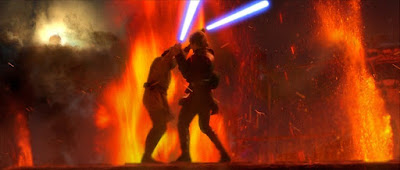
But I understand why for my generation Revenge of the Sith is the Star Wars film. I get it. I can see why at 10 or 12 years of age it blew a lot of peoples' mind in the same way the original films did for the previous generation. The opening action sequence, the lightsaber duels, as well as Obi Wan fighting General Grievous, are really spectacular stuff. Revenge of the Sith is the best of the prequels even though the execution of its stories and themes is still uneven. It has the most dynamic pacing and the strongest overall dramatic arc. In the previous two prequels Lucas was too leisurely in his pacing. In The Phantom Menace in particular we spend an entire act before even getting to Anakin Skywalker. And even then it's not really his story. In Attack of The Clones we get more focus on Anakin and an actual internal struggle, something lacking in Phantom Menace, but in Revenge of the Sith, there's more urgency, and it feels like an actual movie.

At the time Revenge of the Sith was supposed to be the final Star Wars film, bringing the saga full circle back to those twin suns on Tatooine, and a lot was riding on it. As I mentioned, many were disappointed with Phantom Menace and Attack of the Clones and Lucas had to stick the landing on this one. The critical reception was much better this time, with former New York Times critic A.O. Scott calling it better than the original Star Wars, even though he said it made his inner child shudder. And in 2012, critic Camille Paglia called Revenge of the Sith was the greatest work of art of the last 30 years 

Revenge of the Sith is the most streamlined of the prequels but that turns out to be a double edged sword. As I said earlier, Revenge of the Sith feels more urgent compared the first two prequels and has more forward momentum but at the same time it feels almost too compact and rushed. I think the problem, again, lies in Lucas being too leisurely in those first 2 prequels, with Phantom Menace not really being Anakin's story. While most of the necessary pieces are there in the previous films- leaving his mother, not being accepted by the Jedi, the death of his mother, and his love for Padme (Natalie Portman)- something still feels lacking in the development of his arc. For one, Anakin and Padme's lovey story wasn't organically told. However, you can feel Anakin's desperation in wanting to save Padme when he begins having visions of her dying from childbirth. Anakin had visions of his mother dying and wasn't able to save her in time, so it makes he's so determined to prevent this from happening again.

 We also needed see more of Anakin coming to believe the Jedi were corrupt and a genuine threat, turning so violently against them. It's an interesting angle Lucas takes that Palpatine (Ian McDermid) is kind of right about the Jedi. I do sometimes find it hard to know how to take the Jedi in these films, since we don't really get to know them. The Order 66 montage is superb and, again, it makes this film feel more dramatically immediate, but are the Jedi tragic or are they the cause of their own destruction. I guess it's supposed to be both. If we had seen more of Anakin's friendship with the other Jedi, this sequence probably hits even harder. When Anakin tells Obi Wan (Ewan McGregor) that he should've know the Jedi were taking over and from his point of view the Jedi are evil, it doesn't feel completely earned. I guess the point is Anakin isn't thinking straight and is trying to convince himself that what's he doing is right. Still, when  he says he's brough peace and justice to his new Empire, it doesn't really fit with the motivation of trying to save Padme. There is that red flag scene in Attack of the Clones where Anakin talks about the merits of fascism but it's only briefed touched upon and laughed off.


Revenge of the Sith opens pretty well, the strongest of all the prequels' beginning. I like that we see more of the Anakin/Obi Wan friendship then previously, and Anakin feels more like the mature and skilled Jedi that we heard about in the original film. Christensen's acting has gotten a lot of flak over the years but the way Anakin was conceived and written by Lucas, Christensen's acting is kind of fitting. I do wish we had seen more of the Clone Wars in these films instead of just getting the beginning and the end, and it's another reason why Phantom Menace feels kind of disconnected from the second and third films, with it being more of a set up for a duology rather than part one of a trilogy. The Clone Wars maybe should've been ongoing through the trilogy and we could've seen how it devastated the galaxy, establishing that it was so destructive that people wanted to prevent that ever happening again, which is why Palpatine restructuring the republic in to an Empire and killing off the Jedi is so embraced. For such grand-scaled films we don't see how the politicians actually operate, or how they feel and the wider galaxy feels . It is strange that Lucas doesn't use the death of Anakin's mother, Shmi, as more a catalyst for why he turns against the Jedi, since it is largely their fault for keeping Anakin away from, when he could've saved her if he had gotten to Tatooine. The films don't do enough with the whole "Jedi don't anything about slavery" angle, and how that relates to Anakin, who as a child wanted to save the slaves on Tatooine. The irony obviously is that as Vader he helps oppress the whole galaxy.  

Lucas himself compares himself to Vader, saying he became the very thing he fought against. In Anakin's case it was the Sith, in Lucas' case it was the Hollywood studio systems and corporations. Lucas then became a corporate businessman and the conflict between being an artistically pure filmmaker while also making films that could sell toys is deeply felt in the prequels, as well as Return of the Jedi.

I do give Lucas credit for being ahead of the curve with the whole fall of democracy thing. "So this is how liberty dies, with thunderous applause," spoken by Padme, feels pretty relevant in today's world.  Lucas obviously wanted to parallel real world politics and events, showing realistically in a fantasy setting how a democracy becomes a dictatorship. As much as Star Wars was an escapist fantasy, Lucas always had political messages and allegories he was delivering, basing Palpatine on Nixon, and the Empire on the US. The rebellion is the Vietcong, with the Ewoks being the less technologically advanced society that overtakes a massive war machine. And when Anakin tells Obi Wan "You're either with me or you're my enemy," people have always seen that as a clear allusion to George W. Bush. Lucas always talks how these movies "rhyme," and I'll add that  history repeats itself, which keeps these films very relevant. Palpatine and the Empire can be whatever dictatorship or colonial power you want them to be, they're not  locked in to the 70s. And of course the sequel trilogy is all about having to continuingly fight the same battles. 

Lucas also wanted to show even an innocent child who's good at heart become a fascist monster.. I mean how many people started decent before they became monsters? The first time we Anakin is him asking Padme if she's an angel, the last time is this man stuck in a machine looking over a planet destroying weapon. It's quite an arc.  When Anakin and Obi Wan part before Anakin goes down the dark path, Obi Wan reminds us he has trained Anakin since he was a boy. It's a wonderful moment that makes Obi Wan's final speech to Anakin even more tragic. McGregor really sells the love Obi Wan had for Anakin, probably better than the movies have.  

The film's best scene is arguably where Palpatine tells Anakin the story of "Darth Plageuis the Wise." I don't know if Lucas had someone to punch up the dialogue in this scene but it's really well crafted in showing Palpatine beginning to plant the seeds of distrust in Anakin's mind regarding to the Jedi. We see that Anakin does admire what it means to be a Jedi, even though he has a difficult relationship with the council. I love when Palpatine says "They made you do something that made you feel dishonest," in relation to Anakin being made to spy on him. So warm, so understanding. It's easy to see why Anakin viewed him as someone he could talk to. Did Palpatine have some genuine fatherly warmth for Anakin? Maybe so. McDermid is so good in this film because he knows exactly how to pitch his performance, from seductive and warm to hammy. While actors have struggled under Lucas' direction, McDermid knows what kind of movie he is. 

Another great passage in the film is Anakin and Padme looking across the Coruscant skyline from two different locations, edited to look like they're looking at each other. When Lucas lets the images and John Williams' music do their thing he's at his best. I think Lucas definitely struggles a bit with character arcs and A to B plotting. To be fair Lucas never wanted to be a conventional narrative filmmaker, wanting to do experimental films and documentaries, which is why I think he grapples with character scenes arcs and plotting. His first film, THX-1138, based on his short film, is more abstract and mood driven then plot driven. And American Graffiti is very loose in its and structure and has pretty basic characters. The original Star Wars was probably the most plot driven thing he had done at that point. But even that film is very stripped in terms of plot and character.   


While the montage with Anakin and Padme is splendid. Lucas lets down Portman as an actress and Padme as a character. A big part of that is cutting out her scenes where she's forming the rebel alliance with Mon Mothma and Bail Organa. It feels like she has less screen time then in the previous 2 films and just isn't as proactive. She was essentially the hero of Phantom Menace and she was the one who wanted to go help Obi Wan in Attack of the Clones. For being so important to Anakin's turn, she mostly just sits at home in this film. And I while I get that dying from grief is a real thing, I don't think Lucas really sells just how much trauma she's been though

While Lucas is perhaps the most influential filmmaker of the last 50 years, I feel his fellow fillmakers and friends who came up in that era, Steven Spielberg, Martin Scorsese, Francis Ford Coppola, and Brian De Palma are better filmmakers overall. It's hard not to wonder what Lucas would have done if Star Wars hadn't taken over the world and had been more of a modest success. I know directing the film was such a grueling ideal that he didn't direct Empire Strikes Back or Return of the Jedi, but again I'm interested in what he would've directed and what his legacy would be. Creating something as game changing as Star Wars is a mighty weight to hold on your shoulders. I think even Lucas views it as a curse sometimes, despite it giving him a permanent place in film history. 

I feel fans have a hard time criticizing Lucas, using the argument that he made the films he wanted to make the way he wanted to make. My problem is this basically negates any criticism of any film, or any piece of art. The artist made it intentionally that way so it's beyond criticism. I get it, Lucas made Star Wars and many fans have such warm feelings towards Lucas that they have difficulty seeing him as anything less than a God. I mean, Lucas is second to none when it comes to creating a whole cinematic universe on screen, more so than something like Marvel, but I feel post Empire Strikes Back, the films start to become more uneven, including Return of the Jedi, even though there's plenty of stuff I like about that film.

I also feel Lucas probably relied a little too much on CGI for the second and third films. I know people will make the argument that more practical effects and sets were used for these films than the originals but it's hard not feel you're often drowning in a computer generated world, especially when you cut to Ewan McGregor walking in a real environment on the set of the Tantive IV. Now, there is some great us of CGI in this film, particularly that shot of the twin suns at the end. And there's Coruscant in general, maybe my favourite planet in the series, and a great representation of what the Republic used to be, as well as a contrast to where Anakin grew up. 

For better or for worse, Revenge of the Sith was the end of an era, the next time we would see Star Wars on screen would be without his involvement. And regardless of how good you think the newer films, one can tell that these are films made without the original creator, films and tv shows that are riffing on what came before. I think Rian Johnson's The Last Jedi is the most ambitious and narratively and thematically curious of the new trilogy, the one closest to having more a directorial vision. I'll probably have to write about that one one day. So, how do you feel Revenge of the Sith on its 20th anniversary. Comment and let me know. 

Wednesday, 25 May 2022

Begun, the Clone Wars have: "Star Wars Episode II: Attack of the Clones" at 20


Spoilers Below

For a while I've wanted to talk more about Star Wars on this blog, since along with James Bond and Planet of the Apes, it's probably the most important film franchise for me. With the second installment of the Prequel Trilogy, Attack of the Clones, turning 20, I've decided this was a good opportunity to discuss more of my feelings on the series. Attack of the Clones is perhaps the most maligned of George Lucas' maligned trilogy, though the trilogy now has the same nostalgic reverence of the Original Trilogy. If the older generation hated these films then the younger generation, people my age or younger, really took to them. I still consider myself an OT fan but I was at the right age to like these films when they came out. However, over time  my feelings have grown increasingly complicated. I like things about the PT and dislike others. And you know what, often they're the same things. The PT have great ideas and are conceptually brilliant but the execution of the story is were many of the problems lie. It feels like the scripts are all a couple of rewrites from being really solid, especially the first 2. However, I don't want to focus too much on the PT overall. Instead, let's talk about  Attack of the Clones.

As Scott Mendelson points out in his retrospective piece, by the time Attack of the Clones was released, there were challengers to Lucas' blockbuster throne such as the first The Lord of the Rings and Harry Potter films. The first Spider-Man came out several weeks before Attack of the Clones and became the highest grossing film of the year, the first time a Star Wars film wasn't the number one grosser. Attack of the Clones also didn't have the novelty of being the first Star Wars movie in 16 years like The Phantom Menace had. That, and since Phantom Menace burned people so badly there was trepidation about this film. Moreover, during the whole prequel era these aforementioned were better received by critics and audiences. 

For those who need a refresher on the plot, it goes like this: Former Queen of Naboo, now senator, Padme Amidala (Natalie Portman) survives two assassination attempts and is taken back to Naboo to hide by Jedi Padawan Anakin Skywalker (Hayden Christensen), who has grown infatuated with Padme over the last ten years and is struggling with being so close to her again. Meanwhile his master Obi-Wan Kenobi (Ewan McGregor) tracks the dart that killed the would-be assassin to the cloning facility on Kamino, where they've been creating a army using the bounty hunter Jango Fett (Temuera Morrison) as a DNA donor. Jango even had the Kaminoans make him a son, Boba, who we know will be the future bane of Han Solo's existence.

If Phantom Menace was an ensemble piece then then Attack of the Clones is the closest the Star Wars series has gotten to a character study. It asks the question we came to prequels to find out: who is Anakin Skywalker, the future Darth Vader. The answer wasn't what fans expected. Making Anakin a nine year old boy in Phantom Menace was Lucas' first subversion of fan expectations. Then in Attack of Clones, instead of a noble, good-head on his shoulders young man with some personal flaws, this Anakin was all flaws. He's petulant, whiney (though I guess that's where Luke gets it from), disobedient, overly infatuated with Padme, and in one scene, murders a bunch of people. Lucas doesn't portray Anakin as a mythic, larger than life hero, the badass warrior who becomes a badass villain. Instead, Lucas saw Anakin as a "pathetic individual." 

I'm conflicted about Anakin's portrayal in this film. It's certainly a unique characterization and psychologically complicated. Anakin definitely had psychological issues which demanded serious therapy. The characterization does a make certain kind of sense. Unlike the other Jedi who were taken from their parents before they grew attached to them, Anakin left his mother when he already formed a bond with her. He grew a crush on Padme and then spent the next 10 years being taught to suppress his emotions. He was never in a relationship with a woman so I can see how his crush grew until it became an obsessive infatuation. Anakin has no idea how to talk to women so his creepy/stalkerish behaviour towards Padme is fitting. 

The problem lies in the execution. Lucas could've gotten away with Anakin being immature and angry if we saw  him mature throughout the film and become the noble warrior and friend Obi-Wan looks back on fondly in the original film. That, and if his infatuation towards Padme was examined and called attention to as being unhealthy. Either that or you establish Anakin as a heroic warrior, albeit a little arrogant. Then you show him crumbling upon meeting Padme again. Despite his confidence in every other area, when it comes to romantic feelings he's very awkward but in a charming and un-stalkerish way. Padme would deal with her romantic feeling in a more diplomatic (since she's a politician). Lucas also could've fleshed out the idea that neither of them had a normal upbringing, having sworn themselves to their duties.

The romance would've made more sense if Anakin was a little older in Phantom Menace. We could've seen more of Anakin and Padme's friendship grow, allowing Padme to have similar romantic feelings towards him. Since he was a little boy in the she could've never had those feelings; and she definitely wouldn't have feelings for Anakin now, not the guy who extolls the virtues of fascism. That's a weirdly handled scene. It's supposed to be cute and is set against the backdrop of hills from The Sound of Music but when he says "If it works" as a response to Padme saying his preferred style of government sounds like a dictatorship it's very dark foreshadowing for what is laughed off and forgotten.

Then there's Anakin's murder of the sand people for the death of his mother, Shmi (Pernilla August). Anakin going off to save Shmi is one of the strongest parts of the film, with Anakin on a speeder bike set against Tatooine's twin sunsets being a visually potent image. It's a shame Lucas is a such a flat visual stylist when he's shooting dialogue scenes. Shmi's death is honestly effective, showing us hints of an emotionally stronger and better film. Anakin's Kubrickian stare before he murders the sand people also showcases Christensen's acting ability which are often lost under Lucas' dialogue. But what I want to get at is Padme's reaction to Anakin telling her about killing "Not just the men, but the women and the children too." She's way too relaxed and even more so than him championing fascism, it makes usus question how Padme could fall in love with Anakin. 

I also feel like Anakin pretty much becomes Darth Vader when he kills the sand people. When you give in to hate and anger is when you turn to the dark side. In Return of the Jedi Luke's pivotal moment is when he almost kills Vader but then grants him mercy. I understand Shmi's death is crucial to Anakin's choices in Revenge of The Sith. His dreams of her dying which came true and he's scared of his dreams of Padme's coming to fruition as well. However, the murdering of the sand people just feels like too much too soon.

Coming back to the romance (there's a lot to talk about regarding the romance), David Lean's Doctor Zhivago was an influence on the film. Lucas even wanted the poster for Attack of the Clones to mimic the poster for Lean's epic romance about the Russian Revolution and Russia's role in WWI, the backdrop for a romance between a Doctor Yuri Zhivago and Nurse Lara Antipova. While Lean was a director who was able to make the scenes between his characters as powerful and memorable as his grand compositions (he also directed one of the great romances with the smaller scale Brief Encounter), Lucas' scenes between characters are often his weakest, due to the dialogue, blocking and compositions lacky dynamism. I know the dialogue in the Star Wars was always intended to be hokey and melodramatic but since this is more complex story, I think the dialogue and the performances should've been on a higher level than in the OT.

The PT is at its most powerful when Lucas allows the images and music to tell the story The image of Anakin and Padme in silhouette being led out to an arena to be executed, with John Williams' love theme playing, says more than Lucas' words could ever do. I wish Lucas did rely less on dialogue to sell us on this romance. Anakin's and Padme's actions should have spoke for them as we saw them grow closer because of the threat on her life. They never feel in danger though, not until they're led out to die with Obi-Wan on Geonosis.

Speaking of Obi-Wan, we unfortunately don't get to see enough of his friendship with Anakin in this movie. I always feel Phantom Menace could've focused on Anakin and Obi-Wan becoming friends, ending with them becoming master and apprentice. Attack of the Clones would then show us how that affects their relationship. There are moments of warmth between Anakin and Obi-Wan but it'd been nice to see more of that great friendship. It's important to remember that Obi-Wan was never supposed to train Anakin. Obi-Wan's master Qui Gon Jinn (Liam Neeson) was going to train Anakin against the council's wishes. When he was mortally wounded by Darth Maul his dying wish was for Anakin to be trained, to which Obi-Wan agreed. Both Obi-Wan and Anakin lost a father figure, and father/son relationships are obviously an important theme in Star Wars. So, both Anakin and Obi-Wan are both living in Qui-Gon's shadow and attempting to live up to his high hopes for both of them. I think it was a missed opportunity not to mention Qui-Gon at all in this film. It would've been a good bonding moment if these men reminisced about their surrogate father. 

Obi-Wan gets more to do in this film since he got the shaft in Phantom Menace, with arguably Qui-Gon taking on some of what his role originally supposed to be. His sub-plot in this film ties more in to the larger story of the film, the beginning of the Clone Wars. The Clone Wars were name dropped in the original film but we never knew exactly what they were about. Essentially they were a piece of world-building that made the Star Wars universe more alive, that it was a piece of history everyone knew about. It's established  Attack of the Clones and paid off in Revenge of the Sith that the Clone Wars were the beginning of the end for the Jedi. There was something insidious (Darth Sidious) about the creation of the clones but the Jedi were too-shortsighted to truly to see it. It's an idea that I wish was better presented. The way Lucas portrays it makes us question the Jedi's intelligence. It shouldn't have been so obvious how shady the cloning operation was. However, I love the Imperial March playing over the Clones getting ready for battle at the end. It's another example of how great a filmmaker Lucas can be when he's not relying on dialogue to tell the story, just images and music.


I think Lucas is often a better conceptual director than he is a narrative one. He always been an experimental filmmaker at heart, from his early film school films, including THX 1138, which became the basis for his first feature film of the same name. However, he's not always great at crafting character or story arcs, The plot is driving things rather than the characters' choices.  Anakin doesn't really have a character arc here. He doesn't mature and he's already so infatuated with Padme from the beginning there's not much room for him to go anywhere regarding his feelings, at least not how Lucas goes about it.. Stuff happens in Attack of the Clones but it doesn't feel like there's a real arc to the story. Lucas creates a sound structure but doesn't always know what to do in that structure.   

Attack of the Clones does at least give us a clearer picture of how things will connect to the OT, with the beginning of the Clone Wars and Anakin's romance with Padme. The film in several ways is the key to understanding Anakin's story, the middle chapter and heart of the PT in the same The Empire Strikes Back is the heart of the OT. Though I'd argue Attack of the Clones- as I did earlier- suffers from having to re-introduce Anakin. It would've made the flow of the story from Phantom Menace to Attack of the Clones tighter and stronger if we had the same actor continuing their performance from the first film. So, in cloning, I mean closing, Attack of the Clones is the awkward first step towards Anakin's downfall in Revenge of the Sith. We see the beginning of man's obsession with preventing those he loves from dying, which will lead to death of whom he loves and his own spiritual death. 

So, is Attack of the Clones an underrated masterpiece or does it rank low on your list of Star Wars films? Comment and let me know.

Thursday, 24 August 2017

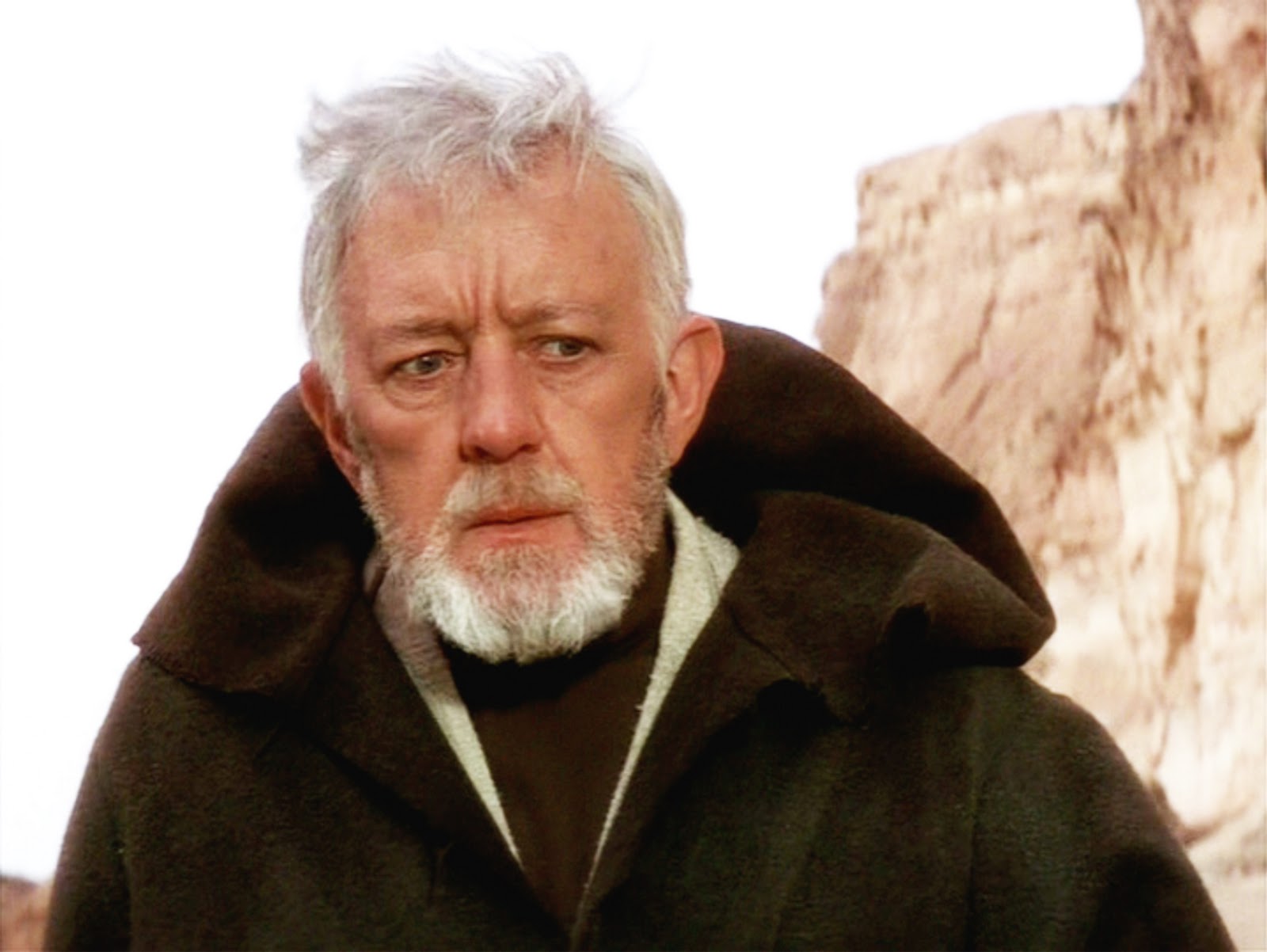
"That's a name I've not heard in a long time..." Some thoughts on the Obi Wan Movie


Image result for obi wan

I find it a little odd how many Star Wars films we've gotten that take place before the original trilogy- the prequel trilogy, last year's Rogue One, and next year's Han Solo film. The original Star Wars doesn't feel to me like part four of an ongoing saga, even though it begins in the middle of a chase sequence. While the film establishes a larger mythology and backstory the film stands on its own.  This isn't to say I don't appreciate expanding the mythology- the mythology is I love most about Star Wars, even though I have issues with how the prequels dealt with certain events. I liked that Rogue One gave a reason for the Death Star's design flaw. This was an example of ret-conning I felt actually improved the original film's story. 

It was recently announced we will be getting an anthology film centred around Obi Wan Kenobi, with Oscar nominated filmmaker Stephen Daldry in talks to direct. It hasn't been revealed what will be the film's story but Lucasfilm and Disney are somewhat limited with what they can do with Obi Wan. The film can't really be an origin story since the prequel trilogy- even though its main focus was Anakin Skywalker's turn to the dark side and his transformation in to Darth Vader-  was about Obi Wan's relationship with Anakin and his journey from apprentice to Jedi Master. In The Phantom Menace we're introduced to Obi Wan as a padawan learner; he meets 9 year old Anakin, loses his master Qui-Gon Jinn at the hands of Sith Lord Darth Maul and kills Maul, becoming a Jedi Knight and taking on Anakin as an apprentice. In the subsequent prequels Obi Wan becomes a Jedi Master and a general in the Clone Wars. Ultimately Obi Wan and Anakin duel, leading to Anakin becoming horrifically burned  and being placed in the iconic Darth Vader suit. The prequel trilogy even ends with Obi Wan walking off in to the Tatooine desert, book-ending the trilogy, as he was in the first scene of the trilogy. 

The only other way to do an Obi Wan origin is to go back pre-The Phantom Menace, with Obi Wan as a teen. For me there's not really a story there; Obi Wan's story begins with The Phantom Menace and ends with him reunited in death with his friends at the end of Return of the Jedi. The Clone Wars have already been covered pretty much by the animated series. To me- and I always presumed this would be the case- the story of the Obi Wan film would be his time on Tatooine looking over Luke Skywalker and living as a hermit. I know some people will wonder how you could make a movie out of that time period. I envision it as western/samurai film, with Obi-Wan helping people- going by the name "Ben" of course. George Lucas was heavily inspired by the films of Akira Kurosawa so I think it's appropriate to return to those works for inspiration- think Yojimbo and Sanjuro. 

Image result for obi wan revenge of the sith

The film would largely be a character study, exploring the psychology of a man who's lost everything. The Republic he fought for has become an authoritarian Empire, the Clones who fought alongside him betrayed him and the other Jedi Knights, his friend and brother has become an agent of evil, for which he's partly responsible, and the Lars family- who are raising Luke- don't want a thing to do with him. It's a pretty bleak story, even though, as with the other prequel films, we know there will eventually be hope. The fact that the filmmakers behind Rogue One were allowed to kill off the entire principal cast gives me hope we could get a film that shows Obi Wan in a really dark place. 

Of course, Ewan McGregor would return. McGregor has expressed interest in the past regarding a possible solo film. For people who grew up with the prequels there would be a definite nostalgic reaction to McGregor's return. And even though I have my issues with the prequels I do like McGregor's performance- particularly his final moments with Anakin. Joel Edgerton- who played Luke's Uncle Owen Lars in the prequels could also return. I'd like to see the conflict between Owen and Obi Wan. Owen would blame Obi Wan for Anakin's turn to the dark side and wouldn't want leading Luke down the path of becoming a Jedi. 
Image result for joel edgerton star wars


I do hope we eventually move past the original trilogy's characters and events but I hold that there's real potential for a compelling and beautiful drama about Obi Wan during his life on Tatooine, a film that isn't merely another franchise movie.

Wednesday, 31 October 2012

Six Possible Directors For "Star Wars: Episode VII"


Yesterday, it was announced that Disney had bought Lucasfilm, thus ow ning the rights to Star Wars and planning to release a new Star Wars film in 2015. With Star Wars: Episode VII in the works, and with George Lucas being a creative consultant on the film, one of big questions that looms heavy is who will take the director's chair. Most of the Star Wars films have been directed by Lucas, but with The Empire Strikes Back, directed by Irvin Kershner, usually considered the best of the Star Wars films, a different director is just what the Star Wars series needs to create something fresh and exciting. Here are some directors who could be a good fit to take us back to that galaxy far far away

1. Duncan Jones
 
With Moon and Source Code, Jones provided audiences with two of the smartest and intricate sci-fi films of recent memory-as well as providing both with a strong emotional core to go along with the mind bending twists. With an even larger canvas to paint on, Jones could create his first real epic science-fiction film, as well as possibly providing some twists to the narrative that made his first two films fascinating to watch. Jones is also very good with creating characters that we sympathize with, due to the fact they're often confused about the situations they are in. One of the problems of the prequel trilogy was how unnatural a lot of the dialogue and performances were. Jones directed one of Sam Rockwell's best performances in Moon, and also did fine work with Jake Gyllenhall in Source Code. Jones would likely get strong performances from his actors that would make us care about them as well as believe they exist as human beings, just in another galaxy.

2. Rian Johnson
 
Like Jones, Johnson created a smart and intricate, thematically and plotwise, sci fi film with this year's Looper. And like Jones-he's mostly worked with a lower budget, creating smaller scale films that play around with genre conventions like Brick and The Brothers Bloom. With Star Wars, he'd be working on the largest scale imaginable. With Brick, he handled the film noir inspired dialogue very well, and if there's any Han Solo or gangster like characters, Johnson could have fun infusing it with that same type of sharp and funny dialogue. Looper also effectively dealt with the criminal underworld, so it'd be exciting to see what Johnson would do with the underbelly of the Star Wars univers And of course, if Johnson did end up directing the film, it's likely he'd find a part for friend and frequent collaborator Joseph Gordon-Levitt- and who wouldn't want to see Levitt as a Jedi knight or a Han Solo-inspired smuggler?

3. Alfonso Cuaron


 Cuaron made what I consider the best of the Harry Potter films, Harry Potter and The Prisoner of Azkaban. What was great about Cuaron coming in for the third film of the Harry Potter series was that he brought a real personal touch to the series, providing a lot of visual invention that complimented J.K. Rowling's already complete creation. He also directed the bleak and gritty Children of Men, proving that he can also handle science fiction as well, albeit a more understated type of science fiction. Cuaron is also directing another sci fi film, Gravity, starring Sandra Bullock and George Clooney as astronauts stranded in space, so he'll have plenty of experience with the genre by the time the new Star Wars goes in to production. His Harry Potter film had a great blend of darkness with a touch of whimsy and magic, and with Children of Men, he combined grittiness and intense action. The Star Wars series has featured all these qualities, and if there's a Luke Skywalker-esque coming of age story, his work on Harry Potter and Y Tu Mama Tambien, is also a benefit to the film.

4. Brad Bird


With Mission Impossible: Ghost Protocol, Bird made a surprisingly inventive, visually spectacular and quite fun film, which was quite a feat considering it was the fourth film in the franchise, as well as Bird's first live action film. Bird is best known for his animated films, The Iron Giant, as well as the two films he helmed for Pixar, The Incredibles and Ratatouille. Since Bird was able to inject some new lifeforce in to the Mission Impossible franchise, he could do the same for what will be the seventh Star Wars film, eight if you count Star Wars: The Clone Wars. Bird has worked for Pixar, so he already has a connection with Disney. It wouldn't be too much of a surprise if execs at Disney were already considering him. Star Wars is great for combining intense action with a lightness of touch and a certain charm, which helped make The Incredibles and Ghost Protocol so entertaining. Both films also emphasized the idea of teamwork, with The Incredibles being all about a family work together and growing closer as a result. What was great about the original Star Wars trilogy was it featured characters who couldn't be any more different from each other, a farmboy, a princess, a space pirate and his furry companion, and two droids, working through their differences to save the galaxy and becoming a family. If the new Star Wars films feature this same kind of dynamic, Bird could make it both very entertaining as well as emotionally resonant.

5. Edgar Wright


Wright, as evident in his last film, Scott Pilgrim Vs. The World, is a strong and inventive visual stylist and nearly every frame of that film was filled with energy. And with Shaun of Dead and Hot Fuzz, he gets what makes genre films great while at the same time poking fun at them. If Wright did direct a Star Wars film, it'd be great to see him self-consciously both reference and poke fun at some of the previous films, without going too far in to parody. He was able to handle a large cast of characters in Scott Pilgrim, which will be an advantage if the new Star Wars deals with a lot of diverse characters. His handling of the relationships between Simon Pegg and Nick Frost in Shaun of the Dead and Hot Fuzz also gave those films a lot of heart, and the original Star Wars films, particulalry The Empire Strikes Back, benefited from the strong relationships between the characters. And the idea of Simon Pegg and Nick Frost appearing in a Star Wars film is very funny. The only problem is Wright will be probably be too buy with Ant-Man, unless Star Wars gets pushed back, which is a possibility, then Wright could be free to do it.

And an even bigger longshot....

6. Joss Whedon


Every one would just nerdgasm if this happened. Since Disney also owns Marvel, like Bird, Whedon already has a relationship with Disney, if you can cal it that. Unless Star Wars is delayed, he won't be directing the first of the new Star Wars films, what with him directing the next Avengers film. Still, with The Avengers, Whedon showed that he could handle big scale action while still incorporating a personal style that really felt like it understood and was passionate about the material. Whedon also knows how to work team dynamics, as in Buffy the Vampire Slayer and The Avengers. As I mentioned earlier, if the new Star Wars has the same team dynamic as the original trilogy, someone like Bird or Whedon could make it work.