Showing posts with label Retrospective. Show all posts

Thursday, 21 August 2025

Why Do We Fall?: 20 Years of Batman Begins


Spoilers below

The Batman film franchise, barring the 1940s serials and the 1966 Adam West movie based on the  TV series, began with Tim Burton's 1989 Batman, released a little over a decade after the original Christopher Reeve Superman opened the doors for all future superhero adaptations. The Burton films were attempt to present a darker, more gothic vision of the dark knight, akin to Frank Miller's Year One and The Dark Knight Returns than the West show. When Batman Returns, the follow-up to Burton's original, where he had more creative control, was met with outcries from parents for being too dark and violent, as well as MacDonald's cutting its Happy Meal deal with Warner Bros. for the same reasons, the studio decided to go in a more kid friendly direction, hiring Joel Schumacher to direct the third installment, Batman Forever. The film was a success and Schumacher was tasked with directing the follow-up, Batman & Robin. To quote George Lucas watching the rough cut of Phantom Menace's climax, Schumacher may have gone a little too far in some places. Schumacher dialed up the camp, and supposedly would say "Remember, it's a cartoon" before yelling action. Ironically, there was a really good Batman cartoon in the 90s that appealed to kids while still being mature and character driven. 

While Schumacher was originally slated to direct a third film, Batman Triumphant, which may have starred Nicolas Cage as the Scarecrow and Madonna as Harley Quinn (except retconned in to being the Joker's daughter), it never came to fruition. Appropriately for a film starring Mr. Freeze, Batman & Robin put the franchise on ice for several years. It wouldn't be until 2005 that we saw the caped crusader again, except this time it wouldn't just be another film in a franchise, but a film that reinvented the whole idea of the Batman franchise, creating something more psychological and character-driven that had been done in the live action films. This was Christopher Nolan's Batman Begins.. At this point in his career Nolan wasn't yet the blockbuster auteur he would become with The Dark Knight and Inception. He was still very much the indie filmmaker making his first blockbuster. The film feels modest compared to the second and third and film in the trilogy but it also feels the most like a stright forward Batman film. 

Burton's approach to Batman was enigmatic and mysterious, while Nolan and Goyer's is internal and personal. Batman Forever tried to be a little more character driven, most of Val Kilmer's arc as Bruce was exorcised in that film. To be fair, those previous 4 films were more interested in the villains than Batman. And I get why- they're often more colorful and entertaining than him. But I appreciate Nolan and Goyer zeroing in on Bruce and Batman essentially giving us the full of arc of Bruce becoming Batman. To get us more in to Bruce's head, Goyer's script employs a flashback structure, beginning with this nightmare Bruce is having of the time when he was a child and fell in to a pit of bats. We then jump to Bruce waking up in prison. In the years since his parents were murdered during a mugging, Bruce has traveled the world learning the ways of criminals, but has completely lost himself in that life. But then a man named Henri Ducard (Liam Neeson) gives him a chance to train under Ra's Al Ghul (Ken Watanabe) and become part of the League of Shadows. As he trains with Ducard we get more flashbacks of Bruce's life before leaving Gotham, including the moment where he about to kill Joe Chill, his parents' murderer, before he is murdered for being a informer by one of mobster's Carmine Falcone's (Tom Wilkinson) cronies. After being given a stern lecture on justice vs. revenge by childhood friend, now lawyer, Rachel Dawes (Katie Holmes), he begins his journey in to the criminal underworld.

Nolan and Goyer don't just use the murder of Bruce's parents as a set up for a completely sepearate story but use is as the film's thematic crux. Joe Chill only existed because of the economic depression, leading to financial desperation in men like him. While the murder of the wealthy Waynes supposedly urged Gotham to pull itself out of this depression Rachel points out that things haven't really gotten better. Gotham is full of corruption and is run by Falcone. And essentially this corruption and decadence fuels Ghul's motivation to destroy Gotham.

Nolan and Goyer trust the audience to wait awhile for Bruce to don the cowl. They knew they had to make Bruce a compelling enough figure our of the suit that audiences wouldn't be impatient getting to  Batman stuff. I think the reason why this approach ended up working for audiences is due to Nolan and Goyer approaching this material with a certain kind of seriousness and earnestness. From very beginning the film plays out as a straight drama rather than a comic-book movie, though I feel of the trilogy this one feels the most a straight-up Batman movie. Ultimately, the film encourages the audience to engage with the narrative on a character and thematic level rather than just pure entertainment. I do hate when people say Nolan was embarrassed to be doing a comic-book movie since I feel it's the opposite. Nolan obviously thought there was something more to this material then silly pulpiness. He saw something mythic and compelling this character. He of course had to strip down some of the fantasy in order to do the story he wanted, but I like when these films have a specific vision. And to be fair, this is still a pretty pulpy movie and it has a sense of humour about itself.

Maybe the film's wisest decisions, is forgoing the Joker as the antagonist. Structurally, it just ended up working better for the overarching story of the trilogy. In this one Batman brings hope back to Gotham City and by the beginning of The Dark Knight is very confident in his abilities, and even underestimates the Joker, as does the mob. only for the Joker to completely destroy his whole world. This film's ending is so satisfying, having Lieutenant Gordon (Gary Oldman) giving Batman the Joker's calling card. It's the best sequel set-up of any superhero film, largely because it wasn't designed to be a set-up, but a payoff of the whole story.  

In typical Nolan fashion, he uses the concept of fear both as a plot device and as a larger thematic concept. Ducard (who is revealed to have been the actual Ghul in the third act) wants to use Dr. Jonathan Crane/Scarecrow's (Cillian Murphy) fear toxin against Gotham so it it will tear itself apart. Bruce uses fear (the symbol of the Batman) to invoke a positive change. And Bruce initially blames his fear of bats (he had to leave the opera due to the people in bat costumes) for his parents' death. 

 While I usually really like Neeson, I do find the character, and his performance, a little bit on smug side. It's a big part of why I have a love/hate relationship with this film. I do like that this movie focuses in more on Batman than any of the previous live action films and feels the most like a Batman of Nolan's trilogy, especially in the aesthetic of Gotham. I do wish Nolan was a stronger visual stylist and that his shooting style wasn't always so basic. There's also some janky editing going on in the fight scenes, and the third act just isn't as strong as the first two. Rachel also feels likes she's just there to tell Bruce what he needs to hear, rather than being a fully formed character, though Nolan has often been a stronger idea and conceptual guy and his characters can often feel like mouthpieces for exposition. However, his Dark Knight Trilogy does have some really good character stuff and oddly feels like his most character driven work.

He's not unlike George Lucas, who also struggles with dialogue and character. Lucas' strengths, like Nolan, are in the bigger picture stuff.  But Lucas and Nolan's flaws as directors don't really matter to most people because their films, often seen by people when they're younger, have such a impact on viewers and define a young person's upbringing as a cinephile. 

Superhero movies often get seen as right wing power fantasies, though someone like Stan Lee was always very progressive in his politics. Batman, in particular, gets reduced, maybe fairly or unfairly, to the rich guy who beats up poor people. Nolan also got blowback when The Dark Knight came out when Batman chose to spy on people via cell phone to find the Joker, viewing this as pro Bush and Patriot Act. And in the third film, Tom Hardy's Bane was seen as a criticism of Occupy Wall Street. The Dark Knight does prevent the surveillance stuff as pretty morally dubious and Bane doesn't really represent the ideals of Occupy Wall Street but rather uses the ideology to turn Gotham against itself. Still, Nolan does try to have it both ways with the surveillance technology, presenting it as necessary one time thing before it's destroyed. The ending of The Dark Knight also prevents lying about Harvey Dent's crimes as a necessary evil to keep order. And The Dark Knight Rises does present the ideology of Occupy Wall Street as useful weapon to turn classes against each other. Nolan's politics are thorny but I'd argue it makes the films more interesting, especially compared to the more overt thematic exposition that has probably hurts these films the most on rewatch. 

The key to casting Batman and Bruce Wayne is you don't go for the traditional leading man like George Clooney. You go for someone like Michael Keaton or Val Kilmer. You need some who you can believe dresses up as bat and fights crime. Christian Bale may have gotten himself the role by playing another rich, crazy guy with Patrick Bateman in American Psycho. I think Bale often gets overshadowed in these movies by the more colorful performances but he's good in this initial go around. Bale can sometimes be too actorly and heavy as an actor, but here he doesn't overplay the seriousness but lets it come naturally. He finds the reality in essentially an outlandish character.

While I feel The Dark Knight and The Dark Knight Rises are stronger films formally, I understand why Batman Begins is often seen as the best of the trilogy and many peoples' favourite. It's thematically the tightest and feels the most comfortable being a superhero film. I always wonder the series would've been like if  Nolan had continued on with this aesthetic. So, what are your feelings about Batman Begins? Is this your favourite? Comment and let me know.


Friday, 30 May 2025

Sith Happens: 20 Years of "Revenge of the Sith"


It's interesting how the reception of the Star Wars prequels, particularly the first has so dramatically changed over the 26 years since The Phantom Menace came out in 1999. There was plenty of vitriol and disappointment from fans when the film was released, and Attack of the Clones wasn't beloved either. Revenge of the Sith- released 20 years ago this past month- was the most critically well received, and I think fans were more responsive. But overall these well liked movies. Red Letter Media became famous for their "Mir Plinkett" reviews and I think fans who liked them were in a minority.

But over time, with people my age or younger who saw the prequels when they younger, and gained a presence online, the prequels have gone through a resurgence. It's not unsurprising. There's something incredibly nostalgic about this franchise, a certain magic that makes it different from anything in film history. And it feels like we're in a era where everything not immediately beloved is almost reclaimed automatically. Prequel fans say the sequel trilogy will never be reevaluated but never say never, right.

But as the prequels have become more praised, with many claiming they're masterpieces of cinema, I've gone in the opposite direction, becoming critical and negative towards them, though I don't consider them irredeemably bad. They are intriguing contradictions-grand scale achievements that revolutionized filmmaking, but not really great films on a directing, acting, or screenwriting level. George Lucas's greatest gift as a filmmaker is his unique imagination but I think he struggles with, and maybe is a little bit bored, with the more intimate and human parts of storytelling. Lucas set out to create a Shakespearian/Greek tragedy with back drop concerning the fall of democracy, but he also wanted to revolutionize and experiment with new special effects. He ended up getting lost in the technology and not taking enough time to finetune the story and character beats and overall dramatic and political arc of the story. 

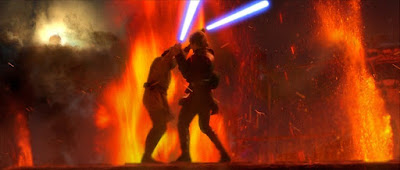
But I understand why for my generation Revenge of the Sith is the Star Wars film. I get it. I can see why at 10 or 12 years of age it blew a lot of peoples' mind in the same way the original films did for the previous generation. The opening action sequence, the lightsaber duels, as well as Obi Wan fighting General Grievous, are really spectacular stuff. Revenge of the Sith is the best of the prequels even though the execution of its stories and themes is still uneven. It has the most dynamic pacing and the strongest overall dramatic arc. In the previous two prequels Lucas was too leisurely in his pacing. In The Phantom Menace in particular we spend an entire act before even getting to Anakin Skywalker. And even then it's not really his story. In Attack of The Clones we get more focus on Anakin and an actual internal struggle, something lacking in Phantom Menace, but in Revenge of the Sith, there's more urgency, and it feels like an actual movie.

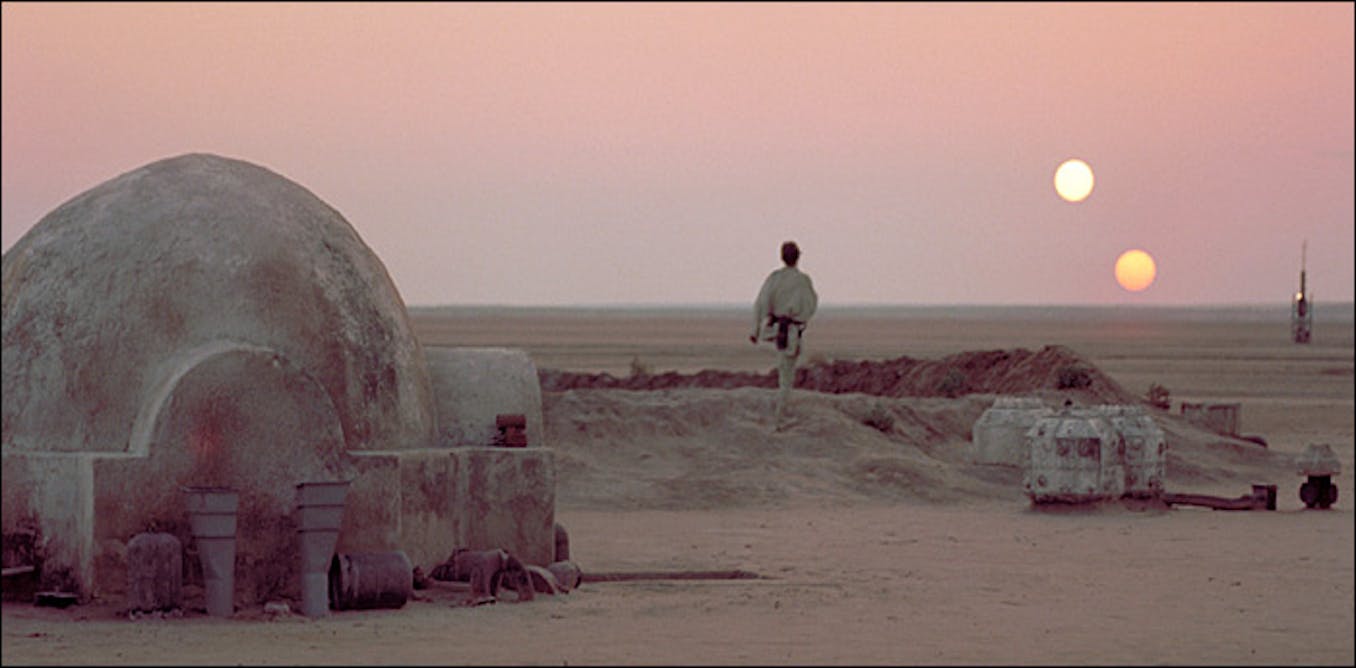
At the time Revenge of the Sith was supposed to be the final Star Wars film, bringing the saga full circle back to those twin suns on Tatooine, and a lot was riding on it. As I mentioned, many were disappointed with Phantom Menace and Attack of the Clones and Lucas had to stick the landing on this one. The critical reception was much better this time, with former New York Times critic A.O. Scott calling it better than the original Star Wars, even though he said it made his inner child shudder. And in 2012, critic Camille Paglia called Revenge of the Sith was the greatest work of art of the last 30 years 

Revenge of the Sith is the most streamlined of the prequels but that turns out to be a double edged sword. As I said earlier, Revenge of the Sith feels more urgent compared the first two prequels and has more forward momentum but at the same time it feels almost too compact and rushed. I think the problem, again, lies in Lucas being too leisurely in those first 2 prequels, with Phantom Menace not really being Anakin's story. While most of the necessary pieces are there in the previous films- leaving his mother, not being accepted by the Jedi, the death of his mother, and his love for Padme (Natalie Portman)- something still feels lacking in the development of his arc. For one, Anakin and Padme's lovey story wasn't organically told. However, you can feel Anakin's desperation in wanting to save Padme when he begins having visions of her dying from childbirth. Anakin had visions of his mother dying and wasn't able to save her in time, so it makes he's so determined to prevent this from happening again.

 We also needed see more of Anakin coming to believe the Jedi were corrupt and a genuine threat, turning so violently against them. It's an interesting angle Lucas takes that Palpatine (Ian McDermid) is kind of right about the Jedi. I do sometimes find it hard to know how to take the Jedi in these films, since we don't really get to know them. The Order 66 montage is superb and, again, it makes this film feel more dramatically immediate, but are the Jedi tragic or are they the cause of their own destruction. I guess it's supposed to be both. If we had seen more of Anakin's friendship with the other Jedi, this sequence probably hits even harder. When Anakin tells Obi Wan (Ewan McGregor) that he should've know the Jedi were taking over and from his point of view the Jedi are evil, it doesn't feel completely earned. I guess the point is Anakin isn't thinking straight and is trying to convince himself that what's he doing is right. Still, when  he says he's brough peace and justice to his new Empire, it doesn't really fit with the motivation of trying to save Padme. There is that red flag scene in Attack of the Clones where Anakin talks about the merits of fascism but it's only briefed touched upon and laughed off.


Revenge of the Sith opens pretty well, the strongest of all the prequels' beginning. I like that we see more of the Anakin/Obi Wan friendship then previously, and Anakin feels more like the mature and skilled Jedi that we heard about in the original film. Christensen's acting has gotten a lot of flak over the years but the way Anakin was conceived and written by Lucas, Christensen's acting is kind of fitting. I do wish we had seen more of the Clone Wars in these films instead of just getting the beginning and the end, and it's another reason why Phantom Menace feels kind of disconnected from the second and third films, with it being more of a set up for a duology rather than part one of a trilogy. The Clone Wars maybe should've been ongoing through the trilogy and we could've seen how it devastated the galaxy, establishing that it was so destructive that people wanted to prevent that ever happening again, which is why Palpatine restructuring the republic in to an Empire and killing off the Jedi is so embraced. For such grand-scaled films we don't see how the politicians actually operate, or how they feel and the wider galaxy feels . It is strange that Lucas doesn't use the death of Anakin's mother, Shmi, as more a catalyst for why he turns against the Jedi, since it is largely their fault for keeping Anakin away from, when he could've saved her if he had gotten to Tatooine. The films don't do enough with the whole "Jedi don't anything about slavery" angle, and how that relates to Anakin, who as a child wanted to save the slaves on Tatooine. The irony obviously is that as Vader he helps oppress the whole galaxy.  

Lucas himself compares himself to Vader, saying he became the very thing he fought against. In Anakin's case it was the Sith, in Lucas' case it was the Hollywood studio systems and corporations. Lucas then became a corporate businessman and the conflict between being an artistically pure filmmaker while also making films that could sell toys is deeply felt in the prequels, as well as Return of the Jedi.

I do give Lucas credit for being ahead of the curve with the whole fall of democracy thing. "So this is how liberty dies, with thunderous applause," spoken by Padme, feels pretty relevant in today's world.  Lucas obviously wanted to parallel real world politics and events, showing realistically in a fantasy setting how a democracy becomes a dictatorship. As much as Star Wars was an escapist fantasy, Lucas always had political messages and allegories he was delivering, basing Palpatine on Nixon, and the Empire on the US. The rebellion is the Vietcong, with the Ewoks being the less technologically advanced society that overtakes a massive war machine. And when Anakin tells Obi Wan "You're either with me or you're my enemy," people have always seen that as a clear allusion to George W. Bush. Lucas always talks how these movies "rhyme," and I'll add that  history repeats itself, which keeps these films very relevant. Palpatine and the Empire can be whatever dictatorship or colonial power you want them to be, they're not  locked in to the 70s. And of course the sequel trilogy is all about having to continuingly fight the same battles. 

Lucas also wanted to show even an innocent child who's good at heart become a fascist monster.. I mean how many people started decent before they became monsters? The first time we Anakin is him asking Padme if she's an angel, the last time is this man stuck in a machine looking over a planet destroying weapon. It's quite an arc.  When Anakin and Obi Wan part before Anakin goes down the dark path, Obi Wan reminds us he has trained Anakin since he was a boy. It's a wonderful moment that makes Obi Wan's final speech to Anakin even more tragic. McGregor really sells the love Obi Wan had for Anakin, probably better than the movies have.  

The film's best scene is arguably where Palpatine tells Anakin the story of "Darth Plageuis the Wise." I don't know if Lucas had someone to punch up the dialogue in this scene but it's really well crafted in showing Palpatine beginning to plant the seeds of distrust in Anakin's mind regarding to the Jedi. We see that Anakin does admire what it means to be a Jedi, even though he has a difficult relationship with the council. I love when Palpatine says "They made you do something that made you feel dishonest," in relation to Anakin being made to spy on him. So warm, so understanding. It's easy to see why Anakin viewed him as someone he could talk to. Did Palpatine have some genuine fatherly warmth for Anakin? Maybe so. McDermid is so good in this film because he knows exactly how to pitch his performance, from seductive and warm to hammy. While actors have struggled under Lucas' direction, McDermid knows what kind of movie he is. 

Another great passage in the film is Anakin and Padme looking across the Coruscant skyline from two different locations, edited to look like they're looking at each other. When Lucas lets the images and John Williams' music do their thing he's at his best. I think Lucas definitely struggles a bit with character arcs and A to B plotting. To be fair Lucas never wanted to be a conventional narrative filmmaker, wanting to do experimental films and documentaries, which is why I think he grapples with character scenes arcs and plotting. His first film, THX-1138, based on his short film, is more abstract and mood driven then plot driven. And American Graffiti is very loose in its and structure and has pretty basic characters. The original Star Wars was probably the most plot driven thing he had done at that point. But even that film is very stripped in terms of plot and character.   


While the montage with Anakin and Padme is splendid. Lucas lets down Portman as an actress and Padme as a character. A big part of that is cutting out her scenes where she's forming the rebel alliance with Mon Mothma and Bail Organa. It feels like she has less screen time then in the previous 2 films and just isn't as proactive. She was essentially the hero of Phantom Menace and she was the one who wanted to go help Obi Wan in Attack of the Clones. For being so important to Anakin's turn, she mostly just sits at home in this film. And I while I get that dying from grief is a real thing, I don't think Lucas really sells just how much trauma she's been though

While Lucas is perhaps the most influential filmmaker of the last 50 years, I feel his fellow fillmakers and friends who came up in that era, Steven Spielberg, Martin Scorsese, Francis Ford Coppola, and Brian De Palma are better filmmakers overall. It's hard not to wonder what Lucas would have done if Star Wars hadn't taken over the world and had been more of a modest success. I know directing the film was such a grueling ideal that he didn't direct Empire Strikes Back or Return of the Jedi, but again I'm interested in what he would've directed and what his legacy would be. Creating something as game changing as Star Wars is a mighty weight to hold on your shoulders. I think even Lucas views it as a curse sometimes, despite it giving him a permanent place in film history. 

I feel fans have a hard time criticizing Lucas, using the argument that he made the films he wanted to make the way he wanted to make. My problem is this basically negates any criticism of any film, or any piece of art. The artist made it intentionally that way so it's beyond criticism. I get it, Lucas made Star Wars and many fans have such warm feelings towards Lucas that they have difficulty seeing him as anything less than a God. I mean, Lucas is second to none when it comes to creating a whole cinematic universe on screen, more so than something like Marvel, but I feel post Empire Strikes Back, the films start to become more uneven, including Return of the Jedi, even though there's plenty of stuff I like about that film.

I also feel Lucas probably relied a little too much on CGI for the second and third films. I know people will make the argument that more practical effects and sets were used for these films than the originals but it's hard not feel you're often drowning in a computer generated world, especially when you cut to Ewan McGregor walking in a real environment on the set of the Tantive IV. Now, there is some great us of CGI in this film, particularly that shot of the twin suns at the end. And there's Coruscant in general, maybe my favourite planet in the series, and a great representation of what the Republic used to be, as well as a contrast to where Anakin grew up. 

For better or for worse, Revenge of the Sith was the end of an era, the next time we would see Star Wars on screen would be without his involvement. And regardless of how good you think the newer films, one can tell that these are films made without the original creator, films and tv shows that are riffing on what came before. I think Rian Johnson's The Last Jedi is the most ambitious and narratively and thematically curious of the new trilogy, the one closest to having more a directorial vision. I'll probably have to write about that one one day. So, how do you feel Revenge of the Sith on its 20th anniversary. Comment and let me know. 

Monday, 12 September 2022

The Essential Films: "Jaws" (1975)


A Series of Writings on Films that I feel are essential for film lovers, coupled with films that are personal to me. Spoilers for people who haven't seen the film.

Jaws is a masterclass in filmmaking. It ranks amongst films like Die Hard, The Exorcist, and the original Star Wars, as one of those films which started out as popular entertainment but can be seen as a masterpiece of its genre. This was only Spielberg's third film; he had done the TV movie Duel and then his first theatrically released feature, The Sugarland Express-starring Goldie Hawn. Duel and The Sugarland Express are impressive films bur Jaws was a huge step forward for Spielberg in terms of his filmmaking abilities. While the film was a difficult- to say the least- shoot, Spielberg's filmmaking is so assured that when I'm watching it I'm hardly thinking of the behind the scene issues. Of course, credit has to go to Bill Butler's gorgeous and warm cinematography (he still with us at 101 years old) as well as Verna Fields' Oscar winning editing, which contributes mightily to the film's fluid pacing.  Spielberg took that assuredness in to his next film Close Encounters of the Third Kind and later Raiders of the Lost Ark, becoming the king of blockbuster movie making. Much like Jaws itself, Spielberg has grown in my estimation as a filmmaker over the last several films. I always liked/loved his films but I guess I took him for granted, didn't realize just how good he is. Now I rank him in my top ten filmmakers.

All you need to do is watch the first scene of Jaws, where Chrissie Watkins (Susan Backlinie) is screaming for life before disappearing under water and everything going silent, to know the film still kills. There's a reason this movie still makes people afraid to go in the water. John Williams' theme- which opens the movie, was originally thought by Spielberg to be a joke, and I get why. It's hard not to find it a little amusing, but like Bernard Herrmann's screeching violins from Psycho are synonymous with "psycho killer," Williams "Duh Duh" is inseparable from "a shark is coming to get you."

After the first shark attack we're introduced to the first of the film's main trio, Chief Martin Brody (Roy Scheider) who has moved to Amity Island recently with his family.  I think he's an underrated actor, good at being the lead or supporting player. He was never the intense Pacino/DeNiro kind of actor but he had a physical presence and the ability to be a regular guy, which works well for Brody, who isn't a tough action hero type. 

Brody begins the investigation in to Chrissy's death and has the beaches shut down. However, the Mayor of the town, Larry Vaughn (Murray Hamilton), convinces him to keep them open due to the summer season being the biggest money-earner of the year for the community. Brody reluctantly agrees but then a boy, Alex Kitner (Jeffrey Voorhees), gets eaten and Brody brings in Oceanographer Matt Hooper (Richard Dreyfuss) to investigate. Meanwhile Alex's mother (Lee Fierro) puts out ads promising a reward for killing the shark, bringing in a lot of amateur shark hunters. The only professional on the island, Quint (Robert Shaw), promises to kill the shark for a much larger reward. While at first the shark is thought to be caught, another shark attack brings Brody, Hooper and Quint together to hunt the shark.

Jaws is actually two films in one. The first film is a damning critique of capitalism and political leadership, the second is an almost Moby Dick-esque adventure at sea, with Quint being a kind of Captain Ahab. I know some may find the film too slow and talky getting to the shark-hunting stuff but I believe it's crucial to this movie's success that we spend the time we do on the island and with the community before going off to sea. The transition from island to sea feels more significant and weighty because of what's happened- Alex's death, Brody's guilt, his dynamic with Hooper and the injection of Quint in to that dynamic. Then there's the three shark attacks. The first one is ignored, the second is addressed and supposedly resolved, then the third is the breaking point where we see some humanity from the Vaughn, who mentions his kids were on that beach. We don't like Vaughn anymore than we did before, but Hamilton plays his revelation beautifully. The way Carl Gottlieb and Peter Benchley (who wrote the novel) structure the three shark attacks and Vaughn's arc is the kind of good screenwriting that seems too rare these days.

I do love the subtle bromance between Brody and Hooper.  Instead of the screenplay creating a forced antagonism between them Brody and Hooper are friendly with each other from the outset. However, Hooper gets angry with Brody when he's examining Chrissy and  finds out this was never reported to the coast guard. Brody is a little naive and thinks the captured and killed shark is the shark who who Chrissy and Alex. Hooper calls him out on his naivete but when he comes to Brody's house that night, he shows that he respects Brody's rationality compared to everyone else. He also knows Brody had a rough day after Mrs. Kitner slapped because she found out he didn't close the beaches earlier. Hooper tells Brody he's out to tell his superiors that there's still a shark problem, leading him and Brody to cut open the dead shark to see what it's ate. The dinner scene is the real beginning of Brody and Hooper's partnership. When they're both trying to convince Vaughn to close the beach and talking over each other, Brody is  telling Hooper to tell the mayor about shark stuff, and it's organically funny, indicative of Brody's earnestness as a man. He obviously respects and is excited by Hooper's knowledge and authority.   

The more I've watched Jaws the more apparent it's become how the characters really make the movie. Not just our main trio but all the islanders as well- Vaughn, Bad Hat Harry, Mrs Taft. Similar to Raiders of the Lost Ark or the original Star Wars trilogy, you remember these supporting and minor characters, and they make the world feel lived in. I'd argue the best scene in the film doesn't feature the shark- it's is the scene where Hooper and Quint are bonding over scars, which leads in to one of the great film monologues - Quint talking about the sinking of the USS Annapolis and the death of most the crew from sharks. Shaw's delivery of the monologue and the vivid imagery it creates in the audiences' minds is perhaps more horrifying than anything we see on screen. It tells us so much about Quint and makes his death even more cruelly ironic- it's one of the most painful deaths I've ever seen in a film. Shaw should've gotten an Oscar nomination just for this monologue. 

I also love how each of the three men relate to the other two. Hooper is the nerdy scientist compared to the more masculine cop and hunter. Brody is the one most uncomfortable at sea next to Hooper and Quint, and Quint is the loner figure, the outsider. It creates an uneasy dynamic between the three and the point of the bonding/monologue is that this is first and last time all three will be at peace with each other. It's right before the final stretch of the film, which doesn't let up until that shark is blown up. 

I saw Jaws on IMAX just a few days ago and seeing it with a audience highlights just what a funny film this is, largely due to Dreyfuss, whose laugh alone is hilarious. I think this where Dreyfuss first established his persona as the intellectual smart-aleck. Some of his best lines- "They're all going to die"- after he's been mocked by the fishermen going out to hunt the shark-, referring to the mayor as wanting to be a "hot lunch," and "That makes a lot of sense" when water-fearing Brody says Amityville is only an island if you look at it from the water.   

But it's not that big of a surprise that the film has plenty of humour. It wouldn't have become what many consider the first summer blockbuster if it was without the levity to contrast with the horror. It's an incredibly entertaining film but the fun never undermines the horror of the film, never makes those moments of terror less impactful. While Spielberg went too far with the darkness with Indiana and the Temple of Doom, Jaws perhaps best shows Spielberg managing both the light and dark. Spielberg has often gotten flak for being too sentimental but I feel he's much darker than the image people have. He's capable of  being incredibly nasty and remorseless when he wants to. I don't think anyone forgets seeing those Nazis' faces being burnt off for the first time. 

Spielberg is also able to do some technically impressive stuff without you really thinking about it. The Aforementioned scene with Brody and Hooper attempting to the convince Vaughn to close the beaches is one shot, with Spielberg moving the actors and reframing the shot effortlessly. The first scene between Brody and Vaughn is similarly one shot that has the actors move in a way that changes the focus of the show.. But you're not thinking of these scenes too much on a technical level, you're just watching the story. Spielberg is able to use his technique to draw you in to a scene without noticing the technique -very hard to do. But then he can also emphasize his shots, as with the "vertigo" shot on Brody on the beach. He employs  it better than Hitchcock and there's no doubt Spielberg is a student of Hitchcock. Hitchcock always believed in the concept of "pure cinema," where the visuals did most of the storytelling, and Spielberg takes that approach here, making sure you can understand what's happening, even if the sound was off. 

In a piece on Spielberg's War Horse (2011), critic Michael Phillips recounts Hitchcock's quote on Spielberg: "Young Spielberg is the first one us who doesn't see the proscenium arch." Phillips explains that Hitchcock is describing Spielberg's filmmaking as "fluidity cinematic," adding he has "Old style craftsmanship with a new spontaneity." Hitchcock's last decade of films can seem behind the times, with the possible exception of Frenzy (1972), especially compared with what Spielberg is doing here. . As much as Spielberg, along with George Lucas, are blamed for destroying what many see as the adult driven nature of 70s films, Jaws did raise the bar for filmmakers, and even Spielberg himself had to attempt to top himself. While he arguably did with Close Encounters and even his latest, West Side Story, blows away all modern movie musicals, Jaws may remain as close to perfect as anything Spielberg's done.  Jaws is the first true Spielberg film, where his specific sensibilities feel pretty much fully formed, contradictory as they may seem. He takes the lessons of Hitchcock and perhaps surpasses his master, changing pop culture forever.                                                                                                                                                                                           

Wednesday, 25 May 2022

Begun, the Clone Wars have: "Star Wars Episode II: Attack of the Clones" at 20


Spoilers Below

For a while I've wanted to talk more about Star Wars on this blog, since along with James Bond and Planet of the Apes, it's probably the most important film franchise for me. With the second installment of the Prequel Trilogy, Attack of the Clones, turning 20, I've decided this was a good opportunity to discuss more of my feelings on the series. Attack of the Clones is perhaps the most maligned of George Lucas' maligned trilogy, though the trilogy now has the same nostalgic reverence of the Original Trilogy. If the older generation hated these films then the younger generation, people my age or younger, really took to them. I still consider myself an OT fan but I was at the right age to like these films when they came out. However, over time  my feelings have grown increasingly complicated. I like things about the PT and dislike others. And you know what, often they're the same things. The PT have great ideas and are conceptually brilliant but the execution of the story is were many of the problems lie. It feels like the scripts are all a couple of rewrites from being really solid, especially the first 2. However, I don't want to focus too much on the PT overall. Instead, let's talk about  Attack of the Clones.

As Scott Mendelson points out in his retrospective piece, by the time Attack of the Clones was released, there were challengers to Lucas' blockbuster throne such as the first The Lord of the Rings and Harry Potter films. The first Spider-Man came out several weeks before Attack of the Clones and became the highest grossing film of the year, the first time a Star Wars film wasn't the number one grosser. Attack of the Clones also didn't have the novelty of being the first Star Wars movie in 16 years like The Phantom Menace had. That, and since Phantom Menace burned people so badly there was trepidation about this film. Moreover, during the whole prequel era these aforementioned were better received by critics and audiences. 

For those who need a refresher on the plot, it goes like this: Former Queen of Naboo, now senator, Padme Amidala (Natalie Portman) survives two assassination attempts and is taken back to Naboo to hide by Jedi Padawan Anakin Skywalker (Hayden Christensen), who has grown infatuated with Padme over the last ten years and is struggling with being so close to her again. Meanwhile his master Obi-Wan Kenobi (Ewan McGregor) tracks the dart that killed the would-be assassin to the cloning facility on Kamino, where they've been creating a army using the bounty hunter Jango Fett (Temuera Morrison) as a DNA donor. Jango even had the Kaminoans make him a son, Boba, who we know will be the future bane of Han Solo's existence.

If Phantom Menace was an ensemble piece then then Attack of the Clones is the closest the Star Wars series has gotten to a character study. It asks the question we came to prequels to find out: who is Anakin Skywalker, the future Darth Vader. The answer wasn't what fans expected. Making Anakin a nine year old boy in Phantom Menace was Lucas' first subversion of fan expectations. Then in Attack of Clones, instead of a noble, good-head on his shoulders young man with some personal flaws, this Anakin was all flaws. He's petulant, whiney (though I guess that's where Luke gets it from), disobedient, overly infatuated with Padme, and in one scene, murders a bunch of people. Lucas doesn't portray Anakin as a mythic, larger than life hero, the badass warrior who becomes a badass villain. Instead, Lucas saw Anakin as a "pathetic individual." 

I'm conflicted about Anakin's portrayal in this film. It's certainly a unique characterization and psychologically complicated. Anakin definitely had psychological issues which demanded serious therapy. The characterization does a make certain kind of sense. Unlike the other Jedi who were taken from their parents before they grew attached to them, Anakin left his mother when he already formed a bond with her. He grew a crush on Padme and then spent the next 10 years being taught to suppress his emotions. He was never in a relationship with a woman so I can see how his crush grew until it became an obsessive infatuation. Anakin has no idea how to talk to women so his creepy/stalkerish behaviour towards Padme is fitting. 

The problem lies in the execution. Lucas could've gotten away with Anakin being immature and angry if we saw  him mature throughout the film and become the noble warrior and friend Obi-Wan looks back on fondly in the original film. That, and if his infatuation towards Padme was examined and called attention to as being unhealthy. Either that or you establish Anakin as a heroic warrior, albeit a little arrogant. Then you show him crumbling upon meeting Padme again. Despite his confidence in every other area, when it comes to romantic feelings he's very awkward but in a charming and un-stalkerish way. Padme would deal with her romantic feeling in a more diplomatic (since she's a politician). Lucas also could've fleshed out the idea that neither of them had a normal upbringing, having sworn themselves to their duties.

The romance would've made more sense if Anakin was a little older in Phantom Menace. We could've seen more of Anakin and Padme's friendship grow, allowing Padme to have similar romantic feelings towards him. Since he was a little boy in the she could've never had those feelings; and she definitely wouldn't have feelings for Anakin now, not the guy who extolls the virtues of fascism. That's a weirdly handled scene. It's supposed to be cute and is set against the backdrop of hills from The Sound of Music but when he says "If it works" as a response to Padme saying his preferred style of government sounds like a dictatorship it's very dark foreshadowing for what is laughed off and forgotten.

Then there's Anakin's murder of the sand people for the death of his mother, Shmi (Pernilla August). Anakin going off to save Shmi is one of the strongest parts of the film, with Anakin on a speeder bike set against Tatooine's twin sunsets being a visually potent image. It's a shame Lucas is a such a flat visual stylist when he's shooting dialogue scenes. Shmi's death is honestly effective, showing us hints of an emotionally stronger and better film. Anakin's Kubrickian stare before he murders the sand people also showcases Christensen's acting ability which are often lost under Lucas' dialogue. But what I want to get at is Padme's reaction to Anakin telling her about killing "Not just the men, but the women and the children too." She's way too relaxed and even more so than him championing fascism, it makes usus question how Padme could fall in love with Anakin. 

I also feel like Anakin pretty much becomes Darth Vader when he kills the sand people. When you give in to hate and anger is when you turn to the dark side. In Return of the Jedi Luke's pivotal moment is when he almost kills Vader but then grants him mercy. I understand Shmi's death is crucial to Anakin's choices in Revenge of The Sith. His dreams of her dying which came true and he's scared of his dreams of Padme's coming to fruition as well. However, the murdering of the sand people just feels like too much too soon.

Coming back to the romance (there's a lot to talk about regarding the romance), David Lean's Doctor Zhivago was an influence on the film. Lucas even wanted the poster for Attack of the Clones to mimic the poster for Lean's epic romance about the Russian Revolution and Russia's role in WWI, the backdrop for a romance between a Doctor Yuri Zhivago and Nurse Lara Antipova. While Lean was a director who was able to make the scenes between his characters as powerful and memorable as his grand compositions (he also directed one of the great romances with the smaller scale Brief Encounter), Lucas' scenes between characters are often his weakest, due to the dialogue, blocking and compositions lacky dynamism. I know the dialogue in the Star Wars was always intended to be hokey and melodramatic but since this is more complex story, I think the dialogue and the performances should've been on a higher level than in the OT.

The PT is at its most powerful when Lucas allows the images and music to tell the story The image of Anakin and Padme in silhouette being led out to an arena to be executed, with John Williams' love theme playing, says more than Lucas' words could ever do. I wish Lucas did rely less on dialogue to sell us on this romance. Anakin's and Padme's actions should have spoke for them as we saw them grow closer because of the threat on her life. They never feel in danger though, not until they're led out to die with Obi-Wan on Geonosis.

Speaking of Obi-Wan, we unfortunately don't get to see enough of his friendship with Anakin in this movie. I always feel Phantom Menace could've focused on Anakin and Obi-Wan becoming friends, ending with them becoming master and apprentice. Attack of the Clones would then show us how that affects their relationship. There are moments of warmth between Anakin and Obi-Wan but it'd been nice to see more of that great friendship. It's important to remember that Obi-Wan was never supposed to train Anakin. Obi-Wan's master Qui Gon Jinn (Liam Neeson) was going to train Anakin against the council's wishes. When he was mortally wounded by Darth Maul his dying wish was for Anakin to be trained, to which Obi-Wan agreed. Both Obi-Wan and Anakin lost a father figure, and father/son relationships are obviously an important theme in Star Wars. So, both Anakin and Obi-Wan are both living in Qui-Gon's shadow and attempting to live up to his high hopes for both of them. I think it was a missed opportunity not to mention Qui-Gon at all in this film. It would've been a good bonding moment if these men reminisced about their surrogate father. 

Obi-Wan gets more to do in this film since he got the shaft in Phantom Menace, with arguably Qui-Gon taking on some of what his role originally supposed to be. His sub-plot in this film ties more in to the larger story of the film, the beginning of the Clone Wars. The Clone Wars were name dropped in the original film but we never knew exactly what they were about. Essentially they were a piece of world-building that made the Star Wars universe more alive, that it was a piece of history everyone knew about. It's established  Attack of the Clones and paid off in Revenge of the Sith that the Clone Wars were the beginning of the end for the Jedi. There was something insidious (Darth Sidious) about the creation of the clones but the Jedi were too-shortsighted to truly to see it. It's an idea that I wish was better presented. The way Lucas portrays it makes us question the Jedi's intelligence. It shouldn't have been so obvious how shady the cloning operation was. However, I love the Imperial March playing over the Clones getting ready for battle at the end. It's another example of how great a filmmaker Lucas can be when he's not relying on dialogue to tell the story, just images and music.


I think Lucas is often a better conceptual director than he is a narrative one. He always been an experimental filmmaker at heart, from his early film school films, including THX 1138, which became the basis for his first feature film of the same name. However, he's not always great at crafting character or story arcs, The plot is driving things rather than the characters' choices.  Anakin doesn't really have a character arc here. He doesn't mature and he's already so infatuated with Padme from the beginning there's not much room for him to go anywhere regarding his feelings, at least not how Lucas goes about it.. Stuff happens in Attack of the Clones but it doesn't feel like there's a real arc to the story. Lucas creates a sound structure but doesn't always know what to do in that structure.   

Attack of the Clones does at least give us a clearer picture of how things will connect to the OT, with the beginning of the Clone Wars and Anakin's romance with Padme. The film in several ways is the key to understanding Anakin's story, the middle chapter and heart of the PT in the same The Empire Strikes Back is the heart of the OT. Though I'd argue Attack of the Clones- as I did earlier- suffers from having to re-introduce Anakin. It would've made the flow of the story from Phantom Menace to Attack of the Clones tighter and stronger if we had the same actor continuing their performance from the first film. So, in cloning, I mean closing, Attack of the Clones is the awkward first step towards Anakin's downfall in Revenge of the Sith. We see the beginning of man's obsession with preventing those he loves from dying, which will lead to death of whom he loves and his own spiritual death. 

So, is Attack of the Clones an underrated masterpiece or does it rank low on your list of Star Wars films? Comment and let me know.

Monday, 16 March 2020

Total Escapism:"Total Recall" as Metaphor for Movies


Warning: Spoilers for Total Recall, Shutter Island and Inception

Paul Verhoeven's Total Recall is a movie about movies. It reflects the reason we go to the movies, which is to escape in to a fantasy, where our seemingly lives can become exciting, where we can become heroes. Wouldn't it be great if we were meant for something more? The film takes this archetypal conceit but asks whether the hero is in a dream world, an interactive movie.

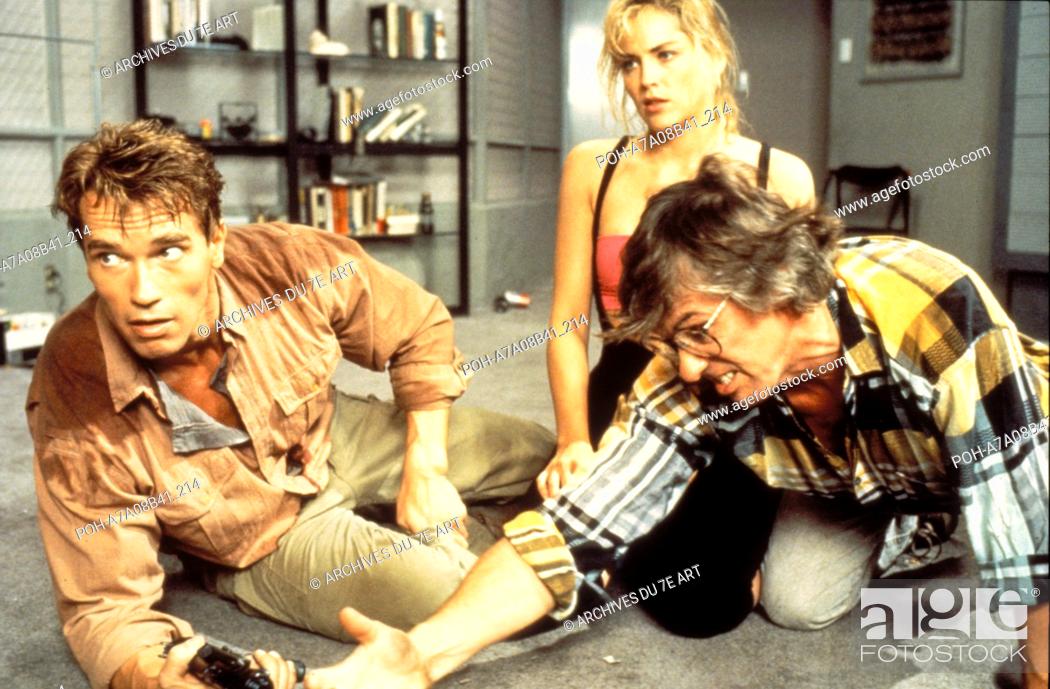
Douglas Quaid (Arnold Schwarzenegger) is a construction worker who- despite being married to the beautiful Lori (Sharon Stone) wants something more from life. He has an obsession with Mars- he dreams every night about being there with a mysterious woman (Rachel Ticotin). Mars is now a tourist destination, run by Governor Vilos Cohaagen (Ronny Cox). There's a rebellion uprising by settlers who have become mutated over time and Lori attempts to dissuade Quaid from going. But in the film's universe a company called Rekall can give you the memory of a vacation as real as actual memories; so Quaid opts for that instead. He also decides to go on a "Ego Trip," where he'll be a secret agent. The twist is he actually is a secret agent named Carl Hauser who worked for Cohaagen but switched sides. Quaid's whole life just an implanted memory and Lori is a spy assigned to watch him. Quaid then has to get his ass to Mars" to uncover the secrets of his identity.

We're asked whether Quaid really is a secret agent with implanted memories or experiencing the memory implant he wanted. It being a dream is given credence by the fact Quaid is told what happens in the Ego Trip by the Rekall salesman, which events then occur. Quaid saves Mars and gets the girl,. But it can also be taken as the movie opening acknowledging movie tropes. I'm a James Bond fan and this movie riffs on certain elements of those movies, particularly in the two major female characters. Lori is white, blonde, and a villainess. Melina-a resistance fighter on Mars and the woman Quaid was with in his dream- is brunette, dark-skinned. The Bond films have often had two contrasting women, one sometimes a femme fatale, like Lori. Getting with two beautiful women, even if one ends up trying to kill you, is part of the (male) fantasy of these kind of movies, and yes, Total Recall is more of a male fantasy than a completely universal experience.

Image result for melina total recall 1990


Bond always goes to exotic locations and Mars is our foreign destination. But the movie tweaks this element of the Bond formula by making Mars unglamorous- it's seedy and militaristic. Bond would probably go to Saturn- the place Quaid is told twice would be preferable.

I want to talk a little about Schwarzenegger and his casting in this film. The fact he's so not the every-man makes the cover identity of supposed normal guy Quaid very impractical and funny. He was never a conventional movie star in that he was so exaggerated physically and vocally as to be ridiculous. He comes across as what a little boy would imagine himself as in his own action fantasy. And we wouldn't want to be ourselves in a movie, we would want to be something different. As McClane tells Quaid, you're always the same on a vacation. Rekall gives the option of being someone new. That's what's appealing about movies- we can see idealized versions of ourselves on screen.

Moreover, movies are often about people growing and becoming better people. Total Recall makes this proverbial character arc more cerberal by having Hauser and Quaid be different men in the same body. Total Recall is based on the short story We Can Remember It For You Wholesale  by Philip K. Dick, who also wrote Do Androids Dream of Electric Sheep?, the basis for Ridley Scott's Blade Runner, another film about implanted memories and question of identity. On that note, Who is Quaid? A dream, an implanted memory, an suppressed part of Hauser's identity. Actors take on roles and we're not always certain which ones are most reflective of that person's identity. Is the whole movie is a dream then Hauser is a role Quaid is taking on.

Image result for paul verhoeven total recall

Total Recall was Verhoeven's follow-up to RoboCop. Both films are ultra-violent and pulpy but with real smarts and expertly crafted. Getting away from the metaphor-for-movies topic, Verhoeven satirizes and critiques corporate greed and apathy. Cohaagen would rather Mars' inhabitants die from lack of oxygen than lose control of the planet. While he comes across as a Bond-villain he's just a petty tyrant. And another appealing thing about movies is that we get to see the villains punished. And Coohagen gets one of the most disturbing deaths in film history.

In 2010 two films about movie-making and being lost in the reality of a film were released, both starring Leonardo DiCaprio- Christopher Nolan's Inception and Martin Scorsese's Shutter Island. I won't say they were directly inspired by Total Recall but there are similarities Shutter Island's main character does decide to have a lobotomy rather then face reality, just as Total Recall's ending implies Quaid is being lobotomized as denying reality. I view Shutter Island as a film about Andrew Laeddis creating his own movie in his head where he is the hero. And Inception ends with Cobb questioning if he's awake before embracing his kids, similar to how Quaid questions if the ending in a dream before kissing Melina.

The film's ending is so archetypal that even Quaid doubts it, and it's hard not to question it. We want to believe it's real even if all's fiction. If the fantasy is questioned in the context of the film, we begin to question it. We want to cling on to the happy ending because we want happy endings for ourselves. And Quaid does get a happy ending, even if he lobotomized, as morbid as that sounds. And maybe we can be as happy for him as well.

Wednesday, 13 March 2019

"The Times They are A- Changin:" Zack Snyder's "Watchmen" at 10


Image result for watchmen 2009

Zack Snyder's Watchmen, adapted by David Hayter from Alan Moore and Dave Gibbons' seminal 1986 graphic novel of the same name, was released 10 years ago this month. It's often referred to as ahead of its time, just like  Moore and Gibbons' masterpiece, entirely different from anything before or after in the medium. And yes, I would say the same about Snyder's film, which stands out from any comic book movie before or since, even his own.

While the superhero genre had matured and deepened by 2009 with Spider-Man 2, and the one-two punch of Iron Man and The Dark Knight the year previously, the concept of adapting a dense and intricate work such as Watchmen was equivalent to adapting The Lord of the Rings- it was seen as impossible to do a successful film adaptation of Watchmen. I think this is because- as has been said in the past- Watchmen is a comic about the comic medium and uses the medium in a very specific way to tell its story. As such, any film version of Watchmen would have to be it's own thing. In his video on the film, "Iamthatroby" says the Watchmen film is a superhero movie about superhero movies. And I the film, while faithful to the overall plot of the graphic novel, has to be viewed in the proper context without judging it too much against the graphic novel. Having just re-watched it, I've come to love the film and think it's quite amazing. I never disliked it just that I needed a few watches for it to really click with me. And the fact it came out 10 years ago, when the idea of an Avengers or Batman/Superman movie was still a comic book fan's dream, is incredible.

The fact such an ambitious undertaking was only Snyder's third feature is also impressive, though his first two films weren't safe bets either. His first, Dawn of the Dead (2004), was a remake of a horror classic and 300 (2007) was a largely visual effects adaptation of Frank Miller's epic graphic novel 300. That which made Snyder's name synonymous with highly stylized visuals and fidelity to the comic book source material. Also, Miller, like Moore, is one of the most important comic book creators of his time (both also contributed to the Batman mythos with Miller writing The Dark Knight Returns, a big influence on Snyder's Batman v. Superman, and Moore writing The Killing Joke.) So, it's not a surprise Snyder got the job bringing Watchmen to screen.

Watchmen takes place in an alternate 1985 where Richard Nixon has been able to retain power and is still President of the United States. This is also a world where costumed vigilantes have and still exist, though costumed crime-fighting has been made illegal. Former Nite Owl (Stephen McHattie), Hollis Mason, tells his successor Dan Dreiberg (Patrick Wilson), also retired, that the earlier generation had it easier. Nixon pushed the younger generation out. I love when Mason calls Nixon a prick then adds "And to think I voted for that prick five times," to which Dan replies "Hey, it was him or the commies." This notion of voting for someone you don't like just to avoid someone who you like less can't help but remind of the attitude in the last American election.

Edward Blake, also known as The Comedian (Jeffrey Dean Morgan), a government agent and former Minuteman/Watchmen, is killed, which kicks off the action of the story. While in the graphic novel, the Comedian's is shown is brief flashbacks, the film opens with a stylized fight sequence establishes the film's action. While I've had a problem with the seemingly normal people in the comic world having super strength in the movie, I think I've come to view the action in this film in the proper context of it being a heightened reality, as well as calling attention exaggerated superhero action. The contrasts stylization with real-world brutality quite effectively.
Image result for watchmen the comedian death

I think Morgan really nails the character. This is a guy who's a real bastard- he tries to rape Sally Jupiter/Silk Spectre (Carla Gugino), kills a Vietnamese woman he impregnated during the Vietnam War, and killed JFK. But he's charismatic and somewhat sympathetic when he experiences an existential crisis. Morgan captures both the humanity and inhumanity of this man, and we can kind of understand why Sally went back to him and eventually had had his child, Laurie (Malin Akerman), the second Silk Spectre. This is perhaps the powerful and poignant aspect of both the comic and movie, that a woman could love a man who attempted to rape her. This is a complex emotional territory and I love Sally telling Laurie that she couldn't hate Blake because "he gave me you."

I want to talk about John Osterman/Dr. Manhattan because in many ways I find him the most fascinating character in the film. Osterman is a atomic physicist who due to a freak science accident is transformed in to a super-powered being named Dr. Manhattan after the Manhattan project. Dr. Manhattan isn't human but he's not quite a god either. Janey Slater (Laura Mennell), Osterman's former lover and fellow scientist, says Manhattan is a god to which says he doesn't believe in God and if he's real, he's nothing like him. Thinking about the character brought to mind the oft-quoted idea that God can't be both all powerful and all good; and if neither why call him God. Manhattan doesn't seem to be either all powerful or all good, eventually having a detached view of humanity and retreating to Mars.

When Blake kills the Vietnamese woman he blames Manhattan for not stopping it and says Manhattan is losing his touch with humanity, adding "God help us all," underscoring how Manhattan isn't God. Manhattan's purpose in the story is to explore how people would react to a super-powered being in the real world. Snyder would also explore this idea in Man of Steel and BvS, in which Lex Luthor does bring up the Problem of Evil (God can't be both all powerful and all good). And like Manhattan, Superman in BvS begins to lose faith in humanity.

But  there's something terrifying about Manhattan, he's not the hopeful figure Superman is. He's a deterrent to Russia starting a Nuclear War with the US but he also creates a kind of fear that would start a war. Manhattan is not all powerful, as Laurie tells him later, he's just going through the motions like a puppet. Nor is he all good- he doesn't prevent Blake's gunning down of a pregnant woman.

I think my favourite sequence in the film is  Manhattan's origin, beautifully edited by William Hoy, Snyder's editor on 300 and his follow-up to Watchmen, Sucker Punch (2011). Hoy  creates a nostalgic, dream-like feel that soon turns in to a nightmare when Osterman becomes Manhattan. I love how the flashback stars out with a warm look at the fair with Osterman and Janey. The scene cuts from Osterman's friend  Wally Weaver looking lively to Weaver dead in a hospital; this shot has a cold look. The scene in the science lab is also shot to look a little colder, foreshadowing Manhattan's personality and look. 

One of the major changes in the film is Adrian Veidt (Matthew Goode) making the world think Manhattan attacked New York City, preventing any nuclear conflict and bringing the world together in an Utopia. In the comic, it's a giant squid but I think-at least in the movie- Manhattan being the scapegoat works really well, tying everything back to the fear surrounding Manhattan. People are willing to accept Manhattan did turn on them. Veidt understands what will unite the world is the fear of something outside of humanity.
Image result for dr manhattan


What I like about Watchmen's ending is it's not about whether Veidt's actions are morally justifiable but what do the characters do in the aftermath of destruction? Do they preserve the lie that has brought peace or reveal the truth, which would mean all those people died in vain if the world went back to the brink of war. It's a no win scenario. Walter Kovacs/Rorschach (Jackie Earle Haley) doesn't compromise and I think it's incredibly appropriate he tells Manhattan to kill him; that's the only way he won't reveal the truth.

Rorschach reminds me of the Marvel Comics character The Punisher, in that he is committed to warring on crime and killing criminals without mercy. When he's arrested and interviewed by a psychiatrist, he tells of how he used to let criminals live until he found the killer of a young girl, brutally murdering with a meat cleaver. This is where- as Rorschach tells it- Walter Kovacs truly died and Rorschach was born. When his mask is taken off by the police, he screams for them to give him back his face. It's part of him, it is him. Rorschach's narration is reminiscent of Travis Bickle, the character portrayed by Robert De Niro in Martin Scorsese's Taxi Driver (1976), due to his narration about the scum on the New York streets. My favourite shot in the film is when Rorschach goes in to the bathroom to kill Big Figure (Danny Woodburn). The door swings eerily and unusually back and forth as we see Rorschach move in for the kill- until we can only see Rorschach before the door closes. For a film with such brutal and explicit violence, this is an effective example of leaving it to the audience's imagination what happens.

Haley has to do a lot of acting with just his voice and body language. I think he absolutely embodies the character. When we see him without his mask, we see a man cold and detached but with much anger underneath the surface. It's only at the end when he tells Manhattan to kill him that we see him actually break down emotionally and cry. For me it's the most affecting emotional moment in the film.     

Rorschach does get the last laugh, so to speak, since his journal will be discovered by a newspaper employee. The film ends with the question of not only will the truth be revealed but what are the consequences? Will humanity go back to the brink of or will it enter a new status quo? It's also a question of personal responsibility and what choice an individual feels he/she should make. Is a world of peace more important than our own feelings of morality? And how do we deal with knowing a dark truth, what does it do to our conscience?

I know one criticism of the film is Veidt being too sinister, telegraphing he's the villain, as opposed to his depiction in the comic. I believe Veidt is intentionally being played up as the villain because the surprise of the film is his plan not be rooted in villainy. He's attempting to make the world a better place. His villainous demeanour is a red herring. Veidt is set up as an archetype, an archetype that's subverted by film's end.

Image result for ozymandias watchmen


I also want to mention Larry Fong, who I think is a fantastic cinematographer. He creates a diverse palette for this, as I mentioned when I talked about the Manhattan origin scene. Some scenes have a warmer look, others colder. There are scenes and shots that reflect an "old-timey" representation of the past, and more urban, gritty scenes. We also  have cosmic stuff with Manhattan on Mars. What's impressive is it all blends together, forming a cohesive world.

The title sequence is a great example of this, as we travel through history, showing us the Minutemen's origin in the 40s, to Manhattan meeting JFK in the early 60s and the emergence of the new Watchmen. There's both happiness and tragedy in this sequence. It's  a brilliant piece of visual storytelling.

Another sequence I think is wonderful is Mason's death. After Nite Owl and Silk Spectre break Rorschach out of prison, some goons think it was the former Nite Owl who did it. They attack Mason who fights back and from his POV we see him imaging the attackers as his former enemies from his time as Nite Owl. The music is stirring until it cuts out when Mason is killed with a trophy, signifying the emergence of brutal reality in to the scene.

Snyder is one of those rare blockbuster auteurs, filmmakers who are making personal and artistic films on a large budget. Instead of relying so much on a formula, movies like Watchmen operate outside of the box. I've come to appreciate Snyder as a filmmaker more since Man of Steel. I'd go as far as listing him as one of my favourite working directors. Watchmen foreshadowed similar themes Snyder would explore later on in MoS and BvS, including the idea of a super-powered, God like being among us.

Image result for zack snyder camera

It's appropriate that Bob Dylan's "The Times They Are A-Changin" plays over the opening credits since Watchmen is about the past and nostalgia. And the perception of superhero cinema has changed over the years. With the deluge of the Marvel Cinematic Universe films, Watchmen shines a little brighter because it's so distinct from other superhero films. Like BvS, it's a grower, and one now I would rank amongst my favourite comic book films.


Sunday, 16 December 2018

"Superman" 40 Years of Believing a Man Can Fly


Image result for superman 1978

Richard Donner's Superman was released 40 years ago and it's arguably the greatest superhero film of all time. It's certainly the one to which all subsequent superhero films are most indebted; not just because it was the first large-scale superhero film but due to its indelible images, music and performances that left their imprint on audiences' imaginations, including the creators behind future superhero films. One can see Superman's D.N.A in something even as singular as Sam Raimi's first Spider-Man (2002). Christopher Nolan has acknowledged it's influence on his approach to Batman Begins (2005) and Kevin Feige, architect behind the Marvel Cinematic Universe, has said its the constant reference point for the films. Its casting of major stars Marlon Brando and Gene Hackman also led to the early Batman films utilising big name actors for its villains. I would argue Superman and the original Star Wars- released a year and a half earlier- helped shape movie culture in to what it is today.

Superman (who was created Jerry Siegel and Joe Shuster) made his original appearance 40 years earlier in Action Comics #1 in 1938, so the film is at the exact mid-point of the character's history. It re-contextualised the character after nearly half a century of stories and defined many peoples' idea of the character since then. Instead of drawing inspiration solely from the comics, Donner used other films and genres as references. The early scenes on Krypton are reminiscent of other 70s sci-fi films, Clark Kent's teenage years feel like something out of Norman Rockwell and John Ford. When Clark gets to Metropolis, the scenes at The Daily Planet invoke His Girl Friday (1940) and Hackman's Lex Luthor is like a Bond villain. 

Donner's versatility as a director remains underappreciated. This is the man who went from The Omen (1976) to Superman, and eventually the Lethal Weapon franchise. He reminds me of Robert Wise, who also had an eclectic career, and Donner's old-school approach was beneficial to the film. Superman needed a classic approach rather than an "auteur's" touch.    

Mario Puzo, author of The Godfather, wrote the screenplay, with Leslie and David Newman, and Robert Benton coming in to do re-writes. It's important to note the screenplays for Superman and Superman II (1980) were written at the same time, with the first movie originally envisioned to end on a cliffhanger. The two films were filmed simultaneously but Donner was fired during work on Superman II. This was due to his poor relationship with the producers, father and son team Alexander and Ilyka Salkind. Richard Lester, director of the Beatles first film, A Hard Day's Night (1964), was brought in to finish Superman II. 

Related image

Returning to the screenplay, the film's structure is not a conventional three-act structure. Instead, it's a series of short films that tell an overarching story. The first film is the Krypton prologue. We witness Kal-El's (Clark/Superman's Kryptonian birth-name) father Jor-El sentencing General Zod (Terence Stamp) and his co-conspirators, who planned a coup, to the Phantom Zone. This version of the Phantom Zone, which is like a floating mirror prison, is its most frightening depiction in the Superman mythology.

We've come to accept acclaimed actors appearing in superhero films as a given. However, having Brando play Superman's father was significant casting for its time. It helped lend credibility to the film as a serious production. Production designer John Barry, who won the Oscar for his work on Star Wars,establishes a sterile and cold society which won't listen to Jor-El's reasonable conclusion that  Krypton will explode

I like how the sentencing of the trio to the Phantom Zone leads naturally to the discussion of Krypton's destruction. The Phantom Zone is a "living death" as Trevor Howard's Elder says but, as Jor-El responds, it's at least a chance at life, since everyone on Krypton will die. When baby Kal-El's ship flies through space, it passes by the prisoners. It's a darkly comic moment that thematically connects Kal-El and the other Kryptonians. They're survivors floating through space.

The second film is Clark's ship crash-landing in Smallville. He's discovered and adopted by Martha and Jonathan Kent (Phyllis Thaxter and Glenn Ford). We then flash forward to Clark as a teenager. It's a testament to Ford's performance that in his short screen time he makes him such a warm and likable character, a good man who Clark clearly respects and after which he will model himself. After Jonathan's death of a heart attack Clark discovers the Kryptonian crystal Jor-El stored in his ship and will help him unlock the secrets of his heritage. I think my favourite scene in the whole film is Clark's goodbye to Martha in the field, which invokes John Ford's The Searchers (1956). Thaxter, whose screen time is also short, gives a achingly touching performance. 


After Clark spends some 12 years learning from Jor-El in the Fortress of Solitude, Christopher Reeve finally enters the film as the adult Clark. Some pretty famous actors were considered for the role of Superman, including some odd choices- Nick Nolte, James Caan- and some understandable ones- notably Robert Redford. Reeve was practically an unknown actor at the time but the decision to go with an unknown- as I mentioned in my piece on Romeo & Juliet- allowed the audience to accept Reeve as the character without associating him with other characters he played. Reeve not only looked like the character but he was a strong actor who had screen presence. He also made us believe that people would never suspect bumbling Clark Kent was actually Superman. 

Reeve's portrayal of Superman has a reputation in certain circles as being boring but I feel his performance is charismatic, witty and sexy. He made this character flesh and blood in a way I don't think he'd been before on screen. And yes, he's old fashioned but he has to be so there's a strong contrast between him and the modern world he occupies. Costume designer Yvonne Blake, who died earlier this year, deserves a lot of credit for creating a Superman suit that was simple but iconic, as well as functional.

This is also the rare superhero film where the male is the object of allure rather than the woman. It seems fitting Zack Snyder became the heir to the franchise since he's also fascinated with the masculine body. 
Image result for superman 1978 flight

Margot Kidder's performance as Lois Lane is also key to the film's success. She and Reeve have instant chemistry as both Clark and Lois and Superman and Lois. We understand why Clark would be attracted to her and respect her. Clark places himself in a weird love triangle with himself. He has a great night with Lois but then reverts to the Clark Kent persona, seeing Lois still occupied with thoughts of Superman. In a great moment he almost reveals his identity to Lois, changing his posture, taking his glasses off, changing from Clark to Superman and back again seamlessly.

I honestly love Gene Hackman's performance as Lex. I know for many he doesn't match the image they have of the character but his portrayal makes sense in the context of what I mentioned earlier- which he's essentially a Bond villain. And I do think he's true to comic-book Lex's megalomaniacal nature. Hackman is just broad enough with delving in to camp- and the dynamic between him and Superman in their one big scene together is well-defined.  

I will say I don't like the reversal of time ending, which was originally intended for the ending of Superman II (and was restored in the 2006 Richard Donner Cut version of the film) and I think it would've worked better as the conclusion of a two film story. The "Can you read my mind?" voice-over also undermines the flight scene with Lois and Superman.

I realised I talked this long with mentioning John Williams' majestic and triumphant score. I'd say the Superman theme is still the definitive superhero theme, aided by the visually stunning credits sequence. Williams' scores imbue in me a deep sense of nostalgia. The music for the film is whimsical, romantic, and filled with a sense of awe.

Image result for geoffrey unsworth


The film is dedicated to the film's cinematographer Geoffrey Unsworth, who died only a few months before the film's premiere. He photographed Stanley Kubrick 2001: A Space Odyssey (1968) and Roman Polanski's Tess (1979), for which he won a posthumous Oscar, his second after Cabaret (1972). Unsworth creates a distinct look for each world of the film, from Krypton to Smallville, to Metropolis, stressing how the film is largely about the different worlds Clark/Superman inhabit.  

Clark/Superman doesn't have a traditional character arc. The film is more about the world around Superman and its reaction to him, as well as his purpose on Earth, which to inspire the good in people. Superman remains an important pop culture figure because of his innate goodness and the importance of hope in dark times. Superman lives on because it's such a happy and hopeful film, even with its darker moments. Reeve and Kidder are no longer with us but they live on in their performances, which are as timeless as the performances from classic Hollywood. To them, Donner, and the rest, thank you.  

Thursday, 25 May 2017

The Essential Films: Looking back on "Star Wars" 40 Years Later

Image result for twin suns tatooine


A Series of Writings on Films that I feel are essential viewings for film lovers, coupled with films that are personal to me

Spoilers Below

In May of 1977, pop culture and cinema was forever changed by the release of director George Lucas' Star Wars. Before it was Episode IV, before it was A New Hope, before people argued about who shot first- it was just that: Star Wars, as pure and simple as the story which it told. Star Wars- and the subsequent episodes of the Original Trilogy, The Empire Strikes Back and The Return of the Jedi- have become so ingrained in the popular imagination, so influential and obsessed over, that's it hard to look at it as just a movie. Like the stories of Superman and Batman- and even the work of J.R.R Tolkien, it's become something like a modern myth, almost a religion. This isn't to say Star Wars is above criticism or that it can't be analysed; just that it's so much bigger than just a really popular movie. 

Star Wars is  one of the biggest franchises in history but when Lucas was making the original film there was no guarantee it would be a success. We've become so accustomed the world of Star Wars but all this stuff about Jedi, the Force, Wookiees, and a big guy in a black suit with a breathing problem would have struck the people involved in the film's production as weird. Lucas' vision was of the pulpy/fairy tale sort rather than the cerebral nature of Stanley Kubrick's 2001 or the original Star Trek series. I don't even think 20th Century Fox had much faith in the film. Harrison Ford had worked with Lucas on Lucas' sophomore feature American Graffiti and would become a star with his performance as Han Solo. He's notorious for telling Lucas that the dialogue could be written but couldn't be spoken. In many ways I would argue Star Wars is the most mainstream and successful cult movie of all time.
Image result for hidden fortress

In crafting the story for Star Wars, Lucas drew inspiration from various genres- samurai film, fantasy, pulp sci-fi, swashbuckling adventure, war epic, western, and coming of age/hero's journey tale. In regards to the specific films which influenced Lucas, Akira Kurosawa's 1958 film Hidden Fortress inspired Star Wars' narrative structure. Lucas begins the film with the droids C-3P0 (Anthony Daniels) and R2-D2 (Kenny Baker). Kurosawa tells the story of his film from the perspective of two peasants who accompany a general and a princess across enemy lines. Fritz Lang's groundbreaking 1927 film Metropolis inspired the design of C-3P0. The homestead burning on Tatooine comes from a similar scene is John Ford's The Searchers (1956). Leni Riefenstahl's Nazi propaganda film Triumph of the Will (1935) was the basis for the medal ceremony which closes the film. 

What's impressive is how Lucas blends diverse genre tropes in to a cohesive whole where the archetypes and iconography compliment each other. The result is a film which feels familiar yet boldly new. I think a big reason for Star Wars' success is how its story already felt old-fashioned back in 1977- and accessible to general audiences- while expanding their idea of what could be accomplished cinematically. More on that later.


Related image


When talking about genre archetypes in relation to Star Wars, the character that stands out most to me is Obi-Wan "Ben" Kenobi (Alec Guinness). Ben represents both a samurai and an old wizard- like Gandalf in The Lord of the Rings. He begins to mentor Luke Skywalker (Mark Hamill) while still carrying the weight of his failure with his last apprentice, Darth Vader; Vader turned to the dark side and helped the Empire eliminate the Jedi Order. I feel Guinness is underrated in the part- maybe due to the fact we don't think of it as a performance, to many he just is Obi-Wan Kenobi. Guinness convinces me he is this old Jedi master, the Force exists and there was once Jedi Knights who protected the galaxy for thousands of years. And when Luke mentions the Clone Wars- which became a huge part of Star Wars media- it provides a sense of history to this universe. 

Along with Guinness, Peter Cushing- who played Grand Moff Tarkin- was the other veteran actor with a major role in the film. Guinness represents the mythological side of this universe while Cushing is the face of the totalitarian and fascist Empire. I would argue he's the true villain of this film, not Vader. Tarkin orders Princess Leia's (Carrie Fisher) home planet of Alderaan destroyed by the Death Star just to prove a point. What's great about Cushing's performance is he doesn't over play Tarkin's evilness, which makes Tarkin's actions and demeanour all the more believable and unsettling.

Image result for darth vader a new hope


But when it comes to villainy in the Star Wars saga, people will always think about Vader. If Vader isn't the greatest screen villain of all time then he's certainly up there. Even in the original film, before it's revealed he is Luke's father, Vader is a commanding and compelling presence. Vader represents the bygone time of the Jedi; He is more connected to the mystic side of the universe rather than the technical. He's contrasted with the technological and brute-force based Empire. During a meeting about the Death Star with the Imperials Vader states the station's power is meaningless next to the Force. General Motti (Richard LeParmentier) tells Vader not to attempt intimidation with his "sorcerer's ways." Motti sees Vader as something of a relic- calling the Force an "ancient religion." Vader displays his power by choking Motti via-the Force. Tarkin orders Vader to stop, further emphasising he's in charge, not Vader. Later Tarkin disregards Vader's sensing of Obi-Wan aboard the Death Star. Vader is an outsider among the Imperials, though we later learn the Emperor is a Sith like Vader.
Related image


Luke, Han and Leia come from different backgrounds. Luke is the farm boy who's never been off Tatooine, Han is the smuggler who never stays in one place, and Leia is a princess who's the only one of the three who has her mind on defeating the Empire. The film is largely about these three people coming together for a single purpose. It's part of why the series is so enduring- it believes regardless of background people can work together and accomplish great things.

Luke longs for a better life, one of adventure and purpose. His uncle Owen (Phil Brown) doesn't allow him to leave because he needs Luke's help on the farm. Owen is also afraid Luke will follow in his father's footsteps and become a Jedi Knight (in the context of this film Luke's father Anakin was murdered), We understand Luke's frustration but we can also see Owen sincerely cares about Luke and is reasonable. The tragedy of Owen and Beru's (Shelagh Fraser) murder is Luke never got to reconcile with Owen. Moreover, now Luke has no choice but to leave Tatooine. Obi-Wan becomes a father figure to Luke. When Obi-Wan dies Luke truly has to grow up. Hamill was already in his mid-20s when he played 19 year old Luke but he conveys Luke's immaturity, genuine decency and infectious energy perfectly.

Leia isn't afraid of Vader nor Tarkin. She's confident but we see her fear and desperation when Tarkin forces her to disclose the location of the rebel base or he'll destroy Alderaan. Her confident and arrogant exterior slips away; we see how powerless she- and the whole idea of royalty-is in this situation. She's snobbish in how she treats Luke and Han but comforts Luke after Obi-Wan's death. Despite losing her planet she shows compassion to the man who rescued her. The late Fisher plays these different sides of Leia's personality with grace, making them all feel part of the same person.

Han is the scoundrel with the heart of gold. The key to Ford's performance is you believe he's really out for himself while at the same time you buy that he comes back to help the rebellion at the film's conclusion. Ford is arguably the closest thing we have to a modern day Humphrey Bogart. His performance is charming, sly, ruthless and funny. The scene where he's talking over the intercom display Ford's ability to convincingly play the tough guy who's occasionally ill-equipped in certain situations.
Image result for star wars visual effects a new hope

I mentioned earlier that Star Wars expanded people's idea about what could be achieved cinematically. This is due to how groundbreaking and influential its visual effects (by John Dykstra and his team at ILM (Industrial Lights & Magic)) were. Star Wars is a film that embraces its goofy pulp sci-fi roots; while being more technically sophisticated then that sub-genre had been before  The opening shot of the Star Destroyer chasing the Tantive IV is still an incredible visual marvel. It automatically establishes the rebels as the underdogs and the Empire as oppressive and all-encompassing. Ben Burtt's sound design also deserves credit. The sound design of Star Wars is so iconic all you have to do is hear the sound of a TIE fighter and you know what you're listening to.

For me, Star Wars isn't quite Star Wars without John Williams' music. The fanfare- accompanying the title as it recedes in to space and the opening scrawl is romantic, epic, poignant and thrilling to this day. The force theme, which plays over Luke looking at the twin sunset, invokes longing and the hope for a better future. It became such an indelible combination of visual and sound that Lucas ended the Prequel Trilogy Owen and Beru looking at the twin suns.

In 40 years, I think this film- and the Original Trilogy as a whole- will still be classic. It's world and its characters feel timeless- appealing to multiple generations and people of different backgrounds. It inspires the imagination and has a purity to it that's often missing in the modern blockbuster landscape. So, what is your favourite aspect of the original film, and what does it mean to you? Comment below and let me know.