Showing posts with label James Cameron. Show all posts

Thursday, 4 January 2024

Death, Taxes, and Franchise Longevity: "Alien 3" and "Alien Resurrection" as Franchise Extensions and Parallel Versions of "Alien" and "Aliens"


Spoilers for the Alien series below

When Charlton Heston blew up the planet of the apes at the end of Beneath the Planet of the Apes, it was thought by Heston- who came up with the idea- that this would prevent any more sequels being made. But, this didn't stop 20th Century Fox from making Escape From The Planet of the Apes shortly after. James Bond is dead but we'll see a new Bond...sometime in the future. Avengers: Endgame felt like, well, the endgame of the MCU. The thing is, a franchise will always find a way to extend its life, even when it probably should end (though I guess there were several loose ends at the end of Endgame).  The question is, how do you continue on a story after it's logical end point. "Rebooting" is always the easy option but there was a time where you didn't really wipe the slate clean- you just continued on with new characters or a new actor as Batman or Bond. When it comes to clear-cut endings, James Cameron's Aliens gives Ellen Ripley (Sigourney Weaver) a pretty neat ending-
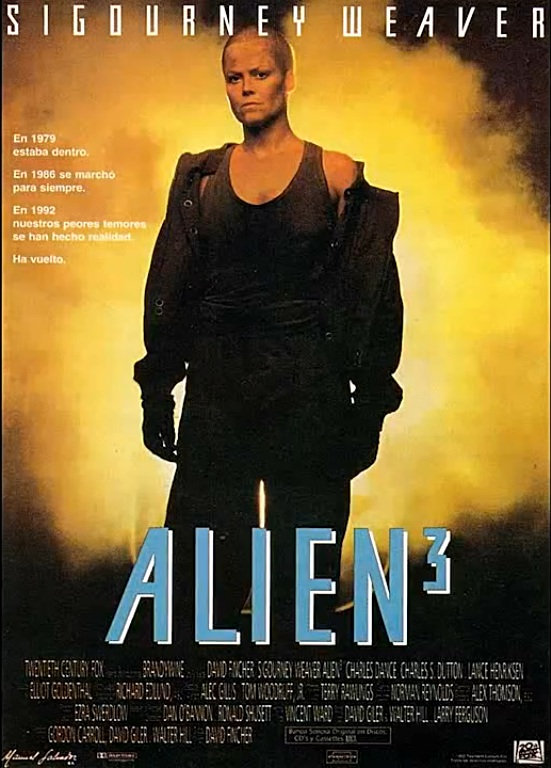
having overcome the trauma from the original Ridley Scott Alien, and gaining a surrogate daughter and possible love interest. But of course, a third film had to be made. After having difficulty nailing down a story, and even without a finished script, Alien 3 was made, helmed by first time director David Fincher. Alien 3 gives an even more definitive end to Ripley's story- having her commit suicide but, again, a sequel had to be made, and Ripley was brought back as a clone for Alien Resurrection, this time directed by French auteur Jean Pierre Jeunet. Neither Alien 3 or Resurrection are beloved as the first two films but in this piece I want to talk about how they operate, not only as franchise extensions, but also largely as parallel versions of the first two films. 

If Aliens is one of the quintessential Hollywood blockbusters, incredibly audience friendly- filled with one liners and an almost Spielbergian sentiment, then Alien 3 is perhaps the bleakest, nihilistic and audience-unfriendly film of any franchise. It essentially tells its audience "Hey, remember that cute little girl and the cool Colonial marine you loved so much from Aliens? Yeah they're dead, and our supporting cast is now of group of ex-convicts guilty of rape, murder and child molestation. And, oh yeah, Ripley has an alien growing inside of her and wants to kill herself." I've heard Alien 3 compared to a Michael Haeneke film and yeah, the tone of the film does feel like you're watching a depressing European art-house film rather than the 3rd film in a popular film franchise. But that's what I kind of love and appreciate about it. I can't think of another franchise installment that gut punches its audience the way this one does (though I understand many had the same experience with The Last Jedi).
It's pitiless and remorseless, in stark contrast to the sentiment of Aliens.

If Cameron makes very audience friendly films with a certain kind of sentiment, than Fincher often really puts the audience through it, not really giving them easy joy or comfort. I can't really see Cameron ever doing anything as bleak as the ending of Seven. This isn't a judgement call on Cameron as a filmmaker, just an observation. What I love about the original 4 movie cycle is that each film stands out as distinct vision. Aliens could've been the template for all the Alien sequels afterwards, similar to how Terminator 2 became the basis for pretty much every Terminator sequel afterwards. Alien 3, on the other hand, feels increasingly radical as a sequel as the years pass since it stops the story of Aliens in its natural path, saying we're not going to Earth or continuing on the family story of Ripley, Hicks and Newt.  We're not doing a bigger scale film but something small, intimate and sad. 

Alien 3 takes a back to basics approach, limiting itself to one alien, and removing guns from the equation. As with the original, the characters have to get creative in how they'll kill the xenomorph. As franchises go on, there's usually a tendency to keep going bigger with the set-pieces and more of what people liked before. However Alien 3 is pretty minimalist as far as sequels go, surprisingly somber and understated. The setting- a former prison colony now overseen as a lead factory by its former inmates who've found religion- also gets back to the original's gothic atmosphere. Star Wars' lived in universe aesthetic influenced Scott when making Alien and its present in Alien 3,  filtered through Fincher's 90s grunge aesthetic. This is perhaps the most visually striking film in the franchise, Alex Thomson's cinematography creating something beautiful out such a bleak setting.
 

The horror of the original Alien was largely based in its theme of sexual assault and death through childbirth. Many have remarked in the past how it subverts the image of sexual assault by having a man raped instead of a woman. . In Alien 3, the fear of sexual assault is placed back on the female character, but this time with the threat of sexual assault coming from the former inmates. If Alien didn't make a big deal of Ripley's gender (I believe Ripley was originally written to be a man) this film positions her as the lone female, the first and only time in the series, with the threat of male violence against her a constant undercurrent. There is an attempted rape by some of the prisoners on Ripley, who's saved by Dillon (Charles S. Dutton). The irony is clear- this is the man who straight out told Ripley he was a "murderer and a rapist of women." Dillon is a man looking for some kind of redemption and he and Ripley become unlikely allies. 

One of the criticisms of the film is its hard to care about killing these men who are guilty of such heinous crimes, which I get. Outside of Ripley, the character we're allowed to feel the most warmth towards is Clemens (Charles Dance), the medical doctor who was once a former prisoner. He there because he got drunk and prescribed an incorrect dose of painkillers on survivors of a fuel plant boiler explosion. Ripley and Clemens become intimate- the only time we actually see a romantic interaction in the four films- but Clemens is killed off pretty early, Psycho-style, leaving the audience with pretty much just the inmates. Again, I actually kind of appreciate how the film doesn't make it easy for the audience. We're not given them easily identifiable or straight out likable characters but I'd argue the film is asking the audience if they're willing to sympathize or at least get on board with these characters. I find something compelling about Ripley and these inmates having to team together to fight the alien. This is essentially a story about people who have either lost everything (Ripley) or had nothing to begin with (Dillon) having to work together against a common enemy. Dillon sums it up pretty well when he tells the inmates that they're all going to die, you just have to decide how you're going to do it. This may sum up the whole franchise- when facing certain death how are you going to do it? 

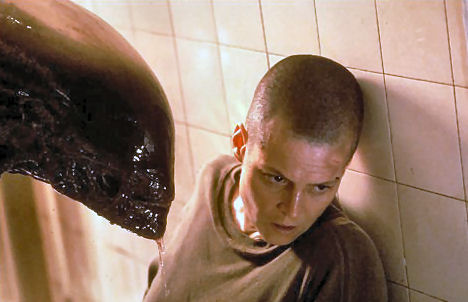
Returning to the theme of sexual assault, the ultimate irony comes when Ripley realizes she's already been sexually assaulted by a facehugger, with a xenomorph growing within her. In Alien, Ripley fought for her own survival, and in Aliens, for her surrogate daughter. Here, Ripley is fighting the right to end her own life.  largely to stop the alien from getting in to the hands of the Weyland-Yutani corporation who want to use it as a weapon. In his video essay on the film for his "The Unloved" series, Scout Tofoya remarks how rare it is to see a mainstream Hollywood emphasize with a woman's desire to have an abortion. Ripley does ultimately succeed in killing herself.  This  may not be the happy ending people were left with at the end of Aliens, is a sort of final triumph for this character, going out on her own terms.


And for a while, Alien 3 was the conclusion of the story. Of course, the ending didn't stick, with Alien Resurrection coming several years later. Just as Alien 3 parallels Alien, with its gothic setting and bleak tone, Resurrection attempts to ape Aliens' more humorous, fun action movie vibe. We have multiple xenomorphs, the return of guns to the equation and the broader characterizations.  The film's director, Jeunet, is probably best known to people as the director of Amelie though he hadn't directed it at this time, though he had directed The City of Lost Children and Delicatessen. Jeunet is the franchise's most off-beat and out of left field choice, with Resurrection being is the strangest, ickiest, and tonally conflicted of the four films. Screenwriter Joss Whedon has expressed his dissatisfaction with the film, saying it was directed wrong, acted wrong, and cast wrong. Unlike Aliens, which I think balanced its tone pretty well, Resurrection can't completely decide what kind of film it needs to wants to be. It wants to be, I think, a fun action movie in the vein of Aliens, but's it almost too grotesque and weird, and not really as exciting as Cameron's film.  
 
We almost had a deeper connection to Aliens with Whedon's original idea of cloning Newt, making her the lead of the film. 20th Century Fox however didn't want a story without Weaver. I feel Newt had potential as the lead of the franchise, if they had cast a strong actress in the role (Carrie Henn quit acting after Aliens, her only film). The idea of cloning Ripley was actually a joke producer David Giler made to Weaver when Alien 3 premiered. Resurrection definitely feels like the textbook definition of a franchise jumping the shark, or maybe we should say xenomorph, in an attempt to extend its life cycle, though the film does do funny and bold things with the idea of Ripley being a clone, though she's not just a clone, she's an alien human hybrid. In interviews Whedon said he thought Weaver wouldn't want to play Ripley in such a weird way but he was surprised she told him to push things further. Like in Aliens, Ripley is a mother figure, having been the bearer of the xenomorph embryo, a queen which gives birth to a human/xenomorph baby- yeah, it's very weird. Ripley was attempting to save her surrogate daughter before whereas now as he she has to kill her literal offspring. 

Another parallel with Aliens, and something I think is integral to Ripley's story, is the continuation of the "Rip Van Winkle" thing with Ripley waking up years in the future. Ripley was in cryosleep for 57 years between the first two movies, now it's 200 years in the future. Ripley becomes more and more of an isolated character as the sequels go on- with the Resurrection positioning her as not even being completely human or even the same Ellen Ripley. When we arrive on Earth at the film's end, the android Call (Winona Ryder) asks what's next, to which Ripley replies that she's a stranger there herself. While I get why killing Newt off is seen as an unforgivable sin by many, I think Ripley works better as a loner, a ultimately a tragic figure. Sure, a big part of me wonders what alternate universe version of Alien 3 looks like but I love that the Alien 3 we got makes you feel the pain of triumph snatched away, that sickening irony. Each sequel does undo the victory of the previous film's ending, though I guess that's just the horror genre- it doesn't matter how many times you kill Michael Myers or Jason Voorhees, they'll be back for the sequel. I think it's best to look a the Alien quadrilogy as variations on a theme, with each director approaching their film as a stand alone film rather than as a Marvel-esque serialized piece of storytelling.

I never know how to end these things so I'll hand it over to you. What are your thoughts on the two latter Alien sequels. Are you a fan or do yo find them huge disappointments. Comment and let me know. 


Wednesday, 5 July 2023

The Essential Films: The Terminator (1984)

A series of writings on films that I feel are essential for film lovers, coupled with films that are important to me. Spoilers for those who haven't seen the film. 

The Terminator is maybe my favourite movie. Many people prefer Terminator 2: Judgment Day but I always go for the first one. T2 is more of a crowd pleasing summer action film about a boy and his pet terminator (I like the movie but have complicated feelings about it) but The Terminator is much bleaker and dirtier, a mixture of sci-fi and horror which its writer and director James Cameron called "tech noir." Like most first films in a franchise there's a real purity to it. There's no formula or call backs, just an inventive story its director, like George Lucas with the original Star Wars, wanted to put on screen.

While Lucas had the success of American Graffiti to his name when he did Star Wars, Cameron had Piranha 2: The Spawning, which bombed with critics and audiences. It was during post production of that film where Cameron got sick and had a fever dream/nightmare about a robot skeleton dragging itself along the floor with kitchen knives. This obviously stuck with Cameron and became the basis for The Terminator. The film is often considered a horror film and of all the Terminator films it's the only one that feels like a pure translation of Cameron's nightmare on screen. The sequels go more for bombastic action than the pure terror of an unstoppable killing machine. And while Cameron could've just made a killer robot movie, he places the "slasher" element within the context of a intriguing time travel narrative that has, what I think, is one of the most underrated twists/payoffs in any movie.

In terms of the slasher genre, Cameron clearly took inspiration from John Carpenter's Halloween. Both Carpenter and Cameron show us ordinary women being stalked by hulking killers who feel out of place in the normal world. Tension is created through this unease and question of when they'll strike at the main character. Cameron's original conception of the Terminator was that of a normal looking guy who could come up to you in a crowd and kill you. But when he met Arnold Schwarzenegger, he rein-visioned it as what we see in the film. This is one of rare instances of Schwarzenegger playing a villain. The image we have of him is the goofy cartoon come to life but here Schwarzenegger is actually quite intimidating, a real beast. We see him kill a couple of innocent women point-blank. Before he kills the first Sarah Connor (he only knows the name of the woman he's after), there's that striking shot of him in the door frame, emotionless. Arguably, one can't call the Terminator evil. Rather, it's just a machine with a program.  

At first we don't know why the Terminator (Arnold Schwarzenegger) wants to Sarah Connor (Linda Hamilton), a waitress who's barely making it by. All we know is there's some future war between humans and machines and, as the opening text crawl tells, the final battle will be fought in the present day- with the Terminator , as well as another guy, Kyle Reese (Michael Biehn), coming from the future. We eventually learn that in the future her son John Connor will lead the human resistance against the machines and winning the war. In a last ditch effort the machines have sent back the Terminator back to kill John before he's even born. 

The key to good exposition is to make the audience forget they're hearing an info dump. Cameron does this creating a sense of urgency during these scenes.  When Reese tells Sarah about her son and the future war, they're on the run from the Terminator, hiding in a car and then attempting to get to another. Cameron also avoids using flashbacks during this scenes so we're allowed to imagine Connor leading the humans against the machines. And when Reese is being interrogated at the police station, talking about the time displacement field, he's talking to a psychologist who clearly doesn't believe him. We're sharing in Reese's frustration with Silberman (Earl Boen), since we know the Terminator is going to arrive at any moment. Reese is captive and Sarah is isolated.  

A more routinely structured film would've given us all this information via Reese being told his mission at he film's beginning Reese would be this version's main character and the story would be that of a cool time-travelling action hero. Instead, Cameron takes a more subversive path, withholding the information regarding Sarah's significance from the audience until she learns it. Cameron wants this to be Sarah's story, a human story rather than just merely a time-travelling action movie.

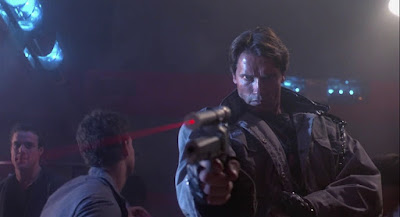
Cameron also subverts the typical male action hero archetype of the time. Physically, Biehn is not a big guy but pretty skinny. And Biehn plays the character in the early parts of the film as very sketchy individual, possibly as dangerous to Sarah as the Terminator. He doesn't scresm "heroic" but makes Sarah nervous when she first sees him, thinking he's the ma who killed the other Sarah Connors (the Terminator doesn't know what Sarah looks like). It's only when Reese saves Sarah from the Terminator at the "Tech Noir" club that it becomes clear he's there to protect her. Cameron slows everything down as the Terminator approaches Sarah. In one of my favourite shots in the film- it points a laser target at Sarah. The suspense builds as Kyle takes out his shotgun and then everything goes back to normal speed as Kyle fires, almost as if the action has brought everything up to speed.


Biehn's performance is all raw, gritted teeth, sweaty, fried out energy. It's the type of character the franchise never revisited, even when they brought back Reese in later sequels. With the sequels, it's always Schwarzenegger as the robotic protector who fight another Terminator. Here, it's two humans against a unstoppable killing machine. It makes things more intimate, especially when Sarah and Reese do have sex. It's implied that Reese is a virgin before this and I can't think of another action movie of this kind that infers this about the main guy. 

Even barring the "mother of the future" thing, Sarah is understandably skeptical of Reese telling her there's a robot from the future trying to kill her. It's only when the Terminator mows down the police station that she truly and fully believes Reese is telling the truth. My favourite moment from the film is when Sarah thinks the Terminator is coming through the door but it's Reese. She's relieved it's him and the two share a brief moment before escaping. It's at this moment that the two are completely together, and will be for the rest of the film

Cameron knew he wouldn't have the budget to do a story set in the future so he wrote this smaller story which has big implications. The fate of the human race depends on the outcome of this chase thriller, and by the end we realize what has occurred is even more monumental and mind-bending, which is that Kyle is John's father. We can also  put 2 and 2 together and realize Sarah trained John because she knew about the future. The whole thing is a time loop and this chase thriller takes on a more mythic quality. 

Unlike most of the sequels, we never see John on screen. I prefer this because I believe John works better as off-screen presence, a symbol. "I'd die for John Connor," Reese tells Sarah, and I don't know if any of the actors who've played John have conveyed what we get from Reese talking about the guy. It also puts the focus on Sarah. She's the hero of the story, not John John can only become the man he is because of his mother's training and being told the truth about his father, the man Sarah loved. At the end she questions whether she should tell John this, if it'll influence his choice to send Kyle back. I believe it's because John Kyle is his father that he sends him back. "No fate but what we make" becomes the philosophy of Terminator 2 but the original implies there can only be one path. Could Sarah ever have done anything different than tell John the truth. I don't know. 

While the film concerns a future war, it's one of the great time capsule films of the 1980s. Sarah's hair is one of the most memorable images and the Tech Noir club, the music, the dancing, its just all drenched in 80sness. The film is also one of the great unsung L.A movies, especially L.A. at night. Cinematographer Adam Greenberg's shooting of the city at night has a Michael Mann-esque quality. I love the shot of the Terminator looking over the L.A cityscape, a city full of people who don't know of the coming apocalypse. And Brad Fiedel's score, that throbbing sound that's like the Terminator's mechanical heart, the mournful and metallic main theme, it's so good.  

The biggest challenge Cameron when writing, casting and direction, was how to convincingly take Sarah from this timid waitress to a survivor who drives off in to a storm at the end, symbolizing, not subtly. the coming apocalypse and the dark days ahead. Even when Sarah accepts there's a terminator after her, she still can't see herself as the actual person it's after. I think we as the audience are also supposed to wonder how this person could ever train a child to become the leader of the human race. But by the end, when Sarah drives off, it feels like we've been on an epic journey with Sarah. Again, Cameron took a small story and makes it feel bigger through its implication. Hamilton is convincing as both the afraid young woman but also the woman at the end who says "You're terminated, fucker." Cameron puts Sarah through so much, and has her bond with so Reese so deeply, that it's completely believable she would harden and be able to save herself, as well as taking on the responsibility of training John. And as I argued earlier, the film is fatalistic. There's only one path for Sarah to take. 


What brings back me to the movie is Sarah and Reese's relationship, as short-lived as it is. This feels like the most intimate of the Terminator films because, as I said earlier, it's two humans up against a machine rather a machine against a machine as in the sequels. Reese dies tragically while destroying  the Terminator's legs, a brutal hit to the audience but necessary for Sarah to eventually survive. That The Terminator ends up as a tragic but also triumphant love story is what makes this film stand out amongst other 80s action movies. While the Terminator is cold without feeling, the film itself, like the Tin Man has a real heart.

Saturday, 29 July 2017

Some Thoughts on the Future of the Terminator Franchise

Image result for the terminator

Spoilers for The Terminator series


When James Cameron directed The Terminator back in 1984, it was only his second film- after Piranha Part Two: The Spawning (1981), and it ultimately changed his entire career, giving him the clout and respect to eventually direct the sequel to Alien- Aliens. He would eventually return to the Terminator universe with Terminator 2: Judgement Day (1991), a film that revolutionized special effects. And of course, he directed the two box office champs, Titanic (1997) and Avatar (2009), the latter of which was also revolutionary in regards to its special effects. 

While Cameron is still very much focused on doing more Avatar films, this week he brought up the possibility of doing more Terminator films. Apparently he and producer David Ellison- who owns the rights to the franchise- have had discussions about a possible three movie story-line. Cameron hasn't been involved with the three previous Terminator films- Terminator 3: Rise of the Machines (2003), Terminator Salvation (2009) and Terminator: Genisys (2015) Cameron says was supportive of the Arnold Schwarzenegger led 3rd and 5th films- since him and Schwarzenegger have remained friends throughout the years- but adds they didn't work for him, "for various reasons."    

For me I believe it's been difficult to make further Terminator films post the second film, arguably even the first film. This is because everything that occurs is on a loop- Kyle Reese will always be John Connor's father, Skynet can only ever be created because the Terminator came back. But coming back to T2, that's the saga's end. Sarah Connor and John prevented Judgement Day, Miles Dyson is dead. There was even an alternate ending set in the altered future where John had become a senator. In T3 all that was undone- Judgement Day is unavoidable. It was a bold way to end the film but the rest of the film- while decent- felt to similar to the previous films. Salvation was set in the future only briefly glimpsed in the first two films. It had potential but didn't capture the oppressive dread of that world. I admired the ideas explored in Genisys but it was too convoluted and fell in to the trap of having the plot revolve around preventing Judgement Day again.

The Terminator was never really designed to set up a franchise. As I mentioned before, the first film is a closed loop. And since time travel is a major factor in the franchise, things keep getting more confusing with each new film. If Cameron wants to direct or produce further Terminator films I think the best approach is to start with a new continuity. It makes things cleaner and less confusing. 

I would also suggest not focusing on Sarah or John; create new human characters we can get invested in. I think you can still keep the basic premise: a machine comes back to kill a human and prevent the machines' defeat in the future. Bob "MovieBob" Chipman proposed ignoring the post-T2 films; the film would be set in a post-labour future where machines haven't turned against us. However, the machines have made certain people obsolete since they're not need for labour anymore. Someone would go back to prevent this, targeting Dyson's now grown daughter who has a prototype terminator who can protect her. Chipman also recommended going for a smaller scale, with which I strongly agree. I like the idea of the franchise going back its horror/sci-fi roots rather than attempting to repeat T2 again.

I don't know if Cameron will ever get around to doing these hypothetical Terminator films or when we'll see another film in the franchise. I'm always open-minded about reinventing a franchise- look at the new Planet of the Apes films. Until then- well, we'll always have the first two films. 

Wednesday, 6 June 2012

In Space...: Revisiting the "Alien" Franchise


I wanted to revisit the Alien series because Prometheus, Ridley Scott's new film which is supposed to be a prequel of sorts to his orginal film, is coming out soon- and also because I really wanted to see them again-especially on Blu-ray! What I like about the four Alien films- the ones starring Sigourney Weaver- is that each of them, helmed by a different director, is it's own thing. The ingredients are pretty much the same but the directors all bring their own style, even if the film isn't very good.


What's remarkable about the first film in the series, Alien, is that, on a plot and character level, it's essentially a B movie, a haunted house movie set aboard a spaceship with an Alien. What makes it an A movie is Ridley's Scott direction, which slowly builds up tension, then giving us a great payoff that never feels just like a jump scare- but he never really relieves us of the tension. The film is also benefited by strong performances from the cast. While the characters are not super complex, the actors make them feel like real people. Who come to sympathize with them and all their deaths really hurt- especially when the captain of the Nostromo, Dallas (Tom Skeritt) is taken by the alien. Once that happens you feel the rock of the film is gone. What also elevates the film in to A film level status is how terrifying the Alien is. Based off designs by H.R. Giger, the alien is never cheesy or lame. And like the shark in Jaws, only a few years prior, Scott doesn't show the alien all at once but slowly shows us more as the film goes along. The fact that we don't always see the alien adds to the terror of the film- by hardly ever seeing it, we feel it can just jump out of nowhere.


The dread in this film just keeps escalating as we realize nothing can stop this monster. What also enhances the dread is that the real villain of the film is never seen. It's the corporation that sent out the ship and which views the crew as expendable- all that matters is getting the alien back to Earth. It's a theme that's present through all the alien films. The alien is a killing machine but what really causes the trouble is Weyland-Yutani. I think that's what makes this film so disturbing. The faceless villain that has doomed the entire ship.


After Dallas is gone, Ellen Ripley (Sigourney Weaver) emerges as the main character of the film. At the time I believe people believed Dallas was going to be the hero of the film. What's also interesting is that supposedly Ripley was the only character written specifically to be a man- but with Weaver in the role, the film takes on feminist undertones. What I like though is that Ripley never really becomes a traditional hero in this film. At the end, left alone, she's scared shitless as she tries to blow up the ship and escape in the hatch pod. They don't make her "tough"- that comes later. She's strong though, scared, but strong.


Aliens, the second film, does what most sequels never have the leisure to do. Most sequels are the same genre of the previous film. Aliens, despite still having the ingredients of a horror film, is actually more of an action film than horror. James Cameron, who had made his name with the first Terminator film, didn't want to remake the first film so he essentially made his own riff on the concept. But while Aliens is very different from Alien, Cameron does a great job of expanding upon the universe Scott created in the first film. In the first film, it was a lone alien in the shadows, stalking the crew. This time, it's war, as the film's tagline declared. Things are no longer just contained to a spaceship, and it's not just one alien.

I think Cameron's main interest in this film is developing the character of Ripley. Ripley has been in hypersleep for 57 years after escaping from the Nostromo. Weyland-Yutani find her but don't believe her story.  In the special edition of the film, which Cameron says he prefers, there's a scene where she discovers her daughter has died- she sees a picture of her, a grandmother and recalls she promised she'd be back home for her 11th birthday. This scene, cut for the theatrical cut, provides a great deal of subtext and emotional weight to her relationship to Newt (Carrie Henn). She wants the mother-daughter bond she can no longer have with her real daughter- and by protecting Newt, somehow may want to redeem herself. Cameron makes Ripley a woman out of time, with every one she ever knew dead or old. She's also plagued by nightmares every night. Only by confronting the aliens with the marines can she be at peace. I think the arc Ripley goes through in this film is the strongest out all the films.


Aliens, I think, is the warmest of the Alien films, the one in which I'm most attached to what's happening on screen. But while it has it's tender moments, it's not overly sentimental. Cameron deftly combines and switches between tenderness and real terror. This makes the stakes higher as we know this young girl, and Ripley's redemption, lies in the balance. The film also develops the "Alien" universe's fear of American bureacracy, personified here by Paul Reiser's Carter Burke. At first Burke seems like a decent enough guy- but we learn what he'll do in order to get an alien specimen.

Also- on an action movie level, this film is spectacular. Cameron stages intense sequences of action without losing any of the suspense or fear needed in a movie like this. This feels almost non-stop- but it never becomes overbearing.


Alien 3 is where the franchise started to lose its way. It was a troubled production from early on. There was trouble settling on a script and on landing a director. Renny Harlin,was hired on as director but left to direct Die Hard 2 once the production wasn't coming together. Vincent Ward, who has a story credit on the film, was called on to direct but was  fired due to disagreements with producers. Eventually, directing duties fell to David Fincher. At the time, Fincher had never directed a feature film before- only music videos. Fincher, from my understanding, was not treated well by the studio (20th Century Fox) during production- and there were constant re-writes on set. Fincher is one of the things that makes Alien 3 worth watching. Even on his first film, and a troubled one at that, one can see his directorial talent, his eye for great visuals, shining through.

My main problem with Alien 3 is that it feels too much like a franchise movie- and I think this is when the series started to be seen in those terms by the studio. When I say it feels like a franchise film, what I mean is that the script essentially finds a new location to put Ripley in, surrounds her with a bunch of characters to be killed off by the alien, and lets the alien run loose and do its thing. Now to be fair, that description fits the first two Alien films. But with Alien, it was okay to have a straightforward plot and Aliens  had a larger scale and a different emotional centre. Alien 3 seems like it takes the basic ingredients for an Alien movie and puts them on screen. The scale of the film also feels too small after Aliens. While I wouldn't want a sequel to Aliens to just replicate that film, I feel this film should have gone to the alien homeworld or bring the aliens to earth- two ideas which were tossed around in the early development stages on Alien 3. By having Ripley crash land on Fiorina "Fury" 161, the film also feels it has crash landed in a story that's not the one the series needed to tell.


Now, I'm not a hater of this film. I can't say I like it because it is such a cold and distancing film- but I do admire some of its elements. I said it feels like a franchise film but there are elements of the film which make it unique. I like the idea of these prisoners "finding God at the ass-end of space," as Ripley puts it. Redemption is a  big theme in this film and finds an interesting outlet through these prisoners. My favourite sequence in the film is near the end when Ripley and the prisoners have the alien chase them through the tunnels, locking a door at certain check points. I also like the relationship between Ripley and the doctor Clemens (Charles Dance). It's the closest thing the film has to an emotional centre. Unfortunately, the alien kills Clemens pretty early on- particularly in the 2003 Assembly Cut. The Assembly Cut, which was the cut I watched when I was revisiting the series, does feel a little more developed than the theatrical cut- but it does seem to drag a bit. The Assembly Cut does restore an interesting subplot involving one of the prisoners, Golic (Paul McGann), who releases the alien after Ripley and the others have captured it. Golic worships the alien like a God because the alien did not kill him when he encountered it. Golic meets his end at the hands (or mouth) of the alien. Golic's subplot fits well with the theme of religion in the film and it's an fascinatng reaction from a character to the alien.

The main criticism people have of Alien 3 is the killing off of Newt and Hicks (Michael Biehn). While I can see why their presence wouldn't have worked in this film, I do feel killing them off killed off the possibilities to develop them further as characters as well as their relationship to Ripley. There is an unshakable feeling that their deaths makes the emotional arc of Aliens, not so much pointless but pointless to this film- and I feel the film should have continued their story. The android Bishop (Lance Henriksen) also gets the shaft. It's a shame he gets reduced to a pile of scrap metal and gets only about a minute of screentime.


The most important element that raises this film above the franchise film label is Ripley's suicide at the end of the film- she chooses to kill herself and the alien inside her to stop the Weyland-Yutani from getting it. It's an appropriate ending to the film- and at that time-the franchise.


Of course, a franchise like this never stays dead for long. Alien Resurrection is the fourth and last (in the standalone Alien series). It's my least favourite film of the franchise. It feels very soulless and pointless. The only really interesting thing about the film is having Ripley being cloned and having her come back as a human with alien DNA. Can she be trusted? How human is she.  I wish the film had gone a little bit further with these ideas. They seem be there mostly as subtext that's slightly on the surface but it's not taken to the extreme levels it could have reached. There's also no emotional centre for the audience to get attached to. No Newt, no Hicks, not even Clemens. There are a few nice moments between Ripley and Annalee\Call (Winona Ryder), the android who wanted to kill her due to her alien DNA, but it's not developed enough to be something we find ourselves getting involved with. My favourite moment of the film is when the ship enters earth's atmosphere. Call asks Ripley what's going to happen and Ripley says she doesn't know- "I'm a stranger here myself." It's a very poignant moment that acknowleges how epic Ripley's journey has been- it's been 200 years since Alien 3, and 57 years passed between the first two films, making it 257 years since Ripley left earth on the Nostromo.


I also like the scene where Ripley finds the failed Ripley clones and proceeds to destroy them all. If the film had been as haunting and compelling as that scene, it would have been a stronger film. The director of the film is Jean-Pierre Jeunet and like the previous three directors, he has a great visual eye, creating a very good looking film. This is the only film of his that I've seen and I'd see a film where his direction is paired with a stronger script. Joss Whedon wrote the script for this film. In an interview he says in terms of direction and casting, the script wasn't treated that well. I feel even with a different director and cast, the script is where most of the problems lie.

So, those are my thoughts on the Alien series. I should also say that Sigourney Weaver gives consistantly strong performances through the franchise. She and Ridley Scott created a terrific female action hero and it's a testament to the character that we remember her as vividley as the alien.

Tuesday, 14 February 2012

Top 11 Films For Valentine's Day


This is a little late but here's my movie playlist for Valentine's Day:

1. Casablanca (Michael Curtiz, 1943)
The Rest (Alphabetically)
2. An Affair to Remember ( Leo McCarey, 1957)
3.The Apartment (Billy Wilder, 1960)
4. Brokeback Mountain (Ang Lee, 2005)
5. Casino Royale (Martin Campbell, 2006)
6. City Lights (Charlie Chaplin, 1931)
7. Make Way For Tomorrow ( Leo McCarey, 1937)
8. Romeo + Juliet ( Baz Luhrmann, 1996)
9. Spider-Man and Spider-Man 2 (Sam Raimi, 2002 & 2004)
10. Vertigo (Alfred Hitchcock, 1958)
11. WALL-E (Andrew Stanton)