Showing posts with label Fantasy. Show all posts

Monday, 14 June 2021

The Oddities: "Legend" (1985)

   Ridley Scott's “Legend” (1985) is Iconic – On the Screen Reviews

I'd argue there's two Ridley Scotts. There's the Hollywood workhorse who has delivered crowd-pleasing fare like Thelma & Louise (1991), The Martian (2015) and Gladiator (2000). And then we have the avant-garde Ridley Scott, who made The Counselor (2013) Blade Runner (1982), and the film I'll be talking about here, 1985's dark fantasy, Legend. Legend was not a box-office or critical hit but became a cult classic over time, especially with its director's cut,  which is the only version I've seen and which will be my focus for this. Legend is a flawed but beautiful film, remarkable in its imagery and visual storytelling. It represents a completely approach to today's cinematic fantasy storytelling. It's timeless but also very much of the 1980s.   

Legend originated back when Scott was directing his first film, The Duellists (1977). It was the abandoned project Tristan and Isolde which inspired Scott's interest in directing a mythological story. But Scott knew that like The Duellists the film he envisioned wouldn't attract a huge audience. So instead he decided to direct a more sure-fire box office success, Alien, which made Scott's career. Scott then returned to the idea of making a fantasy film, reading many of the classic fairy tales. 

He decided that the film needed to be a original story, saying "It was far easier to design a story to fit the medium of cinema than bend the medium for an established story" (Cinefantastique Magazine, Vol 15, No. 5). Scott then discovered the books of William Hjortsberg, Upon meeting Hjortsberg Scott  showed him Jean Cocteau's Beauty and the Beast (1946) and their shared love of the film was the foundation for their collaboration. Before filming began on Blade Runner (1982) Scott and Hjortsberg worked out what the story was going to be. When the script was finished the story had gone through 15 revisions.

Befitting its fairy-tale foundation, Legend is very minimalist in its story, characters and setting. We're never told what the setting is. This could a entirely separate world or it could ours in some distant past. The villain is simply called The Lord of Darkness (Tim Curry\) and he wants to place the world in eternal, well, darkness. Darkness sends his goblin minion Blix (Alice Playton) kill the unicorns who protect the light and bring him their horns, ensuring there will never be another dawn.

Our protagonists are Princess Lili (Mia Sara) and her friend named Jack (Tom Cruise) who lives in the forest. When Jack shows Lili the unicorns, her desire to touch them allows a distraction for Blix to shoot one with a dart. When the unicorns flee Blix is able to take one of their horns. This brings a snow storm upon the world, with Lili and Jack ending up on separate journeys to make things right.

While I understand why so much of Legend is rooted in fairy-tale archetypes  I do wish Lili and Jack's relationship hit a little deeper. I think the problem is Sara and Cruise don't have great chemistry, though I love Sara in this film- she feels like an actual fairy-tale princess. While she's most associated with Ferris Bueller's Day Off (1986) this was her film debut and her performance reflects she understands what kind of movie this is. This was Cruise after he became famous in Risky Business (1983) but before his onscreen persona was solidified in Top Gun (directed by Scott's brother Tony) and The Color of Money (both released in 1986.) Cruise is a little bit lost here. He's known for his intense charisma but role needed a different kind of charisma. Sara was still only 16 when filming took place and Cruise was 22. I think a teenage actor would've matched better with Sara.   

In regard to casting Tim Curry is the standout for many people. Scott cast him because he believed he could be melodramatic while still threatening. Curry crafts something ominous through his voice and I love how we don't see him through most of the film, only his voice. At the film's beginning when Darkness is talking he feels like an entity rather a physical  being. He's almost god-like, paralleling the unicorn's god-like nature. When we finally see Darkness late in to the face his appearance invokes a devil-like creature with hoofs and horns. I'll add that Rob Bottin and Peter Robb-King's Oscar-nominated make-up still holds up. Curry is unrecognizable but is able to give an genuine performance through the make-up.  

Legend (1985) Review |BasementRejects

So, we have the angelic unicorns and the devil. It's not subtle but its clear visual paralleling. The unicorns represent innocence. On the commentary Scott says while Lili is innocent, she is also manipulating Jack, which leads to him showing her the unicorns. Scott says she was originally supposed to turn in to a cat creature as a result of her manipulative nature, having even tempted Darkness. She also tempts one the unicorns, which Scott likens to tempting a god. I would say by engaging in these gods' worlds hell is brought upon the world as punishment.

Legend is best approached as a mood piece, similar to Blade Runner. Both have a dream-like, almost hypnotic quality to them, with an authentic strangeness permeating through the story. This is a film I'd argue you could watch this film on mute and still mostly understand the story. On an aesthetic level the world Legend genuinely feels like fairy tale/fantasy world. The film was all shot on soundstages, which Scott believed could end up looking fake. He hired production designer Assheton Gorton- whom he wanted to work on Alien and Blade Runner- because Gorton understood how to navigate these problems. Scott said, "We both knew that whatever we did would never look absolutely real, but would very quickly gain its own reality and dispense with any feeling of theatricality" (Cinefantastique).  

When it comes to theatricality there are certain scenes I feel have a Shakespearean quality. The opening scene, for example, with Darkness and Blix, feels reminiscent of the dynamic between a Shakespearean villain and his minion: 

Darkness: Ah, Blix come closer.

Blix: You summoned me, lordship.

Darkness: Are you not the most loathsome of my goblins?

Blix: Truly master

Darkness: And is your heart black, and full of hat

Blix: Black as midnight, black as pitch, blacker than the fouler witch."

And the first scene between Jack and the fairy creatures, led by Honeythorn Gump (David Bennent),  brings to mind something out of A Midsummer Night's Dream:

Jack: I must be dreaming.

Gump: If life is but a dream, better dread you the waking. That's Oona, she likes you.

Jack: (to Oona) Go away!

Gump: Does your blood run so cold Jack?  You'll be a corpse before your time.

Jack: How do you know my name?

Gump: How does a migrating swallow know the way south in winter. Or a falling salmon finds the very source of its birth from the cold black depths of the mysterious sea? I know everything Jack."

Scott mentions that Gump was inspired by Mickey Rooney's performance as Puck from Max Reinhardt's film version of A Midsummer Night's Dream (1935). Reinhardt's film is also akin to Legend in its striking art direction and un-Hollywood like atmosphere. Bennent is a Swiss actor and Scott really loved his accent. However, one of the executives at Universal felt Bennent sounded like a "Nazi." Bennent's voice was dubbed by Blix's actor, Alice Playton.    

legend-black-dress | Legend, Fantasy films, Fantasy movies


Let's get  back to the film's theatrical aspects just briefly. I 'll say he dance waltz-Lili's dance with the black dress that then possesses her- is the film's most theatrical sequence. It's also It's my favourite part of the whole film. I find it truly mesmerizing and am stunned when I watch it. On the commentary Scott says it's like a ballet/opera, and it truly is. But it also feels cinematic. He wonders if the film could be put on stage and I'd say there are aspects which would work on stage, including the waltz. I also agree with Scott that the film takes on its own reality. The theatricality is an organic extension of the film's cinematic reality.  

I now want to talk about how Legend became to exist in different versions. Before Legend was released theatrically Scott cut down the film from 150 minutes to 94 due to poor test screenings with younger audiences who didn't take the film seriously. The American version was edited down even further at Universal Studio President Sid Sheinberg's request because he felt the European version wasn't appealing to younger audiences. Moreover, Jerry Goldsmith's score, which was retained for the European version, was replaced with the German new age band Tangerine Dream's synth score, another way in which to appeal to younger viewers (How the 1985 Fantasy Film 'Legend' Ended Up With 2 Soundtracks - Atlas Obscura)

The eventual DVD release of the film's director's cut (113 minutes) started with unofficial Legend historian Sean Murphy and his Legend FAQ site.  You can find plenty of information on the journey to finally getting the director's cut released here: History Of the LEGEND DVD by Sean Murphy (figmentfly.com)

I want to close this piece by saying I've come to appreciate this film more by writing about it. Despite the story and characters feeling too thin I feel there's real beauty to this film in its imagery and music. So, where does Legend rank amongst Ridley Scott's filmography for you? Which is your preferred version? Comment and let me know. 

Friday, 21 December 2012

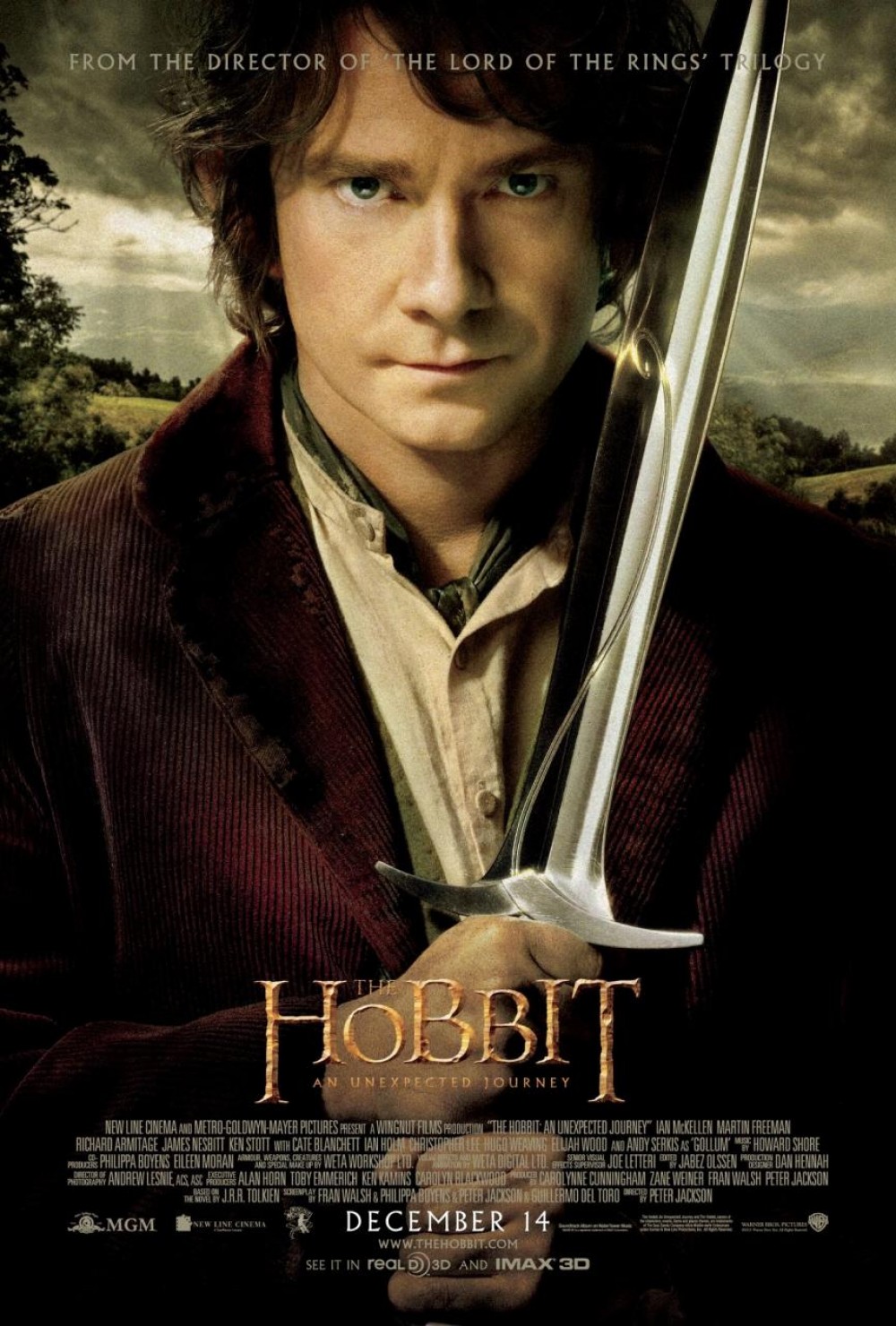
To Dungeons Deep and Caverns Old: "The Hobbit: An Unexpected Journey"


Full disclosure: Until a few weeks ago I had never actually read J.R.R Tolkien's classic novel The Hobbit. I know, pretty shameful, right. Then again, I didn't read Tolkien's The Lord of the Rings books until the movies were coming out either, so I shouldn't be too surprised I didn't read this novel sooner. After reading the novel, I was excited to see the events of the novel on screen. Unfortunately, like everyone else, I had to be prepared only to see part of the story on screen. Director Peter Jackson, who is returning to Middle Earth more than 10 years after directing The Lord of the Rings Trilogy, decided to expand The Hobbit in to three movies, making it a companion trilogy to The Lord of the Rings. Originally, when Guillermo Del Toro was going to direct, and even when Jackson took the director's seat, it was going to be a two parter but then in September, it was announced that extra footage would be shot in order to make a third film. The three films would incorparate events and information from Tolkien's appendices, written after The Hobbit, in order to increase the scale of the film, as well as tie the story in to the events from The Lord of the Rings.

Now, when it was announced that The Hobbit would be three films, I, like many other people, was disappointed and confused about the purpose behind expanding a slim book like The Hobbit into three films. It felt unnecessary and a little too indulgent, almost like Jackson was trying too hard to make this in to an event like The Lord of the Rings, which is a pretty big risk since you're inviting comparisons to an iconic and history making series of films, which you yourself directed. The Hobbit, while it does have a few epic battles, is a much smaller scale story than The Lord of the Rings, and I don't think that a film version could ever compare to The Lord of the Rings Trilogy, even with Jackson at the helm.

Having finally seen the first film in this new trilogy, The Hobbit: An Unexpected Journey, I'm still sceptical of the expansion of the novel. But I'm also more of two minds about it then I was before. On one hand, Tolkien's novel is very episodic, and if  adapted too literally in to one movie, events could end up being rushed and the film could feel like it was just bouncing from one unrelated event to the next. The extra material, taken mostly from Tolkien's appendices, helps give the story a more traditional flow, as well as tie it in to the larger mythology of  Middle-earth. On the other hand, the structure of this first film does suffer from having to create a three act structure around only six chapters of the novel, as well as trying to incorporate larger mythological exposition that relates to the return of the evil Sauron, the villain of The Lord of the Rings Trilogy. And at nearly three hours, one can't help walking out of the theatre wishing the film could've been tightened up, or at least covered more ground from the actual novel.

Critic Joanna Robinson said she felt Jackson was underestimating the power of the source material and the beauty of its simplicity by expanding upon it. I see what see means, and somewhat agree with her. At the same time, I think Jackson, when faced with the task of going back and telling the backstory of Bilbo Baggins, had a dilemma on his hands. As wonderful as the source material is, going back and adapting it after tackling The Lord of the Rings is somewhat ant-climatic. While I don't doubt Jackson respects the source material, he probably felt that if he was going to adapt The Hobbit he'd need to expand upon it in order for it not to appear too small scale next to his original trilogy.

People have already made comparisons to George Lucas and the first Star Wars prequel, The Phantom Menace. It's an understandable comparison but at the same time feels a little forced, almost as if people want to hate Jackson and make him in to the bad guy- everything he's doing is wrong, he raped my childhood, etc. While I'm not saying you can't criticize Jackson's decisions, I don't think making him in to a villain who has ruined The Hobbit and by default his prior trilogy is the right way to go about things. As a director he has to make difficult decisions, as well as follow his own heart, even if things don't turn out perfectly.

Now, I realized I've been meandering and going back and forth without coming down firmly on what I actually thought about the film. Well, if you've stayed with me until now I can say that I enjoyed The Hobbit and felt that, while it does have structure problems due to being only one part of a larger story, it works due to a endearing central performance, and a solid sense of pace even at nearly three hours. The climatic action scenes are wonderfully staged and a return appearance by a fan favourite character makes for one of my favourite scenes of the year as well as one of my favourite scenes of the four Jackson-directed Tolkien films.

The film begins with a prologue narrated by the Hobbit of the film's title, Bilbo Baggins (Ian Holm, reprising his role from the original trilogy), who plans to write down the story of his adventures for his nephew Frodo (Elijah Wood). This is on the very day that The Fellowship of the Ring begins. He tells of the destruction of the Dwarf kingdom by the dragon Smaug, who steals their gold. The Dwarf king's grandson Thorin (Richard Armitage) and a band of Dwarves seek to retrieve the gold from Smaug. This is where the younger Bilbo comes in. The wizard Gandalf the Grey (Ian McKellen, also reprising his role) has the band of Dwarves meet him and Bilbo at Bilbo's home one evening where Bilbo is recruited by the Dwarves to be their "burglar." Due to his ancestry, Gandalf believes Biblo is the right man, er, Hobbit for the job. Biblo is at first very reluctant, since Hobbits are peaceful, care free creatures who don't go on adventures. Nevertheless, in the morning Biblo decides to go along on the journey with the Dwarves and Gandalf.

Martin Freeman plays the young Bilbo and as I mentioned earlier, he gives a really endearing performance. He strikes a nice balance between capturing the spirit of Holm's performance from The Fellowship of the Ring while still bringing his own sense of personality to the role. Freeman makes us wish he were our uncle, someone afraid of the larger world yet still itching to experience it. The appeal of the novel, of breaking out of your normal day-to-day and life and going on an adventure is encapsulated in the scene when Bilbo runs to catch up  with Gandalf and the Dwarves, replying to another Hobbit that he's "going on an adventure"- the joy of this scene and Freeman's performance is very touching.

McKellen, of course, was born to play the role of Gandalf, and as he did in The Lord of the Rings Trilogy, gives Gandalf a combination of gravitas as well as whimsy and mischievousness. The film does have one problem that stems from the book, which is that on several occasions Gandalf disappears for a while only to reappear just in time to save Bilbo and the Dwarves. Gandalf's disappearances and reappearances wouldn't be as problematic if they were only limited to one, or if they had stronger thematic ties to the story, such as when Gandalf reappeared as Gandalf the White in The Two Towers.

Richard Armitage also does fine work as Thorin, the most developed of all the Dwarf characters. There's a scene late at night where one of the Dwarves recounts a battle between the orcs and the Dwarves, where Thorin cut off the arm of Azog, an Orc War chief. The Dwarf says that during this battle he realized Thorin was a Dwarf he could call king. it's a testament to Armitage's screen presence that we also believe Thorin could be King. On another note about Dwarves, on screen, it's harder to have all these Dwarves walking around then it was for Tolkien to just write that there are 13 Dwarves on the journey. It would've been nice to get more character development for some of them but I assume this series will mostly focus on Bilbo, Gandalf and Thorin.
 
Seeing Gollum (Andy Serkis) again was a real treat. Andy Serkis, with the aid of motion capture technology, once again makes Gollum a fully realized dramatic character, tragic yet funny, disgusting yet adorable. The "Riddles in the Dark" chapter from the novel, where Bilbo discovers and takes Gollum's ring, which is actually the One Ring of power, forged by Sauron in order to rule Middle-earth, was one of the best parts of the novel, and so it goes for the film as well.  Bilbo and Gollum play a game of riddles that will either end with Gollum leading Bilbo out of a cave or eating him whole. The scene is both suspenseful and hilarious. There's also a very moving moment where Bilbo, who is invisible due to wearing the ring, has the oppurtunity to kill Gollum but doesn't. It brings to mind the moment from The Fellowship of the Ring where Gandalf tells Frodo that it was out of pity that Bilbo didn't kill Gollum.

The added material, specifically the scenes with Gandalf and the White Council, which features more returning characters and cast members, Elrond (Hugo Weaving), Galadriel (Cate Blanchett) and Sauruman (Christopher Lee), ties in to the overall mythology of Middle-earth, Sauron and the One Ring of power. The wizard Radagast the Brown (Sylvester McCoy) gives Gandalf information that hints at the possible return of Sauron, which we all know will happen, as well as that Bilbo's finding of the Ring ties in to the fate of Middle Earth. This material does give the film an assertive yet subtle foreshadowing of the epic battle that is to come in 60 years, which is pretty cool, but it also seems beside the point of the main thrust of the story. I do hope that as the films progress, the extra material concerning the future of Middle-earth and the main adventure of the novel are more intertwined thematically.

Coming back to the Star Wars comparisons, once the six films were complete, it became clearer than ever that this was the story of a father and son, the father's fall from grace and his redemption through his son. In Jackson's mind, it seems that he sees the story of The Hobbit and The Lord of the Rings partly as a story about an uncle and nephew, two Hobbits who find themselves shaken out of their normal routines and see their lives tied in to the fate of Middle-earth. I'm willing to go with whatever vision Jackson has for this story, even if the films become too bloated. I think that the finished product will work better than any of the stand alone films. Not that you can't judge this film on its own merits, but that you ultimately have to be patient, particularly in this era where franchises are very serialized in terms of their storytelling. I feel The Hobbit Trilogy will ultimately have a better reputation than the Star Wars Prequel Trilogy and will honour and compliment The Lord of the Rings Trilogy. I'm excited to see the next chapter in this trilogy, particularly with that great final shot- pure evil, waking up. So, if you're a fan of this world, go see this film, be open minded, and I think you'll have an enjoyable time.

Friday, 13 January 2012

Midnight Madness: "Midnight in Paris"


Warning: Spoilers Below

Woody Allen's Midnight in Paris is a slyly funny and charmy, as well as almost achingly poignant and nostalgic film. It's this combination that makes the film, despite its small scale, quite meaningful.

The film opens, appropriately, with images of Paris. As the images go by, the day progresses, until we reach...midnight. This opening will no doubt remind Allen fans of his 1979 film Manhattan, which opened with gorgeous black and white images of New York City. The difference between the two openings is that while Manhattan's opening was almost overwhelming and romanticized, Midnight in Paris's opening is rather low key. The images, in colour, as the rest of the film, are romantic but don't seem romanticized. This is a nice contrast with what our main character, Gil Pender thinks of the city in the opening lines of the film, in conversation with his fiance Inez (Rachel McAdams): 

Gil: This is unbelievable! Look at this! There's no city like this in the world. There never was.
Inez: You act like you've never been here before.
Gil: I don't get here often enough, that's the problem. Can you picture how drop dead gorgeous this city is in the rain? Imagine this town in the '20s. Paris in the '20s, in the rain. The artists and writers!
Inez: Why does every city have to be in the rain? What's wonderful about getting wet?


From the very first lines, Gil is established as a romantic. While the opening images may not be romanticized, and we may be exhausted by the end of the opening montage, but Gil sees these images through a romantic's lens. Gil is a successful Hollywood screenwriter but Gil sees himself as a hack. While on vacation in Paris with Iznez and her parents, Gil wants to write a novel, which may have less to do with actual ambitions, than the romantic notion of being a writer in Paris.

Gil finally gets to live the romantic's dream when one night while walking through the city he is transported back in time to 1920s Paris. There he meets F. Scott Fitzgerald (Tom Hiddelston) and his wife Zelda (Alison Pill), as well as Ernest Hemingway (Corey Stoll). Stoll is subtly hilarious as Hemingway. While I haven't listened to a lot of recordings of Hemingway speaking,  I believe Stoll modelled his speech pattern for this film as the real Hemingway. There's a scene, during the second night Gil goes back in time, where a cab pulls up and Gil opens the door. We don't see who's in it but hear Gil say "Hello Mr. Hemingway." We then cut to a close up of Hemingway talking about war. After a while we cut to Gil's reaction and question. Another director or writer would have shown Hemingway earlier in this scene and would have inserted more reaction shots from Gil. By shooting it this way, Allen gives the scene a slightly off balance and humourous feel. As Hemingway keeps talking you're reminded of  Hemingway's sparse sentences and think to yourself, "Oh my God, did he really talk like that?

Gil goes back in time each night, getting advice on his novel, and escaping the annoyance of Inez's gushing over her old friend Paul (Michael Sheen), who is a classic Woody Allen type, the psuedo-intellectual. Sheen does a good job of not overplaying the part. He captures exactly what you'd expect from a guy who's probably smart but over compensates. While I've liked Wilson before I've never been as taken by him as I have here. Wilson does a fine job of blending the laid back nature we associate with his performances with a certain Woodyness that's not an imitation of Allen but rather a channeling of his spirit (I believe Allen has said he would have played the part in the seventies). 

While one of Rachel McAdams' most notable roles is that of Regina George in Mean Girls, we usually associate sweetness with her as an actress. I think it took me a while on first viewing for it to register that her Inez is kind of a...well...you know. Like Sheen, McAdams does a good job of not overplaying her role and while Inez could have been developed more (you feel her and Paul don't get proper payoffs), the point of the film is that there is always a disconnect between her and Gil. Whoever Inez truly is as a person,when she's with Gil, any positive qualities have a hard time coming out.

All the actors in the 1920s sequences are having a lot of fun, particularly Stoll as well as Adrien Brody, playing the surrealist painter Salvadore Dali. I would have liked to have spent more time with these characters. There are a lot of comedic possibilities which Allen could have explored. While it also would have been nice to further develop some of these characters, they're such vivid personalities that you don't seem to mind.

What I really admire about the film, is that the film is less about the famous icons of the period then it is about Gil's relationship with a French woman named Adriana (Marion Cotillard). Cotillard is wonderful here, seductive yet vulnerable, filled with a yearning, like Gil, for a earlier time. This relationship growns the film and ultimately leads to what Allen is getting at in this film, which is nostalgia, can blind someone to their life in the present, particularly when its nostalgia for a different time period. When Gil and Adriana go back in time even further to the 1890s, Adriana wants to stay. Gil realizes that everyone, no matter what time period they live in, has their "golden age." Adriana wants to live in the 1920s, the people from Paris in the 1890s want to live in the Renaissance. Allen seems to be saying that we're the only ones who can appreciate the period in which we live, whereas people looking back at that period always view it through a romantic lens. While the world may never be perfect, we have to make the time we have, and the time we in live in, a golden age, because an actual golden age can never truly exist. It's a slightly sad but wise message.

 It'd be easy to label Allen as being hypocritical with this message due to how the film's 1920s sequences are romantic.  I don't think that's the case. I feel Allen is very sympathetic to Gil's romantic yearnings since Gil seems to be based, in some respects, off of Allen. Also, Allen doesn't demonize nostalgia but acknowledges it as part of human nature. He even gives Paul a line of dialouge where he describes the notion of "Golden Age Thinking," which people like Gil experience. Gil gets the rare chance to experience the time period he loves. It's through this experience that Gil is able to move on. The end of the film suggests new beginnings for everyone. I don't think Gil is no longer a romantic by the end of the film and I don't think Allen expects him to. It's going to be a process for Gil.  But it'll be okay. In one way or another, he'll always have Paris.

P.S. I still haven't seen Allen's The Purple Rose of Cairo, which also deals with similar themes. I need to get on that!