Showing posts with label Rachel McAdams. Show all posts
Sunday, 12 May 2013
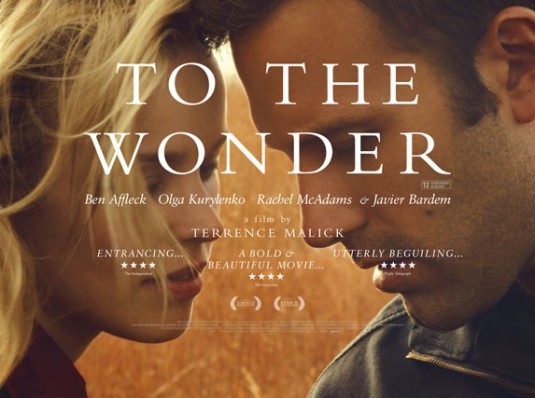
I Write On Water What I Dare Not Say: Some Thoughts on Terrence Malick's "To The Wonder"
As I was watching Terrence Malick's latest film To The Wonder the other night, it occurred to me that, love him or hate, Malick is among the handful of directors, past and present, that has completely infused himself in to every fibre of his films. It's not just that he has a particular style, but that's there not a single moment in this film, or his previous few films, that he's not present. He's there in every image, camera movement, line of dialogue and even performance. Wes Anderson is similar in that regard, and maybe even Stanley Kubrick but I can't think of many directors that have become so much part of their films. I think it's hard to review a Malick film, particularly now, since his films exist outside any typical narrative structure- so this will be more of a "thoughts on" piece rather than a "good or bad" summary. Overall, I liked the film and maybe even loved it. While it's not as monumental a work as his previous film, The Tree of Life, it's a lovely and often beautiful film, telling a simple but universal film about finding and losing love.
The film tells the story of Neil (Ben Affleck) and Marina (Olga Kurylenko) who meet in France and move to Oklahoma to start their life together. Complications in their relationship leads to Neil and reconnecting with his childhood sweetheart Jane (Rachel McAdams). A parallel storyline focuses on Father Quintana (Javier Bardem), a priest struggling with his faith.
Malick tells these stories, as to be expected, through impressionistic imagery and hushed voiceovers. But in this film I found that Malick was moving even further away from dialogue, crafting something focused very much on the physicality and movements of the actors- particularly with Kurylenko and McAdams. I don't think either of these women have ever looked more gorgeous. By just looking at them, watching them move, their beauty really shines through in a pure way.
Journalist and filmmaker Bilge Ebiri wrote a piece interpreting the film as a dance, a ballet. All one has to do is look at Kurylenko and her movements in the film and it becomes clear what Ebiri is talking about and what Malick is trying to achieve. Moreover, I feel that Malick isn't just trying to create a ballet but he's fascinated in taking actors we recognize and using them in a fashion where their usual stature as an actor is stripped down to something quite simple. Think of Sean Penn in The Tree of Life. In this film, Affleck is just a normal man, not the hero of Argo or complicate bank robber of The Town.
This is the shortest gap between movies for Malick, who's taken up to 20 years between films. While it's exciting to get a new Malick film so soon after The Tree of Life, that film was such a bold and visionary piece of work, a film which could possibly be deemed a landmark film, that To The Wonder seems somewhat anti-climatic in comparison. Even if there was a bigger gap between the films, I didn't sense the level of ambition in this film that was present in The Tree of Life. But one has to take the film as what it is. To The Wonder is not as towering an achievement as some of Malick's other films but it's still a film in which we find Malick striving for pure visual poetry, which I think he achieves.
Malick has always had a fascination with exploring America's past- the late 1950s that gave birth to one of America's first serial killers, Charles Starkweather, in Badlands, the turn-of-the-century labor in Days of Heaven, the physical an existential conflict soldiers face during WWII in The Thin Red Line, and the founding of the Jamestown, Virginia settlement in 1607 in The New World. He returned to the 1950s in The Tree of Life- an course in that film Malick went beyond just exploring America's past- he literally dramatized the creation of the universe itself. To The Wonder is Malick's first film set entirely in the present day. I may have to see the film again but I didn't feel Malick was too preoccupied with modern day America- the story could've taken place in nearly any time. But then again, Malick's eye always seems to exist outside of time, showing us not the way things actually were in a given time period- but how they exist in the memory or dreams.
I'm still not sure how the Quintana storyline relates to the love triangle. His struggle with his faith reminds us of The Tree of Life, and also Ingmar Bergman, but it didn't feel directly tied to what has happening between Neil, Marina an Jane. 34444444444I've heard that Quintana's story is also a love story- one between him an God. I assume the relationship between Quintana an God is a spiritual relationship that's falling apart much like the physical relationships between Neil and the two women. I'll have to keep this in mind the next time I see the film.
The way Malick moved the camera in certain scenes reminded me of The Tree of Life- as well as the houses, which brought to mind the O'Brien home. Also, every thing seems bigger through Malick's camera- faces, places, it's a recognizable world but one that seems larger than life.
Those are my initial thoughts on the film. I wasn't as overwhelmed as I was the first time I saw The Tree of Life, but the film, like all of Malick's works, it'll require at least another viewing to completely take every thing in. It'll be interesting to see what To The Wonder's critical standing will be as time goes on, particularly in relation to how it's ranked amongst Malick's other films. The initial reviews have been mixed and maybe the reaction towards the film will always be divided. But for Malick enthusiasts, it's worth seeing and becoming part of Malick's singular world.
Friday, 13 January 2012
Midnight Madness: "Midnight in Paris"
Warning: Spoilers Below
Woody Allen's Midnight in Paris is a slyly funny and charmy, as well as almost achingly poignant and nostalgic film. It's this combination that makes the film, despite its small scale, quite meaningful.
The film opens, appropriately, with images of Paris. As the images go by, the day progresses, until we reach...midnight. This opening will no doubt remind Allen fans of his 1979 film Manhattan, which opened with gorgeous black and white images of New York City. The difference between the two openings is that while Manhattan's opening was almost overwhelming and romanticized, Midnight in Paris's opening is rather low key. The images, in colour, as the rest of the film, are romantic but don't seem romanticized. This is a nice contrast with what our main character, Gil Pender thinks of the city in the opening lines of the film, in conversation with his fiance Inez (Rachel McAdams):
Gil: This is unbelievable! Look at this! There's no city like this in the world. There never was.
Inez: You act like you've never been here before.
Gil: I don't get here often enough, that's the problem. Can you picture how drop dead gorgeous this city is in the rain? Imagine this town in the '20s. Paris in the '20s, in the rain. The artists and writers!
Inez: Why does every city have to be in the rain? What's wonderful about getting wet?
From the very first lines, Gil is established as a romantic. While the opening images may not be romanticized, and we may be exhausted by the end of the opening montage, but Gil sees these images through a romantic's lens. Gil is a successful Hollywood screenwriter but Gil sees himself as a hack. While on vacation in Paris with Iznez and her parents, Gil wants to write a novel, which may have less to do with actual ambitions, than the romantic notion of being a writer in Paris.
Gil finally gets to live the romantic's dream when one night while walking through the city he is transported back in time to 1920s Paris. There he meets F. Scott Fitzgerald (Tom Hiddelston) and his wife Zelda (Alison Pill), as well as Ernest Hemingway (Corey Stoll). Stoll is subtly hilarious as Hemingway. While I haven't listened to a lot of recordings of Hemingway speaking, I believe Stoll modelled his speech pattern for this film as the real Hemingway. There's a scene, during the second night Gil goes back in time, where a cab pulls up and Gil opens the door. We don't see who's in it but hear Gil say "Hello Mr. Hemingway." We then cut to a close up of Hemingway talking about war. After a while we cut to Gil's reaction and question. Another director or writer would have shown Hemingway earlier in this scene and would have inserted more reaction shots from Gil. By shooting it this way, Allen gives the scene a slightly off balance and humourous feel. As Hemingway keeps talking you're reminded of Hemingway's sparse sentences and think to yourself, "Oh my God, did he really talk like that?
Gil goes back in time each night, getting advice on his novel, and escaping the annoyance of Inez's gushing over her old friend Paul (Michael Sheen), who is a classic Woody Allen type, the psuedo-intellectual. Sheen does a good job of not overplaying the part. He captures exactly what you'd expect from a guy who's probably smart but over compensates. While I've liked Wilson before I've never been as taken by him as I have here. Wilson does a fine job of blending the laid back nature we associate with his performances with a certain Woodyness that's not an imitation of Allen but rather a channeling of his spirit (I believe Allen has said he would have played the part in the seventies).
While one of Rachel McAdams' most notable roles is that of Regina George in Mean Girls, we usually associate sweetness with her as an actress. I think it took me a while on first viewing for it to register that her Inez is kind of a...well...you know. Like Sheen, McAdams does a good job of not overplaying her role and while Inez could have been developed more (you feel her and Paul don't get proper payoffs), the point of the film is that there is always a disconnect between her and Gil. Whoever Inez truly is as a person,when she's with Gil, any positive qualities have a hard time coming out.
All the actors in the 1920s sequences are having a lot of fun, particularly Stoll as well as Adrien Brody, playing the surrealist painter Salvadore Dali. I would have liked to have spent more time with these characters. There are a lot of comedic possibilities which Allen could have explored. While it also would have been nice to further develop some of these characters, they're such vivid personalities that you don't seem to mind.
What I really admire about the film, is that the film is less about the famous icons of the period then it is about Gil's relationship with a French woman named Adriana (Marion Cotillard). Cotillard is wonderful here, seductive yet vulnerable, filled with a yearning, like Gil, for a earlier time. This relationship growns the film and ultimately leads to what Allen is getting at in this film, which is nostalgia, can blind someone to their life in the present, particularly when its nostalgia for a different time period. When Gil and Adriana go back in time even further to the 1890s, Adriana wants to stay. Gil realizes that everyone, no matter what time period they live in, has their "golden age." Adriana wants to live in the 1920s, the people from Paris in the 1890s want to live in the Renaissance. Allen seems to be saying that we're the only ones who can appreciate the period in which we live, whereas people looking back at that period always view it through a romantic lens. While the world may never be perfect, we have to make the time we have, and the time we in live in, a golden age, because an actual golden age can never truly exist. It's a slightly sad but wise message.
It'd be easy to label Allen as being hypocritical with this message due to how the film's 1920s sequences are romantic. I don't think that's the case. I feel Allen is very sympathetic to Gil's romantic yearnings since Gil seems to be based, in some respects, off of Allen. Also, Allen doesn't demonize nostalgia but acknowledges it as part of human nature. He even gives Paul a line of dialouge where he describes the notion of "Golden Age Thinking," which people like Gil experience. Gil gets the rare chance to experience the time period he loves. It's through this experience that Gil is able to move on. The end of the film suggests new beginnings for everyone. I don't think Gil is no longer a romantic by the end of the film and I don't think Allen expects him to. It's going to be a process for Gil. But it'll be okay. In one way or another, he'll always have Paris.
P.S. I still haven't seen Allen's The Purple Rose of Cairo, which also deals with similar themes. I need to get on that!
Subscribe to:
Posts (Atom)