Showing posts with label Ben Affleck. Show all posts

Tuesday, 23 March 2021

Hallelujah: "Zack Snyder's Justice League"


Spoilers Below


Zack Snyder's Justice League is a vindication for an often misunderstood and unfairly demonized filmmaker. It's also a reaffirmation that superhero films can be genuine artistic expressions. After viewing the film I'm not sure about what Warner Bros. was in such a panic they felt the need to bring in Joss Whedon to reshoot so much of it. If they wanted the lighter-toned, more optimistic superhero film, Snyder gave it to them. Man of Steel had a rough around the edges Superman make some mistakes on his way to saving the world and Batman v. Superman was a deconstructionist take on the superhero mythos; but ZSJL is the most traditionally superheroic film in the trilogy. I would argue it has the perfect tone- serious but not as heavy as MoS or BvS, with just the right amount of levity without feeling like a MCU film. And even without the behind the scenes turmoil ZSJL would still stand as a very good- even great- superhero epic.

Right from the first scene it's clear this version is a more fluid continuation of BvS  than Whedon's version as we witness Superman's  Henry Cavill) death at the hands of Doomsday from that film's climax. But just that film's beginning had us see MoS's climax from Bruce Wayne's (Ben Affleck) perspective, here Snyder shows us Superman's death screams awakening the three Mother Boxes, which the being Darkseid (Ray Porter) once used in an attempt to conquer Earth thousands of years ago before he defeated by an union between Man, Olympian Gods, Atlanteans, Amazons and Green Lanterns. After the battle the Mother Boxes were separated and hidden. 

BvS and ZSJL's openings emphasize how Snyder's films are about Superman's presence- and absence in the world. BvS had an angry and distrustful Bruce who viewed Superman as a threat to humanity. Here, Bruce understands Superman's death leaves Earth vulnerable to attack- largely in part to his conversation with Lex Luthor (Jesse Eisenberg). Bruce and Diana Prince/Wonder Woman (Gal Gadot)  have to recruit other metahumans- Barry Allen/The Flash (Ezra Miller), Victor Stone/Cyborg (Ray Fisher), and Arthur Curry/Aquaman (Jason Momoa) to combat Darkseid's emissary Steppenwolf (Ciaran Hinds), who is looking for the Mother Boxes.

ZSJL doesn't have the same complex plotting of BvS but it's not as streamlined as the theatrical cut.four hours there's more breathing room for the characters to be fleshed out, especially Barry and Victor, the latter cited by Snyder as being the heart of the film. I loved Barry's introduction when he save Iris West (Kiersey Clemons) from a disastrous car wreck using his speed powers. Scored to Rose Betts' version of Tim Buckley's Song to the Siren, Snyder reminds us how romantic a superheroic feat can be. Without  exchanging words I'm already looking forward Iris and Barry's relationship in Andy Muschietti's Flash movie. 

Victor is the film's most identifiable character since he's the League member who views his powers as a curse, the position many people in reality would take if they were half human, half robot. Victor resents his father Dr. Silas Stone (Joe Morton) for making him this way after he was nearly killed in a car accident that claimed his mother Elinore Stone (Karen Bryson). Silas used one of the Mother Boxes to save Victor and this bit of plotting efficiently makes the Stone family the central part of the story.

Victor is reborn as Cyborg and birth/death/rebirth is a major motif through Snyder's trilogy. MoS begins with Superman's birth and Krypton's death. General Zod's (Michael Shannon) motivation is create a new Krypton on Earth. BvS ends with Superman's death and Bruce's rebirth as a more hopeful man. Clark Kent is reborn as the traditional Superman. He died sacrificing himself for humanity, proving to humanity how much he cares for them. When he returns- again, using a Mother Box- it's significant the first thing he sees is the memorial dedicated to him. And when he's fighting the League due to memory loss, it's Lois Lane (Amy Adams), who brings him to his senses, the person for whom he died. She, along with his mother Martha Kent (Diane Lane) represent humanity's best to Superman.

Snyder is known for his bombastity but Snyder is capable of incredibly intimate moments, some of the best in the genre. The scenes on the Kent farm in ZSJL are nostalgic and  warm, homaging Richard Donner's Superman: The Movie while still working on its own merits. It's about a family coming together, a man with the most important women in his life, finding peace even when the world may come to an end. 

Family is another big theme in this film; as I've already pointed out the Stones are central to the story and Superman has Martha and Lois. Bruce becomes part of a family again after the death of  his adopted son Robin. Diana has her mother and sisters on Themyscira and Arthur has unresolved issues with his Atlantean mother and human father. Barry 's father Henry Allen (Billy Crudup) is falsely imprisoned for the murder of Barry's mother (comic fans know what the backstory behind that is). And speaking of mother, the McGuffins are called Mother Boxes. Moreover, Steppenwolf is Darkseid's uncle who wants to get back in his favor after betraying him. 


I've talked quite a bit about the character stuff here so now I just want to say that Snyder creates the most visually bold and beautiful comic book movies. Snyder shot in the 4:3 aspect ratio, which gives the film wholly different feel than any other superhero film. Snyder has talked about his decision to shoot the film in this manner and how it was supposed to be seen in IMAX: Why Zack Snyder’s Justice League is in a 4:3 Aspect Ratio | Den of Geek

The film's cinematographer Fabian Wagner and Snyder create some truly right-off-the-page comic book images, which brings me to the "Knightmare" timeline, first glimpsed in BvS, where Darkseid has won and Superman is under his control. The Knightmare scene at the film's end is so comicbooky and I love it for that. The fact we have Arthur's queen Mera (Amber Heard) and the Joker (Jared Leto) is kind of incredible. And the dialogue between Batman and Joker feels ripped from an actual comic book.

There's more I'll probably write about ZSJL but for now I do really hope the "Snyderverse'' is restored. There's so much potential for this universe going forward. Snyder no doubt has a vision and embraces the craziness of the comic book universe. And if we're going to keep making comic book and superhero films we directors and writing to push the genre forward to avoid stagnation. So, what did you think of ZSJL? Comment below and let me know.

Monday, 5 October 2020

On Multiverses and the Return of Jamie Foxx's Electro


This past week it was announced Jamie Foxx was in talks to reprise his role as Max Dillon/Electro in the next Spider-Man film starring Tom Holland. The question I have is whether Foxx will be playing the same Electro seen in  The Amazing Spider-Man 2- since Marvel Studios is establishing a multiverse via the Sam Raimi-directed Doctor Strange in the Multiverse of Madness- or if he'll be playing a completely different version of the character- similar to J.K. Simmons returning as an alternate J. Jonah Jameson in Spider-Man Far From Home (which I still haven't seen). Foxx posted on Instagram, teasing he won't be blue this time, implying this will be an Electro unique to the MCU.

TASM 2 wasn't a beloved film-though it does have its fans-and Foxx's take on Electro was compared to the Joel Schumacher Batman villains. By starting over with the character Marvel doesn't have to worry about bringing in that baggage. They can also give him a different character motivation that doesn't have to revolve around Spider-Man. The film can then focus on Spider-Man rather than the larger universe/multiverse.

I still believe a live action Spider-Verse movie could come to fruition. Tobey Maguire returning would have the nostalgic value Michael Keaton will bring to the upcoming Flash film with Ezra Miller. That film will also bring back Ben Affleck's Batman, making it somewhat of a Bat-Verse film. A Spider-Verse film could also give Andrew Garfield the send-off he never got due to the TASM series being cancelled.


The idea of a multiverse is the next stage in building upon the cinematic universes of DC and Marvel, albeit the DCEU is a more loose continuity than the MCU. Miller has already cameoed on the CW Network's Crisis on Infinite Earths crossover event. Said event established that all the previous versions of the DC universe are part of a larger multiverse. The problem, of bringing a multiverse to the big screen is the risk of these kinds of crossovers becoming too gimmicky, though in fairness gimmickry is ingrained in comic book storytelling. The further the movies go with this conceit the more convoluted and alienating it may get for general audiences who may not want to keep track of everything. By the 80s DC comics' continuity became so complicated they needed to fold in everything in to one universe. This was the basis for  the Crisis on Infinite Earths storyline.

As comic book movies become more like their source material audiences may yearn for the earlier films that didn't require as much homework. Comics can often feel very niche and if these movies still want to be the reigning blockbusters they'll have to keep their audiences engaged rather than confused. The idea of a cinematic universe was a gamble that paid off. The question of when the superhero movie bubble will burst- if ever- has long been pondered. The multiverse will be a test of how far this genre can go in replicating the weirder and convoluted aspects of its source material.

So, how do you feel about Jamie Foxx coming back as Electro? Were you a fan of the TASM series? And what are your thoughts about comic book multiverses being brought to the big screen? Comment and let me know.


Monday, 20 May 2019

On Robert Pattinson as Batman and Fan Entitlement.


When it comes to comic book movie- or any big Hollywood movie- casting, history, as in all things, repeats itself. With Robert Pattinson announced as the new Batman in Matt Reeves' upcoming film,
there's already a petition to replace Pattinson, just like his predecessor Ben Affleck when his casting in Zack Snyder's Batman v. Superman was announced. They're both in good company though.

When Michael Keaton was first cast as Bruce Wayne/Batman in Tim Burton's 1989 Batman (which, like me, celebrates its 30th anniversary this year), the reaction from fans was less than positive. Keaton was known for his comedic roles in films such as Mr. MomJohnny Dangerously and Burton's Beetlejuice. Due to Keaton's comedy background, the impression was Burton's film would be similar the Batman TV show from the 60s starring Adam West, which was notably comedic, whereas fans were hoping for a more serious take. 

Burton's film would ultimately turn out to be a fun-house mirror version of the 60s series, with Jack Nicholson's Joker being a more psychotic take on Caesar Romero's performance. West played Batman as just a normal guy dressing up in a Bat-suit; Keaton brought a strong silent presence to his portrayal of the Caped Crusader and played to his comedic strengths as Bruce Wayne. Keaton's performance was a slightly "off" version of Wayne, a version of the character that emphasized how weird and anti-social a guy who decided to dress up as a bat would be. Now, it's hard to disassociate Keaton from the role, especially for my generation who grew up with Keaton and Burton's two films.

Heath Ledger's casting as the Joker in Christopher Nolan's The Dark Knight was met with intense scepticism who couldn't see Ledger as a psychotic clown. Ledger would go on to posthumously win the Oscar for Best Supporting Actor, the only actor to win an Oscar for a superhero film. And his performance is still seen as the benchmark for super-villain performances.

Even Robert Downey, Jr. as Iron Man was met with resistance. But his performance and the original Iron Man gave birth to what's arguably the biggest franchise in film history, the Marvel Cinematic Universe. 

Image result for heath ledger joker

It's okay to have doubts regarding an actor's casting but creating a petition to recast an actor before they even give a performance is, I believe, dictating the film-making process. I feel certain fans want to control the making of these movies when t's the director's crew and cast whom craft it. Pandering to fans does not a good movie make. Look at Justice League, which was re-shot from Snyder's original version to accommodate fans who disliked Batman v. Superman and Man Steel. It ended up making Superman a caricature and losing any of the edge and thematic aspiration that Snyder brought to his previous two films. 

There's also a petition to remake Season 8 of Game of Thrones and before that one to remake The Last Jedi. However one feels about the new season of GOT (I haven't seen it but know the events of the previous episode) or The Last Jedi, they will never be remade. Ultimately they have be viewed as they are, good or bad, or somewhere in between. I have my criticisms of The Last Jedi but there will never be a version of the film which "fixes" my issues with it. Being critical of the media you consume is healthy but wanting an artist to somehow to remake or change a film or TV show reeks of entitlement. Now, there are cases a where a director has gone back and tinkered, added or eliminated things from a film. Oliver Stone continued to rework his maligned Alexander. Ridley Scott went back twice to Blade Runner and of course George Lucas notoriously added to special effects to the original Star Wars trilogy. While it is possible for a film to be changed down the road, in these cases it was the directors' choice to go back and alter their films. Their reasons had to do with their creative fashion rather than fan dictation.

Coming back to Pattinson, I think he's a tantalizing choice for the role because like Keaton and Bale, and even Val Kilmer, he's not a conventional leading man. In his roles in David Cronenberg's Cosmopolis and the Safdie Brother's Good Time, has an off-kilter quality that befits the weirdness inherent in Bruce Wayne's character. I also admire Reeves as a filmmaker. The last two Planet of the Apes films are what more Hollywood blockbusters should aspire to be. So now I leave it to you. What you think about Pattinson's cast as well as fan petitions? Comment below and let me know.

Friday, 2 September 2016

"Men are still good:" An essay on "Man of Steel" and "Batman v. Superman"


Warning: Spoilers for both films will follow


I don't think it's too hyperbolic to say that Zack Snyder's Man of Steel and Batman v. Superman: Dawn of Justice are arguably the most controversial and divisive superhero films ever made. They've received both intense hate and love, which isn't surprising. From tone to characterisation, these are not the films many people want. For many, these films are too dark, too violent ("Batman and Superman shouldn't kill"), and don't have enough levity. For me, MoS and BvS are two of the boldest examples of modern blockbuster film-making- significantly flawed but still potent and filled with numerous moments of visual and emotional beauty. This essay will focus on MoS and BvS' thematic concerns rather than attempt to outright review the films. 

On an important side-note, with the newly released Batman v. Superman: Dawn of Justice- Ultimate Edition on Blu-ray, (which contains 30 more minutes of footage), we're able to see Zack Snyder's original vision for his much maligned film. The Ultimate Edition is fuller and more cohesive. It also feels like the three hour epic as which it was originally conceived.The film's reputation has gained some much needed positivity due to the Ultimate Edition, which I think is helpful as we move closer to next year's Justice League. 

Beginning with MoS, the film shares structural similarities to Christopher Nolan's Batman Begins (David S. Goyer wrote both films, Nolan shares a story credit and is a producer on MoS). Like Batman Begins, MoS has a fractured narrative. As the ship carrying baby Kal (Superman's Kryptonian name) is about to crash on earth, we cut to adult Clark Kent (Henry Cavill) working as a fisherman. It's an elegant way to start at the beginning  of the Superman story (Krypton's destruction) while not wasting time getting to Clark as an adult. We then witness, via flashback, Clark's childhood, where he learns about and struggles with his super-human powers. In the present an adult Clark finally discovers where he came from and of his real purpose on Earth.

By employing a flashback structure, MoS distances and diversifies itself from Richard Donner's original classic with Christopher Reeve, which told its story linearly. And by positioning the scenes of Clark's childhood and young adulthood as flashbacks, it makes the experience of the film more intimate; Clark reflects on the moments of his life that defined him, which inform the moments in the present. The scenes of MoS where Clark is discovering where he came from- are its strongest. They feel less like a traditional superhero film than an independent film about someone who has super powers. When General Zod (Michael Shannon) and his fellow Kryptonians come to earth, the film becomes an alien invasion sci-fi film that happens to have Superman in it.

Both MoS and BvS also approach the concept and character of Superman from a very specific angle, which is, how would people react if Superman actually existed in our world. Some would worship him as a saviour, some would fear him or even hate him, and some wouldn't know how to feel. The film-makers approached MoS as a first-contact story- our first encounter with alien life. By being a story about Earth's first encounter with alien life, MoS isn't just a story about Superman, it's a story about the whole being at the precipice of a new chapter in history. The attempted terra-forming and subsequent battle of Metropolis are ground-zero for everything going forward in the DCEU (DC Extended Universe). We are shown a modern and realistic world that witnesses the birth of a modern mythology. The events of the film will be spoken about for generations to come. The arrival of Superman has irrevocably changed the course of world history.


Image result for superman kills zod


At the end of MoS, Superman is forced to kill  Zod the most controversial moment in either film. I don't want to get in to whether Superman should or shouldn't kill. In the context of the film I feel killing Zod is a sacrifice Superman has to make for humanity. He has to kill the last of his race so that the Earth can survive. This makes him the last living Kryptonian on the planet. By showing he is able to sacrifice Krypton for Earth he becomes the representation of Krypton to Earth- the bridge between Krypton and Earth of which his birth father Jor-El (Russell Crowe) spoke.

Moving on to BvS, in that film's news montage, Vikram Gandhi (playing himself) person says the arrival of Superman is a "paradigm shift," and that we can't presume to make Superman abide by our rules- it just won't work. While we Gandhi states people have to start to thinking beyond politics. But as Andrew Sullivan (also playing himself) says, whatever Superman does can be construed as a political act. Sullivan's statement appears to me to be a comment on the image of Superman as an all-American hero. In the modern era, Superman has to represent everyone and care about the state of the whole world- but again, as grand a figure as he is, he can't really escape the political implications and ramifications of his actions. "Must there be a Superman?" Charlie Rose asks Senator June Finch (Holly Hunter). Her blunt answer: "There is." Superman is here, regardless of whether people want him or not; he is part of their existence. This one line conveys how it would feel to know- and have to accept- someone like Superman existing in our world. 

And maybe people do need a Superman. All super-heroes inspire us to be better and Superman represents this idea of inspiration better than all the others. While some may find Superman outdated, I think he remains relevant in our current time. There is so much hatred and cynicism that poisons the world. that what Superman stands for is still important: Hope. The hope that we can be better as a people if led the way, if we come together instead of continuing to push each other away.


One criticism of both MoS and BvS is they don't have the optimistic and light-hearted tone that we'd expect from a Superman film. And that's true- but despite being quite serious dark in many places, I believe there is an optimistic undercurrent to both films. In MoS, Superman gaining Colonel Nathan Hardy's (Christopher Meloni) trust and respect when he saves Hardy from Kryptonian Faora (Antje Traue) during the fight in Smallville shows Hardy's- and mankind in general- ability to look beyond his prejudice and see Superman as a hero and ally rather than just an alien. And during the film's climax, Perry White (Laurence Fishburne) stay with Jenny (Rebecca Buller) as Metropolis is crumbling around them, displaying the compassion that even the most hardened man is capable of showing.   

Most importantly, by the end of BvS Superman has restored Bruce Wayne's (Ben Affleck) faith in humankind. In the film's closing scenes Bruce tells Diana Prince/Wonder Woman (Gal Gadot), "Men are still good. We fight. We kill. We betray one another. But we can rebuild. We can do better. We will. We have to." Bruce has spent most of the film hating and wanting to kill Superman- but in a bitter-sweet irony, Superman's sacrifice and death in the fight against Doomsday has shown Bruce a person's ability to be selfless and good. Superman still struggles with being a symbol of hope throughout BvS. People still question his motivations- politically and morally- throughout the film. Through his death at the film's end, I feel he becomes that symbol. His death rises him above politics and fear, and his absence allows humanity to reflect on his time on Earth and how they'll move forward. Superman's sacrifice ties both he and Bruce's arcs nicely together. 

Speaking of Bruce Wayne, I think along with Batman BeginsBvS features the best exploration of Bruce/Batman in live-action. The film begins with the funeral of Bruce's parents, Thomas and Martha Wayne- which bookends with Superman's funeral at the end. Just as MoS began with the cries of baby Kal El- the first natural birth on Krypton in centuries- BvS begins with the "birth" of Batman. In a dream sequence where he's at his parents' funeral Bruce falls down a hole and is swarmed by bats who- in one of the film's most striking images- bring him back up to the surface- to a "beautiful lie," as Bruce tells us in voice-over.

We then witness the Battle of Metropolis from Bruce's perspective. This first scene with the older Bruce establishes his motivations for wanting to destroy Superman. He blames Superman the destruction of Metropolis and the loss of the people in of his buildings. He comforts a girl who lost her mother in the destruction. Part of what drives Bruce in his mission as Batman is the need to prevent his tragedy happening to another child. The orphaned girl further fuels Bruce's rage.


He also fears what would happen if Superman decides to turn against mankind. This is highlighted by the "Knightmare" sequence in which Bruce sees a possible future where Superman is a tyrant (reminiscent of the Injustice video game and the subsequent comic book series it inspired). This sequence is a miniature movie in itself. It both reflects and reinforces Bruce's fears of Superman's unlimited capabilities. 

Just before the fight between Batman and Superman, Bruce tells Alfred (Jeremy Irons) that killing Superman will be his legacy. Bruce feels that criminals are like weeds but eliminating Superman will secure the survival of the world. This is an point-of-view from the character I don't think has ever been explored in the comics- Bruce thinking about a legacy outside his war on crime. Maybe it wouldn't work in the comics medium but in a film it makes sense. This Bruce has aged in real time- 20 years in Gotham as the Batman. This exchange between Bruce and Alfred also conveys that Bruce has been driven over the edge by Superman's presence in the world, on top everything else he's experienced through his. He's willing to fight a super-human being so he can secure a legacy beyond that of beating up criminals, one that's befitting of the Wayne name- "They were hunters," Bruce says of his ancestors.

Bruce also mentions he's older than his father ever was. Like other superheroes that followed them, Superman and Batman's beginnings are based in the loss of parents. MoS is very much a film about fathers, as Superman has two- his aforementioned Kryptonian father Jor and his adopted father, Jonathan Kent (Kevin Costner). Jonathan is protective of his son, knowing he's meant for something greater but afraid what will happen when he reveals himself to the world.

If MoS was largely about fathers, then BvS is about mothers. The "Martha" scene has been the subject of much ridicule. People read the scene as Batman becoming Superman's ally just because their mothers share the same name. But I think it goes deeper than that. Batman realizes he's been manipulated by Lex Luthor (Jesse Eisenberg). He also finally sees Superman as someone with genuine humanity- he has a mother who he's trying to save. Batman has an epiphany, which brings him back from the edge.

Now, about Lex Luthor. I feel BvS' Lex is one of the more unusual villains in recent comic-book movie history. Eisenberg's interpretation is the most eccentric Lex we've seen on screen thus far. His motivations have nothing to do with taking over the world or real estate. All the intricate plot mechanics- which were muddled in the theatrical version of BvS- are in service of Lex's anger from a childhood trauma that never healed. Lex tells Superman that no God saved him when his father physically abused him. To Lex, Superman represents the God who was never there when he needed him. Lex directs all his hatred toward Superman and wishes to prove that the perfect God figure isn't perfect- when pushed, he'll kill someone to save his mother. Though, ironically, Lex's plan is self-destructive, since kidnapping Martha Kent (Diane Lane) is what brings Batman over to Superman's side.

Despite its title, BvS isn't really about Batman and Superman fighting. Yes, it's pivotal sequence in the film and the plot threads of the film lead to it- but BvS is more about bringing these heroes together. What's more satisfying than seeing these two titans duke it out onscreen is seeing them reconcile- to witness Batman seeing Superman for who he really is. "I failed him in life. I will not fail him," says Bruce at the end. This line solidifies Bruce's arc in the film; and it says a great deal about how our relationship with someone can drastically change. Bruce began hating Superman but now he'll make certain his sacrifice isn't in vain. Superman's death is the basis for gathering the Justice League, a team that will honour his memory. And when Superman returns, he will lead this team. I don't find the tease of Superman's return in the film's closing shot cheap. The film slows down in it's final scenes, allowing the audience to feel weight of his loss and how it affects the world.
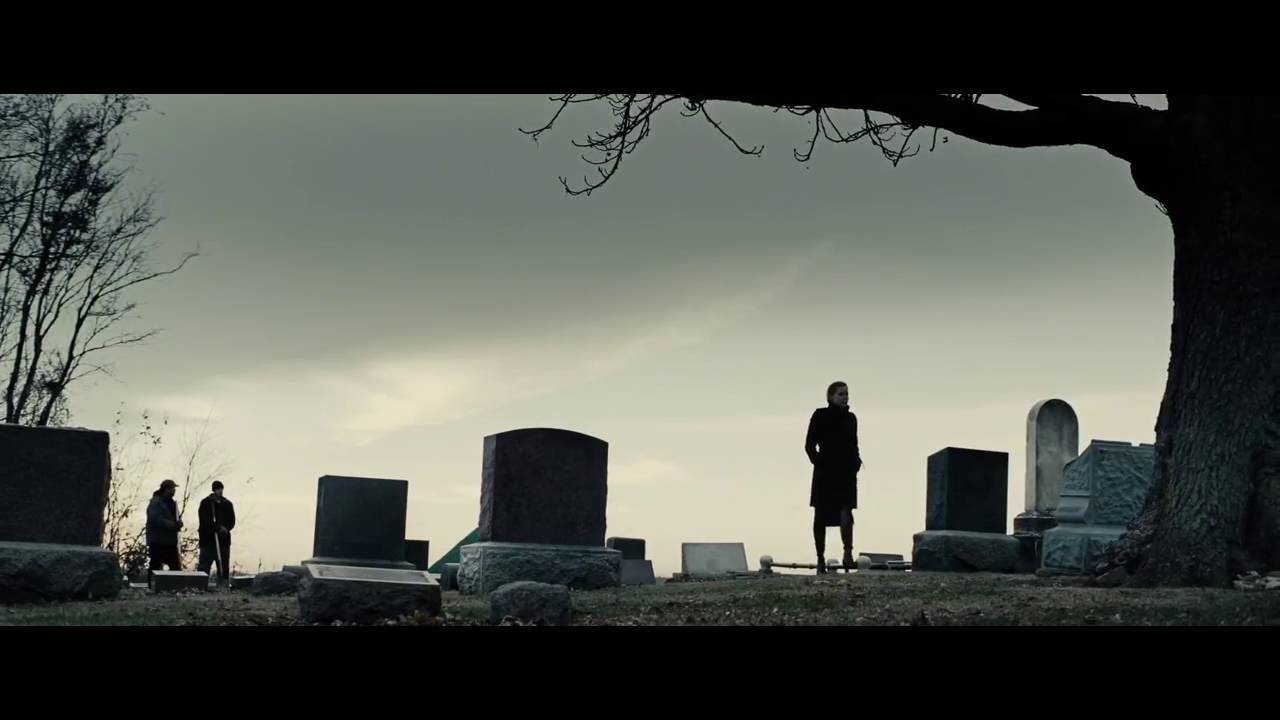


I think what has made Batman and Superman such inspiring figures for readers throughout the years is that they are characters who have suffer tragedies but use those tragedies as the foundation to do good in the world. Superman will never be able to return to Krypton but he can save Earth from Krypton's fate. Batman fights criminals so another child doesn't have to lose his/her parents. They may go about things differently but Batman and Superman can find common ground, which itself is a hopeful sentiment. If Batman and Superman can get along, maybe we all can.

Sunday, 12 October 2014

What Have We Done To Each Other? What Will We Do?: "Gone Girl"


Warning: Major Spoilers Ahead


Throughout his career David Fincher has been attracted to stories that begin as straightforward thrillers but then become something more existential and haunting. Se7en and Zodiac aren’t just police procedurals about the hunt for serial killers. Se7en explores themes of confronting a force of evil beyond human imagination and whether it’s worth fighting for good in an apathetic world. Zodiac is about the affect the Zodiac killer's crimes had on the American psyche and how the search for his identity became a self-destructive obsession for one man. The Girl With the Dragon Tattoo- another film about a serial killer- is a character study of Lisbeth Salander- someone who’s a genius hacker but is socially maladjusted. And Gone Girl, Fincher’s 10th film- based on the novel by Gillian Flynn, who also penned the screenplay- starts out as a missing person/murder mystery but transforms in to a story about perception and identity- media perception, the way people in a marriage view each other and who they pretend to be. I don’t think Gone Girl reaches the heights of Zodiac but it’s an involving, expertly paced and strongly acted film. The film blends the pulp with the prestige, making it an adult drama that’s also very entertaining.


It’s difficult to explore what Gone Girl is about without divulging its central twist. So, I’ll give you the basic set up and then jump to the spoilery parts of the story. The initial premise is that on the fifth anniversary of their marriage, Nick Dunne’s (Ben Affleck) wife Amy (Rosamund Pike) goes missing and Nick soon becomes a suspect. Nick is not arrested and he does have the support of his sister Margo (Carrie Coon) and detective Rhonda Boney (Kim Dickens); but he becomes guilty in the court of public opinion. A sensationalistic media personality in the style of Nancy Grace named Ellie Abbot (Missi Pyle), is also out to crucify Nick. Part of the reason why Amy’s disappearance becomes a big news story is because she was the basis for a series of children’s books written by her parents. These books are exaggerations of Amy’s own life and “Amazing Amy” succeeds whenever Amy fails.  


Okay, now I’m going to enter spoiler territory. I’ll give a little space to allow you an opportunity to leave if you haven’t seen the film yet.


Around the midpoint of the film it’s revealed that Amy is still alive. She faked her death to get revenge on Nick for his adultery. Nick was having an affair with Andie Fitzgerald (Emily Ratajkowski).  Andie is  a former student of Nick's (he lost his job after the recession). Throughout the early parts of the film- similar to the novel- we hear Amy’s narration as she writes in her diary, recounting her marriage to Nick and the supposed violence he inflicted on her one night. We then realize that the Amy we thought we knew is as much a construct as Amazing Amy. When it’s revealed that Amy is alive, we hear a monologue about the “Cool Girl” myth. A Cool Girl is someone who likes all the things a man does. But as Amy says, this Cool Girl doesn’t exist. She’s just pretending to be something she's not to win over a man. Through the character of Amy the film explores the allusiveness of identity, how carefully constructed an external identity can be. Even with Amy’s narration, we’re never explicitly told how Amy became the way she is. She’s an enigma, one that can never be solved.


It’s a difficult role to play and Pike plays it remarkably, showing us the ways in which Amy changes her identity and manipulates others, including her former boyfriend Desi Collings (Neil Patrick Harris). Pike has been on the edge of stardom since her turn as femme fatale Miranda Frost in Pierce Brosnan’s final James Bond film Die Another Day. She’s been a reliable supporting actress for ages but I think her performance as Amy is what will make her a major actress in the coming years. What I admire most about the performance is despite Amy’s cruelty I never disliked her. There’s almost something admirable about how methodical and cunning she is. Flynn was very bold when she constructed the Amy character, particularly when we’re led astray about her in the early parts of the story. As I mentioned earlier, Fincher is interested in digging deeper beyond genre tropes. Amy isn’t just the archetypal femme fatale. She’s a messier, more challenging character.


On the other side of things, I think Affleck is perfectly cast as Nick, in what may be his most autobiographical role to date. Affleck has never been accused of murder or kidnapping. But heknows how harsh media public and perception can be; how difficult it is to win people over once they’ve made up their minds about you. Despite Affleck’s success, including a major comeback after the Gigli debacle; and reinventing himself as an acclaimed filmmaker, you only have to look at the reaction to his casting as Batman in the Batman vs. Superman to see his name still carries negative connotations. The most fascinating sections of the film- to me at least- where the scenes in which Nick attempts to win people over to his side. It all comes down to saying the right words in the right way. When he discovers that Amy is alive he enlists the help of attorney Tanner Bolt (Tyler Perry).


Gone Girl was shot by Jeff Cronenweth- who also photographed Fincher’s Fight Club, The Social Network and The Girl With the Dragon Tattoo. In the opening scenes I didn’t think Gone Girl felt like a David Fincher film. But as we see glimpses of the past via Amy’s narration and more scenes set at night- including a gorgeous reminiscence by Amy about seeing Nick with Andie, set during a snowy evening- the film becomes as distinctly Finchery as the other Cronenweth photographed Fincher films. 

Fincher even in his first film, the compromised Alien 3, has always been a strong visual stylist, creating distinct worlds that seem to swallow us- and the characters-whole. There’s a murder scene here that’s- even if you’ve read the novel-more shocking and violent then most modern horror films. Fincher is also arguably the most precise filmmaker, in terms of composition and camera movement, since the likes of Stanley Kubrick and Alfred Hitchcock. In my review of The Girl With the Dragon Tattoo, I mentioned that Fincher was maybe too restrained for such pulpy material. But it's Fincher restraint that works here. Fincher communicates the absurd humour of the book's premise but is also to make the film play like an authentic drama 


The preciseness of Fincher's films doesn’t just come from his camera work. It's also a result of whom he picks as his editor. Kirk Baxter- who won back to back editing Oscars for The Social Network and The Girl With the Dragon Tattoo with Angus Wall- does a masterful job of making the sections of the film narrated by Amy feel fluid and organic, taking a literary device and making it work cinematically. The montage in which we see Amy devising her plan, with her narration playing over it, is some of the best work Baxter has done for Fincher. Despite being close to 2 ½ hours, I didn’t feel the film dragged or anything was rushed, except for the ending which needed a few more minutes to bring its themes home. But I think that’s more of a writing issue then an editing one.


Speaking of the writing, Flynn does an impressive job of adapting her own novel. While there were certain elements- including a subplot involving Nick and Margo’s Alzheimer’s stricken father- that I feel should of been fleshed out more, Flynn is able to get across the major themes of the story and creates a compact retelling of her intricate novel.


Coming back to Fincher, not only is he a meticulous technician, but he also has a keen eye for casting. Aside from Affleck and Pike, the crucial supporting roles are filled by actors who may not have been another directors’ first choice. I haven’t seen any of Perry’s Madea films but I think Perry shows a new side of himself here. He’s convincing as a charismatic lawyer who knows how to sell people an image.  Kim Dickens brings a certain low key Southern charm and intelligence to the role of detective Boney. And Patrick Fugit (from Cameron Crowe’s Almost Famous) conveys lot in an almost wordless performance as officer Jim Gilpin, sceptical of Nick's innocence. Carrie Coon- who is mostly known as a stage actress- makes an impressive film debut. While Coon’s doesn’t look like Affleck’s twin sister, from her first scene she’s totally believable as someone’s sister. Coon makes Margo someone both stern and caring. She loves her brother but isn’t afraid to point out Nick’s screw ups. Neil Patrick Harris, known for his comedic chops, nicely plays Desi’s creepiness just above the surface. I did feel that Ratajkowski as Andie came across as a plot device rather than a fully realized character.


Some will dismiss this film as ridiculous nonsense, and will wonder why Fincher is wasting his time directing an adaptation of an “airport novel.” Gone Girl isn’t a completely realistic story and does have some trashy elements. But if you get beyond the surface level plot mechanics, the film does have something to say about marriage and creates a complex portrayal of a toxic relationship in the form of Nick and Amy. Amy comes back to Nick when she realizes he’s finally become the man she wanted him to be. Amy tells Nick that the only time he really liked himself was when he was attempting to be someone Amy would like. There’s something truthful- regardless of what you think of Amy- in that statement. We constantly try to be someone else to win peoples' affection. Nick can’t win the public over unless he manipulates them. And Nick eventually decides to pretend- for what may be the rest of his life- that he and Amy are happy together. Gone Girl isn’t just about how people perceive each other; it’s also about how we create those very perceptions, in both conscious and unconscious ways. It then leaves us with an important question: Once we create those perceptions, how do we escape them?    

Sunday, 12 May 2013

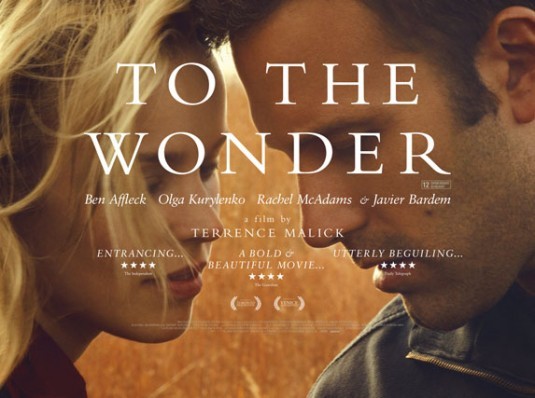
I Write On Water What I Dare Not Say: Some Thoughts on Terrence Malick's "To The Wonder"


As I was watching Terrence Malick's latest film To The Wonder the other night, it occurred to me that, love him or hate, Malick is among the handful of directors, past and present, that has completely infused himself in to every fibre of his films. It's not just that he has a particular style, but that's there not a single moment in this film, or his previous few films, that he's not present. He's there in every image, camera movement, line of dialogue and even performance. Wes Anderson is similar in that regard, and maybe even Stanley Kubrick but I can't think of many directors that have become so much part of their films. I think it's hard to review a Malick film, particularly now, since  his films exist outside any typical narrative structure- so this will be more of a "thoughts on" piece rather than a "good or bad" summary. Overall, I liked the film and maybe even loved it. While it's not as monumental a work as his previous film, The Tree of Life, it's a lovely and often beautiful film, telling a simple but universal film about finding and losing love.

The film tells the story of Neil (Ben Affleck) and Marina (Olga Kurylenko) who meet in France and move to Oklahoma to start their life together. Complications in their relationship leads to Neil and reconnecting with his childhood sweetheart Jane (Rachel McAdams). A parallel storyline focuses on Father Quintana (Javier Bardem), a priest struggling with his faith.

Malick tells these stories, as to be expected, through impressionistic imagery and hushed voiceovers. But in this film I found that Malick was moving even further away from dialogue, crafting something focused very much on the physicality and movements of the actors- particularly with Kurylenko and McAdams. I don't think either of these women have ever looked more gorgeous. By just looking at them, watching them move, their beauty really shines through in a pure way.

Journalist and filmmaker Bilge Ebiri wrote a piece interpreting the film as a dance, a ballet. All one has to do is look at Kurylenko and her movements in the film and it becomes clear what Ebiri is talking about and what Malick is trying to achieve. Moreover,  I feel that Malick isn't just trying to create a ballet but he's fascinated in taking actors we recognize and using them in a fashion where their usual stature as an actor is stripped down to something quite simple. Think of Sean Penn in The Tree of Life. In this film, Affleck is just a normal man, not the hero of Argo or complicate bank robber of The Town.

This is the shortest gap between movies for Malick, who's taken up to 20 years between films. While it's exciting to get a new Malick film so soon after The Tree of Life, that film was such a bold and visionary piece of work, a film which could possibly be deemed a landmark film, that To The Wonder seems somewhat anti-climatic in comparison. Even if there was a bigger gap between the films, I didn't sense the level of ambition in this film that was present in The Tree of Life. But one has to take the film as what it is. To The Wonder is not as towering an achievement as some of Malick's other films but it's still a film in which we find Malick striving for pure visual poetry, which I think he achieves.

 Malick has always had a fascination with exploring America's past- the late 1950s that gave birth to one of America's first serial killers, Charles Starkweather, in Badlands, the turn-of-the-century labor in Days of Heaven, the physical an existential conflict soldiers face during WWII in The Thin Red Line, and the founding of the Jamestown, Virginia settlement in 1607 in The New World. He returned to the 1950s in The Tree of Life- an course in that film Malick went beyond just exploring America's past- he literally dramatized the creation of the universe itself. To The Wonder is Malick's first film set entirely in the present day. I may have to see the film again but I didn't feel Malick was too preoccupied with modern day America- the story could've taken place in nearly any time. But then again, Malick's eye always seems to exist outside of time, showing us not the way things actually were in a given time period- but how they exist in the memory or dreams.

I'm still not sure how the Quintana storyline relates to the love triangle. His struggle with his faith reminds us of The Tree of Life, and also Ingmar Bergman, but it didn't feel directly tied to what has happening between Neil, Marina an Jane. 34444444444I've heard that Quintana's story is also a love story- one between him an God. I assume the relationship between Quintana an God is a spiritual relationship that's falling apart much like the physical relationships between Neil and the two women.  I'll have to keep this in mind the next time I see the film.

The way Malick moved the camera in certain scenes reminded me of The Tree of Life- as well as the houses, which brought to mind the O'Brien home. Also, every thing seems bigger through Malick's camera- faces, places, it's a recognizable world but one that seems larger than life.

Those are my initial thoughts on the film. I wasn't as overwhelmed as I was the first time I saw The Tree of Life, but the film, like all of Malick's works, it'll require at least another viewing to completely take every thing in. It'll be interesting to see what To The Wonder's critical standing will be as time goes on, particularly in relation to how it's ranked amongst Malick's other films. The initial reviews have been mixed and maybe the reaction towards the film will always be divided. But for Malick enthusiasts, it's worth seeing and becoming part of Malick's singular world.