Showing posts with label period piece. Show all posts

Sunday, 29 January 2017

Looking back at Steve McQueen's "Hunger"

Image result for hunger steve mcqueen

Warning: Spoiler for one particular scene 

Steve McQueen's debut film, Hunger chronicles the 1981 hunger strike of IRA member Bobby Sands in Northern Ireland's Maze prison. Sands wanted he and his fellow IRA inmates to be recognized as political prisoners by the British Government. Michael Fassbender plays Sands, who doesn't appear until 26 minutes in to the film. A more conventional film would've started with Sands. Hunger begins with Raymond Lohan (Steve Graham) as he goes about his day as a prison guard. We see him check his car for bombs, wash his bloodied knuckles, smoke and eat lunch. The film then introduces Davey Gillen (Brian Milligan), a new IRA prisoner, and his cellmate Gerry Campbell (Liam McMahon). Campbell has smeared his cell wall with his own feces as part of the "no wash" protest. It's through these characters the film establishes its world and the feeling of being a guards and prisoners in the Maze. 

Coming back to the beginning of the film, McQueen- by showing the bottom of Lohan's car- makes us think there is a bomb. When Lohan checks underneath the car we understand this is something he checks every day. This small detail already tells us something about this man's life and the political climate. McQueen is a director who's also interested in the banal details of these peoples' lives. In a wide-shot we see Lohan smoking outside in the snow. There's a feeling of peace, that this most Lohan gets during the day; it's also the most peaceful the film gets. Then there's the scene where Gillen plays with the fly in his cell. These are the kind of details some would consider boring but they are the small things that make up every day life. The film doesn't follow a traditional act structure. Rather, it is comprised of vignettes and moments.  It's sometimes easy to forget we're watching a film, so vivid is its portrayal of these events. And it's the film's often slow pace which makes the sudden outbursts of violence- most notably Lohan being killed while visiting his mother in a nursing home- all the more visceral.
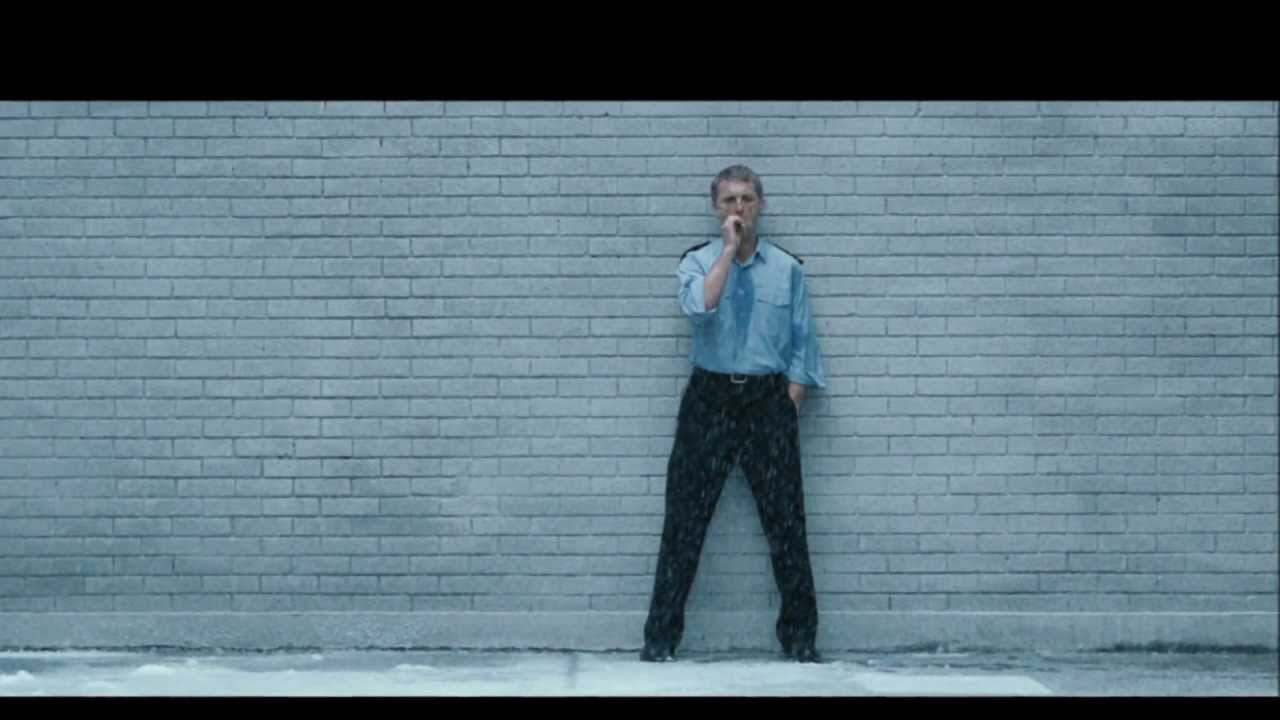
Image result for hunger 2008


What struck me about Hunger is it's almost a completely visual experience. Aside from one extended dialogue sequence McQueen and Enda Walsh's screenplay only sparsely uses dialogue. McQueen is less interested in discourse about politics or terrorism than he is in creating a specific mood and sense of realism through visuals and sound design. As described by the Criterion Collection, McQueen's is experiential and abstract.

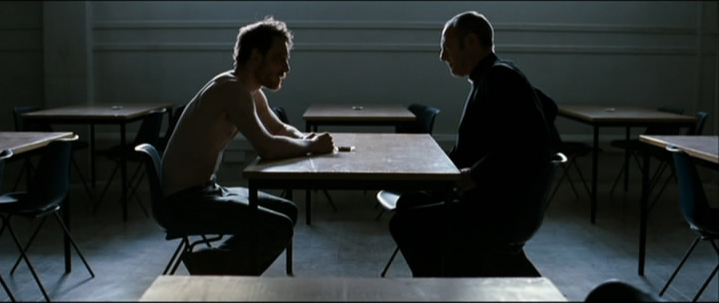
The center-piece of the film is the aforementioned conversation between Sands and Father Dominic Moran (Liam Cunningham), which is filmed in one unbroken long take. Cinematographer Sean Bobbitt- who would photograph McQueen's other two films, Shame and 12 Years a Slave- casts Sands and Moran in silhouette. The smoke from their cigarettes is bright, somewhat blueish. The scene has the look of a film noir. It's a simple set-up but it's that simplicity which gives the scene its absorbing power. We're so accustomed to dialogue scenes being cut in a particular way. There are usually close-ups that punctuate certain lines; this scene- by not cutting- invites us to pay attention to these men's words and their body language. Cunningham actually moved in with Fassbender and they rehearsed the scene during the day. When McQueen finally cuts to a close-up of Sands the close-up has more impact because we haven't already been given a dozen of them already. 

Sands tells Moran he and other IRA inmates plan to go on a hunger strike. Moran doesn't agree with Sands' stance but you can tell these two men have a mutual respect for one another. What's striking about this conversation is that it's not about the IRA being right or wrong so much as its about how far Sands is willing to go to achieve better treatment for prisoners as well as proper acknowledgement as a political prisoner. We also hear snippets of Prime Minister Margaret Thatcher discussing the prisoners but the film isn't concerned with being anti or pro Thatcher either. Her voice is there to remind us of that time and her views on these prisoners.

Fassbender lost weight to play Sands during the hunger strike and it its disturbing see someone so gaunt. McQueen doesn't attempt to lionize Sands or the IRA, though Sands seeing himself as a young boy as he's dying does verge too close to sentiment. It simply shows what he endured to be heard. 

McQueen began his career in art installations before making the transition to short films and eventually feature films. McQueen's three films thus far have all been about physical and emotional violence people have been subjected to or to which they subjected themselves. McQueen's goal is to make the audience experience, with all their senses, the world of his films and the pain of his characters.


Image result for hunger 2008


Hunger eschews conventions and winds up being one of the most unique depictions of prison life and protest committed to film. It's not a easy film to watch but its film-making and performances make it one of the vital films of the century thus far. 

Tuesday, 24 January 2017

Am I Just Praying To Silence?: "Silence"

Image result for silence 2016

Warning: Spoilers Will Follow

Martin Scorsese's Silence is a film one has to give themselves over to completely. It's a somber, meditative, quiet, slow, and challenging experience. It's refreshingly uncompromised and never feels like it was made for all audiences- or even one audience in particular.  It feels very specific, not just to Scorsese's relationship with faith, but to a particular feeling of guilt and what it means to wrestle with one own's faith. It's my favourite film of 2016 and while watching it I was amazed this was a film coming out of a Hollywood studio in 2016. It feels very European and something that belongs to an earlier era. For me, I think it's up there with Ingmar Bergman's The Seventh Seal in regards to films about the nature of faith and wanting an answer from God. I think To Scorsese the cinema is like a religion, and a cinema is a church; and Silence is a film that calls out to be seen in a on a huge screen, similar to 2001 or the epics of David Lean.

The film takes place in the 17th century. Sebastiao Rodrigues (Andrew Garfield) and Francisco Garupe (Adam Driver) are Portuguese Jesuit priests who learn their mentor and fellow priest Cristovao Ferreira (Liam Neeson) has committed apostasy while in Japan. Rodrigues and Garupe have doubts as to the truth of this story so they travel to Japan in search of Ferreira. In Japan Japanese Christians are being prosecuted and forced to renounce Christianity. Rodrigues and Garupe help the Christians who have been driven underground by the Shoguns's Grand Inquisitor Inoue (Issei Ogata). Rodrigues and Garupe eventually split up and Rodrigues is captured by the Inquisitor's men. Rodrigues is told to apostatise or others will be tortured until he does.

The film is based on Shusaku Endo's 1966 novel of the same name, which was made in to a previous film in 1971 by Masahiro Shinoda. The screenplay for Scorsese's adaptation was co-written by Scorsese with Jay Cocks, who co-wrote Scorsese's Gangs of New York. Scorsese has been wanting to direct a film of Endo's novel for years. Having finally made the film, Silence does feel like something Scorsese has been working towards for years, largely because it doesn't move, sound or look like our collective image of a Scorsese film. It's almost like Scorsese has been living with this novel for so long that his passion for it become bigger than his own stylistic sensibilities. The story couldn't be boxed in by an established style.

Scorsese's films are known for their quick-fire editing, which can largely be credited to Scorsese's long time collaborator Thelma Schoonmaker, whose has edited Scorsese's every non-documentary film since Raging Bull. Here, the editing isn't as frantic, the shots last longer, and with one exception there's no sweeping camera moves. Scorsese wants you to soak in the film's atmosphere and feel it in your bones and soul. The film is largely set outdoors and Rodrigo Prieto's cinematography makes you feel the nature of Japan in all its beauty and mystery. 

Image result for silence liam neeson


As with the the search for Marlon Brando's Colonel Kurtz in Francis Ford Coppola's Apocalypse Now we're kept in the dark as to Ferreira's fate until the final act. But as with Coppola's film, Silence is more than just the story about searching for some. The film becomes a spiritual search- a search for meaning amongst unbearable suffering and an answer from God. Throughout the film Rodrigues struggles with his faith and is given a choice between watching others suffer and committing apostasy. The question Rodrigues faces is whether renouncing God is the most Christian thing he can do- if it does stop people from torment. 

But forcing someone to apostatise doesn't prevent that person from still believing in God. However, if you do apostatise, psychologically, you may feel you truly have turned your back on God and can't be redeemed, that what you've said reflects what you feel. But thoughts and words are always in an ambiguous intertwined relationship. Throughout the film Rodrigues thoughts are filled with doubt but what he says never betrays those thoughts. It's only near the end of the film that he verbalizes these doubts. When spreading religion, a man like Rodrigues cannot verbally express doubt. He has to be a figure of zero ambiguity.

As the film goes along we come to understand- to an extent- Inoue's perspective on Christianity in Japan. It is arrogant for people to enter another country and telling people what to believe. Rodrigues exemplifies this arrogance when he says there is one universal truth the Jesuits are spreading. 

One of the best scenes in the film is between Rodrigues and Inoue, discussing religion's place in Japan. It's in this scene where we truly see the point of view of the Japanese. Inoue uses the analogy of a daimyo who had four concubines and were jealous. Eventually the daimyo and was at peace. In the analogy the daimyo is Japan and the concubines are the different countries which are attempting to win Japan over to their side. Rodrigues proposes that Japan take one wife, to which Inoue says Rodrigues means Japan should pick Portugal. Rodrigues says he means the Holy Church but one feels Inoue is right. It's not just about one universal truth, it's about Portugal and having power over Japan. Rodrigues presumes he knows more than Inoue and can convince him that he is right. But Inoue is arguably the more intelligent of the two. Though in many ways Rodrigues and Inoue are to each other the most formidable foe either has encountered. And ultimately, both are stuck in a way of thinking that will either be vindicated or will lead to their destruction.
   
Image result for silence inquisitor


Garfield's performance is truly transformative. I haven't seen his Oscar-nominated work in Mel Gibson's Hacksaw Ridge but I feel he should have been nominated for this. With Garfield, Scorsese is doing what he did with Leonardo DiCaprio, in that he's really pushing Garfield and allowing us to see a different side of the actor. It's amazing this is the same actor that played Spider-Man. Ogata' performance is exaggerated but subdued, he plays Inoue almost but not quite a parody. We're left a little off balance by him, which gives him the advantage. It's kind of a brilliant performance. Driver, whose been building up an impressive performance since appearing on HBO's Girls. I wish he had a little more screentime as Garupe but like Garfield he truly embodies his character. We don't Adam from Girls or Kylo Ren from Star Wars. 

Neeson doesn't reappear until the third act but through his performance we see the culmination of many of the film's thematic threads. As was told, Ferreira has taken a Japanese name and has renounced God. He tells Rodrigues that Japan only believes in their distortion of the Bible and they can't conceive of anything beyond nature, of the Christian God. Ultimately, one religion cannot fit every culture, which is why there must be doubt of a universal truth.  

Viewing Ferreira through Rodrigues' point of view, he's the mentor figure who has drastically changed and can offer no comfort. Rodrigues has found his former master but Ferreira now wants Rodrigues to renounce God. By having Rodrigues renounce God, Ferreira will eliminate the last part of his previous life as a Jesuit priest. Rodrigues' view Ferreira reflects how we can imagine Inoue views Japanese Christians- they are no longer who they were before. Maybe after finally finding Ferreira Rodrigues can finally understand Inoue on some level.

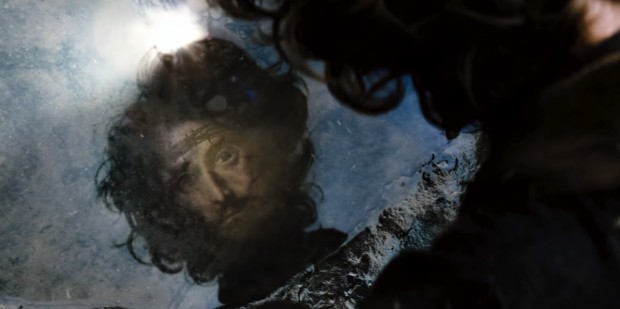
Ferreira tells Rodrigues he can't compare his suffering to Jesus. Rodrigues can't place his suffering above other peoples' which is a difference between Jesus and Rodrigues. Rodrigues is made to look like  Jesus- his facial hair and wardrobe; and there's a great shot where he sees his reflection it changes in to an image of Jesus. But despite these deliberate aesthetic parallels, Ferreira's point of view subverts our expectations that Rodrigues is supposed to be a literal Jesus figure; ultimately Rodrigues' path and destiny is different than Jesus.
Image result for silence scorsese

Rodrigues' journey doesn't end the way he thought it would, but no one's ever does, another reason we can't really be like Jesus. Our fates are not foretold to us. Rodrigues does not die for anyone's sins and fades in to obscurity. Is Rodrigues' fate our own?  We are left with the question of whether Rodrigues was lost to God, which only God can answer. Hypothetically if there was a God only that God can speak or him/her/itself. I feel this question asks us not to attempt an answer but to be compassionate and not dole out judgement. 

Unfortunately the film has not fared well at the box office. This is really a shame because it's so deserving of an audience and feels like it would have garnered more of an audience decades ago. But it's understandable a mainstream film, religious or otherwise. But I hope it gains more of an audience in the coming years. It's a brutal but I think rewarding film that almost feels like a miracle.