Showing posts with label Michael Fassbender. Show all posts

Sunday, 29 January 2017

Looking back at Steve McQueen's "Hunger"

Image result for hunger steve mcqueen

Warning: Spoiler for one particular scene 

Steve McQueen's debut film, Hunger chronicles the 1981 hunger strike of IRA member Bobby Sands in Northern Ireland's Maze prison. Sands wanted he and his fellow IRA inmates to be recognized as political prisoners by the British Government. Michael Fassbender plays Sands, who doesn't appear until 26 minutes in to the film. A more conventional film would've started with Sands. Hunger begins with Raymond Lohan (Steve Graham) as he goes about his day as a prison guard. We see him check his car for bombs, wash his bloodied knuckles, smoke and eat lunch. The film then introduces Davey Gillen (Brian Milligan), a new IRA prisoner, and his cellmate Gerry Campbell (Liam McMahon). Campbell has smeared his cell wall with his own feces as part of the "no wash" protest. It's through these characters the film establishes its world and the feeling of being a guards and prisoners in the Maze. 

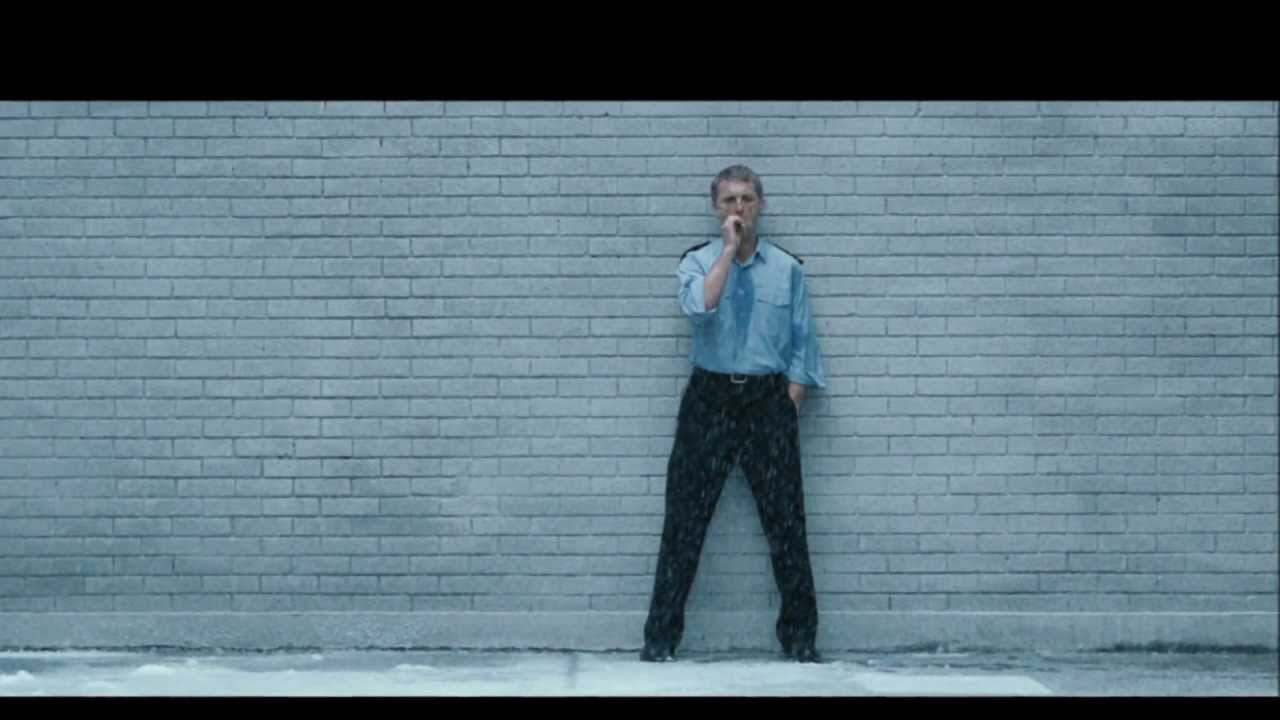
Coming back to the beginning of the film, McQueen- by showing the bottom of Lohan's car- makes us think there is a bomb. When Lohan checks underneath the car we understand this is something he checks every day. This small detail already tells us something about this man's life and the political climate. McQueen is a director who's also interested in the banal details of these peoples' lives. In a wide-shot we see Lohan smoking outside in the snow. There's a feeling of peace, that this most Lohan gets during the day; it's also the most peaceful the film gets. Then there's the scene where Gillen plays with the fly in his cell. These are the kind of details some would consider boring but they are the small things that make up every day life. The film doesn't follow a traditional act structure. Rather, it is comprised of vignettes and moments.  It's sometimes easy to forget we're watching a film, so vivid is its portrayal of these events. And it's the film's often slow pace which makes the sudden outbursts of violence- most notably Lohan being killed while visiting his mother in a nursing home- all the more visceral.

Image result for hunger 2008


What struck me about Hunger is it's almost a completely visual experience. Aside from one extended dialogue sequence McQueen and Enda Walsh's screenplay only sparsely uses dialogue. McQueen is less interested in discourse about politics or terrorism than he is in creating a specific mood and sense of realism through visuals and sound design. As described by the Criterion Collection, McQueen's is experiential and abstract.

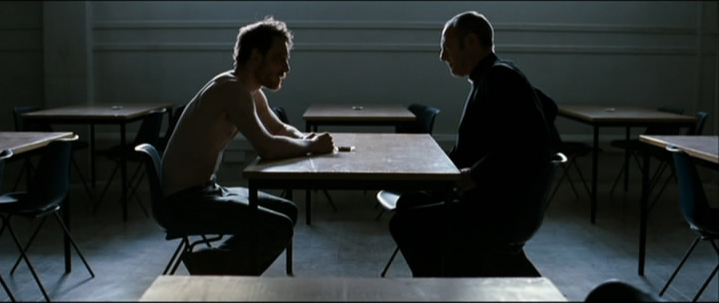
The center-piece of the film is the aforementioned conversation between Sands and Father Dominic Moran (Liam Cunningham), which is filmed in one unbroken long take. Cinematographer Sean Bobbitt- who would photograph McQueen's other two films, Shame and 12 Years a Slave- casts Sands and Moran in silhouette. The smoke from their cigarettes is bright, somewhat blueish. The scene has the look of a film noir. It's a simple set-up but it's that simplicity which gives the scene its absorbing power. We're so accustomed to dialogue scenes being cut in a particular way. There are usually close-ups that punctuate certain lines; this scene- by not cutting- invites us to pay attention to these men's words and their body language. Cunningham actually moved in with Fassbender and they rehearsed the scene during the day. When McQueen finally cuts to a close-up of Sands the close-up has more impact because we haven't already been given a dozen of them already. 

Sands tells Moran he and other IRA inmates plan to go on a hunger strike. Moran doesn't agree with Sands' stance but you can tell these two men have a mutual respect for one another. What's striking about this conversation is that it's not about the IRA being right or wrong so much as its about how far Sands is willing to go to achieve better treatment for prisoners as well as proper acknowledgement as a political prisoner. We also hear snippets of Prime Minister Margaret Thatcher discussing the prisoners but the film isn't concerned with being anti or pro Thatcher either. Her voice is there to remind us of that time and her views on these prisoners.

Fassbender lost weight to play Sands during the hunger strike and it its disturbing see someone so gaunt. McQueen doesn't attempt to lionize Sands or the IRA, though Sands seeing himself as a young boy as he's dying does verge too close to sentiment. It simply shows what he endured to be heard. 

McQueen began his career in art installations before making the transition to short films and eventually feature films. McQueen's three films thus far have all been about physical and emotional violence people have been subjected to or to which they subjected themselves. McQueen's goal is to make the audience experience, with all their senses, the world of his films and the pain of his characters.


Image result for hunger 2008


Hunger eschews conventions and winds up being one of the most unique depictions of prison life and protest committed to film. It's not a easy film to watch but its film-making and performances make it one of the vital films of the century thus far. 

Monday, 2 November 2015

It's Not Binary: "Steve Jobs"


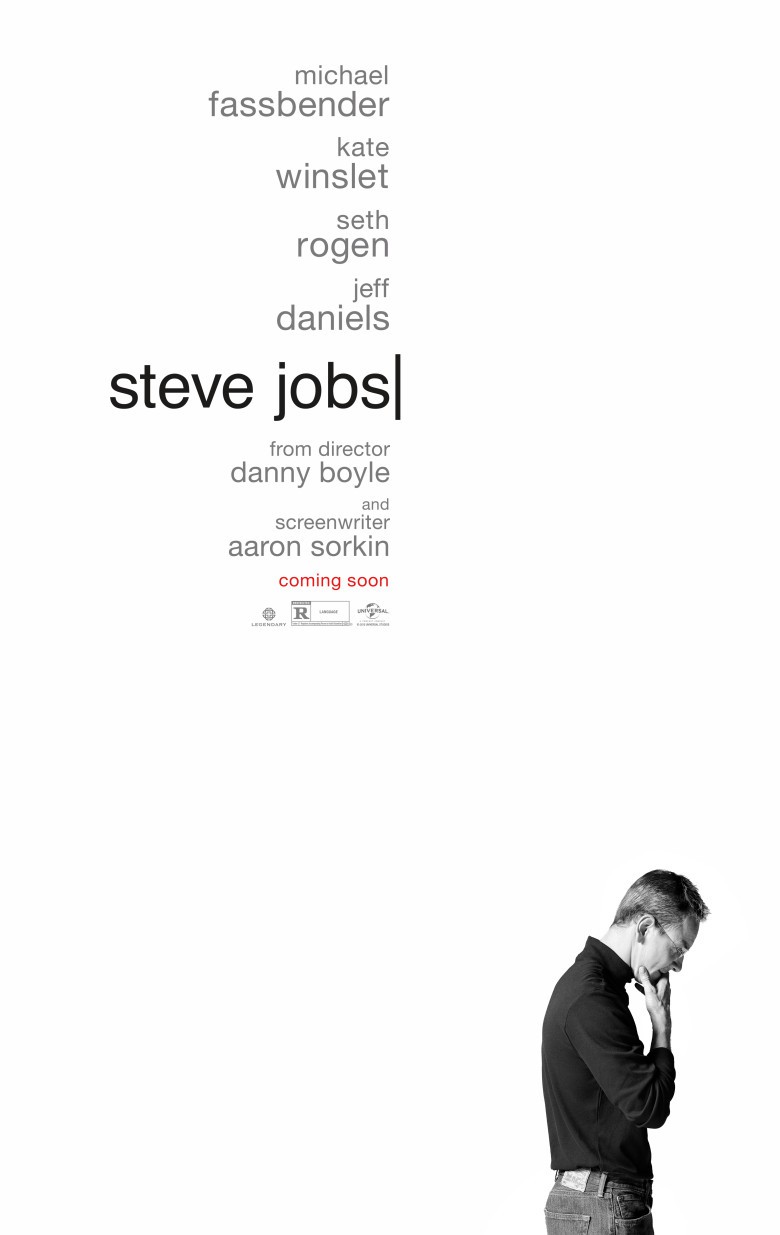
There are two specific scenes in Steve Jobs which illustrate both the ways Jobs thinks and how others view his thought process. In one scene Andy Hertzfeld (Michael Stuhlbarg)- who co-created the original Macintosh computer- asks Jobs (Michael Fassbender) why he wants people to dislike him. Jobs says he doesn't want people to dislike him, he's just indifferent to whether people like him.  In an earlier scene, Steve Wozniak (Seth Rogen) states that being decent and gifted are not binary. For Jobs indifference to people's feelings towards him isn't intrinsic to behaviour which will cause people to dislike or outright hate him. After Herztfeld tells Jobs he never liked him, Jobs says he always like Hertzfeld. This line is both funny and sad, revealing a complicated man beneath the supposed binary thinking. Steve Jobs is largely about the distinction between telling people how we think and our more complex thought processes. 

The script for the film comes from Aaron Sorkin and it's hard not to draw comparisons to the film for which he won the Best Adapted Screenplay Oscar- the David Fincher directed The Social Network- the film about the founding of the social media site Facebook by Harvard undergraduate Mark Zuckerberg. Both centre around figures who revolutionized our relationship with technology (and without people like Steve Jobs there'd probably be no Mark Zuckerberg), question the morality and importance of the men at their centres. And what ultimately unifies the two films is they're more character studies than biopics. Neither film is too interested in how the outside world is affected by Jobs' and Zuckerberg's achievement- they zero in on the personalities behind the innovation, using said personalities as metaphors for the technology they helped redefine.

Image result for katherine waterston steve jobs


The narrative conceit of Sorkin's screenplay is it's divided in to 3 segments, each taking place just before a product launch- the Macintosh in 1984, the NeXT Computer in 1988, and the iMac in 1998. In each segment Jobs has to prepare to unveil something new to the world while also dealing with personal issues-largely involving his former girlfriend Chrisann Brennan and their daughter Lisa. Chrisann wants Jobs to provide for her and Lisa financially. Jobs denies being Lisa's father but there's never really any doubt in Jobs' or anyone else's mind that he's her biological father. Jobs' denial of his fatherhood is more about not wanting to accept responsibility than not believing their blood relation. Jobs' colleague Joanna Hoffman (Kate Winslet) persuades Jobs to embrace being Lisa's father- later on in the film Hoffman will tell Jobs that being a father is supposed to be the "best part" of him, not the technology he helped create. Wozniack- who co-founded Apple with Jobs wants recognition for the Apple II team but Jobs feels this acknowledgement to underminw the unveiling of the Macintosh. The film also explores Jobs' relationship with John Sculley (Jeff Daniels), CEO of Apple and the man who would eventually fire Jobs from the company.

Having all these conflicts arise just before each launch is convenient and not entirely realistic- but the narrative structures serves a thematic purpose- Jobs in a bubble where the personal and the professional can never be completely severed. Moreover, the fact Jobs only appears to know a small group of people highlights hi isolation from the rest of the world. We never see him in any situation that is just purely casual- every thing is related to work or invention.  

Steve Jobs

The film is directed by Danny Boyle- one of the most visually dynamic directors working in the medium today. Aside from a few Boyle-quse touches, Boyle's visual style is much more restrained than in his other works. While I would've liked for Boyle to do more composition and camera movement-wise, the film isn't bland as cinema. Visually, the most interesting technique Boyle brings to the film is how the three segments are filmed in 16mm, 35mm, and digital, respectively, to capture the feel of each time period and the advancement in technology. This works very well in creating a particular sense of place and time without seeing much of the outside world.    
  

Even the film-makers have admitted that Fassbender doesn't look like Jobs. I actually think this woks in the film's favour. The disconnect between the appearance of Jobs and Fassbender allows us to view the man at the film's heart on his own terms. Fassbender isn't playing Steve Jobs so much as he's playing "Steve Jobs"- just as Jesse Eisenberg was playing "Mark Zuckerberg." Fassbender is one of my favourite actors working today- and as Jobs he never pushes too far in one direction- he's not so off-putting as to stop the audience from engaging with the character but he never goes too soft with his characterization either- there's a humanity to Jobs but even by the film's end he's still working on being a better man.

Sorkin can never be accused of being too subtle but his screenplay is more restrained than expected. Sorkin's dialogue- like David Mamet or Quentin Tarantino- has a particular rhythm that when every one is in sync, really sings. While the film is centred around Jobs the film also acts as an ensemble piece- and honestly I don't think there's an off performance amongst the cast. 

Winslet is both Jobs' conscience and the conscience of the film. Winslet brings a solid balance of warmth and sternness to Hoffman. She's one of the only people working with Jobs who's not afraid to be honest when speaking with him. And in many ways Hoffman is Jobs' only true  friend. 

Daniels (who led Sorkin's The Newsroom for 3 seasons) is excellent as Sculley- someone who easily could've been written and performed as the villain of the film- the man who fired Steve Jobs. In a bravado sequence during the 1988 segment the film cuts between Jobs' and Sculley's conversation in the present, the early days of their relationship, and the night Jobs was fired. This sequence is a mosaic of two men's relationship- how it began and where it was during that period of time. 


Rogen brings a quiet but clear sense of betrayal to his portrayal of Wozniack. Wozniack tells Jobs that computers aren't paintings, to which Jobs always replies "fuck you." But Jobs contradicts this philosophy by not giving the Apple II team credit. If computers are truly art can't Jobs acknowledge artists?- is it because they aren't him? Because it'll distract from his art? Maybe it's because Wozniack's words still stick with Jobs: 

"What do you do? You're not an engineer. You're not a designer. You can't put a hammer to a nail. I built the circuit board! The graphical interface was stolen! So come ten times in a day I read Steve Jobs is a genius?" 

While this speech comes from Wozniack- it's also the film questioning the love we give our idols without truly understanding their exact importance or the other people who contributed to history. After Wozniack asks this question, Jobs says he plays the orchestra. That may be the most succinct if somewhat simple answer to Jobs' importance to the technological revolution.

Waterston- who I thought gave a potent performance in Paul Thomas Anderson's Inherent Vice- is far less elliptical here than in Anderson's film. Waterston makes Chrisann  sympathetic without sanding off the character's edge. Chrisann isn't always the most pleasant person to be around. I don't think she has a proper pay-off but the relationship between Jobs and his daughter Lisa is the more important arc. 

Lisa is played by Mackenzie Moss, Ripley Solo and Perla Hanley- Jardine in 1984, 1988, and 1998, respectively. There's a subtle consistency between the three actresses, and Hanley-Jardine carries the weight of Lisa's complicated relationship with Jobs. I feel the culmination of this arc feels a little too pat and sentimental- and the final moments don't feel they match the more morally complicated character the film was portraying.  

I've seen people complain about the number of Steve Jobs films we've gotten since Jobs's death at the age of 56 in 2011. How many movies does one man need?, they ask. Steve Jobs may not be the definitive account of Jobs' life, or even the last film someone makes about his life. But as a character study, Boyle, Sorkin, and Fassbender have created a dense and entertaining portrait of a man who became- and remains- a symbol in an ever changing industry. Computers may not be paintings but symbols are everlasting.  

Sunday, 25 May 2014

We Need You To Hope Again: "X-Men: Days of Future Past"


X-Men: Days of Future Past (Henceforth known as DOFP) always sounded like one of the most ambitious superhero films in some time. Bryan Singer- who helmed the first two X-Men films- would be directing and via two time periods- and a time travel plot- unite cast members from both the original trilogy and cast members from X-Men: First Class (Henceforth known as FC). The film was also said to be correcting the continuity errors that have plagued the franchise, and many thought the much derided X-Men: The Last Stand and X-Men Origins: Wolverine would be retconned out of continuity.

What's most surprising about the DOFP- now that it's been released- is how straight forward and small scaled it is, relatively speaking. While it has several standout set pieces DOFP is more of a character drama than an epic action blockbuster. This is somewhat disappointing since I was hoping for a film that felt bigger in scale. However, taken just as a story DOFP feels like both an organic expansion to the original trilogy and sequel to FC.  

The film opens in the dystopian future of 2023. Mutant hunting robots called Sentinels have killed many mutants and the humans who have helped them.  A band of mutant survivors led by Professor Charles Xavier (Patrick Stewart) devise a plan to send Logan/Wolverine’s (Hugh Jackman) consciousness back in time to stop Mystique (Jennifer Lawrence), once Xavier's surrogate sister Raven, from killing Bolivar Trask (Peter Dinklage). Trask had suggested the idea of Sentinels to the US army but they rejected the idea. When Mystique killed Trask this prompted the US to move forward with the Sentinel program. Mystique was captured after Trask’s assassination and her DNA was used to upgrade the Sentinels so they could adapt to any mutant power.

Wolverine's consciousness gets sent back to 1973. There, he has to convince the younger Xavier (James McAvoy) to help stop Mystique. Wolverine’s mission is complicated due to Xavier being a broken man, both in spirit and body. Xavier was paralysed at the end of FC, lost his friend Erik Lehnsherr, (Michael Fassbender), now going by Magneto, and Mystique. Xavier’s school for gifted youngsters was shut down due to the Vietnam War draft. Hank McCoy (Nicolas Hoult) has created a serum that allows Xavier to walk but eliminates his telepathic powers. Hank takes a similar serum to control his “Beast” form. Hank is like Bruce Banner/the Hulk in this film. The Beast only comes out when he gets angry.

The concept of Xavier choosing to walk over being able to use his powers intrigued me. It also provides a firm character arc for Xavier throughout the course of his film. He eventually has to accept the chair and embrace his gifts so he can change history.  I also think it’s neat how Hank has a somewhat similar character arc to Xavier. Hank, like Xavier, is keeping something about himself locked away. As the film progresses he has to embrace the Beast inside him. The whole concept of Xavier and Hank essentially being recluses in a rundown mansion is also tragic and a tad amusing. I wouldn’t mind eventually getting a short film about these two guys’ lives. I really liked Hoult in FC so I’m glad he's a big part of the film.

I was surprised when McAvoy was first cast in FC. He didn’t strike me as the Professor X type. But seeing him in FC and now DOFP he’s become one of my favourite cast members in this franchise. He’s not trying to be Patrick Stewart but you accept him as a younger, more “rough around the edges” version of the man from the original trilogy. In this film McAvoy pulls off both the broken man and the man who finds his purpose again- going down the path to become the Xavier of later years.  There’s a touching scene where Xavier, via reading Wolverine’s mind, communicates with his older self. The older Xavier tells him he needs “to hope again.” It’s a fascinating conceit, the older Xavier essentially helping his younger self become the man he’s going to be. And I think the film pulls it off beautifully, giving the scene real emotional pathos.

Fassbender continues to be a powerful presence as Magneto. We learn he's been locked in a concrete prison (Magneto can control metal) for killing President John F. Kennedy. The film jokes that Magneto being the assassin is the only way the trajectory of the bullet that killed Kennedy makes sense. What Magneto reveals about his role on that day in Dallas is also a nice little joke that I won’t spoil.

To break Magneto out of prison, Xavier, Hank and Wolverine need the help of Peter Maximoff/Quicksilver (Evan Peters), who has the gift of super speed. There were many who hated the look of Quicksilver in this film but he turns out to be the highlight of the film. Peters has a great oddball comedic sensibility. The sequence where we view an event from Quicksilver’s point of view- as time slows downs while he speeds up- is both visually wonderful and charming. The song choice for the sequence- Jim Croce’s “Song in a bottle” is perfect. Fans know Quicksilver is Magneto’s son in the comics and there's a sly reference made by Quicksilver that Magneto is his dad. I wish that Quicksilver was in the film more. I think the filmmakers didn’t want the film to be too comedic. Or, like Shakespeare with Mercutio from Romeo & Juliet, they didn’t want Quicksilver to run away with the entire film.

I’m a little mixed on Lawrence’s performance. She’s a good actress but I don’t feel she fits the femme fatale role. However, she handles the emotional beats of the character. Her performance is consistent with the character from FC and her Mystique mostly works as the middle grown for the character between FC and the original trilogy.  

I know many don’t like how Wolverine centric these films have been. I agree with this criticism but I do think Jackman owns the role and it’s hard for me to imagine anyone else playing the part after Jackman retires. And while Wolverine is an important character in the film his presence doesn't takes away from Xavier.

Character-wise, Xavier and Magneto needed more screen time together in both the 70s and future scenes. In the 70s we see that Xavier is angry at Magneto for corrupting Mystique but we know there’s more to their conflict than Mystique. Putting too much focus on her as the root of Xavier’s hostility somewhat trivializes the relationship between him and Magneto. Their different philosophies are what caused their separation. That needed to come to the forefront. Old Magneto gets a great moment later in the film when he implies to old Xavier that he regrets all the years they’ve spent fighting. It would've been great to learn more of how this war has affected their complex relationship. 

As to be expected in this franchise, several characters do get shafted, particularly the characters in the future scenes. The newly introduced mutants such as Bishop (Omar Sy) and Blink (Bingbing Fan) hardly get any dialogue or development as characters. I do like Ellen Page as Kitty Pryde, even though she may be a little too Ellen Pagey. Alex Summers/Havok (Lucas Till), who was established in FC, appears briefly but his role feels superfluous, almost as if he’s just there to let the audience know where he was and then move on.

For me, the film would’ve been stronger if the future scenes were as fleshed out as the 70s scenes. Even though the opening of the films vividly shows us what the this world is like for mutants I feel there should’ve been a more active story happening in the future, with more time dedicated to seeing how the mutants operate in this future. It’s also somewhat disappointing that the future scenes taking almost entirely in one location.

From a cinematography standpoint the look of the future is gorgeous (Newton Thomas Sigel, who did the cinematography for X1 and 2 returned to the franchise for this film). I know that's an odd way of describing a post apocalyptic future but I really loved the atmosphere of those scenes. When we’re in the 70s the film does give off an authentic 70s vibe. The use of camera footage of events made to look like footage from that time period is a fine touch.

I’m going to get a little spoilery in discussing this film’s approach towards the franchise's continuity. We live in an age where franchises like Spider-Man, Batman- and next year’s Fantastic Four- just start over with a blank slate. On the flip side DOFP reboots the X-Men franchise within its own continuity. The outcome of DOFP's plot is similar to J.J Abrams’ Star Trek reboot. In both cases time travel is used as a device to create an alternate time line where new stories can take place and pre-established events can occur differently. It’s a risky but arguably more intriguing way to approach the whole idea of a “reboot.” However, I think there are still some continuity hiccups. And the biggest drawback of the film may be that it’s partly a long form version of fan service. Nevertheless, I think the film still works as a cohesive and meaningful story on its own terms.

I know many feel Singer’s directorial approach to the X-Men franchise doesn’t have a place in today’s landscape of superhero films. I understand this point of view. Singer’s X-Men films- including DOFP- aren’t as “comic book on screen” as a film like The Avengers. But what I admire about Singer as a director of superhero films- both X-Men and the heavily criticized Superman Returns- is he always puts a heavy focus on the humanity behind the super powers. All four of his superhero films have real weight and emotion to them. While the climax of DOFP is a set piece the story resolves itself with Xavier trying to convince Mystique, with whom he grew up, to make the right choice. Near the ending Hank mentions the immutable theory of time. This theory states that you can never truly change the future. The timeline will always correct itself. The film sides with the opposite idea, that the future can be changed- and even the past.

Whether or not you enjoy DOFP will depend on how you feel about this franchise- and Singer’s X-Men films in particular. If you’re tired of this continuity then this film may just be a chore. If you love this franchise with all its ups and downs- and if you’re like me, grew up with the first two X-Men films- then DOFP has the potential to touch you deeply. There'll be an undeniable nostalgia factor to the film for many. DOFP is a loving tribute to the X-Men franchise but it’s also a bittersweet goodbye- and an exciting new start.

Thursday, 16 January 2014

Some Brief Thoughts on the 2014 Oscar Nominations


The Academy Award nominations were announced earlier this morning. As always there were the sure things, the occasional surprise inclusion or "snub" as well as the complete shut outs. These will be my brief thoughts on the major categories. I haven't seen every film nominated so I won't be judging each performance in terms of whether it "deserves" to be nominated- this will be more about what direction I think the race will be going in each category. So, without further ado, the nominees...


Best Actor
Christian Bale, American Hustle
Bruce Dern, Nebraska
Leonardo DiCaprio, The Wolf of Wall Street
Chiwetel Ejiofor, 12 Years a Slave
Matthew McConaughey, Dallas Buyers Club


Certain pundits weren't sure if it'd be Bruce Dern in Nebraska or Robert Redford in All is Lost- both are Hollywood veterans- that'd get a nomination in this category, or if both would be shut out. Dern has taken the veteran slot, with Redford shut out. Dern has the veteran card but he faces stiff competition, particularly since the film, while nominated for Picture and Director, still seems a little under the radar.


I'm happy Leonardo DiCaprio made it, especially since there was some doubt about his chances around the time The Wolf of Wall Street was released. If you remember, the academy screening of the film ended with one member blasting Scorsese, leading to people believing the film was too edgy for certain members. Of course that didn't stop the film from gaining several nominations this morning. This is DiCaprio's first nomination since 2006's Blood Diamond and I feel he's been shut out a few times since then, particularly for 2010's Shutter Island. I really think DiCaprio should win. I'm not going to lie, DiCaprio is a favourite actor of mine and this may be his best performance yet. While some may say the performance is just showboating I think DiCaprio nails the character of Jordan Belfort and that his theatrical/method style of acting is more perfectly suited for this character than his previous roles.


I also wouldn't mind see Chiwetel Ejiofor winning. He's one of those hard working actors who's paid his dues and definitely deserves to be here. In another year, he'd absolutely be the frontrunner for his portrayal of Solomon Northrup, a  black man born free but sold in to slavery- a man who attempts to retain his humanity and his sense of self under inhuman conditions.

Despite America Hustle being a frontrunner in several categories, including Best Picture,  I don't see Christian Bale winning. I think Matthew McConaughey, particularly after his Golden Globe win on Sunday, may take it. That's right, we may soon be living in a world where Academy "Award winner Matthew McConaughey" will start being heard and seen in movie trailers. I haven't seen Dallas Buyers Club yet but his role in the true story of a man who was diagnosed with AIDS while helping other AIDS patients get hold of a medication that can prolong their lives- just sounds like the type of role that wins an actor an Oscar, especially since he lost more than 40 pounds to play the part. It'd also cement his career reinvention.


Will Win: Matthew McConaughey
My Pick: Leonardo DiCaprio


Best Actress
Amy Adams, American Hustle,
Cate Blanchett, Blue Jasmine,
Sandra Bullock, Gravity
Judi Dench, Philomena
Meryl Streep, August Osage County


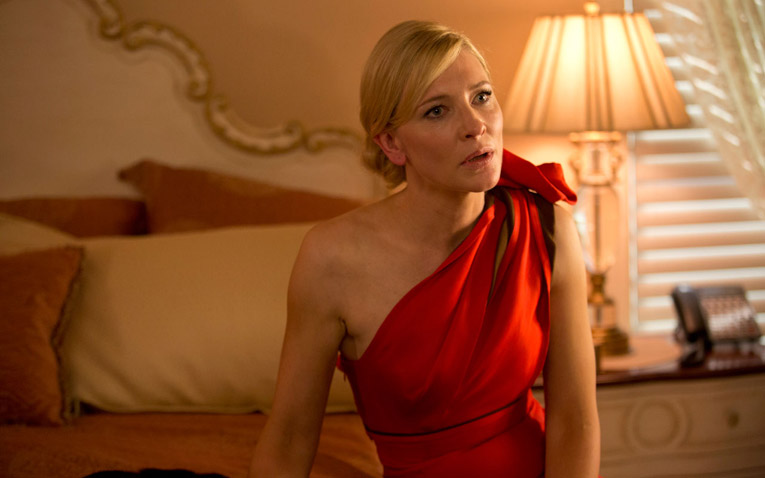
Back in August when Woody Allen's Blue Jasmine was released it really felt like the Best Actress Oscar was Cate Blanchett's in a walk. And more than 4 months later, despite some heavy hitters in the race, Blanchett still appears to be the frontrunner. Her role as a former socialite- who has to live with her adopted sister after her husband (Alec Baldwin), a Bernie Madoff inspired businessman goes to prison- is a devastating portrayal of a woman unable to embrace reality. Some feel the performance is too hammy but I don't think a role like this would work unless it was broad.


Sandra Bullok brings humanity to the spectacle that is Gravity- and certain pundits suggested she could win her second Oscar after winning for The Blind Side in 2010 but I feel that her competition is a little too strong for her to win a second time.


Poor Amy Adams can't catch a break. In a weaker year she could've walked away with the Oscar. This is her first nomination in the Best Actress category after four nominations in the Supporting Actress category. Though you never know. Some voters may feel she's due, which could lead to her upsetting Blanchett.


Judi Dench won Best Supporting Actress for 8 minutes of screen time in Shakespeare In Love. But many voters probably want her to win for a more prominent performance. Like Adams, Dench may be the upset in this category.


Meryl Streep is on her 18th nomination for August: Osage County. I think this is more of a obligatory nomination for Streep rather than a nomination that'll lead to a win. Though no doubt Streep will eventually win a fourth Oscar.


Will Win: Cate Blanchett
My Pick: For now, Blanchett


Best Supporting Actor
Barkhad Abdi, Captain Phillips
Bradley Cooper, American Hustle
Michael Fassbender, 12 Years a Slave
Jonah Hill, The Wolf of Wall Street
Jared Leto, Dallas Buyers Club


A big congratulations to Barkhad Abdi, who made his film debut as the Somali pirate leader who hijacks the merchant ship in Captain Phillips. Abdi was a limousine driver and disc jockey before starring in the film. It's a great little story and I'm happy for him.


Michael Fassbender, who many felt was shut out for his role as a sex addict in Shame received his first nomination this morning for his performance as Northrup's most ruthless slave master. It's a performance that's both ferociously evil but layered and if I was voting I would cast my ballot for him.


Jonah Hill was a bit of a surprise but he has really come in to his own as a genuine actor with this role. Cooper scores his second consecutive nomination at the Oscars, showing that his first nomination for Silver Linings Playbook, another
David O. Russell joint, wasn't a fluke.


But I think this is Jared Leto's to lose. The film not only marks his return to acting after several years of being the frontman of the band 30 Seconds to Mars, like McConaughey, his role as Rayon, a transgendered man with AIDS is the type of performance that screams Oscar.


Will Win: Jared Leto
My pick: Michael Fassbender


Best Supporting Actress
Sally Hawkins, Blue Jasmine
Jennifer Lawrence, American Hustle
Lupita Nyong'o, 12 Years a Slave
Julia Roberts, August: Osage County
June Squibb, Nebraska


It's nice to see Sally Hawkins here. She got Oscar buzz for her breakthrough performance in Mike Leigh's Happy-Go-Lucky but didn't make the cut. Her performance in Blue Jasmine is usually the type of performance that can be overshadowed by an actor like Blanchett. But you need Hawkins' to help ground the film.


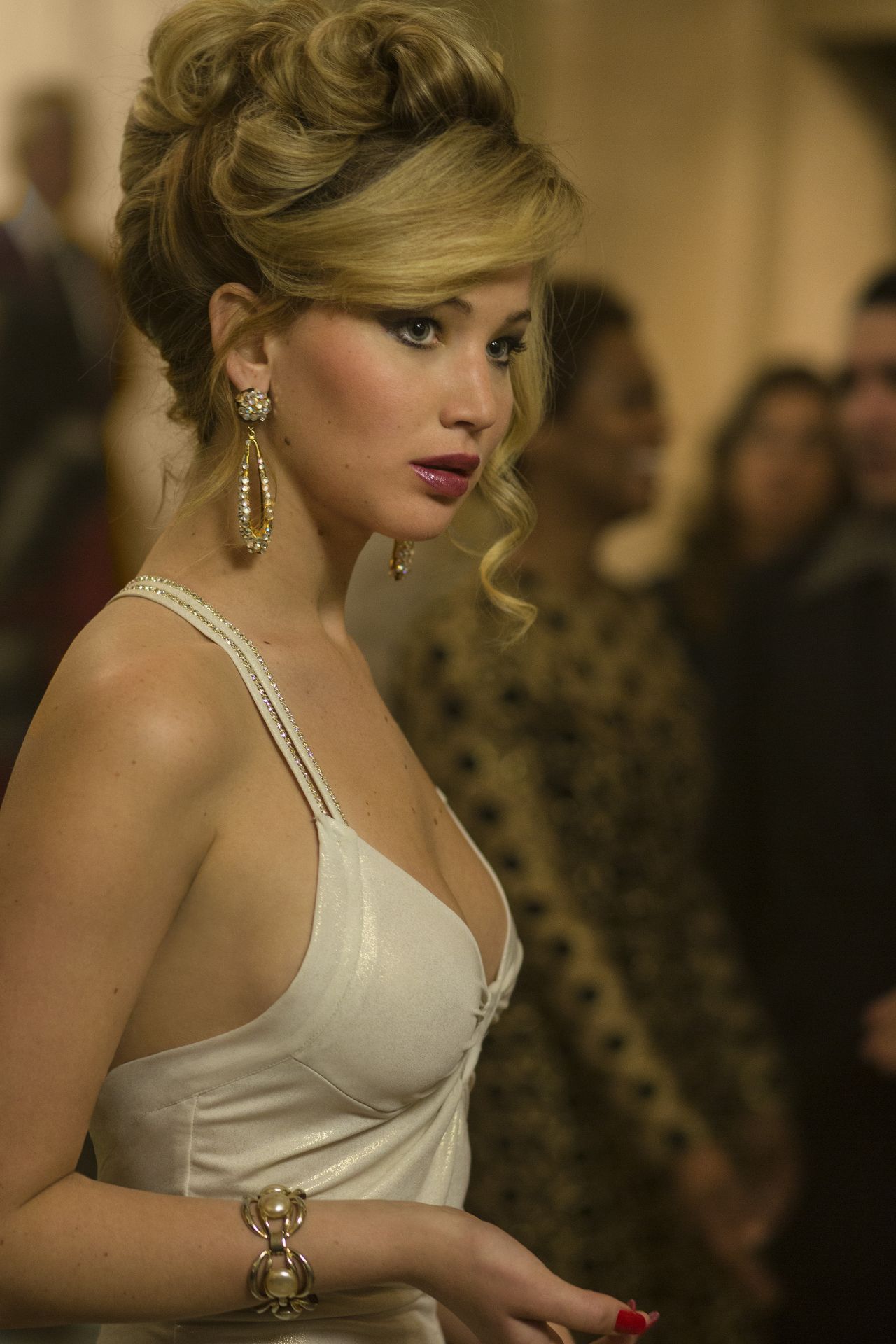
Jennifer Lawrence appears to be the frontrunner which is unfortunate. Lawrence is a talented and charming actress but I don't think she really deserves to win two consecutive Oscars. There are so many actors who have to pay their dues, including certain actresses in this category. I genuinely don't think Lawrence has earned the right to be a two time Oscar winner. Now, I haven't seen American Hustle so I could be totally blown away when I see the film but I think someone else deserves a shot at the win.


If 12 Years a Slave was more of a frontrunner for Best Picture, Nyong'o could be swept along but it appears the film, despite receiving nine nominations, faces more of an uphill climb than it did back in September.

While I'm not overly familiar with June Squibb's work, she's definitely one of those "paid his/her dues" actors and even without even without seeing Nebraska I think she deserves more of a chance at the win.


This is Julia Roberts' first nomination since her Oscar winning role for Erin Brockovich. In another year she'd have a better chance but this may very well be Lawrence's to lose.


Will Win: Jennifer Lawrence
My Pick: Sally Hawkins


Best Director  
Alfonso Cuaron, Gravity
Steve McQueen, 12 Years a Slave,
Alexander Payne, Nebraska
David O. Russell, American Hustle
Martin Scorsese, The Wolf of Wall Street


The Best Director category didn't offer too many surprises. Scorsese made it, which is good. While there's not as much pressure on the Academy to honor him after finally giving him an Oscar for 2006's The Departed, Scorsese definitely deservers to be a repeat winner. Winning for The Wolf of Wall Street may actually be a more "deserving" win than The Departed. At 71 his film had more pure cinematic energy than ones made by directors half his age.


Alexander Payne's due factor in this category is growing but he was more of a contender for 2011's The Descendants.


If Alfonso Cuaron won Best Director it'd be the second year in row a director won for helming a 3D film. Last year Ang Lee won for Life of Pi. Cuaron won the Golden Globe on Sunday but the Golden Globes haven't matched with the Best Director Oscar that often these past several years. David Fincher won the Golden Globe while losing the Oscar to Tom Hooper. James Cameron won the Golden Globe for Avatar but Kathryn Bigelow- his ex-wife no less- won the Oscar for The Hurt Locker. And some voters may view Gravity as more of a technical achievement than a brilliantly directed film. Still, he has a good chance since many view his work on Gravity ground-breaking.


If Steve McQueen won he'd make history as the first Black director to receive the Best Director Oscar. If I was voting I think I'd go for McQueen, not just for history sake but because his direction was nothing short of stunning. The shot of Solomon hanging in that tree for what seems like a lifetime may be the most unforgettable cinematic image of 2013.


Last year I though David O. Russell could possibly win for Silver Linings Playbook but he walked away empty handed. American Hustle is viewed as the frontrunner so this could be his year. Though if there's a split between Picture and Director someone else could win over Russell even with American Hustle winning Best Picture.


Will Win: Alfonso Cuaron
My Pick: Steve McQueen


Best Picture
American Hustle
Captain Phillips
Dallas Buyers Club
Her
Gravity
Nebraska
Philomena
12 Years a Slave
The Wolf of Wall Street


This past September 12 Years a Slave was deemed the frontrunner for Best Picture. In a more just world it'd still be the frontrunner. 12 Years a Slave will be looked back on as one of the most important and essential films made about American slavery and a lasting testament to the story of Solomon Northrup. I feel that if America Hustle wins future generations will look back and say "That won?" As I mentioned earlier, Gravity may be deemed more of a spectacle than a genuinely great film, which may hurt its chances. The Wolf of Wall Street may still be too edgy and raunchy for older viewers. Philomena and Nebraska seem a little too small scale to win Best Picture and Her has a better shot in the Original Screenplay category. Dallas Buyers Club's big wins will be in the acting categories. For now, I'll go with American Hustle for the win, with Gravity and 12 Years a Slave as its biggest competition.


Will Win: American Hustle
My Pick: 12 Years a Slave


Original Screenplay
Woody Allen, Blue Jasmine
Spike Jonze, Her
Bob Nelson, Nebraska
Erin Warren Singer and David O. Russell, American Hustle
Craig Borten and Melissa Wallack, Dallas Buyers Club


If Her doesn't strike Oscar voters as too weird Jonze has a good shot at taking this. Woody Allen's last win in this category was for 2011's Midnight in Paris. While Blue Jasmine's script is arguably even stronger than Midnight, I feel either Her or America Hustle will take it. There's also the resurgence of the controversy surrounding Allen's personal life after Ronan and Mia Farrow's tweets during last Sunday's Golden Globes.


Will Win: Her 
My Pick: For now, Blue Jasmine, but it'll probably be Her after I've seen it.


Adapted Screenplay
Richard Linklater, Julie Delpy and Ethan Hawke, Before Midnight
Steve Coogan and Jeff Pope, Philomena
Billy Ray, Captain Phillips
John Ridley, 12 Years a Slave
Terence Winter, The Wolf of Wall Street.


I would love for Before Midnight to win here, despite feeling that it's a bit odd that a sequel automatically considered adapted, though I guess it's understandable. Linklater and his actors know Jesse and Celine so well that the ark of this screenplay feels completely organic. Winter's screenplay may be deemed too scattered and not focused enough. I feel Before Midnight does have a good chance at the win though Ridley's screenplay could win if 12 Years a Slave is voted Best Picture.


Will Win: Before Midnight
My Pick: Before Midnight


So, those are my initial thoughts on the nominations. I'm disappointed Inside Llewyn Davis and its star Oscar Isaac were shut out, as well as Blue is the Warmest Color not being deemed eligible for Best Foreign Language film. So, what are your thoughts on the nominations and the Oscars in general? Who was snubbed and who are you happy for? The Oscars will air on March 2nd, 2014 with Ellen DeGeneres.


Friday, 8 June 2012

How I Wonder What You Are: "Prometheus"


Mild Spoilers Ahead

Prometheus has been one of the biggest question marks in terms of big studio releases for quite some time. This is director Ridley's Scott return to science fiction- the genre in which he made two classic films, Alien and Blade Runner, which are also the two films which have defined his career. But what made the idea of  Scott returning to science fiction even more intriguing is that Prometheus is a prequel to Alien. The big question mark of the film that I mentioned earlier was how much of an Alien prequel this would be. Early on it seemed we'd be getting a straight up Alien prequel and then it seemed Scott wanted to make a standalone film, with the title of the film being called Prometheus instead of something with Alien in the title. And then we heard rumblings from the cast that the film would have connections to Alien. And from then on, it's been interesting to ponder how the movie would blend it's own story with elements from the first Alien film.

Essentially, while I feel Prometheus is a good philosophical sci-fi horror film, the things it's doing don't all click together. On the one hand, it's asking big questions regarding the dawn of the human race, who created us and why, what it means to be human, darwinism versus creationism. It's also trying to provide some good old fashioned sci-fi horror scares- while at the same time trying to take the first Alien and put it in the context of these big philosophical ideas. As I said, not everything clicks but I admire Scott for putting all these elements in the same film and I feel he has created an bizarrely fascinating take on the whole idea of making a prequel. It also feels this is the most ambitious and go-for-broke Scott has been in quite some time.

The big philosophical question at the heart of the film is "What if God is an alien?" Two archaeologists, Elizabeth Shaw (Noomi Rapace) and Charlie Holloway (Logan Marshall-Green) discover a star map in various caves belonging to ancient civilizations. These civilizations have no connections to each other, leading them to believe they were left there by beings from outer space and are invitations to come find them. A few years later, Shaw and Holloway are on board the ship Prometheus, heading towards the planet these "engineers" are believed to have originated from. The ship lands near an ancient structure, which the crew plans to investigate.

Performance wise, I think the movie is pretty solid. Swedish actress Rapace, who was the orginal Girl with the Dragon Tattoo, is a slightly unconventional choice for the lead role. That's why I think it works. She brings a certain texture to her performance that I think would be missing with another actress. Elizabeth and Charlie are in a romantic relationship and their relationship is presented rather nicely. They do seem authentically in love. Charlize Theron plays Martha Vickers, who works for Weyland Industries(sound familar?) Theron plays Vickers as cold and detached and as the film goes along and we learn about her relationship to Peter Weyland (Guy Pearce), founder of Weyland Indutries, a bitterness and sense of entitlement. I would have liked a little more development with her and her relationship to Weyland. Idris Elba, as Janek, the captain of Prometheus, has some good character moments as well. Overall, the character development is solid but I wish there were a few more character beats for Theron and Elba.

Michael Fassbender as the robot David was my favourite performance and character. I think one of the hardest things for an actor do to is play a robot without coming across as...well, robotic and boring. Fassbender makes David both charismatic and mysterious. What are his motives? How human is he? You feel a tiny bit of Blade Runner- and also 2001 seeping in regarding. I wish the film had pushed these questions about David's humanit and nature a little further, particularly sincce they do link to the idea of creation in the film. I love how David draws inspiration from Lawrence of Arabia- essentially Fassbender is doing a riff on Peter O'Toole. He quotes a line from the film and when asked where's it from, he replies rather sincerely, "from a film I like." I liked that moment a lot.

A conversation with Holloway draws comparisons between the "engineers" and humans. David asks Charlie why he was made by humans. Charlie tells him it's probably because they could. David then asks Charlie how'd he feel if the "engineers" told him the same thing. What if the creation of human existence was as simple as that? It implies that if we were made just because it was possible, also means we are expendable, which becomes the major threat of the film in the third act.

I do love the idea of aliens creating humans. It's a bizarre and almost awe-inspiring idea, especially since, and others have brought this up, if aliens created us, who created them? Elizabeth is a woman of faith and it's interesting she accepts this notion that aliens could have created us. She's accepting of a re-interpretation of God or at least another element in God's design.

As the film moves along it's hard to get Alien out from the back of your head. I hung to every image that was reminescent of Alien and every reference that seemed to tie in to its mythology but I always wanted more from that universe even though I knew I wouldn't get to see the Xenomorph. I don't think it's a flaw in the film so much as it's a result of the unshakable perception that this is a prequel to a great science fiction horror and one wants to see as many connections as possible. At the same time, I found it hard to reconcile all the film I was seeing with the film and mythology it was tying in to.

I think if the script, by Jon Spaihts and Damon Lindelof had reconciled these elements in to a straight line or a more cohesive whole, I feel I could have settled in to it a bit easier. I feel the main problem with the script is that it's not always clear on certain aspects of the "engineers" or how they relate to the origins of the Xenomorph. The final moments of the film are kind of awesome but there's also that feeling "Okay...that was weird." Now, I wouldn't want the film to literally explain every detail but I would have liked to have had a clearer sense "Okay, that's how everything fits together." The ending of the film also can't shake the whole "setting for a sequel" feeling. I wish the film had a more definitive ending that felt that it connected smoothly with the events of the first film. That would be the more satisying ending but it seems we'll have to wait for a sequel to reach that point.

One thing Scott does in this film that I like is how he creates a different feeling towards space travel in this film than in Alien.  In Alien, space travel had this feeling of banality. They were truckers in space, just doing a job. Even when they fine the alien ship, it's more creepy and mysterious than awe-inspiring. In Prometheus, it's more about the thrill of discovery, of what's out there. When things turn darker, it's a good seg-way to what Alien is about- the possibility that what's out there has the possibility to destroy us. In Alien, the robot Ash says the Xenomorph has no delusions of morality and one could draw the same conclusions about the "engineers."

Scott has put his very lean horror film on a mythological scale. Looking back at the Alien series, I felt after the second film the series didn't move the story or mythology forward enough. This seems like the first Alien related film in some time that truly feels like it wants to do something different with the mythology. Scott had to go back and a little to the side to give us a fresh take...but he did it.