Showing posts with label Kate Winslet. Show all posts

Sunday, 25 December 2016

Shakespeare on Film: Looking Back at Kenneth Branagh's Hamlet (1996), 20 Years Later


Image result for hamlet 1996

Branagh's adaptation of Hamlet turns 20 this month.  feels even more bold and radical than it did back in 1996. While it was considered a risky endeavour then, I honestly don't know if it could be made today, at least not with the budget and amount of creative control Branagh had. It could possibly be done on HBO as a mini-series. In many ways it's a miracle this film exists. When Branagh first pitched his idea for an unabridged adaptation of William Shakespeare's Hamlet, most studios wouldn't touch it, sceptical of how well it would do financially, especially after Branagh's previous film, Mary Shelley's Frankenstein failed at the box office. Castle Rock eventually agreed to finance the film under certain conditions- including an all-star cast and an edited 150 minute version for a wide release. Branagh was able to shoot on 70mm- the last film to shoot on the format until Paul Thomas Anderson's The Master in 2012.

The film was the culmination of Branagh's interpretation of Shakespeare on film, following Henry V (1989) and Much Ado About Nothing (1993). Branagh had always strived to make accessible adaptations of Shakespeare for general audiences, and he employed both his theatrical background while also thinking in cinematic terms. What Branagh did with Hamlet was to take it out of the shadowy, black and white world of Laurence Olivier's 1948 Oscar winning film- and also Russian Grigori Kozintsev's 1964 version and sets it against a opulent, majestic and bright castle. In the promo for the Cannes Film Festival Branagh explains that he wanted to go for impressionistic 19th century, not set in one specific year or country; he also wanted to have close enough to reality while retaining a distance that would audiences to accept the heightened language.

The setting and it being shot on 70mm gives it the grandeur of a David Lean epic like Lawrence of Arabia or Dr. Zhivago. The epic scale of the film would appear to run contrary with the play's psychological drama. However, the approach ultimately, I think, works. Consider that Lawrence of Arabia is a study of T.E. Lawrence's psychology while also being a war epic. In the play, Hamlet's personal turmoil and the domestic drama of the royal family is set against the approach of Fortinbras; there's a larger political context to the story.  I would venture this film emphasises that juxtaposition of personal and political more than the other film version.

After Hamlet encounters Fortinbras' soldiers he begins the "How all occasions do inform against me" soliloquy, in which he compares his inaction to the soldiers going in to battle, ready to die. As Hamlet gives the speech the camera pulls back, until the final proclamation, "My thoughts be bloody, or be nothing worth!" has Hamlet against the backdrop of frozen mountains. To me, this both grants Hamlet's pivotal turn a more grand gesture- Claudius' murder won't just be revenge, it'll change the fate of the kingdom. The play ends with Fortinbras becoming king of Denmark, Hamlet giving him his "dying voice." Fortinbras is also a man out to avenge his father's murder, though on a more overtly large scale than Hamlet.
Image result for hamlet 1996 how all occasions


Elsinore does feel like something from a bygone era. The exteriors of the castle were shot at Blenheim Castle in Oxfordshire and the wintry landscape feels Russian; if Olivier's and Kozintsev's versions were 50-era Ingmar Bergman, Branagh's recalls Fanny and Alexander. Tim Harvey's Oscar nominated production design (it lost to The English Patient) represents a place of prestige, privilege and comfort- but it's also a maze of secret rooms where anybody could be spying on you; there's an oppressiveness that weighs down on Hamlet. Despite the castle having a different aesthetic and ambiance from other adaptations, it still functions thematically as Hamlet's ''prison." Alexandra Byrne's costume design- also Oscar nominated and losing to The English Patient- feels both authentic to the time but as per Branagh's vision, not strictly attached to one specific year or country.

Coming back Elsinore being from a bygone era, the invasion at the film's conclusion does represent one era ending and another beginning. The deaths of Claudius, Gertrude and Hamlet signify this end. The film begins with the inscription of "Hamlet" on the statue of Hamlet's father- which also acts as the film's title card- and ends with that statue being torn down. Hamlet's father was already killed literally and at the film's end he's symbolically killed via the statue's destruction.

Branagh plays Hamlet very diva-like, and as someone highly intelligent yet easily overcome with emotion. He does calm down his performance in the second part of the film, which begins after "How all occasions do inform against me." Branagh is complimented by one of the greatest ensemble casts in a Shakespearean adaptation, including Derek Jacobi- who himself played Hamlet- as Claudius, Julie Christie as Gertrude (whom-to continue the David Lean connection- was in Dr. Zhivago), Richard Briers as Polonius, and Kate Winslet as Ophelia. In a interesting bit of history, Baz Luhrmann's Romeo+Juliet was released in the November before Hamlet's release. Leonardo DiCaprio starred in that fil and of course he and Winslet would be seen together a year later in Titanic. Supposedly Winslet learned she was cast as Rose in the film on the day she was to film her strait-jacket scene.


Several of the cameos don't fit. Jack Lemmon, Billy Crystal and Robin Williams stand out too much, especially when compared with actors like Jacobi and Briers. The film gets away with Charlton Heston as the Player King due to his commanding voice and presence. Moreover, there's something poignant about Heston- whom of his early roles was as Marc Antony in a 1950 film version of Julius Caesar- returning to Shakespeare near the end of his film career.

Admittedly, Branagh can go too broad as an actor and as a director. Hamlet in a Jesus pose as his body is being carried out by Fortinbras feels excessive and unnecessary; but Branagh also stages many scenes with restraint and nuance. I admired how he puts Ophelia in a doorway during the "Oh, what a noble mind is here o'erthrown" speech. She's in a literal framework while also framed by the camera. Then there's the way Branagh reveals Hamlet in his first scene- panning across the crowd to find him; this reveal adds an certain ominousness vibe to the character. Hamlet is also constantly lurking. The ever-moving camera during scenes with multiple characters also gives off an Robert Altman-vibe and also acts another spying eye.

As a production Hamlet was part of a resurgence of old-fashioned epic films in the 80s and 90s that included the following year's Titanic, Gandhi, Amadeus the aforementioned The English Patient, Braveheart. This resurgence culminate in with The Lord of the Rings trilogy in the early 2000s, maybe the boldest film-making venture in modern film history.

If Hamlet is partly about one era giving away to another, Branagh's film equally represents one kind of film that has given way to less ambitious and more conventional blockbusters. I've actually dreamt of adapting Othello on the same scale as this film.  Branagh's film is one of a kind, a testament to sincere and passionate movie-making and love of Shakespeare.


Monday, 2 November 2015

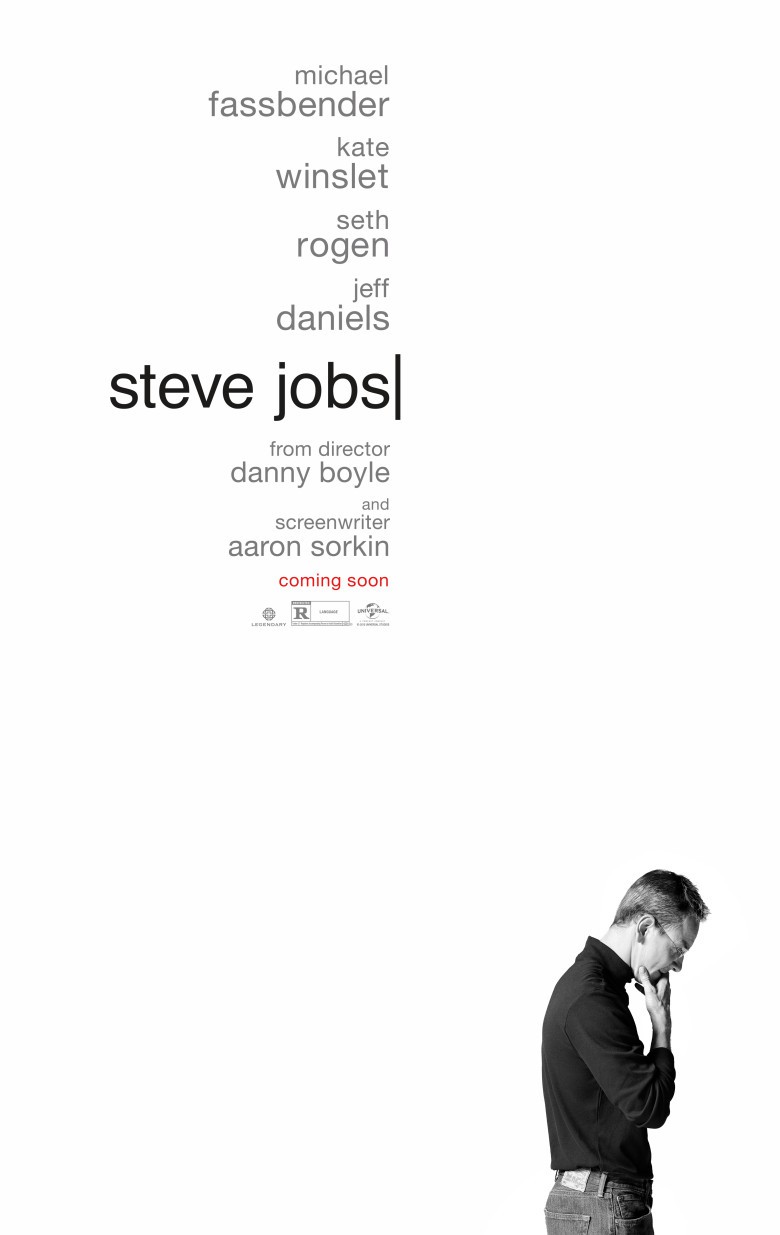
It's Not Binary: "Steve Jobs"


There are two specific scenes in Steve Jobs which illustrate both the ways Jobs thinks and how others view his thought process. In one scene Andy Hertzfeld (Michael Stuhlbarg)- who co-created the original Macintosh computer- asks Jobs (Michael Fassbender) why he wants people to dislike him. Jobs says he doesn't want people to dislike him, he's just indifferent to whether people like him.  In an earlier scene, Steve Wozniak (Seth Rogen) states that being decent and gifted are not binary. For Jobs indifference to people's feelings towards him isn't intrinsic to behaviour which will cause people to dislike or outright hate him. After Herztfeld tells Jobs he never liked him, Jobs says he always like Hertzfeld. This line is both funny and sad, revealing a complicated man beneath the supposed binary thinking. Steve Jobs is largely about the distinction between telling people how we think and our more complex thought processes. 

The script for the film comes from Aaron Sorkin and it's hard not to draw comparisons to the film for which he won the Best Adapted Screenplay Oscar- the David Fincher directed The Social Network- the film about the founding of the social media site Facebook by Harvard undergraduate Mark Zuckerberg. Both centre around figures who revolutionized our relationship with technology (and without people like Steve Jobs there'd probably be no Mark Zuckerberg), question the morality and importance of the men at their centres. And what ultimately unifies the two films is they're more character studies than biopics. Neither film is too interested in how the outside world is affected by Jobs' and Zuckerberg's achievement- they zero in on the personalities behind the innovation, using said personalities as metaphors for the technology they helped redefine.

Image result for katherine waterston steve jobs


The narrative conceit of Sorkin's screenplay is it's divided in to 3 segments, each taking place just before a product launch- the Macintosh in 1984, the NeXT Computer in 1988, and the iMac in 1998. In each segment Jobs has to prepare to unveil something new to the world while also dealing with personal issues-largely involving his former girlfriend Chrisann Brennan and their daughter Lisa. Chrisann wants Jobs to provide for her and Lisa financially. Jobs denies being Lisa's father but there's never really any doubt in Jobs' or anyone else's mind that he's her biological father. Jobs' denial of his fatherhood is more about not wanting to accept responsibility than not believing their blood relation. Jobs' colleague Joanna Hoffman (Kate Winslet) persuades Jobs to embrace being Lisa's father- later on in the film Hoffman will tell Jobs that being a father is supposed to be the "best part" of him, not the technology he helped create. Wozniack- who co-founded Apple with Jobs wants recognition for the Apple II team but Jobs feels this acknowledgement to underminw the unveiling of the Macintosh. The film also explores Jobs' relationship with John Sculley (Jeff Daniels), CEO of Apple and the man who would eventually fire Jobs from the company.

Having all these conflicts arise just before each launch is convenient and not entirely realistic- but the narrative structures serves a thematic purpose- Jobs in a bubble where the personal and the professional can never be completely severed. Moreover, the fact Jobs only appears to know a small group of people highlights hi isolation from the rest of the world. We never see him in any situation that is just purely casual- every thing is related to work or invention.  

Steve Jobs

The film is directed by Danny Boyle- one of the most visually dynamic directors working in the medium today. Aside from a few Boyle-quse touches, Boyle's visual style is much more restrained than in his other works. While I would've liked for Boyle to do more composition and camera movement-wise, the film isn't bland as cinema. Visually, the most interesting technique Boyle brings to the film is how the three segments are filmed in 16mm, 35mm, and digital, respectively, to capture the feel of each time period and the advancement in technology. This works very well in creating a particular sense of place and time without seeing much of the outside world.    
  

Even the film-makers have admitted that Fassbender doesn't look like Jobs. I actually think this woks in the film's favour. The disconnect between the appearance of Jobs and Fassbender allows us to view the man at the film's heart on his own terms. Fassbender isn't playing Steve Jobs so much as he's playing "Steve Jobs"- just as Jesse Eisenberg was playing "Mark Zuckerberg." Fassbender is one of my favourite actors working today- and as Jobs he never pushes too far in one direction- he's not so off-putting as to stop the audience from engaging with the character but he never goes too soft with his characterization either- there's a humanity to Jobs but even by the film's end he's still working on being a better man.

Sorkin can never be accused of being too subtle but his screenplay is more restrained than expected. Sorkin's dialogue- like David Mamet or Quentin Tarantino- has a particular rhythm that when every one is in sync, really sings. While the film is centred around Jobs the film also acts as an ensemble piece- and honestly I don't think there's an off performance amongst the cast. 

Winslet is both Jobs' conscience and the conscience of the film. Winslet brings a solid balance of warmth and sternness to Hoffman. She's one of the only people working with Jobs who's not afraid to be honest when speaking with him. And in many ways Hoffman is Jobs' only true  friend. 

Daniels (who led Sorkin's The Newsroom for 3 seasons) is excellent as Sculley- someone who easily could've been written and performed as the villain of the film- the man who fired Steve Jobs. In a bravado sequence during the 1988 segment the film cuts between Jobs' and Sculley's conversation in the present, the early days of their relationship, and the night Jobs was fired. This sequence is a mosaic of two men's relationship- how it began and where it was during that period of time. 


Rogen brings a quiet but clear sense of betrayal to his portrayal of Wozniack. Wozniack tells Jobs that computers aren't paintings, to which Jobs always replies "fuck you." But Jobs contradicts this philosophy by not giving the Apple II team credit. If computers are truly art can't Jobs acknowledge artists?- is it because they aren't him? Because it'll distract from his art? Maybe it's because Wozniack's words still stick with Jobs: 

"What do you do? You're not an engineer. You're not a designer. You can't put a hammer to a nail. I built the circuit board! The graphical interface was stolen! So come ten times in a day I read Steve Jobs is a genius?" 

While this speech comes from Wozniack- it's also the film questioning the love we give our idols without truly understanding their exact importance or the other people who contributed to history. After Wozniack asks this question, Jobs says he plays the orchestra. That may be the most succinct if somewhat simple answer to Jobs' importance to the technological revolution.

Waterston- who I thought gave a potent performance in Paul Thomas Anderson's Inherent Vice- is far less elliptical here than in Anderson's film. Waterston makes Chrisann  sympathetic without sanding off the character's edge. Chrisann isn't always the most pleasant person to be around. I don't think she has a proper pay-off but the relationship between Jobs and his daughter Lisa is the more important arc. 

Lisa is played by Mackenzie Moss, Ripley Solo and Perla Hanley- Jardine in 1984, 1988, and 1998, respectively. There's a subtle consistency between the three actresses, and Hanley-Jardine carries the weight of Lisa's complicated relationship with Jobs. I feel the culmination of this arc feels a little too pat and sentimental- and the final moments don't feel they match the more morally complicated character the film was portraying.  

I've seen people complain about the number of Steve Jobs films we've gotten since Jobs's death at the age of 56 in 2011. How many movies does one man need?, they ask. Steve Jobs may not be the definitive account of Jobs' life, or even the last film someone makes about his life. But as a character study, Boyle, Sorkin, and Fassbender have created a dense and entertaining portrait of a man who became- and remains- a symbol in an ever changing industry. Computers may not be paintings but symbols are everlasting.