Showing posts with label Kenneth Branagh. Show all posts

Friday, 3 November 2017

Revisiting the Thor Films

Related image

With Thor: Ragnarok being released to North American audiences this weekend, I decided to revisit the first two Thor films. It feels like a long time since we've gotten a Thor film. Thor: The Dark World came out back in 2013, pre-The Winter Soldier and the first Guardians of the Galaxy. That film ended with a huge twist- Tom Hiddelston's Loki disguising himself as Odin (Anthony Hopkins) and ruling on the throne of Asgard. I find it surprising such a major plot point was never addressed in the subsequent Marvel films- though I assume Ragnarok wraps it up. 

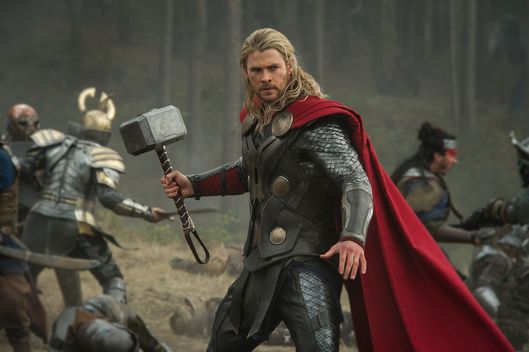
The first Thor, directed by Kenneth Branagh, is the film that opened up the Marvel Cinematic Universe beyond Tony Stark/Iron Man. We already knew Stark was part of a larger universe but Thor announced that Norse Gods existed in this world. Branagh's background in theatre and Shakespeare suited the...well, Shakespearean qualities of the source material. The best parts of the film take place in Asgard. Usually I find the the fantasy elements in Hollywood blockbusters can come across as dry and exposition-heavy. However, I like the interpersonal dynamics of these scenes. Thor (Chris Hemsworth) is about to be crowned Asgard's King when Frost Giants invade. They are killed but Thor wants to retaliate. His anger at this "day of triumph" being ruined and Odin dismissing Thor's desire for revenge shows his arrogance while also making him relatable. Loki is more reserved and an observational than Thor, an Iago-esque character that remains the MCU's most alluring antagonist.

Bo Welch's production design and the  gives Asgard a somewhat alien look feel. There's a grandness and mystery to it, with an specifically spooky atmosphere to it. Alexandra Byrne's costume design finds a middle ground between fantasy and science-fiction. I love how Thor's red cape stands out in this show. I also think it's a beautiful example of the production design, art direction and direction.
  
  
After battling with the Frost Giants in their home world of Jotenheim, Odin banishes Thor to Earth (Midgard to the Asgardians) and strips of his power. He sends Thor's hammer Mjolnir as well but Thor won't be able to pick it up until he becomes worthy. Thor encounters Astrophysicist Dr. Jane Foster (Natalie Portman,) Erik Selvig (Stellan Skarsgard) and Darcy Lewis (Kat Dennings). S.H.I.E.L.D  shows up and takes all their equipment and research due to the three being where Thor landed on Earth. S.H.I.E.L.D's presence in the story is a good example of organic world-building. It makes sense they'd be in this story because they're interested in Mjolnir. They also provide essential conflict for Thor on Earth while not being outright villains. When Thor can't lift Mjolnir at the S.H.I.E.L.D research site and then is lied to by Loki (He tells Thor he's permanently banished) Thor goes from brass braggart to humbled man with no home shows how good Hemsworth is in this role. He's able to be both arrogant, charming, romantic, heroic, and vulnerable. It's a true superhero movie performance.

I think the best scene in the movie is Loki confronting Odin about true lineage. Loki is a Frost Giant- Laufey's (Colm Feore) son- Odin adopted when he was a baby, after Odin waged war against the Frost Giants. We feel Loki's resentment at being lied to and realising while Thor was always favoured over him. Odin's pain over his relationship with both his sons' being broken is also apparent. While Odin can be viewed as simply a pay-cheque role, I think Hopkins is great at both scenery-chewing and more deeply-felt moments. What's intriguing about Loki is you see the evolution of his villainy, though I think the script makes things a little too convenient for Loki, with Thor being banished and Odin, overcome with emotion, falls in to the "Odinsleep." And honestly, I'm still not sure what that it is.
Image result for anthony hopkins odin

   
I wish this film was set entirely in Asgard- a Shakespearean Lord of the Rings mixed with Game of Thrones and 300. I do understand why they needed to create a connection between Thor and Earth, particularly his relationship with Jane. Hemsworth and Portman have good chemistry, the two characters clearly like each other. However, I think this romance needed a few more scenes to develop and deepen, particularly when we get to the second film. The relationship never feels like the grand romance it's supposed to be. 

Returning the matter of scale, I also think the filmmakers wanted to do a throwback to what a Thor movie would be like in the 80s or 90s. I find this movie resembles a early 2000s version of a Thor movie made with 2011 special effects. Even the use of the Foo Fighter's "Walk" over the end credits feels reminiscent of Sam Raimi's Spider-Man films.  
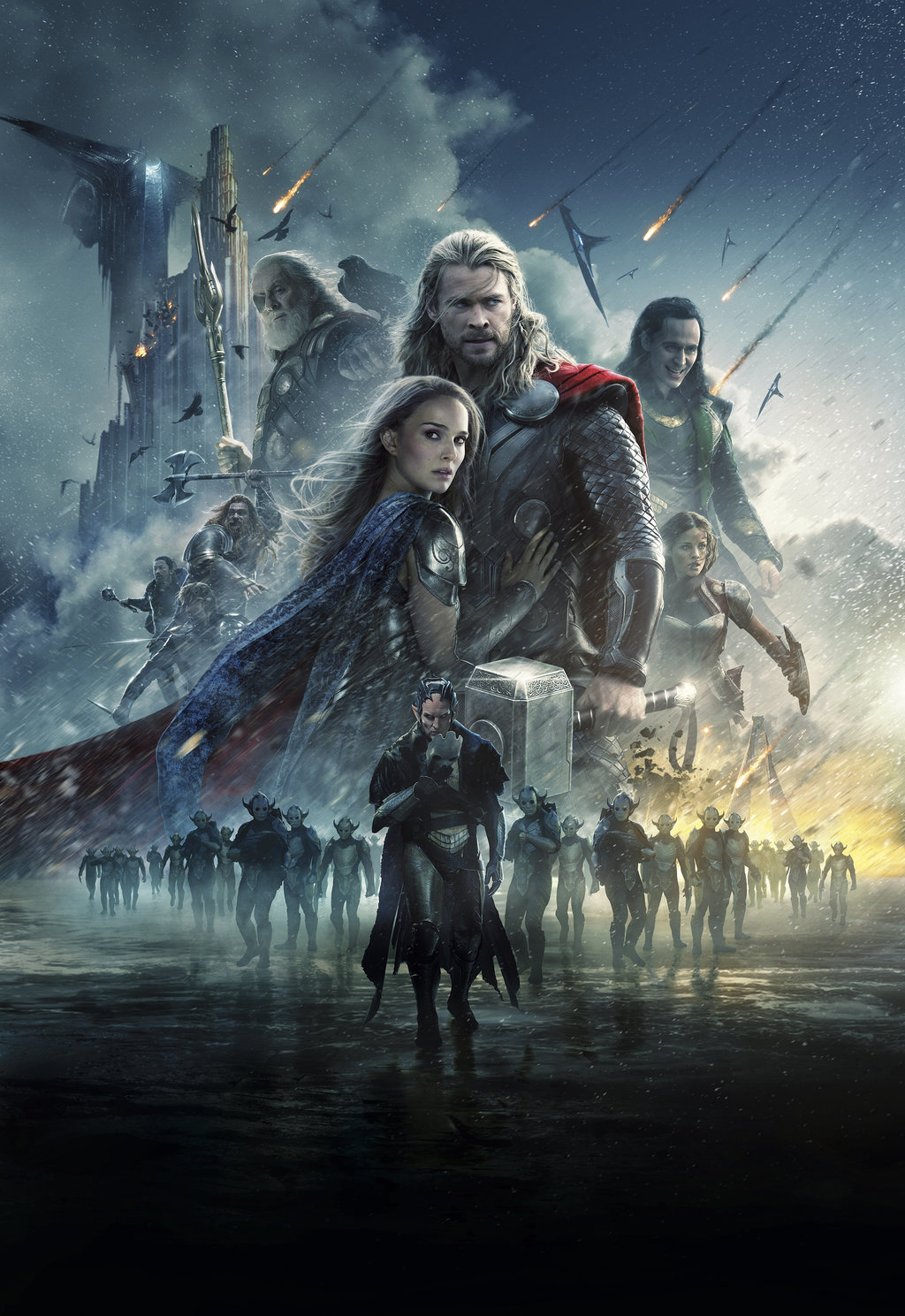
Image result for the dark world

I remember enjoying Thor: The Dark World in theatres, despite feeling it was just a filler film. Revisiting it for the first time since theatres, it's even more apparent the film is essentially a two part TV finale rather than a movie. It's story has potential but it's never fully developed enough, especially in a movie that's under two hours. That's not to say you can't have a well-developed story in under two hours, just that this film felt it needed more time to breathe. I glean there was difficulty in figuring where to take Thor next. Thor doesn't really have an arc in this film. At the beginning he doesn't want to be King of Asgard and by the end he feels the same way. The only real change is he admires Loki for sacrificing his life to help him; but that emotional development is undermined by the ending reveal, essentially an"Oh that Loki" moment that reinforces the filler quality of the film. 

The scenes between Thor and Loki are the film's strongest and emotional. Loki continues to be more multilayered than the other MCU villains. Moreover, The conversation between Loki and his his mother Frigga (Rene Russo) reveals Loki's emotional vulnerability. When he learns of her death at the hands of the Dark Elves, he psychically smashes things in his cell. Without dialogue or even seeing his face, we feel his anger and despair and his mother's death.  

Alan Taylor, who had directed several Game of Thrones episodes, replaced Branagh on this film. Taylor made sense as a replacement due to Game of Thrones having the qualities that would suit a Thor film but I feel Taylor doesn't bring the same directorial stamp as Branagh. Asgard does have a more Game of Thrones feel but it lacks the atmosphere and striking visual look of the first film

Malekith is the weakest villain of the MCU thus far, a shame since Christopher Eccleston is wasted and the character is much more entertaining sinister in the comics. I do like the Star Trek/Wars look of the Dark Elves, with their blasters and spaceships. They're a good representation of how the Thor side of the MCU blends fantasy and science fiction.

The teleportation climax is inventive and Thor getting on the train is a great bit. Skarsgard smartly deadpans Selvig's insanity after being possessed by Loki in The Avengers and is pretty funny- but I wish this plot thread was treated more dramatically. 

Ragnarok is supposed to be the best of the three Thor films. I gather it's the Iron Man 3 to The Dark World's Iron Man 2, less filler, more style and energy. I think Thor is a mostly good film and The Dark World has its entertaining moments but Ragnarok has be excited. Walking in to the Marvel films I always hope it'll be my favourite one so far. 


Sunday, 25 December 2016

Shakespeare on Film: Looking Back at Kenneth Branagh's Hamlet (1996), 20 Years Later


Image result for hamlet 1996

Branagh's adaptation of Hamlet turns 20 this month.  feels even more bold and radical than it did back in 1996. While it was considered a risky endeavour then, I honestly don't know if it could be made today, at least not with the budget and amount of creative control Branagh had. It could possibly be done on HBO as a mini-series. In many ways it's a miracle this film exists. When Branagh first pitched his idea for an unabridged adaptation of William Shakespeare's Hamlet, most studios wouldn't touch it, sceptical of how well it would do financially, especially after Branagh's previous film, Mary Shelley's Frankenstein failed at the box office. Castle Rock eventually agreed to finance the film under certain conditions- including an all-star cast and an edited 150 minute version for a wide release. Branagh was able to shoot on 70mm- the last film to shoot on the format until Paul Thomas Anderson's The Master in 2012.

The film was the culmination of Branagh's interpretation of Shakespeare on film, following Henry V (1989) and Much Ado About Nothing (1993). Branagh had always strived to make accessible adaptations of Shakespeare for general audiences, and he employed both his theatrical background while also thinking in cinematic terms. What Branagh did with Hamlet was to take it out of the shadowy, black and white world of Laurence Olivier's 1948 Oscar winning film- and also Russian Grigori Kozintsev's 1964 version and sets it against a opulent, majestic and bright castle. In the promo for the Cannes Film Festival Branagh explains that he wanted to go for impressionistic 19th century, not set in one specific year or country; he also wanted to have close enough to reality while retaining a distance that would audiences to accept the heightened language.

The setting and it being shot on 70mm gives it the grandeur of a David Lean epic like Lawrence of Arabia or Dr. Zhivago. The epic scale of the film would appear to run contrary with the play's psychological drama. However, the approach ultimately, I think, works. Consider that Lawrence of Arabia is a study of T.E. Lawrence's psychology while also being a war epic. In the play, Hamlet's personal turmoil and the domestic drama of the royal family is set against the approach of Fortinbras; there's a larger political context to the story.  I would venture this film emphasises that juxtaposition of personal and political more than the other film version.

After Hamlet encounters Fortinbras' soldiers he begins the "How all occasions do inform against me" soliloquy, in which he compares his inaction to the soldiers going in to battle, ready to die. As Hamlet gives the speech the camera pulls back, until the final proclamation, "My thoughts be bloody, or be nothing worth!" has Hamlet against the backdrop of frozen mountains. To me, this both grants Hamlet's pivotal turn a more grand gesture- Claudius' murder won't just be revenge, it'll change the fate of the kingdom. The play ends with Fortinbras becoming king of Denmark, Hamlet giving him his "dying voice." Fortinbras is also a man out to avenge his father's murder, though on a more overtly large scale than Hamlet.
Image result for hamlet 1996 how all occasions


Elsinore does feel like something from a bygone era. The exteriors of the castle were shot at Blenheim Castle in Oxfordshire and the wintry landscape feels Russian; if Olivier's and Kozintsev's versions were 50-era Ingmar Bergman, Branagh's recalls Fanny and Alexander. Tim Harvey's Oscar nominated production design (it lost to The English Patient) represents a place of prestige, privilege and comfort- but it's also a maze of secret rooms where anybody could be spying on you; there's an oppressiveness that weighs down on Hamlet. Despite the castle having a different aesthetic and ambiance from other adaptations, it still functions thematically as Hamlet's ''prison." Alexandra Byrne's costume design- also Oscar nominated and losing to The English Patient- feels both authentic to the time but as per Branagh's vision, not strictly attached to one specific year or country.

Coming back Elsinore being from a bygone era, the invasion at the film's conclusion does represent one era ending and another beginning. The deaths of Claudius, Gertrude and Hamlet signify this end. The film begins with the inscription of "Hamlet" on the statue of Hamlet's father- which also acts as the film's title card- and ends with that statue being torn down. Hamlet's father was already killed literally and at the film's end he's symbolically killed via the statue's destruction.

Branagh plays Hamlet very diva-like, and as someone highly intelligent yet easily overcome with emotion. He does calm down his performance in the second part of the film, which begins after "How all occasions do inform against me." Branagh is complimented by one of the greatest ensemble casts in a Shakespearean adaptation, including Derek Jacobi- who himself played Hamlet- as Claudius, Julie Christie as Gertrude (whom-to continue the David Lean connection- was in Dr. Zhivago), Richard Briers as Polonius, and Kate Winslet as Ophelia. In a interesting bit of history, Baz Luhrmann's Romeo+Juliet was released in the November before Hamlet's release. Leonardo DiCaprio starred in that fil and of course he and Winslet would be seen together a year later in Titanic. Supposedly Winslet learned she was cast as Rose in the film on the day she was to film her strait-jacket scene.


Several of the cameos don't fit. Jack Lemmon, Billy Crystal and Robin Williams stand out too much, especially when compared with actors like Jacobi and Briers. The film gets away with Charlton Heston as the Player King due to his commanding voice and presence. Moreover, there's something poignant about Heston- whom of his early roles was as Marc Antony in a 1950 film version of Julius Caesar- returning to Shakespeare near the end of his film career.

Admittedly, Branagh can go too broad as an actor and as a director. Hamlet in a Jesus pose as his body is being carried out by Fortinbras feels excessive and unnecessary; but Branagh also stages many scenes with restraint and nuance. I admired how he puts Ophelia in a doorway during the "Oh, what a noble mind is here o'erthrown" speech. She's in a literal framework while also framed by the camera. Then there's the way Branagh reveals Hamlet in his first scene- panning across the crowd to find him; this reveal adds an certain ominousness vibe to the character. Hamlet is also constantly lurking. The ever-moving camera during scenes with multiple characters also gives off an Robert Altman-vibe and also acts another spying eye.

As a production Hamlet was part of a resurgence of old-fashioned epic films in the 80s and 90s that included the following year's Titanic, Gandhi, Amadeus the aforementioned The English Patient, Braveheart. This resurgence culminate in with The Lord of the Rings trilogy in the early 2000s, maybe the boldest film-making venture in modern film history.

If Hamlet is partly about one era giving away to another, Branagh's film equally represents one kind of film that has given way to less ambitious and more conventional blockbusters. I've actually dreamt of adapting Othello on the same scale as this film.  Branagh's film is one of a kind, a testament to sincere and passionate movie-making and love of Shakespeare.


Wednesday, 11 January 2012

Desert Island DVDs

The volleyball named Wilson by Tom Hanks in 'Castaway'


Recently critc Matt Zoller Seitz asked fellow critics to pick the ten films they'd want to take with them if they were stuck on a desert island. The rules were to pick ten films, one season of television and one short. I posted mine on Jim Emerson's blog, Scanners. I want to post it here as well just for fun.

Films (In no particular order, except for number one)

1. Casablanca- When asked what my favourite film is I pick this one. Roger Ebert said of Carol Reed's The Third Man that it captures the romance of going to the movies for him. I feel that way about this film. Romantic, funny, heroic and ultimately a little tragic, Casablanca has never failed to entertain or move me.

2. Casino Royale (2006)- My favourite Bond film. It may not be a perfect movie but in it's own way it's a perfect Bond film in that it combines fantastical action sequences with a grounded humanity, never escalating in to camp. The romance between Bond and Vesper Lynd is heartbreaking and establishes why Bond is such an emotionally cold bastard sometimes.

3. The Haunting (1963)- A really fun and spooky haunted house film. The fact that you never see a ghost makes it all the more terrifying and surprisingly satisfying.

4. The Apartment (1960)- Billy Wilder's romantic comedy blends humour and tenderness with cynicism and interesting social commentary very well. I think I like this more than Wilder's film before this, Some Like It Hot.

5. Out of the Past- It really encapsulates the film noir genre/style. While romance may not be what one automatically thinks of when they think "film noir" but the doomed romances at the heart of this film are integral to the psychology of the film noir anti-hero.

6. Shutter Island- This may sound blasphemous but this may be my favourite Scorsese film.

7. Hamlet (1996)- I'd need my Shakespeare fix and Kenneth Branagh's epic is my favourite Shakespearean adaptation on film.

8. Rear Window- Hitchcock is my favourite director and it's insanely difficult to pick only one. I think I would go with this one.  It takes something which sounds uncinematic and makes it in to pure cinema.       

9.  The Godfather- Mafia life played at almost Shakespearean heights.

10. The Pink Panther Strikes Back- My favourite of the series

Television: Season Five of The Simpsons
Short: Someone on Emerson's blog picked Geri's Game, which played before Pixar's A Bug's Life. It's the short where the old man plays chess with himself. I think I'd have to pick this one as well.

This is a fun but very difficult game. There are so many more more films I could have swapped with the ones on this list. It would take me too long to list all of them. I encourage everyone to try this exercise. It gives you a sense of the films you really can't live without...and you realize there's a lot!

Saturday, 10 December 2011

Marilyn and Michelle: "My Week With Marilyn"


I think nowadays we take for the notion of fame for granted. We're bombarded with magazine covers and reality shows. It always seems like anyone can become famous so it doesn't seem like a big deal. There's a scene in My Week with Marilyn where Marilyn Monroe (Michelle Williams) and her husband Arthur Miller (Dougray Scott) are swarmed by reporters when they gets off a plane in London. When we see this, we grasp what's it like not just to be famous, but to be FAMOUS. Despite the glamour of it all, there's a messiness to it as well.

It's the messiness of fame which is underneath the surface of My Week With Marilyn. It's what suffocated Marilyn. It pushed her in to playing a part even when she's not on screen. Marilyn Monroe is just another role to play- but she didn't just want to play Marilyn Monroe. She wants to be taken seriously as an actress. This is what led her, in 1956, to take the role of Elsie in the film version of Terrence Rattigan's play, entitled The Prince and the Showgirl. The film was directed by Laurence Olivier, who also played the prince, a role he originated on stage, with his wife Vivien Leigh in the role of Elsie.

My Week With Marilyn shows us the troubled production of the film through the eyes of Colin Clark (Eddie Redmayne), an assistant director to Olivier. The film is based on two of Clark's books, The Prince, the Showgirl, and Me and My Week With Marilyn. In these books Clark alleges he and Monroe had a love affair. I don't know if Clark is telling the absolute truth but the books provide the film with the chance to romanticize the love a young man can have for a beautiful movie star. The irony is no matter how close Colin gets to Marilyn and learn about her, he can still only love the image of Marilyn. He calls her a goddess but I don't think Marilyn wants to be built up as a goddess. She just wants to be viewed as a person but I don't think Colin can truly get past the image; maybe because Marilyn is stuck inside this image.

I've realized I've gone through this review without mentioning who plays Marilyn. Michelle Williams is beautiful and radiant in the part. There are many times where I forgot it was Williams. I think her performance deserved a more expansive film about Marilyn. In this film, Marilyn almost seems like a supporting player than the main character. The making of this film and her relationship with Colin would have more impact as something central to a conventional biopic. By itself, the story seems too small.

My favourite parts of the film are the making of the film. Kenneth Branagh, who was deemed Olivier's heir when he first came on the scene as a Shakespearean actor, plays Olivier with a humorous flippancy towards Monore's acting style. Olivier was a classically trained stage actor while Monroe was interested in the method. She even brings her teacher Paula Strasberg (Zoe Wanamaker) along with her. It's funny to see Olvier, who was this towering presence as an actor, treat acting as it was just a mechanical process. Judi Dench does fine work as Dame Sybil Thorndike. Julia Ormond gives Vivien Leigh a delicacy and acceptance towards being too old to play Elsie. It's also nice to see Harry Potter's Emma Watson as a  wardrobe assistant named Lucy, who is Colin's first's love interest. Unfortunately, her role comes across as a little superfluous. She only seems to be here in order to tell Colin he deserved to have his heart broken, though I didn't belive he did.

People have said that with this film, Monroe was trying to be taken seriously as an actress, and Olivier was trying to be a film star. In essence, they both want to be each other. The disappointing thing about discussing the ideas regarding Marilyn's relationships with Colin and Olivier, is that these ideas are more interesting than the film is either aware of or willing to explore. I appreciated My Week With Marilyn for its performances and is pleasantness. It's an enjoyable film but outside of Williams and Branagh's performances, I don't think it's an essential film.