Showing posts with label The Social Network. Show all posts

Monday, 2 November 2015

It's Not Binary: "Steve Jobs"


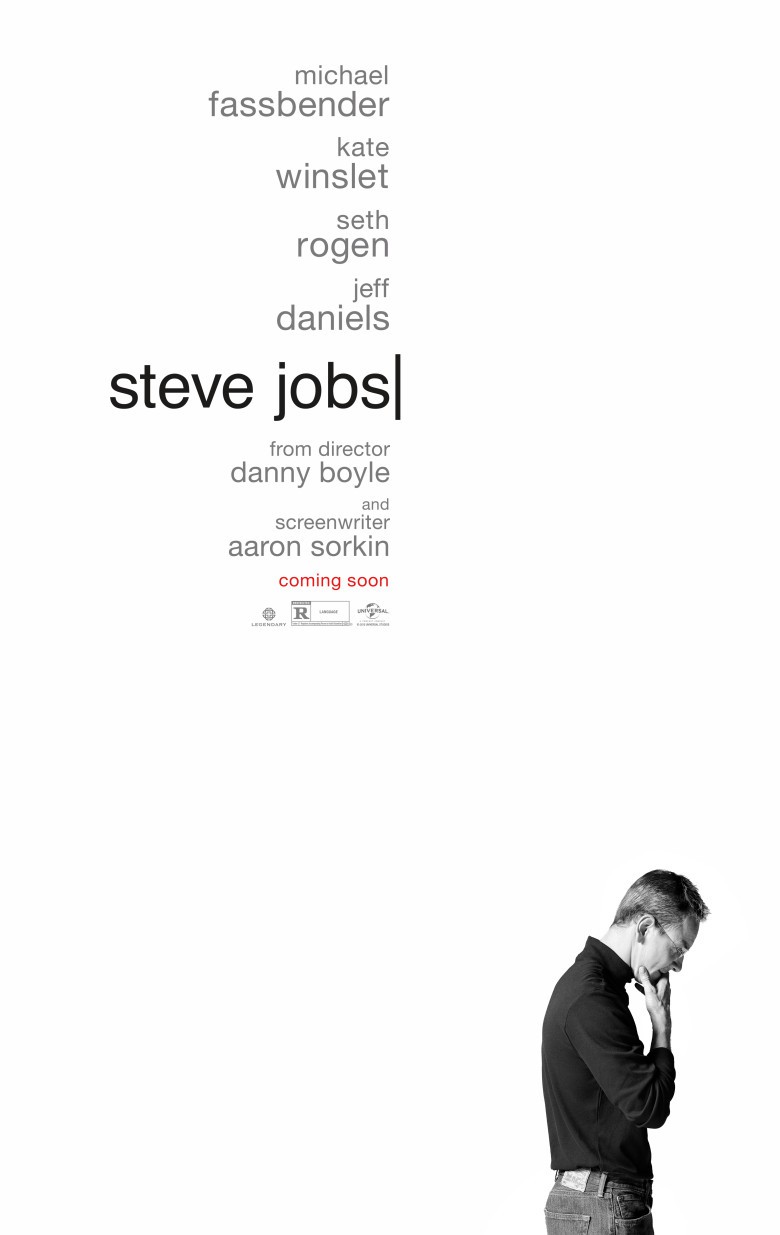
There are two specific scenes in Steve Jobs which illustrate both the ways Jobs thinks and how others view his thought process. In one scene Andy Hertzfeld (Michael Stuhlbarg)- who co-created the original Macintosh computer- asks Jobs (Michael Fassbender) why he wants people to dislike him. Jobs says he doesn't want people to dislike him, he's just indifferent to whether people like him.  In an earlier scene, Steve Wozniak (Seth Rogen) states that being decent and gifted are not binary. For Jobs indifference to people's feelings towards him isn't intrinsic to behaviour which will cause people to dislike or outright hate him. After Herztfeld tells Jobs he never liked him, Jobs says he always like Hertzfeld. This line is both funny and sad, revealing a complicated man beneath the supposed binary thinking. Steve Jobs is largely about the distinction between telling people how we think and our more complex thought processes. 

The script for the film comes from Aaron Sorkin and it's hard not to draw comparisons to the film for which he won the Best Adapted Screenplay Oscar- the David Fincher directed The Social Network- the film about the founding of the social media site Facebook by Harvard undergraduate Mark Zuckerberg. Both centre around figures who revolutionized our relationship with technology (and without people like Steve Jobs there'd probably be no Mark Zuckerberg), question the morality and importance of the men at their centres. And what ultimately unifies the two films is they're more character studies than biopics. Neither film is too interested in how the outside world is affected by Jobs' and Zuckerberg's achievement- they zero in on the personalities behind the innovation, using said personalities as metaphors for the technology they helped redefine.

Image result for katherine waterston steve jobs


The narrative conceit of Sorkin's screenplay is it's divided in to 3 segments, each taking place just before a product launch- the Macintosh in 1984, the NeXT Computer in 1988, and the iMac in 1998. In each segment Jobs has to prepare to unveil something new to the world while also dealing with personal issues-largely involving his former girlfriend Chrisann Brennan and their daughter Lisa. Chrisann wants Jobs to provide for her and Lisa financially. Jobs denies being Lisa's father but there's never really any doubt in Jobs' or anyone else's mind that he's her biological father. Jobs' denial of his fatherhood is more about not wanting to accept responsibility than not believing their blood relation. Jobs' colleague Joanna Hoffman (Kate Winslet) persuades Jobs to embrace being Lisa's father- later on in the film Hoffman will tell Jobs that being a father is supposed to be the "best part" of him, not the technology he helped create. Wozniack- who co-founded Apple with Jobs wants recognition for the Apple II team but Jobs feels this acknowledgement to underminw the unveiling of the Macintosh. The film also explores Jobs' relationship with John Sculley (Jeff Daniels), CEO of Apple and the man who would eventually fire Jobs from the company.

Having all these conflicts arise just before each launch is convenient and not entirely realistic- but the narrative structures serves a thematic purpose- Jobs in a bubble where the personal and the professional can never be completely severed. Moreover, the fact Jobs only appears to know a small group of people highlights hi isolation from the rest of the world. We never see him in any situation that is just purely casual- every thing is related to work or invention.  

Steve Jobs

The film is directed by Danny Boyle- one of the most visually dynamic directors working in the medium today. Aside from a few Boyle-quse touches, Boyle's visual style is much more restrained than in his other works. While I would've liked for Boyle to do more composition and camera movement-wise, the film isn't bland as cinema. Visually, the most interesting technique Boyle brings to the film is how the three segments are filmed in 16mm, 35mm, and digital, respectively, to capture the feel of each time period and the advancement in technology. This works very well in creating a particular sense of place and time without seeing much of the outside world.    
  

Even the film-makers have admitted that Fassbender doesn't look like Jobs. I actually think this woks in the film's favour. The disconnect between the appearance of Jobs and Fassbender allows us to view the man at the film's heart on his own terms. Fassbender isn't playing Steve Jobs so much as he's playing "Steve Jobs"- just as Jesse Eisenberg was playing "Mark Zuckerberg." Fassbender is one of my favourite actors working today- and as Jobs he never pushes too far in one direction- he's not so off-putting as to stop the audience from engaging with the character but he never goes too soft with his characterization either- there's a humanity to Jobs but even by the film's end he's still working on being a better man.

Sorkin can never be accused of being too subtle but his screenplay is more restrained than expected. Sorkin's dialogue- like David Mamet or Quentin Tarantino- has a particular rhythm that when every one is in sync, really sings. While the film is centred around Jobs the film also acts as an ensemble piece- and honestly I don't think there's an off performance amongst the cast. 

Winslet is both Jobs' conscience and the conscience of the film. Winslet brings a solid balance of warmth and sternness to Hoffman. She's one of the only people working with Jobs who's not afraid to be honest when speaking with him. And in many ways Hoffman is Jobs' only true  friend. 

Daniels (who led Sorkin's The Newsroom for 3 seasons) is excellent as Sculley- someone who easily could've been written and performed as the villain of the film- the man who fired Steve Jobs. In a bravado sequence during the 1988 segment the film cuts between Jobs' and Sculley's conversation in the present, the early days of their relationship, and the night Jobs was fired. This sequence is a mosaic of two men's relationship- how it began and where it was during that period of time. 


Rogen brings a quiet but clear sense of betrayal to his portrayal of Wozniack. Wozniack tells Jobs that computers aren't paintings, to which Jobs always replies "fuck you." But Jobs contradicts this philosophy by not giving the Apple II team credit. If computers are truly art can't Jobs acknowledge artists?- is it because they aren't him? Because it'll distract from his art? Maybe it's because Wozniack's words still stick with Jobs: 

"What do you do? You're not an engineer. You're not a designer. You can't put a hammer to a nail. I built the circuit board! The graphical interface was stolen! So come ten times in a day I read Steve Jobs is a genius?" 

While this speech comes from Wozniack- it's also the film questioning the love we give our idols without truly understanding their exact importance or the other people who contributed to history. After Wozniack asks this question, Jobs says he plays the orchestra. That may be the most succinct if somewhat simple answer to Jobs' importance to the technological revolution.

Waterston- who I thought gave a potent performance in Paul Thomas Anderson's Inherent Vice- is far less elliptical here than in Anderson's film. Waterston makes Chrisann  sympathetic without sanding off the character's edge. Chrisann isn't always the most pleasant person to be around. I don't think she has a proper pay-off but the relationship between Jobs and his daughter Lisa is the more important arc. 

Lisa is played by Mackenzie Moss, Ripley Solo and Perla Hanley- Jardine in 1984, 1988, and 1998, respectively. There's a subtle consistency between the three actresses, and Hanley-Jardine carries the weight of Lisa's complicated relationship with Jobs. I feel the culmination of this arc feels a little too pat and sentimental- and the final moments don't feel they match the more morally complicated character the film was portraying.  

I've seen people complain about the number of Steve Jobs films we've gotten since Jobs's death at the age of 56 in 2011. How many movies does one man need?, they ask. Steve Jobs may not be the definitive account of Jobs' life, or even the last film someone makes about his life. But as a character study, Boyle, Sorkin, and Fassbender have created a dense and entertaining portrait of a man who became- and remains- a symbol in an ever changing industry. Computers may not be paintings but symbols are everlasting.  

Wednesday, 7 March 2012

How "The King's Speech" Foreshadowed This Year's Oscar Race


When The King's Speech won Best Picture at the Oscars last February, and ever since then, the academy hs been criticized for being too traditional and "safe" in their choice. The other nine contenders included more modern fare such as David Fincher's The Social Network, which chronicled the creation of Facebook, the website that has shaped a generation, and Christopher Nolan's Inception, which played with narrative structure and created a unique take on the heist film. The Kids Are All Right told the story of a lesbian couple and 127 Hours took a risk by telling the true story of a man who was trapped in a canyon.

I think there was a nostalgic, "they don't make them like this anymore"factor to The King's Speech's victory. Interestingly enough, this year's Oscar race is very much based on nostalgia. I wouldn't call every film nominated for Best Picture this year "traditional" but several of these films, including the winner, appeal to the academy's sense of nostalgia for films and filmmakers of old. This year's winner The Artist, while unique for a film in 2011 because it was silent and in black and white, still appeals the nostalgia for the silent film era and stars of that era. What makes Jean Dujardin's Oscar winning performance so moving is how he reminds us of movie stars from the silent era. The film also has an uplifting ending which tells us that despite "talkies" taking the place of silent films, the artists who made those films have the ability to cross over to "talkies" and create art.

Martin Scorsese's Hugo, while using the very modern technique of 3-D, like The Artist, appeals to nostalgia for the silent film era and more importantly for the pioneers of film including George Melies, played in the film by Ben Kingsley. Christy Lemire and Ignaty Vishnevetsky, co-hosts of Ebert Presents At The Movies, have also said they feel Scorsese's film captures the style of silent films better than The Artist.

Other nominees also have a nostalgic/traditional quality to them. The Help is reminiescent of an old fashioned social issue film. Steven Spielberg's War Horse has been compared to the work of John Ford. Vishnevetsky also said there is nothing in the film which wouldn't have gotten past the Hays Code from the old studio film. Woody Allen's Midnght in Paris, while critical about nostalgia, still creates nostalgia for a bygone era; and as critic AO Scott points out in his review of the film, audiences also have a particular kind of nostalgia for Woody Allen..

Even Terrence Malick's The Tree of Life, the most modern and daring film of the nominees, is essentially about a man looking back at his childhood in the 1950s. The film, in part, is a tribute to growing up in that era. Moneyball, The Descendants, and Extremely Loud & Incredibly Close are actually the only three Best Picture nominees to take place completely in the present, though even  Moneyball and ELIC  both take place about 10 years ago.

I found this year's Best Picture line-up, with a strong focus on the past, in opposition to last year's more modern day line-up. The King's Speech stood out a little bit last year; this year it would have fit right in. I feel The Artist is consciously going for a traditional style whereas The King's Speech just falls in to that style but I think The King's Speech did foreshadow The Artist's victory. I'll be interested to see if the academy goes back to honouring edgier fare as they were doing with films like No Country For Old Men or The Hurt Locker. Can Christopher Nolan's final Batman film, The Dark Knight Rises be the first superhero film to win Best Picture. I think that's a little bit too much to hope for, particularly this far out; but if  any of the academy members are feeling nostalgic for Batman...

Friday, 18 November 2011

Not Like There's Anything Wrong With That: "J. Edgar" Review


There's a moment a little while in to J. Edgar, where an elderly J. Edgar Hoover (Leonardo DiCaprio), dictating his autobiography to an agent (Mike Vaughn) asks the agent, "Who was the most famous person of the twentieth century, thus far?" The agent eventually asks "Is that you, sir?" Hoover seems mildly amused the agent would give this answer, though we can't help but think there's some kind of pride Hoover finds in being seen as famous.

Of course, we don't know exactly what Hoover is thinking in this moment, and its this type of mystery which extends all the way through J. Edgar. The film, while it explores the secret life of the man who was the head of the F.B.I for nearly fifty years, doesn't really try to explain the man. I think it's possible that director Clint Eastwood, who himself grew up when Hoover was in power, is still struggling to figure out the man who arguably held more power than the eight presidents he served under.

The film shifts back and forth from Hoover's younger years in the 1920s and 30s, when he first became head of the Bureau of Investigation, which eventually became what we know as the F.B.I., his relationship with his right hand man, Clyde Tolson (Armie Hammer)-and Hoover as an old man, dictating his biography. I liked this approach for several reasons. One is that it allows you to get used to the old age makeup on DiCaprio and Hammer. The make up has been harshly criticized but I for one was able to settle in to it as the film progressed. I also like how the film's structure gives equal emphasis to both young and old Hoover instead of showhorning older Hoover in to the last few minutes of the film. Another nice structural element is the juxaposition of certain scenes and moments that connect the past and the present. For example, an older Hoover and Tolson get in a elevator and then we cut to the younger Hoover and Tolson getting out of an elevator; we see Hoover on a "date" with secretary Helen Gandy (Naomi Watts) where he asks her to marry her but eventually has to settle for her as his secretary- we then cut to a scene older Hoover and Gandy, and just by juxapositing these two scenes, we get a sense of a long history between these two.

Dustin Lance Black's script (he also won an Oscar for writing another biopic, Milk), as well as the film itself, is surprisingly sympathetic towards Hoover, which has angered at least one critic. The film is less interested in demonizing Hoover than exploring Hoover's inner demons. A major focus of the film is the relationship between Hoover and Tolson, whom many believe was a romantic one. While these claims are still speculative, the film shows Hoover as a man, who despite loving Tolson, cannot be himself because of the era he lived in, his mother's statement that she rather have "a dead son than a daffodil," and his committment to his work above all else. In it's own way, J. Edgar is Brokeback Mountain with cops; but I don't mean to trivialize the film with that joke because J. Edgar gains its emotional resonance, its heart, from the relationship between Hoover and Tolson. Christy Lemire mentions the looks DiCaprio and Hammer share for just a little too long, and its moments like these, as well as Tolson's condition that he joins Hoover as his right hand man, they never skip a meal, which communicate deep yearning for human companionship within both men.

DiCaprio may be the most unglamorous movie star we have in that he specializes in really haunted individuals who aren't always clearly the protagionists of the film. While DiCaprio doesn't look like Hoover, as portrayed in this film, he's an almost perfect fit for DiCaprio. There's always seems to be a certain "DiCaprioness" which comes through in DiCaprio's performances, not that's he's playing himself but more a larger than life version of himself. I think this is what turns some people off of his performances, and certainly it takes a little while to settle in to DiCaprio's performance; but once you do, and I think the old age scenes help, DiCaprio once again provides a really live wire performance. His mid atlantic accent, while distracting at first, gives Hoover an old fashioned feel. It's also been noted, and is shown in the film, that Hoover had a stammer and the accent's rigidness was a result of combating the stammer.

Hammer played the Winklevoss twins in David Fincher's The Social Network; the twins were symbols of American manliness and entitlement but here Hammer gives a much softer and sympathetic performance as Tolson. Hammer gives Tolson an open face, not afraid to show his character's vulnerability, but he also shows Tolson's efficency of character as well as his intelligence and I found him very convincing as a man Hoover could fall in love with.

Unfortunately, Naomi Watts doesn't get as strong a character arc as DiCaprio and Hammer but she's very effective nonetheless in capturing Gandy's loyalty and precision as Hoover's secretary. Judi Dench, who plays Annie Hoover, Hoover's mother is chilling in the aforementioned scene when she tells Hoover about a boy who was killed because he was found out to be gay and that she'd rather her son be dead than gay.

I thought Jeffrey Donovan's accent, playing Robert Kennedy, was distracting so it was to completely get in to his scenes with Hoover.

I think the main problem with J. Edgar is that it tries to focus on too much but not enough. Much of the focus regarding Hoover's career involves the kidnapping of the Linburgh baby, which led to kidnapping becoming a federal crime. This section of the film has great detail and is an important part of Hoover's career but I wish we had seen more of Hoover's career, particularly regarding gangsters like John Dillinger. I also feel, and this comes back to the sympathy issue, that the film doesn't delve deep enough in to Hoover's darker characteristics. We see him blackmail Robert Kennedy with information about his brother's affairs, as well as listen to a bedroom liason between Martin Luther King and a woman, but I think the film needed to show more of Hoover's tyranny over his office. DiCaprio has played morally ambiguous characters before but I feel showing Hoover as a tyrant would have allowed DiCaprio to be darker than ever before. I think with this film, you have to take it less as a completely literal biopic of Hoover than one interpretation or angle on him. If taken that way, J. Edgar provides an interesting cipher of a man and in DiCaprio's performance, still one of the most interesting movie stars of our times.