Sunday, 13 July 2014

"A Planet Where Apes Evolved From Men?:" A Look Back at the Original Planet of the Apes Series


Spoiler Warning: This retrospective will be discussing specific plot points from the five original Planet of the Apes films.


The Planet of the Apes franchise is one of the most audacious, bizarre, bold and bleak film series of the 20th century. Released between 1968 and 1973 the original five films took an allegorical look at the social and political issues that America confronted during this time, such as racism, war, and the fear of nuclear war. As opposed to the James Bond franchise, Planet of the Apes wasn’t merely escapism. They were high entertainment that also presented its audience with cautionary tales about the future of civilization.


The idea of a planet on which apes were the dominant species and humans the primitive creatures sprang from the imagination of French novelist Pierre Boulle. Boulle had previously written the novel The Bridge on the River Kwai, which became the Oscar winning film from David Lean in 1957. Boulle wrote Planet of the Apes in 1963. The novel-while somewhat overshadowed by the film franchise- is a brilliant piece of science fiction that should be read by all fans of the genre. It's narrated by Ulysse Merou, a journalist who takes part in a space journey with Professor Antelle and a physician named Arthur Levain. They land on a planet much like earth, which they name Soror. They realize the planet is dominated by intelligent apes who enslave humans. Levain is killed and Antelle becomes animal-like while locked in a zoo. Unlike the other humans on the planet Ulysse can speak. He shacks up with a woman named Nova and becomes friends with Zira, an animal psychologist, and her archeologist finance, Cornelius. 


In 1968 a film version of Boulle's novel was released. And after nearly 50 years Planet of the Apes is still the definitive film of this franchise. The film stars Charlton Heston as George Taylor, an astronaut on an unspecified mission with three others: two men- Dodge and Landon (Jeff Burton and Robert Gunner), and a woman named Stewart (Dianne Stanley, un-credited). The film opens with Taylor recording a message in which he says their ship is travelling at the speed of light. Even though they have been away from the Earth for only several months (their time) the Earth has aged hundreds of years.


Taylor goes in to hibernation with the rest of the crew and after the title sequence the ship crashes on an unknown planet. The three men discover there was an air leak in Stewart’s tube, which killed her. The three remaining astronauts eventually happen upon primitive humans who cannot speak. Gorillas come along and begin hunting the humans. Dodge is killed but Taylor and Landon are captured. Taylor is shot in the throat so he can’t speak. Thus the apes believe Taylor is just another dumb human. As in the novel Zira and Cornelius (Kim Hunter and Roddy McDowall) become his allies. When Taylor regains his ability to speak he utters one of the film’s most iconic lines, “Get your stinking paws off me, you damn dirty ape!”  


A tribunal is held to discover why Taylor can talk. It’s in these scenes that the film explores the conflict between faith and science. The orangutans believe that its scientific heresy for Zira and Cornelius to claim that Taylor is a missing link in the evolutionary change. Dr. Zaius (Maurice Evans)- an orangutan and the film’s chief antagonist- holds two contradictory positions. He’s both Minister of Science and Chief Defender of the Faith. Near the end of the film Taylor says Zaius's position as Defender of the Faith interferes with his obligations towards the progression of science. Zaius responds by saying: “There is no contradiction between faith and science...true science.” Zaius  can’t or won't acknowledge the conflict in his duties. Zaius knows that man used to rule the planet but believes it’s best to keep the true history of the planet a secret from ape society. He even goes as far as destroy Cornelius’ archeological dig, which contained evidence of an earlier non-ape civilization. Zaius is a great antagonist because his motivations and philosophy make complete sense and we can the situation from his point of view. He feels he’s acting in the best interests of his species. He’s not a noble character but he does have- in his mind at least- noble intentions.


In the closing moments of the film Taylor-on horseback with Nova (Linda Harrison)- discovers the ruins of the statue of liberty on the shore. It turns out this "alien" planet was Earth all along. The final shot of the film is one cinema’s most indelible images and of the greatest closing shots of all time. It’s an image that represents the downfall of civilization-in particular American civilization- the fear of nuclear destruction and the how remnants of the past are always present. The ending of the film also relates to Taylor's character arc. At the beginning of the film Taylor says he has no regrets upon leaving the 20th century and mocks Landon for having any affinity for humanity. By the end Taylor has regained some appreciation for humanity. He tells Zaius that whoever was here before the apes was “better than you.”  When he sees the statue we see a man who's hatred of humanity is arguably validated. The ending also shows that Taylor cared enough about humanity that it's self destruction deeply anguishes him.


What’s also notable about the use of this image is it represents the cultural difference between Boulle’s novel and the film series. While the novel was written through a French perspective the film was directed and written by Americans. The statue of liberty is a thoroughly American image and it’s placement at the end of the film speaks to the fall of America even as it also represents the downfall of civilization at large. Rod Serling was already famous for his TV series The Twilight Zone, which tackled social issues on a weekly basis through the prism of science fiction and fantasy. Serling   co-wrote the screenplay for  Planet of the Apes with Michael Wilson and suggested the now famous ending. In Boulle’s novel the planet is not earth. The novel ends with Ulysse, Nova and their son travelling back to Earth only to discover that it’s also become a planet of the apes. The seed of the film’s ending is there but Serling expanded upon the ending.  The film's twist ending defined the entire mythology on here onwards. It’s strange now to think of the planet being anything else but Earth. It’s a perfect thematic resolution and brings home all the social commentary of the story. The upside down civilization isn’t just a mirror version of our society but the result of man’s self-destruction.


While the Planet of the Apes films aren’t usually thought of as directors’ film, Franklin J. Schaffner’s work here can’t be overlooked. Schaffner invokes and sustains a mood of surreal and nightmarish dread. He makes us feel we’re on a completely “alien world.” Schaffner’s direction captures Boulle’s absurd vision. Jerry Goldsmith’s score also adds to the tension and atmosphere of the film. His score matches the primitive nature of the world.
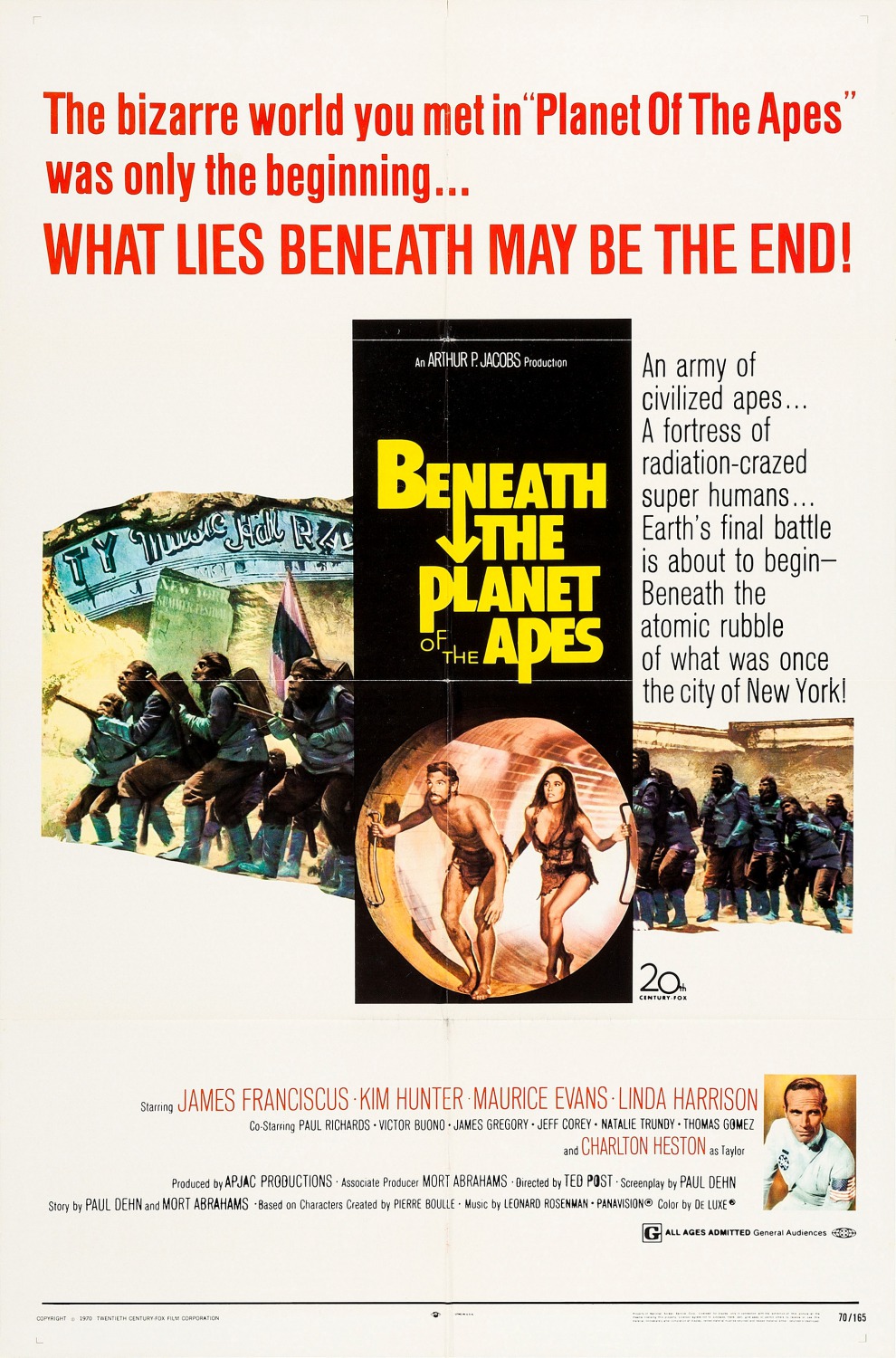


While Planet of the Apes was never designed to be an ongoing series the success and popularity of the film led to a sequel two years later. Beneath the Planet of the Apes (1971) is one of the most gonzo and audacious sequels I’ve ever seen. Its ending alone may be the greatest example of franchise self-sabotage in film history. However, the film suffers early on from feeling like the original film in miniature. Heston only agreed to appear at the beginning of the film (in which he disappears) and then reappear at the end only to be killed off. Thus the filmmakers had to introduce another leading character and actor.

TV actor James Franciscus was cast as Brent, another astronaut who was sent to find Taylor’s ship. Like Taylor Brent lands on future earth. He meets up with Nova, Cornelius and Zira. Then along with Nova searches for Taylor. The early parts of the film do feel like we’re going over familiar ground, with the added wrinkle of looming war as General Ursus (James Gregory) rallies gorillas behind his mission to enter the Forbidden Zone. Franciscus is solid in his role but he can't help but feel like George Lazenby to Heston's Sean Connery. It's too apparent the filmmakers were attempting to "replace" Heston but I feel a different kind of human lead than just another all American astronaut would've made things fresher. Ted Post took over directing duties from Schaffner and does a serviceable job. His direction doesn't feel too inconsistent with Schaffner's and he keeps the pace rolling along smoothly.


 The film becomes more its own animal when Brent and Nova’s search leads them underground. There they discover mutated humans with telekinetic powers worship a nuclear bomb capable of destroying the entire planet. Brent and Nova become the mutants’ captives and we learn Taylor is also imprisoned. The mutants don’t exist in Boulle’s novel but are a creation of the script by Paul Dehn. Their society is a startling new piece of the planet’s mythology. This aspect of the world that was suggested in the first film. Its theorized that Taylor is a mutant. This idea comes to full terrifying light in this film. These mutants are a twisted and perverse representation of how the world’s destruction has changed humanity. Moreover, the worshipping of a bomb as some kind of God is a satirical jab at religion. It's also a play on idea that humanity invented God and not the other way around. If this bomb is the mutant’s God it’s not a benevolent God but a violent and angry one.


The film also comments on the Vietnam War. There are chimpanzee protestors who are against the war, representing the negativity towards the conflict in Vietnam and the generation gap between the powers that be and the younger generation who wanted love, not war. Ultimately, It’s war that brings about the world’s complete destruction. After escaping, Taylor attempts to stop the bomb from going off but is shot by Ursus. Taylor confronts Zaius for the last time and asks for help. Zaius blames humanity for all the destruction in the world. Taylor witnessed Nova being shot by a gorilla. Nova was all Taylor had left and his final act is to activate the bomb, obliterating the earth.  I think the film is saying that history not only repeats itself but repeats itself to an even greater degree. Human civilization as we know it has already been destroyed due to human war but now the entire world, including apes, will cease to exist due to the gorilla war. But it’s a human that sets off the bomb, which may validate Zaius’ fear of humankind.


Beneath the Planet of the Apes’ ending is incredibly bleak and it’s remarkable that the filmmakers got away with it. It’s hard to imagine a major studio today would allow a major franchise film to  eliminate the possibility for more sequels. But while this ending appeared to end the franchise for good, the studio demanded another sequel. In a strange twist of fate destroying the world forced the filmmakers to be creative in how they would continue on the franchise and expand upon the mythology.


In Escape From the Planet of the Apes (1971) we learn a chimpanzee scientist named Dr. Milo (Sal Mineo) was able to repair Taylor’s sunken ship. He, Cornelius and Zira escaped from the planet before it exploded and travelled back in time to 1970s San Francisco. This was an ingenious way for the series to continue and find a fresh context in which to tell another story, despite it being a stretch that Milo could fix Taylor’s ship. By bringing apes to present day Earth the film reverses the dynamic of the previous films. The apes are now the outsiders.


While Cornelius and Zira (Milo is killed by a gorilla when the three of them are first put in a zoo) are first treated as celebrities and the film functions as a light comedy, the film takes a darker turn when it becomes more apparent that the apes will eventually cause the world to be destroyed. Dr. Otto Hasslein (Eric Braeden) wants the apes- including Zira’s unborn baby- to be killed. (Hasslein is the scientist whose theory on light speed travel Taylor mentions in the first film.) The apes have allies in Drs. Lewis Dixon (Bradford Dillman) and Stephanie Branton (Natalie Trudy), along with Armando (Ricardo Montalban), a circus owner. But tragically Hasslein kills both Zira and Cornelius- after Cornelius fatally wounds Hasslein- at the film’s conclusion. Hasslein also kills what he believes to be Zira’s child, which is actually another baby ape. Zira’s real child is with Armando.


Director Don Taylor does an admirable job at balancing the light and dark elements of the film’s script (written by  Dehn once again). The emotional journey on which the audience goes along with the characters feels tonally cohesive and not too jarring. McDowall wasn’t able to come back for Beneath so the role was recast with David Watson but thankfully he was able to reprise his role as Cornelius here. He and Kim Hunter are really the heart of this franchise and it’s devastating to watch them die- especially since we’ve grown close to the characters for two prior films.


Escape is a very philosophical film, particularly when it comes to the ethics of murder. Hasslein asks if we'd kill Hitler when he was a baby or his mother when he was pregnant. Is murder justifiable if it can stop horrible things from happening. The harsh irony in this film is that Hasslein believes murdering Cornelius and Zira will save the future. The truth is the opposite. Cornelius recounts how poorly apes were treated by humans and this cruelty led to the ape uprising. It’s only through love and respect that the future can be saved. I presume the film is attempting to say that even a man of science can be driven to violence but I feel Hasslein too easily slips in to the role of murderer. There needed to be more development for that particular shift.
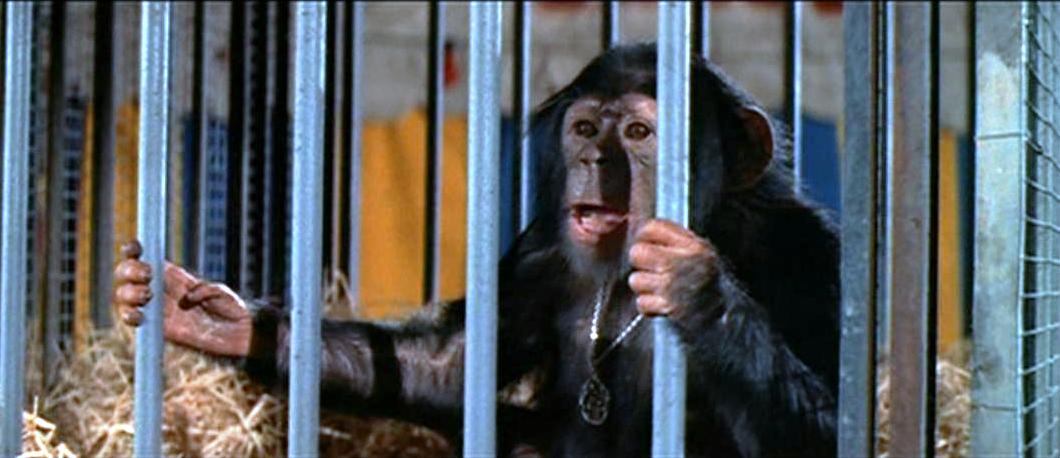


The final shot of the film, with little baby Milo saying his first word over and over- “Mama” is haunting and a perfect finish to this film. Beneath’s ending was very close ended- Escape’s clearly sets the stage for another sequel.


That sequel would be Conquest of the Planet of the Apes (1972). I feel this may be the best of the four sequels. Emotionally it’s the most powerful of the five films- as well as least “fun” of the series. While Escape had its share of lighthearted moments Conquest is consistently unpleasant. This is an angry film and continues the perspective shift found in Escape. It’s no longer the humans are the victimized. We finally see the cruelty and injustice that led to the apes taking over. The film picks up in 1991, 8 years after a plague wiped out all cats and dogs. Humans have taken on highly evolved apes as pets- and essentially slaves. America has also become a police state. Milo (now going by Caesar) is now a teenager and is still in the care of Armando. Caesar has to pretend he can't speak so he won't be discovered as Cornelius and Zira's child.  Montalban does subtly look older and a little more world-weary, which I like. While in the city Caesar curses a police officer who is abusing an ape. Armando attempts to take the blame so Caesar is not discovered. Armando is taken in to custody and Caesar becomes a slave. Armando dies after attempting to escape an interrogation, spurring Caesar to lead a rebellion against humanity. 


 J. Lee Thompson, the director of the original Cape Fear (1962), was brought in for this installment. Thompson creates a harsh atmosphere and a gritty aesthetic to the film, and stages the rebellion scenes with a brutal bluntness and lack of glamour.


Cornelius died in the previous film but Roddy McDowall returned to play his former character’s son. What’s remarkable about McDowall’s performance is Caesar feels like a totally different character than Cornelius. Caesar is a much angrier, rawer and impetuous character than Cornelius. Through makeup McDowall crafts a performance that makes us feel both empathy and terror. It’s a tremendous performance that solidifies McDowall as the signature actor of this series. We understand Caesar’s motives and the film makes us angry along with him. The humans in this film aren’t the primitive savages of the first film but they’re savages nonetheless. They've learned nothing from Cornelius and Zira's arrival- that the mistreatment of apes will be humanity's downfall.


There’s another sympathetic character named MacDonald (Hari Rhodes), the aid to the cruel Governor Breck (Don Murray), who briefly becomes Caesar’s owner. MacDonald is black and he mentions he is the descendant of slaves, which ties him and Caesar together thematically. Caesar tells MacDonald that he is shedding blood by the right of slaves to punish his oppressors, to which MacDonald says that “I, a descendant a slaves am asking you to show humanity.” MacDonald knows that an eye for an eye will just bring on violence, not peace.


Caesar doesn't heed MacDonald's plea and has Breck killed. This is after he gives a speech that foreshadows the world we’ve seen in the original film. This ending had to be changed due to poor test screenings.  The changed ending has an ape named Lisa (Natalie Trudy) say “No” to Caesar, imploring him to show mercy. McDowall recorded another speech which follows the originally shot one, in which Caesar says humans will be ruled with compassion. This speech plays over close up of Caesar’s eyes and reversed footage of gorillas bringing their guns down on Breck. It’s an awkwardly edited ending and the original is much truer to the film’s dark vision. It does, however, match up better with the subsequent film.


Battle for the Planet of the Apes (1973) is the final film of the original series. I think this film is the least of the sequels. The film is let down by having the lowest budget of the five films. Battle needed to be a grand and spectacular finish to the saga but ends up feeling anti-climatic and small in execution. It takes place over a decade after the events of Conquest. The world has been ravaged by nuclear war. Caesar, his apes and a small band of humans are attempting a peaceful cohabitation in ape city. It’s an uneasy truce, particularly with the gorilla Aldo (Claude Akins) not wanting anything to do with humans. Caesar is a softer ape now, comfortable in his role as leader. But Aldo proves a threat to Caesar since Aldo wants to be leader. There’s also the looming danger of humans who are radiated and are the ancestors of the mutant humans from Beneath the Planet of the Apes.


Thompson returns to direct and he brings a somewhat softer touch to this film then with Conquest. I feel Thompson does the best with a limited budget. He can’t quite make a full on epic but he does give the film some stakes as Caesar has to decide whether to fully accept humans as equals or to continue looking down on them . The ape commandment “Ape shall never kill ape” is also broken when Aldo accidently murders Caesar’s son Cornelius.
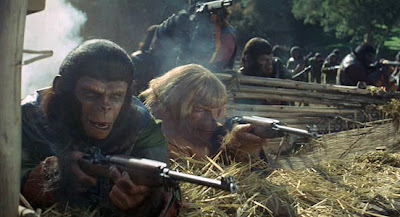

McDowall's performance is strong once again. And I do like the idea behind this film- the whole question of whether ape and man can live together peacefully and whether history repeat itself. Battle has the most optimistic ending of the series, giving us hope that peace is possible but both humans and apes will need to work hard to gain it- even centuries after Caesar’s death. However, the film's optimism doesn't contradict the previous films. Instead, the film moves on from the bleakness of the previous films and brings the saga full circle. Thematically it feels like a logical ending to the series. The film isn’t as fully realized in terms of its scale but it’s earnest and direct in terms of what it wants to say. There's a melancholy quality to this film's ending. In part because we're sad to leave the series behind and that the bookend to the film- with John Huston as the Lawgiver- takes place many years after Caesar's death. We feel we've lost a great ape who did much for his kind- as well as human kind.

So,  that's the original Planet of the Apes series. In the years before Star Wars and the resurgence of Star Trek, these films shaped the science fiction genre. The first is the strongest but the entire saga is a wonderfully told science fiction myth. And it all came from a little novel over fifty years ago.

Monday, 23 June 2014

Some Thoughts on the 25th Anniversary of Tim Burton's "Batman"


Richard Donner’s Superman (1978)- starring Christopher Reeve- made people believe a man could fly and laid the seeds for the domination of the superhero genre years later. But if Superman is the father of the superhero genre than Tim Burton’s Batman (1989) is its creepy uncle. Today marks the 25th anniversary of Batman’s release and in the 25 years since the superhero genre has evolved significantly, with superhero films becoming the dominant blockbusters of modern cinema.  Many superhero films now feel manufactured but Batman is still a distinct and twisted vision- funny, dark, and compulsively re-watchable even after the impact of Christopher Nolan’s Batman trilogy.
 
Before Batman’s release many non-comic readers’ image of the Caped Crusader was of the 1960s Adam West TV series. Those more familiar with the comics became accustomed to a darker vision of the character thanks to late 80s takes on the character such as Frank Miller's Batman Year One and The Dark Knight Returns, as well as Alan Moore’s The Killing Joke. Batman brought that more mature take on the character to life, aiming to satisfy comic fans and to show that the character was more than the comedic West series.
 
Though before the film was released many were afraid the film would be an updated version of the 60s series. These fears stemmed from the casting of Michael Keaton, best known for his performances in comedies such as Night Shift and Mr. Mom. People presumed Keaton’s presence meant the film would be a comedy. Upon hearing about the controversy Jon Peters- one of the film’s producers- released a trailer, highlighting the film’s dark tone, to squash peoples’ fears about the casting. In many ways Keaton’s casting was the first controversial casting in a superhero film. Heath Ledger, Robert Downey Jr., and now Ben Affleck as the new Batman would follow in the years to come.
 
While actors such as Willem Dafoe (who would go on to play the Green Goblin in Sam Raimi’s first Spider-Man), John Lithgow, and Tim Curry were considered for the role of Batman’s nemesis the Joker, screen legend Jack Nicholson was chosen. He had been a favourite of producer Michael Uslan for the role since the early 80s. Nicholson’s contract gave him a large percentage of the film’s gross along with his salary for the film.


Many criticize Nicholson for playing himself in the role of the Joker but whether you’re a fan of the performance or Nicholson as an actor, he’s much more memorable than several recent super-villains of the superhero genre. Personally, I find Nicholson incredibly entertaining in the role and get a kick out of his dialogue: “Can somebody tell me what kind of world we live in, where a man dressed up like a bat gets all of my press?” “Where does he get all those wonderful toys.” This film established the tradition of getting big names to play Batman villains- Jim Carrey as the Riddler, Arnold Schwarzenegger as Mr. Freeze, etc.  A significant flaw in the Batman franchise is that the villains would always get more back-story than Batman and would often overshadow the character in his own movies.

Tim Burton was a relatively new director to feature filmmaking at this time, having mostly directed shorts and two feature length films- Pee Wee’s Big Adventure and Beetlejuice, which starred Keaton. Burton was a risky choice to handle such a big property but this film would solidify Burton as a big Hollywood filmmaker. Burton was not a fan of comics growing up but he admired The Killing Joke and The Dark Knight Returns.


Burton actually pays homage to Moore’s version of the Joker’s origin story. In both Batman and The Killing Joke the Joker’s origin involves Jack Napier (in the film)/the unnamed engineer (Killing Joke) falling in to a vat of acid and going insane upon seeing his reflection, his skin now bleached. What’s noticeable about Batman is it’s more of a Joker origin story than Batman origin story. While Superman and future superhero films focus on the hero’s origin, in Batman the titular character has already taken on the mantle of a vigilante. It's not until later on in the film that Batman's origin is revealed when Bruce Wayne thinks back to the night his parents were murdered. One of the most striking departures this film makes from the comics is that Napier, when he was a young hoodlum, was the murderer of Bruce’s parents. To my knowledge this is the first and only incarnation that interprets the Joker this way. This controversial re-interpretation is one the boldest changes in a superhero themed film and foreshadows the risks filmmakers would take when re-interpreting comic book mythology.
 
Burton keeps the character of Bruce Wayne/Batman largely a mystery to the viewer. Thus we need a character to be a representation for the audience. The character we actually follow throughout the film is Vicki Vale (Kim Basinger), a photographer who’s come to Gotham City due to her interest in the rumours about Batman and teams up with reporter Alexander Knox (Robert Wuhl), who's also obsessed in discovering who or what Batman is. Vicki begins a romance with Bruce and it’s through this relationship we discover who the real Bruce Wayne is behind the rich playboy facade. A large theme of the film is that Bruce has been locked away behind facades for so long that he doesn’t quite know how to embark on a courtship.     


Unlike West, Keaton creates a distinction between the two personas of Bruce Wayne and Batman, emphasizing the character's dual psyche. Keaton puts fears to rest as soon as the film opens with Batman beating up two criminals who committed a mugging that echoes the character’s origin. Gone is the “old chum” Batman of the 60s series. Keaton’s Batman is a stoic, intimidating creature who strikes fear in to the hearts of criminals.  
 
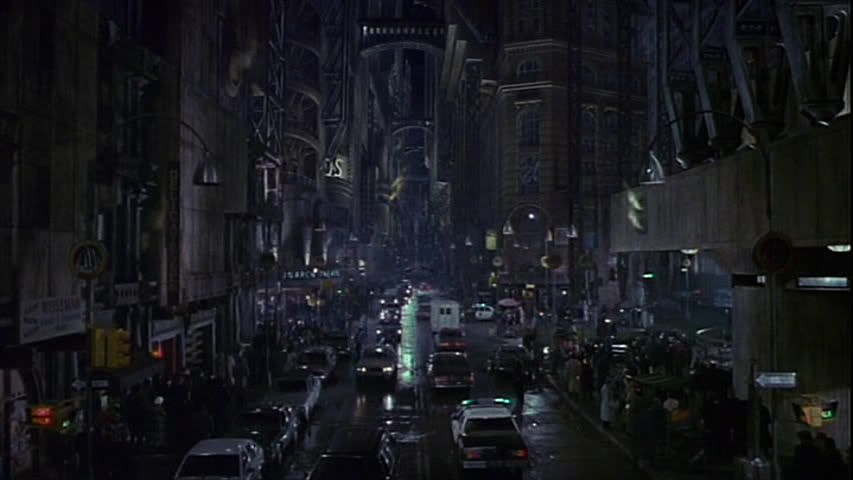
Batman came out in 1989. At this time the blockbuster/action movie scene was populated by Schwarzenegger, Stallone, Indiana Jones and John McClane. This was long before the comic book superhero was the dominant franchise headliner at the cineplex. Despite his popularity, Batman wasn’t the hero people were used to seeing on screen.  And Keaton was not anyone’s image of an action hero. But this is what makes the film and why it had such an impact upon its release. It wasn’t like anything people were seeing at this time.
 
This is largely due to its production designs, which places Batman outside of any specific time setting. There’s a distinct 1930s/1940s vibe to the gangsters’ outfits, cars, etc. but the film doesn’t specifically take place during that period. Aside from the inclusion of music from Prince in one sequence the film’s aesthetic qualities lend it a timeless feel. Similar to the Christopher Reeve Superman films, the film attempts to creates a stylized reality rather than place the character in a modern setting.


The success of Batman led to the creation of the great Batman: The Animated Series, which premiered in 1992 and ran until 1998. The style of the series was influenced by Batman. The film's success also made Warner Bros. give Burton creative control over the sequel, Batman Returns. The result was one of the darkest, depressing,  and most twisted films, superhero or otherwise, to come out of a major studio. The darkness turned off people, namely parents who dragged their kids off to see it.. Warner Bros. then went in another direction and hired Joel Schumacher to helm Batman Forever, a much lighter take on the character.
 
I can’t call Batman a masterpiece or a great film but it’s a memorable, highly entertaining piece of pop entertainment. It's beautifully gothic and an interesting prototype for the future films in the franchise. Happy 25th anniversary Batman.

Friday, 20 June 2014

Shakespeare on Screen: Orson Welles' "Macbeth"


In 1947 Orson Welles began plans to bring a Shakespeare drama to the screen. He initially wanted to adapt Othello but he couldn’t get investors to support the project. Welles would eventually make an adaptation of Othello in 1952 but for the time being he decided to film Macbeth, Shakespeare’s tale of the supernatural and its affect on the human heart. Welles- whose background was in theatre- had staged a production of Macbeth back in 1936. It was nicknamed the “Voodoo Macbeth” due to Welles setting the story in the Caribbean instead of Scotland and substituting the play’s use witchcraft with voodoo.    

Welles was able to gain the support of Herbert Yates, the founder and president of Republic Pictures, to back the film. Yates came on board, hoping that producing a Welles’ directed film would increase Republic Pictures’ prestige as a studio; but Yates wasn’t able to provide Welles with a big budget. Welles agreed to shoot the film in three weeks on a budget of 700,000 and would also pay out of his own pocket if it went over budget.      

Welles’ Macbeth (1948) has been eclipsed over the decades by Akira Kurosawa’s Throne of Blood (1957) and Roman Polanski’s Macbeth (1971) but it’s nevertheless a striking and atmospheric piece of filmmaking. While it’s low on budget it’s an expressionistic vision that’s alive with cinematic gusto. With his first film, Citizen Kane (1941), Welles revolutionized the way we think about filmmaking and how a movie could look and sound. And despite his struggles with studios and funding in the following years, he never stopped creating unique cinema.  

Polanski’s Macbeth was filmed on real locations and but had an otherworldly atmosphere. Welles’ version was filmed on leftover sets from Republic Pictures’ westerns. Cinematographer John L. Russell- who shot Psycho for Alfred Hitchcock- creates the feeling of a nightmare. Like Welles’ other films there’s a surreal quality to almost everything we see and we’re never truly comfortable in this world. This is a world is entirely shrouded in fog, creating a sense of isolation. We are trapped in with Macbeth (played by Welles) and Lady Macbeth’s (Jeanette Nolan) descent in to evil and madness. Macbeth is one of Shakespeare’s leanest plays and this film- just less than two hours- is a streamed lined adaptation.

Welles makes changes in terms of the text. One alteration/interpretation of the text I find the most fascinating is having Banquo (Edgar Barrier) recite his speech from the beginning of act III, scene III- wherein he communicates his suspicions that Macbeth killed the King Duncan- directly to Macbeth. This adds even more tension to the relationship between the two men. Welles also combines certain passages and puts others in different places in the narrative. It’s a risky thing to play around with the text but I think Welles’ makes these changes work. As an adaptation and as a film Macbeth work as a cohesive piece rather than come across like a jumbled mess.

Despite the low budget Welles is able to create a visually striking and imaginative film. The clay version of Macbeth that the witches mold and is beheaded at the end is a sly call back to “Voodoo Macbeth.” I love how he films the banquet scene. When we see Macbeth’s point of view, all the chairs are empty except for the one in which Banquo’s ghost sits. Macbeth points to the ghost and as he does so we see huge ominous shadow of Macbeth’s finger. There’s also a simple but cool scene transition that appears very theatre inspired. It’s after the banquet scene and as Macbeth crosses the stage we’ve shifted locations from the banquet to a barren landscape. Macbeth goes to the top of a hill and speaks to the witches as thunder and lightning comes down around him. Another shot which sticks out in my mind involves Macbeth in a long shot. He comes toward the camera as he speaks. The camera follows him as he moves to the left of frame, revealing the soldiers in the background. It’s brief but it’s a shot I really admire.

Welles uses voiceover for several of the soliloquies- a technique Polanski would use in his version and Laurence Olivier would also utilize in his version of Hamlet, released the same year as this film. I used to not like it in Polanski’s version but I’ve grown accustomed to it as a cinematic technique. However, I think Welles should’ve had Macbeth’s “Tomorrow and tomorrow” soliloquy spoken over an image of fog.   

Welles isn’t the obvious choice to play Macbeth but he equips himself well in the part. He has the proper girth and ruggedness for the part. While there were stronger and more subtle Shakespearean performers at this time Welles was clearly committed to the part. Welles originally wanted Agnes Moorehead or Vivien Leigh for Lady Macbeth but circumstances led to him casting an actress named Jeanette Nolan. Nolan only worked in radio and had no film or stage experience, which makes her turn as Lady Macbeth all the more impressive. Nolan is a commanding presence in the role and this film would lead to a long career in film and television for Nolan.

I felt there was a considerable lack of emotion from Macduff (Dan O’Herlihy) when he learns his family has been slaughtered by Macbeth’s men (another change Welles makes is he has Macbeth present when Macduff’s family is murdered). I understand that Macduff is a restrained man, being a soldier- and certain actors take a more subdued approach towards Shakespeare’s language but I felt that there should’ve been more of an outpouring of grief and anger from Macduff’s, considering it’s his family’s murder that sets in motion the play’s climatic events.

Welles actually had the actors pre-record their dialogue and notably the actors use Scottish accents. When the film received poor reviews, with specific complaints labelled at the supposed incomprehensibility of the dialogue, the actors were called in to re-record their lines, sans accents. The film was also cut down to 89 minutes, from the original 107. It was only years later when the full version was restored, along with the Scottish accents.

Welles’ Macbeth suffered a similar fate as many of his other post-Kane films in that it was tampered with by the studio and didn’t receive strong reviews. But as with other Welles’ films Macbeth now receives considerable acclaim. I think it’s one of the most unique cinematic interpretations of the Bard’s work we have.  It’s a small triumph of ambition and talent over the limitations of budget. And it’s another film that shows how ahead of his time Welles was as an artist.


Wednesday, 11 June 2014

This is as far as you go: "Edge of Tomorrow"


edge-of-tomorrow-poster


Edge of Tomorrow is the kind of action blockbuster of which I don’t feel we get enough. It’s a good film in the way that many modern day blockbusters aren’t. It has strong characters, one of which goes through a satisfying and clear character arc, a layered and involving story- and it doesn’t rely on easter eggs or teases for future films to make an impression. It simply tells a standalone story that’s smartly written and develops organically. Edge of Tomorrow is essentially the film people wish Hollywood would churn out on a regular basis.


As the film opens mankind has been fighting an alien race called the Mimics for several years. Tom Cruise plays Major William Cage, a spokesman for the United Defense Forces, which has created weapon/exoskeletons called jackets to win the war effort. General Brigham (Brendan Gleeson) summons Cage to London and orders him to cover the war effort from the frontlines in France. Cage attempts to blackmail the General to get out of being on the frontlines. When that doesn’t work Cage attempts to escape but is arrested and stripped of his rank. He is sent to Heathrow airport and later is dropped in to the war zone. The Mimics have anticipated the invasion and the soldiers are slaughtered. Cage kills a Mimic, resulting in him being covered in the Mimic's blood. He then wakes up back at the airport.


Cage begins to realize he is in a time loop and every time he dies he "resets" to the day before the invasion. On the battlefield he meets Rita Vrataski (Emily Blunt), the "Angel of Verdun," who won a major battle in the war against the Mimics. In one of Cage’s loops Vrataski discovers Cage has foreknowledge of the future. She tells him to find her when he resets. They’re both killed and Cage seeks out Vrataski before the invasion. He discovers that Mimics are part of a collective consciousness called the Omega. The Omega has the ability to control time, which is why they knew about the invasion in France; and being covered with the Mimics’ blood is what allows Cage to reset after he dies. Vrataski once had the same ability but lost it after a blood transfusion. With Vrataski’s help Cage trains to become a better soldier.


The film that comes to mind when talking about Edge of Tomorrow is the late Harold Ramis’ 1993 film Groundhogs Day. And while it’s an understandable comparison, Edge of Tomorrow exists as its own story. Groundhogs Day had a more spiritual and metaphorical reason behind its premise. In Edge of Tomorrow the time looping has a more specific, sci-fi indebted reason behind it. The explanation for Cage's situation isn’t forced; rather, it's an integral part of the film’s mythology and story. And while the film may become too exposition-y at times the internal logic never becomes too confusing or bogs down the film.


Part of the pleasure of the film is seeing Cage' growth throughout the film. He starts out as somewhat shallow man, never having been in combat nor understanding the sacrifice of men and women during war. He’s also a coward, which makes Cage a different kind of action role for Cruise. But as Cage keeps reliving the same events we see him become  more self-aware about things around him and how he can use foreknowledge of things to his advantage. Like a video game, Cage has to move further in the “level” in order to win. If you’re a gamer at all it’s hard to relate. I  love the bit where Cage attempts to roll under a truck to escape from the military base- and he gets crushed. In other action films the hero would do it right the first time but here Cage can’t immediately be a perfect action hero. The film emphasizes how exhausting it must be for Cage to constantly die over and over again, always getting a really rude wakeup call from a soldier. “On your feet maggot” is this film’s “I’ve got you babe.” Through his training and his relationship with Vrataski Cage not only becomes a better soldier but a better man as well. It’s a simple but satisfying character arc.


Cruise is one of the most polarizing figures in Hollywood but this film shows he can still be a convincing action hero. It’s fascinating to see Cruise go from the more cowardly Cage to a more recognizable Cruise action hero; and he's strong enough an actor and action star to sell both sides. This is one of his best recent performances.


Blunt is also really great here. I’d hate to use the phrase “strong female character” It’s a little condescending- “look at you being strong”- and it’s unfortunate that a well rounded female character has to feel like an anomaly rather than a something to be expected. But for lack of a better phrase, Rita Vrataski is a strong female character. She’s a no-nonsense badass who actually has more depth than Cage. She’s not merely Cage’s love interest nor the "damsel in distress." I also think it’s cool she’s already went through Cage’s ordeal and has to teach him the ropes. And despite Vrataski’s hardened exterior we get hints of her vulnerability and her pain at losing someone close to her. While Cage doesn’t get much of a back-story we feel there’s a lot of history in regards to Vrataski’s character.


Bill Paxton also has a lot of fun here as Master Sergeant Farell. It’s a great character actor parts that’s a highlight of the film, though I wish there was more of a payoff for the character. Gleeson is underutilized but is  good in the two scenes he has with Cruise. I like the J Squad that Cage joins and I wish they were developed a little more, particularly since they’re a huge part of the climax.


One of the trickiest aspects of the film director Doug Liman and screenwriters- notably Christopher MacQuarrie- had to face was how to develop Cage and Vrataski’s relationship when Vrataski is constantly meeting Cage for the first time. It’s through Cage’s growing affection for Vrataski and encountering a situation where he can’t save her no matter what he does – as well as the script giving bits her back-story over the course of the film- that allows the relationship to develop despite the restrictions of the film’s structure.


A film in which events keep repeating themselves runs the risk of seeming too gimmicky or rigid in its structure. But what’s impressive about the film is it has an ongoing story despite being stuck in a specific period of time . The film eventually expands outside of the battlefield and we’re able to see different locations and events. It’s also through the film’s editing- by James Herbert and Laura Jennings- which gives the story a rhythm that makes the structure not feel rigid. The film knows when to show things in full, as early on in the film, and when to use montage and quick editing.  We also don’t see every loop but through Cage’s dialogue we clue in to what events he’s been through, notably in a farmhouse scene which defines the emotions and themes of the film. 


Doug Liman isn’t name that sparks much passion in the hearts of cinephiles but he directed what’s my favourite Jason Bourne film, 2002’s underrated The Bourne Identity, as well as 2007’s Mr. & Mrs. Smith, which began the world’s fascination with the Brad Pitt/Angelina Jolie relationship. While Liman isn't considered an “auteur,” what links the aforementioned films and Edge of Tomorrow is all three have a high concept hook- an assassin who has amnesia, a married couple that doesn’t know each other is a spy, a sci-fi version of Groundhogs Day- but  are also very star driven and it’s the stars that make the concepts work. Matt Damon reinvented himself as an action hero for the Bourne series and Pitt and Jolie’s chemistry is what got people in seats for Mr. & Mrs. Smith. Edge of Tomorrow’s concept works because of Cruise and Blunt.


Liman stages several stellar action sequences and make the war between humans and Mimics feel like an authentic conflict. The first time Cage and J Squad are dropped in the war zone is positively thrilling and invokes the sense of dread before battle and the chaos of war. Liman balances heavy sci-fi ideas and bombastic action while allowing the human elements to breath and to develop smoothly over the film. While some of the climatic action felt dragged down the third act for me, it’s hard not to be impressed with this film's set pieces.


If there’s one wonky element of the film it’s the ending. It’s confusing  in relation to what was established earlier. There needed to be rules established beforehand that made the ending click in to place. The ending is also a little too neat but that element is forgivable considering how likable the protagonists are. And the final moment is kind of perfect.


Edge of Tomorrow is a wonderful piece of entertainment that despite its high concept feels like a throwback to the type of action blockbuster that’s become rare these days. It’s unfortunate it’s struggling at the box office. This is a film you should see and maybe even see again. Cruise is at his best, Blunt is awesome and Liman has arguably made his best film since The Bourne Identity. Like Bill Cage, Edge of Tomorrow will get more chances at life in the near future on DVD/Blu-ray, Netflix, or what have you, which is a very good thing. For sci-fi fans and for fans of good Hollywood films, Edge of Tomorrow deserves your time.