Showing posts with label Terrence Malick. Show all posts

Friday, 20 January 2023

11 Great Films That Were Not Nominated For The Best Picture Oscar


Spoilers Below

The history of the Oscars tell their own narrative regarding the greatest films in the history of the medium. While what we consider great is subjective, the Oscars, I would argue, provide a limited view of cinematic greatness. Genre films are often left out, actors of color ignored, great actors and directors never won. But specifically, I wanted to take a moment and look at 11 films that were not nominated for Best Picture, films which have lived on longer some winners. Some may surprise you, but I think it's important to understand why certain films were not appreciated in their moment, that it took time for them to attain classic stature. So, let's get started. These aren't in specific order, but I will be starting with three by a director who never got his due from Oscar.


1. Rear Window  (1954)

Alfred Hitchcock is defined by his dark and twisted portrayals of human nature in the guise of entertaining Hollywood thrillers. One of the most purely entertaining of films, Rear Window isn't just about whether a man has killed his wife, it's about a peeping tom, kind of a pervert, and the human desire to watch. The film is essentially  a meta commentary on cinema in general, on the need for excitement in our ordinary lives. 

We're watching L.B "Jeff" Jefferies, a photographer who's in a cast, stuck in his apartment (after being injured taking a picture of a race car crash) watch his neighbours in the courtyard of apartments, everyone with a story, an entire universe in and of itself. He needs these stories the same way we need films, which give us the ability to view other peoples' lives (albeit fictional). When Jeff suspects businessman Lars Thorwold (Raymond Burr) of killing his invalid wife, his obsession with proving his guilt gives him the ultimate reprieve from boredom, even bringing him closer to his socialite girlfriend Lisa Friedmont (Grace Kelly). But as much as the film deals with the investigation of Thorwold, the other apartment dwellers are just as important. All these people become as familiar to us as they are to Jeff. 

Hitchcock would get a Best Director nomination for the technical brilliance on display ( the whole film is shot on a set, with Hitchcock giving directions via earpiece to his actors), as well as nominations for Best Writing- Screenplay, Color Cinematography, and Best Sound Recording, but oddly not Best Picture. The five nominees were On the Waterfront, The Caine Mutiny, Seven Wives For Seven Brothers, The Country Girl (for which Kelly won Best Actress), and Three Coins in the Fountain. On the Waterfront was the winner, with its director, Elia Kazan, winning Best Director. For me, I would split the two, giving Hitchcock Director and On the Waterfront Picture. 


2. Psycho (1960)

Hitchcock once again received a Best Director nomination (his last) for this proto-slasher film, but without the film getting in to Best Picture. And like Rear Window, it also received four nominations (Hitchcock, Best Supporting Actress for Janet Leigh, B&W Cinematography, and Best Art Direction-Set Decoration (B&W). 

While the film can be argued to be the first modern slasher film, pre-dating Black Christmas and Halloween by nearly 20 years, it starts out as a film noir about real-estate Marion secretary Crane (Janet Leigh) stealing a client's money so she can start a new life with her boyfriend. She winds up at the Bates Motel, where the whole dynamic shifts with the introduction of proprietor Norman Bates (Anthony Perkins). The film seems to have- like Marion- taken a detour as we spend a lengthy conversation between the two over supper. Norman is a sad and lonely man who's only relationship is with his invalid mother. 

When Marion is killed in the infamous shower scene it's the film's first interjection of horror, upsetting the narrative we thought we were watching. The sequence is still startling in its violence and impressive in its filmmaking. George Tomasini's sharp editing reflects the knife going in to Marion's body and Bernard Herrmann's screeching score has become synonymous with 'crazy.' The film has spent so much time with Marion that the sudden burst of violence unsettles. There's only 2 murder scenes in the film- this and the murder of Private Investigator Arboghast (Martin Balsam) bu the film relies more on atmosphere and build-up to create a sense of subtle horror in the audiences' mind. 

It's revealed Norman killed his mother and her lover and took on a split personality- he and his mother. The film was never about the money or Marion, it was about Norman's psychosis, with every thing else being a distraction from the truth about Norman  Perkins' performance is so convincing that he could never escape the role. Perkins is deeply sympathetic as Norman; I never view him as the film's villain but as a tragic character, despite the horrible crimes he commits. 

Hitchcock's direction displays his mastery of visual storytelling and his ability to place us n the minds of both Marion and Norman, two people who are closer in spirit than either of them realizes, two people who are tragically torn apart by "mother."  

The Best Picture Nominees that year were The Apartment, The Alamo, Elmer Gantry, Sons and Lovers, and The Sundowners. The winner was The Apartment, which, like On the Waterfront, is one my favourite Best Picture winners. Again, I would give Hitchcock the directing Oscar (Billy Wilder won), while giving Best Picture to The Apartment.


3. Vertigo  

Yes, another Hitchcock, but probably the biggest one to be left out of Best Picture. Not surprisingly, since Vertigo took many years to earn the critical acclaim it now enjoys. The film which was voted the greatest of all time by Sight & Sound back in 2012, and holds at # 2 in 2023, only got two Oscar nominations, for Best Art Direction-Set Decoration and Best Sound. Bernard Herrmann's swooningly melancholic and romantic score, James Stewart and Kim Novak's layered performances, Hitchcock's visionary direction, all ignored. And I get it, I get in 1958 why this was seen as a misfire, why it takes a rewatch or two to really appreciate this film. It took me a second viewing to begin to embrace it. It's probably Hitchcock's most purely artistic and audacious film, one whose D.N.A can be found in other films like David Lynch's Mulholland Drive, George Sluizer's The Vanishing, and Brian De Palma's Obsession. But despite being the influence behind several films, the story remains fresh and unique in the way it moves from ghost story to romance and finally, to obsession. 

It's the story of an acrophobic detective, Scottie Ferguson (Stewart). hired by a old college friend, Gavin Elster, (Tom Helmor)  to follow his wife, Madeleine (Novak), whom he believes has been possessed by the ghost of her great-grandmother. Scottie falls in love with Madeleine but fails to stop his suicide. Afterwards meets another woman named Judy (Novak), who looks like Madeleine, whom he tries to make over in to the image of his dead love. 

Vertigo has an hypnotic power that brings me back time and again, and time is a big theme in the film. Scottie didn't get to Madeleine in time, the past is coming back to haunt Madeleine and then Scottie, near the film's end Scottie says he needs to do one thing to be free of the past.        

The nominees that year were Gigi, Cat on a Hot Tin Roof, Auntie Mame, The Defiant Ones, and Separate Tables, with Gigi being the winner (its director Vincente Minnelli won Best Director), which I've still have yet to see.


4. The Searchers

John Ford had already won 4 Oscars for directing by the time he did the The Searchers, and a fifth one wouldn't have been out of the question, except Ford and the film were completely shut out at the Oscars (Ford did get a DGA nomination, however), which now seems inexplicable considering The Searchers stature as an American classic. It's a difficult film to reconcile, a story dealing with racism that also still has some racist leanings, but it nonetheless a great film, though I still prefer Stagecoach. John Wayne plays Ethan Edwards, a confederate soldier returning to his brothers' home after the Civil War. When his brother Aaron, and Aaron's wife are murdered by Comanche Native Americans,, Edwards, along with his adopted nephew Martin (Jeffrey Hunter) go off in pursuit of Ethan's kidnapped nieces. 

The film, courtesy of Ford cinematographer of Winton C. Hoch, has some of the striking visuals of any western, capturing what director John Milius said felt to him what the real American west was like. And even with the many revisionist westerns that followed, The Searchers still feels like the most realistic western of its time, especially in terms of its violence, which is still unsettling. The most disturbing aspect of the film is the notion that Ethan will kill one of his nieces Debby (Natalie Wood) after she's "gone native" living with the Comanches for several films (the other, Lucy (Pippa Scott) was killed). 

Wayne plays his most complex role in a performance that, as Martin Scorsese said, makes you hate him but still love him when he returns Debbie home by film's end. And of course, there's that great closing shot of him walking away, as a door closes, bookending the opening door at the beginning. It's wistful and, honourable and poetic. 

The nominees that year where Around the World in 80 Days, Giant, Friendly Persuasion, The King & I, and The Ten Commandments. Around the World in 80 Days, directed by Michael Anderson and produced by Elizabeth Taylor's then husband Mike Todd, who would die a year later in a plane crash. The extravagant film is probably one of the weaker Best Picture winners but is still worth seeing for the sheer scale of it, it's a fascinating time capsule. 


5. Days of Heaven

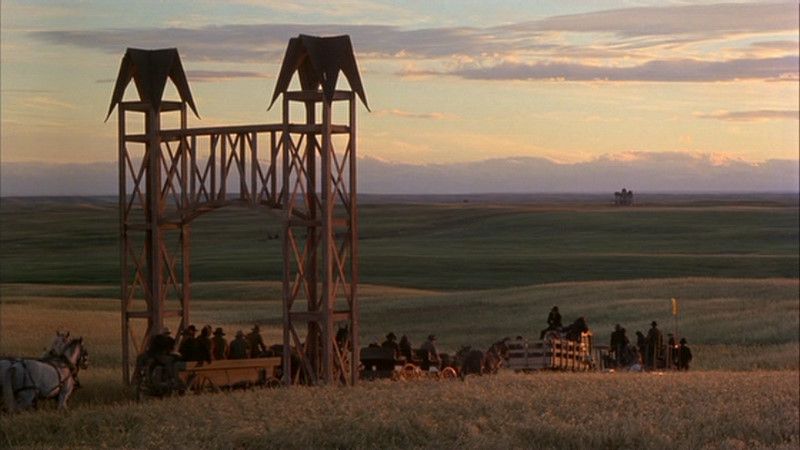
After establishing his esoteric sensibilities in Badlands (1973), Terrence Malick came back with his voice and style fully formed with Days of Heaven, one of the most ravishing films of all time. It won the Oscar for Best Cinematography- given to Nestor Almendros, though Haxell Wexler took over after after Almendros had to fulfill his commitment to shooting Francois Trauffaut's The Man Who Loved Women.

Taking what 20 years earlier what would've been a 3 hour plus epic, Malick strips down the story of a Chicago steelworker, Bill (Richard Gere) on the run after killing his boss, his sister Linda (Linda Manz), his girlfriend Abby (Brooke Adams), and the dying farmer (Sam Shepherd) Abby marries, in a compact 90 minutes, showing us the fragments of a story through an impressionistic visual style that favours mood and setting over complex characterization.  

The nominees that year were The Deer Hunter, Coming Home, Heaven Can Wait, Midnight Express, and An Unmarried Woman. The Deer Hunter won, which I'm ashamed to say I still haven't seen.


6. Alien 

Ridley Scott's Alien has only gotten better in age, a genuine masterpiece of horror sci fi. The story is so simple but what it's doing is difficult, essentially blending the slow pace of 2001, the lived in junky feel of Star Wars, and the grisliness of The Texas Chainsaw Massacre, all while updating a 50s sci-fi creature and placing it in an symbolic haunted house. The alien could've looked goofy, the setting cheap, the pace too slow, but this didn't happen. The pace is slow but with a great sense of dread. The alien is kept in the shadows so we only get glimpses of it and the production design is immaculate, making us believe in the film's unglamorous vision of the future.

A brilliant choice by the film's screenplay- by Dan O'Bannon, with a story by Ronald Shusett-  is conceiving the ensemble of characters as "truckers in space" rather than explorers or scientists.  The characters have a lived-in-ness, a believability as blue collar workers. Them being truckers is also why the Nostromo is so junky- this isn't supposed to be the Enterprise. Michael Seymour's production design and Derek Vanlint's cinematography make the Nostromo one of the most atmospheric settings in horror cinema. 

Like the shower scene in Psycho, the chestburster sequence hasn't lost its shocking impact. Both scenes happen just when things feel like they're getting better, in moments of peace. When Captain Dallas (Tom Skerritt) is killed, it really feels like things are at their worst. And then Ash (Ian Holm) is revealed as an android who has been working against them, leaving only Ripley (Sigourney Weaver), Parker (Yaphet Khotto) and Lambert (Veronica Cartwright), the feeling of claustrophobia is palpable. 

Weaver became a star for her performance as Ripley, giving her assertiveness, sternness but also vulnerability. Her fear during the final stretch of the film feels authentic and her decision to go back and save the cat is a relatable human moment  Her ultimate survival is almost surprising, given this was the decade of the downer ending but it's not completely triumphant either. She's lost her ship and crew, and has found out she was viewed as expendable by the company for which she works. Still, there is a sense of peace for Ripley at the film's end, as she goes back in to cryosleep, going back in to a dream after a nightmare

The nominees that year were Apocalypse Now, Kramer vs. Kramer, All That Jazz, Breaking Away, and Norma Rae. I personally would go with All That Jazz.


7. The Innocents

Completely shut out of the Oscars, though nominated for the Palme d'Or, this is the spookiest film ever made, as well as the best haunted house movie. Governess Miss Giddens? (Deborah Kerr, in a performance that should've earned her an Oscar nomination) is sent to look after two orphaned children , Miles and Flora, whose uncle has no use for them. After learning about the influence of the late Peter Quint and Miss Jessel on the children, Miss Giddens begins to see apparitions that match their descriptions. She soon comes to the conclusion these ghosts are controlling the children. 

The ambiguity surrounding whether Miss Giddens is actually seeing the ghosts or imagining them is what keeps The Innocents so fascinating 60 years after it premiered. Cinematographer Freddie Francis' Widescreen black and white compositions are immaculate and director Jack Clayton captures a certain Victorian-era Britishness in the performances and characters. The film's chilly atmosphere also makes it-like Stanley Kubrick's The Shining- a perfect alternative Christmas film.

The nominees that year were West Side Story, The Hustler, Fanny, The Guns of Navarone, and Judgement at Nuremberg, with West Side Story winning, along with nine other wins. I prefer Spielberg's new West Side Story (My thoughts here :Davies in the Dark: Tonight, Tonight: "West Side Story" (thenoirzone.blogspot.com) and if I were picking from these nominees I would go with The Hustler (which I wrote about here: Davies in the Dark: Search results for the hustler (thenoirzone.blogspot.com)


8. Carrie

Brian De Palma's masterpiece is also the first Stephen King adaptation and one of the best. A hallucinatory film, but one that has moments of sweetness that only make the tragedy of its climax hit even harder.

 Carrie may be the best film about teenage isolation ever made. Despite being incredibly stylized the film finds emotional truth through Sissy Spacek's nominated performance as Carrie White.  What stood out watching it this time is how Spacek makes Carrie both incredibly unusual but also very sweet and nice. We see her coming out of her shell as things being to go- and then when she's humiliated she really comes out of her shell as she unleashes her telekinetic powers against her tormenters. 

The whole prom sequence and how it leads to the pig blood pouring over Carrie is virtuoso filmmaking. In De Palma fashion it feels like he's showing off but you don't mind because it's so impressive. Then there's Carrie's return home and her final confrontation with her religious zealot mother, Margaret (Piper Laurie, in the film's other nominated perfomances), another amazing stretch of filmmaking. This is one of those films you could watch on mute and still understand what's happening.  The emotions and story are all communicated through the visuals. 

Mario Tosi's cinematography gives the film a hazy dreamlike quality that turns in to a nightmare during the prom sequence- and Carrie covered in blood is one cinema's indelible images.  

The nominees that year were Rocky, Taxi Driver, All The President's Men, Network, and Bound For Glory. Bound for Glory is the only one I haven't see but it's a pretty strong line-up overall. 


9. Close Encounters of the Third Kind

My second favourite Spielberg, right behind Jaws. This is also the ultimate Spielberg film, made a couple of years after Jaws, with his voice fully formed. He received his first Best Director nomination (the only time he and pal George Lucas were nominated alongside each other- Lucas was nominated for Star Wars). The film was beat out in most categories by Star Wars, though it won Best Cinematography for Vilmos Zsigmond's stellar work on the film and won a special award for sound effect editing.

It's a darker film then you may remember, with Roy Neary (Richard Dreyfuss) becoming obsessed with U.F.Os after a close encounter with one and alienating his family. But it's also awe-inspiring and wonderous, encapsulating what Spielberg does better than anyone else. It's hard to imagine a blockbuster movie like this getting made now, given it doesn't have a big action climax, but a climax involving the attempt to communicate with an alien mothership. Denis Villenueve's Arrival is the only equivalent I can think of.

Dreyfuss won for The Goodbye Girl (which I haven't seen) but I also would argue he could've been nominated for this instead, making Roy a relatable and likable character even as he becomes more unhinged.

The nominees that year were Annie Hall, Star Wars, The Turning Point, Julia, and The Goodbye Girl. Annie Hall was the winner, with Woody Allen winning for direction and screenplay. The film has plenty of baggage attached to it, but it's a very fine winner overall 


10. 2001: A Space Odyssey

Maybe the greatest film not to be nominated for Best Picture, and the best film about contact with alien beings, mostly because we never see them. Stanley Kubrick (who was nominated for Best Director) keeps them mysterious and kind of spooky. The film is a visual marvel (it won Best Visual Effects and it still feels ahead of its time, even as we've long since passed the year in which it takes place. The nominees that year were Oliver!, The Lion in Winter, Funny Girl, Rachel, Rachel, and Romeo & Juliet. Oliver! was the winner, with Carol Reed winning Best Director. I feel Reed should've won for The Third Man instead. Oliver! is okay but I think I would go with The Lion in Winter or Romeo & Juliet


11. Singin' in the Rain

The greatest movie musical of all, and a great film about Hollywood, Stanley Donen and Gene Kelly's Singin' in the Rain is superior to the previous year's Best Picture winner, another Kelly musical, An American in Paris. The film is about Hollywood's transition from silent films to talkies, with movie star Don Lockwood falling in love with chorus girl Kathy Selden (Debby Reynolds), while his screen partner Lina Lamont (Jean Hagen in an Oscar nominated performance), whose shrill voice doesn't make the cut when it comes to talkies, becomes jealous. Donald O'Connor lends support as Don's friend Cosmo Brown, a performance that also should've garnered a Oscar nomination. 

The dancing is off the charts great, the songs funny and poignant, Kelly is at his most charismatic, Hagen is hilarious, and Reynolds becomes a star right before our eyes. It's a truly joyous film, technically brilliant and with a lot of heart. A great example of Hollywood studio filmmaking done right.

The nominees that year were The Quiet Man, The Greatest Show on Earth, High Noon, Ivanoe, and Moulin Rouge. The Greatest Show on Earth won, with John Ford winning for The Quiet Man (his fourth Oscar). The film is usually considered one of the worst- if not the worst film to win Best Picture, though I haven't seen it. For me, I would go with The Quiet Man, maybe my favourite of Ford's films, along with Stagecoach.


So, what films do you think should've been nominated for Best Picture? Comment and let me know.


Sunday, 12 May 2013

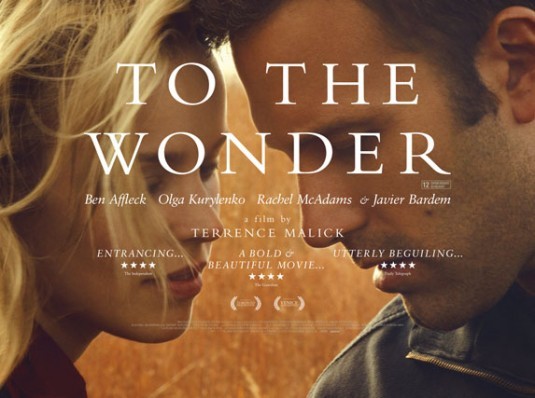
I Write On Water What I Dare Not Say: Some Thoughts on Terrence Malick's "To The Wonder"


As I was watching Terrence Malick's latest film To The Wonder the other night, it occurred to me that, love him or hate, Malick is among the handful of directors, past and present, that has completely infused himself in to every fibre of his films. It's not just that he has a particular style, but that's there not a single moment in this film, or his previous few films, that he's not present. He's there in every image, camera movement, line of dialogue and even performance. Wes Anderson is similar in that regard, and maybe even Stanley Kubrick but I can't think of many directors that have become so much part of their films. I think it's hard to review a Malick film, particularly now, since  his films exist outside any typical narrative structure- so this will be more of a "thoughts on" piece rather than a "good or bad" summary. Overall, I liked the film and maybe even loved it. While it's not as monumental a work as his previous film, The Tree of Life, it's a lovely and often beautiful film, telling a simple but universal film about finding and losing love.

The film tells the story of Neil (Ben Affleck) and Marina (Olga Kurylenko) who meet in France and move to Oklahoma to start their life together. Complications in their relationship leads to Neil and reconnecting with his childhood sweetheart Jane (Rachel McAdams). A parallel storyline focuses on Father Quintana (Javier Bardem), a priest struggling with his faith.

Malick tells these stories, as to be expected, through impressionistic imagery and hushed voiceovers. But in this film I found that Malick was moving even further away from dialogue, crafting something focused very much on the physicality and movements of the actors- particularly with Kurylenko and McAdams. I don't think either of these women have ever looked more gorgeous. By just looking at them, watching them move, their beauty really shines through in a pure way.

Journalist and filmmaker Bilge Ebiri wrote a piece interpreting the film as a dance, a ballet. All one has to do is look at Kurylenko and her movements in the film and it becomes clear what Ebiri is talking about and what Malick is trying to achieve. Moreover,  I feel that Malick isn't just trying to create a ballet but he's fascinated in taking actors we recognize and using them in a fashion where their usual stature as an actor is stripped down to something quite simple. Think of Sean Penn in The Tree of Life. In this film, Affleck is just a normal man, not the hero of Argo or complicate bank robber of The Town.

This is the shortest gap between movies for Malick, who's taken up to 20 years between films. While it's exciting to get a new Malick film so soon after The Tree of Life, that film was such a bold and visionary piece of work, a film which could possibly be deemed a landmark film, that To The Wonder seems somewhat anti-climatic in comparison. Even if there was a bigger gap between the films, I didn't sense the level of ambition in this film that was present in The Tree of Life. But one has to take the film as what it is. To The Wonder is not as towering an achievement as some of Malick's other films but it's still a film in which we find Malick striving for pure visual poetry, which I think he achieves.

 Malick has always had a fascination with exploring America's past- the late 1950s that gave birth to one of America's first serial killers, Charles Starkweather, in Badlands, the turn-of-the-century labor in Days of Heaven, the physical an existential conflict soldiers face during WWII in The Thin Red Line, and the founding of the Jamestown, Virginia settlement in 1607 in The New World. He returned to the 1950s in The Tree of Life- an course in that film Malick went beyond just exploring America's past- he literally dramatized the creation of the universe itself. To The Wonder is Malick's first film set entirely in the present day. I may have to see the film again but I didn't feel Malick was too preoccupied with modern day America- the story could've taken place in nearly any time. But then again, Malick's eye always seems to exist outside of time, showing us not the way things actually were in a given time period- but how they exist in the memory or dreams.

I'm still not sure how the Quintana storyline relates to the love triangle. His struggle with his faith reminds us of The Tree of Life, and also Ingmar Bergman, but it didn't feel directly tied to what has happening between Neil, Marina an Jane. 34444444444I've heard that Quintana's story is also a love story- one between him an God. I assume the relationship between Quintana an God is a spiritual relationship that's falling apart much like the physical relationships between Neil and the two women.  I'll have to keep this in mind the next time I see the film.

The way Malick moved the camera in certain scenes reminded me of The Tree of Life- as well as the houses, which brought to mind the O'Brien home. Also, every thing seems bigger through Malick's camera- faces, places, it's a recognizable world but one that seems larger than life.

Those are my initial thoughts on the film. I wasn't as overwhelmed as I was the first time I saw The Tree of Life, but the film, like all of Malick's works, it'll require at least another viewing to completely take every thing in. It'll be interesting to see what To The Wonder's critical standing will be as time goes on, particularly in relation to how it's ranked amongst Malick's other films. The initial reviews have been mixed and maybe the reaction towards the film will always be divided. But for Malick enthusiasts, it's worth seeing and becoming part of Malick's singular world.


Friday, 27 January 2012

Some Thoughts on The Oscar Nominations

Oscars+-+first+pic.png


On Monday night I posted some half-hearted predictions for the Oscar nominations. I rightly predicted Gary Oldman for Best Actor but missed out on Terrence Malick and The Tree of Life. I was hoping he and the film would be nominated and I felt he had a chance. Ultimately I put in David Fincher instead of him where I should have just gone for Malick. Here's a rundown of what I thought:

Some (quasi) surprises
While I knew who Demian Bechir was I didn't think he would make it in to Best Actor ahead of Leonardo DiCaprio or Michael Fassbender. Looking back at it, Bechir's SAG nomination was a strong indicator of his support from his fellow actors, which take up a large chunk of the Academy.

I almost put in Rooney Mara ahead of Glenn Close but I felt Close pretty much had a nomination locked. Mara ultimately knocked off Tilda Swinton. I think Mara can be considered the ingenue (I hate that word) nominee for the year, in the fashion of Jennifer Lawrence or Ellen Page.

Bigger Surprises
I thought Albert Brooks was a lock for his performance in Drive but he became this year's Andrew Garfield for me. Brooks lost out on a SAG nomination, which I guess was a foreshadowing of things to come.

While I thought Max von Sydow would have a decent shot at getting in for Best Supporting Actor, Extremely Loud and Incredibly Close didn't seem to have enough steam to become a major player. Despite it's poor reviews, it scored a Best Picture nomination but broke director Stephen Daldry's nomination streak, being nominated for his last three films.

What I'm Happy About
While I haven't seen Tinker, Tailor, Soldier, Spy, It's really great to see Gary Oldman score his first Best Actor nomination.

I'm happy to see Terrence Malick recognized for his unique and personal The Tree of Life. Whether you love it or hate it, it provoked a reaction in people and will probably be the film that most people go back and watch, and talk about, long after this year's ceremony is over.

I really liked Bridesmaids and, while early on,  a nomination for Melissa McCarthy didn't seem like it would happen, she had enough support to make it in to Best Supporting Actress. McCarthy is really funny and human in the film and while she probably won't win, this gives more of a boost to McCarthy's career.

Woody Allen's Midnight in Paris is a very charming and poignant film, one Allen's most enjoyable of his recent films. While he probably won't attend the ceremony, it's nice to see him represented.

What I'm Sad About
While I knew it wouldn't happen, it's unfortunate that Joseph Gordon-Levitt's performance in 50/50 never truly caught on. Even Will Reiser's autobiographical script didn't make the cut

While I've enjoyed some of  Leonardo DiCaprio's performances more than his work in J. Edgar, I would have like to have seen him in Best Actor.

Not only was Albert Brooks ignored for Drive, so was Ryan Gosling for his subtle but affecting performance as the man only known as Driver. Heck, he was ignored for Crazy Stupid Love. and The Ides of March as well.

Who I Think Will Win
If Michel Hazanavicious wins the DGA then I think he'll probably win the Oscar since history shows that whoever wins that award goes on to win Best Director- and if he wins the Oscar The Artist will probably win Best Picture. I can't see Hazanavicious just winning Best Director, particularly ahead of some of these other guys. I could see Martin Scorsese winning Best Director and Best Picture going to The Artist.

George Clooney seems to be the front runner for his fine work in The Descendants but could Gary Oldman take it? If it was any other year, it'd probably be his. Same goes for Brad Pitt in what could be considered a career best performance in Moneyball. If it wasn't for Clooney, I think Pitt would win. Between Clooney and Pitt, I'd probably vote for Pitt.

It seems to be a race between Meryl Streep and Viola Davis. I haven't seen either performance yet but something tells me I'd vote for Davis. If Streep wins the SAG award, I think the Oscar will go to her.

I think Christopher Plummer will win the Oscar. In another year it could be Nick Nolte or Max von Sydow.

Octavia Spencer and Jessica Chastain, both nominated for The Help, could split the vote. This would open the door for the three other nominees. If Glenn Close isn't going to win for Albert Nobbs then I can't see Janet McTeer winning. Melissa McCarthy could go all the way. If there's enough love for The Artist then Berenice Bejo would get support. Still, Spencer seems to be the frontrunner and I think she'll probably win.

Only a month until the big show!

Thursday, 5 January 2012

Favourite Films of 2011 and Looking Ahead to 2012

I think doing top ten lists is probably the most difficult part of a film critic's job, whether professional or aspiring. This is the rough version of my top ten list. I like to think of this as a list of favourites rather than objectively "best" films. There are still films I need to see because I feel there are a number of them which could make this list. Anyway, here's my list!


1. The Tree of Life- Terrence Malick has created a film of contradictions- both cosmological and earthbound, distant and moving, odd and mundane, universal and personal, and while it may be Malick's most personal film, it's still very much part of his other work up until now. It's these contradictions which make The Tree of Life such a rich and unique experience. It shows us how an entire universe can be captured in a single household. It shows us how a father can be cruel but its that very cruelty which makes his children want to please him. It shows us the choice being living a path of either nature or grace is a choice between two people, a mother and a father. It also asks whether one can live with the choice they make or if its possible to live only one path. Malick supposedly is working on a six hour cut of the film. It's not too surprsing. Another contradiction of the film is while it feels self contained, it also has the feeling of continuely expanding. It's still developing and asking questions after it ends. That's why it haunts you.


2. Bridesmaids- Like most of Judd Apatow produced films, Bridesmaids has a somewhat messy structure and maybe goes on a little too long but with great performances which balance the comedic and the human, including Kristen Wiig's star solidifying and Melissa McCarthy's star making turns, some very funny set pieces, enjoyable characters, combined with an honest story about friendship, Bridesmaids still worked like gangbusters, or should I say bridebusters.


3. 50/50- 50/50's comedic elements may feel to some like "sugar coating'' the harrowing reality of cancer but it's the film's injection of humour which makes the quieter moments where Joseph Gordon Levitt's Adam has to face the implications of his illness all the more effective.


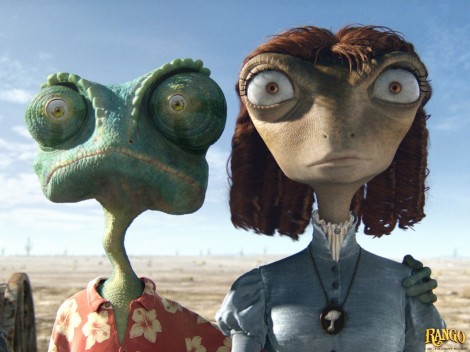
4. Rango- I had a real giggle (yes giggle) fest when watching this film for the first time recently. Not only is the animation visually beautiful, it's also visually very funny. There are shots where just the sight of Johnny Depp's chameleon Rango and other of the Desert town Dirt's inhabitants is just hilarious. While Rango may pack the emotional punch of films like Toy Story 3 or Wall-E, Rango's eccentric sense of humour and great voice acting elevates it outside its somewhat conventional plot and makes it one of the pleasant surprises of the year.


5. Drive- Film noir at its most brutal and stripped down. While I still have some mixed feelings towards Drive due to its violence and how it's almost too stripped down, not always developing its characters as much as it can, I still have love for a lot that's in this film. Not only is Ryan Gosling  great in the strong silent type role, ala Clint Eastwood or Steve McQueen, but he and director Nicolas Winding Refn create a fascinating deconstruction of this kind of character. At the beginning they show us an efficient, calculated getaway driver, only known as Driver, but as the film progresses, and as soon as Driver beats a man's head in in an elevator, we know there's a much darker, unhinged personality in their. Think of it as Taxi Driver in reverse.

The (Roughly) Next Five:
6. Moneyball
7. Midnight in Paris
8. X-Men: First Class
9: We Need to Talk About Kevin
10. The Skin I Live In

Honourable Mentions: Attack the Block, Captain America, Crazy, Stupid, Love., The Descendants, Harry Potter and the Deathly Hallows: Part 2, Horrible Bosses, Hugo, Insidious J. Edgar, Melancholia, Rise of the Planet of the Apes, Super

Still Need to See: A Dangerous MethodThe Adventures of Tintin, Albert Nobbs, The Artist, A Seperation, Contagion, Coriolanus, Friends with Benefits, The Girl With the Dragon Tattoo, The Help, The Ides of March, The Iron Lady, Mission Impossible: Ghost Protocol, The Muppets, Rampart, Submarine, Super 8, Take Shelter, Tinker Tailor Soldier Spy, Tyrannosaur, Uncle Boonmee Who Can Recall His Past Lives, Young Adult, War Horse, We Bought a Zoo


Looking Forward to 2012: My most anticipated film of this year, as I've said before, is The Dark Knight Rises. What I've admired about Christopher Nolan's past two Batman films is how Nolan and his creative team have made Gotham City feel very contemporary. Moreover, I like how through this contemporary prism, the filmmakers are still getting at the issues which have always been central to the character of Batman. I'm excited to see if the film can manage not to feel anti-climatic in comparison to The Dark Knight, which was ambitious and epic, and had Batman and Gotham City pushed to its limits by the Joker. I think Tom Hardy as Bane will be a great successor to Heath Ledger's already iconic portrayal of the Joker and Anne Hathaway's Selina Kyle/Catwoman will most likely be more interesting than the Rachel Dawes character. Third movies are tough for any franchise, particularly superhero films- think Spider-Man 3 or X-Men 3. But I think Nolan and his team are committed to this character and the specific interpretation of Gotham City they've established. I think this has a good chance of breaking the super-hero third movie curse.


I'm really mixed about The Amazing Spider-Man. I like Spider-Man and it has a strong cast. It's just that honestly I'm getting a little sick of Emma Stone. Believe me, you don't want me to start with my love/hate relationship with her. I'm also not sure if this film, even if it'll strike a different tone than Sam Raimi's trilogy, will offer anything new to the super-hero genre. There have been so many super-hero films in the last decade that it's arguably become overkill. Returning to Nolan's Batman films, The Dark Knight, as I said, was ambitious. It was this ambition as well as the willingness to go beyond pure escapism, to create something thematically dense and assertive- and psychologically intense, which always stands out when I think about the film. While I don't expect or want every super-hero film to be like The Dark Knight, since it's sometimes too serious and oppressive a film, none of the other superhero film released since The Dark Knight, not even Watchmen, have really grabbed me the same way that film did. Again, while The Amazing Spider-Man doesn't have to be like The Dark Knight, I hope it goes in a direction that really surprises and reaches an emotional high which resonates afterwards. I'm just afraid it'll like more of a set-up movie, where we have to wait until the second installment to get to the really good stuff.


While The Avengers aren't close to my heart the way Batsy and Spidey are, The Avengers is the first of its kind: it's a superhero epic which has been set-up through numerous Marvel produced films, establishing a continiuity similar to that of the Marvel universe and bringing together Iron Man, Captain America, The Hulk and Thor. It's sure to be a spectacle and arguably, if it's a success, it'll have more impact on future superhero films than even The Dark Knight Rises.


My most anticipated film after The Dark Knight Rises is Skyfall, the 23rd James Bond and the third starring Daniel Craig. I love Casino Royale, it's my favourite Bond film, and after seeing Quantum of Solace a few times, despite it being underdeveloped in some areas, I would argue it's one of the more underrated Bond films, economic and brutal. I also think Daniel Craig is perfect for this kind of Bond, cold, rugged, broken hearted and angry. It'll be interesting to see how the filmmakers deal with Bond being Bond after the last two films where about him becoming Bond. I hope he doesn't lose his humanity, that they strike a balance between the darker Bond established in the last two films, and the Bond we're more familiar with, preferably Sean Connery. Q is back! Ben Whishaw is playing the gadget master and I kind of love the idea of having a younger Q in this franchise. Sam Mendes is directing and I think he's bring a elegant visual style to the film, particularly with Roger Deakins as his cinematographer. While the Bond series may seem as overkill as the way I've described super-hero films, as I was saying about The Dark Knight, this new Bond franchise is going in interesting directions, which makes them still worth the audience's time.


Ridley Scott hasn't made a science fiction film since his 1982 classic Blade Runner. Along with 1979's Alien, Scott has made two of the most iconic sci-fi films of the 20th century. His new film this year, Prometheus, started as a prequel to Alien but from what Scott has said, it's won't technically be a prequel but will be part of the same universe, with the same "D.N.A" from the first movie creeping in. I'm facinated to see how it plays out. The prospect of Scott returning to the genre where he's arguably done his best work is exciting, particularly if it brings him back to the franchise he started with Alien.

 This new year brings a lot of exciting films to look forward to. Hopefully they'll live up to the hype!

Friday, 23 December 2011

Movie Journal # 1

The Tree of Life (Dir. Terrence Malick, 2011)- A film of contradictions- epic yet intimate, cosmological yet earthbound, confusing yet crystal clear, similar to Terrence Malick's other works yet feeling like his most personal, but while personal, the film is extremely universal. The Tree of Life was one of the most polarizing films of 2011- and as a friend once told me, that may be a sign of greatness. Brad Pitt gives what is arguably his best performance as an authoritarian father, Mr. O'Brien, in 1950s Texas. Pitt expertly captures a particular type of father figure, very strict, yet with a deep love buried inside of him. Early in the film, we get a flashforward of him finding out his 19 year old son has died, he talks about his guilt at treating him so poorly. This confession reverberates throughout the film. Jessica Chastain is ethereal and gorgeous as the mother of the three children. She is the "grace" to  Mr O'Brien's "nature." I don't think the the film has any fixed meanings. It's more concerned with asking questions about choices made in our childhood and throughout our life, as well as our place in the universe, and why we should act good even when people suffer.

The Descendents (Dir. Alexander Payne, 2011)- Director  Alexander Payne's first film since his excellent 2004 film Sideways, Payne chronicles the troubles of Hawaiian lawyer Matt King, played by George Clooney. Matt's wife is in a coma after a sailing boat accident, his two daughters are out of his control, and he has to decide to whom to sell the land his family owns. Payne does an fine job of taking Matt on a emotional journey without having to completely change him or making it seem he doesn't have to grow anymore. The film ends with a simple image of a family on a couch. They still have a lot to learn, but at least they each other.

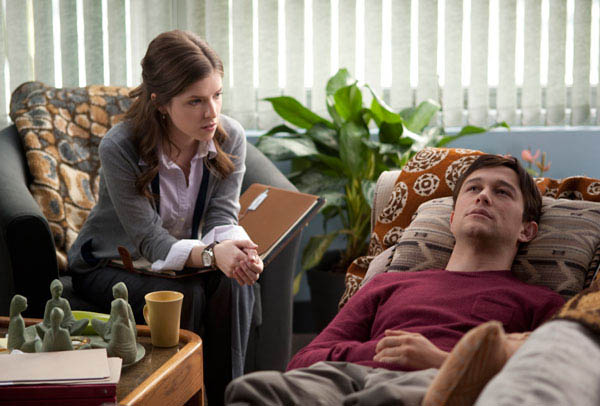
50/50 (Dir. Jonathan Levine, 2011)- 50/50 walks a tightrope between humour and sadness, levity and anger. The film manages to not have its humour make too light of Joseph Gordan Levitt's Adam's cancer, nor be so depressing it becomes a chore to sit through. It's actually the film's allowance of humourous moments which makes the quieter moments of anxiety and sadness hit quite hard. Ignatiy Vishnevetsky criticized the film as being a romantic comedy with a cancer gimmick, in regards to Adam's relationship to his young therapist, Katherine, played by Anna Kendrick. I actually admired the film for not going down that direction. Their relationship is only one aspect of the film and is allowed to develop throughout the film. It never takes  precedence over the cancer dilemma. The performances are all strong. The only drawback is this: Seth Rogen is good in the film but it's easy to become too aware of the Seth Rogen persona seeping in.

Paul (Dir. Greg Mottola, 2011)- While not as funny as it should be, with the director of Superbad and stars Simon Pegg and Nick Frost writing, Paul, the story of two sci-fi buffs encountering a real life extra terrestrial, is still a enjoyable comedy. The chemistry between Pegg, Frost, Paul (voiced by Seth Rogen) and Kristen Wiig, a christian fundamentalist who runs a motor park with her father, who finds herself in the company of the odd trio. The digs at her character's christianity seem a little gratuitous. I also didn't understand what was tying the together thematically. I think Mottola's previous two films Superbad and Adventureland were stronger movies on this front. At the end of the film Paul jokes about what the characters have learned throughout the film and I feel the movie has the same kind of attitude. It cares about its characters but doesn't develop them enough. Bill Hader, Joe Lo Truglio and Jason Bateman are all good as agents chasing after Paul and Blythe Danner adds some pathos as the older version of the girl who saved Paul when he first crash landed on Earth over sixty years ago.

The Skin I Live In (Dir. Pedro Almodovar, 2011)- My first Almodovar film. It reminded of Hitchcock, not so much in tone or style but thematically. In Hitchcock's films, he shows that sexuality and obession can go hand in hand, particularly in the male psyche. Almodovar's film does the same thing and creates an even more twisted version of Vertigo for the 21st century. Antonio Banderas, miles away from Puss 'n' Boots, plays Dr. Robert Ledgard, a plastic surgeon who has created a synthetic skin which resists damage. He has tested it on a mysterious woman named Vera (Elena Anaya). I don't want to reveal too much. It's best to go in without too much knowledge. I feel there could have been more development in some areas, particularly in Robert's relationship with his wife and daughter, but it's a film which, pardon the pun, truly gets under your skin.

We Need to Talk About Kevin (Dir. Lynne Ramsay, 2011)- A horror film grounded in the real life consequences of negligence and timidness, We Need to Talk About Kevin took me a while to get in to. But once I settled in, the character of Kevin, the child of Tilda Swinton's Eva, who even at a young age displays bizarre behaviour,  truly unnerved me. My nerves weren't helped by Ezra Miller's performance as teenage Kevin. The film is about the lead up to going on a killing spree at his high school, a puzzle which as all the pieces come together, things become more complicated. This is because the film asks us about responsibility and whether blame is ever a simple solution.

Sherlock Holmes (Dir. Guy Ritchie, 2009)- I actually enjoyed this more the second time I watched it. I like how the film allows Sherlock (Robert Downey, Jr.) and Watson (Jude Law) to be themselves. Holmes, the stuffy yet eccentric super slueth, and Watson, the dogged companion of Holmes. Of all American actors, Downey, Jr. is arguably the best choice for Holmes since Downey, Jr. can play the eccentricity needed for Holmes' character. The supernatural plot does pay off nicely at the end and I enjoyed this aspect of the film more the second time around. I liked Rachel McAdams as Irene Adler and thought it was interesting to have her and Holmes' relationship already established at the beginning of the film. The same goes for Holmes and Watson's relationship. The film doesn't waste time on being an origin story or being about the beginning of Holmes and Watson's relationship. The film centers on how their relationship is being broken apart by Watson's impending marriage. The film could almost be a sequel.

Sherlock Holmes: A Game of Shadows (Dir. Guy Ritchie, 2011)- I had a really mixed reaction to this film, even more so than when I saw the first film. It seems like it can't decide if it wants to be large scale or small scale. Thankfully there's enough small scale stuff which allows the movie to breathe and, like the first film, it allows Holmes and Watson to be themselves. The film ends not with a big action sequence but with Holmes and Professor Moriarty (Jared Harris) conducting a literal and figurative chess match. I also liked seeing Watson putting his deductive reasoning to the test. The ending has a great reference to the source material and the last scene is funny and suggests something...different for the future.

Saturday, 17 December 2011

Some Thoughts on the Oscar Race


I'm not much of a prognosticator when it comes to awards season. Mostly I go from what others are saying, with a few of my own thoughts creeping in. Nevertheless, it's been a while since I wrote about the Oscars and now is as good a time as any. I'll going through several of the categories giving my thoughts on each one.

Best Actor
Could this year's race really come down to a battle between the two biggest movie stars on the planet? It looks like it, with George Clooney and Brad Pitt being virtual locks for their performances in The Descendents and Moneyball, respectively. There's a certain stigman against movie stars; a belief no one famous could be talented, or according to Emma Stone, talented enough to make people forget he or she is a star and play a real person. Some will scoff at the idea of two movie stars being leading candidates for the Best Actor Oscar but from what I've heard, Clooney and Pitt give career best performances. Add the fact Pitt has also recieved acclaim for his work in Terrence Malick's The Tree of Life and Clooney did quadriple duty this year with directing, producing, co-writing and acting in the political thriller The Ides of March, and it's no suprise these two guys are frontrunners.

Another big star, Leonardo DiCaprio, also has a solid chance at getting his first Best Actor nomination since 2006's Blood Diamond, with Clint Eastwood's J. Edgar. I liked DiCaprio's performance but I still prefer his work in Shutter Island and Blood Diamond. If anything, I hope DiCaprio's probable inclusion doesn't lead to Gary Oldman's exclusion. I haven't seen Tinker, Tailor, Soldier, Spy yet but Oldman is supposed to be terrific in the role of George Smiley. Oldman has also never been nominated before. After so many years in the business and being able to go from playing Dracula to Commissioner Gordon, I think most are in agreement it's finally time.

Adding to the list of movie stars, Jean Dujardin, a star in France, is also likely to get a Best Actor nomination for his work in the silent film The Artist.

Woody Harrelson is also supposed to be great in Rampart but like Oldman he missed out on the SAG and Golden Globe nominations. Ryan Gosling was just nominated for his roles in Crazy Stupid Love and The Ides of March at the Golden Globes. His role in Ides is probably the best bet for a nomination but something tells me he's going to be left out agan this year.  

I think the eventual line-up will be: Clooney, Pitt, DiCaprio, Dujardin, Oldman.

Best Actress
Despite having two Oscars , there's a feeling Meryl Streep is overdue. It's been nearly thirty years since she won for Sophie's Choice and she has been pretty close with her roles in Doubt and Julie and Julia, losing out to Kate Winslet and Sandra Bullock. She plays former British Prime Minister Margaret Thatcher in The Iron Lady and it's the kind of role which screams Oscar, namely a real person, and a wildly controversial one at that. For the longest time people were talking about the race for Best Actress would be between Streep and Glenn Close, who hasn't been nominated since the 1980s. Her role in Albert Nobbs is that of a woman pretending to be a man in 19th century Ireland. This is also a role which screams for a Oscar. Close has never won, giving her the "due" factor. I'm just wondering if the film will make enough of an impression for Close to win.

Some, like Dave Karger of Entertainment Weekly, feel the race is between Streep and The Help's Viola Davis. The Help has a better chance of being nominated for Best Picture than The Iron Lady or Albert Nobbs, which I feel gives Davis a slight advantage over both of them.

I think Michelle Williams is also a lock for playing Marilyn Monroe in My Week With Marilyn but as I said in my review of the film I think Williams deserves a better movie. Tilda Swinton is gaining momentum for her work in We Need to Talk About Kevin. I had Elizabeth Olsen as one of the top five, thinking she'd be the Jennifer Lawrence of this year, but I think she's lost steam recently. Charlize Theron or Rooney Mara could be get the fifth spot, or the fourth and fifth if Swinton if left out.

Best Supporting Actor
I think Christopher Plummer has a really good shot at finally winning an Oscar this year. Plummer only recieved his first nomination two years ago for The Last Station but lost to Christop Waltz for Inglorious Basterds. His role in  Beginners as a father who reveals he's gay in his seventies has already landed Plummer a few of the critic's awards for Best Supporting Actor. Albert Brooks has also picked up a few awards for Drive, making him Plummer's closest competition. Ingmar Bergman alumni and acting legend Max von Sydow could also get in for his role in Extremely Loud and Incredibly Close. The thing is, the film, despite it's pedigree, doesn't seem like a big player, which may be a result of it being screened later than other films. I also think Kenneth Branagh has a good chance at a nomination but like Williams, I think he deserves a better movie. Could Jonah Hill, a SAG and Golden Globe nominee for Moneyball ride Brad Pitt's wave to a nomination? I could see it happening but he's not a lock yet. Armie Hammer has just been nominated for a SAG for his role in J. Edgar. This puts him back in the race after it seemed he was pretty much out. Like Hill, I still think he could get left out, particularly if J. Edgar isn't a big player.

Best Supporting Actress
I think this race could come down to the ladies of The Help, Octavia Spencer and Jessica Chastain. Chastain has been in everything this year, and has been in danger of splitting the vote among her performances. I think she's safe for a nomination though, with people leaning towards The Help. Chastain could still split the vote with Spencer. Shailene Woodley, who plays George Clooney's daughter in The Descendants, could take it if there's a vote split but I don't see the academy giving it her. She's still fairly young and new to the movie scene. There's no pressure to give it to her either. Vanessa Redgrave has been seen as a frontrunner for some time now but she lost out on the SAG and Golden Globe Nomination for her role in Ralph Fiennes' adaptation of Shakespeare's play Coriolanus. I think Laurence Olivier was the first and last actor to win for a Shakespearean role, that of Hamlet. I would love a Shakespearean performance to win this year. The Artist's Berenice Berjo also seems like a likely candidate. Some people have mentioned Sandra Bullock in Extremely Loud and Incredibly Close but even if it picks up steam, which it can, I don't see Bullock getting in.

Best Picture/Best Director
I think The Artist and The Descendants are locks for Best Picture. Their respective directors, Michel Hazanavicius and Alexander Payne will also get in. Martin Scorsese's Hugo as well. While I'm a little mixed on Hugo, I think it'd be great for Scorsese to win another Best Director Oscar. The pressure to award him is gone though so they'll probably give to someone else. The Help has a good chance at getting in but I feel it's director Tate Taylor is not a big enough name to get a nomination. Midnight in Paris, while a small scale film, is getting more love than most of Woody Allen's recent films. It could get in, with Woody Allen receiving his first Best Director nomination since 1994's Bullets over Broadway. Never underestimate Steven Spielberg, particularly with two big holiday releases this year, War Horse and The Adventures of Tintin. The director I most want to see get nominated is Terrence Malick for The Tree of Life. Unfortunately, I think the origin of the universe and afterlife sequence will turn off some academy members.

So there you go, some of my thoughts on a slightly open Oscar race this year.

Tuesday, 16 August 2011

Oscar Nominations: 2012


It's almost September which means we're coming to my favourite time of the year: Oscar Season! Well, maybe's it not that time yet but certainly once we get in to the fall, the studios unleash their big guns, the films which they feel have the best chance at claiming Oscar Gold. I'm going to talk about some of the films coming out in the fall, along with films released earlier this year, in no particular order, and theorize about their Oscar chances.


J. Edgar- Clint Eastwood's biopic about the infamous head of the F.B.I, J. Edgar Hoover, is one of those films which has all the markings of an Oscar contender. It has the prestigious director, Eastwood, the leading man, Leonardo DiCaprio, diving in to the role of a real person. It's also written by the Oscar winning writer of Milk, Dustin Lance Black. I felt DiCaprio should have been nominated for Shutter Island last year and I feel he has a pretty good chance of taking the gold this year, possibly being the one to beat. Arnie Hammer, who broke out last year as th Winklevoss twins in The Social Network, plays the assistant director of the F.B.I. and rumoured lover of Hoover. I don't how much the film will delve in to Hoover's supposed homosexuality but I think Hammer will get some plum scenes with DiCaprio and may have a good chance of receiving a Best Supporting Actor nomination. Naomi Watts also stars as Hoover's secretary, Helen Gandy. Like Hammer, she's probably has ample screen time with DiCaprio and if the Best Supporting Actress race doesn't get too croweded, I can definitely see her getting a nomination. It'll be interesting to see if this is Eastwood's Oscar comeback. While Changeling and Invictus scored nominations for its actors, an Eastwood has received a Best Picture or Best Director nomination since 2006's Letters From Iwo Jima. I feel his time away from the Best Director category was a good thing, for this film at least, and a nomination this year for both him and the film, for now at least, seems like a good bet. Black also seems to have a good chance of getting a screenwriting nomination.


The Help- Controversy will get you noticed in the Oscar race but it can also hurt your chances. The Help seems like the type of film the academy loves. It deals with an important social issue, which is the treatment of black maids in 1960s Mississippi and the plight of two maids, played by Viola Davis and Octavia Spencer, as well as a young white woman named Skeeter, played by Emma Stone, to reveal the truth about these conditions in a book. It's a period piece, and from the reviews it sounds like an acting showcase, and by a nearly all female cast to boot. Unfortunately, the film has been criticized for distorting historical fact as well as falling prey to the "white saviour" model of storytelling, where a story about African Americans is told through the perspective of  a white character who ultimately saves the black characters. On the other hand, I've also read things which say it is the story of the black maids more than it is about Skeeter. The controversy could hurt the film but I think it's main problem will be retaining momentum through the fall season. From the praise Davis has been getting, I think she may be close to a lock for a Best Supporting Actress nomination, or as some have been saying, a Best Actress nomination. It all depends on the campaigning. Spencer's performance has also been praised and I can both her and Davis in the Best Supporting Actress category. Stone's chances seem up in the air at the moment. She's Hollywood's new "It Girl" and seems well liked in the community, which could definitely push her in to the Best Actress category. Again, it all depends on campaigning. Some have even suggested her for the Best Supporting Actress category, where she could compete with Spencer. Davis could take a Best Actress slot. Hey, let's go even further and put Davis and Spencer both in the Best Actress race and have Stone compete with Bryce Dallas Howard or Jessica Chastain. Sorry, that's getting pretty complicated. I do have a feeling Spencer will be supporting either way. Also, in a reply tweet from Entertainment Weekly's Dave Karger, he told me the academy would probably focus more on Davis and Spencer than Stone. Maybe not getting a nomination will be the best thing for Stone since she's already been a little bit too overexposed. Tate Taylor, close friend of Kathryn Stockett, the author of the novel on which the novel is based, may not be a name people know well enough to get a best director nomination; most of the praise has been going to the actresses. A lack of a best director nomination could also hurt it's chances at a nomination for Best Picture. Again, I think it needs to keep its momentum through the season.


The Tree of Life- The film that caused a 100 walkouts, thanks to some dinosaurs and the creation of the universe. The Tree of Life's buzz seems to have died down but I think a film like this, once seen, is hard ro forget. If it gets a campaign push when it comes to DVD and Blu-Ray, I think this film, due largely to its ambition, as well the the legendary status of director Terrence Malick can get a Best Picture nomination. Winning is another matter. The Tree of Life, which juxtaposes the life a 1950s family with a sequence where we see the creation of the universe, is an impressionistic film, one which abandons a linear narrative structure and a clear cut ending. The film is a divider and that hurt its chances winning Best Picture. I think Brad Pitt and Jessica Chastain are terrific as Mr. and Mrs. O'Brien but due to the impressionistic style of the film, their performances may be overlooked. The cinematography by Emmanuel Lubezski and original score by a Alexandre Desplat who was just nominated for The King's Speech also have solid chances of getting nominations. I also feel the editing, which is the core of the film's aesthetic, also has a good chance of being noticed.


Midnight in Paris- Director Woody Allen's ode to romantic nostaligia has been called his best film in ages. I really liked the film but I feel it's too small a film to get a Best Picture nomination. It's best chance is probably in the Best Original Screenplay category where they may even decide to honour him for the film. Owen Wilson gives what may be his best performance here but I don't think it's the kind of role which can lead to a nomination.


Drive- Ryan Gosling, who some feel was snubbed for last year's Blue Valentine, which resulted in a Best Actress nomination for Michelle Williams, has gotten some serious buzz for his performance as a Hollywood stuntman who moonlights as a wheelman. The film is supposed to be excellent and it'll be interesting to see if the academy warms to it.


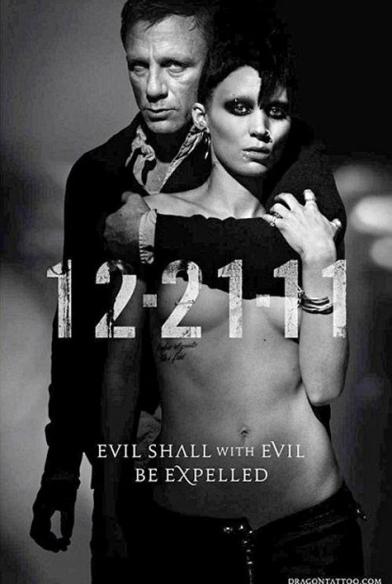
The Girl With The Dragon Tattoo- Already being marketed as "The Feel Bad Movie of Christmas," David Fincher's take on the international bestseller will rise and fall, I think on the performance of Rooney Mara as computer hacker Lisbeth Salander. Mara played Mark Zuckerberg's girlfriend in Fincher's last film The Social Network and he clearly saw something in her while they were filming and during the audition process which led Fincher to pick her over more established actresses. If Mara hits it out of the park, I think she'll have a great chance at securing a nomination. I don't know if Daniel Craig's role, despite being the lead, will be baity enough to get a nomination but only time will tell. Those who've read the novel know this is dark and gruesome material and fortunately the academy can embrace movies like this, with Black Swan being nominated this year and The Silence of the Lambs winning Best Picture nearly twenty years ago. Many feel Fincher was robbed this year for The Social Network so there is the possibility he may recieve a make-up Oscar this year.


Extremely Loud and Incredibly Close- Based on a novel by Jonathan Safran Foer, this film chronicles the story of nine year old Oskar, whose father died two years earlier on 9/11. He discovers a key which belonged to his father and proceeds to journey around New York to find information about the key. The film will concede with the 10 Anniversary of the attacks, which add to its emotional poignance. The academy also seems to love its director, Stephen Daldry, so I can see this possibly being a contender if its subject matter, which from what I gather exists in heightened reality, can work on film. It's been a while since Tom Hanks was nominated for an Oscar but I don't know if his role as Oskar's father will be his return to the race. It all depends on how the film is received and whether the role is fleshed out enough.


The Ides of March- George Clooney received a Best Director Nomination for his work on Good Night, and Good Luck  and I can see him getting another Best Director nomination for this political drama about a staffer (Ryan Gosling), learning about politics while on the campaign trail for a presidential candidate, played by Clooney. If the role is meaty enough, Clooney could also score a nomination or either Best Actor or Best Supporting Actor. It depends how Clooney is campaigned. I wonder if Gosling will be pushed for this film instead of Drive. I sense that Gosling is the lead and Clooney is supporting. Phillip Seymour Hoffman and Paul Giamatti could also score nominations if their roles are big enough, though it'll probably be Clooney who gets the push.


My Week With Marilyn- Michelle Williams could score two consecutive Best Actress nominations if she's nominated for playing Marilyn Monroe in this film. It seems like the kind of role Oscar would love to nominate. Kenneth Branagh plays Laurence Olivier but I feel much of the attention will go to Williams. Emma Watson also stars but I believe her role is small so while it's not hard to see Watson getting a nomination some time down the road, it probably won't be for this film.

That's all for now. Certainly there are quite a few more films to talk about but I just wanted to touch on a few possible contenders. Hopefully the race this year will have some actual suspense and excitement.

Saturday, 9 July 2011

The Films of Terrence Malick: "Days of Heaven"


It's a little unoriginal to say that Days of Heaven is one of the most gorgeously photographed films of all time but it's nevertheless as true a statement as one will find in cinema history. There are images here which just rape you with their beauty, which I know is an unpleasant image but there you go. Certainly, there will be shrugs of "so what" by some people if the quality of the film is attributed to the look of it. I would say the "so what" lies entirely within the images Malick presents us. By creating such rich and lush visuals, Malick is able to immerse the audience inside the world of the characters and the American culture of the early 1900s.

The film centers on the character of Bill (Richard Gere), who after killing his boss at a steel mill, flees with his girlfriend Abby (Brooke Adams) and his little sister Linda (Linda Manz), and go to work on a farm run by a character only known as the farmer (Sam Sheperd), Bill and Abby pretending to be brother and sister. The farmer, who is informed that he is dying, falls in love with Abby. Bill comes up with a plan to have Abby marry the farmer and inherit his money when he dies. The farmer's health stabilizes, which ruins the plan. There's also the sense that a real romance has occurred between Abby and the farmer. As with many things in Malick's films,this is not said out loud but strongly implied through specific images such as a snow ride between the farmer and Abby. 

Like all of Malick's films, there is a voiceover narration, the type of narration which is less about describing what's going on screen than it's about itself and the person who is talking. Like Malick's first film Badlands (1973), there is a singular narrator, which in this case is Linda. Like Sissy Spacek/Holly in Badlands, the narration here hasn't become the heavily philosophical, hushed voice narration of his later films. Like Holly's narration in Badlands, the narration is about how Linda views the events of the film rather than about getting at something philosophical, though as I mentioned in my Badlands review, critic Jim Emerson feels that when Linda is talking about mundane things, what she says is more meaningful than when she is trying to be profound.

It is frequently noted how the film can be viewed as Linda's interpretation of events rather than what exactly happened. Malick's films do have a highly impressionistic quality to them, particularly from this point on in his career and in a way, we have to take Linda and Malick's version of the story as the same. This is to say that Malick himself is filling in the blanks,stripping things down, as Slate Magazine's Nick Schager says, to "their bare, poignant essentials." I think Malick does this is in order to make things both more immediate and mysterious. As Malick fills in the blanks, so do we with our own personal experiences, which can be seen as why characterization and plot are so sparse; Malick wants us to bring a lot of ourselves to the characters. Malick is also interested in making his characters symbolic.

The farmer is not even given a name, which makes his role as a farmer singular within this universe and through most of the film, the universe of the film is the farm. When that universe collapses at the end, after the "day of the locusts," in which a swarm of locusts and a  fire destroy the farm, the story leads to two murder. The farmer, realizing Bill and Abby are not brother and sister tries to kill Bill, only to be killed by Bill. The second murder is that of Bill at the hands of the police, and there's also the seperation of Abby and Linda. Does the farm so how represent a kind of paradise, heaven as it were, considering the explicit biblical reference in the title of the film? Compared to the steel mill at the beginning of the film, which has been noted as possibly representing a vision of hell due to its furnace, the farm is a very beautiful and tranquil place, and when the working season is over, it does become a home for Bill, Abby and Linda. It's only when the farmer sees Bill and Abby kissing, realizing they are liars, that paradise falls apart.

The ending of the film, with Linda meeting up with another young girl, suggests a "life goes on" ending, in which things fall a part but the survivors of a tragedy try to find their "days of heaven" again. Whether that means redemption or merely a sense of happiness is the question.

Monday, 13 June 2011

The Films of Terrence Malick: "Badlands"


Looking back on 1973, it was quite an important year for film. Roger Moore stepped in as James Bond. The Exorcist, considered by many to be the scariest movie of all time, was released. Al Pacino soldified his status as a major actor with Sidney Lumet's Serpico; and two young directors who became two of the most important American filmmakers of the last forty years, would release their major breakout films. These directors were Martin Scorsese and Terrence Malick, whose films Mean Streets and Badlands, respectively, were both shown at the 1973 New York Film Festival.

What strikes me as the most fascinating aspect of Badlands is how it encompasses two time periods. The film takes place in 1959 and is based on the real life killing spree by Charles Starkweather and his girlfriend Caril Ann Fugate. The film does an excellent job of envoking the feeling of the 1950s, even as the two main characters, Kit (Martin Sheen) and Holly (Sissy Spacek) get away from civilization. As I said about Malick's The New World, this may not be exactly how the time period was but the film still captures something truthful nevertheless. The film was made 14 years after the time period it depicts, in 1973. The film is a fascinating document of one time period being filtered through the cinematic sensibilities of another. Badlands feel likes a film from the seventies, with its realistic violence and the sense one gets from watching it that there is a personal vision behind the images. There had certainly being auteurs in cinema befor the 1970s, particularly in other countries, and American did have directors like Howard Hawks and Samuel Fuller; but in the 1970s, from what've I learned, American cinema saw the emergence of directors like Brian DePalma, Martin Scorsese, Steven Spielberg, George Lucas, Francis Ford Coppola, and Terrence Malick. They weren't the first American auteurs but they be called the third generation of American film auteurs, directors who made some of the defining films of their time. That was a digression and I apologize. Basically what I want to say is that Badlands captures the period of the late 1950s through the lens of the 1970s. What is impressive about this conversion of time periods is how well they blend together, creating something evocative of both eras yet at the same time, timeless.

The first shot of the film establishes Holly as the main character of the film or at least the character through whom the audience views the story. She tells us in narration about her life until now:
My mother died of pneumonia when I was just a kid. My father had kept their wedding cake in the freezer for ten whole years. After the funeral he gave it to the yardman... He tried to act cheerful, but he could never be consoled by the little stranger he found in his house. Then, one day, hoping to begin a new life away from the scene of all his memories, he moved us from Texas to Ft. Dupree, South Dakota.
We see her in her bedroom on the bed with her dog. Coupled with the voiceover narration, this opening shot establishes her character as a young girl, one who has gone through tragedy yet has a certain distance from this tragedy, which foreshadows the murder of her father by Kit and the violence she witnesses while on the run with him. Kit is a garbage man who loses his job and becomes Holly's boyfriend. To her, he was "the handsomest man I ever saw-he looked just like James Dean." This similarity between Kit and James Dean is reiterated by a law officer near the end of the film when Kit is arrested. There's also the moment, late in the film, when Kit lays his rifle across his shoulders, in a homage to Dean's role in George Steven's film Giant. Kit being seen as a James Dean figure emphasizes Holly's romanticization of her and Kit's relationship. Coming back to Holly's distance from her family tragedies, as well as the violence she sees Kit commit, these contribute to the romanticization of her and Kit's story. Romanticization requires a certain emotional distance and I think Holly has this distance.

What struck me about watching Badlands is if I hadn't known Malick was the director, I wouldn't have necessarily thought of Malick, even with the voiceover and the meditative shots of nature. I can't quite say why, I think it has to do with how the characters are treated, which I found did not shrink in to the background the same way they did in The New World or Days of Heaven. I found the voiceovers in this film did not reach for the poetic as much as in The New World. Jim Emerson recently wrote a piece on Days of Heaven where he said that he found the more banal topics that Linda talked about where more poetic than the topics which where supposed to be poetic. I think I felt the same way about the narration here. While Holly is not trying to be poetic, there are passages which get at a certain truth about her character.

Sheen and Spacek give very lived in performances. Sheen does remind one of James Dean, the sexy rebel who has that streak of danger. He also has a little naivete in him because one senses he has no idea of what it means to be a criminal. Spacek also conveys a naivete but in her voiceover we sense she is more aware of the world than Kit, more conteplative. There is one voiceover where she asks herself where she would be if she never met Kit or lost her mother. In the early parts of this film it doesn't seem to be a set-up for a story about senseless killings but I think the normalcy of the early parts of the film make the descent in to violence all the more disturbing. It also suggests that the descent in to violent has the same mundaness that Kit and Holly's early life had. Kit and Holly, while on the run, don't seem to have any clearer goals than they did earlier in the film. The goal seems to become legendary more than anything else.
 
The final shot is that of the heavens, which thinking back on, I find relates to the final lines of the film

Kit: Sir... Where'd you get that hat?
Trooper: State.
Kit:  Boy, I'd like to buy me one of those.
Trooper: [the trooper smiles] You're quite an individual, Kit.
Kit: Think they'll take that into consideration?
When Kit asks whether "they'll take that into consideration," we as the audience automatically think of the judge and jury, etc. The final image of the heavens suggests that Kit is also thinking of getting in to heaven, whether him being "quite an individual" will get him in to heaven. The final shot may also be asking us whether we believe in something like heaven and wonder if the good we've done, despite our flaws, will be taken in to consideration.  

Monday, 6 June 2011

The Films of Terrence Malick: "The New World"


Note: This is a review of the Extended Cut of the film. 

The films of Terrence Malick, like those of Andrei Tarkovsky, the great Russian director, are more like visual poems than traditional narratives, though narrative structure still plays a factor in both directors' films. Malick's 2005 film The New World, which is a retelling of the Pocahontas legend, in particular, has to be approached in this fashion, as a poem, not a narrative. I also think the film requires a balance between being able to absorb it while also analyzing what Malick is presenting the audience, while at the same time not being too coldly analytical. If I sound like I'm writing an instructional manual for how to watch a movie, one from Malick or otherwise, I apologize, but I do feel it's important to know how to approach a work as challenging as The New World.

The film begins in 1607 in Virginia when ships as part of the Jamestown expedition have come to establish a colony. Before we are introduced to these English settlers, the film begins with a shot of a river, with a voiceover from a young woman talking to what can be perceived as Mother Nature, or Mother Earth: "Come spirit, help us sing the story of our land. You are our mother; we, your field of corn. We rise from out of the soul of you." This opening narration both establishes the trademark Malick voiceover, as well as the deeply spiritual nature of the film. The film is not just about a literal new world but also the connection the people have to an abstract spiritual world. The voiceover also subtly establishes Pocahontas (Q'orianka Kilcher) as someone who will ultimately become the main character of the film. Nevertheless, shortly after this introduction the audience is introduced to  Captain John Smith, who audiences will embrace as the main character, particualrly since he is played by Colin Farrell.

Bill Cody, of  the website Rope of Silicon, feels that Farrell is miscast as John Smith and that he stands out like a sore thumb. I can see where Cody is coming from but I think Farrell gives a fine performance, subtly suggesting admiration for Pocahontas yet also a reservation about having a relationship with her. While Farrell does stick out in comparison to the other actors, I think that's on purpose. While The New World does have a basis in historical fact, the film still has romanticized elements, such as the romance between Smith and Pocahontas. I believe Smith is supposed to be portrayed as a romantic and masculine figure, and Farrell fits that type of character. Moreover, I feel that Pochahontas stands out within her respective group as well. To my memory, we do not see many female native characters other than Pocahontas. I feel that Smith is probably more of an outsider than Pocahontas, particularly since at the beginning of the film Smith is to be hanged for mutiny, though pardoned by Captain Newport (Christopher Plummer), the leader of the expedition. Pocahontas is not an outsider in a negative sense but as Smith says in voiceover,

 All the children of the king were beautiful, but she, the youngest, was so exceedingly so that the sun  himself- though he saw her often - was surprised whenever she came out into his presence. Her father had a dozen wives, a hundred children, but she was his favorite. She exceeded the rest not only in feature and proportion but in wit and spirit too. All loved her.

Pocahontas trandscends the other natives, making her an outsider in a positive sense. Both Smith and Pocahontas are outsiders in their own way, which may be the factor that ultimately draws them together, coupled with  Smith leading a group to seek trade with the natives, which leads to his capture and eventual embrace of the natives.

Film critic Ty Burr has an interesting theory about the structure of the film, which is that the supposed romance between Smith and Pocahontas is a dream, Smith's dream in fact:

She [Pocahontas] falls in love with Smith, as adolescent girls do, and he falls in love with the idea of her, as a romantically inclined explorer might do...It's such a lovely dream, and, yes, it comes to look fairly silly to an outsider -- to Powhatan, to the other colonists, to the viewers in the audience. But a dream it is, and the use of Mozart's 23d Piano Concerto on the soundtrack alerts us to the fact that it's a European dream -- John Smith's dream.
   
It's a fascinating theory that emphasizes the contrast between the more romanticized elements of the film, which mostly include the romance between Smith and Pocahontas and the fact based elements such as Pocahontas' journey to England and her marriage to English settler John Rolfe, played by Christian Bale in the film. To my memory, these passages with Smith and Pocahontas are more dream like than the the passages with the English settlers. It's actually like waking up from a dream when Smith returns to the settlers and Smith, in voiceover, addresses these experiences as a dream: If only I could go down that river. To love her in the wild, forget the name of Smith. I should tell her. Tell her what? It was just a dream. I am now awake." One problem with this theory has to do with Pocahontas' reaction to learning that Smith has is alive, despite being told he had drowned, leading her to tell her husband Rolfe that she is already married, implying that she loves Smith, which leads me to believe to that this romance is real. There is also the moment in the snow between Pocahontas and Smith which implies a real romance of sorts had happened.

The dream interpretation, whether accepted or not, addresses the pervading tone of the film, which is that of a dream, one that captures a particular time and place, maybe not exactly how it felt, but something that feels truer than the ultimate reality. Malick supposedly wrote this script in the seventies and It and it can be seen as his dream, his connection to the past. Malick's films are all period pieces; Badlands, which I haven't seen takes place in 1959, Days of Heaven (1978) is set during the depression, and The Thin Red Line (1998) takes place during WWII. His latest, The Tree of Life (2011) takes place in the 1950s but I believe the Sean Penn sequences are supposed to be set in present day. Malick clearly wants to find elements of the American past that are relevent today.

The voiceovers from Smith, Pocahontas, and Rolfe, rather than the characters just narrating the events of the story, seem exist outside the character's bodies and even outside of time, narrating to the audience from the future. The voiceovers also emphasize the human connection to nature, which is an important theme in this film, as in Malick's other films as well.

The film is also about the disconnect between world, how that disconnect can result in a connection created by love. Sadly, this love is  ultimately too precious to last. I view this as the reason behind the separation of Smith and Pocahontas as well as Pocahontas death at the end of the film. It's interesting that Pocahontas is never referred to by name except when she becomes Rebecca Rolfe. The last shot of the film, as pointed out by rogerebert.com editor and critic Jim Emerson, is that of the tree of life, hinting at Malick's future film as well as the concept of Pocahontas finally finding her name after death.

Whether misfire or Masterpiece, and individual critics are divided, The New World should be approached openmindedly, without pretention or prejudice. After seeing the film twice, once with the 135 minute theatrical cut and once with the 172 minute extended cut, which I take is the final cut though with Malick one can't be sure, I still feel like I'll need to revisit over my life to write more completely on it. As of now, I think this is a gorgeous film, one, like a great poem, that whether analyzed or simply absorbed, provides a deeply rewarding experience.