Monday, 7 March 2022

"Diamonds are Forever" and "Live and Let Die" as Films of Transition


After George Lazenby made On Her Majesty's Secret Service he was convinced by his agent that James Bond was fast becoming a relic of the 60s and would not last in to the 70s. This led to Lazenby leaving the role, which would prove to be big mistake since the series did last in to the 70s and beyond. But the series transition from the 60s in to the 70s is a conspicuous one, with Diamonds are Forever and Live and Let Die showing the struggle to remodel the franchise for the 70s. These films took the James Bond series from the glamorous 60s to the rougher, grittier 70s, from cloak and dagger to camp, from Japan to Las Vegas, from baccarat to blaxploitation. This is when the series pretty much shifted from Ian Fleming's original conception to something more offbeat and strange. 

After Lazenby left the role  Bond producers Harry Saltzman and Albert R. Broccoli persuaded Sean Connery to return to the role he abdicated after You Only Live Twice. Connery was paid 1.25 million (the most any actor was ever paid at the time) and came back for what is essentially a one-off before Roger Moore inherited the role, playing it for 12 years and 7 movies. It's perhaps appropriate that after beginning the character's cinematic legacy in the 60s, Connery would bring us in to the 70s before passing the torch to Moore, the Bond of the 70s. 

The contrast between Diamonds are Forever and its predecessor OHMSS is important when examining the transition the series made from the 60s in to the 70s. OHMSS was grand and romantic, hopeful and happy until it turned tragic at the conclusion with the death of Bond's wife Tracy (Diana Rigg) After the shattering of Bond's world,  Diamonds are Forever's world is a marked departure from the universe of OHMSS and the other previous Bond films. It's sleazier, grittier, chintzier. But it's not just Bond's world that has changed, it's that the real world because increasingly more cynical and morally uncertain as we transitioned in to the 70s.As Xan Brooks discusses in his essay on why Diamonds are Forever is his favourite Bond film: 

Cubby Broccoli's franchise started out in the early 60s fired by a sleek moral certitude, prowling a        world of clearly defined good and evil before slipping into a jokey self-parody during the mid-to-late     70s. Diamonds, though, is the missing link, the crucial transition; ideally placed at the turn of the      decade and implicitly haunted off in the nation at large. Here is a Bond film in which the old glamour has lost its sparkle and resolute hero has lost his way. It's jaded, uncertain and disillusioned.

I'd argue the self-parody begins here and gives way to what the Moore films became. Blofeld (Charles Gray) is in drag in one scene and Bond drives a moon buggy. There's even a sheriff who may have been the model for Sheriff J.W. Pepper (Clifton James in Live and Let Die and The Man With the Golden Gun. But I do agree with Brooks that there is a more cynical feel to the film and Connery's portrayal. The death of Plenty O'Toole (Lana Wood)- drowned at bottom of a pool- feels cruel even by the standards of the previous Bond films. And Bond may not be having as much fun as he was in Goldfinger. Part of that is because Connery was pretty much here for a paycheck. 

Another way Diamonds are Forever is transitional film is it puts a capper on the Blofeld/SPECTRE storyline that ran through the first five Connery films, with the exception of Goldfinger. This would be Blofeld's last official appearance in the series until Spectre in 2015. This is due to a legal battle with producer Kevin McClory, who worked with Ian Fleming on a screenplay that would be the basis for the book Thunderball. McClory was able to attain the rights to the Blofeld character but an unnamed version of the character would appear in For Your Eyes Only and be killed by Bond as revenge for the death of his wife. And Max von Sydow would appear as the character in the McClory produced Never Say Never Again, a remake of Thunderball starring Connery. Blofeld was the villain in three straight Bond films- You Only Live Twice, OHMSS and Diamonds are Forever. But moving in to the Moore films and beyond, Blofeld and SPECTRE do not officially appear. 

After Connery declined the offer to return once again for Live and Let Die, Moore was chosen and established his Bond as the proper English gentleman to Connery's more rough-and-tumble version. After Lazenby left and Connery brought it felt like the producers saying "Well we tried with a new guy and it didn't work so here's the real James Bond again." But Moore's distinct take on the character  helped the series flourish through the 70s and 80s. I'd argue the main reason Live and Let Die is a transitional film because is it proved Bond could survive beyond Connery.  

As I mentioned before the Moore films also marked the transition away from Blofeld and SPECTRE being a ongoing threat throughout the series Moreover, the villain's scheme is on smaller scale than the last three plots. Dr. Kanaga (Yaphet Kotto) plans to distribute 2 tonnes of heroin free of charge through his restaurants, putting drug dealers out of business and increasing the amount of addicts, which he would exploit for his new monopoly. The series was going smaller; Even Diamonds are Forever's climax feels miniature compared to YOLT and OHMSS. It wouldn't be until The Spy Who Loved Me that we got back to epic Bond.

Live and Let Die would also be where the Bond series started to borrow from different genres. It is often said that the Bond series went from being a trendsetter to being a trend follower. The next film, The Man With the Golden Gun, would have a kung-fu sequence due to Enter the Dragon and other such films. Licence to Kill is often compared to other 80s action films and the Craig films took inspiration from Jason Bourne (Casino Royale and Quantum of Solace) and The Dark Knight (Skyfall). And Spectre has been theorized to be an attempt at something equivalent to the Marvel Cinematic Universe in regard to connecting the previous three Craig films together. But Live and Let Die is where we begin to see Bond being influenced by popular culture.

In the case of Live and Let Die, the filmmakers looked at the blaxploitation films of the era, a subgenre that had black characters as the leads and black communities as the settings. Harlem is a setting in this film. Bond being white provides a juxtaposition between Bond's race and the black communities in which he occupies. And even more so than Diamonds are Forever, Live and Let Die has a gritty aesthetic that stands in contrast to the cleaner and more glamorous look of the 60s films. This also makes Moore's very polished feel even more of an outsider when he's in New York and Harlem. It's a little awkward placing a white character as the lead in what is a black subgenre, especially with the introduction of the aforementioned J.W. Pepper as comedic relief, which relies on his racist nature. All in all, the experiment in genre appropriation doesn't completely work.  

Diamonds are Forever and Live and Let Die show the Bond series awkwardly entering a new era, and it wouldn't be until TSWLM that the series would truly find it's footing in the decade with a more authentically feeling 70s update of the Bond formula. So, what are your thoughts on these two transitional films? Where do they rank for you in the Bond series? Comment and let me know.


Thursday, 10 February 2022

The Oddities: "Lured" (1947)

Spoilers Below

Douglas Sirk's Lured is an underrated gem from the 40s and represents a curious mix of romantic comedy and film noir/serial killer mystery. But is it a romantic comedy disguised as a serial killer drama or vice versa? The two sides perhaps don't mesh perfectly but this is an entertaining film regardless, largely because of its witty dialogue, good production design and cinematography, and a wonderful cast.

The film is a remake of Robert Siodmak's Pieges (1939). Lured was originally entitled Personal Column. Joan Leslie was originally intended to star but left when production was stalled. Producer James Nassar, who was to produce the film under his company Oakmont Pictures, sold the rights to Hunt Stromberg. Stromberg hired Sirk and actor George Sanders, who had made two films together already, Summer Storm (1944) and A Scandal in Paris (1946). Sirk immigrated to America in 1937,  working on the stage as a producer and director. He eventually switched to movies, with his first film being Hitler's Madman (1943).   

Now, on to the movie. Lucille Ball plays Sandra Carpenter, an American who moved to London to perform in a show that flopped and is now a a taxi dancer, someone who is paid to dance with customers. Her friend Lucy goes missing, becoming what the police believe is the latest victim of the "Poet Killer." This person lures women in through personal ads and the police poems about the victims. When Sandra goes to talk to the police about Lucy she is convinced by Inspector Harley Temple (Charles Coburn) to act as bait for the killer. I liked Coburn's warmth and determination in the role. Temple asks Sandra to close her eyes and describe the room and then him. She tells him he's a softy even though he pretends not to be. It's a sweet moment that shows the beginnings of a friendship that'll grow throughout the film. Added in to the mix is Robert Fleming (Sanders), a producer for whom Sandra was supposed to audition until her manager wouldn't let her. She eventually meets Fleming  while acting as bait for the killer. 

Sandra and Fleming's relationship becomes the heart of the film and provides some wonderful back-and-forth between the two. Fleming is sardonic (he's George Sanders, of course he's sardonic) and Sandra is ballsy but vulnerable and eventually charmed by Fleming. Fleming pretends to be his own secretary over the phone, which provides a humorous sort of meet cute. 

Ball is of course known her comedic work and she does provide subtle moments of humour- as when she gets a gun from Temple- but she doesn't go too far with the comedy, still allowing there to be moments of tension between her and the men who are possibly the killer. Boris Karloff gets a funny/creepy scene as a deranged fashion designer who's looking for a model for his make believe show.

Another highlight of the film is George Zucco as Sandra's guardian angel, the crossword occupied Officer H.R. Barrett. The running gag of him figuring out clues via the situations Sandra are is amusing and Zucco gives a hardened but likable performance. William Daniels' cinematography and Nicolai Remisoff's production provide the appropriate gothic but naturalistic atmosphere.  

After Sandra and Fleming are married he is framed for the murder of the missing girls. However, the real killer is Fleming's business partner Julian Wilde (Sir Cedric Hardwicke), who is in love with Sandra. The film lets us know that Wilde is the killer before it's actually revealed so the final stretch of the film is less about the mystery and more about the tension when Wilde will be caught. I would argue the ends up being less about the mystery and more about the character interactions and the romance between Sandra and Fleming, as well as Fleming's feelings of betrayal when he discovers Sandra has been working with the police.

Lured is a nice blend of charming and chilling, with colorful and memorable performances. So, have you seen Lured? What are your thoughts on it?  Comment and let me know.  


Wednesday, 2 February 2022

All We Can Do Is Understand and Remember: Time Travel and Tragedy in "Last Night in Soho"


Spoilers Below


What if we could travel back in time but were unable to change anything and were forced to be a passive witness to tragedy? How painful would that be, especially if we were nostalgic towards that period. We would have our heart broken by the dark reality of the time with which we were so enamored. This is what happens to aspiring fashion designer Eloise Turner (Thomasin McKenzie) in Edgar Wright's Last Night in Soho, a film about the inability to see we can't change the past but can only learn from it. In this short essay I will discuss how Eloise is not a typical time traveler and her actual role in the story. I will also discuss the dream-like quality of the time travel in this film.

First, I want to give more context regarding the film's plot. Eloise lives with her Aunt Peggy (Rita Tushingham) and through a supernatural ability is able to see the ghost of her mother, who committed suicide when Eloise was very young. Eloise is accepted in to a fashion school in London but when she moves there she quickly realizes she doesn't fit in with her roommates so she rents a room from Ms. Collins (Diana Rigg). On the first night in that room she is able to travel back in time to 1960s London and witness the story of Sandie (Anya Taylor Joy), an aspiring singer who comes to London and is ensnared by supposed talent manager Jack (Matt Smith), who pimps her out to wealthy men in clubs.

While many time travel movies fall in to the science fiction genre there's no technological component to the time travel in this film. It's a supernatural conceit that allows Eloise to travel back in time. But what truly makes Eloise different from other time travelers is she can't change things or interact with the past, though she sometimes experiences things through Sandie. Eloise is almost like a ghost from the future, haunting the past even as it begins to haunt her.  

The time-travel sequences feel like dream sequences, which makes sense since they occur when Eloise has gone to sleep. The way Eloise enters 1960s London has a dream logic to it. She gets out of bed and walks down an alleyway on to a London city street. In "Anatomy of a Scene" from the New York Times Youtube page, Wright even compares the first time-travel sequence to The Wizard of Oz. Wright says that when you see the film in a theatre the soundtrack switches from front-facing stereo to all the surround sound kicking in when Eloise steps out of the alley. Wrights says this is the audio equivalent of Dorothy stepping in to Oz. I think the film also clearly visually parallels that moment by having the camera follow Eloise from behind as she enters this new world, the same way the camera does with Dorothy. 

Another conceit the films uses to craft a dream-like atmosphere is having Eloise seemingly embodying Sandie and experiencing things from her perspective. In the first sequence  Eloise looks in the mirror in the Cafe de Paris and she sees herself as Sandie. The camera pushes in to the reflection. and as the camera turns away from the mirror it's Sandie on the other side, replacing Eloise. And when the camera turns back to the mirror, it's Eloise on the other side. And during Sandie's dance with Jack we transition- through editing and camera movies- from seeing Sandie dancing to seeing Eloise dancing. 

Let's come back to the mirrors, as Sandie walks down some steps we see Eloise in the mirrors going downwards. And when Jack is kissing Sandie on the neck, in a mirror we see him kissing Eloise. These shots of Eloise in mirrors are a visual metaphor for her being an outsider in the past rather than an active participant. Eloise will again be seen in a mirror as she watches Sandie talking to the men to which she is being propositioned. Eloise tries to break through to the other side but when she gets through and grabs Sandie, she wakes up. Eloise being seen in mirrors also represents how her and Sandie are mirror images of each other. They're both ambitious and artistic young women who move to London and learn it's not all they expected. Their romantic image of the city is shattered. When Eloise first gets to London she has an uncomfortable encounter with a cab driver and her run ins with a older gentlemen (Terence Stamp), whom she believes to be the older Jack are also unsettling for her. Eloise and Sandie's dreams have become nightmares. And speaking of nightmares, when Eloise believes she sees Sandie killed by Jack, the bloodied vision of Sandie appears to Eloise in the present, along with the ghastly shadow men. 

Eloise becomes determined to solve Sandie's murder and get for justice for her. So she is an inactive protagonist in the past but in the present she able to be active. Eloise attempts to expose "Jack" but it turns out he's actually a retired Soho vice cop named Lindsey (Sam Claflin) whom we and Eloise had seen talk to Sandie in the past. And just how Lindsey wasn't Jack, there's another identity reveal around the corner. This is Ms. Collins is the elderly Sandie, who killed Jack and many other men who abused her, whose bodies she's hid in the house for over 50 years (the shadow men are their ghosts).  Eloise went to the police about Sandie's murder and traveling back to the past. This caused the police to come to Ms. Collins' house. Becoming afraid that her crimes will be discovered, Ms. Collins attempts to kill Eloise. So Sandie is the true murderer of the story, not Jack. It's the final subversion and shattering of Eloise's nostalgic vision of the 60s and her idealization of Sandie. Sandie is a victim but also someone capable of brutal violence. And Eloise is almost killed by the woman for whom she so desperately wanted justice.

Sandie didn't literally die but as Ms. Collins says, the young Sandie died 100 times in that room in which Eloise has slept. Sandie's soul died, with Ms. Collins being a ghost of her former self. She's a ghost in the present just as Eloise is a ghost in the past. And Eloise didn't realize the real Sandie was there all along nor did Ms. Collins know that Eloise was witnessing her story in the past. They were so close together but by the time Eloise realizes the truth she doesn't have time to truly explain how much she knows about Sandie's story. As the house burns down Ms. Collins decides to stay behind. She refuses to go to prison because, as she tells Eloise, she's been in a prison her whole life. That one encapsulates so much of the tragedy of Sandie's life. It's really painful, I find. 

Eloise's role in this story is not to change things or solve a murder but to understand what happened to Sandie and why she killed those men. Eloise is here to remember Sandie and who she was before her innocence and vibrancy was robbed from. And while time travel exists in this film we're reminded time travel doesn't exist in reality, that like Eloise we can't change the past. We are all on the other side of the mirror when it comes to history. We can't save it's victims but we can remember them. 

In the final scene we see a presentation of Eloise's designs, with "Downtown" by Petula Clark playing, the song Sandie sang when she auditioned at a Soho nightclub. The audience watching the show doesn't understand the irony of the song choice. It's a happy song but it's not the reality of the 60s, it's not Sandie's life. She didn't get the happy ending she deserved. The song choice tells us that while Eloise still loves 60s fashion, she understands the darkness underneath the glamour. On the commentary Wright says nostalgia is a failure to deal with the present. "You're in retreat," he says. Him and co-writer Krysty Wilson-Cairns agree it's better to make a better world in the present because the past was never a better world. But I'd argue we have to learn from it if there to be a better future an it's always going to haunt us. Which brings us to the film's final moments. Eloise sees Sandie in a mirror,  suggesting the past is never truly dead and that, to paraphrase that classic song that plays at one point in the film, there will always be something there to remind you.

Saturday, 29 January 2022

My Favourite James Bond Pre-Title Sequences


The pre-title sequence is a signature of the James Bond franchise. Even the rule-breaking Daniel Craig films kept to this tradition, sans the gunbarrel  at  beginning for most of the films. While the Bond franchise weren’t the first movies to have pre-title sequences, they’re most closely aligned with the series. So, I want to talk about my favourite pre-title sequences of the franchise. Starting with the one that reintroduced the character of 007 and showed us how he gained his "00" status.


Casino Royale

In my piece late last year about Casino Royale I talked about film's opening sequence, saying 

"it efficiently sets up this version of  Bond as we see him talking calmly to MI6 Section Chief (and traitor) Dryden while cutting to Bond earlier brutally killing Dryden's contact, Fisher, in a bathroom. The black and white cinematography switches between a stark and gritty look in the bathroom to a smoother one in the present. This contrasts the hands on killing of Fisher with one silent bullet assassination of Dryden. Though to be fair, Fisher does come back to life and Bond shoots him as well."

This opening quickly establishes this as a different kind of Bond movie and a different kind of Bond.  This new Bond is a "blunt instrument" but also someone capable of a cleaner kill. I love the use of the different black and white footage, contrasting the more brutal and messy kill of Fisher and the efficiency of the Dryden kill. Craig's performance immediately proves  how he was the perfect choice for this new version of Bond, rough and rugged, but also cool and cold. And incorporating the gunbarrel in to the actual narrative- as Fisher revives and attempts to kill Bond- is such a brilliant reinvention of an old tradition. 


From Russia With Love

The series' first pre-title sequence came with the second film and was the first to "kill off" Bond. We're led to believe the real Bond (Sean Connery) is being stalked by an assassin named Red Grant (Robert Shaw) but it's revealed to be SPECTRE training exercise. It effectively sets up Grant as a threatening and ruthless villain for Bond to face, creating genuine suspense through it's visual storytelling. The atmosphere is perfect and only two movies in showed the franchise was willing to subvert audience expectations. 


Goldeneye

From the opening dam jump to the climatic plane escape, Goldeneye's pre-title sequence made Bond a action hero for the 90s. That dam jump is still one of the most impressive stunts in film history and Pierce Brosnan established himself as great Bond, cool under pressure but with hints of vulnerbility, as when he witnesses the "death" of fellow 00 agent Alec Trevelyan (Sean Bean). It was great to see Bond work with another 00 and his supposed death adds genuine drama to the action. The chemical weapon facility has great production design,  a terrifically cold late cold-war aestethic. It's one of the series most memorable locations.


Skyfall

That opening shot with Bond (Craig) stepping in to frame with the first couple of notes of the Bond theme playing is so good. And it showcases Roger Deakins' gorgeous cinematography right from the start. From there the action becomes what director Sam Mendes calls a "Russian nesting doll,”  going from car chase to bike chase all the way to a fight on a train, where Bond is accidentally shot by Moneypenny (Naomie Harris) when M (Judi Dench) tells her to take the shot at Patrice, the man Bond is fighting. Bond's "death" primes us for a film that will be about rebirth and reinvention, both for Bond and the franchise. The opening also shows us how the relationship between Bond and M will be tested to the limit throughout the film.


Thunderball

It's the jetback, it's pretty much that. That, and the origin of  Austin Powers punching a woman he thinks is a man. 


Goldfinger

While From Russia With Love had the franchise's first pre-title sequence, Goldfinger solidifies what the pre-title sequence would be going forward. We have the real Bond (Connery) this time, placing explosives in a drug factory then taking off his wetsuit, revealing a white dinner jacket. He then waits for the explosion, smoking casually as they go off. This is all quintessential Bond and helped define the franchise's image. And then there's that "shocking" climax, where Bond throws a lamb in a bathtub, killing his would-be assassin.


No Time To Die

The most recent pre-title sequence is also the series' longest to date. And it's actually two sequences in one, both which see Madeleine Swann (Lea Seydoux) lose someone close to her. The first sees young Madeleine encounter the film's villain Safin (Rami Malek), who kills her mother. The second has Madeleine lose her lover, Bond (Craig), who is tricked in to believing she's betrayed him as Vesper Lynd did. Bond visiting Vesper's grave ties the film back to Casino Royale and Bond's actions after it blows up reveals Bond never really got over her betrayal. This dooms him and Madeleine's relationship, losing 5 years with Madeleine and his daughter. This is the most emotional pre-title sequence, with Bond sending Madeleine away on a train, beautifully and hauntingly segwaying in to Billie Eilish's title song, which reflects Bond's emotional state at the moment.  


Spectre

While Spectre falls apart once it gets to Blofeld's compound, the pre-title sequence is strong, especially with its opening tracking shot which follows Bond in to a hotel and then out on to a balcony. And then there's Bond fighting a bad guy in a helicopter, leading it to flip over. It's a shame the rest of the film's action doesn't live up to this prologue.


The Living Daylights

Timothy Dalton's debut as Bond introduced-through the pre-title sequence-an authentically physical Bond who chases down a Russian assassin who kills two 00s during a training exercise. After the obvious stunt doubles in Roger Moore's A View to a Kill Bond on the roof of a truck as it drives down a cliff is refreshing and thrilling. 


The Spy Who Loved Me

After three smaller scale- and somewhat cheap feeling films (Diamonds Are Forever, Live and Let Die, The Man With the Golden Gun) The Spy Who Loved Me makes it clear right from the beginning that epic Bond is back, having a submarine be hijacked in the first scene. Then during a ski chase Bond (Roger Moore) jumps off a cliff then releases his parachute with the Union Jack, a moment that got cheers when the film had its UK premiere. The chase itself is terrific and ties in to the emotional arc of the film by having Bond kill the lover of Russian agent XXX (Barbara Bach), with whom Bond will team up during the course of the film. 


Moonraker

One of the weaker Bond films but one of the better openings. Bond (Moore) is pushed out of a plane without a parachute by Jaws (Richard Kiel, who first appeared in TSWLM). It has great stunt work and I love how it's just a random event in Bond's life that doesn't tie in to the rest of the film, sans Jaws.


For Your Eyes Only

While I don't like the way it unceremoniously dispatches the unnamed villain (who is Blofeld but because of rights issues wasn't able to be called that), Bond (Moore) being stuck in a remote controlled helicopter is a inventive conceit. It was also a nice touch to have Bond visit his wife Tracy's grave since it was Blofeld who had her killed.


So, what are your favourite pre-title sequences and are they from your favourite films? Comment and let me know. 

Monday, 17 January 2022

The Essential Films: "Paper Moon:" (1973)


A Series of Writings on Films that I feel are essential for film lovers, coupled with films that are personal to me. Spoilers for those you haven't seen the film.

Paper Moon is a gem of a film, one of the under-sung great films of the 1970s, made by a great director in his prime. With the recent passing of Peter Bogdonovich  I decided to look back on his fourth film, a poignant but unsentimental road trip featuring a real-life father/daughter pair playing a pair who may or not be father and  daughter. Paper Moon begins in 1935 with the funeral of Addie Loggins' (Tatum O'Neal) mother and the arrival of "family friend" Moses Pray, who may be Addie's father. Moses is asked to take Addie to her aunt's, to which he reluctantly obliges. It's soon revealed that Moses is a conman, selling bibles to widows under the pretense that their late husband bought it and had their name inscribed in it. Addie catches on pretty quickly and becomes Moses' unlikely partner. 

Paper Moon is based on the novel Addie Pray by Joe David Brown. Bogdonovich didn't like the title and came up with the title Paper Moon after seeing the title of the song "It's only a Paper Moon" on a list of songs that were popular during the 1930s. When Bogdonovich asked Orson Welles what he thought of the title Welles told him just to be release the title instead of the film. 

Bogdonovich had just done What's Up Doc? with [Ryan] O'Neal and wanted to do another film with him, which is how he met Tatum and got her on board. Casting a real life father and daughter could've easily been a gimmick but the two O'Neals have a whip-smart chemistry. Supposedly, Roberts Evans, the head of Paramount at the time, suggested Warren Beatty and Jack Nicholson for Moses. It's hard to imagine what Nicholson could've brought to the role but I think O'Neal, while never being one of the "heavyweight" actors of the time- compared to Nicholson, De Niro or Pacino- has the right amount of sleaziness without becoming outright unlikable. And it's no wonder Tatum won an Academy Award for her performance. It's almost fifty years later and she's still wonderful in the film. She makes Addie a lived in child of the 1930s rather than 70s and Bogdonovich trusts that opening the film with a close-up of her face will establish the whole tone of the film. And it does. Addie's look is somber and mature beyond her years. This will not be a sentimental kid's film but a film about a particular place and time that was full of despair for the United States.  

The film has a lived in quality but also feels like a memory, a vision of the past rather the real thing. This is due to Laszlo Kovacs's black and white cinematography. There's something about black and white which puts a film outside of reality. It was Welles who suggested shooting the film in black and white through a red filter, to give the images high contrast. The film is visually rich, a real treat. There's a section in the film where Moses picks up a dancer named Trixie Delight (Madeleine Kahn) and her maid Eugenie (PJ Johnson). Addie becomes jealous, showing the audience the growing bond between her and Moses. After they've stopped for lunch on a hill, Addie stays under a single tree, not wanting to sit in back of the car with Trixie in front. This shot, and the shots of Trixie attempting to persuade Addie to come along, are magnificent. 


The film's visual storytelling is impeccable. Going back a little, when Addie first discovers Moses' con with the bibles, visually we see it through Addie's perspective- she sees the bibles and what Moses uses to print the names on the bibles. It reminds us that Addie is the main character and we're seeing much of the story through a child's perspective. While she won Supporting Actress, O'Neal should've won Best Actress. Even Khan, who was nominated in Best Supporting Actress with O'Neal, said O'Neal was the Best Actress and she the Best Supporting Actress. I agree O'Neal is the lead actress and Addie is the character who propels the story forward. She makes Moses her partner, breaks up him and Trixie and gets herself and Moses out of going to jail during the bootlegger segment. 

 But having a child lead the film doesn't make it too cutesy or sentimental. Paper Moon's lack of sentiment is a big part of why it's so great. The film looks at Addie and Moses' relationship matter-of-factly. They're two people who belong together, whether or not they're actually father and daughter. The fact its never confirmed Moses and Addie are father and daughter contributes to the film's unsentimental approach. That they are most likely biologically related remains a unspoken truth rather than an easy way to pull on the heart strings. Moses eventually brings Addie to her aunt's but Addie leaves, telling Moses he still owes her money. Again, no sentiment. These two characters are above that. It doesn't have to be spoken out loud that they love each other. And the film ends with them on the back of a truck, driving in to an unknown future. But as I said, these two belong together, for better or for worse. 

Tuesday, 4 January 2022

Why did this story feel like a memory?: "The Matrix Resurrections"


Spoilers Below


"They took my life and turned in to a video game" laments Neo (Keanu Reeves) at one point in Lana Wachowski's The Matrix Resurrections, her return, sans her sister Lily, to the universe that defined them. Neo has learned after his sacrifice at the end of The Matrix Revolutions he was resurrected and put back in to the Matrix, where he was given the identity of a video game developer who created the video game called...The Matrix. One of the big themes of The Matrix was choice of identity. The Matrix gives you an identity but it is not one of your choosing. In Resurrections Neo's identity has been robbed of him and his life has been reduced to entertainment. The Matrix took humanity's imprisonment and turned it in to mass entertainment created by the very man who attempted to free humanity from their virtual prison. It would be a cosmic joke except it was specifically manufactured by a computer program, the Analyst (Neil Patrick Harris), who took over the Matrix from the Architect, he of the "ergo" and "vis a vis."

Bugs (Jessica Henwick), a resistance fighter, tells Neo that the Matrix took something so important to her and others, Neo's story and "turned it in to something trivial. Were better to bury truth than in something as ordinary as a video game?" One can hear through Neo and Bugs' conversation Wachowski lamenting on what was so personal to them becoming so commercialized. Hell, The Matrix was turned in to a video game, one written and directed by them. So maybe there's a little bit of self-critique from Wachowski. The Matrix was so personal to them- it's often read as a trans allegory- so perhaps it was reductive to turn it in to a video game and make sequels from it.

It's no coincidence the film's title has Resurrections in it, acknowledging  this is a dead franchise being resurrected, along with a couple of previously thought dead characters. The film is a meta-commentary on legacy sequels, nostalgia and the role of a creator. This is Wachowski grappling with the legacy of her creation and the burden of creating something so popular it almost becomes bigger than you.

The Matrix Resurrections was to be made even without the Wachowskis' involvement but Lana Wachowski came on to steer the ship along with novelist and co-screenwriter David Mitchell (who wrote the novel Cloud Atlas on which the Wachowskis' film was based.) Neo (Thomas Anderson in the Matrix), like the Wachowskis, is told by his business partner (Jonathan Groff)- who's actually a new version of Neo's old nemesis Agent Smith- a sequel is happening to his seminal game with or without him. Smith even name drops Warner Bros. Making a sequel to the game is largely about nostalgia and Wachowski is critiquing how legacy sequels are largely dependent and coast on nostalgia. There's also the irony, as I already mentioned, of humanity's imprisonment becoming a touchstone for a generation via this game. 

The success of the game has plagued Neo as he is unable to separate his "real life" from his "creation," even almost walking off a roof, believing he could fly.  As a creator you can become so defined by your creation that it becomes a curse. You're not able to completely move on from it and people keep asking for more, more of you that you shouldn't have to give, more of what gives them comfort from the real world. In the film's case the "real world" is in itself a virtual reality. When you're playing a video game you're enjoying a simulation within what you don't realize is a simulation. 

Your creation can also be co-opted by people for whom it was never meant. Look at how the concept of the Red Pill was incorporated in to the alt-right philosophy even though The Matrix was made by two trans women, people whom that movement hates. While art is always open to anybody to interpret as they wish, certain people can attach themselves to and misinterpret your work.

Coming back to Neo being unsure of his own reality- when Morpheus (Yahya Abdul Manteen II) shows up Neo thinks he's going crazy. This Morpheus is a computer program created by Neo, an amalgamation of the real Morpheus and Smith. I like Manteen's laidback and chic cool cat interpretation of Morpheus. This version of Morpheus is a cool conceit and I like that he can interact with people in the real world via a new technology. But my favourite performance in the film may be Groff's. Groff doesn't imitate Hugo Weaving but instead invokes something about that performance, all while adding his own corporate cut-throat smarm to the part. And his "awakening" provides one of the film's most memorable moments.

When Neo is taken out of the Matrix and learns the truth he begins grappling with his own legend and questions whether his sacrifice at the end of Revolutions mattered, due to learning his whole life became a video game for mass consumption. He's a little like Luke Skywalker in The Last Jedi in that regard. He has to be told that what he did indeed mattered, even if things didn't work out perfectly. There actually was peace between machines and humans until a civil war broke out between the machines over an energy shortage. The last human city Zion was destroyed but humans and their machine allies forged a new underground city called IO. And Neo reunites an old ally, Niobe (Jada Pinkett Smith), who never believed in the concept of the "One" but believed in Neo. There's even a field of study encompassing his life called "Neology." 

Neo is defined by his own legend, just like the Wachowskis are defined by their creation. He is a man who can never just be a man. He is the One, he is a legend, he's the creator of the most important video game ever. Whether in the Matrix or out he's burdened by expectation, just like the Wachowskis are expected to always return to this universe. The only thing grounding Neo is Trinity (Carrie-Anne Moss), who died in Revolutions but along with Neo was resurrected by the aforementioned Analyst, who was tasked with researching Neo. He discovered Neo's powers were linked to Trinity and he could run the Matrix based on Neo and Trinity's relationship. I'm still a little confused on how this all works. But essentially, with Neo leaving the Matrix, it has destabilized. Trinity was given the name "Tiffany" while in the Matrix and the Analyst made sure to keep her and Neo close together in the Matrix. Neo wanting her out of the Matrix puts him at odds with the Analyst who wants him back in the Matrix. While the love story between Neo and Trinity didn't quite work for me in the trilogy I found there was something genuinely touching about their reunion in this film. 

As others have pointed out, the Analyst is essentially a cynical Kevin Feige- like studio producer who's vision of the Matrix is to give people what they want. "The sheeple aren't going anywhere. They like my world," he tells Neo and Trinity in the final scene. "They want to be controlled. They crave the comfort of certainty." Coming back to the title, he's essentially resurrected the franchise and its dead characters. But Neo and Trinity tell him they're going to rewrite the Matrix. This echoes the original film's ending which implied Neo could change the Matrix, which the sequels ignored. It's also commenting on change and creativity in a franchise a good thing. And I would hope if there is a Matrix 5 the Matrix should look very different. 

I feel I'm liking this film more in retrospect, which I know I've said before about certain films. I do feel this a film that's more interesting than enjoyable. It perhaps loses itself in its meta-commentary to the detriment of being a satisfying entertainment. The reason the original film is still the best is because it was just a exceptionally cool action film, with its blend of philosophy, martial arts, cyberpunk and rage against the system energy. The first two sequels- particularly The Matrix Reloaded- doubled down on the philosophy and action, ending up disappearing up their own asses. Re-watching them recently what stands out is the thin and stretched out story. Most of the films' running time is dedicated to bigger action sequences and duller scenes of philosophical discussion.

The original film had the right amount of philosophy without losing the audience. It was simple and accessible. And it was one of those zeitgeist defining films, a film I'd argue is the Star Wars of its time. And It probably never should have never gotten a sequel.  The Matrix films have become like the Terminator franchise, in that it's been difficult to continue on the story from the first film- though Terminator 2 is a terrific sequel. The Matrix Resurrections critiques its own existence but may not prevent more Matrix films. It may have even opened the door. But as Morpheus would say, the Wachowskis will be the ones who have to walk through it.  

Monday, 27 December 2021

"Do you want to know what it is?:" Looking Back At The Matrix Trilogy

The Art of Cinematography — The Matrix (1999) 

Spoilers for all 3 films below

In 1999 Star Wars- Episode 1: The Phantom Menace was the year's- and maybe the decade's- most anticipated film. But in late March, just before The Phantom Menace's May premiere, Lily and Lana Wachowski The Matrix premiered, a film without the same level of expectation that The Phantom Menace had but I 'd argue is the Star Wars of its time. Like Star Wars, The Matrix took aspects from different genres and weaved them together to create something singular and new. But if George Lucas took from samurai films, westerns and old movie serials then the Wachowskis took from cyberpunk, martial arts films and film noir. And while The Phantom Menace disappointed many The Matrix entertained and energized audiences, resulting in a sleeper hit that led to two divisive sequels and a just released fourth film

What I love about the first Matrix film is first act's sense of mystery. Instead of providing context for thing Wachowskis instead drop you in to their world, not telling or showing us what the Matrix is or how this mysterious woman named Trinity (Carrie Ann-Moss) can defy physics. Adding to the mystery are the mysterious agents led by Agent Smith (Hugo Weaving), who also break the rules of reality. This all immediately gets the audience asking questions and wanting to continue following the story. Our main character Thomas Anderson (Keanu Reeves), a computer hacker named Neo by night and office worker by day, is being pursued both by the agents and Trinity. Trinity works with a mysterious terrorist named Morpheus (Laurence Fishburne), for whom Neo also been searching. When Neo and Morpheus finally meet he reveals what the Matrix is, a computer program that most of humanity is plugged in to, a prison for your mind. 

Morpheus tells Neo of a man born in the Matrix who freed the first humans and prophesized his return. Morpheus freed Neo from the Matrix because he believes Neo is the reincarnation of this man, the "One" who will destroy the Matrix and free humanity. The concept of the Matrix is horrific but the trade-off is you get to be a hero instead of working a drab office job. Finding your real identity is a crucial component of Neo's character arc. Inside the Matrix he is Thomas Anderson and he can only be Neo by night, in the shadows. Outside of the Matrix you forge your own identity, have your own name. "The Matrix can't tell you who you are," Trinity tells him. But being told you're the One is still being told something about yourself that you haven't forged for yourself tells Morpheus he doesn't like the concept of fate because he wants to be in control of his own destiny. And in the sequels Neo and the audience realize Neo is still part of a system of control even though he's free of the Matrix. But more on that later.

Reeves' inherent sincerity as an actor helps us root for him to be the One and fulfill his destiny. Neo's humility feels genuine because Reeves is such a genuine performer. Neo does start to believe that he's the One until he is taken to a woman named The Oracle (Gloria Foster) by Morpheus. She tells Neo he's  not the One. After Neo and Trinity save Morpheus from the Agents and Neo performs a stunning feat, Morpheus says the Oracle told Neo the exact thing Neo needed to hear. I take this as meaning that once Neo felt unburdened by these expectations he was free to make choices which led naturally to him becoming the One.

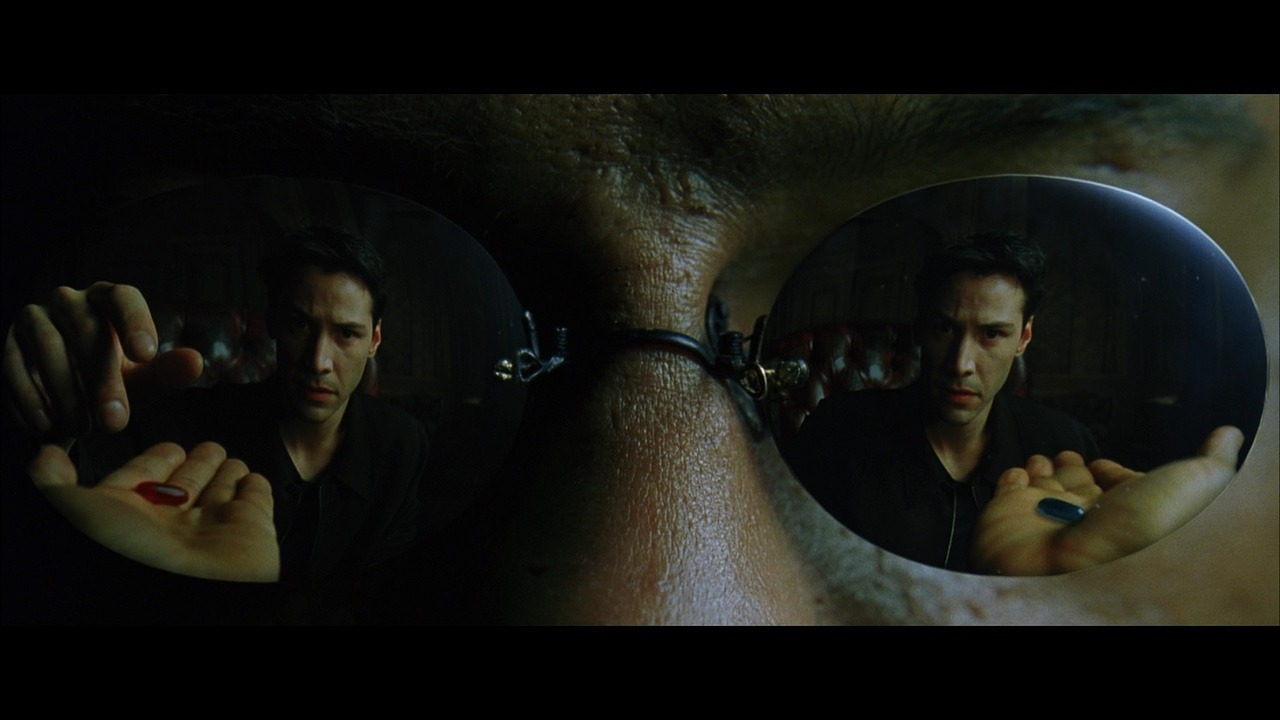
And choice is a major theme in this film. Morpheus gives Neo two pills to choose from, a blue pill that will allow him to go back to his ordinary life or a red pill that will show him "how far the rabbit hole goes" as Morpheus puts it, alluding to Alice in Wonderland. My reading on the blue pill/red pill choice is this: you're given a choice but not all the information regarding what that choice means. Morpheus tells Neo "No one can be told what the Matrix is, you have to see it for yourself."  Once you realize the truth it's too late to go back. I would argue you didn't choose to be freed. However, being freed is arguably inseparable from learning the truth; you wouldn't necessarily believe you were part of a computer program without concrete evidence. 

Cypher (Joe Pantiolano), who is part of Morpheus' crew aboard the ship the Nebuchadnezzar, would agree with me. He tells Neo he wished he'd had taken the blue pill instead. Cypher believes he and the rest of the crew were lied to by Morpheus, which is why he betrays  Morpheus to the agents in exchange to be put back in to the Matrix and his memory wiped. Cypher doesn't believe he's free since the real world is a nightmarish hellhole. He also hates taking orders from Morpheus.  He says "ignorance is bliss" when eating a steak within the Matrix and it's easy to understand where he's coming from. And what does it mean to be free? What can the humans do with their other than fight an endless war? Is it even worth being free? I would argue yes. It's worth being free so you can find a purpose outside of a fake reality. To live and die for something is important. 

Cypher wants to be put back in the Matrix but the aforementioned Agent Smith- who like the other agents is a computer program designed to prevent people being freed from the Matrix- wants to be free of it. He is aware not just of being in a computer program but being a program himself. He is as much a slave as the humans are. He despises humanity but this fact shows he is capable of human emotions. Neo and Smith both seek an escape from their existence and both need Morpheus for that. Morpheus has the codes to the last human city Zion's mainframe. Smith wants them so the war can end and he can be set free. 

Smith is seemingly destroyed by Neo at the film's end but he returns in the two sequels, The Matrix Reloaded and The Matrix Revolutions. Smith hating humans showed he was capable of human emotion. In the sequels, as Captain Logan of the Youtube channel Geekvolution points out,  he becomes what he accused of humans being- parasites. Smith assimilates others, creating multiple versions of himself. In Revolutions specifically he takes over everyone in the Matrix, taking what was his prison and making it his domain. Smith is also able to exit the Matrix by assimilating one of the freed humans named Bane while still in the Matrix. But Smith is still trapped-  trapped in a human body that he refers to not being designed to survive due to its fragility. 

I find Smith to be the most interesting character in the trilogy due to how he becomes increasingly human and independent of his programming, paralleling how Neo becomes independent of what his purpose is as the One. But more on that later.

Admittedly I struggled re-watching the sequels. Maybe I wasn't in the right mind-set or just didn't focus enough on them, and maybe going in with a negative attitude, but I found them hard to engage with. Reloaded doubles down on the elements of which the original had the right amount.  For example, the action is too bloated this time around. It's impressive but it's not as lean and essential to the story like in the original. And while the original had plenty of philosophical "mumbo jumbo," it helped propel the story and Neo's character arc forward. In Reloaded there are two many scenes of characters talking about philosophy but don't move the story forward. It's also not clear  what the main thematic arc is supposed to be. And it takes almost an hour for Neo to be given a goal, which is to find the Keymaker who can get him to the Source.

At the film's climax Neo learns from the Architect- the program who created the Matrix- that his purpose is not to destroy the Matrix but begin a new cycle that has occurred 5 times previously; moreover there have been 5 previous Ones like Neo, all anomalies that can't be prevented. Zion will be destroyed by the machines and Neo is to choose humans from the Matrix to repopulate Zion.  He will prophesize his own return and use the code in his body to reload the Matrix.

While the ideas in this scene are intriguing and the Wachowskis were bold in blowing up their own mythology, the Architect's dialogue- while appropriately dense and machine-like- lacks dynamism and Neo should have had a more emotional reaction to learning that he is still not free of the machines' control. In the first film he learned his reality wasn't real. Now he learns he has been deceived again. This should shatter Neo but I don't believe that's felt enough in the film's denouement. 

If there is a thematic arc to Reloaded- and subsequently to Revolutions- I would argue it's one regarding choice and free will. Instead of doing what his predecessors did,  Neo decides save Trinity from being killed by an agent. This breaks the cycle and leaves the future in flux. Revolutions follows that up with a new status quo established at the film's end. The big problem is the Architect told Neo there'd be a complete system shutdown if he saved Trinity and that everyone in the Matrix would die. Instead nothing really happens as a result of Neo's actions. The third film never answers why there wasn't a system failure and it's never brought up in dialogue as far as I remember.

In the third film the philosophy takes somewhat of backseat to the war against the machines. This brings me to the main reason why I like the original film compared to the sequels, which is it had a smaller-scale. The film focuses on Neo's character arc and the climax is about Neo vs. Smith, not humans in mech-suits against thousands of machines. Character is so unimportant in Revolutions that Trinity dies by accident half an hour before the film's end. Morpheus is also wasted and the sequels overall introduce too many characters.

Neo makes a deal with the machines to defeat Smith- who's assimilated everyone in the Matrix- in exchange for peace with the humans. Neo sacrifices himself fighting Smith and a truce is established between humans and machines. In the final scene between the Oracle and the Architect he tells her humans who wish to be free will be. 

I'll admit I don't have much to say about Revolutions. Of the three it's the least interesting and both sequels feel really drawn out. Neo doesn't really have a character arc in the sequels. Instead he's mostly being driven by the plot. I think the sequels should have gone in a different direction with the story and Neo's character. The original ended with the implication Neo could control the Matrix so I think the status quo should've been considerably different at the beginning of Reloaded. Maybe Neo shouldn't have even been the main character. He's essentially become a God in this virtual world so I would argue it makes more sense to see him from a new character's perspective.

Ideally The Matrix should've remained a standalone film but with the latest installment, The Matrix Resurrections, just released, The Matrix has certainly expanded beyond its initial self-contained story. So, what are your thoughts about the Matrix Trilogy and have you seen The Matrix Resurrections yet? Comment and let me know.