Monday, 12 September 2022

The Essential Films: "Jaws" (1975)


A Series of Writings on Films that I feel are essential for film lovers, coupled with films that are personal to me. Spoilers for people who haven't seen the film.

Jaws is a masterclass in filmmaking. It ranks amongst films like Die Hard, The Exorcist, and the original Star Wars, as one of those films which started out as popular entertainment but can be seen as a masterpiece of its genre. This was only Spielberg's third film; he had done the TV movie Duel and then his first theatrically released feature, The Sugarland Express-starring Goldie Hawn. Duel and The Sugarland Express are impressive films bur Jaws was a huge step forward for Spielberg in terms of his filmmaking abilities. While the film was a difficult- to say the least- shoot, Spielberg's filmmaking is so assured that when I'm watching it I'm hardly thinking of the behind the scene issues. Of course, credit has to go to Bill Butler's gorgeous and warm cinematography (he still with us at 101 years old) as well as Verna Fields' Oscar winning editing, which contributes mightily to the film's fluid pacing.  Spielberg took that assuredness in to his next film Close Encounters of the Third Kind and later Raiders of the Lost Ark, becoming the king of blockbuster movie making. Much like Jaws itself, Spielberg has grown in my estimation as a filmmaker over the last several films. I always liked/loved his films but I guess I took him for granted, didn't realize just how good he is. Now I rank him in my top ten filmmakers.

All you need to do is watch the first scene of Jaws, where Chrissie Watkins (Susan Backlinie) is screaming for life before disappearing under water and everything going silent, to know the film still kills. There's a reason this movie still makes people afraid to go in the water. John Williams' theme- which opens the movie, was originally thought by Spielberg to be a joke, and I get why. It's hard not to find it a little amusing, but like Bernard Herrmann's screeching violins from Psycho are synonymous with "psycho killer," Williams "Duh Duh" is inseparable from "a shark is coming to get you."

After the first shark attack we're introduced to the first of the film's main trio, Chief Martin Brody (Roy Scheider) who has moved to Amity Island recently with his family.  I think he's an underrated actor, good at being the lead or supporting player. He was never the intense Pacino/DeNiro kind of actor but he had a physical presence and the ability to be a regular guy, which works well for Brody, who isn't a tough action hero type. 

Brody begins the investigation in to Chrissy's death and has the beaches shut down. However, the Mayor of the town, Larry Vaughn (Murray Hamilton), convinces him to keep them open due to the summer season being the biggest money-earner of the year for the community. Brody reluctantly agrees but then a boy, Alex Kitner (Jeffrey Voorhees), gets eaten and Brody brings in Oceanographer Matt Hooper (Richard Dreyfuss) to investigate. Meanwhile Alex's mother (Lee Fierro) puts out ads promising a reward for killing the shark, bringing in a lot of amateur shark hunters. The only professional on the island, Quint (Robert Shaw), promises to kill the shark for a much larger reward. While at first the shark is thought to be caught, another shark attack brings Brody, Hooper and Quint together to hunt the shark.

Jaws is actually two films in one. The first film is a damning critique of capitalism and political leadership, the second is an almost Moby Dick-esque adventure at sea, with Quint being a kind of Captain Ahab. I know some may find the film too slow and talky getting to the shark-hunting stuff but I believe it's crucial to this movie's success that we spend the time we do on the island and with the community before going off to sea. The transition from island to sea feels more significant and weighty because of what's happened- Alex's death, Brody's guilt, his dynamic with Hooper and the injection of Quint in to that dynamic. Then there's the three shark attacks. The first one is ignored, the second is addressed and supposedly resolved, then the third is the breaking point where we see some humanity from the Vaughn, who mentions his kids were on that beach. We don't like Vaughn anymore than we did before, but Hamilton plays his revelation beautifully. The way Carl Gottlieb and Peter Benchley (who wrote the novel) structure the three shark attacks and Vaughn's arc is the kind of good screenwriting that seems too rare these days.

I do love the subtle bromance between Brody and Hooper.  Instead of the screenplay creating a forced antagonism between them Brody and Hooper are friendly with each other from the outset. However, Hooper gets angry with Brody when he's examining Chrissy and  finds out this was never reported to the coast guard. Brody is a little naive and thinks the captured and killed shark is the shark who who Chrissy and Alex. Hooper calls him out on his naivete but when he comes to Brody's house that night, he shows that he respects Brody's rationality compared to everyone else. He also knows Brody had a rough day after Mrs. Kitner slapped because she found out he didn't close the beaches earlier. Hooper tells Brody he's out to tell his superiors that there's still a shark problem, leading him and Brody to cut open the dead shark to see what it's ate. The dinner scene is the real beginning of Brody and Hooper's partnership. When they're both trying to convince Vaughn to close the beach and talking over each other, Brody is  telling Hooper to tell the mayor about shark stuff, and it's organically funny, indicative of Brody's earnestness as a man. He obviously respects and is excited by Hooper's knowledge and authority.   

The more I've watched Jaws the more apparent it's become how the characters really make the movie. Not just our main trio but all the islanders as well- Vaughn, Bad Hat Harry, Mrs Taft. Similar to Raiders of the Lost Ark or the original Star Wars trilogy, you remember these supporting and minor characters, and they make the world feel lived in. I'd argue the best scene in the film doesn't feature the shark- it's is the scene where Hooper and Quint are bonding over scars, which leads in to one of the great film monologues - Quint talking about the sinking of the USS Annapolis and the death of most the crew from sharks. Shaw's delivery of the monologue and the vivid imagery it creates in the audiences' minds is perhaps more horrifying than anything we see on screen. It tells us so much about Quint and makes his death even more cruelly ironic- it's one of the most painful deaths I've ever seen in a film. Shaw should've gotten an Oscar nomination just for this monologue. 

I also love how each of the three men relate to the other two. Hooper is the nerdy scientist compared to the more masculine cop and hunter. Brody is the one most uncomfortable at sea next to Hooper and Quint, and Quint is the loner figure, the outsider. It creates an uneasy dynamic between the three and the point of the bonding/monologue is that this is first and last time all three will be at peace with each other. It's right before the final stretch of the film, which doesn't let up until that shark is blown up. 

I saw Jaws on IMAX just a few days ago and seeing it with a audience highlights just what a funny film this is, largely due to Dreyfuss, whose laugh alone is hilarious. I think this where Dreyfuss first established his persona as the intellectual smart-aleck. Some of his best lines- "They're all going to die"- after he's been mocked by the fishermen going out to hunt the shark-, referring to the mayor as wanting to be a "hot lunch," and "That makes a lot of sense" when water-fearing Brody says Amityville is only an island if you look at it from the water.   

But it's not that big of a surprise that the film has plenty of humour. It wouldn't have become what many consider the first summer blockbuster if it was without the levity to contrast with the horror. It's an incredibly entertaining film but the fun never undermines the horror of the film, never makes those moments of terror less impactful. While Spielberg went too far with the darkness with Indiana and the Temple of Doom, Jaws perhaps best shows Spielberg managing both the light and dark. Spielberg has often gotten flak for being too sentimental but I feel he's much darker than the image people have. He's capable of  being incredibly nasty and remorseless when he wants to. I don't think anyone forgets seeing those Nazis' faces being burnt off for the first time. 

Spielberg is also able to do some technically impressive stuff without you really thinking about it. The Aforementioned scene with Brody and Hooper attempting to the convince Vaughn to close the beaches is one shot, with Spielberg moving the actors and reframing the shot effortlessly. The first scene between Brody and Vaughn is similarly one shot that has the actors move in a way that changes the focus of the show.. But you're not thinking of these scenes too much on a technical level, you're just watching the story. Spielberg is able to use his technique to draw you in to a scene without noticing the technique -very hard to do. But then he can also emphasize his shots, as with the "vertigo" shot on Brody on the beach. He employs  it better than Hitchcock and there's no doubt Spielberg is a student of Hitchcock. Hitchcock always believed in the concept of "pure cinema," where the visuals did most of the storytelling, and Spielberg takes that approach here, making sure you can understand what's happening, even if the sound was off. 

In a piece on Spielberg's War Horse (2011), critic Michael Phillips recounts Hitchcock's quote on Spielberg: "Young Spielberg is the first one us who doesn't see the proscenium arch." Phillips explains that Hitchcock is describing Spielberg's filmmaking as "fluidity cinematic," adding he has "Old style craftsmanship with a new spontaneity." Hitchcock's last decade of films can seem behind the times, with the possible exception of Frenzy (1972), especially compared with what Spielberg is doing here. . As much as Spielberg, along with George Lucas, are blamed for destroying what many see as the adult driven nature of 70s films, Jaws did raise the bar for filmmakers, and even Spielberg himself had to attempt to top himself. While he arguably did with Close Encounters and even his latest, West Side Story, blows away all modern movie musicals, Jaws may remain as close to perfect as anything Spielberg's done.  Jaws is the first true Spielberg film, where his specific sensibilities feel pretty much fully formed, contradictory as they may seem. He takes the lessons of Hitchcock and perhaps surpasses his master, changing pop culture forever.                                                                                                                                                                                           

Wednesday, 10 August 2022

The Essential Films: "Signs" (2002)


A Series of Writings on Films that I feel are essential for film lovers, coupled with films that are personal to me. Spoilers for those you haven't seen the film

20 years ago the cover of Newsweek proclaimed writer/director M. Night Shyamalan "The Next Spielberg," ahead of his latest film, the alien invasion drama Signs. While many laugh at this proclamation now, considering the rough road Shyamalan's career went down, if you rewind your mind back to 2002 it's not a surprise he gained this moniker. Like Spielberg, Shyamalan was a filmmaker with an seemingly innate understanding of filmmaking language whose made genre films  about ordinary people in extraordinary circumstances, imbued with the kind of sentiment often seen in Spielberg's work. Re-watching Signs, I found it's Shyamalan's most Spielbergian film, the closest to a modern day Close Encounters of the Third Kind in that both are intimate family dramas in disguise as alien arrival stories. While I'd argue Unbreakable is his best film, Signs is the one closest to my heart. This may sound funny but Signs was an important film for me on my journey as a cinephile. I think this was the first film I analyzed on a filmmaking level, where I started to think about shot composition and framing. I know you're laughing but hey, I was 13. 

Signs centers around the Hess family: Graham (Mel Gibson), a former priest who left the church after his wife was killed after being hit by a car, Merrill (Joaquin Phoenix), a failed Minor League baseball player, and Graham's two children, Bo (Abigail Breslin) and Morgan (Rory Culkin). They all live on a farm in Bucks County, Pennsylvania and one morning they wake up to discover a crop circle in their corn field. Things get stranger when an intruder is seen on the property and lights appear in the sky over Mexico. While there are several other characters present in the film, including police officer Caroline Paski (Cherry Jones) and Ray Reddy (Shyamalan), the man who killed Graham's wife Colleen (Patricia Calmeber), the story is told through the eyes of the Hesses. Shyamalan eventually leaves behind the other characters, isolating the Hesses. This is similar to Alfred Hitchcock's The Birds, where Hitchcock also isolates Melanie Daniels and The Brenner family by the film's end. Also, when the Hesses board up their house is a direct reference to The Birds' climax.

As I mentioned earlier, Shyamalan as innate filmmaking sense. There's a preciseness to his compositions and camera movement. There's a Kubrickian feel to this shot:


And the way the camera pans to the knife, foregrounding it, is funny and tense in exactly the right way.


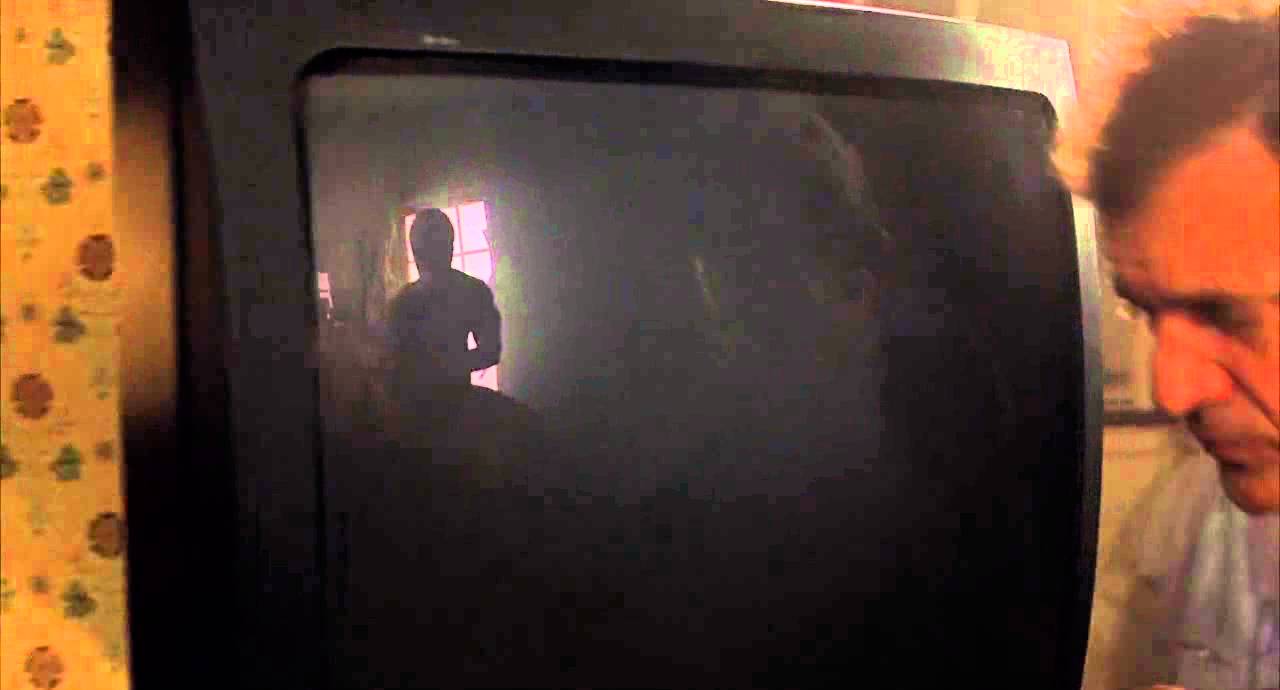
I also love the reveal of the alien still being in the house at the end through the TV screen


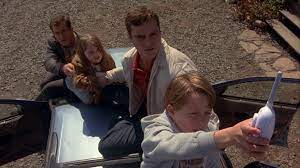
Coming back to Spielberg, the scene where the Hesses are using a walkie-talkie to hear the aliens talking is perhaps the most Spielbergian in the film:


The Sixth Sense and Unbreakable were films about coming to accept the incredible, whether it be the ability of a young boy being able to see ghosts, or that you're a superhero. Malcolm Crowe (Bruce Willis), at first doubts that Cole Seer (Haley Joel Osment) can see ghosts, realizes he's telling the truth after discovering his former patient had the same ability. David Dunn (Willis again), comes to accept he has superhuman powers. In Signs, Graham eventually can't deny there are aliens ready to invade. These films are about faith and belief, as well as accepting your purpose- Cole as the helper of the deceased, David as a superhero vigilante. Shyamalan takes these themes further in Signs by having Graham not just realize these aliens are real but there's a greater design to the universe, something he may have once believed in but turned his back on after his wife was killed. In perhaps Signs' best scene, Graham tells Merrill that there are two groups of people: people who see those lights in the sky and think they're seeing a miracle; the other believe that whether good or bad, there's no higher power looking out for them. 

I think Gibson gives what may be the best performance of his career in this film. Like with Willis, Shyamalan casts Gibson against type as a non-confrontational former priest who can't swear convincingly. When Graham and Merrill are attempting to scare off the intruder Graham awkwardly says "I'm losing my mind." It's hard not to imagine Gibson having fun playing a guy *pretending* to lose his mind rather than genuine loose cannons like Martin Riggs and Mad Max. This role also allows Gibson to be the most emotionally vulnerable he's been since the first two Lethal Weapon movies. There's a scene where Graham encounters Ray, whose trapped an alien in his house and leaving for a safer place, in which her tells Graham he's sorry for the pain he caused him. Gibson's reaction to that-the pain, the anger, but the acceptance of Ray's apology, displays how stronh he can be as actor. Overall it's a great movie star performance and perhaps the last time Gibson was without baggage as an actor/star.

Instead of casting another huge movie star as Merrill Shyamalan went for a more offbeat choice with Phoenix. Phoenix was coming off his first Oscar nomination for Gladiator and Walk the Line was a few years down the road. This was the film that turned me in to a Phoenix fan. He's so funny here. His reaction to the alien walking across the TV screen and the image of him sitting with the children, all of them wearing tinfoil hats, is likely the funniest thing Shyamalan has put on screen. Merrill is sort of a loser but he's got a good heart and is pretty endearing. I love that when Graham asks Merrill if he believes in miracles Merrill tells of the time he avoided being vomited on a girl he wanted to kiss because he had to take a piece of gum out. This is the same scene where Graham outlines the two groups of people and Shyamalan really gives us a good sense of how these two guys approach life. Gibson and Phoenix don't look a thing like brothers but I really enjoy their chemistry.

Coming back to the themes of faith and belief, Shyamalan's twist ending her- along with the Village- is his most audacious conceptually and thematically. I remember when I first the saw Signs I was expecting a twist along the lines of The Sixth Sense or Unbreakable, more of an "Oh my God!" than a slow realization of what has been set up over the course of the film. Shyamalan is going less for shock than for quiet realization. Bo's leaving glasses of water around for various reasons (supposed contamination, tastes funny), Morgan's asthma, Merrill's bat hanging in the living room, and Colleen's final words to Graham about telling Merrill to swing away, are all part of a grand design, calling back to Graham's question, "What if there are no coincidences?" Morgan's asthma protects him from the aliens' poisons and the glasses of water kill the aliens. Graham's faith is restored and the final shot shows him months later getting ready to go to church. He's found his purpose again. I find the ending I find little too pat. If Shyamalan had made things more ambiguous regarding whether certain things were coincidental or not it would've provided some great discussion. Instead, there's not much room for questioning these things. If we're going to continue the Spielberg comparisons, it's the kind of  easy ending for which, Spielberg often gets criticized. 

Ultimately, I don't think Signs is a particularly deep movie but I still think the movie overall works on an emotional and technical level. After using Eduardo Serra on Unbreakable as his cinematographer, Shyamalan brought back his The Sixth Sense cinematographer Tak Fujimoto (who photographed no less than Terrence Malick's debut feature Badlands as well as The Silence of the Lambs) for Signs. Fujimoto bring an eerily cozy feel to the film, the same way he did with The Sixth Sense. There's a paradoxical cold and warmth to these early Shyamalan films. James Newton Howard's elegant and elegiac scores also bring a beautiful autumnal melancholy this film and Shyamalan's other work. There's a little bit of Danny Elfman too in Howard's main theme for Signs. If not for Shyamalan's name you'd be forgiven if you thought maybe you were about to watch a Tim Burton alien invasion film. 

Like H.G.Wells' War of the Worlds and its cinematic interpretations, the aliens are defeated pretty easily at the end of story, which I'm okay with because the story isn't really about a war against aliens. It's a home invasion thriller which just happens to be set against a backdrop of a world invasion. The Birds, which I referenced earlier is also a smaller, almost apocalyptic story that's focused on this small town and its inhabitants. Shyamalan goes even smaller than Hitchcock, creating an almost chamber drama feel to the certain parts of the film. I almost wish there no other characters in the film other than the Hesses. 

The next Spielberg moniker obviously didn't stick, with The Village getting mostly negative reviews and Shyamalan getting worse and worse reviews over the next several films, though he's made a comeback or the last several years. However,  I don't think Shyamalan has ever recaptured what made people deem him the heir to Spielberg. The specific atmosphere of his early work has never completely returned for me unfortunately. Still, Shyamalan has always stayed true to his own particular sensibilities, similar to George Lucas, who's also gone through a reappraisal regarding his specific quirks. Maybe because we're at a place where pop culture lacks vision and spark it's easier to appreciate people like Shyamalan more now. Signs, along with The Sixth Sense, Unbreakable and yes, The Village, represent a filmmaker unafraid of being laughed at for his earnestness, whose pretentiousness oddly feels like genuine sincerity. 

It's weird to think of Signs as a 20 year old film but it makes sense- it does feel like a film from another era, a star and director driven blockbuster, the kind that would feel like a throwback if released now. I never know how to end these things so I'll say that despite it losing some of its luster for me over the years, I still think Signs is a beautiful, if somewhat reductive, film, which represents a filmmaker who at the time seemed unstoppable as a pop culture force, even if calling him the next Spielberg ended up being a curse. So, what are your thoughts on Signs and M. Night Shyamalan's career. Comment and let me know. 

Wednesday, 25 May 2022

Begun, the Clone Wars have: "Star Wars Episode II: Attack of the Clones" at 20


Spoilers Below

For a while I've wanted to talk more about Star Wars on this blog, since along with James Bond and Planet of the Apes, it's probably the most important film franchise for me. With the second installment of the Prequel Trilogy, Attack of the Clones, turning 20, I've decided this was a good opportunity to discuss more of my feelings on the series. Attack of the Clones is perhaps the most maligned of George Lucas' maligned trilogy, though the trilogy now has the same nostalgic reverence of the Original Trilogy. If the older generation hated these films then the younger generation, people my age or younger, really took to them. I still consider myself an OT fan but I was at the right age to like these films when they came out. However, over time  my feelings have grown increasingly complicated. I like things about the PT and dislike others. And you know what, often they're the same things. The PT have great ideas and are conceptually brilliant but the execution of the story is were many of the problems lie. It feels like the scripts are all a couple of rewrites from being really solid, especially the first 2. However, I don't want to focus too much on the PT overall. Instead, let's talk about  Attack of the Clones.

As Scott Mendelson points out in his retrospective piece, by the time Attack of the Clones was released, there were challengers to Lucas' blockbuster throne such as the first The Lord of the Rings and Harry Potter films. The first Spider-Man came out several weeks before Attack of the Clones and became the highest grossing film of the year, the first time a Star Wars film wasn't the number one grosser. Attack of the Clones also didn't have the novelty of being the first Star Wars movie in 16 years like The Phantom Menace had. That, and since Phantom Menace burned people so badly there was trepidation about this film. Moreover, during the whole prequel era these aforementioned were better received by critics and audiences. 

For those who need a refresher on the plot, it goes like this: Former Queen of Naboo, now senator, Padme Amidala (Natalie Portman) survives two assassination attempts and is taken back to Naboo to hide by Jedi Padawan Anakin Skywalker (Hayden Christensen), who has grown infatuated with Padme over the last ten years and is struggling with being so close to her again. Meanwhile his master Obi-Wan Kenobi (Ewan McGregor) tracks the dart that killed the would-be assassin to the cloning facility on Kamino, where they've been creating a army using the bounty hunter Jango Fett (Temuera Morrison) as a DNA donor. Jango even had the Kaminoans make him a son, Boba, who we know will be the future bane of Han Solo's existence.

If Phantom Menace was an ensemble piece then then Attack of the Clones is the closest the Star Wars series has gotten to a character study. It asks the question we came to prequels to find out: who is Anakin Skywalker, the future Darth Vader. The answer wasn't what fans expected. Making Anakin a nine year old boy in Phantom Menace was Lucas' first subversion of fan expectations. Then in Attack of Clones, instead of a noble, good-head on his shoulders young man with some personal flaws, this Anakin was all flaws. He's petulant, whiney (though I guess that's where Luke gets it from), disobedient, overly infatuated with Padme, and in one scene, murders a bunch of people. Lucas doesn't portray Anakin as a mythic, larger than life hero, the badass warrior who becomes a badass villain. Instead, Lucas saw Anakin as a "pathetic individual." 

I'm conflicted about Anakin's portrayal in this film. It's certainly a unique characterization and psychologically complicated. Anakin definitely had psychological issues which demanded serious therapy. The characterization does a make certain kind of sense. Unlike the other Jedi who were taken from their parents before they grew attached to them, Anakin left his mother when he already formed a bond with her. He grew a crush on Padme and then spent the next 10 years being taught to suppress his emotions. He was never in a relationship with a woman so I can see how his crush grew until it became an obsessive infatuation. Anakin has no idea how to talk to women so his creepy/stalkerish behaviour towards Padme is fitting. 

The problem lies in the execution. Lucas could've gotten away with Anakin being immature and angry if we saw  him mature throughout the film and become the noble warrior and friend Obi-Wan looks back on fondly in the original film. That, and if his infatuation towards Padme was examined and called attention to as being unhealthy. Either that or you establish Anakin as a heroic warrior, albeit a little arrogant. Then you show him crumbling upon meeting Padme again. Despite his confidence in every other area, when it comes to romantic feelings he's very awkward but in a charming and un-stalkerish way. Padme would deal with her romantic feeling in a more diplomatic (since she's a politician). Lucas also could've fleshed out the idea that neither of them had a normal upbringing, having sworn themselves to their duties.

The romance would've made more sense if Anakin was a little older in Phantom Menace. We could've seen more of Anakin and Padme's friendship grow, allowing Padme to have similar romantic feelings towards him. Since he was a little boy in the she could've never had those feelings; and she definitely wouldn't have feelings for Anakin now, not the guy who extolls the virtues of fascism. That's a weirdly handled scene. It's supposed to be cute and is set against the backdrop of hills from The Sound of Music but when he says "If it works" as a response to Padme saying his preferred style of government sounds like a dictatorship it's very dark foreshadowing for what is laughed off and forgotten.

Then there's Anakin's murder of the sand people for the death of his mother, Shmi (Pernilla August). Anakin going off to save Shmi is one of the strongest parts of the film, with Anakin on a speeder bike set against Tatooine's twin sunsets being a visually potent image. It's a shame Lucas is a such a flat visual stylist when he's shooting dialogue scenes. Shmi's death is honestly effective, showing us hints of an emotionally stronger and better film. Anakin's Kubrickian stare before he murders the sand people also showcases Christensen's acting ability which are often lost under Lucas' dialogue. But what I want to get at is Padme's reaction to Anakin telling her about killing "Not just the men, but the women and the children too." She's way too relaxed and even more so than him championing fascism, it makes usus question how Padme could fall in love with Anakin. 

I also feel like Anakin pretty much becomes Darth Vader when he kills the sand people. When you give in to hate and anger is when you turn to the dark side. In Return of the Jedi Luke's pivotal moment is when he almost kills Vader but then grants him mercy. I understand Shmi's death is crucial to Anakin's choices in Revenge of The Sith. His dreams of her dying which came true and he's scared of his dreams of Padme's coming to fruition as well. However, the murdering of the sand people just feels like too much too soon.

Coming back to the romance (there's a lot to talk about regarding the romance), David Lean's Doctor Zhivago was an influence on the film. Lucas even wanted the poster for Attack of the Clones to mimic the poster for Lean's epic romance about the Russian Revolution and Russia's role in WWI, the backdrop for a romance between a Doctor Yuri Zhivago and Nurse Lara Antipova. While Lean was a director who was able to make the scenes between his characters as powerful and memorable as his grand compositions (he also directed one of the great romances with the smaller scale Brief Encounter), Lucas' scenes between characters are often his weakest, due to the dialogue, blocking and compositions lacky dynamism. I know the dialogue in the Star Wars was always intended to be hokey and melodramatic but since this is more complex story, I think the dialogue and the performances should've been on a higher level than in the OT.

The PT is at its most powerful when Lucas allows the images and music to tell the story The image of Anakin and Padme in silhouette being led out to an arena to be executed, with John Williams' love theme playing, says more than Lucas' words could ever do. I wish Lucas did rely less on dialogue to sell us on this romance. Anakin's and Padme's actions should have spoke for them as we saw them grow closer because of the threat on her life. They never feel in danger though, not until they're led out to die with Obi-Wan on Geonosis.

Speaking of Obi-Wan, we unfortunately don't get to see enough of his friendship with Anakin in this movie. I always feel Phantom Menace could've focused on Anakin and Obi-Wan becoming friends, ending with them becoming master and apprentice. Attack of the Clones would then show us how that affects their relationship. There are moments of warmth between Anakin and Obi-Wan but it'd been nice to see more of that great friendship. It's important to remember that Obi-Wan was never supposed to train Anakin. Obi-Wan's master Qui Gon Jinn (Liam Neeson) was going to train Anakin against the council's wishes. When he was mortally wounded by Darth Maul his dying wish was for Anakin to be trained, to which Obi-Wan agreed. Both Obi-Wan and Anakin lost a father figure, and father/son relationships are obviously an important theme in Star Wars. So, both Anakin and Obi-Wan are both living in Qui-Gon's shadow and attempting to live up to his high hopes for both of them. I think it was a missed opportunity not to mention Qui-Gon at all in this film. It would've been a good bonding moment if these men reminisced about their surrogate father. 

Obi-Wan gets more to do in this film since he got the shaft in Phantom Menace, with arguably Qui-Gon taking on some of what his role originally supposed to be. His sub-plot in this film ties more in to the larger story of the film, the beginning of the Clone Wars. The Clone Wars were name dropped in the original film but we never knew exactly what they were about. Essentially they were a piece of world-building that made the Star Wars universe more alive, that it was a piece of history everyone knew about. It's established  Attack of the Clones and paid off in Revenge of the Sith that the Clone Wars were the beginning of the end for the Jedi. There was something insidious (Darth Sidious) about the creation of the clones but the Jedi were too-shortsighted to truly to see it. It's an idea that I wish was better presented. The way Lucas portrays it makes us question the Jedi's intelligence. It shouldn't have been so obvious how shady the cloning operation was. However, I love the Imperial March playing over the Clones getting ready for battle at the end. It's another example of how great a filmmaker Lucas can be when he's not relying on dialogue to tell the story, just images and music.


I think Lucas is often a better conceptual director than he is a narrative one. He always been an experimental filmmaker at heart, from his early film school films, including THX 1138, which became the basis for his first feature film of the same name. However, he's not always great at crafting character or story arcs, The plot is driving things rather than the characters' choices.  Anakin doesn't really have a character arc here. He doesn't mature and he's already so infatuated with Padme from the beginning there's not much room for him to go anywhere regarding his feelings, at least not how Lucas goes about it.. Stuff happens in Attack of the Clones but it doesn't feel like there's a real arc to the story. Lucas creates a sound structure but doesn't always know what to do in that structure.   

Attack of the Clones does at least give us a clearer picture of how things will connect to the OT, with the beginning of the Clone Wars and Anakin's romance with Padme. The film in several ways is the key to understanding Anakin's story, the middle chapter and heart of the PT in the same The Empire Strikes Back is the heart of the OT. Though I'd argue Attack of the Clones- as I did earlier- suffers from having to re-introduce Anakin. It would've made the flow of the story from Phantom Menace to Attack of the Clones tighter and stronger if we had the same actor continuing their performance from the first film. So, in cloning, I mean closing, Attack of the Clones is the awkward first step towards Anakin's downfall in Revenge of the Sith. We see the beginning of man's obsession with preventing those he loves from dying, which will lead to death of whom he loves and his own spiritual death. 

So, is Attack of the Clones an underrated masterpiece or does it rank low on your list of Star Wars films? Comment and let me know.

Tuesday, 3 May 2022

The Essential Films: "Sunset Boulevard" (1950)


A series of writings on films that I feel are essential for film lovers, coupled with films that are personal to me. Spoilers for those who haven't seen the film.

What happens to those whom Hollywood leaves behind? What happens when their star has faded and, for women, when they get older? Director Billy Wilder, who was born in Austria in 1906 but came to L.A. in 1933, always wondered what happened to the silent film stars who still lived in the mansions from the 1920s. This gave birth to the idea which became Sunset Boulevard, one of his greatest films, which delves in to the life of a silent movie star who still desires to be famous  

Wilder always railed against easy genre categorization in his films. The Apartment (1960) is a romantic comedy that's also a drama about adultery and selling your soul for a promotion. Double Indemnity (1944) is a film-noir about helping a woman murder her husband that's also an incredibly funny and occasionally warm story about male friendship; and Some Like It Hot (1959) is a 1920s set comedy about two men in drag being pursued by gangsters because they witnessed the St. Valentine's Day Massacre. Sunset Boulevard is his most daring tightrope act when it comes to genre and tone. It's a film noir, a dark comedy, a Hollywood satire, a gothic melodrama, and a tragedy. Film critic Richard Corliss called it "the definitive Hollywood horror film" and director John Landis also called it a murder mystery. .

Sunset Boulevard was Wilder's and writing partner Charles Brackett's 17th and final collaboration. Wilder ended the partnership due to a fight over a montage in the film though they ended up winning writing Oscars for the film. Wilder and Brackett began writing a script in 1948 but it didn't please either of them. To help with the script they hired D.M Marshman, Jr., a film critic for Life Magazine whose review for Wilder's The Emperor Waltz- co-written with Brackett- impressed them. Marshman came up with the idea of the main character being a gigolo to a silent film star. Wilder was afraid of the censors because it was an expose on Hollywood and dealt with the subject matter of an relationship between an younger man and an older woman. The script was actually submitted a few pages at the time. When they began shooting only one third of the script was completed.

The film aptly starts with a screenwriter having his own writing problems. Joe Gillis (William Holden) needs work and money. He's also got repo men on his tail for his car. While on the run from these men he hides his car in the garage of a mansion belonging to aging silent movie star Norma Desmond (Gloria Swanson). Joe goes in to the house and is mistaken for an undertaker (her monkey has died). When she discovers he's a screenwriter she asks his opinion on her script which will serve as her comeback vehicle (though she prefers to call it a return). While Joe's voice-over narration (more on that later) tells us the script isn't very good he needs the money so he gets Norma to hire him to work on the script. Norma also insists he lives in the mansion with her. Later Joe realizes she had romantic feelings for him. Out of disgust he leaves but comes back when he learns she's attempted suicide. He also eventually becomes Norma's gigolo.

Sunset Boulevard is  about desperation. Joe needs money and Norma is desperate to hold on to the fantasy she can stage a comeback and be relevant again. And you know what? I understand Norma's desperation to be famous and to be loved. It can be a poison that rots you inside and makes you bitter at what you can't have. You are so desperate for it you feel you are going insane. In Norma's case, she has. And that poison has not only rotted her inside but outside as well. Despite only being 50 she appears 20 years older. While Norma can appear as a grotesque and sexist caricature of an aging actress- and in some ways she is since she was written by two men in the 40s- she's also a deeply tragic as well as funny character. That's largely due to Swanson's performance, who gives a hellish and hilarious performance, one of the seminal screen performances of all time. 

Before Swanson was considered Wilder reached out to several other silent film actresses, including Mary Pickford, who didn't like the theme of a older woman in a relationship with a younger man. And Clara Bow declined because she wanted to stay retired. It was director George Cukor who suggested Swanson. This was a comeback role for Swanson who had, after her career waned in the 40s, quit movies and worked on stage, TV, and radio. Swanson was intrigued when she was offered the part but didn't want to do a screentest for Sunset Boulevard  since she had been such a big star. Cukor joked that he would shoot her if she didn't. 

Montgomery Clift was cast as Joe but dropped out supposedly because the role reminded him of his part in The Heiress (1949), where he played a man having a relationship with an older woman. But the the suspected real reason was him actually being in a relationship with an older women, singer Libby Holman. Clift didn't want people thinking Holman was like Norma so he gave up the role. It worked out pretty well for Holden, who became an A-List star after this performance, which also earned him an Oscar nomination. He lost to Jose Ferrer for Cyrano de Bergeac (1950) but would win several years later for another Wilder film, Stalag 17 (1953). I'm glad Holden got the part. Clift was a strong actor but I think  he was a little too serious for the wise-cracking Joe. Holden's much better with sarcasm and playing a likable jerk.

Coming back to Swanson, what's integral to her performance, beyond being grotesque, funny and tragic all at once, is how she contrasts with Holden. Holden  is giving a mostly naturalistic performance but Swanson is more theatrical in her gestures and facial expressions. This creates plenty of humour- Joe's sarcasm against Norma's non-ironic claim of "I am big. It's the pictures that got small." It also creates the feeling that Norma is always giving a performance never being completely in reality, and this just solidifying how's she losing her mind. I'm reminded of Vivien Leigh's performance in A Streetcar Named Desire (1951), where her theatrical style of acting juxtaposes with Marlon Brando's method acting. Blanche, like Norma, is mentally unbalanced and this style of acting, pitted against naturalistic acting, makes that clearer to the audience. 

There's a clear separation between Norma's world and the "real" world, which is how the film manages its different tones. The gothic horror and film-noir elements don't intrude when Joe's outside the mansion. Things always feel normal. Film historian Tom Stempel wrote about how the lighting (courtesy of cinematographer John F. Seitz) blends the two worlds of the film together.

"In both Double Indemnity and Sunset Boulevard, Seitz does something that has always impressed me. Both are films noir, and he finesses the fact that both are set in the sunniest of locales, Los Angeles... he brings together the light and the dark in the same film without any seams showing... he brings together the realistic lighting of Joe Gillis out in the real world with the gothic look of Norma Desmond's mansion. Again with no seams showing."

The contrast between the darkness of Norma's world and the brightness of L.A is important. Her world is the dark underbelly of Hollywood. I'd argue Joe is the bridge between the two worlds. If he's not completely destroyed by Hollywood he's at least on his way. He could become like Max Von Mayerling (Erich von Sroheim, playing a version of himself), a former silent film director and Norma's former first husband, now butler. He couldn't bare it when Norma left him so he turned his back on directing and became her servant. He even writes fake fan letters to her, feeding her delusions. Stroheim gives a drolly comic performance as Max but there's something haunted in his eyes. This is a man who has fallen very far and has had to watch his ex-wife descend in to madness. Through him we see that Norma wasn't always like this and he acts as a reminder of what Joe could become if he doesn't cut Norma out of his life completely.

Norma's opposite is Betty Schaefer (Nancy Olson), a script reader who once wished to be an actress. It didn't work out but unlike Norma she isn't bitter about not being famous. She sees the merit of working behind the scenes and wishes to be a screenwriter. She's also the counterpoint to Joe due to her belief that a story should have a message. She also isn't as cynical-minded as Joe. She criticized one of his stories early in the film as trite and formulaic, believing he's too good of a writer to waste his talents on overdone stories. However, she sees potential in another of Joe's story and wants to work on it together.  

Joe and Betty fall in love though she has a fiancee, Artie Green (Jack Webb). When Joe's leaving Norma he pushes Betty away emotionally so Norma won't hurt her and because Joe knows she deserves better, which is Artie. Joe is then shot by Norma and falls in to her pool. We were shown this corpse at the beginning.  I'm not sure how much of a twist it is that Joe's been narrating this whole time from the dead. but the image of Joe's corpse in the pool is a brilliant and spooky shot, created by having a mirror at the pool's bottom.


The original opening had Joe in a morgue recounting his death to other corpses. The preview audience laughed at it and it was removed for the finished film, which I think was a good choice. I think the narration from a dead man is morbid enough without going too far. I think it's a great bit of sardonic humour, though film critic Thomas M. Pryor of the New York Times didn't care for. I think it works as subversion of the bodyless voice narrating, literally making that voice detached from a dead body. The murder mystery bookends and narration are also part of how the film incorporates film-noir tropes

In the film's final and most famous scene Norma is to be arrested but she believes the cameras are there to shoot the film with DeMille. Max returns to the directors' chair as he calls action. She comes down the stairs and thanks the crew, ending with the iconic line, "Alright Mr. DeMille, I'm ready for my close-up," coming towards the camera, and essentially us, with the image blurring and fading to black. Norma gets an oddly happy ending. In an anonymous essay for the film the writer comes to the conclusion that Norma has been completely absorbed by the glory of her past:

 In the final shot of the film as Norma stares directly into the camera, we see the soft-focus glow that was a trademark of the silent film era increase in intensity before enveloping her completely as the film fades to black. Norma’s mind has finally been wholly consumed by the past that she’s long yearned for, but her hollow, wide-eyed gaze lives on in the minds of all who beheld it, pleading with us to consider our own role in her descent

Norma said earlier that she abandoned her audience but it was the audience who left her behind. Sunset Boulevard is about the ones who Hollywood and we leave behind and how fame fading away is often worse than never being famous. To know glory and then to lose it becomes a living death for Norma. Wilder was cynical but not uncompassionate. The film is a damnation of the system that created Norma Desmond and then threw her away because audiences got bored. Hollywood and audiences could never see the real person behind the star and what may happen when they were abandoned. Without stardom, some of these people feel they have nothing. What do audiences owe these stars? Maybe nothing. Maybe just some compassion. I think I relate to Norma too much. She may not be easy to love but it's easy to part of ourselves in her, the desire to be loved and comfort that hope brings us, even if's a delusional hope that'll eventually swallow us up.   


Monday, 7 March 2022

"Diamonds are Forever" and "Live and Let Die" as Films of Transition


After George Lazenby made On Her Majesty's Secret Service he was convinced by his agent that James Bond was fast becoming a relic of the 60s and would not last in to the 70s. This led to Lazenby leaving the role, which would prove to be big mistake since the series did last in to the 70s and beyond. But the series transition from the 60s in to the 70s is a conspicuous one, with Diamonds are Forever and Live and Let Die showing the struggle to remodel the franchise for the 70s. These films took the James Bond series from the glamorous 60s to the rougher, grittier 70s, from cloak and dagger to camp, from Japan to Las Vegas, from baccarat to blaxploitation. This is when the series pretty much shifted from Ian Fleming's original conception to something more offbeat and strange. 

After Lazenby left the role  Bond producers Harry Saltzman and Albert R. Broccoli persuaded Sean Connery to return to the role he abdicated after You Only Live Twice. Connery was paid 1.25 million (the most any actor was ever paid at the time) and came back for what is essentially a one-off before Roger Moore inherited the role, playing it for 12 years and 7 movies. It's perhaps appropriate that after beginning the character's cinematic legacy in the 60s, Connery would bring us in to the 70s before passing the torch to Moore, the Bond of the 70s. 

The contrast between Diamonds are Forever and its predecessor OHMSS is important when examining the transition the series made from the 60s in to the 70s. OHMSS was grand and romantic, hopeful and happy until it turned tragic at the conclusion with the death of Bond's wife Tracy (Diana Rigg) After the shattering of Bond's world,  Diamonds are Forever's world is a marked departure from the universe of OHMSS and the other previous Bond films. It's sleazier, grittier, chintzier. But it's not just Bond's world that has changed, it's that the real world because increasingly more cynical and morally uncertain as we transitioned in to the 70s.As Xan Brooks discusses in his essay on why Diamonds are Forever is his favourite Bond film: 

Cubby Broccoli's franchise started out in the early 60s fired by a sleek moral certitude, prowling a        world of clearly defined good and evil before slipping into a jokey self-parody during the mid-to-late     70s. Diamonds, though, is the missing link, the crucial transition; ideally placed at the turn of the      decade and implicitly haunted off in the nation at large. Here is a Bond film in which the old glamour has lost its sparkle and resolute hero has lost his way. It's jaded, uncertain and disillusioned.

I'd argue the self-parody begins here and gives way to what the Moore films became. Blofeld (Charles Gray) is in drag in one scene and Bond drives a moon buggy. There's even a sheriff who may have been the model for Sheriff J.W. Pepper (Clifton James in Live and Let Die and The Man With the Golden Gun. But I do agree with Brooks that there is a more cynical feel to the film and Connery's portrayal. The death of Plenty O'Toole (Lana Wood)- drowned at bottom of a pool- feels cruel even by the standards of the previous Bond films. And Bond may not be having as much fun as he was in Goldfinger. Part of that is because Connery was pretty much here for a paycheck. 

Another way Diamonds are Forever is transitional film is it puts a capper on the Blofeld/SPECTRE storyline that ran through the first five Connery films, with the exception of Goldfinger. This would be Blofeld's last official appearance in the series until Spectre in 2015. This is due to a legal battle with producer Kevin McClory, who worked with Ian Fleming on a screenplay that would be the basis for the book Thunderball. McClory was able to attain the rights to the Blofeld character but an unnamed version of the character would appear in For Your Eyes Only and be killed by Bond as revenge for the death of his wife. And Max von Sydow would appear as the character in the McClory produced Never Say Never Again, a remake of Thunderball starring Connery. Blofeld was the villain in three straight Bond films- You Only Live Twice, OHMSS and Diamonds are Forever. But moving in to the Moore films and beyond, Blofeld and SPECTRE do not officially appear. 

After Connery declined the offer to return once again for Live and Let Die, Moore was chosen and established his Bond as the proper English gentleman to Connery's more rough-and-tumble version. After Lazenby left and Connery brought it felt like the producers saying "Well we tried with a new guy and it didn't work so here's the real James Bond again." But Moore's distinct take on the character  helped the series flourish through the 70s and 80s. I'd argue the main reason Live and Let Die is a transitional film because is it proved Bond could survive beyond Connery.  

As I mentioned before the Moore films also marked the transition away from Blofeld and SPECTRE being a ongoing threat throughout the series Moreover, the villain's scheme is on smaller scale than the last three plots. Dr. Kanaga (Yaphet Kotto) plans to distribute 2 tonnes of heroin free of charge through his restaurants, putting drug dealers out of business and increasing the amount of addicts, which he would exploit for his new monopoly. The series was going smaller; Even Diamonds are Forever's climax feels miniature compared to YOLT and OHMSS. It wouldn't be until The Spy Who Loved Me that we got back to epic Bond.

Live and Let Die would also be where the Bond series started to borrow from different genres. It is often said that the Bond series went from being a trendsetter to being a trend follower. The next film, The Man With the Golden Gun, would have a kung-fu sequence due to Enter the Dragon and other such films. Licence to Kill is often compared to other 80s action films and the Craig films took inspiration from Jason Bourne (Casino Royale and Quantum of Solace) and The Dark Knight (Skyfall). And Spectre has been theorized to be an attempt at something equivalent to the Marvel Cinematic Universe in regard to connecting the previous three Craig films together. But Live and Let Die is where we begin to see Bond being influenced by popular culture.

In the case of Live and Let Die, the filmmakers looked at the blaxploitation films of the era, a subgenre that had black characters as the leads and black communities as the settings. Harlem is a setting in this film. Bond being white provides a juxtaposition between Bond's race and the black communities in which he occupies. And even more so than Diamonds are Forever, Live and Let Die has a gritty aesthetic that stands in contrast to the cleaner and more glamorous look of the 60s films. This also makes Moore's very polished feel even more of an outsider when he's in New York and Harlem. It's a little awkward placing a white character as the lead in what is a black subgenre, especially with the introduction of the aforementioned J.W. Pepper as comedic relief, which relies on his racist nature. All in all, the experiment in genre appropriation doesn't completely work.  

Diamonds are Forever and Live and Let Die show the Bond series awkwardly entering a new era, and it wouldn't be until TSWLM that the series would truly find it's footing in the decade with a more authentically feeling 70s update of the Bond formula. So, what are your thoughts on these two transitional films? Where do they rank for you in the Bond series? Comment and let me know.


Thursday, 10 February 2022

The Oddities: "Lured" (1947)

Spoilers Below

Douglas Sirk's Lured is an underrated gem from the 40s and represents a curious mix of romantic comedy and film noir/serial killer mystery. But is it a romantic comedy disguised as a serial killer drama or vice versa? The two sides perhaps don't mesh perfectly but this is an entertaining film regardless, largely because of its witty dialogue, good production design and cinematography, and a wonderful cast.

The film is a remake of Robert Siodmak's Pieges (1939). Lured was originally entitled Personal Column. Joan Leslie was originally intended to star but left when production was stalled. Producer James Nassar, who was to produce the film under his company Oakmont Pictures, sold the rights to Hunt Stromberg. Stromberg hired Sirk and actor George Sanders, who had made two films together already, Summer Storm (1944) and A Scandal in Paris (1946). Sirk immigrated to America in 1937,  working on the stage as a producer and director. He eventually switched to movies, with his first film being Hitler's Madman (1943).   

Now, on to the movie. Lucille Ball plays Sandra Carpenter, an American who moved to London to perform in a show that flopped and is now a a taxi dancer, someone who is paid to dance with customers. Her friend Lucy goes missing, becoming what the police believe is the latest victim of the "Poet Killer." This person lures women in through personal ads and the police poems about the victims. When Sandra goes to talk to the police about Lucy she is convinced by Inspector Harley Temple (Charles Coburn) to act as bait for the killer. I liked Coburn's warmth and determination in the role. Temple asks Sandra to close her eyes and describe the room and then him. She tells him he's a softy even though he pretends not to be. It's a sweet moment that shows the beginnings of a friendship that'll grow throughout the film. Added in to the mix is Robert Fleming (Sanders), a producer for whom Sandra was supposed to audition until her manager wouldn't let her. She eventually meets Fleming  while acting as bait for the killer. 

Sandra and Fleming's relationship becomes the heart of the film and provides some wonderful back-and-forth between the two. Fleming is sardonic (he's George Sanders, of course he's sardonic) and Sandra is ballsy but vulnerable and eventually charmed by Fleming. Fleming pretends to be his own secretary over the phone, which provides a humorous sort of meet cute. 

Ball is of course known her comedic work and she does provide subtle moments of humour- as when she gets a gun from Temple- but she doesn't go too far with the comedy, still allowing there to be moments of tension between her and the men who are possibly the killer. Boris Karloff gets a funny/creepy scene as a deranged fashion designer who's looking for a model for his make believe show.

Another highlight of the film is George Zucco as Sandra's guardian angel, the crossword occupied Officer H.R. Barrett. The running gag of him figuring out clues via the situations Sandra are is amusing and Zucco gives a hardened but likable performance. William Daniels' cinematography and Nicolai Remisoff's production provide the appropriate gothic but naturalistic atmosphere.  

After Sandra and Fleming are married he is framed for the murder of the missing girls. However, the real killer is Fleming's business partner Julian Wilde (Sir Cedric Hardwicke), who is in love with Sandra. The film lets us know that Wilde is the killer before it's actually revealed so the final stretch of the film is less about the mystery and more about the tension when Wilde will be caught. I would argue the ends up being less about the mystery and more about the character interactions and the romance between Sandra and Fleming, as well as Fleming's feelings of betrayal when he discovers Sandra has been working with the police.

Lured is a nice blend of charming and chilling, with colorful and memorable performances. So, have you seen Lured? What are your thoughts on it?  Comment and let me know.  


Wednesday, 2 February 2022

All We Can Do Is Understand and Remember: Time Travel and Tragedy in "Last Night in Soho"


Spoilers Below


What if we could travel back in time but were unable to change anything and were forced to be a passive witness to tragedy? How painful would that be, especially if we were nostalgic towards that period. We would have our heart broken by the dark reality of the time with which we were so enamored. This is what happens to aspiring fashion designer Eloise Turner (Thomasin McKenzie) in Edgar Wright's Last Night in Soho, a film about the inability to see we can't change the past but can only learn from it. In this short essay I will discuss how Eloise is not a typical time traveler and her actual role in the story. I will also discuss the dream-like quality of the time travel in this film.

First, I want to give more context regarding the film's plot. Eloise lives with her Aunt Peggy (Rita Tushingham) and through a supernatural ability is able to see the ghost of her mother, who committed suicide when Eloise was very young. Eloise is accepted in to a fashion school in London but when she moves there she quickly realizes she doesn't fit in with her roommates so she rents a room from Ms. Collins (Diana Rigg). On the first night in that room she is able to travel back in time to 1960s London and witness the story of Sandie (Anya Taylor Joy), an aspiring singer who comes to London and is ensnared by supposed talent manager Jack (Matt Smith), who pimps her out to wealthy men in clubs.

While many time travel movies fall in to the science fiction genre there's no technological component to the time travel in this film. It's a supernatural conceit that allows Eloise to travel back in time. But what truly makes Eloise different from other time travelers is she can't change things or interact with the past, though she sometimes experiences things through Sandie. Eloise is almost like a ghost from the future, haunting the past even as it begins to haunt her.  

The time-travel sequences feel like dream sequences, which makes sense since they occur when Eloise has gone to sleep. The way Eloise enters 1960s London has a dream logic to it. She gets out of bed and walks down an alleyway on to a London city street. In "Anatomy of a Scene" from the New York Times Youtube page, Wright even compares the first time-travel sequence to The Wizard of Oz. Wright says that when you see the film in a theatre the soundtrack switches from front-facing stereo to all the surround sound kicking in when Eloise steps out of the alley. Wrights says this is the audio equivalent of Dorothy stepping in to Oz. I think the film also clearly visually parallels that moment by having the camera follow Eloise from behind as she enters this new world, the same way the camera does with Dorothy. 

Another conceit the films uses to craft a dream-like atmosphere is having Eloise seemingly embodying Sandie and experiencing things from her perspective. In the first sequence  Eloise looks in the mirror in the Cafe de Paris and she sees herself as Sandie. The camera pushes in to the reflection. and as the camera turns away from the mirror it's Sandie on the other side, replacing Eloise. And when the camera turns back to the mirror, it's Eloise on the other side. And during Sandie's dance with Jack we transition- through editing and camera movies- from seeing Sandie dancing to seeing Eloise dancing. 

Let's come back to the mirrors, as Sandie walks down some steps we see Eloise in the mirrors going downwards. And when Jack is kissing Sandie on the neck, in a mirror we see him kissing Eloise. These shots of Eloise in mirrors are a visual metaphor for her being an outsider in the past rather than an active participant. Eloise will again be seen in a mirror as she watches Sandie talking to the men to which she is being propositioned. Eloise tries to break through to the other side but when she gets through and grabs Sandie, she wakes up. Eloise being seen in mirrors also represents how her and Sandie are mirror images of each other. They're both ambitious and artistic young women who move to London and learn it's not all they expected. Their romantic image of the city is shattered. When Eloise first gets to London she has an uncomfortable encounter with a cab driver and her run ins with a older gentlemen (Terence Stamp), whom she believes to be the older Jack are also unsettling for her. Eloise and Sandie's dreams have become nightmares. And speaking of nightmares, when Eloise believes she sees Sandie killed by Jack, the bloodied vision of Sandie appears to Eloise in the present, along with the ghastly shadow men. 

Eloise becomes determined to solve Sandie's murder and get for justice for her. So she is an inactive protagonist in the past but in the present she able to be active. Eloise attempts to expose "Jack" but it turns out he's actually a retired Soho vice cop named Lindsey (Sam Claflin) whom we and Eloise had seen talk to Sandie in the past. And just how Lindsey wasn't Jack, there's another identity reveal around the corner. This is Ms. Collins is the elderly Sandie, who killed Jack and many other men who abused her, whose bodies she's hid in the house for over 50 years (the shadow men are their ghosts).  Eloise went to the police about Sandie's murder and traveling back to the past. This caused the police to come to Ms. Collins' house. Becoming afraid that her crimes will be discovered, Ms. Collins attempts to kill Eloise. So Sandie is the true murderer of the story, not Jack. It's the final subversion and shattering of Eloise's nostalgic vision of the 60s and her idealization of Sandie. Sandie is a victim but also someone capable of brutal violence. And Eloise is almost killed by the woman for whom she so desperately wanted justice.

Sandie didn't literally die but as Ms. Collins says, the young Sandie died 100 times in that room in which Eloise has slept. Sandie's soul died, with Ms. Collins being a ghost of her former self. She's a ghost in the present just as Eloise is a ghost in the past. And Eloise didn't realize the real Sandie was there all along nor did Ms. Collins know that Eloise was witnessing her story in the past. They were so close together but by the time Eloise realizes the truth she doesn't have time to truly explain how much she knows about Sandie's story. As the house burns down Ms. Collins decides to stay behind. She refuses to go to prison because, as she tells Eloise, she's been in a prison her whole life. That one encapsulates so much of the tragedy of Sandie's life. It's really painful, I find. 

Eloise's role in this story is not to change things or solve a murder but to understand what happened to Sandie and why she killed those men. Eloise is here to remember Sandie and who she was before her innocence and vibrancy was robbed from. And while time travel exists in this film we're reminded time travel doesn't exist in reality, that like Eloise we can't change the past. We are all on the other side of the mirror when it comes to history. We can't save it's victims but we can remember them. 

In the final scene we see a presentation of Eloise's designs, with "Downtown" by Petula Clark playing, the song Sandie sang when she auditioned at a Soho nightclub. The audience watching the show doesn't understand the irony of the song choice. It's a happy song but it's not the reality of the 60s, it's not Sandie's life. She didn't get the happy ending she deserved. The song choice tells us that while Eloise still loves 60s fashion, she understands the darkness underneath the glamour. On the commentary Wright says nostalgia is a failure to deal with the present. "You're in retreat," he says. Him and co-writer Krysty Wilson-Cairns agree it's better to make a better world in the present because the past was never a better world. But I'd argue we have to learn from it if there to be a better future an it's always going to haunt us. Which brings us to the film's final moments. Eloise sees Sandie in a mirror,  suggesting the past is never truly dead and that, to paraphrase that classic song that plays at one point in the film, there will always be something there to remind you.