Tuesday, 6 May 2014

You Are My Path: "The Amazing Spider-Man 2"


Warning: Spoilers Ahead


The decision to reboot the Spider-Man film franchise has always been a controversial one- even four years after the reboot was officially announced in January 2010. For everyone happy about the re-launch of the series- 2012’s The Amazing Spider-Man, directed by Marc Webb (henceforth known as TASM)- and considers it superior to Sam Raimi’s trilogy, there are still many detractors. I’ve had complicated feelings towards that film for some time. The backlash against the Raimi films has definitely soured me towards this new series, despite feeling there are things in that TASM which are stronger than the Raimi films.


Now, almost two years later, The Amazing Spider-Man 2 (henceforth known TASM 2)- which sees Webb returning to the director's chair- is here and I have a similar reaction to the one I had in the days after seeing TASM for the first time- that of disappointment and depression. As with TASM there’s a potentially great film nestled deeply in TASM 2 but it suffers from the same problems of TASM. Namely, this series is more concerned with constructing a franchise and an expansive universe then just telling a solid story that can stand on its own terms. The main difference between the two films is TASM scenes cut out that would have made the film more cohesive a compelling, whereas TASM 2 has too much stuff to juggle, resulting in a unfocused film that never decides what story it wants to tell.

One of the main criticisms I and others had about TASM was its lack of exploration concerning the disappearance of Peter Parker’s (Andrew Garfield) parents and his father’s connection to the spider that gave Peter his extraordinary powers. In that this plot line was dropped mid way through and didn’t have a strong enough through line in the film. Many said it would be picked up in the sequel but that mentality towards the film was a huge problem. People were too willing to forgive the film's dependence on getting a sequel in order to tell its story. Again, franchise building took precedence over clean story-telling, both for the filmmakers and certain audience members.

Thankfully, the story about Peter’s parents does get some resolution in this film. The film opens with Richard Parker (Campbell Scott) recording a video message explaining his disappearance. We get a shortened reprise of TASM’s opening scene, with Richard and Mary Parker (Embeth Davidtz) leaving the young Peter in the care of his aunt and uncle, May and Ben (Sally Field and Martin Sheen). We cut to Richard and Mary on board a private jet with Richard uploading files from his laptop. An assassin is on board attempt to kill them. Mary is shot but Richard is eventually able to blow out the windows of the plane, sending the assassin to his demise- but also sealing Richard and Mary’s fates. It’s a solid sequence with a touching ending. Nevertheless, I feel Webb wanted to craft a James Bond/Christopher Nolan style prologue but I don’t feel it reaches those heights.

After this sequence we essentially get another prologue with Spider-Man stopping the a Russian gangster (Paul Giamatti) from stealing Oscorp’s plutonium shipment. This sequence feels the most Spider-Man-y of any in a Spider-Man film thus far. The jokey Spider-Man stuff works better here than in TASM and Garfield feels pretty much like Spider-Man, even if I still can’t fully embrace the performance. On a side note: this is the best looking live action Spider-Man suit we've gotten so far. Peter makes his high school graduation just in time but his relationship with Gwen Stacy (Emma Stone) becomes strained. Peter is having visions of Gwen’s deceased father Captain George Stacy (Denis Leary), who was killed by the Lizard (Rhys Ifans) at the end of TASM and made Peter promise to leave Gwen alone, lest Peter’s crime fighting life put her in danger.  

The ending of TASM was very controversial since Peter, after keeping away from Gwen, decides to continue his relationship with Gwen. Many took the ending as Peter being too flippant about keeping a promise to a dying man. I wasn’t too up in arms about the broken promise but I did feel Peter's decision negated much of his character arc and made unclear what transformation he was supposed go through. I admire that this film confronts that criticism pretty head on by showing us Peter’s conflicting emotions over desiring to be with Gwen but wanting to protect her. They essentially break up but they still try to be together in some capacity.   

During the plutonium heist Spider-Man save Max Dillon (Jamie Foxx), an Oscorp employee who becomes obsessed with Spider-Man. In typical superhero movie fashion Max, after attempting some maintenance work, falls in to a batch of electric eels, turning him in to Electro, who's essentially able to control electricity. Around the same time Peter’s childhood friend Harry Osborn (Dane DeHaan) returns after many years absent. He takes over Oscorp after the death of his father Norman Osborn (Chris Cooper). We learn that Harry has the same disease which killed Norman. If you remember, Norman dying was established in TASM. In an odd twist of fate, Spider-Man’s blood may be the only thing that can save Harry.

Explaining the plot of this movie is pretty exhausting.  And as I mentioned earlier, there’s too much going on. I'm of two minds considering Electro's place in the film. Visually he looks great and the fight sequences between him and Spider-Man are miraculous. At the same time the film feels like it needed to focus on Harry's story and his eventual transformation in to the Green Goblin and having Electro gets in the way of this story. Electro’s subplot doesn’t have a strong enough thematic connection to Harry's story. It could be argued that the connection between the two is they both feel betrayed by Spider-Man. Spider-Man doesn’t want to give Harry his blood- afraid that it could harm him rather than heal him. And after confronting Spider-Man in Times Square Electro believes Spider-Man never cared about him. His delusion about them being friends is essentially shattered.

But the film doesn’t have enough of a thematic focus for the parallel between Harry and Electro to be sufficiently developed. Despite being built up as the lead villain, It feels like Electro is more of a plot device than a fully formed character, essentially here just so he's established for the eventual Sinister Six team up. I’m not certain anyone was truly committed to exploring his character or crafting a story around him. I wish Electro's shift from loving to hating Spider-Man was explored in more depth as well. I get that the character is delusional but his change of heart happen too quick.

If the film did focus on just Harry, the film could've paralleled Peter and Harry-both are orphans, both abandoned by their fathers. There's also the whole sins of the father theme that exists between them. Norman wanted to use RIchard's research for militarized weapons and Richard, who says in his video message that "People will call me a monster for what I've done," attempts to redeem himself before his death.   

As with the first film, Garfield and Stone have a strong onscreen rapport which adds weight to conceptually tedious material. There’s an improvisational quality to some of their scenes that makes one wonder if everything they say is scripted or if Webb allowed them to riff together. I can’t say I enjoyed watching their scenes- probably because Garfield and Stone’s deep connection on and off-screen makes me depressed about myself. But that's neither here nor there.  

Foxx is a good actor but his performance gets lost under a lot of CGI, though I really liked the scene where he takes on the name Electro. DeHaan is quite good as Harry. He has a slightly unhinged quality that emphasizes his troubled past and eventual evil transformation. The scene between him and Cooper, shot in a darkened room with Norman on his deathbed, is a great example of one scene being able to tell us a lot about the relationship between two people. It is surprising that we’re told Norman Osborn has died but it’s strange to think Norman is gone for good. He’s too important a part of the Spider-Man and Marvel mythos to be relegated to a cameo. At the same time, considering the route this film goes down with Harry suggests that maybe Norman may not come back. I’m still convinced that Norman is coming back, especially since there was a deleted post-credits scene with Norman's head in a jar, Futurama style.   

I’m not a purist but there are certain twists to the mythology that I’m not sure I like. For one, I feel Uncle Ben’s influence on Peter’s life has been somewhat marginalized. Ben had more of a presence in TASM than in Raimi’s original film but the film implied it was Stacy’s lecture about vigilantism that spurred Peter to use his powers to help others- whereas in the traditional origin story it’s Peter’s guilt over not stopping the man who would eventually kill Ben which makes him realize that “with great power must come great responsibility.”  And in TASM 2 its Stacy’s ghost that Peter sees throughout the film but Ben’s presence is hardly felt.

I’m also not fully onboard with Richard having a connection to his son’s eventual transformation in to Spider-Man. I understand the desire to deepen a superhero character’s origin story. But most of the time with these characters, the appeal of their origin stories are their simplicity. Peter Parker was a just an ordinary kid (aside from being a genius), an outcast who was bitten by a radioactive spider and inherited super powers. He made a mistake that got his uncle killed and now uses his powers to fight evil. That’s pretty much it.

What TASM suggested and the filmmakers confirm here is Peter was essentially the only one who could become Spider-Man, and that undermines Peter’s relatability as a character. Moreover, Peter is supposed to be a character with the weight of the world on his shoulders, a guy who has a lot of bad luck and who has difficultly balancing being a superhero and living an ordinary life-because essentially he can’t. This was the central dilemma of Raimi’s Spider-Man 2 and crafting a film around Spider-Man's existential crisis is why I feel it’s still the best Spider-Man film. And I know I’m not the only one who’s disappointed that J. Jonah Jameson is never seen in this film.


I don’t want to say that the filmmakers don’t understand Spider-Man at all since I’m not an expert either. And there are many moments that are very much Spider-Man. The ending, which I’ll get to later, also says something incredibly meaningful about superheroes and this character in particular.

Now, I want to get to the big part of this film, which may not be a complete surprise, especially to comic book readers. So, spoiler warning........


The death of Gwen Stacy is something many fans have wanted to see on screen. And ever since Gwen Stacy was known to be in this new franchise there was constant discussion about when and if she would die in the series. For a while it appeared she wouldn’t die in TASM 2 since Electro and Rhino were the only confirmed villains- that is, until Green Goblin was revealed to be in the film. The sequence in which she dies is not exactly like the comic story but it's still incredibly powerful. Garfield’s reaction to Gwen’s lifeless body is beautiful and has the potential to break the most hardened heart.

However, her death does seem redundant after the deaths in TASM, which occurred so Peter could learn about responsibility and the tragedy that's part of life he’s been thrust in to. I also feel, as I mentioned earlier, Harry’s transformation in to the Green Goblin needed more breathing room. For being involved in such a significant moment as Gwen’s death, Green Goblin is essentially a cameo. There’s also the whole issue of Gwen feeling like she was just in this franchise to die. I do like the cemetery montage, which shows us, without words, Peter’s grief over Gwen’s death and his numbness to anything else. It’s a haunting piece of filmmaking by Webb that shows how talented he can be.   

Coming back to the final scene, where Spider-Man returns after a significant absence to battle the Rhino,  now in a mechanized suit created by Oscorp.  What I like about this ending is shows that despite all the tragedy in his life Peter will still push forward and reminds us that “with great power...” The sequence states what’s beautiful about these heroes: they use the tragedy in their lives to do good for others.


Spoilers for ending over


I wrote an article some time ago concerning my mixed feelings about Marc Webb and this franchise: http://thenoirzone.blogspot.ca/2014/03/some-thoughts-on-my-mixed-feelings.html. I still stand my feelings but I’m not mad at Marc Webb. He does have talent. I’m more upset with Sony and how they didn’t allow this film to breathe and be a story. TASM 2 isn’t a soulless film. It has some incredibly soulful and beautiful human moments, Webb crafts some magnificent visual effects sequence and its climax is pretty much perfect. It’s just that Sony has suffocated this franchise with world building and wanting to catch up with Marvel Studios.  Ultimately, TASM 2 is too problematic in regards to its story and character development to be a completely satisfying.
 

Tuesday, 15 April 2014

I'm With You Till The End of The Line: "Captain America: The Winter Soldier"


I think 2011’s Captain America: The First Avenger (henceforth known as TFA) is one of the most underrated recent superhero films- and one of Marvel Studios’ unsung gems. It’s an earnest throwback to the hero’s time during WWII. Steve Rogers (Chris Evans) is a scrawny kid who wants to join the army but can’t. However, due to his pure heart, Rogers is selected to receive a super soldier serum that turns him in to Captain America. And after a noble sacrifice Rogers is frozen for nearly 70 years. The film is lighthearted and good natured, featuring a protagonist who’s not snarky, arrogant or angst-ridden. Rogers is just a good guy from beginning to end. And while that may sound boring to some the film makes this lack of a traditional character arc work.

It was a wise choice for Marvel to set TFA almost entirely in the 1940s. It would’ve been easy to have Rogers frozen in the opening minutes of the film and then wake up in modern times. Either that or not even do the “man out of time” angle and just have Rogers be a modern soldier. The 40s settings is what gives that film its charm and unique tone. It also allows the next chapter in this franchise, Captain America: The Winter Soldier (henceforth known as TWS), to be in stark contrast to its predecessor.   

TFA was a throwback to the classic Captain America stories from the 40s and TWS is akin to the more modern and spy thriller style of Ed Brubaker. And if TFA is Star Wars then TWS is The Empire Strikes Back. Like that film, TWS is a much darker, grittier and morally ambiguous film than its predecessor. Moreover, like ESB TWS changes the landscape of its universe. Nothing is going to be the same after the events in this film. This makes TWS an exciting and satisfying chapter in the Marvel Universe. This is a rock solid and thrilling adventure that arguably eclipses the original.

After the events of The Avengers Rogers is still adapting to life in the modern world and working for the espionage agency S.H.I.E.L.D.  While he has allies in the Avengers, nearly all the people he knew are dead. There’s a touching scene between Steve and Peggy Carter (Hayley Atwell), a British officer who Rogers worked alongside and fell in love with during the war. Seeing the two together, Rogers still a young man and Peggy an elderly woman, reminds us of what they could’ve had and highlights the tragedy of Rogers as a character.

Rogers becomes suspicious of S.H.I.E.L.D and its director Nick Fury (Samuel L. Jackson) when he learns of something called Project Insight, a plan by S.H.I.E.L.D. to pre-emptively neutralize threats. This plan is largely in response to the events of The Avengers and the Battle of New York.  Rogers tells Fury “This isn’t freedom. This is fear.” This moment between the two men shows us Rogers’ philosophy and how his views don’t match up to this modern world’s morally ambiguous politics. Evans and Jackson are convincing as two men that have known each other for quite some time now. Rogers calling Fury “Nick” is a nice character beat.

The film quickly becomes a conspiracy thriller as Fury is targeted by a group led by the mythic Winter Soldier (Sebastian Stan), an assassin for Russians. This attack is in regards to Fury attempting to discover more information about Project Insight and it soon becomes clear that S.H.I.E.L.D. has been compromised. But just how compromised and by whom is one of the film’s most interesting examples of storytelling and world-expanding.  Rogers can only trust a select few, including Scarlett Johansson’s Natasha Romanoff and a new ally- Sam Wilson (Anthony Mackie) - a war veteran who comic fans will recognize as Falcon.

What TWS tells us about S.H.I.E.L.D. makes Iron Man 3 and Thor: The Dark World feel like casual strolls through the park. What we learn both deepens TFA and the whole Marvel Universe. In fact, this film is often more about the Marvel Universe than it is Captain America. But they couldn’t have done this film without Captain America. He represents optimism and old fashioned heroism in its purest form. He comes from a time when one could distinguish between good and evil. To put him in the middle of a dark spy thriller where the line between good and evil becomes blurry is thematically interesting. The situation become even more personal for Rogers as the Winter Soldier has ties to Rogers’ past. The Winter Soldier is a strong presence and is a formidable foe for Rogers. I also like that the film’s true villain isn’t a super villain at all, which keeps things relatively grounded.

I think what’s most impressive about this film is how it’s able to go down a darker route than the other Marvel movies while not becoming excessively serious like The Dark Knight Rises or Man of Steel and I say that as an admirer of both films). Despite its dark overtones TWS still embraces its comic book origins and keeps its sense of humour intact. I also admire that this film’s action sequences are dirtier and more brutal than in the other Marvel films. Instead of magic hammers we have bullets, knives and hand to hand combat. Directors Joe and Anthony Russo do a fine job of crafting kinetic and mostly comprehensible action.

The climax of this film, while being predictably large scale, works spectacularly due to the stakes feeling huge. This is nowhere near the final film in the Marvel Universe but the climax brings with it a weight that tells us this is a major turning point.  The climax juggles several characters at once and while it can get a little messy it clicks together well and provides a high amount of tension.

Captain America is hard part for an actor to pull off.  Like Superman, I feel many people view Captain America as “boring” or out of date. But Evans makes Rogers a likable and believable hero for the modern age while still representing a man from a different era.  He’s so good in the role that he’s arguably to Captain America what Christopher Reeve was to Superman.  

Johansson has the most fun in the role of Romanoff yet and I like she’s gotten more personality over the course of the three films in which she’s appeared. Romanoff was largely a cipher in Iron Man 2 but in The Avengers and now this film she’s become one of the more complex and interesting characters in this universe. Mackie is charismatic as hell as deserves to be a bigger star. Fury has his most significant role to date and Jackson nails the dramatic beats of Fury’s story.  Robert Redford plays Alexander Pierce, one of S.H.I.E.L.D.’s top brass. You would think Redford’s role would just be a glorified cameo but Pierce plays a crucial part in this film’s story and Redford balances the different side of this character. What I love about Redford being in this film is that he’s always been the all-American male movie star and could’ve played Captain America in the 70s.

I do have some minor issues with the film.  One is that I wish Emily VanCamp had a larger role as Agent 13, who comic readers will know to be Sharon Carter, niece of Peggy. Though to be fair, she’s mostly here to set up the character for a third film. I also would’ve liked a little more of Maria Hill (Cobie Smulders). She’s an important part of Rogers’ team in the climax but I don’t feel I know the character well enough.  The film also takes too long to make clear what its plot and themes exactly are.     

I’ve become skeptical and cynical towards the superhero genre but TWS is a superior entry in both the Marvel Universe, maybe even their best film to date. It’s ambitious in attempting to make a political statement and how it reshapes the universe. TWS is one piece of a larger canvass but its robust, smart and thrilling blockbuster entertainment.

Sunday, 6 April 2014

This Barbaric Slaughterhouse That Was Once Known as Humanity: "The Grand Budapest Hotel"


I’ve only seen Wes Anderson’s The Grand Budapest Hotel once at the time of writing this piece but I feel the film may be Anderson’s greatest accomplishment yet as a filmmaker. To be fair, I haven’t seen The Darjeeling Limited (2007) yet and I do need to revisit The Royal Tenenbaums (2001), which I saw at an age when I was too young to completely appreciate the style of Anderson’s filmmaking. Nevertheless The Grand Budapest Hotel is a triumph- a film that-like all of Anderson’s work- crafts a fully realized world of artificiality while still creating a sense of poignancy that deepens the whole experience  

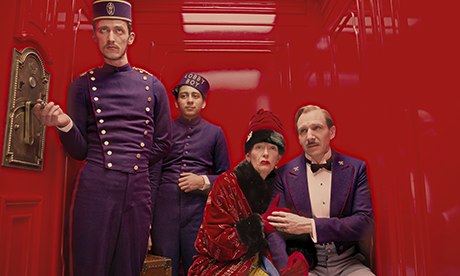
The film is told through layers of narrative- Inception done Anderson style. A female student in the present comes to a cemetery to see a monument dedicated to a writer. She begins reading the authors’ memoir and we’re sent back to 1985 where the author (Tom Wilkinson) begins talking about the story he’s about to tell. Then we’re in 1968 where we meet the younger version of the author (Jude Law), who talks about his trip to the Grand Budapest Hotel.  The hotel is no longer the glamorous and luxurious place it used to be and the author meets Zero Moustafa (F. Murray Abraham), the owner of the hotel. During dinner the Moustafa tells the author about his early years as the lobby boy to the Hotel’s concierge Gustave H. (Ralph Fiennes). We’re whisked back to 1932 where Zero (Tony Revolori) and Gustave become embroiled in a complex plot involving a dead widow/one of Gustave’s lovers, Madame D. (Tilda Swinton), her prized portrait that Gustave steals, Gustave being framed for murder, a prison break, and Madame D.’s son Dmitri (Adrien Brody) who also wants the painting. Willem Dafoe also shows up as an assassin.  

For me personally I became a little lost in regards to the plot. Maybe I’m just too dense or maybe the Anderson’s goal is to create a somewhat vague plot. There is one hilarious moment when Gustave, after breaking out of prison violently asks Serge X (Mathieu Amaliric) - the D. Family butler- “What the f—k is going on.” It’s a somewhat meta-moment that highlights the ridiculousness of the plot and how the characters we’re dealing with aren’t exactly any clearer on the proceedings than the audience.  

Ultimately I don’t think the plot really matters. What does matter is the escalation of absurdity and violence, constantly keeping the audience on its toe to what surprise or shock is right around the corner. The film is essentially a farce but Anderson’s craftsmanship makes it so the film transcending merely being a farce. The pure joy of the film is so seductive and infectious that I could have watched the film for another hour.  Anderson is one of the select filmmakers that have truly created their own cinematic world- Anderson’s filmography is essentially a sandbox in which he can play in. I know many don’t like and resist Anderson’s style- and also don’t like him using similar aesthetics in each film. But while all of Anderson’s films-with the exception of his debut feature Bottle Rocket (1996) – have a recognizable visual style and tone, Anderson- to me at least- never seems to tell the same story twice. As I said Anderson’s world is a sandbox and while his films have familiar surroundings he always tells a unique and charming story each time out.

Anderson is one of the most meticulous filmmakers working right now. His shot compositions often are perfectly symmetrical- Anderson often seems like a warmer Stanley Kubrick.  Almost every shot in this film is one you want to live in. Anderson’s films are perfect for the DVD generation- there’s so much detail that you can’t catch everything on first viewing. And many shots you want to- and pardon the cliché- hang up as painting. A fascinating visual element of this film is how it shifts between different aspect ratios- 1:37:1 for the 30s scenes, 2:35:1 for the 60s scenes and 1:85:1 for the present day scenes. The aspect ratio for the 30s works very well with Anderson’s compositions which already have a boxed in quality. The change in aspect ratio reflects how films were framed throughout history. They also reflect the story’s different layers and make the time frames feel like individual worlds.    

The film’s multiple layers present us with Anderson’s commentary on how story telling is all about layers or to put it this way- storytelling is about passing down stories over time. The young student- for all we know- has never met the author or the elderly Zero- and definitely not Gustave-but through the authors’ work she gets a glimpse in to the past- or at least a version of the past. Maybe that’s the whole point. We only see the past through Zero’s memories, which may be why these events seem to exist in such a heightened reality.

The Grand Budapest Hotel, for me, is a very nostalgic film- told through the eyes of a man (Zero) who was there when a hotel was majestic and another man (the author) when it was past its glory days but still held on to by Zero. But it’s also one that acknowledges how- in respect to Gustave- the old world in which some feel they have lived may have already been long gone before they even entered the world.  Like Woody Allen’s Midnight in Paris (2011), The Grand Budapest Hotel suggests that the idea of a “golden age” is just that- an idea rather than something that actually exists or existed. Gustave may have been the last representation of something glorious and is now gone forever.

Zero’s nostalgic connection to the hotel has less to do with its ties to a long lost world than with its association with Agatha (Saorise Ronan), the girl who works at Mendl’s, a pastry shop beloved by Gustave. Agatha became the love of Zero’s life and while I won’t reveal what exactly happened to Agatha, Zero’s explanation of why he’s kept the hotel all this time is incredibly poignant and sweet in its simplicity- and brings to mind the happiness that we all wish to share with someone in our lives, in only for a short time. Ronan’s lovely and beautiful presence makes us believe in Zero’s love for Agatha, and we can see ourselves falling in love with her too.

Ronan is one part of a large ensemble cast that fills out this universe and gives it texture.Many of these actors are Anderon regulars- along with many several new faces, like Fiennes. Fiennes is the standout here, giving a dryly funny performance, presenting us with a man both debonair and somewhat clueless.

My only complaint about the film is- similar to Anderson’s previous film Moonrise Kingdom, my favourite film of 2012- there’s a bit of animal cruelty that felt a little too dark. That and some of the violence felt a little too jarring in this universe.

On a closing note, I can see The Grand Budapest Hotel becoming a beloved classic as the years go by. Like Anderson’s other films there’s timeless quality to the film. It’s bittersweet and ultimately tragic but still manages to be one of the most joyous experiences I’ve had at the movies in quite some time.

Tuesday, 25 March 2014

Shakespeare on Screen: Romeo & Juliet (2013)


Extra Large Movie Poster Image for Romeo and Juliet


Part of the pleasure of watching a staging or film adaptation of Shakespeare's work is seeing how actors and directors interpret the characters and their dialogue through performance and setting. While Shakespeare's plays are rooted in a historical context- directors have updated the setting while retaining the language. And most of the time it works. That's part of Shakespeare's greatness. His words can be spoken in any setting- his works are universal and the emotions of his characters still relevant to us. All that matters when you're adapting Shakespeare is retaining the language. It can be cut down but the words still have to be the same.


This is the fundamental flaw of director Carlo Carlei's 2013 film version of Romeo & Juliet. The language has been changed in this adaptation, with new lines added and certain passages simplified. This problem lies not with the director however. It's an issue with the screenplay by Julian Fellowes, the Oscar winning screenwriter of Robert Altman's Gosford Park (2001) and the creator of the TV series Downton Abbey. While I'm not up in arms about Fellowes' adaptation I don't think he did in his screenplay really adds anything or improves upon Shakespeare's text. In fact, it lessens the text and robs it of its poetry.


I can see changing Shakespeare's text if you were attempting to do a meta-critique/parody of Shakespeare but that's not what Fellowes or the film is doing. There's nothing clever or unique in how it approaches the language. It's essentially Fellowes attempting to "simplify" things for younger viewers or those not well versed in the Bard, while at the same time wanting to compete with Shakespeare, saying "I can sound like you and nobody will notice." While many probably didn't notice- I'm well read enough in Shakespeare that the changes and additions feel very jarring.


Another reason the text change is a bad decision is the classical approach director Carlei has taken to the material. This is not the hyper kinetic world of Baz Luhrmann's 1996 Romeo  Juliet starring Leonardo DiCaprio and Claire Danes as the doomed lovers. If anything, this is closer to the spirit of Franco Zefferelli's 1968 version, which also took a classical, old school approach to the material. The classical setting, combined with these new lines, makes the  play feel like a neutered and twisted version of itself.


There are good things about the film however. I do love that Carlei- instead of placing the story in an modern setting- created an unabashedly old fashioned take on the story. Hailee Steinfeld, who received an Oscar nomination for her role in the Coen Brothers' 2010 remake of the John Wayne classic True Grit, has a lovely presence as Juliet- and she and Douglas Booth as Romeo have decent chemistry. Paul Giamatti gives an enjoyable performance as Friar Laurence and the look of the film is very beautiful (the cinematographer is David Tattersall). Unfortunately, Romeo & Juliet doesn't leave the viewer with much to dwell on or cherish. It's sadly on the lower rung of Shakespearean film adaptations.

Thursday, 6 March 2014

Some Thoughts on My Mixed Feelings Towards Marc Webb and "The Amazing Spider-Man" Franchise


Just this past week it was announced that Marc Webb- the director of 2012's Spider-Man reboot The Amazing Spider-Man and this year's sequel The Amazing Spider-Man 2- had signed on to direct the third installment in this new series. This wasn't a huge surprise since this series is so obsessed with universe building- Sony definitely wants to keep on the same director for at least one more film to keep things consistent. But if you remember, Webb almost didn't return to direct The Amazing Spider-Man 2 due to his contract with Fox. For me, this announcement brought my conflicting feelings towards Webb being the director of this franchise-for now- to the surface. Unlike a lot of people I am not really on board on the Webb love train.


Now- to be completely clear- I don't have anything against Webb personally or professionally. I remember really enjoying his debut feature- 2009's (500) Days of Summer- and he deserves a hearty congratulations for breaking in to Hollywood in such a big way. The reasons I'm not in love with the idea of him directing Spider-Man films are somewhat paradoxical. For one, I don't exactly like the idea of a upcoming director wasting the first stage of his film career directing sequels- particularly when they're essentially films that aren't personal works but are films essentially made for Sony. I'd like to see him take on more interesting projects and forge his own path apart from Spider-Man. Of note is that Webb- aside from signing on to The Amazing Spider-Man 3- has also been linked to the project Cold Comfort, based on the book How to Catch a Russian Spy co-written by Ellis Henican. The project sounds interesting and it'd be nice if we could see a non-Spider-Man film from Webb before the third Amazing is released.


My other problem regarding Webb directing the Spider-Man franchise- and this is where things get contradictory- is I don't find Webb that exciting or interesting a director. This isn't to say he's a bad director- he did fine work on (500) Days and there were certain directorial touches in The Amazing Spider-Man I really liked- but overall I just wasn't blown away by his direction in that film. To be fair I don't think The Amazing Spider-Man was ever going to be a director's film. Due to the circumstances regarding its inception the film was always going to be mostly a studio controlled film. That- and the fact it was Webb's first Blockbuster. He likely wasn't confident enough to really bring forth a particular vision-nor would Sony let him.


I am glad, however, that Webb got another go at this universe. With superhero franchises the first film is more of a test run while the second film emerges as a stronger effort- think Bryan Singer's X-Men United and of course Sam Raimi's Spider-Man 2. The Amazing Spider-Man 2 does look more promising- more colorful, more action-packed and we're past the origin story stuff. Moreover, people have suggested Webb has more control over this film than the previous installment. Ideally Webb will bring more of his own ideas in to the mix and the film will have a more confident feel. Still, while The Amazing Spider-Man 2 will likely be a good film I get the sense from watching the trailer that'll still feel like it came off a conveyor belt and be more of a  Hollywood product than a singular vision from a great artist.  


Maybe it's superhero fatigue or that I shouldn't be watching trailers. I just can't help but wonder what someone Alfonso Cuaron or Edgar Wright (who's directing Ant-Man with Paul Rudd and Michael Douglas for Marvel) would do with this franchise. When Cuaron came on board the Harry Potter franchise for the third film- Harry Potter and the Prisoner of Azkaban- he made what is- in my eyes- the most imaginatively directed and re-watchable of all the Harry Potter films.


For the sake of transparency my mixed feelings towards Webb and these films have a lot to do with the backlash against the Sam Raimi-directed Spider-Man films. I'm okay with seeing someone else's take on the character and universe but the hatred towards those films has turned me off this new franchise to a large degree. Especially when it comes to Cinemablend critic Sean O'Connell being the walking definition of "conflict of interest" as he has become practically a "cheerleader" (his words) for this franchise and acts like The Amazing Spider-Man was completely his vision. I feel O'Connell's love for The Amazing Spider-Man has to do with certain things absent from the Raimi films being present in this new franchise- mechanical web shooters, Gwen Stacy as Peter Parker's first major romance and more sarcastic jokes from Spider-Man. But I don't think these elements being present in the film makes Webb a brilliant auteur. Nevertheless, Raimi is now seen as the man who butchered Spider-Man, the man who couldn't less about fans while Webb is a man of the people who can do no wrong.The film gave what certain fans wanted and now Webb is hailed as some sort of visionary.


The Amazing Spider-Man 2 could be a truly mind-blowing and great film. But it'd have to reach that level for me to get completely excited for a third Marc Webb-directed Spider-Man film. Webb is a solid director and may grow in to a great one in time. But first I think he needs to get out of the Sony/Spider-Man wheelhouse before he can truly bloom.

Thursday, 6 February 2014

An Unspeakable Act: "The Hunt"


When he was a young child, director Alfred Hitchcock was sentto the police station with a note from his father. A desk sergeant read the note and locked young Hitchcock in a cell for several minutes. He was eventually let out and was told by the officer this is what happened to boys who did bad things. This incident stayed with Hitchcock his entire life and provided a central theme to his filmography- that of the “wrong man,” an innocent man out to prove his innocence, which was the foundation for light escapist fare such as North by Northwest (1959), The 39 Steps (1935) and Saboteur (1942). Hitchcock treated this theme most seriously in The Wrong Man (1956), the only Hitchcock film based on a true story. The film tells of a New York musician named Manny Balestrero (Henry Fonda), who was mistaken for criminal.

Thomas Vinterberg’s The Hunt can be seen as a companion film to Hitchcock’s overlooked thriller, as well as an extension of Hitchcock’s favourite theme. The film concerns a Kindergarten teacher named Lucas (Mads Mikkelsen) who, after a remark by Klara, one of the Kindergarten children, is accused of molesting her. The small Danish town in which Lucas lives then turns against him. The title can refer to the hunting by Lucas that occurs in the woods but the deeper significance of the title refers to how the story of the film becomes that of a modern day witch hunt- a The Crucible for the 21st Century.

While we understand the town’s disgust at the crime they believe Lucas committed- child molestation is a despicable crime- but the film shows how morality and outrage at horrible acts can slowly turn us in to monsters ourselves. There is a turning point- albeit a highly manipulative one- in the story where the town crosses a line and loses our sympathy. Even so the film never forgets these are human beings. This is what makes the film so unsettling. How far can seemingly sane people go when confronted with what they view as one evil man?

The film also asks the question, as did The Wrong Man, of what an innocent man can do when he is accused of something he didn’t do. It’s not as easy as saying “I’m innocent.” In the court of public opinion, once the seed of distrust is planted, it grows until it takes over the heart and mind. And why would Klara lie? I’m sure some will criticize the film for showing a young girl to be untrustworthy regarding matters of sexual abuse. But I don’t believe the film is suggesting we should never listen to children when it pertains to this crime. Rather, the film is showing us one remark can set off a chain reaction that can’t be stopped.

I like that before Lucas comes under fire we get a little of his back-story- he’s a divorcee who wants his teenage son Marcus to live with him and not his mother. This back-story adds some texture to Lucas’ character and makes him more than a blank slate victim. The fact Klara is the daughter of Lucas’ best friend Theo adds to the anguish of the film. How can Theo ever look at his friend the same way? It’s devastating and the shows the depths of pain Klara’s remark makes.

It’d be easy for the film to be played histrionically- and there are several very heightened and intense moments- but the film knows how to restrain itself- due to Vinterberg’s minimalist visual style as well as Mikkelsen’s performance. There’s a scene in a church near the end where we’re allowed to take in Lucas’s emotions- just through Mikkelsen’s wearied and broken down face.

As The Hunt enters its final scene we begin to think we’re in for a neat ending. But the final moments and image suggests the shadow of the previous year will always be there. There’s no turning back from the feelings we experience and the events we go through. They’ll always be there- regardless of guilt or innocence.

Thursday, 16 January 2014

Some Brief Thoughts on the 2014 Oscar Nominations


The Academy Award nominations were announced earlier this morning. As always there were the sure things, the occasional surprise inclusion or "snub" as well as the complete shut outs. These will be my brief thoughts on the major categories. I haven't seen every film nominated so I won't be judging each performance in terms of whether it "deserves" to be nominated- this will be more about what direction I think the race will be going in each category. So, without further ado, the nominees...


Best Actor
Christian Bale, American Hustle
Bruce Dern, Nebraska
Leonardo DiCaprio, The Wolf of Wall Street
Chiwetel Ejiofor, 12 Years a Slave
Matthew McConaughey, Dallas Buyers Club


Certain pundits weren't sure if it'd be Bruce Dern in Nebraska or Robert Redford in All is Lost- both are Hollywood veterans- that'd get a nomination in this category, or if both would be shut out. Dern has taken the veteran slot, with Redford shut out. Dern has the veteran card but he faces stiff competition, particularly since the film, while nominated for Picture and Director, still seems a little under the radar.


I'm happy Leonardo DiCaprio made it, especially since there was some doubt about his chances around the time The Wolf of Wall Street was released. If you remember, the academy screening of the film ended with one member blasting Scorsese, leading to people believing the film was too edgy for certain members. Of course that didn't stop the film from gaining several nominations this morning. This is DiCaprio's first nomination since 2006's Blood Diamond and I feel he's been shut out a few times since then, particularly for 2010's Shutter Island. I really think DiCaprio should win. I'm not going to lie, DiCaprio is a favourite actor of mine and this may be his best performance yet. While some may say the performance is just showboating I think DiCaprio nails the character of Jordan Belfort and that his theatrical/method style of acting is more perfectly suited for this character than his previous roles.


I also wouldn't mind see Chiwetel Ejiofor winning. He's one of those hard working actors who's paid his dues and definitely deserves to be here. In another year, he'd absolutely be the frontrunner for his portrayal of Solomon Northrup, a  black man born free but sold in to slavery- a man who attempts to retain his humanity and his sense of self under inhuman conditions.

Despite America Hustle being a frontrunner in several categories, including Best Picture,  I don't see Christian Bale winning. I think Matthew McConaughey, particularly after his Golden Globe win on Sunday, may take it. That's right, we may soon be living in a world where Academy "Award winner Matthew McConaughey" will start being heard and seen in movie trailers. I haven't seen Dallas Buyers Club yet but his role in the true story of a man who was diagnosed with AIDS while helping other AIDS patients get hold of a medication that can prolong their lives- just sounds like the type of role that wins an actor an Oscar, especially since he lost more than 40 pounds to play the part. It'd also cement his career reinvention.


Will Win: Matthew McConaughey
My Pick: Leonardo DiCaprio


Best Actress
Amy Adams, American Hustle,
Cate Blanchett, Blue Jasmine,
Sandra Bullock, Gravity
Judi Dench, Philomena
Meryl Streep, August Osage County


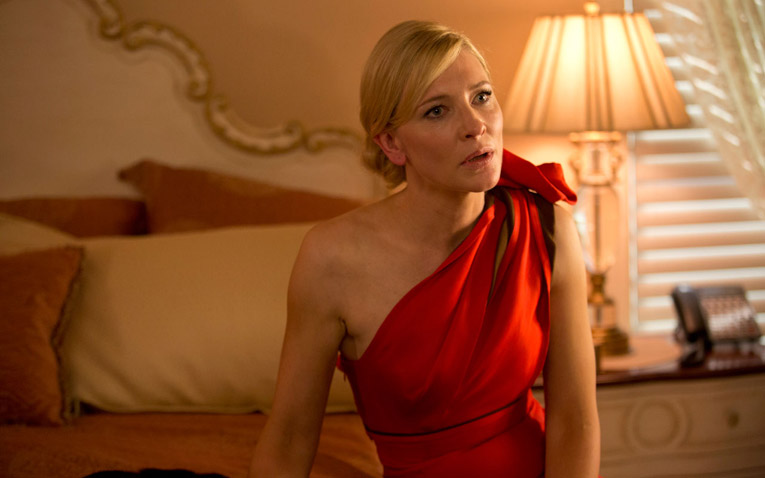
Back in August when Woody Allen's Blue Jasmine was released it really felt like the Best Actress Oscar was Cate Blanchett's in a walk. And more than 4 months later, despite some heavy hitters in the race, Blanchett still appears to be the frontrunner. Her role as a former socialite- who has to live with her adopted sister after her husband (Alec Baldwin), a Bernie Madoff inspired businessman goes to prison- is a devastating portrayal of a woman unable to embrace reality. Some feel the performance is too hammy but I don't think a role like this would work unless it was broad.


Sandra Bullok brings humanity to the spectacle that is Gravity- and certain pundits suggested she could win her second Oscar after winning for The Blind Side in 2010 but I feel that her competition is a little too strong for her to win a second time.


Poor Amy Adams can't catch a break. In a weaker year she could've walked away with the Oscar. This is her first nomination in the Best Actress category after four nominations in the Supporting Actress category. Though you never know. Some voters may feel she's due, which could lead to her upsetting Blanchett.


Judi Dench won Best Supporting Actress for 8 minutes of screen time in Shakespeare In Love. But many voters probably want her to win for a more prominent performance. Like Adams, Dench may be the upset in this category.


Meryl Streep is on her 18th nomination for August: Osage County. I think this is more of a obligatory nomination for Streep rather than a nomination that'll lead to a win. Though no doubt Streep will eventually win a fourth Oscar.


Will Win: Cate Blanchett
My Pick: For now, Blanchett


Best Supporting Actor
Barkhad Abdi, Captain Phillips
Bradley Cooper, American Hustle
Michael Fassbender, 12 Years a Slave
Jonah Hill, The Wolf of Wall Street
Jared Leto, Dallas Buyers Club


A big congratulations to Barkhad Abdi, who made his film debut as the Somali pirate leader who hijacks the merchant ship in Captain Phillips. Abdi was a limousine driver and disc jockey before starring in the film. It's a great little story and I'm happy for him.


Michael Fassbender, who many felt was shut out for his role as a sex addict in Shame received his first nomination this morning for his performance as Northrup's most ruthless slave master. It's a performance that's both ferociously evil but layered and if I was voting I would cast my ballot for him.


Jonah Hill was a bit of a surprise but he has really come in to his own as a genuine actor with this role. Cooper scores his second consecutive nomination at the Oscars, showing that his first nomination for Silver Linings Playbook, another
David O. Russell joint, wasn't a fluke.


But I think this is Jared Leto's to lose. The film not only marks his return to acting after several years of being the frontman of the band 30 Seconds to Mars, like McConaughey, his role as Rayon, a transgendered man with AIDS is the type of performance that screams Oscar.


Will Win: Jared Leto
My pick: Michael Fassbender


Best Supporting Actress
Sally Hawkins, Blue Jasmine
Jennifer Lawrence, American Hustle
Lupita Nyong'o, 12 Years a Slave
Julia Roberts, August: Osage County
June Squibb, Nebraska


It's nice to see Sally Hawkins here. She got Oscar buzz for her breakthrough performance in Mike Leigh's Happy-Go-Lucky but didn't make the cut. Her performance in Blue Jasmine is usually the type of performance that can be overshadowed by an actor like Blanchett. But you need Hawkins' to help ground the film.


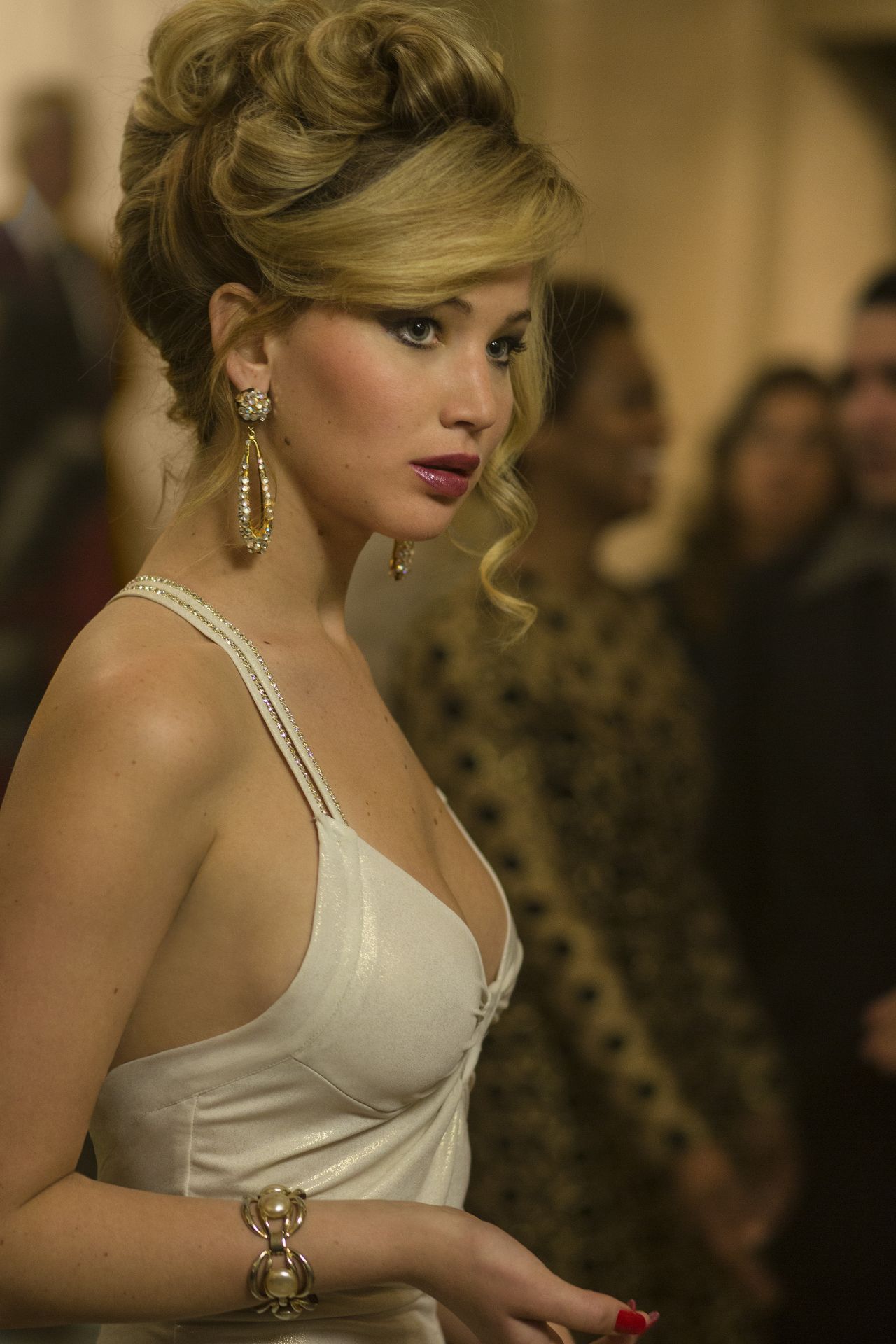
Jennifer Lawrence appears to be the frontrunner which is unfortunate. Lawrence is a talented and charming actress but I don't think she really deserves to win two consecutive Oscars. There are so many actors who have to pay their dues, including certain actresses in this category. I genuinely don't think Lawrence has earned the right to be a two time Oscar winner. Now, I haven't seen American Hustle so I could be totally blown away when I see the film but I think someone else deserves a shot at the win.


If 12 Years a Slave was more of a frontrunner for Best Picture, Nyong'o could be swept along but it appears the film, despite receiving nine nominations, faces more of an uphill climb than it did back in September.

While I'm not overly familiar with June Squibb's work, she's definitely one of those "paid his/her dues" actors and even without even without seeing Nebraska I think she deserves more of a chance at the win.


This is Julia Roberts' first nomination since her Oscar winning role for Erin Brockovich. In another year she'd have a better chance but this may very well be Lawrence's to lose.


Will Win: Jennifer Lawrence
My Pick: Sally Hawkins


Best Director  
Alfonso Cuaron, Gravity
Steve McQueen, 12 Years a Slave,
Alexander Payne, Nebraska
David O. Russell, American Hustle
Martin Scorsese, The Wolf of Wall Street


The Best Director category didn't offer too many surprises. Scorsese made it, which is good. While there's not as much pressure on the Academy to honor him after finally giving him an Oscar for 2006's The Departed, Scorsese definitely deservers to be a repeat winner. Winning for The Wolf of Wall Street may actually be a more "deserving" win than The Departed. At 71 his film had more pure cinematic energy than ones made by directors half his age.


Alexander Payne's due factor in this category is growing but he was more of a contender for 2011's The Descendants.


If Alfonso Cuaron won Best Director it'd be the second year in row a director won for helming a 3D film. Last year Ang Lee won for Life of Pi. Cuaron won the Golden Globe on Sunday but the Golden Globes haven't matched with the Best Director Oscar that often these past several years. David Fincher won the Golden Globe while losing the Oscar to Tom Hooper. James Cameron won the Golden Globe for Avatar but Kathryn Bigelow- his ex-wife no less- won the Oscar for The Hurt Locker. And some voters may view Gravity as more of a technical achievement than a brilliantly directed film. Still, he has a good chance since many view his work on Gravity ground-breaking.


If Steve McQueen won he'd make history as the first Black director to receive the Best Director Oscar. If I was voting I think I'd go for McQueen, not just for history sake but because his direction was nothing short of stunning. The shot of Solomon hanging in that tree for what seems like a lifetime may be the most unforgettable cinematic image of 2013.


Last year I though David O. Russell could possibly win for Silver Linings Playbook but he walked away empty handed. American Hustle is viewed as the frontrunner so this could be his year. Though if there's a split between Picture and Director someone else could win over Russell even with American Hustle winning Best Picture.


Will Win: Alfonso Cuaron
My Pick: Steve McQueen


Best Picture
American Hustle
Captain Phillips
Dallas Buyers Club
Her
Gravity
Nebraska
Philomena
12 Years a Slave
The Wolf of Wall Street


This past September 12 Years a Slave was deemed the frontrunner for Best Picture. In a more just world it'd still be the frontrunner. 12 Years a Slave will be looked back on as one of the most important and essential films made about American slavery and a lasting testament to the story of Solomon Northrup. I feel that if America Hustle wins future generations will look back and say "That won?" As I mentioned earlier, Gravity may be deemed more of a spectacle than a genuinely great film, which may hurt its chances. The Wolf of Wall Street may still be too edgy and raunchy for older viewers. Philomena and Nebraska seem a little too small scale to win Best Picture and Her has a better shot in the Original Screenplay category. Dallas Buyers Club's big wins will be in the acting categories. For now, I'll go with American Hustle for the win, with Gravity and 12 Years a Slave as its biggest competition.


Will Win: American Hustle
My Pick: 12 Years a Slave


Original Screenplay
Woody Allen, Blue Jasmine
Spike Jonze, Her
Bob Nelson, Nebraska
Erin Warren Singer and David O. Russell, American Hustle
Craig Borten and Melissa Wallack, Dallas Buyers Club


If Her doesn't strike Oscar voters as too weird Jonze has a good shot at taking this. Woody Allen's last win in this category was for 2011's Midnight in Paris. While Blue Jasmine's script is arguably even stronger than Midnight, I feel either Her or America Hustle will take it. There's also the resurgence of the controversy surrounding Allen's personal life after Ronan and Mia Farrow's tweets during last Sunday's Golden Globes.


Will Win: Her 
My Pick: For now, Blue Jasmine, but it'll probably be Her after I've seen it.


Adapted Screenplay
Richard Linklater, Julie Delpy and Ethan Hawke, Before Midnight
Steve Coogan and Jeff Pope, Philomena
Billy Ray, Captain Phillips
John Ridley, 12 Years a Slave
Terence Winter, The Wolf of Wall Street.


I would love for Before Midnight to win here, despite feeling that it's a bit odd that a sequel automatically considered adapted, though I guess it's understandable. Linklater and his actors know Jesse and Celine so well that the ark of this screenplay feels completely organic. Winter's screenplay may be deemed too scattered and not focused enough. I feel Before Midnight does have a good chance at the win though Ridley's screenplay could win if 12 Years a Slave is voted Best Picture.


Will Win: Before Midnight
My Pick: Before Midnight


So, those are my initial thoughts on the nominations. I'm disappointed Inside Llewyn Davis and its star Oscar Isaac were shut out, as well as Blue is the Warmest Color not being deemed eligible for Best Foreign Language film. So, what are your thoughts on the nominations and the Oscars in general? Who was snubbed and who are you happy for? The Oscars will air on March 2nd, 2014 with Ellen DeGeneres.