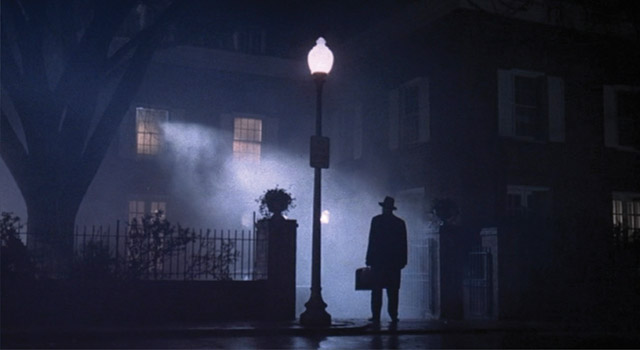
The Exorcist ranks amongst the most seminal horror films, right up there with The Shining, Night of the Living Dead and Psycho. It's spawned a couple of sequels, two very different prequels (from Renny Harlin and Paul Schrader) and a two-season TV show. But it's William Friedkin's original that endures, a film whose power to terrify comes from grounding the horror in a believable reality. The film made people feel like it could happen in their homes or down the street. It received 10 Oscar nominations and won for William Peter Blatty's screenplay (adapted from his own novel) and Best Sound. And like many classics it's once again getting a continuation.
Blumhouse is producing a new Exorcist trilogy, similar to the new Halloween films. The trilogy will follow the original film, with Ellen Burstyn set to reprise her Oscar nominated role as Chris MacNeil, the mother of the possessed Regan (Linda Blair). And David Gordon Green, who directed 2018's Halloween sequel and the upcoming Halloween Kills, is set to direct. While producer Jason Blum has alluded to this sequel ignoring the previous sequels Green has said those films are "acceptable mythology."
I wish they hadn't announced a trilogy before the first film is even released. It already makes me feel cynical towards the whole endeavor. I believe it's important to just make a good movie first before thinking about sequels. You run the risk of making the first film more set-up than story. And while I liked aspects of Green's Halloween it felt like it needed some streamlining. There were several subplots which could have been nixed. And having the same director as the Halloween sequels already makes it feel like Blumhouse is counting on replicating the success of the last Halloween film. I don't want Green to repeat himself, doing the "trauma affecting three generations of a family" story.
There's also the problem being too reverential towards the original. I get it, The Exorcist is an amazing film but it's difficult to recapture the film's impact. It's better just to go in your own direction, similar to the already made sequels. I haven't seen John Boorman's Exorcist II: The Heretic. I know it's infamously bad but it feels it at least did something different. I have seen Exorcist III, directed by Blatty himself, and that is really good, containing maybe the best jump scare of all time. The Exorcist has influenced exorcism movies ever since it's release so the challenge Green is faced with is how to make it fresh.
I know I'm sounding really down on the idea of these movies and I don't want to be. I believe in being open-minded towards upcoming movies. I am interested in what the story is going to be and seeing Burstyn again- and possibly Blair- is alone an exciting prospect. I hope the movies can surprise us as to what story they're telling.
So, what are your thoughts on The Exorcist sequel(s). Comment and let me know.
Francois Truffaut's Fahrenheit 451 (1966) was a surprise to me. For years I thought it was supposed to be an successful adaptation of Ray Bradbury's classic 1953 novel- about a future society where books are banned and "firemen" burn them. When I saw it in the library I think I forgot it was even directed by Truffaut. But I wanted to see it because I knew it'd at least be interesting. What I found was actually a strong film in many ways. And the DVD making of documentary made me appreciate it more. This is an underrated gem from the 60s and a singular adaptation by Truffaut, bringing an European flavour to an American classic.
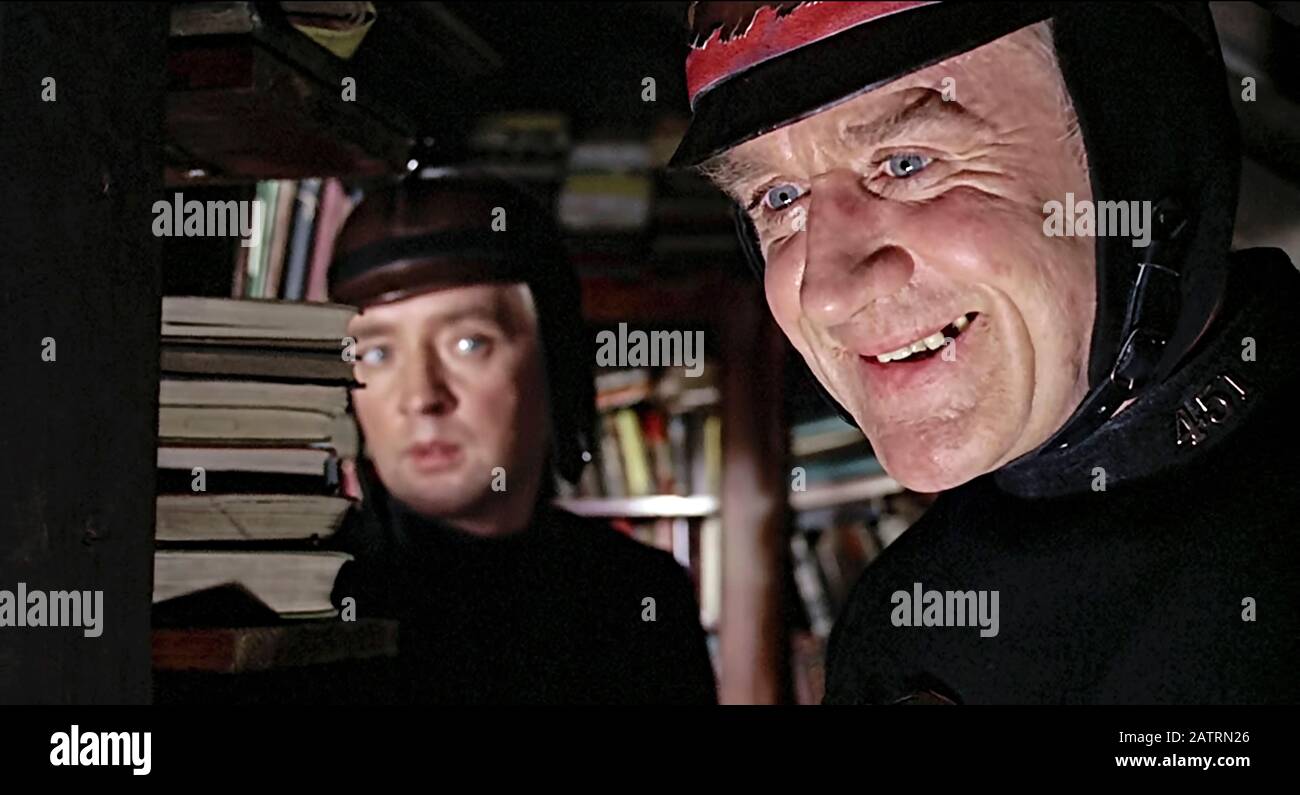
What makes the film European isn't merely having a French director but having an non-American cast, with a German actor in the lead role and Britons as his co-stars. Themes of fascism were always there in the novel but the film takes this further by visualizing the firemen in Nazi-esque all-black uniforms and its main character Guy Montag (Oskar Werner) having blonde hair. And as others have pointed out Montag even gives his boss Captain Beatty (Cyril Cusack) a salute similar to the Nazis. So yeah, this isn't a subtle metaphor.
The European flavour also extends to the film's overall atmosphere. It feels less like a Hollywood movie and more art-house. Having Julie Christie play both Montag's vapid wife Linda and his next door neighbor Clarisse, a school-teacher who awakens Montag's curiosity in reading, also feels more avant-garde than Hollywood. It was actually producer Lewis M. Allen's idea (he was the husband of screenwriter Jay Presson Allen). Truffaut didn't want Linda and Clarisse to have a villain/hero thing going on but to be two sides of the same coin.
Christie playing duel roles brings to mind Alfred Hitchcock's Vertigo. That film sees Kim Novak playing duel roles as well though technically it's one character playing a part. But the key similarity is the woman being the instigator of the protagonist's journey. And in both films the two women represent a choice. In Vertigo Scottie could choose the normal and nice life with Judy. Instead he wants the romanticized figure of Madeline. In Fahrenheit 451 Montag is given the choice between the monotonous but safe life with Linda or the more intellectually fulfilling but dangerous path with Clarisse. She is one of the "book people," radicals who memorize books to preserve them.
In the DVD documentary film historian Annette Insdorf calls this chapter of Truffaut's career his "Hitchcock period," where he delved extensively in to Hitchcock's work. His films around this time- The Soft Skin (1964), The Bride Wore Black (1968) and Mississippi Mermaid (1969) have gotten comparisons to Hitchcock's work. The documentary discuses how Truffaut used the "Vertigo Effect" in one scene, which is also called a dolly zoom. This is when the camera operator zooms in while dollying forwards or backwards.. There's also a dissolve which homages The Wrong Man (1956). Another Vertigo-esque sequence is Montag's dream after a woman burns down her because she won't leave her books. Montag later has a dream where he sees Clarisse in the woman's outfit. This brings to mind Scottie's dream where he sees Carlotta in the scene with him and Madeline's husband, Gavin Elster.

Werner based his performance on the idea of being robotic; he felt science fiction films demanded this kind of performance. But Truffaut wanted Werner to act like a a monkey discovering books for the first time, even going as far to sniff them. While Truffaut and Werner got along well when they made Jules and Jim Werner's ego got inflated after starring in Stanley Kramer's Ship of Fools, for which he received a Best Actor nomination. By the time he made Fahrenheit 451 I guess he thought himself above Truffaut. Regardless of Werner's ego I think his approach to the character makes sense. Montag should be a more reserved guy, someone who doesn't have felt much passion. When he begins to read he awakens his soul.
I want to talk a little bit more about Truffaut and what brought him to this project. Truffaut wasn't a science fiction fan and Insdorf, when she first saw the film, didn't know what to expect given Truffaut's previous films were all character dramas. Upon watching the film she realized it wasn't science fiction because Truffaut was more interested in the themes dealing with literature. I'd argue Truffaut stripped down a lot of the book's sci-fi and focused on the speculative aspect of the story. The production design isn't very futuristic but more vague and disparate in its elements. On the documentary it's discussed how the film combines the new and the old. Linda buys Montag a straight razor to replace his electric one, there are old phones and wall-screens. And as I said earlier the world of the film feels very insular. There's nothing grand about this future. If anything it all feels banal.
By the film's end Montag becomes one of the book people. Like the firemen they burn books but only after they've been memorized. They're protected in a person's mind and they refer to themselves by the book in their head. While they are defined by a book rather than personality traits they're more individuals than the rest of society. This is because they have something important about them which is the art they're preserving. The snow in the final scene where we see the book people walking around memorizing the books was happenstance. It makes the final image of these people incredibly poignant.
Fahrenheit 451 wasn't a box office or critical success. But I think it holds up pretty well nearly 60 years later and can be better appreciated for being a distinctive film in Truffaut's filmography. So, what's your favourite Truffaut film? And where does Fahrenheit 451 rank for you in his output. Comment and let me know.
I'd argue there's two Ridley Scotts. There's the Hollywood workhorse who has delivered crowd-pleasing fare like Thelma & Louise (1991), The Martian (2015) and Gladiator (2000). And then we have the avant-garde Ridley Scott, who made The Counselor (2013) Blade Runner (1982), and the film I'll be talking about here, 1985's dark fantasy, Legend. Legend was not a box-office or critical hit but became a cult classic over time, especially with its director's cut, which is the only version I've seen and which will be my focus for this. Legend is a flawed but beautiful film, remarkable in its imagery and visual storytelling. It represents a completely approach to today's cinematic fantasy storytelling. It's timeless but also very much of the 1980s.
Legend originated back when Scott was directing his first film, The Duellists (1977). It was the abandoned project Tristan and Isolde which inspired Scott's interest in directing a mythological story. But Scott knew that like The Duellists the film he envisioned wouldn't attract a huge audience. So instead he decided to direct a more sure-fire box office success, Alien, which made Scott's career. Scott then returned to the idea of making a fantasy film, reading many of the classic fairy tales.
He decided that the film needed to be a original story, saying "It was far easier to design a story to fit the medium of cinema than bend the medium for an established story" (Cinefantastique Magazine, Vol 15, No. 5). Scott then discovered the books of William Hjortsberg, Upon meeting Hjortsberg Scott showed him Jean Cocteau's Beauty and the Beast (1946) and their shared love of the film was the foundation for their collaboration. Before filming began on Blade Runner (1982) Scott and Hjortsberg worked out what the story was going to be. When the script was finished the story had gone through 15 revisions.
Befitting its fairy-tale foundation, Legend is very minimalist in its story, characters and setting. We're never told what the setting is. This could a entirely separate world or it could ours in some distant past. The villain is simply called The Lord of Darkness (Tim Curry\) and he wants to place the world in eternal, well, darkness. Darkness sends his goblin minion Blix (Alice Playton) kill the unicorns who protect the light and bring him their horns, ensuring there will never be another dawn.
Our protagonists are Princess Lili (Mia Sara) and her friend named Jack (Tom Cruise) who lives in the forest. When Jack shows Lili the unicorns, her desire to touch them allows a distraction for Blix to shoot one with a dart. When the unicorns flee Blix is able to take one of their horns. This brings a snow storm upon the world, with Lili and Jack ending up on separate journeys to make things right.
While I understand why so much of Legend is rooted in fairy-tale archetypes I do wish Lili and Jack's relationship hit a little deeper. I think the problem is Sara and Cruise don't have great chemistry, though I love Sara in this film- she feels like an actual fairy-tale princess. While she's most associated with Ferris Bueller's Day Off (1986) this was her film debut and her performance reflects she understands what kind of movie this is. This was Cruise after he became famous in Risky Business (1983) but before his onscreen persona was solidified in Top Gun (directed by Scott's brother Tony) and The Color of Money (both released in 1986.) Cruise is a little bit lost here. He's known for his intense charisma but role needed a different kind of charisma. Sara was still only 16 when filming took place and Cruise was 22. I think a teenage actor would've matched better with Sara.
In regard to casting Tim Curry is the standout for many people. Scott cast him because he believed he could be melodramatic while still threatening. Curry crafts something ominous through his voice and I love how we don't see him through most of the film, only his voice. At the film's beginning when Darkness is talking he feels like an entity rather a physical being. He's almost god-like, paralleling the unicorn's god-like nature. When we finally see Darkness late in to the face his appearance invokes a devil-like creature with hoofs and horns. I'll add that Rob Bottin and Peter Robb-King's Oscar-nominated make-up still holds up. Curry is unrecognizable but is able to give an genuine performance through the make-up.
So, we have the angelic unicorns and the devil. It's not subtle but its clear visual paralleling. The unicorns represent innocence. On the commentary Scott says while Lili is innocent, she is also manipulating Jack, which leads to him showing her the unicorns. Scott says she was originally supposed to turn in to a cat creature as a result of her manipulative nature, having even tempted Darkness. She also tempts one the unicorns, which Scott likens to tempting a god. I would say by engaging in these gods' worlds hell is brought upon the world as punishment.
Legend is best approached as a mood piece, similar to Blade Runner. Both have a dream-like, almost hypnotic quality to them, with an authentic strangeness permeating through the story. This is a film I'd argue you could watch this film on mute and still mostly understand the story. On an aesthetic level the world Legend genuinely feels like fairy tale/fantasy world. The film was all shot on soundstages, which Scott believed could end up looking fake. He hired production designer Assheton Gorton- whom he wanted to work on Alien and Blade Runner- because Gorton understood how to navigate these problems. Scott said, "We both knew that whatever we did would never look absolutely real, but would very quickly gain its own reality and dispense with any feeling of theatricality" (Cinefantastique).
When it comes to theatricality there are certain scenes I feel have a Shakespearean quality. The opening scene, for example, with Darkness and Blix, feels reminiscent of the dynamic between a Shakespearean villain and his minion:
Darkness: Ah, Blix come closer.
Blix: You summoned me, lordship.
Darkness: Are you not the most loathsome of my goblins?
Blix: Truly master
Darkness: And is your heart black, and full of hat
Blix: Black as midnight, black as pitch, blacker than the fouler witch."
And the first scene between Jack and the fairy creatures, led by Honeythorn Gump (David Bennent), brings to mind something out of A Midsummer Night's Dream:
Jack: I must be dreaming.
Gump: If life is but a dream, better dread you the waking. That's Oona, she likes you.
Jack: (to Oona) Go away!
Gump: Does your blood run so cold Jack? You'll be a corpse before your time.
Jack: How do you know my name?
Gump: How does a migrating swallow know the way south in winter. Or a falling salmon finds the very source of its birth from the cold black depths of the mysterious sea? I know everything Jack."
Scott mentions that Gump was inspired by Mickey Rooney's performance as Puck from Max Reinhardt's film version of A Midsummer Night's Dream (1935). Reinhardt's film is also akin to Legend in its striking art direction and un-Hollywood like atmosphere. Bennent is a Swiss actor and Scott really loved his accent. However, one of the executives at Universal felt Bennent sounded like a "Nazi." Bennent's voice was dubbed by Blix's actor, Alice Playton.

Let's get back to the film's theatrical aspects just briefly. I 'll say he dance waltz-Lili's dance with the black dress that then possesses her- is the film's most theatrical sequence. It's also It's my favourite part of the whole film. I find it truly mesmerizing and am stunned when I watch it. On the commentary Scott says it's like a ballet/opera, and it truly is. But it also feels cinematic. He wonders if the film could be put on stage and I'd say there are aspects which would work on stage, including the waltz. I also agree with Scott that the film takes on its own reality. The theatricality is an organic extension of the film's cinematic reality.
I now want to talk about how Legend became to exist in different versions. Before Legend was released theatrically Scott cut down the film from 150 minutes to 94 due to poor test screenings with younger audiences who didn't take the film seriously. The American version was edited down even further at Universal Studio President Sid Sheinberg's request because he felt the European version wasn't appealing to younger audiences. Moreover, Jerry Goldsmith's score, which was retained for the European version, was replaced with the German new age band Tangerine Dream's synth score, another way in which to appeal to younger viewers (How the 1985 Fantasy Film 'Legend' Ended Up With 2 Soundtracks - Atlas Obscura)
The eventual DVD release of the film's director's cut (113 minutes) started with unofficial Legend historian Sean Murphy and his Legend FAQ site. You can find plenty of information on the journey to finally getting the director's cut released here: History Of the LEGEND DVD by Sean Murphy (figmentfly.com)
I want to close this piece by saying I've come to appreciate this film more by writing about it. Despite the story and characters feeling too thin I feel there's real beauty to this film in its imagery and music. So, where does Legend rank amongst Ridley Scott's filmography for you? Which is your preferred version? Comment and let me know.
This post will discuss the plot of The Fly in detail. Don't read until you've seen the film
Kurt Neumann's The Fly is a startling sci-fi horror film, even after 60 years and a remake that's become a classic in its own right. The most significant factor which contributes to its unsettling nature is its intimacy. The film employs intimacy in regards to its setting, emotions and psychology to make a domestic horror film. The Fly shows the nuclear family being torn apart. It's also a tragic love story about a woman seeing her husband lose his humanity.
The film begins with scientist Andre Delambre (David Hedison) being found dead-crushed by a hydraulic press. His wife Helene (Patricia Owens) calls his brother Francois (Vincent Price) to confess to his murder. She doesn't provide a motive and is obsessed with a fly with a white head. By telling Helene he has caught the fly Francois persuades her to tell him the circumstances behind Andre's death. Andre was working on a teleportation machine which could send objects from one location to another. Andre tests it on himself but a fly gets in the teleporter with him, resulting in Andre getting the head and arm of a fly. The only way he can possibly reverse the transformation is catching the fly and going through the teleporter again.
The first way the film creates intimacy is regulating most of the story's action to the Delambre's home. This is largely where my idea of The Fly being a domestic horror story arises. Despite the film's fantastical nature, keeping the action mostly in the home makes the story oddly relatable. For example, the sequence where Helene and her son, Philippe, attempt to catch the fly feels like what would occur in this situation. The Delambres having a son makes this a story largely about the nuclear family being disrupted. Moreover, it's a story about a man who is torn between his work as a scientist and his role as a father and husband. It's Andre's ambition as a scientist which interrupted the family's tranquility, bringing this horror in to the household.
The second way the film creates intimacy is the focus on Andre's physical and psychological imprisonment in this fly/human body, losing his ability to think as a human. Andre locks himself in his lab as a form of self-punishment for bringing this horror in to their home. This parallels and stresses his physical/psychological imprisonment. Also, keeping him isolated from his son further shows how the family is being separated by this nightmare. It's the lab that kept him away from his family in the first place. The lab is a constant reminder of the divide between the scientist and the family man.
The film never shows us Andre's transformation and he wears a hood so as not to scare Helene. This is another way the film creates psychological and emotional intimacy in regards its characters. Not showing Andre's accident puts us in Helene's perspective. We share her fear of what happened to her husband. Helene gets Andre to go through the Teleporter again, without the fly. She wants to believe this will reverse his condition. After he comes out she takes off his hood, revealing him for the first time. Her joy at the possibility Andre is restored provides the perfect contrast to her terrified reaction. Showing us Andre's perspective through his fly eyes is also a great and disturbing detail.
The nuclear family is restored in the film's final scene due to Francois being positioned as a father figure to Philippe, with Helene there as well. We also know from earlier in the film that Francois did love Helene. However he didn't want to get in the way of Andre and Helene's relationship. The final scene perhaps feels too neat and tidy but it fits with the motif of the family unit running throughout the film. Francois' final speech about the search for truth being important does feel like an attempt to reconcile the film's dichotomy between dedication to family and dedication to science. Andre was not wrong in his pursuit of knowledge. As Francois says, he was just careless for one moment. As I said, the ending does feel tacked on but it's attempting to resolve the film's major themes.
So, what do you think of the original version of The Fly? Do you prefer David Cronenberg's remake? Comment below and let me know.
A series of Writings on Films that I feel are essential for film lovers, coupled with films that are personal to me. Spoilers for those who haven’t seem the film.
Henry King's western The Gunfighter is one of the quietist films about violence I've ever seen. The Gunfighter could've been the title of a hundred different traditional action-driven westerns but King’s film concerns a man who doesn't want to be a gunfighter and is burdened by his own legend, which gives the title a melancholic and tragic quality. I would argue the film is an anti-western in how it refuses to fulfill the audiences' desire for violence and when it does there's no glamour, triumph or thrilling-ness to it. The film is largely about trying to outrun your own reputation.
Jimmy Ringo (Gregory Peck) is known as the fastest gun in the west. After he kills a young man named Eddie (Richard Jaeckel)- who wanted to become the man who killed Ringo- in self-defence, Ringo heads to the town of Cayenne. He waits to speak to his wife Peggy (Helen Westcott), with whom he has a son he's never met, while Eddie's brothers are in pursuit. Ringo's arrival also brings unwanted attention. Like High Noon (1952) the film takes place in a short amount of time and has a sense of intimacy in regards to the town. We become acquainted with several members of the town, most importantly the town's Marshal, Mark Strett (Millard Mitchell), an old friend of Ringo's and whom was in a gang with Ringo. In Strett we see a man who never became cursed by legend and was able to start over as a lawman. And Peggy has changed her surname, to conceal her marriage to Ringo.
I said the film was an anti-western but it's also a film-noir in its themes and visual style. Many noir films deal with men and women wanting to escape their past but are caught in the web of fate. I also mentioned High Noon, which sees Gary Cooper's Marshal Will Kane walk around town in an attempt to gather people to help him fight outlaws who have targeted Will for revenge. In The Gunfighter Ringo is in a saloon for long stretches of the film. He has no interest in fighting Eddie's brothers. High Noon, despite being an unconventional western, still has the hero facing down the villains at the climax. There is no climatic showdown in this film. And Ringo isn’t portrayed as a hero. Like many film noir protagonists, he’s morally grey.
John Bowers and Andre De Toth originally wrote the story for John Wayne. Wayne loved the story and offered Bowers 10,000 for it. Bowers thought it was worth more and eventually sold it to to Columbia for 70,000. Wayne refused to work for Columbia's President Harry Cohn, who had treated Wayne poorly earlier in his career. 20th Century Fox ultimately bought the story and Peck was cast. Peck wasn't associated with westerns the way Wayne obviously was. On the Criterion Collection Blu-Ray/DVD, filmmaker Gina Telaroli remarks how the film visually changes Peck's onscreen image, giving him a period accurate mustache and clothes that don't completely fit, also a period accurate detail.
Telaroli adds that Peck was considered too intellectual an actor for the part but argues- and I agree- Peck's intellectualism suits the more psychological quality the film has. I feel the humility and pragmatism Peck radiates as an actor is perfect for Ringo's approach to his own legend and to killing. For Ringo killing is a matter or "him or me." He doesn't view it as glamorous or exciting. When Ringo kills Eddie at the beginning the film's editor Barbara McLean doesn't show Ringo fire the shot. We see Eddi gunned down and then a shot of Ringo with his gun drawn, punctuating Eddie's death. By not showing Ringo fire, cutting the scene in a more matter of fact matter, the audience is made to look at the situation more objectively, the way Ringo does.
I mentioned the film's noir inspired visual style earlier and never got around to talking about it. Cinematographer Arthur C. Miller's use of shadows is obviously very noir-ish. Keeping the story indoors allows Miller to create a claustrophobic atmosphere in regards to the framing. The film keeps Ringo very isolated at his table, with Miller's deep-focus photography allowing us to see the other people in the saloon watching Ringo. This emphasizes the separation between Ringo and the townspeople. Despite its minimalist plot, King and Miller make the film visually interesting striking.
At the end of the film it's not Eddie's brothers who get Ringo. It’s Hunt Bromley (Skit Homeier), another young man like Eddie who wants to be Ringo’s killer. Ringo says he drew first, saving Bromley from hanging. Ringo does this in order to have Bromley live the rest of his life with the reputation Ringo had, the curse which will bring challengers against Bromley. The curse of reputation and myth is passed down, and will continue to be passed down from killer to killer.
The Gunfighter is a gem of a film. It's not always the first film mentioned when talking about the great westerns but it deserves more consideration. It sets itself apart from other westerns in its intimacy and seemingly anti-drama elements. But in its simplicity it harbors complex ideas concerning the challenge in separating yourself from your reputation, and the question you are vs. what you've been built up to be. And ultimately I believe Jimmy Ringo doesn't want to be more than his reputation; he just wants to be less.
Zack Snyder's Justice League is a vindication for an often misunderstood and unfairly demonized filmmaker. It's also a reaffirmation that superhero films can be genuine artistic expressions. After viewing the film I'm not sure about what Warner Bros. was in such a panic they felt the need to bring in Joss Whedon to reshoot so much of it. If they wanted the lighter-toned, more optimistic superhero film, Snyder gave it to them. Man of Steel had a rough around the edges Superman make some mistakes on his way to saving the world and Batman v. Superman was a deconstructionist take on the superhero mythos; but ZSJL is the most traditionally superheroic film in the trilogy. I would argue it has the perfect tone- serious but not as heavy as MoS or BvS, with just the right amount of levity without feeling like a MCU film. And even without the behind the scenes turmoil ZSJL would still stand as a very good- even great- superhero epic.
Right from the first scene it's clear this version is a more fluid continuation of BvS than Whedon's version as we witness Superman's Henry Cavill) death at the hands of Doomsday from that film's climax. But just that film's beginning had us see MoS's climax from Bruce Wayne's (Ben Affleck) perspective, here Snyder shows us Superman's death screams awakening the three Mother Boxes, which the being Darkseid (Ray Porter) once used in an attempt to conquer Earth thousands of years ago before he defeated by an union between Man, Olympian Gods, Atlanteans, Amazons and Green Lanterns. After the battle the Mother Boxes were separated and hidden.
BvS and ZSJL's openings emphasize how Snyder's films are about Superman's presence- and absence in the world. BvS had an angry and distrustful Bruce who viewed Superman as a threat to humanity. Here, Bruce understands Superman's death leaves Earth vulnerable to attack- largely in part to his conversation with Lex Luthor (Jesse Eisenberg). Bruce and Diana Prince/Wonder Woman (Gal Gadot) have to recruit other metahumans- Barry Allen/The Flash (Ezra Miller), Victor Stone/Cyborg (Ray Fisher), and Arthur Curry/Aquaman (Jason Momoa) to combat Darkseid's emissary Steppenwolf (Ciaran Hinds), who is looking for the Mother Boxes.
ZSJL doesn't have the same complex plotting of BvS but it's not as streamlined as the theatrical cut.four hours there's more breathing room for the characters to be fleshed out, especially Barry and Victor, the latter cited by Snyder as being the heart of the film. I loved Barry's introduction when he save Iris West (Kiersey Clemons) from a disastrous car wreck using his speed powers. Scored to Rose Betts' version of Tim Buckley's Song to the Siren, Snyder reminds us how romantic a superheroic feat can be. Without exchanging words I'm already looking forward Iris and Barry's relationship in Andy Muschietti's Flash movie.
Victor is the film's most identifiable character since he's the League member who views his powers as a curse, the position many people in reality would take if they were half human, half robot. Victor resents his father Dr. Silas Stone (Joe Morton) for making him this way after he was nearly killed in a car accident that claimed his mother Elinore Stone (Karen Bryson). Silas used one of the Mother Boxes to save Victor and this bit of plotting efficiently makes the Stone family the central part of the story.
Victor is reborn as Cyborg and birth/death/rebirth is a major motif through Snyder's trilogy. MoS begins with Superman's birth and Krypton's death. General Zod's (Michael Shannon) motivation is create a new Krypton on Earth. BvS ends with Superman's death and Bruce's rebirth as a more hopeful man. Clark Kent is reborn as the traditional Superman. He died sacrificing himself for humanity, proving to humanity how much he cares for them. When he returns- again, using a Mother Box- it's significant the first thing he sees is the memorial dedicated to him. And when he's fighting the League due to memory loss, it's Lois Lane (Amy Adams), who brings him to his senses, the person for whom he died. She, along with his mother Martha Kent (Diane Lane) represent humanity's best to Superman.
Snyder is known for his bombastity but Snyder is capable of incredibly intimate moments, some of the best in the genre. The scenes on the Kent farm in ZSJL are nostalgic and warm, homaging Richard Donner's Superman: The Movie while still working on its own merits. It's about a family coming together, a man with the most important women in his life, finding peace even when the world may come to an end.
Family is another big theme in this film; as I've already pointed out the Stones are central to the story and Superman has Martha and Lois. Bruce becomes part of a family again after the death of his adopted son Robin. Diana has her mother and sisters on Themyscira and Arthur has unresolved issues with his Atlantean mother and human father. Barry 's father Henry Allen (Billy Crudup) is falsely imprisoned for the murder of Barry's mother (comic fans know what the backstory behind that is). And speaking of mother, the McGuffins are called Mother Boxes. Moreover, Steppenwolf is Darkseid's uncle who wants to get back in his favor after betraying him.
I've talked quite a bit about the character stuff here so now I just want to say that Snyder creates the most visually bold and beautiful comic book movies. Snyder shot in the 4:3 aspect ratio, which gives the film wholly different feel than any other superhero film. Snyder has talked about his decision to shoot the film in this manner and how it was supposed to be seen in IMAX: Why Zack Snyder’s Justice League is in a 4:3 Aspect Ratio | Den of Geek
The film's cinematographer Fabian Wagner and Snyder create some truly right-off-the-page comic book images, which brings me to the "Knightmare" timeline, first glimpsed in BvS, where Darkseid has won and Superman is under his control. The Knightmare scene at the film's end is so comicbooky and I love it for that. The fact we have Arthur's queen Mera (Amber Heard) and the Joker (Jared Leto) is kind of incredible. And the dialogue between Batman and Joker feels ripped from an actual comic book.
There's more I'll probably write about ZSJL but for now I do really hope the "Snyderverse'' is restored. There's so much potential for this universe going forward. Snyder no doubt has a vision and embraces the craziness of the comic book universe. And if we're going to keep making comic book and superhero films we directors and writing to push the genre forward to avoid stagnation. So, what did you think of ZSJL? Comment below and let me know.